Showing posts with label Anne Hathaway. Show all posts

30 August 2012

Not If You Were the Last Woman in Gotham City


The Dark Knight Rises
2012, USA/UK
Christopher Nolan

There is no shortage of ways in which the conclusion to Christopher Nolan's Batman trilogy, The Dark Knight Rises, sucks. For starters, despite its disguise as a loud Hollywood action film, it's pretty boring, which is, I guess, how you can tell they were making a "serious film." This can easily be blamed on Nolan's notoriously exhausting spouts of exposition, which reached a comical level in Inception, the film he made in between The Dark Knight and his rousing. While I tend to be a bit more forgiving of the absurdity in Inception, the exposition in The Dark Knight Rises isn't used to explain complex, made-up ideas and rules that govern its film universe; it is instead used to pander to stupidity of its audience, which – judging by the lengths the screenplay requires the characters to ridiculously expel Wikipedia entries about the background of the film's villain or, worse, verbally explain the subtext of what is unfolding before them – Nolan presumes is bountiful. This however is more telling of Nolan than his audience. One could grumble about the jumbled action sequences, the over-editing, or downright silliness of most of the hand-to-hand combat, but in Nolan's defense, he's come along way since Batman Begins in that regard. But where The Dark Knight Rises, and really the entire trilogy, is most reprehensible is in its depiction of women (and lack thereof).

After Rachel, Bruce Wayne's love interest (and not much more), gets a change of actress and a "surprising," mid-film demise in The Dark Knight, Gotham City is left with a critical, though never addressed, problem: how can the city continue its legacy if its only woman has perished? Thankfully in its opening moments, The Dark Knight Rises introduces us to two additional birth canals: jewel thief Selina Kyle (Anne Hathaway) and philanthropist Miranda Tate (Marion Cotillard). Though it's very possible (I'm not totally sure) that the women never share a frame in the entire film, it becomes clear in the film's final third that the women's actions have been governing the other's for the duration of the film. This may not have been so glaring if it didn't take Nolan three films to introduce a woman who actually had things to do or if the whole trilogy wasn't so over-saturated with men.

Now with Selina Kyle, or Catwoman as we know her best, Nolan tried something I wasn't expecting. When Selina is longingly embraced by her partner-in-crime, played by Juno Temple, it appeared as if the film suggested that the feline metaphors didn't stop at "cat burglar." This is hardly an original notion, as the lesbian undertones were anything but subtle between Halle Berry and Sharon Stone in the joyless Catwoman movie, but it was something that genuinely surprised me and actually provided a deeper layer to Selina's otherwise thinly-drawn character. Like in Catwoman, this all proves to be nothing more than a tease, as this trait only aligns with Catwoman as a "bad guy," something that is forced to shift once the secret of Miranda Tate's dark identity is revealed.

I suppose Nolan assumed that since two women finally moved into Gotham City he didn't want anyone to think he was making a generalized statement about all women. After all, most of the vindictive women in Nolan's movies have a counter. In Memento, Carrie-Anne Moss has Guy Pearce's martyred wife. In Inception, Marion Cotillard, playing a character whose made-up Gallic name directly translates as "evil," has a sexless, brainiac Ellen Page. For The Dark Knight Rises, the two women keep each other in check. Just as Catwoman begins to feel bad about leading Batman to his doom, the coast is clear for Miranda to begin her nefarious plans, after "fooling" everyone with her clean energy initiative. Nolan makes the sanitization of Catwoman even more vile by ignoring the obvious hints he made to her sexuality, writing her girlfriend out of the film, and ultimately placing Batman and Catwoman in a heterosexual happily-ever-after paradise. It would be one thing if Nolan just simply didn't know how to write female characters, but he takes his inability to a whole new level of shittiness. Hey, at least all the girls of Gotham City got to make-out with the caped crusader...

With: Christian Bale, Tom Hardy, Gary Oldman, Joseph Gordon-Levitt, Anne Hathaway, Marion Cotillard, Morgan Freeman, Michael Caine, Liam Neeson, Alon Aboutboul, Ben Mendelsohn, Cillian Murphy, Nestor Carbonell, Tom Conti, Matthew Modine, Juno Temple, Daniel Sunjata, Aidan Gillen, Thomas Lennon, Robert Wisdom, William Devane, Brett Cullen, Josh Pence, Burn Gorman

20 December 2009

The Decade List: Rachel Getting Married (2008)

Rachel Getting Married – dir. Jonathan Demme

[There's going to be quite a few reposts and/or brief write-ups coming soon on The Decade List, as I'm pressed for time. This is what I had to say about it on my best of 2008 list, and my feelings haven't changed, after watching it again.]

Rachel Getting Married falls into the same category I place David Fincher's Zodiac. It's acceptable to dislike them (as a handful of people do), as long as you don't do so for the wrong reasons. If someone drops the phrase, "well, nothing happens," you can cross them off your list of people whose opinions are worthy of respect. The fact that "nothing happens" in both Zodiac and Rachel Getting Married is where their brilliance lies. Both take familiar subjects (a hunt for a serial killer; a dysfunctional family reunion or wedding movie) and display a sublime fascination in the mundane. In easily his finest fiction film to date, Jonathan Demme conducts Jenny Lumet's screenplay like a beautifully enchanting piece of music. It's frequently mystifying, but always grounded. Rachel Getting Married doesn't sacrifice its bedazzlement or its rawness, allowing the hypnotic dancing sequences to feel perfectly in place with its astute depiction of the unbearable guilt between family members.

With: Anne Hathaway, Rosemarie DeWitt, Bill Irwin, Mather Zickel, Debra Winger, Anna Deavere Smith, Tunde Adebimpe, Anisa George
Screenplay: Jenny Lumet
Cinematography: Declan Quinn
Music: Donald Harrison Jr., Zafer Tawil
Country of Origin: USA
US Distributor: Sony Pictures Classics

Premiere: 3 September 2008 (Venice Film Festival)
US Premiere: 3 October 2008

17 January 2009

2009 Notebook, Volume 2: Expanded

There's a scale I use to place a certain type of film - the micobudget, tongue-in-cheek horrorcomedy. The scale slides along a plane with Terror Firmer (or Citizen Toxie) at the highest pole and Gutterballs at the furthest. Most of these films flutter around the Gutterballs arena with their tasteless (and humorless) gore fests, but Yeti: A Love Story is probably one of the few that sits on high. It's intermittently amusing, particularly in its coining of the sexual term "Mellancamping," which is described by the douchebag frat guy who eventually falls in love with the yeti as "making one hurt so good." Though heavy on beastial sodomy, it never reaches the brilliance of Toxie giving birth to his mother in Terror Firmer, but color me amused.
Queer cinema has always been my focal point in writing about the medium, which forces me to endure some of the most scathingly awful pieces of celluloid (or, more likely, consumer-level video). Piccadilly Pickups is easily one of the most taxing endurance tests I've undertook in this realm. Starring a pre-op Alexis Arquette as a porno film director named Henri de la Plus Ooh Arrgh, the film crawls its way through thankless gender-fucking sex scenes like Bruce LaBruce's two-legged puppy. It doesn't deserve any of the words I'm using for it, which is about the biggest crime I can give any film, and if you need perspective, I dedicated at least twenty-five pages of my thesis to Another Gay Movie.
On a happier note, I finally got around to Christopher Larkin's seminal A Very Natural Thing, one of the first American films to explicitly deal with the love life of a gay man, played by Robert Joel who also starred in Russ Meyer's Up! Megavixen. A Very Natural Thing is appropriately flawed by its mix of documentary and fiction footage, the former of which containing interviews with individuals at the 1973 New York City Gay Pride Parade. However, its intentions are always just, and its vision is always surprising. In addition to the film's final, breathtaking slow-mo nude run across a beach, A Very Natural Thing hits so many right notes in terms of narrative disposition, a brilliant precursor to some of queer cinema's more recent high points (Presque rien being the most obvious).

Christophe Honoré is such a perplexing figure in French cinema. He's absolutely inferior to his co-patriot peers (François Ozon, Sébastien Lifshitz), and yet there's still some sort of attraction in his glaring failures. While Les chansons d'amour suggests he might be heading in the proper direction (his more recent film La belle personne was bought by IFC Films last year), his directorial debut, 17 fois Cécile Cassard, is a giant mess of a film. Supposedly divided into seventeen "moments" of a woman's life, surprisingly downplayed by the wonderful Béatrice Dalle, the film begins awkwardly with Dalle speaking to her dead, naked husband (Johan Oderio-Robles), rear-projected into her otherwise empty bedroom. Every "moment" in not just this film but all of his others excluding Chansons and Tout contre Léo has been done before more successfully by finer directors like Arnaud Desplechin and Jean-Luc Godard, whom he embarrassingly emulated in Dans Paris. And yet, there's still something mildly compelling here. With the benefit of enlisting actors who are too good for their material (Dalle, Romain Duris, Jeanne Balibar), Cécile's confusing journey to Toulouse after abandoning her young son seems guided by good intentions, even if the overall result is a bit lackluster. None of the characters make much sense in their life decisions. Why did Cécile abandon her son and become Toulouse's resident fag hag all of a sudden? What exactly does Duris see in his friendship with Cécile anyway? Like Ma mère and Dans Paris, it's easier to just allow for Honoré to thoughtless throw the occasional juicy sequence to hide the dramatic shortcomings.
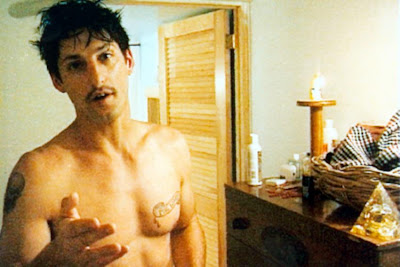
The morbid curiosity of witnessing Tony Ward, model and former love interest to Madonna, expose himself in just about every way is the only thing that keeps Jochen Hick's Sex/Life in LA interesting. His attempts to name-drop the icon at every given moment, including a story about her burning him with a cigarette, are just as curiously desperate as allowing the director to film him jerk-off in a bathtub. Nothing about Sex/Life in LA, or its sequel Sex/Life in LA 2: Cycles of Porn, is particularly revelatory or enlightening, even though it stands as a weird Behind-the-Music exposé of many of the people involved with Bruce LaBruce's Hustler White. Along with Ward, performance artist Ron Athey, co-director and photographer Rick Castro and irritating surfer boy porn star Kevin Kramer are all featured here, alongside shitty sub-porn music and under no worthy direction at all.
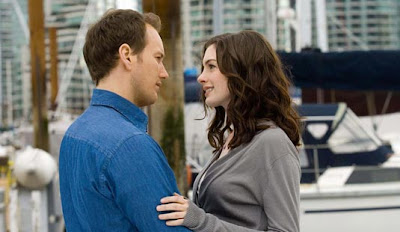
Poor Anne Hathaway. She's just begging to keep that Oscar out of her grasp. After giving me (and probably many others) justification for liking her in Rachel Getting Married, she's following that up with films like Passengers and Bride Wars. Though I don't think I can bring myself to watch anything with Kate Hudson in it, I did sit through Passengers which finds Hathaway treating the reluctant survivors of a terrible plane crash. With Hathaway finally finding the shoe that fit in Rachel, her role choices of bland romantic leads and professional women feel even more out of place. Under the pretense of being a mystery, Passengers waits until the end to reveal its cop-out "twist," which almost pushes the film into Seven Pounds territory. Strangely though, Rodrigo García actually has dramatic reasoning for the shitty rug-pull he does, and even though it doesn't work on the dramatic level he wanted it to, the fact that he didn't just want to pull the strings of his audience keeps Passengers from being the utter failure it might have been. You've seen it before, trust me.
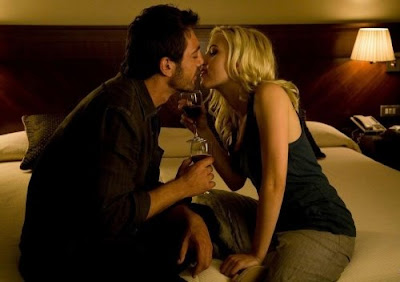
I'm not planning on speaking at length about any of the 2000-and-beyond films I'm revisiting, as many of them will turn up on my planned best of the decade list, but I've learned a thing or two about myself with another viewing of Vicky Cristina Barcelona. I know Woody Allen has a pretty large fan base, and I know most of which has lost faith in the director's recent oeuvre, but falling in love with Vicky Cristina Barcelona all over again just proved that I will never have my finger on the pulse of America. I saw Vicky show up on plenty of top 10 lists this year and I've enthusiastically suggested many of my friends to go see it, and I have yet to find anyone I know personally that shares the relief and elation I felt with both viewings. It's so ravishingly complex in terms of characterization, narration (which is brilliant, despite many people's gripes about it), visualization and humor that I just can't wrap my mind around all the people I know who thought it was "good, but didn't blow me away." More on Vicky around the month of November, for sure. PS: It's my dark horse candidate for a Best Picture Oscar nomination.

04 December 2008

And the ball is rolling...

The National Board of Review has started critics' award month for cinema, giving Danny Boyle's Slumdog Millionaire the top prize. There appears to be too many awards for actors given out by NBR, but so be it... The NBR usually ranks as one of the less sophisticated of the year's awards. The rest are as follows:

Picture: Slumdog Millionaire - dir. Danny Boyle
Director: David Fincher (The Curious Case of Benjamin Button)
Actor: Clint Eastwood (Gran Torino)
Actress: Anne Hathaway (Rachel Getting Married)
Supporting Actor: Josh Brolin (Milk)
Supporting Actress: Penélope Cruz (Vicky Cristina Barcelona)
Foreign Film: Mongol - dir. Sergei Bodrov
Documentary: Man on Wire - dir. James Marsh
Animated Feature: WALL·E - dir. Andrew Stanton
Breakthrough Actor: Dev Patel (Slumdog Millionaire)
Breakthrough Actress: Viola David (Doubt)
Directorial Debut: Courtney Hunt (Frozen River)
Original Screenplay: Nick Schenk (Gran Torino)
Adapted Screenplay: (tie) Eric Roth (The Curious Case of Benjamin Button); Simon Beaufoy (Slumdog Millionaire)
Spotlight Award: Melissa Leo (Frozen River); Richard Jenkins (The Visitor)

Top 10 Films (That Aren't Slumdog, "Independent" or "Foreign," but Can Be Animated)
Burn After Reading - dir. Ethan Coen, Joel Coen
Changeling - dir. Clint Eastwood
The Curious Case of Benjamin Button - dir. David Fincher
The Dark Knight - dir. Christopher Nolan
Defiance - dir. Edward Zwick
Frost/Nixon - dir. Ron Howard
Gran Torino - dir. Clint Eastwood
Milk - dir. Gus Van Sant
WALL·E - dir. Andrew Stanton
The Wrestler - dir. Darren Aronofsky

Top 10 "Independent Films"
Frozen River - dir. Courtney Hunt
In Bruges - dir. Martin McDonagh
In Search of a Midnight Kiss - dir. Alex Holdridge
Mister Foe [Hallam Foe] - dir. David Mackenzie
Rachel Getting Married - dir. Jonathan Demme
Snow Angels - dir. David Gordon Green
Son of Rambow - dir. Garth Jennings
Wendy and Lucy - dir. Kelly Reichardt
Vicky Cristina Barcelona - dir. Woody Allen
The Visitor - dir. Thomas McCarthy

Top 5 "Foreign" Films (That Aren't Mongol)
The Edge of Heaven [Auf der anderen Seite] - dir. Fatih Akin
Let the Right One In [Låt den rätte komma in] - dir. Tomas Alfredson
Roman de gare - dir. Claude Lelouch
A Secret [Un secret] - dir. Claude Miller
Waltz with Bashir - dir. Ari Folman

Top 5 "Documentaries" (That Aren't Man on Wire)
American Teen - dir. Nanette Burstein
The Betrayal - dir. Ellen Kuras, Thavisouk Prasavath
Dear Zachary - dir. Kurt Kuenne
Encounters at the End of the World - dir. Werner Herzog
Roman Polanski: Wanted and Desired - dir. Marina Zenovich

07 October 2008

Chasing Cars!

My worlds collided today when I watched both How Tasty Was My Little Frenchman and selected skits from this past week's Saturday Night Live. Did anyone make the connection that when The Frenchman is finally assimilated into the tribe, he gets a haircut similar to that of Kristen Wiig's on the Lawrence Welk skit this past weekend when Anne Hathaway hosted? I guess high fashion never dies. Or maybe I just wanted to draw your attention to how fucking hysterical Wiig is. Oh well.

11 December 2006

Oh, fashion...

The Devil Wears Prada - dir. David Frankel - 2006 - USA

That The Devil Wears Prada is not a good film may not come as much of a surprise, but that The Devil Wears Prada features Meryl Streep in one of her most complex roles may. The film is rigidly formulaic: small-town girl with ambition arrives to the Big Apple to be swallowed whole. Yet sometimes a film can overcome its pitfalls and stand as something truly remarkable. The Devil Wears Prada could never be called boring, but it falls into the trappings of most conventional Hollywood films. Our protagonist Andy (Anne Hathaway) is so painfully idealistic that her very downfall and rebirth could be seen before even viewing the film. Plucky Andy, a size six, accidentally lands a job at Runway Magazine, the pinnacle of haute culture New York fashion, to gather references in her goal in becoming an important journalist. Stealing the job from the herds of more fashionably inclined young women, Andie becomes the assistant for the magazine’s maven (or Nazi, if you will) of glamour, Miranda Priestly (Streep). Miranda puts her new assistant through rings of fire, causing the naïve Andy to lose sight of what really matters in her life. Blah, blah, blah. You know what’s going to happen going into the film, so why bore you with plot details? The Devil Wears Prada is all about Meryl Streep and Marilyn Priestly, and I’ll spend the rest of this review talking about that.

Streep’s top-billing over Hathaway has little to do with screen time as it does prestige. She’s easily the supporting character here, and this is all the better. Marilyn Priestly doesn’t exist so much as a character as she does a myth. Her actions are inhumane, her disposition cruel. With the combined force of David Frankel’s direction and Aline Brosh McKenna’s screenplay, based on the novel by Lauren Weisberger, Marilyn Priestly always stays firmly in the background, even when she’s mouthing cruel insults at her staff. She’s like Marlon Brando in Apocalypse Now, an ominous, impermeable figure, hidden in the shadows. We, the audience, like Andy, are never given the “in” on what sort of a person she might be when she’s not wearing her fashion like battle armor. With this positioning of Marilyn within the film, she becomes an eternally fascinating figure. While on a date talking with another fashion big wig (Simon Baker), Andy states exactly what should make Marilyn such a complex figure: she’s a woman in a man’s position, therefore being dubbed “ice queen” and “bitch” when words like “skillful” and “professional” would be attached to a man in her shoes. Granted, they wouldn’t look nearly as good. However, if this were simply it, the film would have become preachy and uninteresting. Instead, Marilyn becomes a figure of high intrigue and fascination, whether she be man or woman. The Devil Wears Prada may present itself as a piece of fluff, but you’d be surprised how much it has to say about the face and design of power and how richly fascinating a study that can be.