 The Girl on the Train
La fille du RER
The Girl on the Train
La fille du RER
2009, France
André Téchiné
When Kelly Reichardt’s
Wendy and Lucy came out, many people found it to be a rather telling portrait of the economic crash of 2008, though many others noted that the film was made (and even premiered) before that had happened. What was fascinating though about the label placed upon it was that the film concerned a woman in her mid-20s, played by Michelle Williams, while the media focused on those individuals who were being laid off from jobs they’d had for years. André Téchiné’s latest film,
The Girl on the Train, is one of the first films to really address this age group, the students who graduated at a time when the work field was grim to say the least, with that in mind… though what’s most appealing about the film is that it never directly approaches the subject.
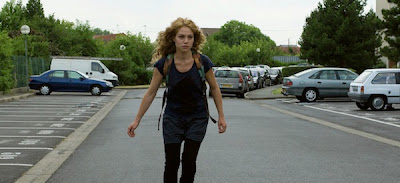
Twentysomething Jeanne (Émilie Dequenne) is a charming, naïve young woman who lives with her mother Louise (Catherine Deneuve) and spends most of her afternoons rollerblading through Paris. The first moment we see Louise, she’s sitting in front of a computer, looking online for jobs to which her daughter could apply. The scene comes across as rather benign, trivial moment within the film. Louise nags her daughter about finding a job, Jeanne agrees with her while trying to change the subject, Louise adds that the particular job she’s found is working for someone she used to know and offers to revise Jeanne’s résumé. At first, the scene appears to exist in order to establish the relationship between the mother and daughter, who otherwise carry on like the best of friends, but it also establishes a generational gap and places context for the film’s driving act, midway through the film.

For a filmmaker approaching 70, Téchiné has a rather astounding grasp of what it means to be young in this economy. Jeanne lives comfortably with her mother and finds distraction with her iPod and rollerblades, while still harboring a hint of shame about her unemployment, as she lies to Franck (Nicolas Duvauchelle), the boy who fancies her, about working at the job for which she interviewed and (evidently) didn’t get. The other significant youth in the film is the grandson of Samuel Bleistein (Michel Blanc), the lawyer whose secretarial position Jeanne applied for. Nathan’s (Jérémy Quaegebeur) situation is a bit different. He’s 13, approaching his bar mitzvah and consistently bossed around by his quarrelling, liberal parents (Ronit Elkabetz and Mathieu Demy) even though they happen to think their actions are in sync with their son’s wishes. Despite the age difference between Jeanne and Nathan, he’s the only one who seems to understand her situation, or at least the only one willing to lend an ear without imposing judgment upon her, another example of the miscommunications between generation.
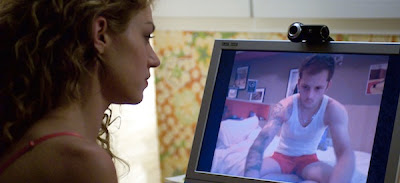
On a purely superficial level, Téchiné cinematically captures personal exchanges via the Internet in a totally magnificent, compelling way. One of the biggest hurdles filmmakers have had to tackle in recent years is how to make an online conversation visually stimulating, and it’s an obstacle at which most have failed. Favoring online video chat over phone calls, Jeanne and Franck communicate with one another as most kids would, and without a word spoken, Téchiné manages to make their exchanges as dynamic, sexy and engaging as if they were talking back and forth in person. He even adds a surprising touch with Jeanne and Franck’s first sexual experience together happening through the video chat, which could be chalked up to avoiding the interference from Jeanne’s mother or Franck’s roommate or the comfort Jeanne feels through the impersonal medium, avoiding the likely awkwardness of first having sex with someone (or both, naturally).
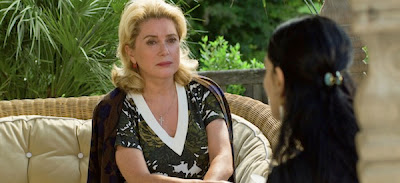
Jeanne’s situation, the one that only Nathan is able to understand, is not the pangs of being young but specifically the film’s central act in which Jeanne lies to the police claiming to have been a victim of an anti-Semitic attack. Jeanne isn’t Jewish, but she’s living in a world (the film world, that is; I’m not sure whether this is true in the real one or not) where anti-Semitic attacks are on the rise. Her recognition of this fact is probably brought upon through Bleistein, a Jew who’s gained media attention for defending the victims in court. Téchiné spends a great deal of time building up to Jeanne’s act, diving the film into two chapters, “Les circonstances” (Circumstances) and “Les consequences” (Consequences). No single moment, even the apparent one, gives explanation to why Jeanne did what she did. It’s best understood as a product of realities of her life (obviously) and her struggle not to disappear. Jeanne’s entire relationship with Franck provides the biggest clue to this. On most levels, Franck doesn’t seem like the sort of guy Jeanne would normally be attracted to. He’s rough, streetwise and has a family history of crime… not to mention that Louise seems to disapprove of him (which may be one of his appeals, I’m not sure). What Jeanne finds appealing in Franck is the attention he gives her; he appears dedicated and loyal to her, even if he’s rather shady and manipulative otherwise.

Jeanne never really gives a reason for what she did, and it’s very possible that she isn’t even aware of it in the first place. She doesn’t appear to be a racist toward Jews or the North Africans she claimed attacked her. She seems oblivious to a lot of things, including her own motives. The choice of casting Dequenne as Jeanne doesn’t seem to be an accident. Jeanne shares quite a few similarities with the title character in
Rosetta, the role Dequenne is famous for. Both young women feel the weight of the economy crushing them, and both have unorthodox (and morally grey) ways of surviving through it. While Rosetta’s situation is one of singularity, Jeanne’s however is a sentiment that’s, unfortunately, considerably widespread.
La fille du RER
will hit DVD from Strand Releasing in the US on 18 May; it is already on DVD in Canada (from Mongrel Media) and France (from UGC Vidéo) and will be released theatrically in the UK in June.