Turned a map from the Flatiron Building in a single-level dungeon with 30 rooms (so I could add a d30 table or two to go with it—to come in a future post).
Showing posts with label adventure creation. Show all posts
Showing posts with label adventure creation. Show all posts
Friday, July 18, 2025
Saturday, November 7, 2015
Rumor Table for Vault of the Faceless Giants
I'm working on an introductory level adventure to support the Basic Psionics Handbook. Mind you, it's not going to be "purely" psionic. There will be plenty of stuff for all the classes to deal with. The whole point is that the psionic portions are woven in so they don't overwhelm the adventure.
[SPOILER ALERT: I know it's more likely many of you might actually run this adventure rather than play in it, but if you think there's a chance you might play in this one (that includes my local folks for whom I might run this in person or online), you might ignore the map when you read the rumor table.]

[SPOILER ALERT: I know it's more likely many of you might actually run this adventure rather than play in it, but if you think there's a chance you might play in this one (that includes my local folks for whom I might run this in person or online), you might ignore the map when you read the rumor table.]
- There is a cave-in that blocks direct access to the temple complex.
- There are natural cavern passages just north of the main entrance that might access the temple interior without having to go through the main entrance
- The temple is a place of evil—built by evil men who praised and worshiped chaotic gods.
- The temple is populated by a group of religious fanatics who receive their instructions directly from their evil and chaotic gods, and are perfectly willing to die for them
- The temple is populated by a group of religious fanatics that follow an unhinged magic-user
- The temple is populated by a group of religious fanatics that take orders from an evil cleric
- The temple is populated by a group of psionic-using religious fanatics that follow a dark and powerful mystic
- An evil relic called the Mask of Rab (pronounced “rabe”) is housed in the temple. Whoever wears the mask will be made the servant of Rab, Demon King of Lanku. (Lanku is a legendary island fortress located in the lowest of 128 sub-levels of an Abyssal layer known as Nork).
- Many mystical and magical items are hidden in plain sight throughout the temple complex.
- There are many reflective pools throughout the complex. It is said that those who stare too long into one of these pools “lose themselves.”
- The seven-faced representation of Rab symbolizes his complete command over the seven chakras.
- The statues in the complex are faceless because they represent Rab’s ability to steal identities and travel unrecognized among men.
- The statues in the complex are faceless because they represent Rab’s ability to steal psionic powers.
- The sect that used to inhabit the temple was intent on opening a portal directly to Nork (the 128th level of the Abyss) in order to allow direct passage to the Material Plane for Rab, Demon King of Lanku.
- There are several pagoda-style shrines throughout the complex, some of which have magical powers.
- There are several pagoda-style shrines throughout the complex, some of which have mind-altering powers.
- Those who enter the temple will fall under the control of the demon lord Rab.
- It is better to die than to become the servant of Rab the demon lord.
- Rab himself resides in the temple. (If this is true, there is not much chance for a group of novice adventurers to do much more than die or become servants of Rab).
- Those who die in the complex are reborn in the Abyss as abyssal larvae, maturing thereafter into abyssal locusts.
Friday, March 7, 2014
"Shreds of Fabric" Adventure Design Technique
There's actually a lot of story going on here that's not obvious from that illustration or this sketch (which really does nothing more than lay out the major encounter areas, and note how they're related). The story does, however, drives the whole thing.
In some ways, the way I'm approaching adventure design as-of-late is based on a technique I'm calling the "shreds of fabric" technique. Hah! I just made that up. Look, if Hemingway could use an "iceberg" approach to storytelling, why can't I use a "shreds of fabric approach." Okay, I'll admit, "shreds of fabric" is just my way of saying that little clues are planted here and there, and as more shreds of fabric and placed to together, the clearer the picture becomes of what really happened. I know that's not really a new technique (and those writing professors out there will probably chime in with a more appropriate term for the technique), but it does help me think about how I want the story to be woven as the characters progress through the encounters, regardless of the order of those encounters.
Part of what I'm resolving in this map-sketch (which actually deals with both encounters AND story), is when and how to reveal the story's big plot twist. (I'm avoiding the tendency to want to railroad this kind of reveal. As such, I'll be reworking those "blocked passages" in the middle of the map.)
I'm reminded of the movie The Sixth Sense. Somebody had warned me not to read too much about it before I saw it, because of the big plot twist at the end. Because I knew there was a twist, when I saw the movie for the first time, I started looking for it. Halfway through the movie, I figured it out. Watching the rest of the movie just reinforced my hypothesis. So when the twist was finally revealed at the end, I thought to myself, "Yep. I figured it out." But it didn't necessarily reduce my enjoyment of the story. I'm hoping this adventure is the same. That even if the characters discover the "plot twist" (i.e., get the "whole picture") halfway through the adventure, that it doesn't keep them from enjoying the other little shreds of fabric as they discover them.
Thursday, November 14, 2013
Free "Adventure": The Lost Caverns of Azgot
First off, the reason I put the word "Adventure" in quotes, it's because it's not so much an adventure as it is a locale - a fully-described locale, but generally "empty" in regards to monster and treasure. This was an intended support piece for Valley of the Five Fires, and I still like the story it sets up, but it never really came together as an adventure. I think it's got a pretty cool backstory, but anything I would have stocked it with wouldn't really have fit well in the context of the module, so I dropped it.
Unlike the freebies I usually put up on the Free Downloads page, this one is available from RPGNow, since the last page is a pretty blatant promotion for the complete Valley of the Five Fires module (available in print from Lulu.com, and available in PDF from RPGNow).
BTW, the 5th page is not previewed below, but is pretty much the same as this.
Click here to go to the RPGNow page for
Old School Adventures™ Mini-Module VA1a:
The Lost Caverns of Azgot.

Unlike the freebies I usually put up on the Free Downloads page, this one is available from RPGNow, since the last page is a pretty blatant promotion for the complete Valley of the Five Fires module (available in print from Lulu.com, and available in PDF from RPGNow).
BTW, the 5th page is not previewed below, but is pretty much the same as this.
Click here to go to the RPGNow page for
Old School Adventures™ Mini-Module VA1a:
The Lost Caverns of Azgot.
Tuesday, October 22, 2013
A Look Inside My Crowded Head Sketchbooks
So, here I am, about a week past the two year anniversary of this blog, and I thought I'd take a look back through my sketchbooks and share some pages. I'm always interested to see the way others work, and thought many of you might be interested in the same.
this is one of the pages where I was working out the gem values for the d30 DM Companion.
I was watching one of those Syfy or Discovery Channel specials when I statted up the Crimson Death Worm.
a Ziggurat I drew up, but which never went any further than a few pages of half-formed ideas. I'm sure we all have plenty of those.
A drawing of a creature based on some results generated from Appendix D in Dungeon Masters Guide, "Random Generation of Creatures from the Lower Planes." I think I might have took some leeway here; I don't remember. Almost a year-and-a-half later, I'm still trying to decide whether I'm going to use it for something or not (though if I do, I already know where).
A monster I obviously statted up, but never did anything with. Particularly, I never sketched/illustrated it. I recall thinking it would be generally crab-like (but I guess the name "Snipper" and a "pincer" attack pretty much imply that).
This was the final rough version of "The Stupa of Divine Madness" from The Valley of the Five Fires. This went through several iterations before being refined into this very-close-to-final version. Some additional refinements were made when the map and encounters were committed to final form.
This is the rough introduction I wrote for the Lost Catacombs of Kadmos. (BTW, I'll be starting this up in Roll20 soon, and looking to recruit some online players.)
This is a chart I was trying to work up that, with the roll of 2d6s, would determine a player's character class (using BX classes). It's workable, but not flawless.
Monday, October 21, 2013
Playtesting Cubed
Over the weekend, I had a chance to do three things...
First, I had a chance to run a rough/partial playtest of the adventure from the upcoming second issue of the Dragon Horde zine. I, constructed the space to be entered from three different entries. The party found one of the two "back ways" in, and (in the process) skipped a lot of information about what was in store for them. However, on the fly, I turned a wandering monster encounter with an NPC cleric into a chance to both put the PCs on their toes and reveal a lot of backstory. Enough so, that I'm reworking the write-up to provide for this eventuality (should the DM choose to use it).
 Second, I finally got to try out Roll20. I'm still learning how everything works, but even on the fly it allowed me to quickly map some areas while play was on a restroom break. And the fog of war feature is truly invaluable. It's still not as seamless for me using a dry erase marker and miniatures on a laminated grid, but I know that I'm also not using Roll20 to its full abilities yet (e.g., tracking player stats, etc.), but I'll get there pretty quickly (I figure another couple of sessions and I'll be up to full steam). This brings me to...
Finally, this was my first real opportunity to use the "beta" version of my BX DM Screen. I was afraid the text might be a tad small, but so far legibility has not been an issue.
First, I had a chance to run a rough/partial playtest of the adventure from the upcoming second issue of the Dragon Horde zine. I, constructed the space to be entered from three different entries. The party found one of the two "back ways" in, and (in the process) skipped a lot of information about what was in store for them. However, on the fly, I turned a wandering monster encounter with an NPC cleric into a chance to both put the PCs on their toes and reveal a lot of backstory. Enough so, that I'm reworking the write-up to provide for this eventuality (should the DM choose to use it).
Finally, this was my first real opportunity to use the "beta" version of my BX DM Screen. I was afraid the text might be a tad small, but so far legibility has not been an issue.
Friday, August 9, 2013
My Attempt At Telecanter's Visual Dungeon Challenge
Yesterday, as his 999th post, Telecanter issued the following challenge:
I think mine (at bottom of post) is particularly stripped down from Telecanter's intention, since I have absolutely no stats included. But honestly, if you've run enough zombies, rats, bats, and spiders, you can wing it (even if you don't remember exact ACs for example).
What I really miss not having in this format is the detail. Sure, a picture is worth a thousand words, but there are some times when I'd rather have the perfect three or four words, than the other 997 or 997. It was a fun exercise, and something I may re-attempt in the future, but I'm much more of a fan of the single-page format. But maybe that's because it's much easier to do something with only the most minimal of visual needs (like my Tomb of Ludor single-pager).

Make a one page dungeon that uses only imagesI think the challenge is interesting, and it did give me an opportunity to come back from my recent slacking and get some new things posted to this blog. I think the format has both disadvantages and advantages. As for the former: 1) it's hard to do anything too complex for fear of being misunderstood/misinterpreted, 2) #1 seems to drive the content toward familiar clichés, and 3) it feels a little cookie cutter (but maybe that's because I didn't spend too long trying to push the format). As for the latter: 1) it really leaves a lot of things open to interpretation by the DM, and 2) it really does allow flexibility for strength and number of monsters, as well as type and amount of treasure.
and visual devices. No words. No abbreviations.
I think mine (at bottom of post) is particularly stripped down from Telecanter's intention, since I have absolutely no stats included. But honestly, if you've run enough zombies, rats, bats, and spiders, you can wing it (even if you don't remember exact ACs for example).
What I really miss not having in this format is the detail. Sure, a picture is worth a thousand words, but there are some times when I'd rather have the perfect three or four words, than the other 997 or 997. It was a fun exercise, and something I may re-attempt in the future, but I'm much more of a fan of the single-page format. But maybe that's because it's much easier to do something with only the most minimal of visual needs (like my Tomb of Ludor single-pager).
Monday, July 1, 2013
Ogress of Anubis: Free PDF Now Available!
After Welbo and I did a run-through of the adventure Friday night, I realized it had a few holes to be filled. That meant going from 12 pages to 16. So what are you getting now? Information for adapting to different OSR rules editions; adventure background; regional overview (small map + info on villages and wandering monsters); information on the temple compound and its vicinity (including wandering monsters); a detailed map of the temple compound; a 4-page detailed encounter key for the temple compound; new monster (animal mummy w/ 7 variants, statted for Oe/BX/1e); "generic" stats for all monsters and NPCs mentioned in the adventure; 12 pre-generated NPCs w/ details; 10 adventure seeds (for continuing adventures in the area); and 8 additional unkeyed maps (7 tombs, 2 caves, 1 sunken city) for use with the adventure seeds.
And it's abso-freaking-lutely free!
Available at this link from RPGNow.com >>
New preview image below.

And it's abso-freaking-lutely free!
Available at this link from RPGNow.com >>
New preview image below.
Friday, June 28, 2013
Ogress of Anubis: Preview of Free PDF
First off, an apology. I realized as I was trying to put the entire encounter key for this past Monday's map into a blog post, it was going to take a long time to typeset, and wouldn't be terribly user friendly. Since the plan all along was a free PDF of the whole thing (map, encounter key, etc.), that I'd just do a preview of the entire layout today, and then let you know it will be available Monday a.m. for FREE from RPGNow. I'm not even going to do a "pay what you want." I'm simply going to make it free. And then, in about a week, a print version will be available (at cost) from Lulu.
So here's what you get for the incredibly low price of absolutely nothing....
• an adventure that's Oe/BX/1e (and compatible) ready
• page 1: a fancy cover page with vintage clip art!
• page 2: an overview on adapting to editions, and the adventure introduction
• page 3: an area map (no scale), overview of the villages, and wandering monster tables
• page 4: a map of the temple
• pages 5-7: the encounter key for the temple map
• page 8: new monster info for the animal mummy
• page 9: monster stats (for wandering and encounter monsters), and NPC information
• page 10: twelve pre-generated characters, with stats and equipment
• page 11: ten adventure seeds (one of which has variations for every village)
• page 12: the obligatory OGL and © information
And it's all packaged into 12-pages so you can print it on tabloid paper and saddle-stitch. Or let the free PDF help you decide whether it's going to be worth the $5.53 for the fancy Lulu version with the added color cover! Which, by the way, will available the following Monday (July 8) at the same time as... The Valley of the Five Fires. (Huzzah!)
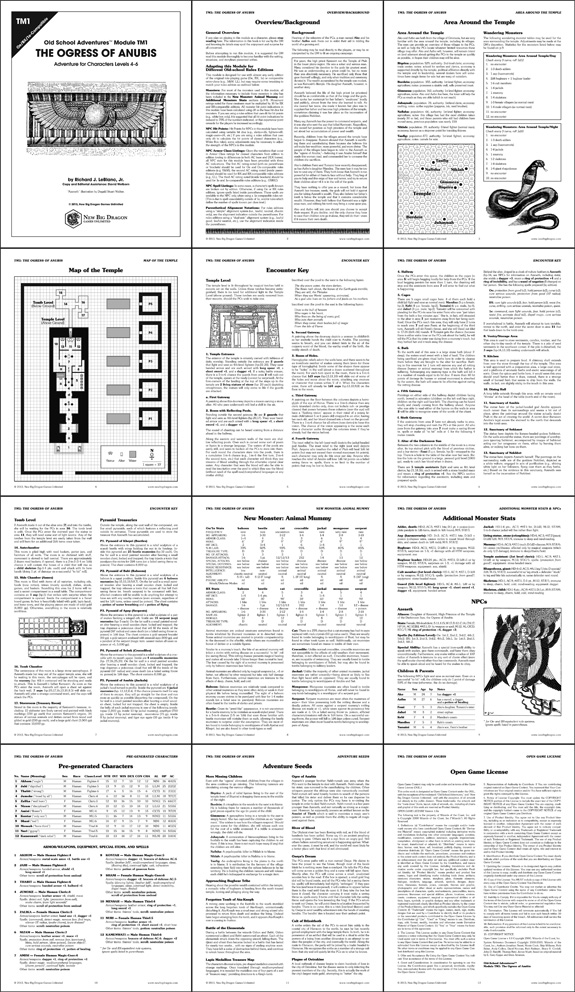
So here's what you get for the incredibly low price of absolutely nothing....
• an adventure that's Oe/BX/1e (and compatible) ready
• page 1: a fancy cover page with vintage clip art!
• page 2: an overview on adapting to editions, and the adventure introduction
• page 3: an area map (no scale), overview of the villages, and wandering monster tables
• page 4: a map of the temple
• pages 5-7: the encounter key for the temple map
• page 8: new monster info for the animal mummy
• page 9: monster stats (for wandering and encounter monsters), and NPC information
• page 10: twelve pre-generated characters, with stats and equipment
• page 11: ten adventure seeds (one of which has variations for every village)
• page 12: the obligatory OGL and © information
And it's all packaged into 12-pages so you can print it on tabloid paper and saddle-stitch. Or let the free PDF help you decide whether it's going to be worth the $5.53 for the fancy Lulu version with the added color cover! Which, by the way, will available the following Monday (July 8) at the same time as... The Valley of the Five Fires. (Huzzah!)
Thursday, June 27, 2013
The Ogress of Anubis: Adventure Seeds
I know this is a bit out of order, and the post-adventure adventure seeds should really come after the encounter key for the temple, but that's taking longer than expected to put into a blog post.
More Missing Children
Even with the “ogress” eliminted, children from the villages in the area continue to go missing. The following rumours are circulating among the various villages:
Approaching Bugbear Tribe
Hearing about the possible wealth contained within the temple, a nomadic tribe of bugbears is heading from the south toward temple, looting and pillaging along the way.
Forgotten Tomb of Ata-Kneph
A mining crew working in the foothills to the south stumbled across the long forgotten tomb of Ata-Kneph, unintentionally disturbing it. Ata-Kneph was a cruel man and strong wizard who promised to return from death and enslave the living. Undead have begun emerging from the tomb, and it appears Ata-Kneph’s vow is coming to fruition.
Battle of the Elementals
During a battle between the wizards Odion and Bebti, Odion summoned a djinni and Bebti summoned an efreet. Each of the elementals struck down the opposing wizard, killing them. The djinni and efreet then became locked in a battle that has lasted for nearly two weeks... with no signs of ending anytime soon. They have left a wake of destruction behind them, and continue to wreak havoc throughout the area.
Lapis Medallion Treasure Map
The characters discover a lapis, pie-shaped medallion covered with strange markings. Once translated (through read/comprehend languages), it is revealed the medallion one of four parts of a sort of “treasure map,” providing directions to a King’s tomb.
Ogre of Anubis
Azeneth’s younger brother Nekh-rumah was away when the PCs went to the temple to deal with Azeneth. Nekh-rumah, like his sister, was rumored to be cannibalizing the children. Other whispers purport the siblings were also romantically involved. Nekh-rumah will send bounty hunters in search of the persons that killed his sister and deliver them so he can dispense his justice. The only option the PCs may have is re-visiting the temple in order to deal Nekh-rumah. Nekh-rumah is a few years younger than Azeneth, and not naturally as strong as a magic-user. However, he supposedly possess an artifact known as the Amulet of Thoth which is said to maximize a magic user’s powers, as well as provide them the ability to negate all magic used against them.
River of Blood
The Olufemi river has been flowing with red, as if the blood of hundreds has been spilled. Some say it’s an ancient prophecy coming to pass. Others say it’s a sign from an angry god. Still others believe something unnatural is happening upriver. Whatever the cause, it must be evil, and the world will most likely be a better place with that kind of evil eliminated.
Oseye’s Dream
The PCs cross paths with a man named Oseye. He claims to have the power to see the future, though most of the locals think he is nothing more than a crackpot. He tells the PCs they will come across a golden frog and a curse will fall upon them. Shortly after, the PCs will come across a small, unadorned wooden box in the road. If the box is opened, a small gold frog idol will be found inside, and all the PCs who fail a saving throw (vs. spells) will immediately feel slightly “unhinged.” If they pass the box (and leave it unopened), it will continue to appear before them in the road until they do open it. If they take the box but leave it closed, the character carrying it must make a saving throw vs. spells every 3 turns until that character fails the saving throw and opens the box (revealing the frog). If the PCs return to seek out Oseye, he will point them to a location frequented by bandits. There is no curse; this is a trick (low-level illusion) used by Oseye to send wealthy adventurers into the hands of awaiting bandits. The bandits’ den is located near their ambush point.
Cult of Rtlzsithoth
A scribe enlists the aid of the PCs to escort him safely to the coastal city of Hieracon to the north; he says he has recently gained employment with the large temple there. In truth, he is in possession of an artifact that will be used in a ritual to enlist the powers of a being from another dimension in an attempt to enslave the peoples of the city, and eventually the world. Along the route to Hieracon, the party will be joined by a trader headed to Hieracon. He recognizes the scribe as a member of a strange cult from that city and will quietly let the PCs on to what he knows.
Plague of Ostrakine
A local outbreak of disease begins to claim hundreds of lives in the city of Ostrakine, but the disease seems to only infecting the poorest members of the city. Secretly, this is actually the work of the city’s largest trade guild, attempting to “better” the city.
More Missing Children
Even with the “ogress” eliminted, children from the villages in the area continue to go missing. The following rumours are circulating among the various villages:
Biqeira: A pack of rabid hyenas living to the east of the temple (west of Biqeira) is dragging them away in the middle of the night.
Burdein: A criosphinx in the woods to the west is to blame. He is holding them for ransom a number of thousands of gold pieces equal to the age (in years) of the child.
Gimmeza: A gynosphinx living in a temple to the east is simply bored. She has captured the children as a sort of “experiment.” She wishes to see how the villagers respond. Should anyone come for the children, she will release each one for the cost of a riddle answered. If a riddle is answered wrongly, the child will die.
Juhaynah: A convocation of hieracosphinxes living in the foothills to the south has been capturing the children to eat them. If this is true, there is not much hope many (if any) that the children are still alive.
Nafisha: A psychopathic killer in Niklah is to blame.
Niklah: A psychopathic killer in Nafisha is to blame.
Taufig: An androsphinx living in the plains to the north is to blame. It is retribution for the farmers of the village extending their field into what the sphinx believes to be his territory. He is holding the children ransom and will release each child he’s kidnapped in exchange for a magic item.
Approaching Bugbear Tribe
Hearing about the possible wealth contained within the temple, a nomadic tribe of bugbears is heading from the south toward temple, looting and pillaging along the way.
Forgotten Tomb of Ata-Kneph
A mining crew working in the foothills to the south stumbled across the long forgotten tomb of Ata-Kneph, unintentionally disturbing it. Ata-Kneph was a cruel man and strong wizard who promised to return from death and enslave the living. Undead have begun emerging from the tomb, and it appears Ata-Kneph’s vow is coming to fruition.
Battle of the Elementals
During a battle between the wizards Odion and Bebti, Odion summoned a djinni and Bebti summoned an efreet. Each of the elementals struck down the opposing wizard, killing them. The djinni and efreet then became locked in a battle that has lasted for nearly two weeks... with no signs of ending anytime soon. They have left a wake of destruction behind them, and continue to wreak havoc throughout the area.
Lapis Medallion Treasure Map
The characters discover a lapis, pie-shaped medallion covered with strange markings. Once translated (through read/comprehend languages), it is revealed the medallion one of four parts of a sort of “treasure map,” providing directions to a King’s tomb.
Ogre of Anubis
Azeneth’s younger brother Nekh-rumah was away when the PCs went to the temple to deal with Azeneth. Nekh-rumah, like his sister, was rumored to be cannibalizing the children. Other whispers purport the siblings were also romantically involved. Nekh-rumah will send bounty hunters in search of the persons that killed his sister and deliver them so he can dispense his justice. The only option the PCs may have is re-visiting the temple in order to deal Nekh-rumah. Nekh-rumah is a few years younger than Azeneth, and not naturally as strong as a magic-user. However, he supposedly possess an artifact known as the Amulet of Thoth which is said to maximize a magic user’s powers, as well as provide them the ability to negate all magic used against them.
River of Blood
The Olufemi river has been flowing with red, as if the blood of hundreds has been spilled. Some say it’s an ancient prophecy coming to pass. Others say it’s a sign from an angry god. Still others believe something unnatural is happening upriver. Whatever the cause, it must be evil, and the world will most likely be a better place with that kind of evil eliminated.
Oseye’s Dream
The PCs cross paths with a man named Oseye. He claims to have the power to see the future, though most of the locals think he is nothing more than a crackpot. He tells the PCs they will come across a golden frog and a curse will fall upon them. Shortly after, the PCs will come across a small, unadorned wooden box in the road. If the box is opened, a small gold frog idol will be found inside, and all the PCs who fail a saving throw (vs. spells) will immediately feel slightly “unhinged.” If they pass the box (and leave it unopened), it will continue to appear before them in the road until they do open it. If they take the box but leave it closed, the character carrying it must make a saving throw vs. spells every 3 turns until that character fails the saving throw and opens the box (revealing the frog). If the PCs return to seek out Oseye, he will point them to a location frequented by bandits. There is no curse; this is a trick (low-level illusion) used by Oseye to send wealthy adventurers into the hands of awaiting bandits. The bandits’ den is located near their ambush point.
Cult of Rtlzsithoth
A scribe enlists the aid of the PCs to escort him safely to the coastal city of Hieracon to the north; he says he has recently gained employment with the large temple there. In truth, he is in possession of an artifact that will be used in a ritual to enlist the powers of a being from another dimension in an attempt to enslave the peoples of the city, and eventually the world. Along the route to Hieracon, the party will be joined by a trader headed to Hieracon. He recognizes the scribe as a member of a strange cult from that city and will quietly let the PCs on to what he knows.
Plague of Ostrakine
A local outbreak of disease begins to claim hundreds of lives in the city of Ostrakine, but the disease seems to only infecting the poorest members of the city. Secretly, this is actually the work of the city’s largest trade guild, attempting to “better” the city.
Wednesday, June 26, 2013
The Ogress of Anubis (Introduction)
I'm going to postpone (until tomorrow) the encounter key promised for today in Monday's map post. Today I'm posting the introduction/background and I'll post the encounter key tomorrow.
Hearing of the reknown of the PCs, a man named Ako and his brother Azibo seek them out to enlist their aid in ridding the world of a growing evil.
The following may be read directly to the players, or may be re-interpretted by the DM to fit an ongoing campaign:
Hearing of the reknown of the PCs, a man named Ako and his brother Azibo seek them out to enlist their aid in ridding the world of a growing evil.
The following may be read directly to the players, or may be re-interpretted by the DM to fit an ongoing campaign:
| For years, the high priest Kemosiri ran the Temple of Ptah in the lower plains region. He was a sober and serious man. Many considered his devotion to the gods his greatest asset. He was as understanding as a priest could be, but no more than was absolutely necessary. He sacrificed only those that gave themself willingly, and only when tradition and ceremony dictated it. The wealth accumulated by the temple was modest, as was Kemosiri’s lifestyle. His daughter Azeneth, however, is another story. Azeneth believed the life of the high priest (or priestess) should be as comfortable as that of the kings and the gods. She spoke her contempt for her father’s “weakness” loudly and publicly, almost from the time she learned to talk. As she neared her teens, she made it known her plan was to supplant her father and become high priestess of the temple, sometimes claiming it was her place as the incarnation of the goddess Nekhbet. Many say Azeneth has the power to command serpents, and it was she who sent the asp that killed Kemosiri. Regardless, she siezed her position as high priestess of the temple and set about her accumulation of power and wealth. Recently, children from the villages around the temple have begun to disappear. Rumors abound that Azeneth is sacrificing them and cannibalizing them because she believes this will make her wealthier, more powerful, and more divine. The people of the villages have begun to refer to the temple as the temple of the “ogress of Anubis,”—believing Anubis himself made this woman a monster and commanded her to consume the children she sacrifices. Ako’s children Femi and Tumaini have recently disappeared, as has Azibo’s daughter Mandisa. The men fear it may be too late to save any of them. They both know that Azeneth is too powerful for either of them to face without help. They beg of you to help end this reign of fear and terror, and try to return their children alive... if it is in the will of the gods. They have nothing to offer you as a reward, but know that Azeneth has treasure; surely, the gods will not hold it against you for taking Azeneth’s wealth. They also believe her father’s tomb is below the temple and that it contains considerable wealth. However, they both believe that Kemosiri was a righteous man, and robbing his tomb may bring a curse upon you. Ako and Azibo will join you should you choose to accept their request. If you decline, and the only chance they have to save their children is to go it alone, they will do that... even if it means their own death. |
Monday, June 24, 2013
Temple of the Darkmoon Sun (TBD)
Free Map Today; Encounter Key Wednesday
While Welbo and I put the finishing touches on Valley of the Five Fires I needed a "short-term" distraction. I decided to do sort of a themed week, but not necessarily make a big deal about it. What I've got is a small adventure entitled Temple of the Darkmoon Sun. This has nothing to do with the Temple of the Darkmoon Talisman map from September of last year, other than I like the sound of the word "darkmoon." Today, I'm just posting a JPG of the map, but later this week (aiming for Wednesday) the encounter key will follow.
Tomorrow (Tuesday) I have a killer new monster, which I have to post before the encounter key (since the encounter key includes the variants of the new monster). When I sent the preview of the new monster to Welbo, I commented that it was "one of my most inspired monsters yet," to which he replied, "ooooh ... that is cool!" It was actually the new monster that got me inspired to put together this quickie mini-adventure; plus I haven't done one in a while and felt like it was due.
So where was I? Oh yeah... today is the map, tomorrow is the new monster, Wednesday is the encounter key, and Thursday will be all the NPC information. (I might flip Wed. and Thu.) Then, if all works out as planned, I'll have a free PDF version ready for download on Friday (probably through RPGNow). So, feel free to copy today's map and tomorrow's monster and the rest of the week's stuff and assemble it yourself; but by the time you get it done, the free PDF should be ready.

Tomorrow (Tuesday) I have a killer new monster, which I have to post before the encounter key (since the encounter key includes the variants of the new monster). When I sent the preview of the new monster to Welbo, I commented that it was "one of my most inspired monsters yet," to which he replied, "ooooh ... that is cool!" It was actually the new monster that got me inspired to put together this quickie mini-adventure; plus I haven't done one in a while and felt like it was due.
So where was I? Oh yeah... today is the map, tomorrow is the new monster, Wednesday is the encounter key, and Thursday will be all the NPC information. (I might flip Wed. and Thu.) Then, if all works out as planned, I'll have a free PDF version ready for download on Friday (probably through RPGNow). So, feel free to copy today's map and tomorrow's monster and the rest of the week's stuff and assemble it yourself; but by the time you get it done, the free PDF should be ready.
Sunday, May 26, 2013
Valley of the Five Fires: Update and "Ad" Preview
To cut to the chase, I made the final revisions/updates The Valley of the Five Fires on Friday. The major item was converting some of the clerics to the new steppe shaman class; oddly enough, most of the spells stayed the same, and only the weapons and armor had to change. Speaking of armor... I tell you what, that AC Cheat Sheet sure as hell made it a snap to check (and revise) the armor information for all the NPCs, and there are 34 of them! Now the PDF is in Welbo's hands for a proof review, and then I need to give it another read, and it should be ready to release.
Coinciding with that release, I'll be offering a free PDF of the shaman class through RPGNow. And the final page of that PDF will be a shameless bit of self-promotion for the module itself. For the ad, I really wanted something that felt like it came out of the pages of an old Dragon Magazine, so I opted for B&W in lieu of any color. Below is where I ended up; I think it captures the spirit of those old ads pretty well. (BTW, the "blurry part" is the print/PDF pricing/availability; I'm still working that out, and didn't want to commit to anything via this post.)

Coinciding with that release, I'll be offering a free PDF of the shaman class through RPGNow. And the final page of that PDF will be a shameless bit of self-promotion for the module itself. For the ad, I really wanted something that felt like it came out of the pages of an old Dragon Magazine, so I opted for B&W in lieu of any color. Below is where I ended up; I think it captures the spirit of those old ads pretty well. (BTW, the "blurry part" is the print/PDF pricing/availability; I'm still working that out, and didn't want to commit to anything via this post.)
Wednesday, May 22, 2013
Using Nostradamus Predictions as Adventure Seeds
While flipping channels yesterday, I stumbled across yet another show about Nostradamus's predictions, and it struck me that Nostradamus quatrains could make cool little adventure seeds. Not to mention they sound cool enough for the words of the predictions themselves to be incorporated into the game world.
Take, for example, the passage I clicked haphazardly from the Nostradamus Quatrain Browser:
Before the Empire changesOkay. I had to look up porphyry, but that's half the fun of a Nostradamus quatrain, isn't it? Looking stuff up? From Wikipedia:
a very wonderful event will take place.
The field moved, the pillar of porphyry
put in place, changed on the gnarled rock
- Century I Quatrain 43
Porphyry is a variety of igneous rock consisting of large-grained crystals, such as feldspar or quartz, dispersed in a fine-grained feldspathic matrix or groundmass. The larger crystals are called phenocrysts. In its non-geologic, traditional use, the term "porphyry" refers to the purple-red form of this stone, valued for its appearance.So we have a wonderful event... the raising of a monument or the construction of a building, royal in nature, and it has been placed on what was a gnarled rock.
The term "porphyry" is from Greek and means "purple". Purple was the color of royalty, and the "Imperial Porphyry" was a deep purple igneous rock with large crystals of plagioclase. This rock was prized for various monuments and building projects in Imperial Rome and later.
Now we just have to take this event that has happened and find our inciting incident. (Any of you who've ever dabbled in screenwriting know that the story doesn't really get started until the inciting incident). We could either work out from the event without help from Nostradamus, or poke around again until something makes sense. Like...
The fertile, spacious Ausonian plainOkay. So by the quatrains above, and with a little embellishment, and some help from Donjon's Fantasy Name Generator, the adventure seed we've generated looks something like this...
Will produce so many gadflies and locusts,
The solar brightness will become clouded,
All devoured, great plague to come from them.
- Century IV Quatrain 48
An obelisk honoring King Awfrith was erected at the edge of the Ausonian plains in honor of his victory over the tribes of the Arman. The festivities had barely begun the sky grew black with gadflies and locusts, and so began the plague on the peoples of Baltha. Awfrith's son Waltin, recent heir to the throne, is at his wits' end. He's seeking a group of adventurers to investigate the blah, blah, blah... evil wizard... blah, blah, blah... towering citadel... blah, blah, blah... reward... blah, blah, blah...Or you could just use the d30 Adventure Seed Generator.
Wednesday, May 8, 2013
Update to the Player Handout Map
from Valley of the Five Fires
I reframed this from the earlier version of the player handout map for The Valley of the Five Fires to visually concentrate on the areas where the pre-generated adventures are placed, not to mention where most of the adventure seeds point.

Tuesday, April 30, 2013
A-to-Z Challenge Day 26
Free PDF Download...
Map to the Lost Catacombs of Kadmos
So here it is... one month after I started this A-to-Z challenge and I've essentially written an adventure one post at a time. And so, there's nothing left but the map. So... here 'tis!
Be forewarned, there will be some inconsistencies between what was written over the last month and the map that appears here (and is downloadable via the link below). Also, I know there is no legend on the map, but each square equals 5' and when reading the type in its proper orientation, the "top" of the page is north. Also, the map is "incomplete" to some degree; for example, you will note some rooms have specific floor tiles that are marked. The intention at some point is to have additional support images within the DM's encounter descriptions, as well as having a set of player "handouts" (via an "illustration booklet" a la Tomb of Horrors).
Please note the PDF is 2 pages and contains both of the pages previewed below.
Click here to download a free PDF of the maps
to the Lost Catacombs of Kadmos (from MediaFire).


Be forewarned, there will be some inconsistencies between what was written over the last month and the map that appears here (and is downloadable via the link below). Also, I know there is no legend on the map, but each square equals 5' and when reading the type in its proper orientation, the "top" of the page is north. Also, the map is "incomplete" to some degree; for example, you will note some rooms have specific floor tiles that are marked. The intention at some point is to have additional support images within the DM's encounter descriptions, as well as having a set of player "handouts" (via an "illustration booklet" a la Tomb of Horrors).
Please note the PDF is 2 pages and contains both of the pages previewed below.
Click here to download a free PDF of the maps
to the Lost Catacombs of Kadmos (from MediaFire).
Monday, April 29, 2013
A-to-Z Challenge Day 25: 24 Cursed Magic Items
(Treasure List for Eggs of Vice)
Entry 25 for The Lost Catacombs of Kadmos
Just a reminder: the Greek alphabet has only 24 letters, so the A-to-Z posting finished up for me on Saturday. I am, however, using today (and tomorrow) as an "addendum" to the challenge.
As promised in Saturday's post of the Omega (Ω) Room, below are the treasures imparted by the eggs from the Omega (Ω) Room on the Path of Vice. (For information on the Path of Virtue and the Path of Vice, see Upsilon (Υ): The Paths of Vice & Virtue.)
I had originally intended that the 24 eggs in the Omega (Ω) Room on the Path of Virtue contain 24 different magical boons, but have since decided that all of the Eggs of Virtue will impart the same magical boon... a permanent 1 pt. increase to the characters lowest ability score. This boon is granted to each character as they crack the egg they choose and are teleported outside the catacombs. This way, none of them know what's inside the eggs (and will think that they are individually choosing their reward, since other members of their party will disappear before the PCs remaining in the room know what was inside the previous egg).
The Eggs of Vice will transport the characters in a similar manner (but put each PC at within a 100 mile radius of the catacombs at a disparate location from the others). While the boon for the Eggs of Virtue are all the same (per above), the treasure granted by each Egg of Vice is a different story...


BTW, don't forget tomorrow is the complete map of the catacombs.
Just a reminder: the Greek alphabet has only 24 letters, so the A-to-Z posting finished up for me on Saturday. I am, however, using today (and tomorrow) as an "addendum" to the challenge.
As promised in Saturday's post of the Omega (Ω) Room, below are the treasures imparted by the eggs from the Omega (Ω) Room on the Path of Vice. (For information on the Path of Virtue and the Path of Vice, see Upsilon (Υ): The Paths of Vice & Virtue.)
I had originally intended that the 24 eggs in the Omega (Ω) Room on the Path of Virtue contain 24 different magical boons, but have since decided that all of the Eggs of Virtue will impart the same magical boon... a permanent 1 pt. increase to the characters lowest ability score. This boon is granted to each character as they crack the egg they choose and are teleported outside the catacombs. This way, none of them know what's inside the eggs (and will think that they are individually choosing their reward, since other members of their party will disappear before the PCs remaining in the room know what was inside the previous egg).
The Eggs of Vice will transport the characters in a similar manner (but put each PC at within a 100 mile radius of the catacombs at a disparate location from the others). While the boon for the Eggs of Virtue are all the same (per above), the treasure granted by each Egg of Vice is a different story...
BTW, don't forget tomorrow is the complete map of the catacombs.
Saturday, April 27, 2013
A-to-Z Challenge Day 24
Omega (Ω): Omega Maiden/Man & Ovoids
Entry 24 for The Lost Catacombs of Kadmos
For information on the "dual track" encounters below, see Upsilon (Υ): The Paths of Vice & Virtue. Please note, the choice of paths was phrased in such a way as to make it ambiguous which path is the path of virtue and which path is the path of vice (from the POV of the PCs).

Look for the Eggs of Vice and Eggs of Virtue charts on Monday,
and the complete map of the catacombs on Tuesday.
For information on the "dual track" encounters below, see Upsilon (Υ): The Paths of Vice & Virtue. Please note, the choice of paths was phrased in such a way as to make it ambiguous which path is the path of virtue and which path is the path of vice (from the POV of the PCs).
|
and the complete map of the catacombs on Tuesday.
Friday, April 26, 2013
A-to-Z Challenge Day 23
Psi (Ψ): Psalteries of Vice and Virtue
Entry 23 for The Lost Catacombs of Kadmos
For information on the "dual track" encounters below, see Upsilon (Υ): The Paths of Vice & Virtue. Please note, the choice of paths has been phrased in such a way as to make it ambiguous which path is the path of virtue and which path is the path of vice (from the POV of the PCs).
For information on the "dual track" encounters below, see Upsilon (Υ): The Paths of Vice & Virtue. Please note, the choice of paths has been phrased in such a way as to make it ambiguous which path is the path of virtue and which path is the path of vice (from the POV of the PCs).
|
Subscribe to:
Posts (Atom)