Showing posts with label Arena of Blood. Show all posts

Tuesday, June 10, 2025

Dusty's PrairieCon XLIV After Action Report Part 2 - "Arena of Blood"

 On Saturday morning of PrairieCon I was scheduled to run 'Arena of Blood' by Wiley Games. I didn't have any preregistered participants, but over the course of the two hour slot I was able to recruit a total of eight players who played at least two games each. (The event organizers had stands with a sign that read 'Players Wanted' which I used to attract some players.)


Set up at PrairieCon with 'Players Wanted' sign

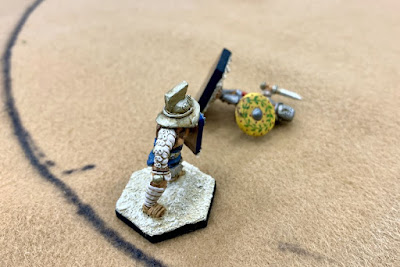
Samnite defeats Murmillo

Murmillo defeats Crupellarius

Hoplomachus and Murmillo versus Velite  

Hoplomachus and Murmillo versus another Murmillo

Murmillo victorious over Secutor

Murmillo vs Thracian, Dimachaerus vs Sagittarius

Sagittarius vs Thracian

Sagittarius victorious over Dimachaerus

Velite defeats Murmillo

The games were all 'fast and furious' with much of the play determined by the luck of the die rolls, but with still a bit of tactical decision making required with regards to which special skills a player was willing to lose to any major wounds, whether it was better to loose a defensive ability versus an offensive one. The best play of all the games was a young player fielding a Murmillo who played a Jack for an extra attack dice, and rolling three 6s to take out his opponent, 

No games went the full three turns, each of four phases, and game duration was generally 15-20 minutes. Conscript Dave and I have taken the game to several conventions already, but this was the first opportunity I have had to put all the gladiator figures I painted for the Analogue Hobbies Painting Challenge to use.  

Later in the afternoon I participated in a 'Wings of Glory' WW1 aerial combat game, flying a Sopwith Camel along with two other Allied players trying to taking down a Zeppelin Staaken R. VI bomber defended by a Fokker Dr 1.The defensive fire from the bomber was quite brutal and all the Allied planes were shot down before the bomber had suffered any significant damage. The only thing that kept us from being downed sooner was the frequent jams suffered by the German player.

Somewhere in France
 
The might Staaken bomber

 Thanks for reading. Stay tuned for Part 3 of my AAR.

Sunday, April 20, 2025

AHPC XV Submission #9 - Roman Gladiators for 'Arena of Blood'

My ninth submission was a selection of Roman Gladiators from Crusader Miniatures that I plan to use with Wiley Games 'Arena of Blood' rules. In the past I have played gladiatorial combat with a variety of rules, some which were very complex regarding planning your attack or defence, while other required special dice to play, or a hex grid area. 'Arena of Blood' is a fast game that requires no measurement, and still provides a wide scope for both tactics and strategy. DaveV and I have taken the game to two games conventions so far, and the people who join in the game found it easy to learn, and fun to play. I will be running the game at PrairieCon at the end of May.

After some initial play testing with other members of the Fawcett Avenue Conscripts, we found that we didn't have figures for all the different types of gladiators available in the rules. A quick order to Crusader Miniatures filled the gaps for most of the types we were missing.

The figures were cleaned up of any mould lines, etc. and glued to some hexagonal bases that I picked up at Historicon. The two mounted gladiators and one of the velites all required a small javelin that I made to a length of florist wire. I added a layer of fine sand with PVA glue, and then primed them with Vallejo Desert Tan using an airbrush. I mounted the shields onto some popsicle sticks using some blue tack to hold them while priming, and painted the back side. The gladiators were painted using a variety of Vallejo and Army Painter acrylics. I made a point of varying the skin tone on the figures to present the different ethnic groups that became part of the Roman Empire using Flat Flesh, Cork Brown, and Chocolate Brown. Once the main figures were completed, I mounted the shields and then painted them. When everything was done, I finished off with a wash of Army Painter Soft Tone. Here is the final result.

"Ave Imperator! Morituri te salutant."

Murmillones & Crupellarius - A Murmillo was a heavily armoured gladiator wearing a fish crest on his helmet. Murmillones were typically paired with a Thraex opponent, but occasionally with the similar hoplomachus. A Crupellarius was the most heavily armed gladiator, whose armor consisted of a lorica segmentata, manica on both arms, and high segmented greaves up to the thighs. The helmet was typical for ancient Roman gladiators, completely covering the head and face with only small openings for the eyes and mouth.

Murmillones (1,3,& 4) and Crupellarius (2)


 Secutores & Scissor - The Secutor ("Pursuer") developed to fight the retiarius. The helmet of the secutor covered the entire face with the exception of two small eye-holes in order to protect his face from the thin prongs of the trident of his opponent. The Scissor fought using a weapon consisting of a hardened steel tube that encased the gladiator's entire forearm, with the end capped off and a wicked semicircular blade attached to it.


Scissor (1) and Secutores (2 - 4)

 Thraeces & Hoplomachi - The Thraex's weapon was the Thracian curved sword. They were introduced as replacements for the Gaulish gladiator type after Gaul made peace with Rome. They commonly fought murmillones or hoplomachi. The Hoplomachus was Romanised Greek for "armed fighter". He was equipped with a gladius and a very small, round shield. He also carried a spear, which he would have to cast at his opponent before closing to hand-to-hand combat.

Hoplomachi (1 & 2) and Thraeces (3 & 4)


Eques - Early forms of the eques gladiator were lightly armed, with sword or spear. They had scale armour; a medium-sized round cavalry shield (parma equestris); and a brimmed helmet with two decorative feathers and no crest. Later forms also had greaves to protect their legs, a manica on their right arm and sleeveless, belted tunics. Generally, they fought only other equites.


Provocatores & Dimachaeri - Provocatores were the only gladiators protected by a breastplate (cardiophylax) which was usually rectangular, later often cresent-shaped. They fought with a tall rectangular shield and the gladius. They were paired only against other provocatores.  The Dimachaerus (Greek διμάχαιρος, "bearing two knives") was a type of gladiator that fought with two swords. They were referred to as fighting against a hoplomachus class gladiator.

Dimachaeri (1 & 2) and Provocatores (3 & 4)


 Velites & Sagittarius - The Veles (pl. velites - "skirmishers") is presumed to have fought on foot, armed with a spear, sword and small round shield (parma); this also assumes that the type was named for the early and lightly armed Republican army units of the same name. The Sagittarius was an archer whose main weapon was the bow.

Velites (1 - 3) and Sagittarius (4)


 Thanks for stopping by.