Showing posts with label boardgame. Show all posts

Wednesday, 17 January 2024

Boardgames Played in 2023

If you spotted my equivalent post last year you will already know I also play lots of boardgames alongside my miniature wargames but don't post much content at all on those here.  I thought I would again share some of the games from my collection that I have played typically with some of my miniature wargaming friends.


Do let me know in the comments if you would like to know more about any of these games.

Friday, 17 January 2014

First Look: Strike of the Eagle

I was lucky enough to get a copy of Strike of the Eagle from Academy Games for Christmas.  Strike of the Eagle is a block wargame covering the Polish Soviet War and is the first (and at present only) game in the Fog of War series from Academy Games.

I was interested in getting this particular game for a couple of reasons.  I am interested in the Polish Soviet War itself, the game has a different take on the usual block game mechanisms and it is capable of accommodating more than 2 players.

The board represents the part of Poland, Soviet Russia, the Ukraine and the disputed land between them.  It is divided into two fronts, effectively separated by the Pripet Marshes, which mean that in the full game the units on each front can be split between players allowing up to 4 people to play.  Movement is point to point and the board shows the various towns and cities of the area and the road and rail links between them.

Whilst this is a block game with the usual fog of war that brings it adds some interesting new dynamics through the use of cards and orders.  Each side has a deck of cards and can use these for one of four different things:
  1. Increasing the number of orders which can be issued (the default is two)
  2. Generating reinforcements
  3. Modifying combat
  4. A historical event 
This provides some serious choices and decisions as you normally only a hand of 6 cards at the beginning of each turn and their are five operations phases when they can be used within each turn.

The orders are represented by thick card counters which are placed either on individual locations and units.  You have to place one recon order each turn which allows you to see the enemy blocks where it is placed and whilst this can be used to bluff the enemy it does mean that you only get one further order each phase unless you play a card to increase it.  The other orders are movement to or from a location (infantry one space, cavalry two spaces), forced marches (as movement but a further space), withdraw (if attacked), defend, reorganise (regain a single strength point) or rail transport (move up to 4 blocks up to 8 spaces along rail lines).


Initiative is tracked separately on each front and this allows the player with initiative to determine the order in which orders are placed and, within the order sequence, who reveals and executes their orders first (which can be critical as blocks can be pinned in place by advancing blocks).

Each block represents between 1,500 and 8,000 men as represented by its individual strength point value (and as you would expect adjusted by rotating the block) which is then combined with various modifiers and the value from a card to determine how many strength points are lost by the other side making the combat diceless.

Supply lines are important too and can have a serious impact if units end up out of supply.  There are also leader blocks which have other effects.

The game comes with 9 scenarios (I have only played the first - the introductory scenario - shown above) which provides for plenty of replay-ability.

The game is beautifully produced, has a good amount of historical information included and provides some really challenging decisions - I am looking forward to getting it to the table again.

If you want to know a little more here's a video review of the game from Marco Arnaudo:

Wednesday, 23 October 2013

White Star Rising: Nations At War

I've been thinking of adding to my board war-game collection so when I spotted a discounted copy of White Star Rising from Lock 'n Load Publishing at Infinity Games I decided to pick it up.

White Star Rising is a platoon level game set in WW2 based on the World At War moderns system.  The game comes with a 33 page rules and scenario book, one each of 2 different quick reference sheets, 200ish counters, four mounted (11 x 17") geomorphic maps and 4d6.

Here's what's in the box:


Units are activated using a chit pull system with two end of turn chits - which ensures that all units activate at least every other turn.  The counters have all the information you are likely to need printed on them and the rules seem relatively straightforward (they're about half of the booklet with the remainder being 16 scenarios).

If you want to know a little more here's a video review of the game from Marco Arnaudo:


Having already tried a game from Lenin's copy of World At War: Blood and Bridges I'm really looking forward to getting this to the table.

Thursday, 26 September 2013

First Play: A Few Acres of Snow

A Few Acres of Snow is board/card game covering the French and Indian wars designed by Martin Wallace - a man whose name will be familiar to anyone who is interested in boardgames.

At its heart A Few Acres of Snow is a deck building game - which is a genre I haven't particularly been interested in - with the board being used to show links between locations and who controls them.

The game cleverly uses the deck to simulate the logistical problems of fighting in wilds of North America and Canada (as they became) at the end of a long supply chain which stretched back across the Atlantic.  If you want to settle or attack somewhere you need to plan it carefully in advance!

Lenin and I had a first game of A Few Acres of Snow in between miniatures games with Lenin playing the British and me the French.  It took a little while to really start to see which cards to select and how best to put them together to best advantage.


The game went back and forth with both of us settling new locations but Lenin concentrating more on developing his locations and me on raiding.  It wasn't clear who had actually won until the end of the game and I think both of us would like to play it again now we have an idea how best to put our plans together.

If you would like to know more about the game here's a video review by Marco Arnaudo:

Wednesday, 2 May 2012

Geek & Sundry: Small World

If you haven't spotted it already Wil Wheaton hosts a boardgame show on the new Geek & Sundry channel on YouTube.  Here is the first episode on the Days of Wonder game, Small World:

Sunday, 4 March 2012

First Look: 1812 - The Invasion of Canada

In my search for a light, family friendly entry board wargame, recently picked up a copy of 1812: The Invasion of Canada from Academy Games.  Perhaps somewhat unsurprisingly the game is based around the US invasion of Canada in 1812.

This is a relatively recent release and having read some early reviews it looked like a good candidate to introduce certain wargame-phobic members of the family to a game themed around a historic conflict (I have had mixed success in this area previously with Shogun (the Queen Games version), Friedrich and Wars of the Roses).

1812 is an area control game which can be played with between 2 and 5 players.  It is essentially a team game with the US regulars and US militia facing up against the British regulars, Canadian militia and Native Americans.  The units are represented by wooden cubes and each faction has their own deck of movement and special cards which drive the game.

The board is a map of the US/Canadian border, the former in blue and the latter red, with each broken into the various regions.  The objective of the game is to capture the key areas on the opponent's side of the board.
Turn order is randomly determined by drawing from a bag.  Movement is governed by the cards and combat through special dice for each faction.  The faces of the dice are printed with either a target (a hit), a running man (meaning the unit flees) or a blank (a command decision - allowing withdrawal to a friendly region).  The faction dice differ to reflect the nature of the forces, for example the British regular dice have no running men.

During a turn a player musters new troops, recovers troops which have fled from previous combats, plays a movement card and, if they wish up to two special cards, fights any ensuing combats and then refills their hand.  The movement cards show how many units can be moved and how far either by land or by water (across the lakes).  The special cards provide various advantages, based on history and differ from faction to faction.

As you can see the basic mechanisms are very straightforward.  The challenge is in the decisions which have to be made which are different for each side.  The British muster their regular units at Montreal on the East side of the board but have a number of key regions in the centre whilst the US have their muster locations more evenly distributed but have farther to go to reach the border.

The game comes with three scenarios, the short introductory one and full 1812 and 1813 campaigns.  I have only played the introductory scenario so far but I am really keen to try the full blown campaigns.

Thursday, 29 December 2011

U-Boat Leader

I was lucky enough to receive a few games this Christmas, amongst these was my first solo boardgame from Dan Verssen Games - U-Boat Leader.  Having long been fascinated by WW2 submarine warfare and Das Boot this was an excellent choice.

The game  includes four campaigns covering different stages of the Battle of the Atlantic:

  • The Battle Begins: covering operations at the start of World War II to about mid-1940.
  • The Happy Time: covering the period from mid-1940 to mid-1941 when the U-boats and wolfpacks dominated the seas.
  • Operation Drumbeat: covering operations off the American coast and in the Caribbean in early 1942.
  • The Hunted: covering the time period when the tide starts to turn against the U-boats in mid 1942.
Each of these can be played as a short, medium of long game depending on the number of patrols you wish to play.  It also includes the following U-Boats:

  • Type IIB/C coastal submarines
  • Type VII A/B/C Atlantic submarines
  • Type IX A/B/C long-range submarines
  • Type XXI Elektro-boat
Each of which can be selected from (or developed through) various experience levels (Green, Trained, Veteran and Ace).
The game is split between the campaign map, where you direct several U-Boats:
and the Tactical Display where the actual combat occurs:
Each campaign provides you with a pool of Special Option points which you can spend on your U-Boat flotilla and other special missions and actions.  Movement across the campaign map triggers events (which can include contacts) and when the U-Boat reaches its patrol area it can check for contacts.  If a contact is made then things transfer to the Tactical Display with the target vessels represented by generic counters until they are identified (which is managed through a card deck) - sometimes revealing some nasty surprises!

A U-Boat can try to form a Wolfpack by contacting other boats in the same patrol area but with the chance of alerting the target.  The combat consists of relative movement, detection and combat phases with the U-Boat finally having to exit the display - which can be tricky if you have been detected.

I have only played the game once so far but really enjoyed the experience.  I am sure this is not a game for everyone but I will be breaking this out plenty more times in the future.

Sunday, 14 August 2011

First Play: Wars of the Roses

I was lucky enough to be given a copy of the Z-Man Games Wars of the Roses: Lancaster vs York boardgame for my birthday and thought I would report back on my first game.

Wars of the Roses, designed by Peter Hawes, is a 2-4 player game lasting around 3 hours.  The first thing that struck me was the weight of the box.  Not only is it stuffed with components, they are all really nice quality.  There is a large board depicting England divided into six regions each with their own royal castle, large and small towns and port. There are four thick player screens with castle artwork to conceal the players' planning charts each with useful historical and game related information printed on the inside.  There are an assortment of wooden cylinders and cubes in each of the player colours and some black and white cubes (for bribing the nobles).  Then there are the thick tokens and cards representing troops, money, nobles and the like.  Finally there are the cards representing the locations, nobles etc.  The boards, screens, tokens and cards are pretty clearly laid out and very nicely illustrated.


At its core this is an area control game played out over five turns, each representing a number of years.  The objective of the game is to amass victory points through controlling the various regions.  Each turn is broken down into eight phases:
  1. Determine Turn Order
  2. Draw Cards
  3. Collect Income
  4. Planning
  5. Deployment
  6. Bribery
  7. Combat
  8. Parliament
Turn order is determined by reversing the players' positions on the victory point track, thus the player with the least points will go first.  Then a number of cards are drawn and placed face up next to the board,  These represent the castles, towns, ports, bishops, nobles, ship captains and mercenaries.  The players take it in turn to choose a card which will become theirs to control.  Income is determined by totalling up the income generated by the cards that the player controls.  Play then moves on to the planning phase which is the meat of the game.


Players need to determine whether to move their nobles and ships, raise troops, bribe their own nobles to stay loyal or opposing noble to swap sides and spend money to influence the King to make them the Captain of Calais.  Other than movement these actions all cost money!  Once all the players have finished planning then the screens are removed and the remaining phases are played out based on what they have planned to do.


Attacks on castles, towns and ports can only be made when a player has a presence in the relevant region, which is where the nobles become important.  Combat is based on a simple majority approach but does deplete your forces dramatically, which is where player order becomes important as locations can change hands more than once in a turn.  Parliament is dependent on the balance of control in each of the areas influencing which house is in the ascendancy.

I have only had a single two player game so far but really enjoyed it.  I suspect that the addition of further players will only make the game more interesting and I am looking forward to getting this back to the table as soon as I can.

Sunday, 10 May 2009

New Boardgames

After playing yet another enjoyable game of Commands & Colo(u)rs: Ancients with Lenin during our last wargame weekend, I decided it was time to upgrade the weakest part of the game - the board. Unfortunately, GMT Games decided to include their usual thin card board with the original game and it does let it down a bit - not least by not laying flat.

Fortunately both Expansions 2 and 3 both contain the thicker board and so you do have some options in this regard. I did consider getting Expansion 3, which at £15 is the cheaper of the two, on its own but as the scenarios in it need the blocks from Expansion 2 it seemed a bit of a false economy; however, Expansion 3 does contain the epic rules and four epic scenarios which needs two board put together. Another dilemma.

In the end I decided to throw caution to the winds and bought both. Possibly a little extravagant but it does give me the better board I wanted and the option to play epic games, with up to 8 players, as well as all the new scenarios which can be found in both sets.

Expansion 2, Rome vs the Barbarians, has the new thicker board, around 330 new blocks, some additional terrain tiles, a couple of quick reference sheets and a rule book with 23 new scenarios including several with Spartacus and also a couple in Britain.

I have to say I don't relish having to apply the stickers to the blocks, one to each side, and decided to start on the smalle number of blocks in Expansion 3 first.

As with all the Expansions you need a copy of the original game to play as you don't get the dice, cards or sufficient terrain tiles in these ones in order to play the scenarios.

Expansion 3, Roman Civil Wars, has somewhat less in it than number 2 which probably shouldn't be a surprise as it is half the price. It still comes in the same sized and very good quality box though.

This one has the new thicker board, an additional 120 or so blocks, 19 scenarios for the traditional game, the epic rules and four epic scenarios along with another two quick reference sheets.

The epic rules allow you to place two board together (they have one side as the traditional board and one designed to marry up with another board to make a new wider, 26 x 9 hex layout needed). This allows you to play with up to 8 players, three field commanderS (left, centre and right) and an army commander per side. The rules are the same as the original game with the exception that the army commander can select three cards and distribute them to the field commanders to use. In addition, some of the cards are designated as army cards and so can only be played by the army commander. You don't need 8 players and could play with just two if you wanted though.

I'm really looking forward to getting an epic game arranged but, in the meantime, the new board and scenarios will make a big difference.
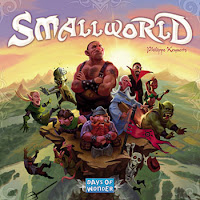
Whilst I was ordering the C&C expansions I decided to pick up a copy of the new Days of Wonder game, Small World. This is their version of the game Vinci but with slightly simpler rules and a fantasy theme.

Scott Nicholson has done one of his excellent reviews on Board Games with Scott and it was this which persuaded me that Small World would be worth getting. The game is essentially a land grab but with some difficult decisions to be made as to which race to take (each has their own strengths) and with special powers which change each game. You also need to decide when to put a race into decline and move onto a new one. Scott has a very through run through of the game play if you would like more detail.

We've only had one game so far but it was a lot of fun.

Sunday, 17 August 2008

First Look: Thebes

We managed to get Thebes to the table a couple of days ago for the first time. As with Shogun, the other Queen Games product I have, the production quality is excellent. The theme is turn of the 20th Century archaeology with the players travelling around Europe, the Mediterranean and the mid-East researching ancient civilisations, conducting excavations and then exhibiting their finds.

There are a couple of novel mechanics which fit in very well. The "currency" of the game is time with each action taking a varying amount and the players' counters being moved along the time track appropriately (the game is played over 3 years with time measured in weeks). The key being that the player who has used the least time acting first. This mechanism works really well with valuable research actions taking a long time. The second mechanic relates to excavations with each civilisation having a different selection of artefacts tokens and blank tokens placed in separate bags. When you carry out an excavation you count up the amount of knowledge you have about the relevant civilisation and then decide how many weeks to dig for. By consulting a nicely produced little wheel you determine how many tokens you may draw (unseen) from the bag. The blank ones are then returned making subsequent visits progressively less likely to find anything.

With nice production, a well integrated theme and not too much complexity, Thebes turns out to have been a good choice - it got the thumbs up from my wife which is always a good sign.