I know it has been an age since my last post and I have quite a backlog of items to post but when they say "old habits die hard" I'm not sure what they mean... I've found getting back into the old habit of actually blogging regularly has been pretty hard! I suspect part of it is the desktop being a bit less easily accessible and my experimentation with blogging from an iPad less than successful. But I now have a new option and so I'm going to see if that can get me back into posting regularly (no promises though!)
In any case, back to the original purpose of this post. Last weekend I met up with some old friends and we sat down to a decent sized pike and shot game using the Tercios rules. The game was Nieuport 1600 with the Anglo Dutch facing off against the Spanish with both sides having a liberal sprinkling of mercenaries.
I managed to bag the English and Frisian troops under Sir Richard Vere on our left flank. I was a little cautious given I didn't know the rules but got the hang of them pretty quickly. My left flank was anchored by the sea and my wing was pike & shot with a battery of artillery with my right flank supporting the Dutch centre.
Opposite me was a mixed group of cavalry and infantry. We were deployed with an estuary at our backs and so retreat was simply not an option - something the Spanish decided to use against us with an aggressive advance.
My artillery followed by my musketeers, as the range closed, managed to cause some serious damage to their advancing cavalry. But their second rank of cavalry overran my guns but we repulsed by my second line. Then followed their infantry but with some spectacularly poor luck with the dice I had soon put paid to them and their entire flank collapsed!
Unfortunately our centre was hard pressed and the main cavalry battle on the right wing was as usual a exercise of them chasing each other around the table.
I turned my troops and began to threaten the Spanish centre's now exposed flank. Their Tercios were pretty hard but had taken some hits from our centre before it crumbled and so with a concerted assault and a heroic charge by Sir Richard combined with our cavalry coming back after seeing their's off, we managed to take the day.
All in all it was a fun game and great to catch up with the old crowd. Just a shame that I don't really have any thirty years war figures - although I'm sure the rules could be used for other similar things. Of course it has got me interested in planning our a game with my Tudor Irish...
A place to share my thoughts on miniature wargaming, reviews of rules and miniatures, and comments on board and card games, RPGs (and anything else that takes my fancy!)
Showing posts with label renaissance. Show all posts
Tuesday, 9 August 2016
Friday, 18 October 2013
First Look: By Savvy and Steel
By Savvy and Steel is the latest release from Two Hour Wargames and is obviously intended to capture the spirit of the Three Musketeers.
The rules are 90 pages can be purchased as either a pdf or in hard copy. As you might expect By Savvy and Steel is built around the Two Hour Wargames' reaction system but with a few extra elements in keeping with the genre and combined with a campaign system based around the fictional country of Edenstein.
Character generation is somewhat more detailed than many of the other THW rules - largely as these are based on having a much smaller number of characters. In addition to the usual Reputation, players have to determine their character's Birthright, Social Standing, Age, Nationality, Class and Attributes.
Once you have your main character you can then try to recruit some Grunts to help you on your adventures - this can actually form part of your adventure.
The core rules will be very familiar if you've used the reaction system before; however, you can supplement the standard melee mechanism with a special more detailed duelling system if both participants are of sufficient social standing.
The rules are about half the book and are then followed by a campaign and scenario system which takes up the remainder and provides plenty of variety of genre appropriate situations and encounters. It includes everything you need to generate non-player characters and PEF (possible enemy forces) rules which will allow players to play against the system or for the game to be played solo.
Given that I have suitable figures for the Musketeers, Cardinal's Guard etc. I could hardly not try these rules out and I'm looking forward to getting them to the table.
The rules are 90 pages can be purchased as either a pdf or in hard copy. As you might expect By Savvy and Steel is built around the Two Hour Wargames' reaction system but with a few extra elements in keeping with the genre and combined with a campaign system based around the fictional country of Edenstein.
Character generation is somewhat more detailed than many of the other THW rules - largely as these are based on having a much smaller number of characters. In addition to the usual Reputation, players have to determine their character's Birthright, Social Standing, Age, Nationality, Class and Attributes.
Once you have your main character you can then try to recruit some Grunts to help you on your adventures - this can actually form part of your adventure.
The core rules will be very familiar if you've used the reaction system before; however, you can supplement the standard melee mechanism with a special more detailed duelling system if both participants are of sufficient social standing.
The rules are about half the book and are then followed by a campaign and scenario system which takes up the remainder and provides plenty of variety of genre appropriate situations and encounters. It includes everything you need to generate non-player characters and PEF (possible enemy forces) rules which will allow players to play against the system or for the game to be played solo.
Given that I have suitable figures for the Musketeers, Cardinal's Guard etc. I could hardly not try these rules out and I'm looking forward to getting them to the table.
Wednesday, 22 August 2012
Wargaming Weekend: Battle at the Ford
So last weekend was another opportunity for Lenin to visit and for us to break out a few games. First up was a playtest of the new Pike & Shotte rules
using my Tudor Ireland figures.
As with our previous game Lenin took command of the English and I took the Irish. The English force consisted of three battalia, two of foot and one of horse. Each foot battalia consisted of two units of pike, two of muskets and one each of swordsmen and billmen. The horse contained two units of Border Horse. The Irish also had three battalia, again two foot and one horse. The foot were a mixture of Gallowglass, New Scots muskets, Bonnachts, Kern (including a unit of arquebus) and a bow armed unit of the Rising Out. The horse were a mix of Irish and Scots.
The English was a relief force whose mission was to advance down the valley, across the ford and off the table. Whilst the Irish simply had to stop them.
The English began their advance and their horse quickly spotted the units of Kern and Rising Out holding my right flank. They obviously decided that these were going to be easy meat. Our bow fire was desultory and the English horse charged home smashing my flank with only the Rising Out managing to avoid the onslaught.
Meanwhile the English foot had continued to march forward. I advanced my Irish horse to their front and sent the Scots in skirmish order around their flank. With the impact of their own horse on my foot in mind the English musketeers rushed to the protection of their pike. With the main body of the English in hedgehog their advance had been nicely slowed I waited for their next move.
It wasn't long in coming. Rather than move across the front of my foot to engage my horse, the English decided to move to attack my foot defending the river bank. Unfortunately for them, the river was deeper where they chose to cross and their advance was considerably slowed. This gave my New Scots enough time to loose a volley of musket fire into them and one of the English units was destroyed. The other successfully crossed the stream and charged into my foot, who collapsed and routed off the table - followed by the English horse!
With the English cavalry threat neutralised I could concentrate on their foot. My Scots horse advanced through the wood to the left of the English and emerged behind them - maintaining their need to stay in their hedgehogs. However, the English were having none of it and their swordsmen and billmen were continuing to advance.
The English mad a beeline for the ford and charged my Gallowglass. At first this looked like it would work well for the English with the Gallowglass falling back; however, the Irish rallied and the flanking Gallowglass units made a ferocious charge into the English swords and routed them. They made similarly short work of the English bills.
My other New Scots fired a volley into the leading English pike formation and then the Bonnachts and Gallowglass charged in - at which point the English army's morale broke and the day was ours.
Overall, we were quite pleased with the rules. Having played Black Powder previously certainly helped. Although Pike & Shotte do differ is certain areas, it was clear they are derived from Black Powder. Lenin had more recently read Hail Caesar and commented how different these rules were from those in a number of respects. I'm certainly going to give these another go once my Montrose figures are all based.
As with our previous game Lenin took command of the English and I took the Irish. The English force consisted of three battalia, two of foot and one of horse. Each foot battalia consisted of two units of pike, two of muskets and one each of swordsmen and billmen. The horse contained two units of Border Horse. The Irish also had three battalia, again two foot and one horse. The foot were a mixture of Gallowglass, New Scots muskets, Bonnachts, Kern (including a unit of arquebus) and a bow armed unit of the Rising Out. The horse were a mix of Irish and Scots.
The English was a relief force whose mission was to advance down the valley, across the ford and off the table. Whilst the Irish simply had to stop them.
The English began their advance and their horse quickly spotted the units of Kern and Rising Out holding my right flank. They obviously decided that these were going to be easy meat. Our bow fire was desultory and the English horse charged home smashing my flank with only the Rising Out managing to avoid the onslaught.
Meanwhile the English foot had continued to march forward. I advanced my Irish horse to their front and sent the Scots in skirmish order around their flank. With the impact of their own horse on my foot in mind the English musketeers rushed to the protection of their pike. With the main body of the English in hedgehog their advance had been nicely slowed I waited for their next move.
It wasn't long in coming. Rather than move across the front of my foot to engage my horse, the English decided to move to attack my foot defending the river bank. Unfortunately for them, the river was deeper where they chose to cross and their advance was considerably slowed. This gave my New Scots enough time to loose a volley of musket fire into them and one of the English units was destroyed. The other successfully crossed the stream and charged into my foot, who collapsed and routed off the table - followed by the English horse!
With the English cavalry threat neutralised I could concentrate on their foot. My Scots horse advanced through the wood to the left of the English and emerged behind them - maintaining their need to stay in their hedgehogs. However, the English were having none of it and their swordsmen and billmen were continuing to advance.
The English mad a beeline for the ford and charged my Gallowglass. At first this looked like it would work well for the English with the Gallowglass falling back; however, the Irish rallied and the flanking Gallowglass units made a ferocious charge into the English swords and routed them. They made similarly short work of the English bills.
My other New Scots fired a volley into the leading English pike formation and then the Bonnachts and Gallowglass charged in - at which point the English army's morale broke and the day was ours.
Overall, we were quite pleased with the rules. Having played Black Powder previously certainly helped. Although Pike & Shotte do differ is certain areas, it was clear they are derived from Black Powder. Lenin had more recently read Hail Caesar and commented how different these rules were from those in a number of respects. I'm certainly going to give these another go once my Montrose figures are all based.
Saturday, 12 March 2011
Wargames Weekend: Breakthrough - Connaught 1599
Time for yet another wargames weekend with Lenin. We have a couple of new rule sets to test out this time so we started off with Tudor Ireland using the To the Banners rules by Stephen Danes. It was also a chance to get my Vendel and Graven Images figures to the table again along with the Warbases movement trays which I picked up to do just this sort of larger game.
The scenario was taken from the rules and involved the English troops advancing up a valley through some woods in an attempt to break through to relieve another English force. The Irish had laid an ambush having blocked the road at the most difficult point for the English to pass.
Things started fairly slowly with the English pike advancing in column up the road flanked on both sides with units of shot. The Irish faced them with four units of Kern with their Gallowglas held in reserve further up the valley.

The English advanced slowly toward the Irish barricade and opened fire on the Irish troops. Eventually the English pike summoned up the courage to charge the Irish who stood their ground. It was not an even match and the pike pushed the kern back again and again until having taken as much punishment as they could they turned and fled. The English pike pushed on into the next unit of Kern with similar results whilst the Gallowglas looked on unable to respond.

With the English pike advancing but their shot stalled at the edge of the wood the pike now came into contact with the lead Gallowglas unit which was a more even match. The charged and the Gallowglas, probably seeking revenge for the Kern, counter charged. A bitter struggle ensued with the units evenly matched. Then suddenly the tables turned and the Gallowglas managed to get the upper hand pushing the pike back until eventually they routed.
With the English pike streaming back through their ranks the English troops were disordered and back to fall back. With the English attack faltering the Irish took to their heels to set up another ambush further along the path of their advance.
After the game we spent a little while reviewing the rules. We liked the innovative approach to the initiative mechanic which provided some real command and control issues for both sides. Although the rules had some significant omissions which did call into question how thoroughly they had been playtested and could have been laid out in a more accessible manner. We plan to give them another go with a more conventional set of forces to see how they perform.
The scenario was taken from the rules and involved the English troops advancing up a valley through some woods in an attempt to break through to relieve another English force. The Irish had laid an ambush having blocked the road at the most difficult point for the English to pass.
Things started fairly slowly with the English pike advancing in column up the road flanked on both sides with units of shot. The Irish faced them with four units of Kern with their Gallowglas held in reserve further up the valley.
The English advanced slowly toward the Irish barricade and opened fire on the Irish troops. Eventually the English pike summoned up the courage to charge the Irish who stood their ground. It was not an even match and the pike pushed the kern back again and again until having taken as much punishment as they could they turned and fled. The English pike pushed on into the next unit of Kern with similar results whilst the Gallowglas looked on unable to respond.
With the English pike advancing but their shot stalled at the edge of the wood the pike now came into contact with the lead Gallowglas unit which was a more even match. The charged and the Gallowglas, probably seeking revenge for the Kern, counter charged. A bitter struggle ensued with the units evenly matched. Then suddenly the tables turned and the Gallowglas managed to get the upper hand pushing the pike back until eventually they routed.
With the English pike streaming back through their ranks the English troops were disordered and back to fall back. With the English attack faltering the Irish took to their heels to set up another ambush further along the path of their advance.
After the game we spent a little while reviewing the rules. We liked the innovative approach to the initiative mechanic which provided some real command and control issues for both sides. Although the rules had some significant omissions which did call into question how thoroughly they had been playtested and could have been laid out in a more accessible manner. We plan to give them another go with a more conventional set of forces to see how they perform.
Tuesday, 26 January 2010
Wargames Weekend: Beyond the Pale
Last weekend was another of our quarterly gaming weekends. We decided for a little bit of an experimental first day with a new period and some modified rules and then a playtest game of some others.
First up was a chance to get my Vendel Tudor figures to the table. I bought these some considerable while ago (as I recall I collected them a Salute when it was at Olympia!) but haven't settled on a rules system. The figures grew from my original Border Reivers project and when Vendel added the Irish figures I was persuaded to start a new project. I bulked out the pike with some figures from Graven Images which, whilst bulkier, do mix reasonably well.
Having done plenty of reading about the period I thought my best bet was to model the harassing the column type engagement with formed English troops advancing through Ireland being attacked on the way by the locals rather than the later more formal battles of Tyrone's rebellion. This presented a bit of a problem when looking for suitable rules . Two Hour Wargames' Colonial Adventures rules may seem an odd choice but when I went back to basics the regular formed troops versus irregular troops seemed to me to be a common theme. So I created some new reaction tables and added additional tests for forming units and reloading muskets and a new set was born.
Our playtest scenario was a simple one with an small English column advancing up the table to a small ford. I used the Colonial Adventures patrol scenario which provided enough mechanics to deal with the potential enemy forces (PEFs). The English were given two units of calivers and one unit each of pike, billmen and border horse. The horse came on first and got a little ahead of the main infantry column when they spotted some Irish. These were resolved as a unit of Gallowglass and some Kern. The former decided to charge from their hiding place and the English horse managed to counter charge. It was a bloody encounter and the smaller unit of horse came off worst with the Kern simply looking on the whole time.
This little fight gave the column the chance to advance and form up.
They sent the billmen off to scout through the woods and they managed to spot some Irish horse and some archers. With no real ranged weapons the billmen took a couple of showers of arrows and decided discretion was the better part of valour and retreated to the column with the archers following up cautiously. Meanwhile having taken some caliver fire the Gallowglass and the Irish horse decided to attack the English head on (probably not the wisest move but we needed to test the rules!). The English shot bore the brunt of the assault and whilst one wing took some serious casualties the other managed to hold their own.
Having suffered quite a few losses the Irish decided to melt away and leave the slightly battered English column to carry on their advance. Of course who knows what might await them further up the road!?
First up was a chance to get my Vendel Tudor figures to the table. I bought these some considerable while ago (as I recall I collected them a Salute when it was at Olympia!) but haven't settled on a rules system. The figures grew from my original Border Reivers project and when Vendel added the Irish figures I was persuaded to start a new project. I bulked out the pike with some figures from Graven Images which, whilst bulkier, do mix reasonably well.
Having done plenty of reading about the period I thought my best bet was to model the harassing the column type engagement with formed English troops advancing through Ireland being attacked on the way by the locals rather than the later more formal battles of Tyrone's rebellion. This presented a bit of a problem when looking for suitable rules . Two Hour Wargames' Colonial Adventures rules may seem an odd choice but when I went back to basics the regular formed troops versus irregular troops seemed to me to be a common theme. So I created some new reaction tables and added additional tests for forming units and reloading muskets and a new set was born.
Our playtest scenario was a simple one with an small English column advancing up the table to a small ford. I used the Colonial Adventures patrol scenario which provided enough mechanics to deal with the potential enemy forces (PEFs). The English were given two units of calivers and one unit each of pike, billmen and border horse. The horse came on first and got a little ahead of the main infantry column when they spotted some Irish. These were resolved as a unit of Gallowglass and some Kern. The former decided to charge from their hiding place and the English horse managed to counter charge. It was a bloody encounter and the smaller unit of horse came off worst with the Kern simply looking on the whole time.
This little fight gave the column the chance to advance and form up.
Having suffered quite a few losses the Irish decided to melt away and leave the slightly battered English column to carry on their advance. Of course who knows what might await them further up the road!?
Sunday, 17 January 2010
Tudor English
Here are a couple of photos of the English foot who will be going beyond the Pale at the weekend:

The figures are Vendel with a few Graven Images pikemen thrown in.
Saturday, 22 August 2009
JWS Reunion
As you may have notice from my Twitter feed, last weekend was a get together for the old guard of the Jersey Wargames Society. We haven't got together as a group for quite a while and so we decided to put on a few games.
First up Lenin provided the Battle of Um Bbongo Gorge as an outing for his extensive Darkest Africa figure collection. Playing to type I took the part of Commandant Hercule Poirot (a famous Belgian) the representative of His Majesty Leopold II, King of the Belgians. As the only representative of law and order in the chaos that is Africa, my mission was to stop an invasion by that upstart self-appointed so-called king Ndofa, tackle any slavers and collect taxes and export duties.
Things did not start well when I was ambushed by some uppity locals and one section took rather a beating. Having regrouped I spotted some suspicious arabs who could only be up to no good and advanced to investigate. A closer look and the application of my "little grey cells" told me they were slavers and quite hostile. After giving them a pretty good thrashing I turned back toward the local village which was under attack from that rotter Ndofa. After clearing up the misunderstanding with the locals we joined forces to stop Ndofa from stealing the the village cattle and drove him off, albeit the village was a little scorched afterwards. With little persuasion the villagers paid their tax dues in cattle and I was free to discuss the export of ivory and other goods with some big game hunters (must have been after some very big game as they had a small artillery piece!). I made a rapid assessment and secured the appropriate duty and then escorted them to our steamer.
The afternoon game was the Battle of Flodden Field in 1513. With most of the players knowing relatively little about the actual battle it unfolded in a relatively historic way with the English discovering the marsh in front of the Scots position the hard way. With some nicely conflicting victory conditions the Scots forces (some of which I was commanding) played a pretty defensive game but eventually the English got their forces through the marsh and our lack of effective ranged weapons led to the natural conclusion.
On the Sunday we were treated to a series of small games all of which had been cleverly designed to fit onto a chess board. The first I played was a tavern fight between the Three Musketeers and Rochefort with some Cardinal's Guards.
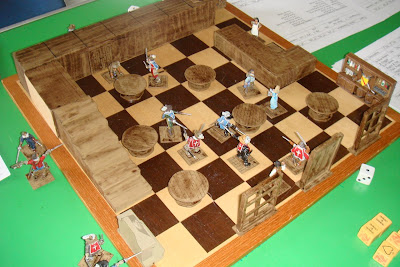
The rules provided for all the usual chandalier swinging, bar sliding and table crushing action and use poker dice for combat resolution. As Rochefort I managed to capture two of the Musketeers and D'Artagnan but one slipped through my fingers...
The next compact game was the Fight in Balin's Tomb between the Fellowship of the Ring and a horde of goblins with a Cave Troll! This game is still in the development stage but provided some fun action, especially with the Troll.
Next on the agenda was my game, Chaos in Caracabra de la Cruz, a 28mm skirmish in the Spanish Civil War. With five factions, three Nationalists and two Republican, with some interesting victory conditions the game promised some interesting encounters.
Clearly some of the players actually read their victory conditions because the Carlist contingent followed their's precisely and captured and held a significant part of the village. The Anarchist and Communist militias almost opened fire on each other but the timely intervention of the local priest, in defence of his church, avoided that blue on blue encounter. The Falange reached the church but couldn't get in a withdrew, just in time to block and advance by the Communists who had already had a little encounter with the Guardia Civil.
The Anarchists decided that dynamite was the obvious solution to a locked church door; however the effect led to an appropriate quote from the Italian Job! A similar attempt by the Communists to use dynamite went a little awry when it turned out the dynamitero was quite a familar with it as he'd made out and dropped it amongst his own side.
Meanwhile the Anarchists, playing to type, blew up the church and withdrew (almost in that order!). In the end though it was the Carlists who held on to their conquests, despite a serious challenge from the retreating Anarchists.
First up Lenin provided the Battle of Um Bbongo Gorge as an outing for his extensive Darkest Africa figure collection. Playing to type I took the part of Commandant Hercule Poirot (a famous Belgian) the representative of His Majesty Leopold II, King of the Belgians. As the only representative of law and order in the chaos that is Africa, my mission was to stop an invasion by that upstart self-appointed so-called king Ndofa, tackle any slavers and collect taxes and export duties.
The afternoon game was the Battle of Flodden Field in 1513. With most of the players knowing relatively little about the actual battle it unfolded in a relatively historic way with the English discovering the marsh in front of the Scots position the hard way. With some nicely conflicting victory conditions the Scots forces (some of which I was commanding) played a pretty defensive game but eventually the English got their forces through the marsh and our lack of effective ranged weapons led to the natural conclusion.
Next on the agenda was my game, Chaos in Caracabra de la Cruz, a 28mm skirmish in the Spanish Civil War. With five factions, three Nationalists and two Republican, with some interesting victory conditions the game promised some interesting encounters.
The Anarchists decided that dynamite was the obvious solution to a locked church door; however the effect led to an appropriate quote from the Italian Job! A similar attempt by the Communists to use dynamite went a little awry when it turned out the dynamitero was quite a familar with it as he'd made out and dropped it amongst his own side.
Meanwhile the Anarchists, playing to type, blew up the church and withdrew (almost in that order!). In the end though it was the Carlists who held on to their conquests, despite a serious challenge from the retreating Anarchists.
Saturday, 3 November 2007
Have I found Solomon Kane?
In my search for a suitable Solomon Kane figure, Lenin pointed me to Black Cat Bases who have this "Vampire Hunter" in their "Civilians, Townsfolk and Mercenaries for hire" range:
He certainly looks the part to me!
Monday, 29 October 2007
The Savage World of Solomon Kane
I really enjoyed Robert E. Howard's The Savage Tales of Solomon Kane and this book allows you to bring it to both the RPG and tabletop world with the Savage Worlds rules.
Of course now I need a figure for Kane himself...
Sunday, 7 October 2007
Wargames Weekend Update
Managed to get quite a few games in when Lenin visited last weekend including Troops, Weapons and Tactics, Metal Storm, Renaissance Raiders, Savage Worlds and Commands and Colors: Ancients Expansion #1.
Troops, Weapons and Tactics is heavily based on the Too Fat Lardies previous rules I Ain't Been Shot, Mum! (IABSM) and that is very apparent. As the rules are lower level, with the tactical unit being a fire team rather than the IABSM section, a few additional mechanics have been added. This was only the first try out but our initial impression was that, whilst they did provide an interesting game, the additional chrome didn't produce a result which was a pleasing as Nuts! in terms of the "feel". Obviously this is highly subjective but I think the additional mechanics confuse and complicate the basic IABSM approach but don't deliver proportional added value - which is a shame as I am a big fan of IABSM and use them as my preferred rules for the next level up.
Metal Storm was another first outing. The rules appear to be heavily based on Peter Pig's AK47 Republic rules with the addition of different dice sizes and rules for more modern weaponry. As with all rules which use up and downgrading using different dice sizes (d4, d6, d8, d10 etc.) the statistics are a little iffy but the overall result was a fun game (though we're reserving judgement on the realism element) and I expect these will see another outing (though possibly with some tweaks).
For oue first go at Renaissance Raiders from the Antwerp Fusiliers, we pulled out my 28mm Vendel Border Reivers, Grand Manner Bastle House and Gripping Beast livestock for a little sheep and cattle rustling on the borders. The rules are heavily influenced by the Commands and Colors system and are intended to be hex based. Since I don't have any hex terrain I chose to restructure them slightly to allow them to be used on a normal tabletop. Again they gave a fun game but in my view the card and average dice initiative mechanic was a little too involved for the type of game we were trying and the cards needed to pop up more often (and be a little more varied) to add flavour. The core approach is sound but a few changes are what's needed for it to become ideal for a Reivers game rather than a more traditional Renaissance battle.
Savage Worlds once again proved it is a versatile ruleset allowing you to meld various genres successfully. Lenin presented an excellent Pulp meets Call of Cthulhu game which was tremendous fun.
And having spent ages putting the stickers on my Greek and Eastern Kingdom expansion for Commands and Colors: Ancients (CC:A), I was determined to actually use it - so we set up and played the Gaugamela scenario. CC:A is still a favourite and the card system provides some real challenges for each commander.
Troops, Weapons and Tactics is heavily based on the Too Fat Lardies previous rules I Ain't Been Shot, Mum! (IABSM) and that is very apparent. As the rules are lower level, with the tactical unit being a fire team rather than the IABSM section, a few additional mechanics have been added. This was only the first try out but our initial impression was that, whilst they did provide an interesting game, the additional chrome didn't produce a result which was a pleasing as Nuts! in terms of the "feel". Obviously this is highly subjective but I think the additional mechanics confuse and complicate the basic IABSM approach but don't deliver proportional added value - which is a shame as I am a big fan of IABSM and use them as my preferred rules for the next level up.
Metal Storm was another first outing. The rules appear to be heavily based on Peter Pig's AK47 Republic rules with the addition of different dice sizes and rules for more modern weaponry. As with all rules which use up and downgrading using different dice sizes (d4, d6, d8, d10 etc.) the statistics are a little iffy but the overall result was a fun game (though we're reserving judgement on the realism element) and I expect these will see another outing (though possibly with some tweaks).
For oue first go at Renaissance Raiders from the Antwerp Fusiliers, we pulled out my 28mm Vendel Border Reivers, Grand Manner Bastle House and Gripping Beast livestock for a little sheep and cattle rustling on the borders. The rules are heavily influenced by the Commands and Colors system and are intended to be hex based. Since I don't have any hex terrain I chose to restructure them slightly to allow them to be used on a normal tabletop. Again they gave a fun game but in my view the card and average dice initiative mechanic was a little too involved for the type of game we were trying and the cards needed to pop up more often (and be a little more varied) to add flavour. The core approach is sound but a few changes are what's needed for it to become ideal for a Reivers game rather than a more traditional Renaissance battle.
Savage Worlds once again proved it is a versatile ruleset allowing you to meld various genres successfully. Lenin presented an excellent Pulp meets Call of Cthulhu game which was tremendous fun.
And having spent ages putting the stickers on my Greek and Eastern Kingdom expansion for Commands and Colors: Ancients (CC:A), I was determined to actually use it - so we set up and played the Gaugamela scenario. CC:A is still a favourite and the card system provides some real challenges for each commander.
Saturday, 28 April 2007
First Look: Gloire
I picked up a softcover copy of the rules at Salute for £10 but they are available as a .pdf download from either Rattrap or RPGnow for US$11 along with a few free scenarios, game aids and pre-generated characters. There is also a yahoo discussion group to support the rules.
Saturday, 16 December 2006
First Look: Shogun
As with Wallenstein, the game is card driven with combat resolution using a nice dice tower based mechanic. The game has been designed with language independent components and is provided with rules booklets in English, French, German, Spanish and Japanese.
The game is for 3 to 5 players and is available from Games Lore amongst other outlets for £29.99 or less.
Subscribe to:
Posts (Atom)