Showing posts with label fire and fury. Show all posts

Monday, 3 April 2023

Viniard Field at Chickamauga, 19 September 1863

I met up with some old friends on Saturday for a 15mm ACW game using Brigade Fire & Fury (the original) in an actual shed!  Here's the background from the player briefing:

The Union’s Tullahoma Campaign began on 24 June 1863 with William Rosecrans moving south-east from Murfreesboro, his Army of the Cumberland constantly outmanoeuvring Braxton Bragg’s Army of Tennessee.  Within ten days, Bragg had been forced to withdraw through central Tennessee to Chattanooga close to the border with Georgia. The campaign ended on 3 July, in a week that saw the Union victory at Gettysburg and the Confederate surrender of Vicksburg.  

In mid-August, after resting and re-supplying his army, Rosecrans moved on Chattanooga.  Capturing the city would provide a vital rail hub, opening the way to Atlanta. Beginning on 21 August, and over the next two weeks, Union artillery sporadically bombarded the north-east of the city.  This kept Bragg's attention whilst the bulk of Rosecrans's army crossed the Tennessee River south-west of Chattanooga. When Bragg learned of this on 8 September, he abandoned Chattanooga and withdrew the Army of Tennessee into Georgia.   

Rosecrans pursued Bragg, but his Corps became scattered traversing the difficult rocky, wooded terrain.  Bragg, having now received reinforcements, planned to attack and overwhelm these isolated elements of the Union army. His plans were poorly executed, but alerted Rosecrans to the threat and he began to concentrate his corps.  Bragg resolved not to lose the initiative, forming up the Army of Tennessee near to the Chickamauga Creek by 18 September. He wants to strike the Union left before Rosecrans can fully concentrate his army, additionally cutting them off from Chattanooga.  Rosecrans foresees this, ordering forced marches to reinforce his left.  

Shortly after dawn on 19 September, Bragg launches the first in a series of assaults against the Union lines, opening up the Battle of Chickamauga. Some of the fiercest fighting in the entire battle taking place in and around Viniard Field. 

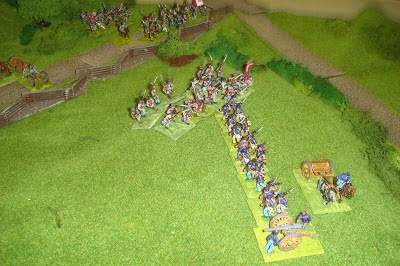
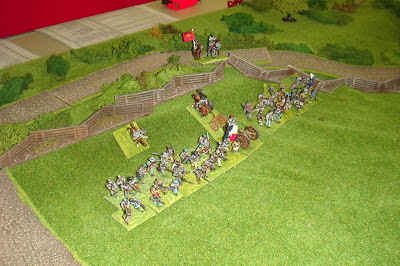
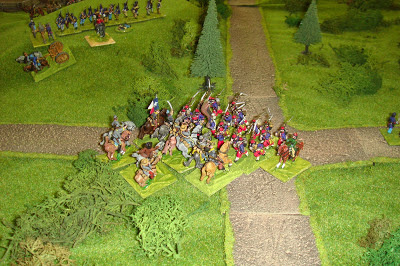
I took command of Heg's brigade who had stumbled across Gregg’s Confederate Brigade in an advance position in the woods. This meant I was in the thick of the action right from the beginning and was hard pressed as more and more Confederate units arrived in front and to the flank of my position.

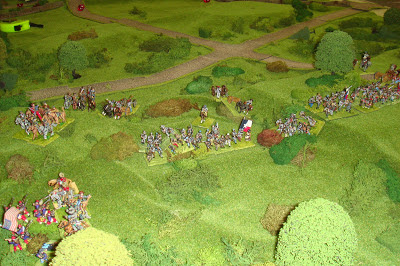
Here are some photos from the game:


Despite my holding action in the woods I was forced to withdraw as I was overwhelmed and fell back towards our defences.  Unfortunately a traffic jam on the Lafayette road found our reinforcements stalled and as a result the game was a Confederate victory in the end.

Wednesday, 22 January 2014

First Look: Regimental Fire & Fury Scenarios Vol. 1 1861-1862

Having enjoyed paying the Brigade level Fire and Fury rules I picked up a copy of the Regimental level version.  With this now tried on the tabletop I thought it would be worth "investing" in a copy of the scenario booklet for the Regimental rules.  I have both of the equivalents for the Brigade level rules and thought they were well put together and have played a few games from them.

The book is sub-titled "Volume 1: 1861-1862" which both indicates more to come (?) and the period it covers.  It is paperback in colour, in letter format and runs to around 80 pages.  It starts off with a brief foreword and introduction followed by some new "optional rules" covering Skirmishers, changes to Extended Line Frontages, Twilight & Night Turns, Change Front manoeuvres, Plunging Fire through Wooded High Ground and Massed Artillery Fire.

The book covers 11 engagements (some with multiple associated scenarios) from various battles or smaller encounters.  Although when I say small it must be said that none of these scenarios can be considered "small" in the sense of the number of troops required.


  • Battle of Big Bethel, June 10 1861
  • First Battle of Bull Run, July 21 1861 - Henry House Hill
  • Battle of Belmont, November 7 1861
  • Battle of Pea Ridge, March 7, 1862 - (2 scenarios - Leetown and Elkhorn Tavern)
  • First Battle of Kernstown, March 23, 1862
  • Battle of Port Republic, June 9, 1862
  • Second Battle of Bull Run, August 28, 1862 - Brawner Farm
  • Battle of Antietam, September 17, 1862 - The Cornfield
  • Battle of Iuka, September 19, 1862
  • Battle of Perryville, October 8, 1862  - (3 scenarios - Polk's Right Wing Attack, Hardee's Left Wing Attack and the Full Battle)
  • Battle of Prairie Grove, December 7, 1862 - (3 scenarios - Herron Assaults The Ridge, Blunt To The Rescue and the Full Battle)

Each scenario follows a similar format with an introduction providing the historical background, a description of the scenario itself, then moving onto the terrain.  This is followed by an Order of Battle in both a summary table and diagrammatic format (which can be copied to provide the labels for the units) along with any specific arrival timing or other restrictions.  The game length, victory conditions and any special scenario rules are then set out.  This is all accompanied by a scenario map.

I had hoped that this would provide me with some useful scenarios to get me going with the rules; however, I found that despite having what I considered a reasonably sized collection (about 100 stands per side) I didn't actually have enough troops or enough of the right troops for any of the scenarios.  Of course you can choose to rescale or adapt the scenarios to fit your own requirements but this does rather reduce the benefit of having pre-made ones.  I guess I will just have to buy more troops!

As with the previous Brigade level scenario booklets this one is well presented but whether you consider it represents good value will depend on looking carefully at the content.

Sunday, 12 January 2014

Brawner's Farm, August 1862

Lenin popped over for New Year and so we decided to give Regimental Fire and Fury its first outing.  I picked a smaller scenario from the separate scenario booklet - although I was still some figures short so some rather Mexican Adventure flavoured stands found their way onto the Confederate side until the Union had caused enough casualties for them to be replaced!

The scenario I had selected was Brawner's Farm, which covers the initial engagement on the evening of 28th August 1862 which turned into the second Battle of Bull Run.  Lenin took command of the Union forces and I took the Confederates.

The game began with the 2nd Wisconsin with Brigadier General John Gibbon holding the Broomsedge Field (the key position) for the Union supported by the 19th Indiana and 7th Wisconsin in Brawner's Woods.  They were facing my "Stonewall Brigade" under Baylor and Taliaferro along the fence line near Brawner's Farm.


The Union troops quickly consolidated their hold on the Broomsedge Field despite attacks from my Stonewall Brigade whilst my artillery and reinforcements (in the form of the 26th and 60th Georgia) advanced towards them.  The Union battery under Campbell emplaced on the overlooking knoll and Reynold's Battery (off table) caused some serious casualties to the 26th Georgia as they advanced.


Soon the 76th New York and 56th Pennsylvania arrived to support the Union lines.


The 31st and 38th Georgia arrived to reinforce my troops and I deployed the 26th and 60th Georgia along the Broomsedge Field fence line.


The Union were holding my initial attack but after a few volleys of musketry I gave a Rebel yell and advanced into the field.


We battled on into dusk.  The melee was hard fought but the Union line was thrown back out of the field (a significant penalty to their morale).


Meanwhile more Union and Confederate reinforcements had arrived on my left and began, what ultimately turned out to be a rather inconclusive exchange of fire.

I pushed on in the centre and as my assault started to outflank some of the Union troops their morale collapsed and they started to withdraw.  With night now falling the Union decided to pull back and left us in control of the ground.

---

Whilst Regimental Fire and Fury shares many of its mechanisms with the original Brigade level rules, the changes they have made to make them play somewhat differently.  I must admit to being sceptical about the revisions to the musketry approach but it's the changes to the manoeuvre mechanism which had the most profound effect in our game.  Units which are in command are likely to carry on even when worn or spent but once out of command and with penalties for losing key positions and being outflanked these have a massive impact.  Obviously I need to play the game a few more times to get the changes properly embedded in my mind (and I'm sure we have probably missed stuff this time round) but I think the revised set are certainly worth persevering with alongside the original.

Sunday, 3 November 2013

First Look: Regimental Fire and Fury

With the original (Brigade level) Fire and Fury rules one of my favourite sets of rules and now, sadly, no longer available I decided to take a look at their Regimental little brother.

Regimental Fire and Fury comes as a 96 page full colour hardback book and are set out in a two column format interspersed with photographs, diagrams and tables.  The format will be instantly familiar to anyone who has seen the original Fire and Fury.

The rules were written for 15mm figures but are easily converted for larger or smaller figures.  Units are made up on several, multi-figure, stands with each stand representing 40 men.  With the exception of some types of stand having moved to circular bases (more cosmetic than material) and a couple of new markers being introduced everything else looks pretty much the same as the original - which means you can use those troops without any changes. As with the original these rules are based around the d10.

Each game turn is divided into two player turns each of which has three identical phases - Manoeuvre, Musketry & Cannonade and Charge.  The Manoeuvre phase combines movement and morale in a single elegant mechanism.  Musketry & Cannonade allows the opponent to resolve defensive fire before offensive fire is resolved.  And finally Charge is where melee occurs.

Casualties from firing and melee are represented by the removal of stands.  Units have three states of effectiveness - Fresh, Worn and Spent - which is determined by the number of stands lost.  This allows different levels of effectiveness to be reflected (three are suggested Spirited, Reliable and Unreliable) by units being able to have more stands removed before they drop to the next level.

All of this will sound remarkably familiar again to anyone who has played the original rules but there are a number of changes which have been introduced to reflect the different level of engagement being represented.

In Brigade level Fire and Fury a unit's experience (Green, Veteran or Crack) was used to determine its effectiveness; however, in Regimental Fire and Fury these have been expanded to include Trained and contribute their own modifiers and have separate target columns on the musketry table.

Formations remain pretty much the same with line, field column and march column being represented with the main change being line is two stands deep and a single stand deep represents an extended line.

Command radii has taken on something of a new dimension as rather than contributing a bonus on the Manoeuvre table separate columns are included for units In Command and Out of Command which allows for a non-linear impact on the effects.

More granularity has been introduced with regard to weapons (which was mostly abstracted at the Brigade level) with entries for Rifle Musket, Repeater, Breechloader, Inferior Rifle, Rifle Carbine, Smoothbore Musket and Shotgun & Hunting Rifle appearing in the Musketry Fire Point table for example.

There are a number of other changes from the original rules but it looks as if they have incorporated all the changes within the original (excellent) framework and so I am very much looking forward to trying these on the table.  I suspect I may have to develop an aide memoire to the changes which I will post if it's any good.

Tuesday, 15 October 2013

Gettysburg - Lee's Grand Attack

A couple of weeks ago I managed to get away and play a big game of 15mm American Civil War using Fire and Fury with a few of my old gaming buddies.  The game was taken from the scenario in the rulebook covering the second day of the battle.

I had command of V Corps under Sykes and planned to advance up to secure Little Round Top whilst III Corps under Sickles delayed the Confederates.  Unfortunately things didn't quite go as planned with Johnny Reb cutting through Sickle's Corps like a hot knife through butter (not least as a result of some rather interesting dice rolls!).  I just managed to get my advanced units onto Little Round Top and threw back the first wave of the Rebels; however, I wasn't so lucky with the second and I was then on the back foot throughout the rest of the game.

There was a fascinating ebb and flow in the fight for Culp's Hill and Cemetery Hill at the other end of the table but the collapse of our wing rather swung the battle in favour of the Confederacy.

Here are a few photos from the game:

Saturday, 1 June 2013

Battle of Sabine Crossroads 1864

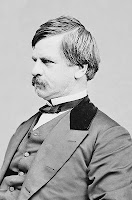
Maj. Gen. Banks
Having, almost literally, stumbled over the box containing my 15mm ACW figures I thought it was high time I got them back on the table.  So I put together a small game for the club based on the Battle of Sabine Crossroads (or Mansfield if you prefer) from April 8th 1864.

I had to make a few slight adjustments to the Union order of battle to deal with the fact I don't actually have any Union cavalry - so the lead cavalry division suddenly became infantry but otherwise I tried to stick to a good representation of the forces using the original Fire and Fury rules.  I had the Union deploy historically but allowed the Rebels a freer hand.
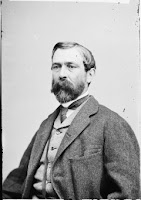
Lt. Gen. Taylor
The Union forces under Major General Nathaniel P. Banks had been advancing up the Red River. They split their joint Army and Navy force and marched towards Mansfield up a single track through the woods. Recognising the enemy’s weakened position, the Confederates under Lieutenant General Richard Taylor had selected the Sabine Crossroads to meet them. Deploying their troops in the woods along the edge of the open ground between the Sabine Crossroads and Pleasant Grove to hide their exact strength and disposition from the enemy the Confederates had to beat the enemy and capture their wagon train to halt their advance.

Brigadier General Albert L. Lee commanding the Union advance division found the Confederates in position overlooking the open ground between the Sabine Crossroads and Pleasant Grove.  He sent a messenger back to General Banks but Bank chose to disbelieve Lee and ordered him to continue his advance.  So our battle commenced with the entire Confederate force deployed at the end of the woods and the two Union brigades from Lee's Division having taken positions in the open ground in front of them.  The Union 4th Division, XIII Corps under Colonel William J. Landram was still in march column advancing up the track towards Pleasant Grove with the remainder of Banks' men someway back amongst the massive wagon train which was blocking the road.


The Confederates saw the substantially outnumbered the lead Union Division and so charged out from the woods towards the Union lines.
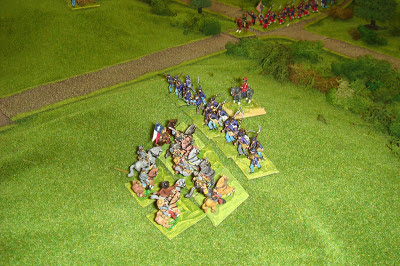
Bagby's Cavalry charging Dudley's Union Brigade

Randal's Confederate Brigade assaulting Lucas' Brigade
Mouton's Division advance in the centre
Clearly some of the Union troops were taken by surprise as Dudley's Brigade only managed a desultory fire at the incoming Confederate cavalry and the ensuing melee saw the Union troops thrown back and the Rebels breaking through toward the advancing Union column.  The Union right managed to put more resistance and threw the initial Confederate brigade back.

Fortunately the Confederate cavalry didn't have the legs to hit the Union infantry column which gave them time to deploy.  After their initial rebuff Walker's Texas infantry Division regrouped whilst the Union infantry took the chance to fall back towards Pleasant Grove.
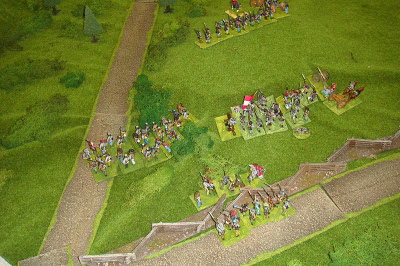
The Rebels regroup for a second attack

Bagby's Brigade charge into Vance's infantry Brigade
Bagby's Rebel horse weren't so lucky this time and Vance's Union infantry fired a decent volley before the cavalry charged home and managed to see them off.  But Lucas' Brigade wasn't so fortunate when Walker's Texans assaulted them a second time.

With Vance's Brigade having checked the Union cavalry it gave time for Emerson's Brigade to form line and cover the retreat of Lucas's rather battered infantry.  Then the fight for Pleasant Grove began.


With Landram's Division hard pressed defending Pleasant Grove, Union reinforcements in the shape of Brigadier General Robert A. Cameron and the 3rd Division of XIII Corp began to advance alongside the wagon train.  But they had a long way to travel up through the woods and the Confederate attack wasn't slowing.


With the sheer weight of numbers telling Landram's Division bravely fought on and, despite having been outflanked by Rebel cavalry they were holding up a large part of the enemy infantry.

The remnants of Dudley's Brigade, who had fled from the first Confederate cavalry charge,  were being pursued by the cavalry and decided to turn and make a fight of it.
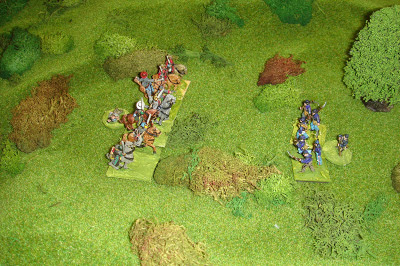
A devastating volley checks the cavalry
But with the Union centre shrinking this small act of defiance wasn't going to be enough.


Finally the weight of Confederate fire and numbers took its toll and the grim determination of Vance's Brigade couldn't hold them.  The Union troops fell back but were outflanked by the advancing Rebel cavalry and were caught in an unenviable position.


With the lead Union Divisions crushed and the Rebels pillaging the front of the wagon train it looked like it was all over for the Union.


But finally hope was in sight as Brigadier General William H. Emory and the 1st Division of XIII Corp began arriving and forming up behind the stream.
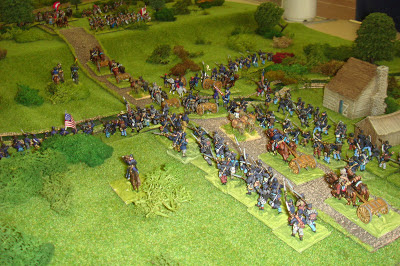
Emory's Division arrive and form up
Seeing the danger the Confederates formed themselves up on the ridge overlooking the Union position and dared the Federals to advance!
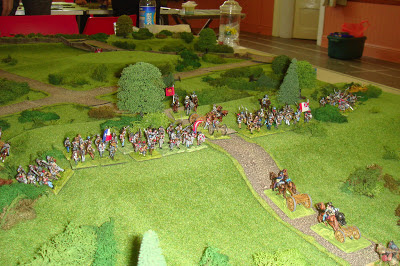
The Confederate right

The Confederate left
With battle lines drawn and dusk beginning to fall the Union left advanced towards the Rebel lines.


A fight began on the Union left and the Rebels put up a hell of a fight with charges being made by both sides.  Waul's Confederate Brigade almost single handedly held up the main Union attack.  And with the Confederate cavalry having regrouped and advancing around the flank of the Union their position began to look slightly precarious; however, the light failing allowed the Union troops to withdraw leaving the Confederates to celebrate their victory.

Sunday, 6 July 2008

Battle of Fredericksburg

The weekend saw a reunion with some old gaming buddies and a day long re-fight of part of the Battle of Fredericksburg using 15mm figures (including my own) and Fire and Fury. I was allocated the role of Darius Couch commanding a corps containing French's, Hancock's and Howard's divisions. I was to assault the confederates behind the stone wall opposite and take Marye's heights behind them. Unfortunately, lady luck was not shining on me, as I only managed to roll over 5 in combat two times in I don't know how many melees. Although I did get over the wall twice, on each occasion the rebs managed to through me back and, in the end, with only one unit not spent I was forced to withdraw.

The Union forces as the other end of the table had varying fortunes but put the confederates under considerable pressure and, at one point, actually managed to cut the road to their rear (another of of our objectives).

The game ended in a pretty bloody draw with both troops and players pretty worn!

I managed to forget to take my camera (doh!) but here are a couple of photos courtesy of Uncle Del: