Showing posts with label medieval. Show all posts

Tuesday, 27 February 2024

Battle of Bannockburn 1314

Last weekend I visited the Herts Volunteers for a refight of the Battle of Bannockburn using the second edition of the Hail Caesar rules.

 I took command of the Scottish left wing and despite a string of particularly poor dice rolls managed to hold off the advancing English.  Unfortunately our attack in the centre were equally unlucky at key moments and so history was overturned!

 Here are a few photos from the game:


Thursday, 17 October 2013

Punish the Village

Our second pre-SELWG game was a medieval skirmish.  The Peasants are revolting (aren't they always?) and the Lord is taking his retinue to punish them for their temerity.  I had command of the vanguard and gleefully charged my knights over the bridge with our surcoats flapping and the sun glinting off our armour - straight into the pits which had been dug on the far side!


Two of my knights went down and whilst the others managed to pull up before the pits they then cam under a hail of crossbow fire.  Obviously the villagers were not only prepared but had some help (from seven mercenaries it transpired - I think you can see whether this might be going...)

We advanced into the village with one of my rather impetuous knights trying to charge down some of the villagers.


He turned the corner to be faced by a barricade - which he jumped majestically - only to find himself alone and cut off from the rest of my troops.  Of course he was then mobbed, pulled from his horse and came to a sticky end.


The Lord and remainder of the retinue followed across the bridge somewhat more cautiously.


My remaining mounted knights rode on through the village and found some carts blocking the other main thoroughfare.  These were easily pulled apart and they advanced.


The villagers scattered once again and my knights pursued them into an alley where they tried to make a stand (somewhat more successfully than I was expecting!)


The remainder of my men on foot advance to the first barricade and encountered some rather better armoured and skilled opposition than we had been anticipating.  Meanwhile the villagers attempted to ambush my soldiers who were starting to fire their houses.  One of the villagers attacked one of my knights and was almost cut in half and the remainder were soon chased off and a couple of houses set ablaze.


With the Lord and his knights advancing on the left flank and my knights having pushed through the alley the mercenaries were near to being surrounded.  With a couple of their number having been killed they decided to withdraw and the day was ours - although with rather more casualties than we would have liked!

Sunday, 28 July 2013

Towton Battlefield

We went on a trip up to York for a couple of days so I made sure that our route passed through at least a couple of the area's battlefields.  On the way there it was the site of the Battle of Towton in 1461 one of the bloodiest battles in England during the Wars of the Roses.

It was a very different day to the day of the battle, we had bright sunshine and high temperatures whilst on Palm Sunday in 1461 it was snowy and somewhat colder!

The battlefield and the surrounding area are given over to farm land and given the often poor recognition of the history of some battlefields I was impressed that Towton has display boards and a battlefield trail that you can walk.

The introductory display board

The old monument

A view across the field of battle


If you would like more information have a look at the Towton Battlefield Society website.

Wednesday, 9 January 2013

First Look: Deus Vult

The Medieval period and, in particular the Crusades, have long been of interest but it's another one where I have found it difficult to find a set of rules I was happy with for more than a skirmish.  So when I spotted that the new Deus Vult rules from Fireforge Games was in the NorthStar sale I ordered a copy.

The rules come as a hardback book, in the smaller Osprey size rather than the larger Black Powder format, they are 192 pages in colour and are split into 16 main sections.  The rules themselves are around 75 pages in a two column format interspersed with photos and art work with a side bar containing explanations and quotations.


The rules are written for 25-30mm figures and a 6' x 4' playing area for two players but there are specific sections which allow you to use different figure and table sizes along with more players.  Figures are intended to be individually based but on movement trays (to allow for casualty removal) with infantry on 20x20mm bases 6 to a stand (3x2) and cavalry 25x50mm 2 to a stand - but they also have suggestions as how to deal with differently based armies.

The rules are principally d6 based, although d4, d8, d10 and d12 are used for the leader duels.  In some cased you can end up rolling quite a few dice - which is great if you like that sort of thing!  Army lists are provided for the Early Crusader States 1100-1128AD and the Arab Dynasties 945-1150AD with some sample units for other eras (e.g. Teutonic Knights, Seljuk Turks) with the full lists coming in supplements to be release later.  


Armies are built in Divisions each commanded by a Battle Leader who is pretty crucial to their success although more from an activation and command basis; however, they do have some attributes which seem like they could be pretty handy.  There is an interesting pre-battle phase with the opportunity to using scouts to influence terrain and deployment and also to introduce some subterfuge which should add some interest value.

A set of seven different battle scenarios are provided covering everything from a stand up fight to an encirclement.  There is also a summary of the Crusades but not much detail on any of the battle unfortunately and an overview map.  This is followed by an almost blow by blow account of the fictional battle of Samosata, some advice on flexing the rules and creating new scenarios followed by a set of game aids and the reference section of the rules but no separate quick reference sheet.

I must be getting old but the small typeface and fonts used on the back cover and side bars (especially as it's white on dark brown) I found rather hard to read.  The rules themselves are relatively clear and the scenarios seem to have a good range of options.  I was initially put of by the points system but that's not a deal breaker for me as it is a useful tool for evaluating the relative power of different units and abilities.  There's some nice eye candy with the photographs and artwork which certainly provide some inspiration and the sample battle really helps to put the whole thing together.  I am really looking forward to giving these a try on the tabletop.

Amazingly enough this is actually my 500th post on the blog so that's another little milestone I've reached!

Sunday, 14 August 2011

First Play: Wars of the Roses

I was lucky enough to be given a copy of the Z-Man Games Wars of the Roses: Lancaster vs York boardgame for my birthday and thought I would report back on my first game.

Wars of the Roses, designed by Peter Hawes, is a 2-4 player game lasting around 3 hours.  The first thing that struck me was the weight of the box.  Not only is it stuffed with components, they are all really nice quality.  There is a large board depicting England divided into six regions each with their own royal castle, large and small towns and port. There are four thick player screens with castle artwork to conceal the players' planning charts each with useful historical and game related information printed on the inside.  There are an assortment of wooden cylinders and cubes in each of the player colours and some black and white cubes (for bribing the nobles).  Then there are the thick tokens and cards representing troops, money, nobles and the like.  Finally there are the cards representing the locations, nobles etc.  The boards, screens, tokens and cards are pretty clearly laid out and very nicely illustrated.


At its core this is an area control game played out over five turns, each representing a number of years.  The objective of the game is to amass victory points through controlling the various regions.  Each turn is broken down into eight phases:
  1. Determine Turn Order
  2. Draw Cards
  3. Collect Income
  4. Planning
  5. Deployment
  6. Bribery
  7. Combat
  8. Parliament
Turn order is determined by reversing the players' positions on the victory point track, thus the player with the least points will go first.  Then a number of cards are drawn and placed face up next to the board,  These represent the castles, towns, ports, bishops, nobles, ship captains and mercenaries.  The players take it in turn to choose a card which will become theirs to control.  Income is determined by totalling up the income generated by the cards that the player controls.  Play then moves on to the planning phase which is the meat of the game.


Players need to determine whether to move their nobles and ships, raise troops, bribe their own nobles to stay loyal or opposing noble to swap sides and spend money to influence the King to make them the Captain of Calais.  Other than movement these actions all cost money!  Once all the players have finished planning then the screens are removed and the remaining phases are played out based on what they have planned to do.


Attacks on castles, towns and ports can only be made when a player has a presence in the relevant region, which is where the nobles become important.  Combat is based on a simple majority approach but does deplete your forces dramatically, which is where player order becomes important as locations can change hands more than once in a turn.  Parliament is dependent on the balance of control in each of the areas influencing which house is in the ascendancy.

I have only had a single two player game so far but really enjoyed it.  I suspect that the addition of further players will only make the game more interesting and I am looking forward to getting this back to the table as soon as I can.

Saturday, 30 January 2010

Wargames Weekend: Scavanger Hunt

The first game on our final day was yet another playtest, this time Chain Reaction 3.0 - Swordplay. On the whole have been pretty pleased with the reaction system based games from Two Hour Wargames for modern periods and even as far back as Black Powder Battles but less happy with the only medieval rules we tried (Montjoie). But having rather a lot of 28mm pointy stick figures I was keen to see whether Swordplay might be better.

The scenario involved some Crusaders out foraging encountering some, perhaps unsurprisingly, hostile locals when trying to take their supplies. I used my 28mm Gripping Beast figures along with my desert hamlet from the Colonial Steamboat Company.

The small force of Crusaders consisted of five mounted armoured knights (Rep 5) with shields and lance along with five unarmoured warriors (Rep 3) with spears and shields. The Saracens consisted of one armoured noble (Rep 5) with sword and shield, 10 unarmoured warriors (Rep 3) with spears and shields and 5 unarmoured archers (Rep 3). The relative sizes were based on the points system from the rules. I took command of the Crusaders and Lenin the Saracens.

With the classic Two Hour Wargames Rep based initiative system my knights activated on most turns but my foot troops were a little less enthusiastic. As the knights approached the village they triggers a crisis test for the Saracen archers who opened fire (There is no equivalent of the In Sight test from the more modern CR rule sets but rather one based on approaching within 12 inches). The arrows merely bounced off my knights' armour and their reaction was to charge!

Unfortunately for the knights, access to the village was limited on their size of approach and so only one could charge through the archway (ducking theatrically to avoid being swept from horseback!) but facing two spear armed Saracens. The charge ended up with one of the Saracens becoming intimately familiar with the knight's lance but the other managed to unhorse him. This started a lengthy fight in the archway with my knight besting the Saracen warriors but meeting his match with their Noble. Even with assistance from another knight the Crusaders just couldn't get the edge over the Saracen.

Meanwhile three of the other knights became bored watching the fight but not being able to join in and went in search of another way in. They found another archway and, having dismounted, advanced into the village. Spotting the remainder of the Saracen force defending the main village gate the Crusaders charged! Fortunately for the Saracens they reacted in time and most of them turned to face off the Crusader attack. Unfortunately the unarmoured Rep 3 warriors didn't do too well against the armoured Rep 5 knights even though outnumbering them and the fight was soon over.

Eventually the Saracen Noble, after putting up a spirited resistance even though outnumbered, was overcome. The Crusaders discovered the Saracen archers cowering in a nearby building and captured them.

We thought the rules worked pretty well and will be using them again. Although for le=arger games the combat mechanism would begin to slow matters down as it works on rolling groups of d6, looking for successes and then rerolling them until one side doesn't get any.

However, it was clear that the points system wasn't a good basis for trying to balance the game. The Crusader infantry didn't actually take part at all and the Rep 5 knights were a lot more capable and hardy than the Rep 3 Saracen warriors. So we'll need to give that some thought for next time.

The rules are available as a free download from the Two Hour Wargames website.

Monday, 26 October 2009

Richard III: Wars of the Roses

I just picked up my copy of Richard III, the new block game from Columbia Games, from the sorting office this afternoon. It has been a while in coming since I pre-ordered it and getting clobbered for £4 VAT (plus the outrageous £8 Royal Mail handling fee!) was a pain.

Anyway, I popped the sixty odd stickers onto the blocks and read through the rules earlier and it looks very interesting. The board is the usual card type but it doesn't detract from the overall excellent presentation.

The combat system is based on the traditional Columbia and the card action/event system is similar to that used in Hammer of the Scots amongst others.

Once I have had a chance to give it a go I'll post my thoughts.

Saturday, 22 August 2009

JWS Reunion

As you may have notice from my Twitter feed, last weekend was a get together for the old guard of the Jersey Wargames Society. We haven't got together as a group for quite a while and so we decided to put on a few games.

First up Lenin provided the Battle of Um Bbongo Gorge as an outing for his extensive Darkest Africa figure collection. Playing to type I took the part of Commandant Hercule Poirot (a famous Belgian) the representative of His Majesty Leopold II, King of the Belgians. As the only representative of law and order in the chaos that is Africa, my mission was to stop an invasion by that upstart self-appointed so-called king Ndofa, tackle any slavers and collect taxes and export duties.Things did not start well when I was ambushed by some uppity locals and one section took rather a beating. Having regrouped I spotted some suspicious arabs who could only be up to no good and advanced to investigate. A closer look and the application of my "little grey cells" told me they were slavers and quite hostile. After giving them a pretty good thrashing I turned back toward the local village which was under attack from that rotter Ndofa. After clearing up the misunderstanding with the locals we joined forces to stop Ndofa from stealing the the village cattle and drove him off, albeit the village was a little scorched afterwards. With little persuasion the villagers paid their tax dues in cattle and I was free to discuss the export of ivory and other goods with some big game hunters (must have been after some very big game as they had a small artillery piece!). I made a rapid assessment and secured the appropriate duty and then escorted them to our steamer.

The afternoon game was the Battle of Flodden Field in 1513. With most of the players knowing relatively little about the actual battle it unfolded in a relatively historic way with the English discovering the marsh in front of the Scots position the hard way. With some nicely conflicting victory conditions the Scots forces (some of which I was commanding) played a pretty defensive game but eventually the English got their forces through the marsh and our lack of effective ranged weapons led to the natural conclusion.
On the Sunday we were treated to a series of small games all of which had been cleverly designed to fit onto a chess board. The first I played was a tavern fight between the Three Musketeers and Rochefort with some Cardinal's Guards.
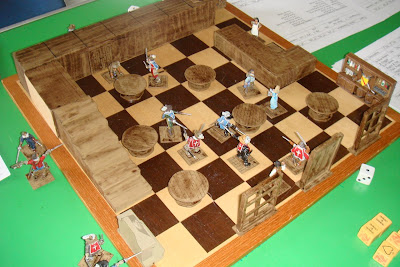
The rules provided for all the usual chandalier swinging, bar sliding and table crushing action and use poker dice for combat resolution. As Rochefort I managed to capture two of the Musketeers and D'Artagnan but one slipped through my fingers...
The next compact game was the Fight in Balin's Tomb between the Fellowship of the Ring and a horde of goblins with a Cave Troll! This game is still in the development stage but provided some fun action, especially with the Troll.

Next on the agenda was my game, Chaos in Caracabra de la Cruz, a 28mm skirmish in the Spanish Civil War. With five factions, three Nationalists and two Republican, with some interesting victory conditions the game promised some interesting encounters.

Clearly some of the players actually read their victory conditions because the Carlist contingent followed their's precisely and captured and held a significant part of the village. The Anarchist and Communist militias almost opened fire on each other but the timely intervention of the local priest, in defence of his church, avoided that blue on blue encounter. The Falange reached the church but couldn't get in a withdrew, just in time to block and advance by the Communists who had already had a little encounter with the Guardia Civil.

The Anarchists decided that dynamite was the obvious solution to a locked church door; however the effect led to an appropriate quote from the Italian Job! A similar attempt by the Communists to use dynamite went a little awry when it turned out the dynamitero was quite a familar with it as he'd made out and dropped it amongst his own side.

Meanwhile the Anarchists, playing to type, blew up the church and withdrew (almost in that order!). In the end though it was the Carlists who held on to their conquests, despite a serious challenge from the retreating Anarchists.

Thursday, 29 November 2007

The Road to Milan, April 1522

We tried out the To the Banners rules by Partizan Press at the club last week. Bronze picked these up at SELWG last year IIRC and he umpired the game. The rules embody some interesting mechanisms, particularly around initiative and artillery which make good use of the d6. It did, however, become clear that the rules were really designed for two player games rather than multi-player ones (unless you enjoy lots of downtime) and that some of the mechanics could have done with much better explanation in the booklet. Added to that units have to take some serious punishment before being eliminated which isn't really compatible with our limited playing time.

The rules did simulate the difficulties in co-ordinating units and the effect of leaders and the artillery was ineffective but fun.

Overall they are nicely presented and gave a fun game but you need to persevere with some of the text and keep to two players. Given that we liked the rules I suspect Bronze will be trying some amendments to cater for multi-player games.

Saturday, 11 November 2006

First Look: Montjoie!

Montjoie! is a set of medieval rules by Ken Sidenblad, edited by Bob Minadeo and produced by Ed Teixeira of Two Hour Wargames.

The rules have similarities to other Two Hour Wargame sets in both format and mechanisms but obviously do not rely on the In Sight test of their modern counterparts like Chain Reaction 2. So the concepts of “Rep” as the main measures of a figure’s effectiveness and “passing dice” are retained along with elements of the ranged and melee combat tables; however, the rules are more geared around groups and encompass the necessary features relating to armour and the focus on hand to hand combat.

A campaign system is included allowing your “Stars” to progress to command greater numbers of troops and attributes have also been included. There are even rules for sieges. Army lists are provided for most of the main medieval wars and forces.

The rules are available from Two Hour Wargames as a 40 page .pdf for $14.00.