Showing posts with label Perry. Show all posts

Monday, June 1, 2026

Hessian Fusilier Regiment Von Ditfourth - American Revolutionary War


This Hessian Fusilier regiment traces its origins back to 1702.


It had "sulfur yellow" facings and cloth backing on their miters.


It fought at White Plains, Rhode Island, and Charleston. 

These are Perry figures once again.

The flag is from Flags of War. 

It became a Musketeer regiment in 1782.

Saturday, May 23, 2026

Hessian Artillery and General Officers, American Revolutionary War

Each Hessian Infantry regiment had 2 light 3pounder cannon attached to it. 


Amazingly, the carriages were painted white, with the spokes and metal work painted red (Hessian colors); quite a striking combination!

Reminds me of an early 20th century Carnival wagon!

The guns were served by members of the Feldartillerie Corps. They wore dark blue jackets with crimson cuffs, lapels, and turnbacks, with paille vests and breeches. In dress, the men's hats were trimmed with white lace, and the officer's hats were trimmed with gold lace.

Perry makes 3 German officers for the AWI, representing Generals Knypausen, Riedesel (a Brunswicker), and Stirn. 

I have painted the portly gentleman on the right as Stirn, wearing a kore or less standard Hessian General's uniform of this time.  He was a Hessian Brigade commander during the Revolutionary Wart. 

In the center is Knyphausen, who I have painted in the uniform of his Regiment, with black facings. He lead the attack by Hessian forces at Brandywine. 

The final figure is von Riedesel, painted in the uniform of a Brunswick general. He and his Brunswickers were a major portion of the troops serving under General Burgoyne in the ill-fated Saratoga campaign. 

Wednesday, May 20, 2026

Indians #3 Mohawk and Seneca tribes


This group I have designated as from the Mohawk tribe, or in their own language, Kanien’kehá:ka (People of the Flint"). The Easternmost of the Iroquois (Haudenosaunee)  tribes, they were traditionally referred to as "Keepers of the Eastern Door" of the Confederacy. 

 The Iroquois tried to remain neutral during the Revolutionary War, but the war ultimately wound up splitting the Confederacy as much as it di the Europeans; The Oneida and Tuscarora supported the Americans, and the other four tribes the British. 
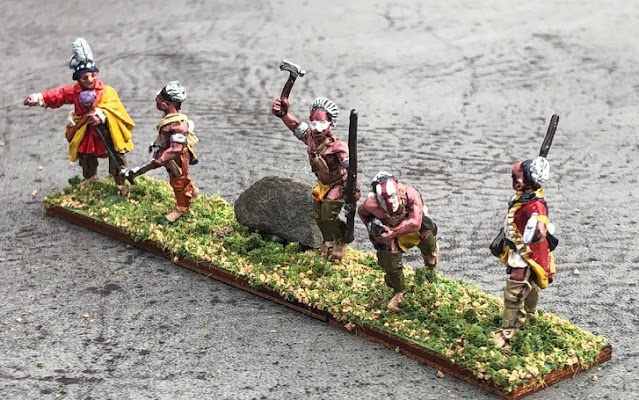
A key figure of the Mohawks during this time, was Joseph Brant. whose Indian name was Thayendanegea. He formed a good relationship with the British, and especially Sir William Johnson, who was the British superintendent of the Indians of North America. In 1759, Johnson married Brant's sister, Molly. Johnson selected Brant and several other Mohawks to attend Moor’s Charity School for Indians, a school which would later develop into Dartmouth College. At school, Brant converted to the Anglican faith and learned to read and write English. While Brant’s education at Moor’s gave him the skills which made him prosperous, most students at Moor’s were not nearly as successful as Brant. The school’s administrators and employees used their power to force students who were not of top caliber into exploitive manual labor.
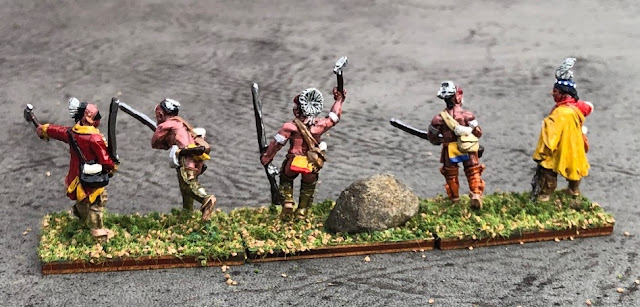
After receiving his education, Brant accompanied Johnson during the French and Indian War. After the war concluded, Brant stayed with his brother in law and assisted in running the British “Indian Department.” During this time, he traveled throughout the Iroquois land, mainly as a missionary. Throughout his travels, Brant learned to speak at least three languages of the different Iroquois tribes and likely spoke all six tribal languages. These early missionary years established Brant as a trusted and respected leader of both natives and settlers.

This second group I have designated as being from the Seneca tribe (Onondowagah in their language, "Great Hill People"). They were the Westernmost of the Iroquois tribes, the "Keepers of the Western Door", and the largest of the Six Nations. 

Returning to the story of Joseph Brant, in 1775 he Six Nations met to discuss their role in the burgeoning War for independence. While many advocated for neutrality, almost prophetically, Brant predicted that independence for the colonists meant that the natives across the North American continent would lose their land. Brant’s argument, along with Johnson’s influence, succeeded in convincing four of the six nations to fight for the British cause, the Mohawks, Onondagas, Cayugas, and the Senecas.
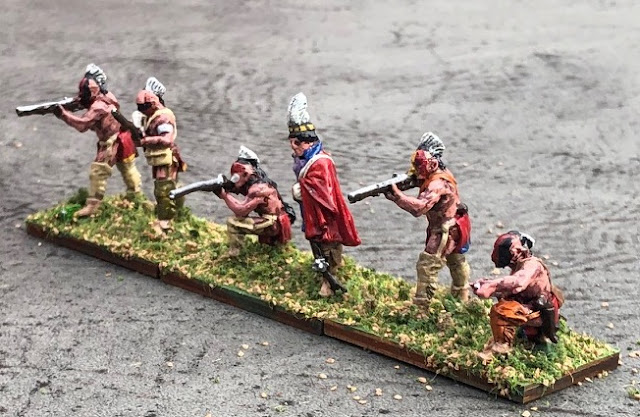
In November 1775, Brant traveled to England to discuss native roles in the War along with land disputes. Brant returned to America in July of 1776 and participated in the British campaign to retake New York.  It is likely he served with General Hugh Percy during the British push through Jamaica Pass, which was a key phase of the Battle of Long Island.  Brant and Percy quickly formed a lifelong friendship. Percy would be the only white man which Brant would remain close with after the war. Following the New York campaign, Brant returned to the Six Nations, and rallied the tribes for war against the American colonists.
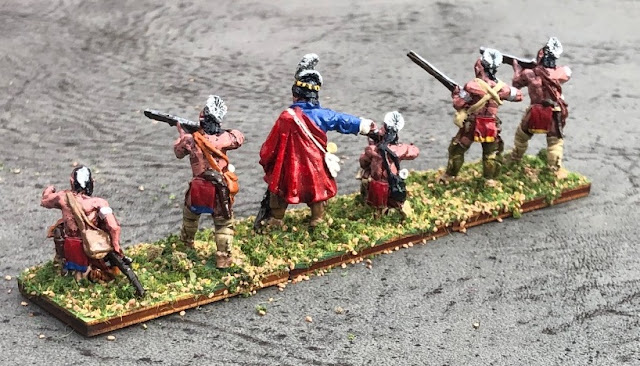
Throughout 1777 and 1778, Brant’s forces were exclusively involved in the Mohawk Valley. Brant’s army participated at the Battle of Oriskany, in attacks on Cobleskill, and in raids on German Flatts. While Brant’s forces were on a raid, continental troops attacked Brant’s Onoquaga base. The continentals razed the city, leaving buildings burned, cattle dead, and crops reaped. Brant, as a response, led the attack which became known as the Cherry Valley Massacre. During the attack, Seneca forces sought out innocents killing at least thirty civilians. This action gave Brant a reputation for brutality and the nickname “Monster Brant;” however, Brant, although active in the valley, was not present at the Cherry Valley Massacre, primary sources from British leaders and Brant showing that he instead attempted to contain the Seneca’s’ violence.


  By 1779, the British  granted him the rank of “Captain of the Northern Confederated Indians” and promised provisions for his men but no pay for the native troops. Because of his new salary and wartimes despoiling, Brant became moderately wealthy. This wealth caused jealousy among rival chiefs and even his unpaid volunteers. When a commission to make Brant a colonel came, British colonial officers did not tell Brant in order to preserve his negotiating power with other tribes. In late 1779, the Sullivan Campaign devastated Mohawk lands, forcing Brant and the Iroquois out of New York and pushing them back to Fort Niagara.

In 1781, Brant was sent west to the Ohio Country. During this campaign, Brant was seriously injured in the leg and was forced to recover at Fort Detroit. During this time he tried to keep western tribes loyal to the British, even after the catastrophic defeat of the British at Yorktown. 

The 1783 Treaty of Paris did not acknowledge the Six Tribes or any indigenous groups independence. The British had failed to accomplish the promise which prompted many native tribes to join their cause, the protection of indigenous land. Brant would spend the rest of his life fighting for the land rights of his people and other disaffected indigenous tribes in America. His first attempt at protecting the land was forming the Western Confederacy, a group of thirty native nations which agreed to fight for the Fort Stanwix Treaty line. Brant sought British support in 1785, and while the British compensated Mohawk losses in the war and gave Brant a pension, they refused to join in support of the thirty tribes. Brant and Washington both made attempts at peace. Brant sought a peace treaty but failed. Washington tried to create a reservation for the Mohawks and give Brant a large pension, but Brant refused. The American forces overwhelmed the Western Confederacy resulting in the thirty tribes’ alliance disintegrating.

Thursday, May 14, 2026

Hessian Fusilier Regiment Erbprinz - American Revolutionary War


Just as the Hessians of the time of the American Revolutionary War army copied many features of Prussian uniforms of the time, they raised regiments of Fusiliers as well as Musketeers. There was even less difference between these units and their Musketeer brethren than in the Prussian Army (where they were chiefly new units raised from recently captured territories, such as Silesia). These men were felt to be less robust than the Brandenburg and Pomeranians that made up the units of the old army, and thus were more lightly equipped. To make up for their smaller stature, Frederick gave them headgear based on a cut down version of the Prussian Grenadier miter. After the Revolutionary era, Prussian Fusiliers would begin evolving into actual light infantry ...sans the miters. 


The origins of  Fusilier Regiment Erbprinz date back to 1680; interestingly, in 1780 it was converted to a Musketeer regiment, and was renamed Prince Freidrich in 1783. 

Th pink I used is probably a more bold hue than used at the time, although contemporary illustrations do show a more intense hue than than rather pale version seen in armies of the Napoleonic era. 

In any event, there's no doubt about the impressive appearance of even the Fusiler miters!

Evidently captured miters were highly prized by patriot soldiers! These are Perry figures, with the flag being from Flags of War.

The Erbprinz regiment was among the first Hessian contingent to arrive in North America, at New York in August of 1776. and fought at the Battles of Long Island and White Plains later that year. Other major actions were Fort Washington and Yorktown. 

Tuesday, May 5, 2026

Queen's Rangers: Hussars


Robert Rogers was born in Massachusetts in 1731, and lead a famous and very effective unit of colonial  Rangers during the French and Indian War (Seven Years War in Europe), 1754 - 1763. 


A known Loyalist, with the beginning of the American Revolution, Rogers was arrested on the order of General Washington in July, 1776, on suspicion of espionage. He contrived to escape, and made his way to an offshore British Naval vessel. In August 1776, General Howe commissioned him to raise a unit of Loyalist Rangers. 

The regiment didn't get off to a good start; they were caught off guard by a patriot night attack on October 21, 1776 near Mamaroneck, NY, and suffered heavy losses despite eventually repulsing the attack. A January 1777 visit by a British Inspector General found the regiment not up to snuff, leading General Howe to relive Roberts of command. Roberts was plagued by heavy debts after the French and Indian Wars, and was drinking heavily. 

In his place, Howe appointed Lieutenant Christopher French to command the unit. Col. French trained the unit relentlessly over the winter, resulting in much improved performance when the fighting resumed in the Spring of 1777. 


The regiment participated in the Philadelphia campaign, now under the command of Major James Wemyss, and particularly distinguished itself at the Battle of Brandywine creek, September 11, 1777, where 2/3 of the officers were wounded or killed, along with 1/3 of the enlisted men. It fought again at Germantown on October 3, 1777, where it performed well but Major Wemyss suffered multiple wounds, causing him to relinquish his command of the unit. 

With the unit's reputation now well established, an ambitious lower ranking officer in Howe's command, John Greave Simcoe, pushed hard for the command, and was granted it buy Howe as of October 15, 1777. The son of a Naval Captain, Simcoe had attended Eton and the Merton college at Oxford. However, he dropped out of college after a year, purchasing an Ensign's commission in the 35th Foot. He was only 25 years old when he took command of the Rangers. 
 
Under Simcoe’s leadership, the Queen’s Rangers became a mixed unit, eventually combining elements of all three combat arms. When at Philadelphia a superior officer offered Simcoe the use of his cavalry, he set up his own troop of hussars. Meanwhile, a Highland company from North Carolina sporting the MacNab tartan had joined the Regiment as well, and over time there would also be sharpshooters armed with rifles, a grenadier company, and even a trio of gunners firing a “grasshopper” three-pounder cannon. Eventually growing to 11 companies of foot, in addition to the hussar troop, during the Revolutionary War most Rangers remained light infantry outfitted with Brown Bess muskets and bayonets.

Friday, April 24, 2026

Hessian Grenadier Battalion #1, American Revolutionary War


For my own convenience, this battalion is composed of 3 figures each in the uniforms of my 4 Musketeer regiments. 

Hessian (Hesse-Cassel) infantry regiments were composed of single battalions, each with 5 Musketeer or Fusilier companies, and one company of Grenadiers. 

The Grenadier companies of four different infantry regiments were combined to form each Gfenadier battalion. 

While the Grenadier battalions did not ordinarily carry standards, I have loaned them one of the all white Leibcompagnie colors, which were carried by the first company of each line battalion (the other four companies carried the colored standards). 

Miters are so 1700's! :-)

The Grenadier battalions saw action at most of the many battles that the Hessian troops fought during the American Revolutionary War. 

Vorwarts!
These are Perry figures with a flag by Adolfo Ramos. 

Thursday, April 9, 2026

Hessian Leib Musketeer Regiment

This rather flashy regiment was raised in 1700.


It has yellow collars, cuffs, lapels, waistcoats, and breeches.

It fought st the battles of White Plains, Brandywine, Germantown, Monmouth Courthouse, Connecticut Farms, and Springfield. 

This regimental flag is by Adolfo Ramos. Other sources show it as being purple and white. 

Drummers had purple facings, and white lace with a purple stripe. The drum hoops were purple and white. 

The regimental colonel was (officially) none other than Landgraf Friedrich II himself; in 1783 it passed to his son, Erbprinz Wilhelm, and became known as the Erbprinz regiment. 

Overall, a most striking unit!


Saturday, March 28, 2026

Hessian Musketeer Regiment Von Trumbach

This regiment was first raised in 1701; in 178 its colonel changed to GM Carl Ernst Johann von Bose, and it was thence known as Musketeer Regiment von Bose. 

The regimental uniform had white collar, cuffs, lapels, waistcoats, and breeches. 


Drummer's uniforms had yellow lace with a narrow red stripe, and the drum hoops were red and white with a narrow blue stripe. 

The regimental flag is by Flags of War. I actually think I have accidentally reversed the flags between this unit and Musketeer regiment . Considering the small difference between white and paille, I don't think I will worry about it! 

The regiment fought at the battles of Forts Clinton and Montgomery, Connecticut Farms, Springfield, Guilford Courthouse, Green Springs, and Yorktown.

These are Perry figures once again. 

After the Battle of Guilford Courthouse, General Lord Cornwallis wrote the the regiment "deserves my warmest praises for its discipline, alacrity, and courage...". 


Yes, this regiment has a re-enactor group.

Hmm, I may have to try adding that red line to the drummer's lace!

Grenadiers of the Regiment von Bose/von Trumbach in the snow!