Mostrar mensagens com a etiqueta simon and garfunkel. Mostrar todas as mensagens

terça-feira, 27 de janeiro de 2026

An Eternal Masterpiece With 56 Years Old

Original released on LP 
Columbia KCS 9914 (US) / CBS S 63699 (UK)
(1970, January 26)

"Bridge Over Troubled Water" was one of the biggest-selling albums of its decade, and it hasn't fallen too far down on the list in years since. Apart from the gospel-flavored title track, which took some evolution to get to what it finally became, however, much of "Bridge Over Troubled Water" also constitutes a stepping back from the music that Simon & Garfunkel had made on "Bookends" - this was mostly because the creative partnership that had formed the body and the motivation for the duo's four prior albums literally consumed itself in the making of "Bridge Over Troubled Water". The overall effect was perhaps the most delicately textured album to close out the 1960s from any major rock act. "Bridge Over Troubled Water", at its most ambitious and bold, on its title track, was a quietly reassuring album; at other times, it was personal yet soothing; and at other times, it was just plain fun. The public in 1970 - a very unsettled time politically, socially, and culturally - embraced it; and whatever mood they captured, the songs matched the standard of craftsmanship that had been established on the duo's two prior albums. Between the record's overall quality and its four hits, the album held the number one position for two and a half months and spent years on the charts, racking up sales in excess of five million copies. The irony was that for all of the record's and the music's appeal, the duo's partnership ended in the course of creating and completing the album. (Bruce Eder in AllMusic)

An established major act as the '60s came to a close and poised to reach an artistic Everest that most can only dream of, Simon and Garfunkel were slowly falling apart due to creative tensions and aspirations that stretched beyond music. It took almost a year, but "Bridge Over Troubled Water" was worth the wait and effort, a perfect way to say goodbye to their studio album career and full-time partnership. A recurring theme of the album is to start a song off rooted in the traditional folk that S&G had originally made their living from, then gradually blend into a louder, fuller sound drawn from various styles. For instance, the title track begins with a lone piano set against Art Garfunkel's delicate vocals (written by Simon, as was always the case), progressing towards the addition of Vibraphone and echo chamber drums before finally crescendoing in a strings and soaring Garfunkel that the Righteous Brothers would have been proud of. Likewise "The Boxer", recorded and released almost a year before "Bridge Over Troubled Water", starts off with a lone folksy guitar and Simon's quiet biopic vocals, then steadily collects Garfunkel, a bass harmonica, occasional pedal steel and piccolo trumpet over the next four minutes, climaxing with - you guessed it - echo chamber drums and strings. "Cecilia", a tale of afternoon dalliance, has a much more consistent volume and beat throughout, with very subtle use of instrumentation that has almost a hands-and-knees-clap quality to it - you know you're experimenting successfully when dropping drumsticks on the floor becomes a classic. Each of these songs became monster hits around the world, as did the album, which stayed on many major charts for years during the early '70s. This certainly isn't the most extreme example on record of folk boundaries being pushed, but it's definitely the most ornate and tasteful. (Azapro Nineoneone in AllMusic)

sábado, 25 de janeiro de 2020

A Canção da Vida do Rato


SIMON & GARFUNKEL: 
"BRIDGE OVER TROUBLED WATER"

A canção nasceu no Verão de 69, quando Paul Simon começou a escrevê-la numa casa de férias alugada pelo duo em Los Angeles. Curiosamente, tratava-se da mesma casa, localizada numa rua chamada "Blue Jay Way", onde George Harrison tinha composto o tema homónimo apenas dois anos antes. Na altura Art Garfunkel encontrava-se no Mexico, na rodagem do filme “Catch 22 / Artigo 22”. 

Nesse mesmo Verão a realidade tomava o lugar do sonho e a 20 de Julho o Homem pisava pela primeira vez solo lunar. Cerca de um mês depois, numas termas portuguesas, dois desconhecidos olhavam-se também pela primeira vez e descobriam o Primeiro Amor (o tal que, segundo os entendidos, é suposto durar toda uma vida). Ele tinha 16 anos, ela 14. O encontro foi breve. E pouco tempo depois a distância intrometeu-se, só lhes permitindo palavras escritas como consolo.


Entretanto Garfunkel, regressado do Mexico, teve a grata surpresa de Simon insistir que a voz em Bridge fosse exclusivamente a sua. Assim foi e Art gravou o tema sózinho - as duas primeiras estrófes em Nova Iorque, a terceira em Los Angeles - isto porque de início a canção era para ter apenas duas partes, com uma letra completamente diferente. A extensão ficou a dever-se à insistência de Garfunkel e também do produtor Roy Halee. Consta que mais tarde Paul se arrependeu desse gesto altruísta devido ao grande êxito alcançado pela canção - nada menos do que 5 Grammys: melhor gravação, melhor canção, melhor arranjo, melhor engenharia de som e melhor canção contemporânea. Haveria ainda mais um Grammy para o album, justamente considerado o melhor de 1970.


Quando o single e o album homónimo saíram nos princípios de 1970, aquele romance de férias ganhou novo alento e a canção tornou-se rapidamente num dos seus laços mais fortes: «porque não páro de ouvir “Bridge Over Troubled Water” e porque me vêm as lágrimas aos olhos quando o faço? Porque desejo tanto ver-te, falar-te, estar a teu lado, não em pensamentos, mas na realidade?» E depois de uma longa espera, o re-encontro tão ansiado aconteceu enfim: «pusémos o Bridge a tocar e começámos a dançar, ternamente, muito juntos, experimentando um mundo de sensações que nos estavam proibidas há tanto tempo! E depois foi o meu primeiro beijo, o nosso primeiro beijo, e não sei descrever a beleza e a maravilha que sentimos. Nessa tarde só essa música tocou no gira-discos e por incrível que pareça nunca nos cansámos de a ouvir. Passámos o resto do dia assim, meio adormecidos, meio acordados...»

Mas uma vez mais a separação voltou a acontecer, só que então com carácter definitivo: «partíamos com as mãos docemente amarradas e os corações estoirando uma alegria breve, quando a noite descia apaixonada como o longo beijo da nossa despedida»

(O tempo passou. Apenas o tempo. E mais outro tempo também)

Existem amores, vagos e fugidios, que duram apenas três dias. Mas há outros, raros e preciosos, que o tempo e a saudade alimentam e que duram toda a vida. O nosso é destes e regressou, passados quase 20 anos:

«Tu vieste.
E acordas todas as horas, preenches todos os minutos,
acendes todas as fogueiras, escreves todas as palavras.»

Foi um regresso breve, transitório. Mas durou o suficiente para que a canção
fosse ouvida de novo, uma derradeira vez. Juntos. Ao entardecer.

Como de costume o tempo voltou a passar. Apenas o tempo.
E mais outro tempo virá ainda onde não saberás sequer o meu nome.
Um nome que se apagará pouco a pouco dos teus lábios, da tua memória.
E seremos reduzidos a algumas canções. Ou só a uma.

*
When you're weary
feeling small
when tears are in your eyes
I will dry them all.
I'm on your side
when times get rough
and friends just can't be found
like a bridge over troubled water
I will lay me down
like a bridge over troubled water
I will lay me down.
*
When you're down and out
when you're on the street
when evening falls so hard
I will comfort you.
I'll take your part
when darkness comes
and pain is all around
like a bridge over troubled water
I will lay me down
like a bridge over troubled water
I will lay me down.
*
Sail on silvergirl
sail on by
your time has come to shine
all your dreams are on their way.
See how they shine
if you need a friend
I'm sailing right behind
like a bridge over troubled water
I will ease your mind
like a bridge over troubled water
I will ease your mind.


WALLPAPER: "Bridge Over Troubled Water"


quarta-feira, 15 de maio de 2019

S&G Sounds Of Silence

Original released on LP Columbia 
 CL 2469 (mono) / CS 9269 (stereo)
(US 1966, January 17)

Simon & Garfunkel's second album, "Sounds of Silence", was recorded 18 months after their debut long-player, "Wednesday Morning, 3 AM" - but even though the two albums shared one song (actually, one-and-a-half songs) in common, the sound here seemed a million miles away from the gentle harmonizing and unassuming acoustic accompaniment on the first record. In between, there had been a minor earthquake in the pop/rock world called "folk-rock," which resulted in the transformation of their acoustic rendition of "The Sound of Silence" into a classic of the new genre, complete with jangling electric guitars and an amplified beat that helped carry it to the top of the charts. The duo hastily re-formed, Paul Simon returning from an extended stay in England with a large song bag (part of which he had already committed to vinyl, on his U.K. album "The Paul Simon Songbook"). Simon & Garfunkel rushed into the studio in the fall of 1965 to come up with a folk-rock album in a hurry: fortunately, they'd already recorded two sides, "Somewhere They Can't Find Me" (actually, Simon's rewrite of their first album's title track) and "We've Got a Groovey Thing Goin'," both featuring a band accompaniment. Davy Graham's bluesy "Anji," a rare instrumental outing by Simon, filled another slot, and "Richard Cory" filled another. The latter, Simon's adaptation of poet Edwin Arlington Robinson‘s work, was a sincere effort at relevance - Richard Cory has every material thing a man could want but still takes his own life, a hint at one aspect of middle-class teenaged angst of the mid-'60s; high school English teachers were still using it to motivate students in the '70s. Though a rushed effort, this was a far stronger album than their debut, mostly thanks to Simon's compositions; indeed, in one fell swoop, the world learned not only of the existence of a superb song-poet in Paul Simon, but, in Simon's harmonizing with Art Garfunkel, the finest singing duo since the Everly Brothers. The parts that work best, "I Am A Rock""Kathy's Song" and "April Come She Will," were similar to the stripped-down originals Simon had cut solo in England, and among the most affecting (as opposed to affected) folk-style records of their era; similarly, Simon's rendition of the folk-blues instrumental "Anji" is close to composer Davy Graham's original, just recorded hotter, while "Leaves That Are Green" is pleasantly if unobtrusively ornamented with electric harpsichord, rhythm guitar, and bass.

The First Album From SIMON & GARFUNKEL

Original released on LP Columbia 
CL 2249 (mono) / CS 9049 (stereo)
(US 1964, October 19)

"Wednesday Morning, 3 AM" doesn't resemble any other Simon & Garfunkel album, mostly because their sound here was fundamentally different from that of the chart-topping duo that emerged a year later. Their first record together since their days as the teen harmony duo Tom & Jerry, the album was cut in March 1964, at a time when both Simon and Garfunkel were under the spell of folk music. As it had in 1957 with "Hey, Schoolgirl," their harmonizing here came out of the Everly Brothers' playbook, but some new wrinkles had developed - Paul Simon was just spreading his wings as a serious songwriter and shares space with other contemporary composers. The album opens with a spirited (if somewhat arch) rendition of Gibson and Camp's gospel/folk piece "You Can Tell the World," on which the duo's joyous harmonizing overcomes the intrinsic awkwardness of two Jewish guys from Queens, New York doing this repertory. Also present is Ian Campbell's "The Sun Is Burning," a topical song about nuclear annihilation that Simon heard on his first visit to England as an itinerant folksinger the year before. But the dominant outside personality on the album is that of Bob Dylan - his "Times They Are A-Changing" is covered, but his influence is obvious on the oldest of the Simon originals here, "He Was My Brother." Simon's first serious, topical song, dealing with the death of a freedom rider - and dedicated to Simon's slain Queens College classmate Andrew Jacobs - it was what first interested Columbia Records producer Tom Wilson in Simon & Garfunkel. By the time the album was recorded, however, Simon had evolved beyond Dylan's orbit and developed a unique songwriting voice of his own, though he still had some distance to go. His other originals betray the artifice of an English major at work, sometimes for better, as on "Sparrow" and the original, all-acoustic release of "The Sound of Silence," and at times for worse, on the half-beautiful but too-precious title song (which he would re-write more successfully as "Somewhere They Can't Find Me"). There are also a pair of traditional songs, a beautifully harmonized rendition of "Peggy-O" - which they probably picked up in Greenwich Village, or from recordings by Dylan or Joan Baez - and "Go Tell It On the Mountain," both of which fit well into the zeitgeist of the folk revival. The record didn't sell on its original release, however, appearing too late in the folk revival to attract much attention - Bob Dylan was already taking that audience to new places by adding electric instruments to his sound. But the seeds of the duo's future success were planted when, months after the album had been given up for dead - and the duo had split up - the all-acoustic rendition of "The Sound of Silence" started getting radio play on its own in some key markets, which possessed to producer Wilson to try and adapt it to the new sound, overdubbing an electric band.

quarta-feira, 8 de agosto de 2018

OLD FRIENDS

Original released on LP Columbia CS 9529
(US 1968, April 3)

Simon & Garfunkel quietly slipped "Bookends", their fourth album, into the bins with a whisper in March 1968. They are equal collaborators with producer/engineer Roy Halee in a multivalently layered song cycle observing the confusion of those seeking an elusive American Dream, wistfully reflecting on innocence lost forever to the cold winds of change. "Bookends" opens with an acoustic guitar stating a theme, slowly and plaintively. It erupts into the musical dissonance that introduces "Save the Life of My Child." Its uneasy rock & roll frames highly metaphorical and ironic lyrics and a nursery rhyme bridge. "America" is a folk song with a lilting soprano saxophone in its refrain as a small pipe organ paints acoustic guitars, framed by the ghostly traces of classic American Songbook pop structures. Two people travel the landscape by bus searching for the track's subject, eventually discovering that everyone else on the freeway is too. Its sophisticated harmonic invention is toppled by its message; "America" becomes an ellipsis, a cipher, an unanswerable question. "Overs," a study about the end of a relationship, contains Halee's ingenious use of sound: lighting a cigarette and inhaling and exhaling its smoke underscore the story told by the melody and lyrics. In a two-minute field recording of the voices of old people collected from nursing homes by Garfunkel, disembodied voices reveal entire lifetimes in a few seconds. "Old Friends" carries the message deeper. Simon's image of two old men sitting on a park bench sharing memories and their fears of the changes surrounding them is indelible. A horn section threatens to interrupt their reverie, reflecting the chaos they perceive, but is warded off as the gentle melody returns and fades into the album's opening theme.


In "Fakin' It," Simon reveals the falsity inherent in modern life - it's better to appear to have it together than reflect the struggle of not being able to: «This feeling of fakin' it/I still haven't shaken it/I know I'm fakin' it/I'm not really makin' it.» The album's final three tracks, "Mrs. Robinson" (the iconic theme song from the film "The Graduate"), "A Hazy Shade of Winter," and the album's concluding track, "At the Zoo," offer a tremblingly bleak vision of the future rooted in the lives of everyday people who "fake it," living an illusory dream publicly while trembling with confusion and fear in private (no matter one's generation), subverting the Madison Avenue notion of the "generation gap" simply and honestly. "Bookends"' problematic, disillusioned themes, sometimes disguised in wry humor, striking arrangements, and augmented orchestral instrumentation, portray the sounds of people in an American life that they no longer understand, or understands them. Simon & Garfunkel never overstate; instead they observe, almost journalistically, enormous life and cultural questions in the process of them being asked. In just over 29 minutes, "Bookends" is stunning in its vision of a bewildered America in search of itself. (Thom Jurek in AllMusic)


quarta-feira, 31 de janeiro de 2018

S&G: "Parsley, Sage, Rosemary And Thyme"


Original released on LP Columbia CS 9363
(US 1966, October 10)
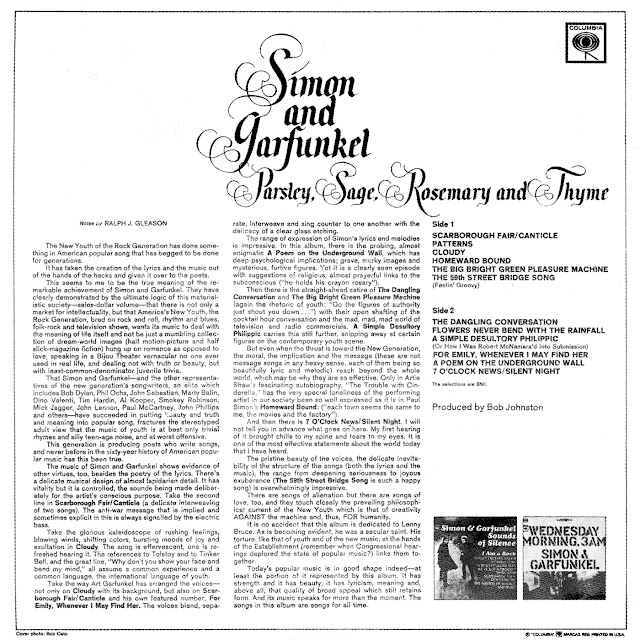

Simon & Garfunkel's first masterpiece, "Parsley, Sage, Rosemary and Thyme" was also the first album on which the duo, in tandem with engineer Roy Halee, exerted total control from beginning to end, right down to the mixing, and it is an achievement akin to the Beatles' "Revolver" or the Beach Boys' "Pet Sounds" album, and just as personal and pointed as either of those records at their respective bests. After the frantic rush to put together an LP in just three weeks that characterized the "Sounds of Silence" album early in 1966, "Parsley, Sage, Rosemary and Thyme" came together over a longer gestation period of about three months, an uncommonly extended period of recording in those days, but it gave the duo a chance to develop and shape the songs the way they wanted them. The album opens with one of the last vestiges of Paul Simon's stay in England, "Scarborough Fair/Canticle" - the latter was the duo's adaptation of a centuries-old English folk song in an arrangement that Simon had learned from Martin Carthy. The two transformed the song into a daunting achievement in the studio, however, incorporating myriad vocal overdubs and utilizing a harpsichord, among other instruments, to embellish it, and also wove into its structure Simon's "The Side of a Hill," a gentle antiwar song that he had previously recorded on "The Paul Simon Songbook" in England. The sonic results were startling on their face, a record that was every bit as challenging in its way as "Good Vibrations," but the subliminal effect was even more profound, mixing a hauntingly beautiful antique melody, and a song about love in a peaceful, domestic setting, with a message about war and death; Simon & Garfunkel were never as political as, say, Peter, Paul & Mary or Joan Baez, but on this record they did bring the Vietnam war home.


The rest of the album was less imposing but just as beguiling - audiences could revel in the play of Simon's mind (and Simon & Garfunkel's arranging skills) and his sense of wonder (and frustration) on "Patterns," and appreciate the sneering rock & roll-based social commentary "The Big Bright Green Pleasure Machine." Two of the most beautiful songs ever written about the simple joys of living, the languid "Cloudy" and bouncy "The 59th Street Bridge Song (Feelin' Groovy)," were no less seductive, and the album also included "Homeward Bound," their Top Five hit follow-up to "The Sound of Silence," which had actually been recorded at the sessions for that LP. No Simon & Garfunkel song elicits more difference of opinion than "The Dangling Conversation," making its LP debut here - one camp regards it as hopelessly pretentious and precious in its literary name-dropping and rich string orchestra accompaniment, while another holds it as a finely articulate account of a couple grown distant and disconnected through their intellectual pretensions; emotionally, it is definitely the precursor to the more highly regarded "Overs" off the next album, and it resonated well on college campuses at the time, evoking images of graduate school couples drifting apart, but for all the beauty of the singing and the arrangement, it also seemed far removed from the experience of teenagers or any listeners not living a life surrounded by literature ("couplets out of rhyme" indeed!), and understandably only made the Top 30 on AM radio. "For Emily, Whenever I May Find Her" was a romantic idyll that presented Art Garfunkel at his most vulnerable sounding, anticipating such solo releases of his as "All I Know," while "Flowers Never Bend With the Rainfall" was Simon at his most reflectively philosophical, dealing with age and its changes much as "Patterns" dealt with the struggle to change, with a dissonant note (literally) at the end that anticipated the style of the duo's next album.


"A Simple Desultory Philippic," which also started life in England more than a year earlier, was the team's Dylanesque fuzz tone-laden jape at folk-rock, and a statement of who they weren't, and remains, alongside Peter, Paul & Mary's "I Dig Rock & Roll Music," one of the best satires of its kind. And the last of Simon's English-period songs, "A Poem on the Underground Wall," seemed to sum up the tightrope walk that the duo did at almost every turn on this record at this point in their career - built around a beautiful melody and gorgeous hooks, it was, nonetheless, a study in personal privation and desperation, the "sound of silence" heard from the inside out, a voice crying out. Brilliantly arranged in a sound that was as much rock as film music, but with the requisite acoustic guitars, and displaying a dazzling command and range of language, it could have ended the album. Instead, the duo offered "7 O'Clock News/Silent Night," a conceptual work that was a grim and ironic (and prophetic) comment on the state of the United States in 1966. In retrospect, it dated the album somewhat, but that final track, among the darkest album-closers of the 1960s, also proved that Simon & Garfunkel weren't afraid to get downbeat as well as serious for a purpose. Overall, "Parsley, Sage, Rosemary and Thyme" was the duo's album about youthful exuberance and alienation, and it proved perennially popular among older, more thoughtful high-school students and legions of college audiences across generations. (Bruce Eder in AllMusic)
The closing track on the "Parsley, Sage, Rosemary & Thyme" album is one of the more unique and effective studio creations of the limit-smashing 1966-1967 pop era. The backdrop of the piece is a piano-backed version of Simon & Garfunkel singing an immaculate and tender version of the classic Christmas hymn "Silent Night." Yet, as the carol fades (barely) into the background, there is a wholly dramatic, dry reading of a news broadcast. As the events of 1966 such as civil rights marches, the death of Lenny Bruce, the escalation of the Vietnam War, and other horrifying events are read, the heavenly Simon & Garfunkel singing again gradually takes over. The effect is positively chilling, and creates an organic daydream nightmare that is scary, real, and undeniable (Matthew Greenwald in AllMusic)

[Silent night, holy night
All is calm, all is bright
Round yon virgin mother and child
Holy infant so tender and mild
Sleep in heavenly peace
Sleep in heavenly peace]

This is the early evening edition of the news.

The recent fight in the House of Representatives was over the open housing section of the Civil Rights Bill. Brought traditional enemies together but left the defenders of the measure without the votes of their strongest supporters. President Johnson originally proposed an outright ban covering discrimination by everyone for every type of housing but it had no chance from the start and everyone in Congress knew it. A compromise was painfully worked out in the House Judiciary Committee.

In Los Angeles today comedian Lenny Bruce died of what was believed to be an overdose of narcotics. Bruce was 42 years old.

Dr. Martin Luther King says he does not intend to cancel plans for an open housing march Sunday in the Chicago suburb of Cicero. Cook County Sheriff Richard Ogleby asked King to call off the march and the police in Cicero said they would ask the National Guard to be called out if it is held. King, now in Atlanta, Georgia, plans to return to Chicago Tuesday.

In Chicago, Richard Speck, accused murderer of nine student nurses, was brought before a grand jury today for indictment. The nurses were found stabbed and strangled in their Chicago apartment.

In Washington the atmosphere was tense today as a special subcommittee of the House Committee on Un-American Activities continued its probe into anti-Vietnam war protests. Demonstrators were forcibly evicted from the hearings when they began chanting anti-war slogans. Former Vice-President Richard Nixon says that unless there is a substantial increase in the present war effort in Vietnam, the U.S. should look forward to five more years of war. In a speech before the Convention of the Veterans of Foreign Wars in New York, Nixon also said opposition to the war in this country is the greatest single weapon working against the U.S.

That's the 7 o'clock edition of the news, good night.

segunda-feira, 1 de janeiro de 2018

S&G: The Concert In Central Park

Original released on Double LP Warner Bros 2BSK 3654
(US, March 1982)

Simon & Garfunkel reunited on September 19, 1981, to perform a free concert in Central Park, New York City. This two-record set presents some of the duo's biggest hits in a live context, and also allows listeners a chance to hear what many Simon solo numbers could sound like in S&G mode. (William Ruhlmann in AllMusic)


Related Posts Plugin for WordPress, Blogger...