Showing posts with label AHPC. Show all posts

Saturday, April 26, 2025

AHPC XV Submission #12 - Early WW2 German Kradschützen

 My last submission for this year's AHPC consisted of two squads of German Kradschützen for a total of 28 men on 24 motorcycles or in sidecars for Bolt Action.

Kradschützen, vorwärts!

 These are all 3D prints using STL files purchased from MyMiniFactory of German motorcycle troops either as single bikes or bikes with sidecars. Of the various sources for 3D prints I have seen, I thought these did an excellent job of rendering the Mauser Kar98k rifles and the M35 helmets. Where they fall down a bit is in depicting the standard German ammo pouches, which look more like the German Army flashlight. A few figures even had them positioned where the flashlight was often hung from the Y-straps. There was one figure that had pouches for MP40 magazines (yeah!) but was still equipped with a rifle (boo!). Also the motorbikes don't quite look like either a BMW or a Zündapp, primarily in the position of the muffler.

All the bikes were mounted on popsicle sticks using PVA glue. They were then primed with Vallejo German Panzer Grey Surface Primer using an airbrush. Painting was done primarily using Vallejo acrylics (Army Painter colours indicated by AP) as follows: faces and hands - Flat Flesh; jackets - German Fieldgrey; trousers - AP Uniform Grey; canteen covers - Flat Earth; gas mask canister - Luftwaffe Camo Green; helmets - Charcoal Grey; belts, jackboots, ammo pouches, and bike tires - Black; rifle stocks - Beige Brown; rifle slings - Mahogany Brown; metal weapons parts - German Grey; motorbikes - German Panzer Grey; motorbike seats, and goggle straps - AP Leather Brown. When all was done, the figures got a coat of Army Painter Strong Tone Quick Shade. Once the Quick Shade was dry, the bikes were mounted on bases that are either Warlord Games cavalry bases, or larger ones cut from old plastic restaurant gift cards.


 Thus concludes my painting challenge projects. Thanks for stopping by.

Thursday, April 24, 2025

AHPC XV Submission #11 - More Polish 10th Motorized Brigade

 For my penultimate submission for this year's challenge I painted up some more troops for my 10th Polish Motorized Brigade, also known as 'The Black Brigade'. 

10th Polish Motorized Brigade

Ten of the figures are from a box of Warlord Games Polish Infantry Squad in Greatcoats that I bought last July at Historicon. After I got back home I decided I would rather have a fourth squad of Black Brigade motorized troops and did a bit of conversion work, carving away the gas mask bag and replacing it with a German style canister, and swapping out the heads that came with Polish helmets for spare German ones. The M35 helmet doesn't have quite the same profile as the M16 helmet, so I added 'ventilation horns' characteristic of the earlier helmet. 

The remaining 24 figures are 3D prints using an STL from MyMiniFactory of Polish motorcycle troops wearing the black leather coats that gave the formation the nickname of 'The Black Brigade'. I am generally pleased with the look of the prints, but again there are a few niggling errors - the bayonet looks more like a belt knife, being rather small and mounted too high, the profile of the helmet is off at the back, rising much like a Soviet helmet, and two of the figures have 'carrying straps to nowhere', running over the shoulder, but with nothing suspended from them like a haversack or gas mask canister.

All the figures were mounted on 25mm round bases, and some fine sand was added using PVA glue. They were then primed with Vallejo Black Surface Primer using an airbrush. Painting was done using Vallejo acrylics as follows: faces and hands - Flat Flesh; greatcoats and trousers - Green Brown; haversacks and equipment straps - Green Grey; gas mask canister - Luftwaffe Camo Green; helmets - Brown Violet; belts and ammo pouches - Flat Earth; rifle stocks - Beige Brown; rifle slings - Mahogany Brown; leather coats and metal weapons parts - German Grey; jackboots - Black, bayonets - Gungrey. When all was done, the figures got a coat of Army Painter Strong Tone Quick Shade.

Polish motorized infantry squad (front)

Polish motorized infantry squad (side)

Polish motorized infantry squad (back)

Closeup of conversion work (gas mask canister)

Closeup of conversion work (ventilation horns added to helmet)

Polish motorcycle infantry Squad 1 (front)

Polish motorcycle infantry Squad 1 (rear)

Polish motorcycle infantry Squad 2 (front)

Polish motorcycle infantry Squad 2 (side)

 Since getting these troops painted, I acquired another STL from the same designer for motorcycles with sidecars and the field car similar to the Kromlech miniatures I painted up last year, but I haven't got them printed yet. A project for AHPC XVI?

Thanks for stopping by.

Tuesday, April 22, 2025

AHPC XV Submission #10 - Reinforcements for the 4th Indian Division


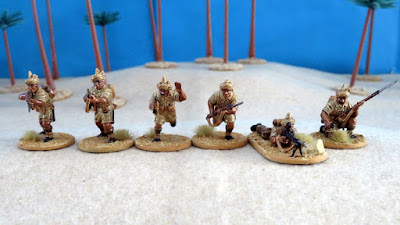
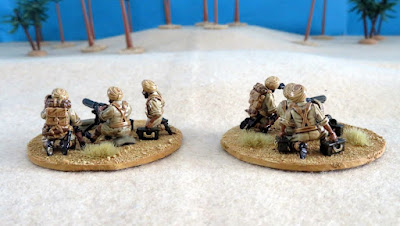
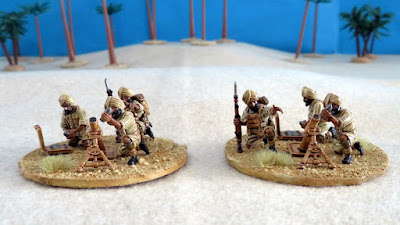
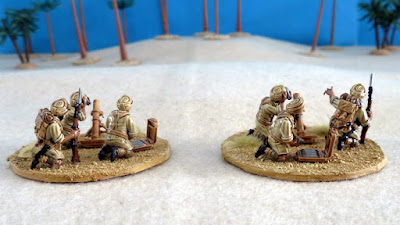
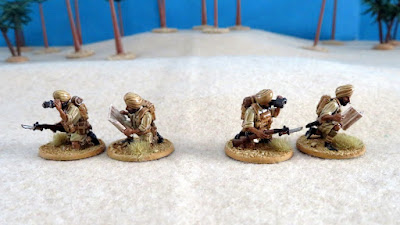
During last year's painting challenge I painted up several units of the 4th Indian Division in North Africa. However I felt that they needed some additional troops. For my tenth submission I  added another six-man section of the 4th Battalion, 16th Punjab Regiment, two Sikh Vickers machine gun teams, two Sikh 3" mortar teams, two Sikh two-man forward observer teams, and four Indian Pattern wheeled armoured carriers, each with a three-man crew inside. The final figure is a bit of a conundrum - an Italian NCO lost somewhere in the desert.

The section of Punjabis are from an 8th Army multipart sprue by Warlord Games. All the Sikhs and the armoured carriers are 3D prints using STL files from MyMiniFactory. Some of those figures were also multipart. While I liked the general animation and sculpting of the 3D prints, the designer got a number of the small details wrong such as buckles were there shouldn't be any, and missing buckles where they should be. Also the Bren guns are a little stubby, and the 'Lee-Enfields' look more like a Mauser than the SMLE used in North Africa. These complaints are just my OCD for historical accuracy kicking in, but most people probably won't notice when the figures are deployed on the tabletop. 

All the single figures were assembled and mounted on 25mm bases, and some fine sand was added using PVA glue. In the case of the support weapons and their crews, and the crews of the carriers, they were glued onto a popsicle stick with a small dab of PVA glue to give me something to handle while priming and painting. In the case of the carriers, only the wheels were separate pieces, and these were glued on after painting, but before any washes were applied.

All the figures and vehicle were primed with Vallejo Desert Tan Surface Primer using an airbrush, expect the wheels which were primed with Vallejo Black Surface Primer. This made painting the tires so much easier than trying to do it with a paintbrush. The soldiers' uniforms were left the base colour of Desert Tan. I then painted the rest primarily with Vallejo acrylics as follows: faces, arms and legs - Cork Brown; webbing - Iraqi Sand; canteen covers and ground sheets - US Field Drab; rifle stocks - Beige Brown; boots, beards, bayonet scabbards, and metal weapons parts - German Grey; socks - Khaki; gas mask bag - Tan Yellow; turbans - Dark Sand; machine gun water jackets and tripods - Camo Olive Green; mortar tubes - Tan Yellow, bayonets - Gungrey. Once completed, everything got the ol' "Army Painter Strong Tone Quick Shade" treatment. When that was dry, the support weapons and crews were glued to their bases using Super Glue. Here's the final result.
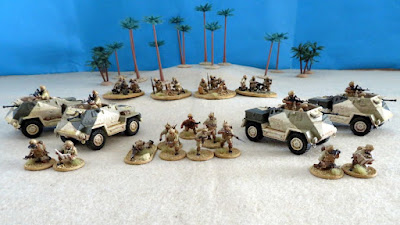
Reinforcements for the 4th Indian Division

Section of the 4th Battalion, 16th Punjab Regiment

Sikh Vickers machine gun teams (front)

Sikh Vickers machine gun teams (rear)

Sikh 3" mortar teams (front)

Sikh 3" mortar teams (rear)

Sikh Forward Observer teams
 

 One of the more interesting items in this submission are the four Armoured Carrier, Wheeled, Indian Pattern (ACV-IP), known also as the Indian Pattern Carrier or other similar names. It was an armoured car produced in India during the Second World War based on the Canadian Military Pattern truck chassis. It was typically armed with a Boys anti-tank rifle and a Bren light machine gun. Those produced by Tata Locomotives were called "Tatanagars" after the location of the works. A total of 4,655 were produced, and used by Indian units in the Far East and Mediterranean and Middle East theatres, typically in the divisional reconnaissance regiments. My friend who did the printing for me only produced five storage bins for the back of the vehicles, so I filled in the space on three of them with various tarps and fuel cans I had in my bits box. I also had to do some trimming off the back corner of the seats of the driver and anti-tank gunner in order to get them into their slot inside the vehicle without breaking something. These were painted using the Caunter camouflage scheme similar to the vehicles I did last year. The Vallejo colours used, going from lightest to darkest, are Ivory, Stone Grey, and German Field Grey. The vehicles then got a wash consisting of a mixture of 3 parts Citadel Seraphim Sepia, 3 parts Citadel Agrax Earthshade, and 4 parts water. When that was dry, they got a liberal application of Vallejo Wash FX Desert Dust.
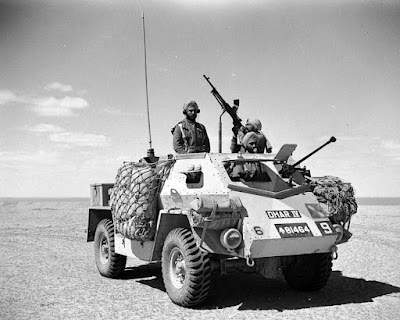
IWM photo of an Indian Pattern carrier with Caunter camo dated April 1942


The last figure in this submission is one I was gifted by fellow Fawcett Avenue Conscript, DallasE. It is an old Battle Honours mini he acquired two decades ago from either Bartertown or eBay with the purchase of a mixed bag of what was advertised as British 8th Army and German DAK. When I got him, he was still shiny metal. He was painted using a method similar to the Indian troops, and will now join my North Africa Italians from last year's challenge.


 Thanks for stopping by.

Sunday, April 20, 2025

AHPC XV Submission #9 - Roman Gladiators for 'Arena of Blood'

My ninth submission was a selection of Roman Gladiators from Crusader Miniatures that I plan to use with Wiley Games 'Arena of Blood' rules. In the past I have played gladiatorial combat with a variety of rules, some which were very complex regarding planning your attack or defence, while other required special dice to play, or a hex grid area. 'Arena of Blood' is a fast game that requires no measurement, and still provides a wide scope for both tactics and strategy. DaveV and I have taken the game to two games conventions so far, and the people who join in the game found it easy to learn, and fun to play. I will be running the game at PrairieCon at the end of May.

After some initial play testing with other members of the Fawcett Avenue Conscripts, we found that we didn't have figures for all the different types of gladiators available in the rules. A quick order to Crusader Miniatures filled the gaps for most of the types we were missing.

The figures were cleaned up of any mould lines, etc. and glued to some hexagonal bases that I picked up at Historicon. The two mounted gladiators and one of the velites all required a small javelin that I made to a length of florist wire. I added a layer of fine sand with PVA glue, and then primed them with Vallejo Desert Tan using an airbrush. I mounted the shields onto some popsicle sticks using some blue tack to hold them while priming, and painted the back side. The gladiators were painted using a variety of Vallejo and Army Painter acrylics. I made a point of varying the skin tone on the figures to present the different ethnic groups that became part of the Roman Empire using Flat Flesh, Cork Brown, and Chocolate Brown. Once the main figures were completed, I mounted the shields and then painted them. When everything was done, I finished off with a wash of Army Painter Soft Tone. Here is the final result.

"Ave Imperator! Morituri te salutant."

Murmillones & Crupellarius - A Murmillo was a heavily armoured gladiator wearing a fish crest on his helmet. Murmillones were typically paired with a Thraex opponent, but occasionally with the similar hoplomachus. A Crupellarius was the most heavily armed gladiator, whose armor consisted of a lorica segmentata, manica on both arms, and high segmented greaves up to the thighs. The helmet was typical for ancient Roman gladiators, completely covering the head and face with only small openings for the eyes and mouth.

Murmillones (1,3,& 4) and Crupellarius (2)


 Secutores & Scissor - The Secutor ("Pursuer") developed to fight the retiarius. The helmet of the secutor covered the entire face with the exception of two small eye-holes in order to protect his face from the thin prongs of the trident of his opponent. The Scissor fought using a weapon consisting of a hardened steel tube that encased the gladiator's entire forearm, with the end capped off and a wicked semicircular blade attached to it.


Scissor (1) and Secutores (2 - 4)

 Thraeces & Hoplomachi - The Thraex's weapon was the Thracian curved sword. They were introduced as replacements for the Gaulish gladiator type after Gaul made peace with Rome. They commonly fought murmillones or hoplomachi. The Hoplomachus was Romanised Greek for "armed fighter". He was equipped with a gladius and a very small, round shield. He also carried a spear, which he would have to cast at his opponent before closing to hand-to-hand combat.

Hoplomachi (1 & 2) and Thraeces (3 & 4)


Eques - Early forms of the eques gladiator were lightly armed, with sword or spear. They had scale armour; a medium-sized round cavalry shield (parma equestris); and a brimmed helmet with two decorative feathers and no crest. Later forms also had greaves to protect their legs, a manica on their right arm and sleeveless, belted tunics. Generally, they fought only other equites.


Provocatores & Dimachaeri - Provocatores were the only gladiators protected by a breastplate (cardiophylax) which was usually rectangular, later often cresent-shaped. They fought with a tall rectangular shield and the gladius. They were paired only against other provocatores.  The Dimachaerus (Greek διμάχαιρος, "bearing two knives") was a type of gladiator that fought with two swords. They were referred to as fighting against a hoplomachus class gladiator.

Dimachaeri (1 & 2) and Provocatores (3 & 4)


 Velites & Sagittarius - The Veles (pl. velites - "skirmishers") is presumed to have fought on foot, armed with a spear, sword and small round shield (parma); this also assumes that the type was named for the early and lightly armed Republican army units of the same name. The Sagittarius was an archer whose main weapon was the bow.

Velites (1 - 3) and Sagittarius (4)


 Thanks for stopping by.

Wednesday, April 16, 2025

AHPC XV Submission #7 - Gunfighters of the Old West

 In the Spring of last year I picked up the rules for 'What A Cowboy' from TooFatLardies. The mechanics of the game has similarities with their 'What A Tanker' rules, which I enjoy playing with the local gang of Fawcett Avenue Conscripts. However I didn't have any appropriate figures to go with the rules. While on my re-enacting travels I came across two sets of multipart plastic figures from Great Escape Games to go with their Dead Man's Hand rules. Each box contains two identical sprues with five sets of legs and torsos, but with enough options of heads, arms, and weapons to build ten unique figures. They have since come out with a box of mounted gunfighters, but the heads, and torsos match those in the first of the two sets. That is definitely a future project of building mounted versions of the gunfighters I have just painted.

 All the figures came with small oval bases, so they got glued onto larger 25mm round bases, and a layer of fine sand was then added to the bases with PVA glue. They were primed black with a rattle can before being painted with a variety of Vallejo and Army Painter acrylics. All the figures were given a coat of Army Painter Soft Tone Wash. The bases were painted with craft acrylics and a few tufts of dry grass were added. Here is the final result.

21 unique gunfighters of the Old West

 Here are some closeups of the figures built from the Gunfighters box. There were two figures where I didn't like the fit of the neck to the torso, so I covered up the area with a bandana sculpted out of epoxy putty. I have arranged the figures in the two photos so that the legs match from left to right. I was able to create ten unique figures from the options available.


Gunfighters - Group A

Gunfighters - Group B
 

 Here are some closeups of the figures built from the Gunfighters II box. Again I have arranged the figures in the two photos so that the legs match from left to right. It shows the variety that can be created from the options available to once more give ten unique figures.


Lady Gunfighters - Group A

Lady Gunfighters - Group B

In July I attended Historicon and the theme was 'From Hollywood to Historicon". Their 40th Anniversary Mini was a figure of ‘The Outlaw Josey Wales’ sculpted by Paul Hicks. It will be a useful addition to all the other gunfighters.

"Well, you gonna pull those pistols, or whistle 'Dixie'?"


 Thanks for stopping by.