Showing posts with label Poles. Show all posts

Thursday, April 24, 2025

AHPC XV Submission #11 - More Polish 10th Motorized Brigade

 For my penultimate submission for this year's challenge I painted up some more troops for my 10th Polish Motorized Brigade, also known as 'The Black Brigade'. 

10th Polish Motorized Brigade

Ten of the figures are from a box of Warlord Games Polish Infantry Squad in Greatcoats that I bought last July at Historicon. After I got back home I decided I would rather have a fourth squad of Black Brigade motorized troops and did a bit of conversion work, carving away the gas mask bag and replacing it with a German style canister, and swapping out the heads that came with Polish helmets for spare German ones. The M35 helmet doesn't have quite the same profile as the M16 helmet, so I added 'ventilation horns' characteristic of the earlier helmet. 

The remaining 24 figures are 3D prints using an STL from MyMiniFactory of Polish motorcycle troops wearing the black leather coats that gave the formation the nickname of 'The Black Brigade'. I am generally pleased with the look of the prints, but again there are a few niggling errors - the bayonet looks more like a belt knife, being rather small and mounted too high, the profile of the helmet is off at the back, rising much like a Soviet helmet, and two of the figures have 'carrying straps to nowhere', running over the shoulder, but with nothing suspended from them like a haversack or gas mask canister.

All the figures were mounted on 25mm round bases, and some fine sand was added using PVA glue. They were then primed with Vallejo Black Surface Primer using an airbrush. Painting was done using Vallejo acrylics as follows: faces and hands - Flat Flesh; greatcoats and trousers - Green Brown; haversacks and equipment straps - Green Grey; gas mask canister - Luftwaffe Camo Green; helmets - Brown Violet; belts and ammo pouches - Flat Earth; rifle stocks - Beige Brown; rifle slings - Mahogany Brown; leather coats and metal weapons parts - German Grey; jackboots - Black, bayonets - Gungrey. When all was done, the figures got a coat of Army Painter Strong Tone Quick Shade.

Polish motorized infantry squad (front)

Polish motorized infantry squad (side)

Polish motorized infantry squad (back)

Closeup of conversion work (gas mask canister)

Closeup of conversion work (ventilation horns added to helmet)

Polish motorcycle infantry Squad 1 (front)

Polish motorcycle infantry Squad 1 (rear)

Polish motorcycle infantry Squad 2 (front)

Polish motorcycle infantry Squad 2 (side)

 Since getting these troops painted, I acquired another STL from the same designer for motorcycles with sidecars and the field car similar to the Kromlech miniatures I painted up last year, but I haven't got them printed yet. A project for AHPC XVI?

Thanks for stopping by.

Sunday, December 8, 2024

Analogue Hobbies Painting Challenge XIV #2 - Early WW2 Poles


My second submission for the challenge was a selection of early World War 2 Poles of the 10th Cavalry Brigade, sometimes called the Black Brigade.  It was the only fully operational Polish motorized infantry unit during the invasion of Poland. The figures are from a range called Kromlech Historical. Unfortunately they are now out of production, but a few stores still have some remaining stock. According to some posts I found in a discussion group, the sculptor who designed the range passed away, and the company is planning to revamp the line at some point. These were picked up at another hobby store I visited while traveling home from a re-enactment event back in April. I had seen these online for a while, but I had resisted buying any until now. 

First up is a wz. 1914/1919 Skoda 100mm howitzer and crew, along with a 3D printed Polski FIAT 621L truck done by a friend of mine. He had already printed off four for me that I had painted for last year's challenge, and he felt bad that one of the truck beds was warped, so he printed off another to replace it, so I now have five. I ran into a bit of a snag when I went to assemble the howitzer and found that the wheels were missing. However a friend came through with a pair of wheels from his bits box that solved the problem. They were actually some Warhammer 40K Ork wheels that started out being pretty chunky, but I sanded them thinner to fit the Skoda. The end result works for me. The howizter's base is MDF and came with the set. It is designed so that two of the gunners can be removed as a result of casualties. The other two gunners are sitting on seats on the sides of the trail, and the sculpting is well done so that the folds of the greatcoat fit nicely up against it.


Next is a reconnaissance section consisting of two Sokol 1000 motorcycles with sidecars, and a Polski FIAT 508 III Lazik field car, with three drivers and five soldiers, two armed with Browning wz. 28 automatic rifles. The motorcycles are resin castings, while the field car is a combination of resin and metal bits, such as the front bumpers, windshield, steering wheel, and front seat. All the drivers and crew are metal. Everything went together nicely, although I did have to trim the feet of the field car driver so that he would fit into the front seat better. The motorcycles came with MDF bases, and I decided to make a base for the field car so that it would be easier to handle. The front bumpers looked like something that could get broken off on the gaming table. I quite like the sculpts of the passengers. Instead of the usual staid poses that one sees, the men have their weapons at the ready. The ones in the field car have a foot on the running board, ready to leap out, while the passengers on the motorcycles look like they are leaning into the wind as the bikes speed along.


Lastly I have a section of motorized infantry wearing German WW1 style helmets and gas mask canisters, and armed with Karabinek wz.29 rifles, plus one man carrying a Browning wz. 28 automatic rifle. With the exception of the squad leader, all the figures were one piece castings. They came with 25mm round MDF bases, but since all but one came with a tab designed for a slotted base, I mounted them on some I had in my inventory already. Although some of the proportions seem a bit off, the animation in the sculpts is quite dramatic with lots of variation. One soldier has his collar turned up, while another is a left-handed shooter.There was only one figure that I modified a bit by trimming the length of one corner of his greatcoat that didn't look right.


All of the figures and vehicles were painted using Vallejo acrylics and then given a coat of Army Painter Strong Tone Quickshade. The Quickshade leaves the figures with a glossy sheen, so when the weather is warm enough to go outside, they will get a treatment of matt spray. The colour palette was essentially that laid out in 'Flames of War' for Polish infantry, with the exception of the tall boots worn by the 10th Brigade that were painted black instead of flat earth. See the illustration from 'Flames of War' below for the different colours used.


Wednesday, January 11, 2023

Analogue Hobbies Painting Challenge XIII Submission #1 - Opening Salvo

 This may seem more like a collection of random shots rather than a concentrated salvo, but it clears away a number of small projects associated with my various Bolt Action armies, specifically my early war Poles, early war Germans, and late war British.

 Last year I started the challenge by painting a squad of the Polish 10th Motorized Brigade. One squad just wasn't enough, so I added a second squad from the Warlord Games Bolt Action range. These were painted using Vallejo acrylics followed by a coat of Army Painter Strong Tone Quick Shade. Since you can't be a motorized brigade without some motor transport, I have added four Polish Fiat trucks to move them around the battlefield. These are 3D prints done by a friend. One of the truck beds came out a bit warped and my attempts to fix it were unsuccessful. In the end I scratch-built a replacement from thin plastic card. These were also painted with Vallejo acrylics followed by a wash of Vallejo European Dust.


Polish 10th Motorized Brigade squad (Last year's squad taking cover in the background)


A column of Polish Fiat trucks
 
 Since many of the scenarios in the 'Germany Strikes' campaign book involve command tanks, I decided to add a Panzerbefehlswagen I (aka Sd.Kfz. 265). This is a 3 piece resin casting from Warlord Games with metal bits such as the machine gun, hatches, and commander. The pose of the commander had his right arm extended to rest on a turret hatch, but it didn't match up with the location of the hatch on the tank model. I decided to remove the arm and replace it with one holding a pair of binoculars that was left over from a German Blitzkrieg Infantry sprue. The tank was primed black using Vallejo Surface Primer and painted grey using AK Interactive Dunkelgrau. Highlights were dry brushed onto raised surfaces and some AK Splatter Effects Dry Mud applied to the tracks and road wheels. Since the theme of the special challenges this year is a movie studio, I also painted up a Propagandakompanie cameraman, also from Warlord Games. It was painted using Vallejo acrylics followed by various Citadel washes.
 
 
Cameraman filming a command tank during the invasion of Poland

Panzerbefehlswagen I of the 4th Panzer Division

 
Cameraman of a German Army propaganda company

 
 Next up is a Churchill Crocodile flamethrower tank of the 79th Armoured Division in Normandy. I got another Corgi diecast Churchill tank from another member of the Fawcett Avenue Conscripts that was painted up for Tunisia in Desert Yellow and Olive Green camouflage hoping to use it with my planned 8th Army project, but the yellow on the model didn't look very desert. Last year I had repainted one in the colours of the the 14th Tank Regiment (Calgary Tanks) at Dieppe, but I didn't need anymore Dieppe tanks. I decided to convert it to a Crocodile using a resin conversion kit from Quarter Kit Model Shop in Paris, France. This was basically the armoured trailer that carried the fuel for the flamethrower, and the special nozzle that replaced the hull machine gun.  The resin of the kit was quite brittle, and a few pieces arrived broken despite being shipped in a blister. With the careful application of some super glue followed by a sprinkling of baking soda, everything got repaired and assembled. Both tank and trailer were primed in black and then painted with Vallejo UK Bronze Green. Raised surfaces got dry brushed with a light green, and the lower areas of the tank were given a wash of European Dust.
 
 
Side view showing how the trailer was attached to the tank.

 
View from above showing the special nozzle in place of the hull MG

Next we have a small bit of terrain. Last year I painted a stone bridge as part of my first submission, so it seems appropriate to finish this submission with a broken bridge. The two halves are actually display bases that came with 1/72 Matchbox Sherman Firefly kits when they were released back in 1974. I no longer have the tanks, but I still had the display bases in one of my boxes of terrain building bits. A number of different ideas have been bouncing around in my head over the years, including building the center portion of the span that could be lifted out in a scenario where the bridge gets blown, a partially constructed repair done by engineers, or incorporating the two halves into a more elaborate river crossing with a ruined central support of a two arched bridge. I am not entirely sure what final direction I will take, so I am going to call this 'Under Construction'.
 
 
A bridge over troubled waters?

 
Thanks for reading.

Saturday, January 8, 2022

Challenge Submission #2 - Early WW2 Polish Reinforcements

I started painting an early WW2 Polish army two years ago, and wanted to flesh it out with a few more support weapons and vehicles. For this submission I have completed a Polish 10th Motorized Brigade Squad, a Polish Army Medium Motor Team, a boxed set of Polish Army Marksman, Anti-Tank Rifle, and Light Mortar teams, and a Polish Vickers E 6 ton Tank, all from Warlord Games. All are 28mm or 1/56 scale with the foot figures cast in metal and the Vickers 6-ton cast in resin. The armoured car is actually a 1/48 scale plastic model of a Soviet FAI-M light armoured car by Ace Models, a company out of Kyiv, that I picked up from a local hobby store. I painted it in Polish camouflage to stand in as a proxy for a Samochód pancerny wz. 34 light armoured car. As with the Polish Army miniatures I had already done, these were painted using Vallejo acrylics and then treated with Army Painter Strong Tone Quick Shade.

Polish armoured car and Vickers E 6-ton tank


Polish Army Mediuim Mortar Team


Polish Army Marksman, Anti-Tank, and Light Mortar Teams. The bases for the prone anti-tank rifleman, and the light mortar are cut from recycled plastic gift cards.


Polish 10th Motorized Brigade Squad consisting of a squad leader in the unit's distinctive black leather jackets, a BAR gunner, and eight riflemen. When the brigade was formed, the men were equipped with WW1 vintage German and Austro-Hungarian helmets.


 Thanks for reading.

Friday, November 19, 2021

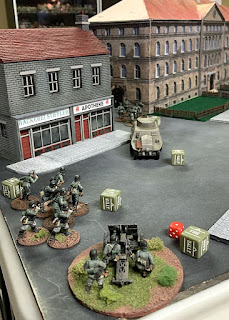
The First Shots – Early-WW2 Bolt Action Battle Report

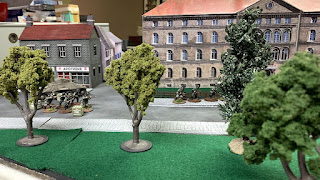
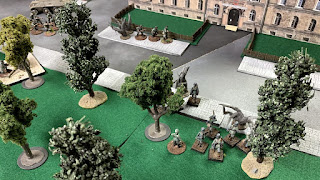
A year ago I finally finished painting my early war Polish army and was looking for a suitable scenario to deploy them on the table top. I hit upon Scenario 1 from the Bolt Action campaign book ‘Germany Strikes!’ which is about the defence of the Polish Post Office in Danzig. There were a few special units required, such as Steyr ADGZ armoured cars and several German light and medium artillery pieces. Doing some research into the actual battle, I was inspired to not only paint up the additional units, but to build the center piece of the battle, the massive Polish Post Office itself. (Use the tag ‘Polish Post Office Danzig’ to find the related posts on our blog.)

Last night Conscript Dallas hosted the game in the ‘Churchill Bunker’ with five other conscripts to command the Polish and German Forces. The Poles are superior in quality to the majority of German units, but they are significantly outnumbered and outgunned.  With the hard cover of the post office building, and the inexperience of the attackers, it would still be a difficult task for the Germans to capture the building.


The Polish Forces consisted of 2nd Lieutenant Konrad Guderski, six rifle sections of four men, two light machine gun teams, and two grenade launcher teams. Guderski is a veteran with a +2 morale modifier, and the rest of his men are regulars. The Poles have a ‘No Where To Run’ special rule which allows them to re-roll failed morale tests. In addition, Guderski also has a ‘They Shall Not Pass’ special rule where he can set off a massive grenade charge which causes every model  within  a radius of 3” of him (including himself)  to take a hit with a +1 Penetration value.

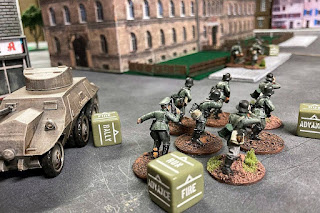
The German Forces consisted of a mix of SS-Heimwehr Danzig, SA, and Ordnungspolizei, supported by two armoured cars, a medium machine gun team, two light howitzers, a medium howitzer and a small section of assault pioneers with a flamethrower and satchel charges. They would come on in three waves as follows:

1st Wave: 1 x 2nd Lieutenant, 2 x Ordnungspolizei Sections, 1 x MMG Team, 1 x Light Howitzer, 1 x Steyr armoured car, Deploy on the table anywhere outside 12” from the Post Office.

2nd Wave: 1 x 2nd Lieutenant, 3 x SS-Heimwehr Danzig Sections, 1 x Assault Pioneer (Sapper) Team, 1 x Medium Howitzer. Enter on Turn 3 from any board edge

3rd Wave: 1 x Sturmabteilung Section, 1 x Light Howitzer, 1 x Steyr armoured car.  Enter on Turn 4 from any board edge.

While the officers, support weapons, armoured cars, and sappers are regulars, the rest are all inexperienced with the SS-Heimwehr also rated as Green (on first casualty roll D6 - 1: extra D6 pins & go Down, 2-4: no effect, 5-6: upgrade to Regular), and the SA rated as Shirkers (always take order test, count pins as double).

The Polish defenders were trying to hold more rooms in the post office building than the Germans at the end of the game, which would last a minimum of 5 turns. At the end of that turn, there is a chance of a sixth turn, with a chance of a seventh.

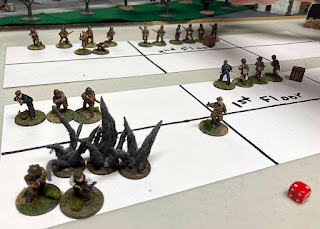
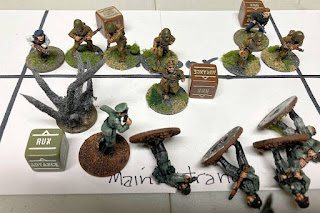
Rather than have the Poles inside the building model, they were deployed on a grid off board designating the six rooms on each floor. Not knowing where the Germans were coming from, the Polish players deployed in ‘all round defence’

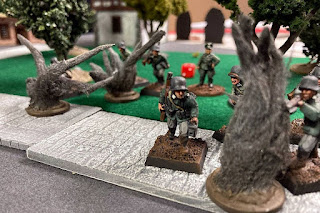
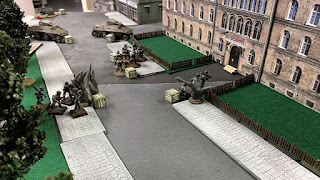
The Germans players deployed their first wave near the eastern end of the post office building, and began bringing artillery and machine gun fire on that part of the building. Initially the German artillery had little success, and the Polish defenders were able to take out the Germans’ MMG team. However, with the arrival of the second wave, things started to swing over to the Germans’ side. They were able to score a devastating hit with the medium howitzer that took out a rifle section, a grenade launcher team, and a LMG team.  Meanwhile two sections of SS-Heimwehr tried charging the front entrance of the post office, and the Assault Pioneers planted a satchel charge against the west end of the building. 
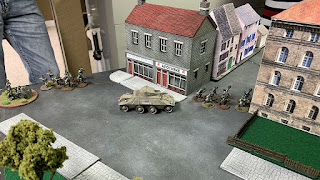


Although Polish casualties were mounting, the defenders successfully repelled some of the Germans rushing the front entrance. One Heimwehr section got upgraded to Regulars on receiving their first casualty, but later rolled a ‘FUBAR’ on their command check two turns in a row and ran off the game board. However, a section of Ordnungspolizei and an officer were able to get inside.  At that point the Polish commander set off a bag of grenades in the midst of the Germans that wiped out the squad, but due to the vagaries of the game rules, the Polish and German officers both managed to survive the blast.
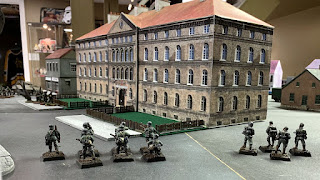


Despite this brief success, the Germans gradually managed to gain the upper hand. Polish squads were forced to retreat to the south side of the building to avoid the German artillery fire, while the Steyr armoured cars started to drive around to that side to bring them under machine gun fire. Meanwhile the satchel charge blew a hole in the west wall allowing more German squads to enter the building. 


The game ran to the maximum seven turns with the Germans finally controlling more rooms than the Poles at the very end. This played out much as the historical battle. At the end of the game, I gave a brief summary of the fate of the Polish defenders. The players enjoyed the game, which hung in the balance until the final turn.  It was good to finally see all the newly painted units on the table top, as well as the model of the post office building. A few of the conscripts have suggested that the scenario would do well as a participation game at a wargames convention.  Until next time!