Showing posts with label 2nd Canadian Divsion. Show all posts

Monday, October 3, 2022

Dieppe at 80 - Green Beach - Petit Appeville Bridges

 As Conscript Dallas hinted at the end of his Dieppe- White Beach post, the Petit Appeville scenario was connected to the results of that game. If the Calgary Tanks had been able to penetrate into Dieppe, there was a chance for them to meet up with the Cameron Highlanders. The details of the game were taken from a book titled 'This Is War - Raid On Dieppe!' by Tim Waybright that was published in 2010. The composition of some of the elements listed in the book, as well as their morale ratings, were tweaked to fit the Bolt Action rules.

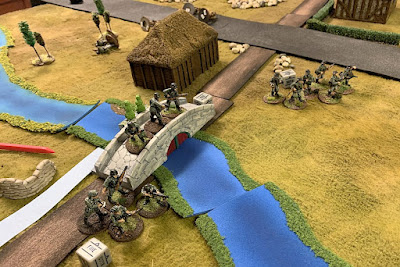
Members of the Queen's Own Cameron Highlanders of Canada advanced inland towards their objective, having pushed through Pourville after landing 30 minutes late. They were harassed by enemy fire from the heights to the east of the River Scie, and so moved to their right to proceed under cover of trees to a position looking down on the bridge of Petit Appeville. Unaware that the tanks which were landing on Red and White Beaches were unable to get through Dieppe, their orders were to take and hold the vital road junctions until the armour could advance. Unfortunately for them, the German commander had already dispatched troops to do the same thing.
 

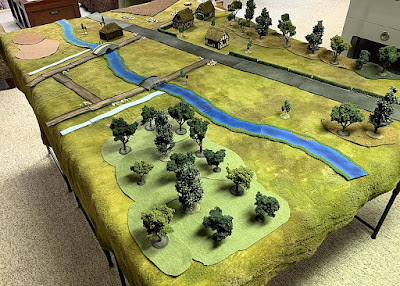
Petit Appeville bridges, looking East

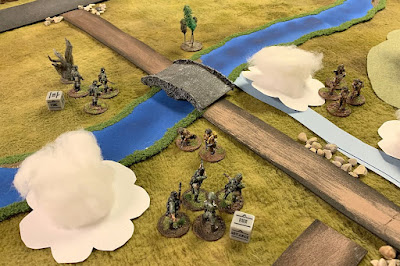
Petit Appeville bridges, looking South
 

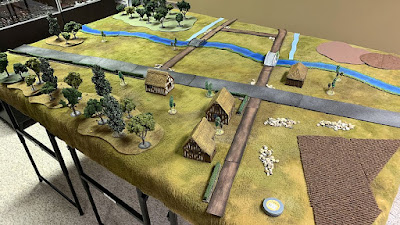
According to the scenario outline, the Germans could deploy anywhere up to 26" from the southern board edge. They would also have 5 hastily dug slit trenches that could accommodate two men each and provide light cover. All the woods were considered light woods that did not impede movement on foot, but troops in the woods could not be given a RUN order. The hedges were low and provided no cover. The buildings and woods both provided light cover, while the  wheat field and stone piles blocked line of sight to any prone figures. The River Scie, running down the center of the board had steep banks that gave heavy cover to models adjacent to the river's edge, while the ditches were an obstacle to wheeled vehicles only. The Canadian entry points were anywhere along the northern and western edge of the table outside the German deployment zone. The game would run a minimum of six turns, with a 50% chance of a seventh.

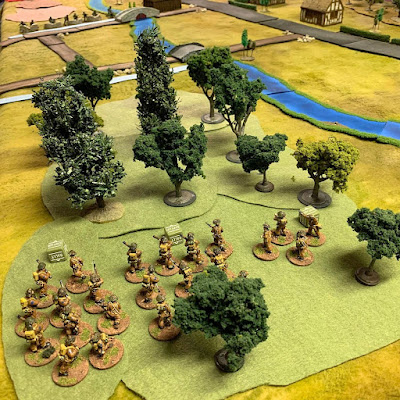
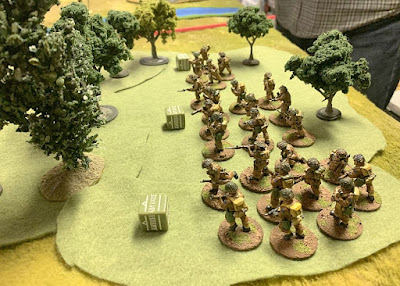
The Canadians are elements of 'B' and 'C' Companies of the Queen's Own Cameron Highlanders of Canada under the command of Major A.T. Law. They consisted of a headquarters section of Major Law (+4 morale bonus, 4 extra order dice, 12" command radius) plus three soldiers, three infantry sections of ten men (1 SMG, 1 Bren gun and loader, 7 rifles), a 2" mortar light team, and a 3" medium mortar team. All the Canadians were rated as Regulars, and given the 'Up an' at 'em' national characteristic option, which meant any assault orders were considered to be automatically passed.


Cameron Highlanders under Major Andy Law


The Germans are elements of the 1st Battalion, 571st Infantry Regiment, 302nd Division under the command of Oberleutnant K. Fischer. They consisted of a headquarters of Oberleutnant Fischer (+2 morale bonus, 3 extra command dice, 6" command radius) plus two soldiers, two infantry sections of ten men (2 SMGs, 1 LMG and loader, 6 rifles), a 50mm light mortar, and a 75mm light howitzer towed by a truck. They also had a Kübelwagen with a Leutnant (+1 morale bonus, 2 extra command dice, 6" command radius) and three riflemen that could enter along one of the roads from the East starting on Turn 3 on a D6 score of the Turn Number or less. The Germans also had the army characteristics of 'Blitzkrieg' (officers draw an extra order dice) 'Hitler's Buzzsaw' (MGs get an extra fire dice), and 'Initiative Training' (on the loss of a section leader, roll a D6, on a score of 2-6, the second in command takes over with no morale loss).
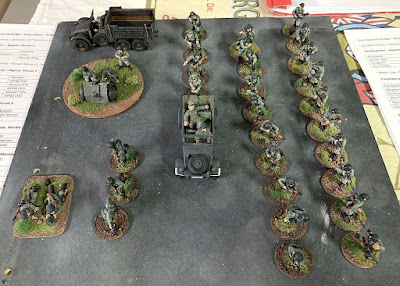
 

German forces under Leutnant Karl Fischer
 

Unlike many of our earlier Bolt Action games that featured anti-tank gun and medium machine gun teams as the support weapons, this time we had a lot of indirect fire from the mortars and the light howitzer with the use of smoke rounds to mask troops from enemy fire.
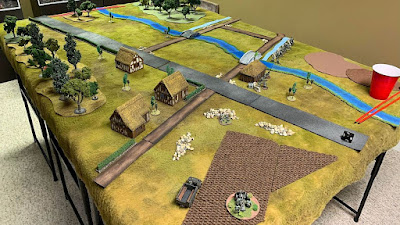
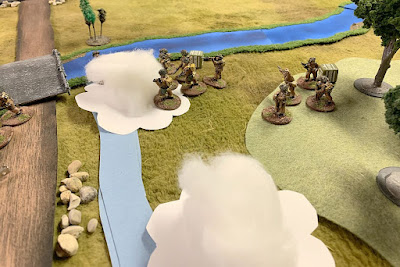
Initial German deployment
 

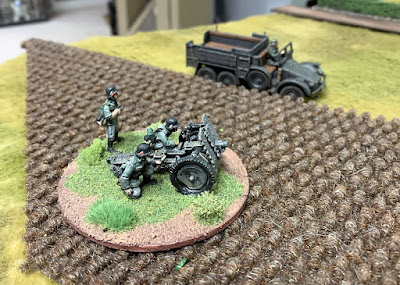
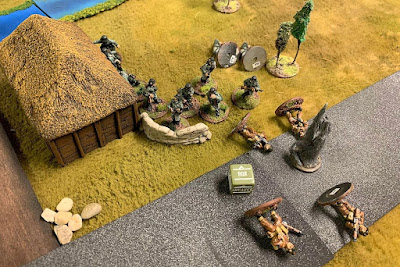
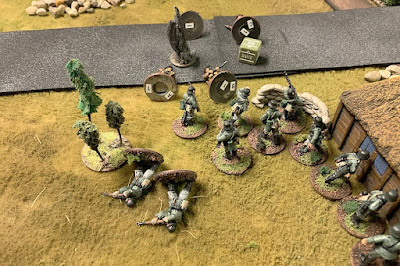
The Germans set up with one section in slit trenches along the southern ditch, one section in the wooden building just west of the River Scie, the mortar team behind a stone pile near the southern crossroad, and the light howitizer in the wheat field. On Turn 1, the Canadians began entering from the northern and western board edges, using the woods for cover. 
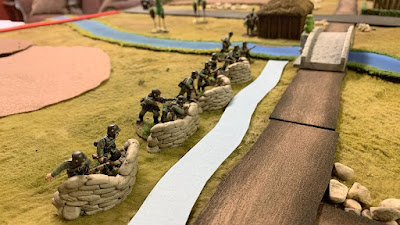
 

German slit trenches

 
German light howitzer and tow


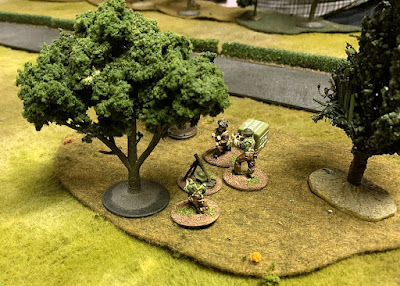
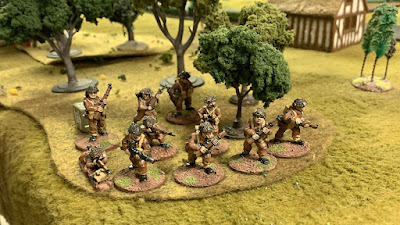
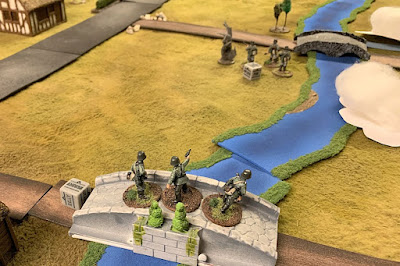
Major Law with two infantry sections

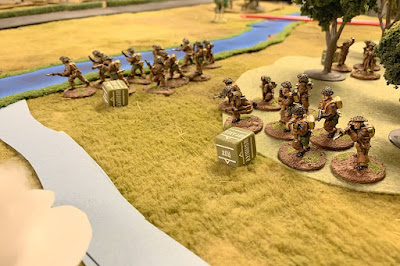
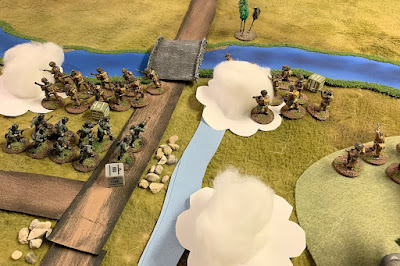
The Canadians advance in force

3" mortar team moves into position


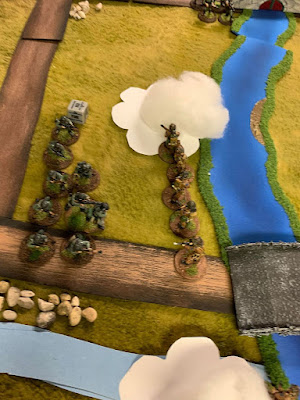
A Canadian section moves up in the western wood

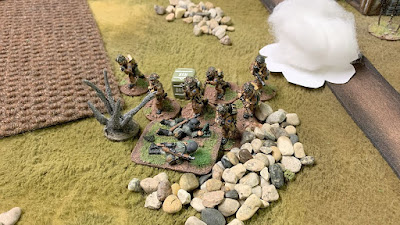
2" mortar ready to provide HE or smoke

At first, there was little the Germans could do as the Canadians were either out of range or obscured by intervening terrain. Meanwhile the Canadians used Major Law's command ability to activate a significant number of their elements with the 'You men, snap to action!' rule. As the Canadians worked their way forward from the north, the third section moved in from the west to engage the German mortar with small arms fire and followed up with an assault. The German mortar team reacted quickly enough to shoot two of the Canadians before being overwhelmed.
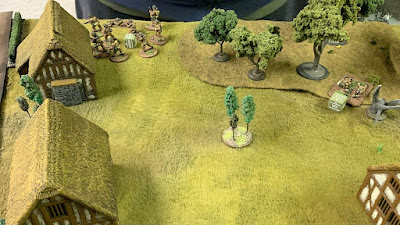
Canadians moving to the west of the village

 
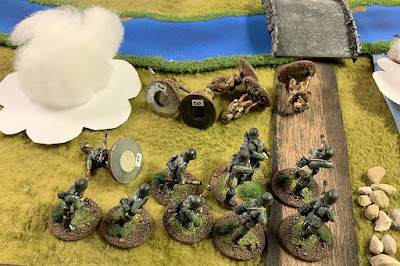
German mortar team assaulted by Canadians

The Germans reacted by pulling one of their sections out of the building they occupied and bringing concentrated fire onto the Canadian attackers. Undeterred by casualties, the Canadians pressed their attack and came to close quarters with the German infantry. More men fell to German defensive fire before those remaining were put out of action in the ensuing melee.
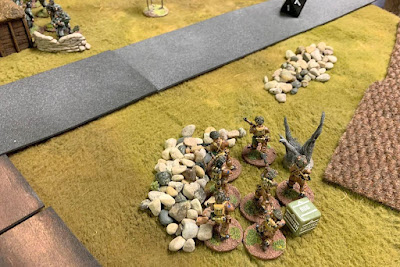
Canadian section regrouping
 
Germans respond to the flank attack

A gallant but futile assault by the Canadians

The German section wins the fight

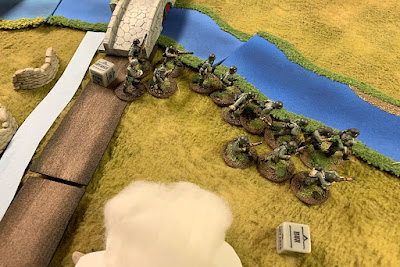
Meanwhile the Canadians advancing from the north came within range of the German section manning the slit trenches. The mortars were able to provide some cover by dropping smoke rounds to obscure the German fire as one Canadian section moved out of the woods to advance along the river bank. With the threat from the West eliminated, the Germans abandoned their trenches to drive the Canadians away from the northern bridge. The Canadians responded by pushing further south to get into a blocking position. It was very 'touch and go' at this point with success going to which ever side drew the first order die. 

Luck went to the Germans who were able to assault the lead Canadian section from close range.  The Canadians went down to defeat, either killed or captured. The supporting Canadian section counterattacked with supporting fire from Major Law's HQ section, but they were in turn counterattacked by the German platoon command that has arrived in the Kübelwagen. The Germans then ordered a general advance with all their personnel. The infantry section that had previously been successful in fending off the Canadian bayonet charge now fell prey to some accurate 3" mortar fire, an accurate HE impact taking out the section commander, the LMG, and a rifleman. Despite the losses, the survivors successfully passed their morale check. The action went down to the wire in the seventh turn, but in the end the bridge was still contested, which was a victory for the Germans. The tanks never arrived.
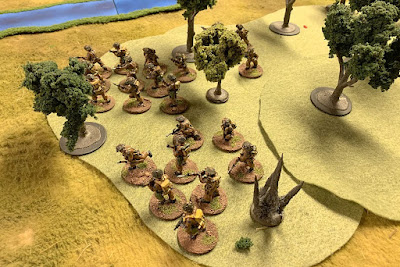
Canadians close on the northern bridge

Germans move to counterattack

Canadian section advances along riverbank

Canadians advancing through a smoke screen

Germans outflank the lead Canadian section

Canadians pinned against the riverbank

Canadians are defeated in the melee


Oberleutnant Fischer orders a general advance
Germans west of the river are hit by 3" mortar HE fire

Germans regroup to await a counterattack

Canadian counterattack is hit by fresh troops

German commander surveys the battlefield

This was an interesting game, one which I have wanted to run ever since I read the scenario in the campaign book. As mentioned earlier, the support weapons were primarily indirect fire. It's very hard to get a first round on target. In fact, only one round of HE fire hit its mark, but with devastating effect, killing 3 of 4 that were caught in the blast. The smoke was also an aspect of the game that we have never played before. Even misses still land on the table, placed by the opposing side with 12" of the aiming point. Plus smoke has the possibility to dissipate, drift, or persist, depending of a dice roll at the beginning of any turn where there is smoke on the board.

The victory conditions were difficult for the Canadians to achieve. All the Germans had to do was get an element within 6" of a bridge to contest control to prevent the Canadians from winning. Still, it was a near run thing. Had the first die out of the cup at the beginning of Turn 6 been a Canadian one, it might have gone the other way.

On a historical note, during the fighting at Petit Appeville, the Camerons received a radio order from brigade headquarters to withdraw back to Green Beach to re-embark. Major Law was one of those who made it back to England. In January 1943 he was promoted to the rank of Lieutenant Colonel and commanded the Camerons until February of the following year. He was awarded the Distinguished Service Order, and was also 'mentioned in dispatches'. The regiment eventually returned to France in July 1944.

 Thanks for reading. Be sure to comment.

Saturday, January 1, 2022

Second World War Canadians

With many of the Conscripts involved in the Analogue Hobbies Painting Challenge, there have not been many posts on our blog page lately, so here is another one of my ‘Armies in Review’ posts. When I started doing Bolt Action my first army of choice was a Canadian force, and as I had been a member of the Queen’s Own Cameron Highlanders of Canada in my younger days, I wanted to paint up my infantry units marked for the 2nd Canadian Division, and all the supporting units marked for those that actually supported the Camerons in Northwest Europe in 1944-45. At the moment I can currently field two 38 man infantry platoons, a company headquarters, a 6pdr anti-tank gun, 3 Vickers medium machine guns, 2 medium mortars, a carrier platoon of four Universal carriers, a few 25pdr field guns, a forward observation officer, a reconnaissance troop of scout and armoured cars, a troop of Sherman tanks, and a pair of Ram Kangaroo armoured personnel carriers.

The full force on parade.

Vickers machine gun teams, mortar teams, and 6pdr anti-tank gun

The machine gun teams are a mix of manufacturers being (from left to right) old school Bolt Action, Crusader Miniatures, and Westwind Miniatures. The team 'on the move' is also by Westwind. The 6pdr anti-tank gun and the mortar teams are by Battle Honors.


Carrier platoon to rapidly move the support weapons

The two carriers on the left are metal models by Battle Honors, with crews and extra stowage by Bolt Action. The two carriers on the right are resin casting by Bolt Action, as are the crews. The dimensions for the Battle Honors carriers are a bit off, primarily in that the part of the vehicle in front of the driver is too short. They end up being wider than the Bolt Action castings, but the same length.


Ram Kangaroo armoured personnel carriers

The Ram Kangaroos are conversions using the chassis from a 1/50 scale Solido Grant tank and a resin kit from Quarter Kit. I had purchased the Grants as something to use with my Soviets, but once I had enough T34/76 tanks, they got repurposed. The conversion kit went together very nicely, but I think they are no longer available.


Company headquarters, with supporting artillery in behind

All the figures are from the Westwind range, with the jeep being a repainted 1/50 scale Corgi diecast model with a crew from Bolt Action that was specifically marketed to go with the Corgi jeeps. At some point I have to do a conversion on the officer to replace his forage cap with a proper Highland Balmoral.


First platoon of the Queen's Own Cameron Highlanders of Canada

The platoon consists of a headquarters, a PIAT team, a light mortar team, and three 10 man sections, all wearing the blue divisional patch of the 2nd Canadian Division. The infantry sections are a mix of Westwind Miniatures and Crusader Miniatures. The Westwind figures are closer to true 25mm size, and I really love the animation in the sculpts. Each section consists of a section commander with a Sten gun, a Bren gun team and seven riflemen. The officer, NCO, and radio team of the platoon headquarters are Westwind castings, and the PIAT and Mortar teams are from Crusader.


Second platoon with the same composition as the first


A reconnaissance troop of two scout cars and two armoured cars

The reconnaissance regiment of the 2nd Canadian Division was the 8th Reconnaissance Regiment (14th Canadian Hussars). The Daimler 'Dingo' scout cars and the Daimler armoured cars are repainted Dinky Toy diecast models that I picked up cheaply from eBay. All had seen a lot of wear and tear, and much of the original paint had worn off, which was the main reason why I got them for the minimum bid. I didn't mind about the paint as I planned to repaint them anyway.


A troop of Sherman tanks 

The 2nd Canadiain Division regularly received armoured support from the 2nd Canadian Armoured Brigade. Since this gave me another opportunity to represent a home town unit on the gaming table, these Shermans are marked as 'C' Squadron Fort Garry Horse. They are all Solido 1/50 diecast models. Two were originally the version of the Sherman with the 105mm howitzer. On one of these I replaced the howitzer barrel with an appropriate 76mm barrel, while the other was converted to a Sherman 'Firefly' with a 17pdr anti-tank gun using a resin kit from Quarter Kit. All have extra track sections welded to their hulls to beef up their armour, as well as plenty of gear stowed on the rear deck. The extra track and stowage are resin casting.


25pdr field gun, transport, and a forward observation officer

One of the artillery units that was part of the 2nd Canadian Division was the 4th Field Regiment Royal Canadian Artillery. All the vehicles sport the proper tactical signs for that unit. The field gun, limbers, and crew are Battle Honors casting, while the Quad Field Artillery Tractors are again Dinky Toy diecast models acquired off of eBay and repainted. 


Me (on the right) in a Universal carrier

The above photo was taken in front of the Manitoba Legislative Building during the 100th Anniversary parade of the formation of the Queen's Own Cameron Highlanders of Canada in 2010. The vehicle bears the correct tactical signs for the Camerons. Thanks for reading. I wish everyone all the best in 2022, and good luck to all the Conscripts who are involved in the Analogue Hobbies Painting Challenge.


Saturday, April 2, 2011

Maple Leaf Up

After a flurry of posts on my 2nd Canadian Division in January and February, things got rather sparse in March. Painting slowed down a bit, but I got some additional figures completed: a 25 pounder howitzer with crew and limber, a 6 pounder anti-tank gun with crew and limber, two 3 inch mortars with crew and a group of eight Foundry French partisans. Battle Honors 25 Pounder with crew and limber. I have been looking for a vehicle to tow this but nobody seems to make a Quad Gun Tractor in any scales other than 1/72 or 1/35 Battle Honors 6 pounder anti-tank gun and crew. It came with an ammunition limber but my research seems to indicate that these were not used. One of my Universal Carriers will be the vehicle used to haul this around the battlefield. Battle Honors 3 inch mortars with crew. While I find that the sculpting of the Battle Honors range is not up to the same standard as the Bolt Action or Crusader range of miniatures, I like the fact that the crew are in shirt-sleeve order. Having fired an 81 mm mortar, I know that hauling that around and humping ammo can be sweaty work. Foundry French maquis. I picked these up years ago just because I loved the sculpting on these figures. They are equipped with a mixture of British and captured German rifles, pistols and sub-machine guns. I always find painting motley attire more difficult that uniforms, often because I can't decide what colours would look right. I ended up with a range of blues, browns, grays and black that seemed appropriate for 1944 French civilians.

Sunday, February 6, 2011

More vehicles for the 2nd Canadian Division Motor Pool

I have added four jeeps and crews to my 2nd Canadian Division. The vehicles are Corgi 1/50 scale and the crews are Bolt Action Miniatures from several years ago that were sculpted to specifically fit into the Corgi Jeeps. Two of the jeeps originally had red crosses on the hood while the other two had the white star, which I did not paint over. All the vehicles were re-painted in British/Canadian colours and appropriate divisional and unit markings added. One of the drivers that I had was wearing a field service cap rather than a helmet, so I put Artillery markings on it for the 4th Regiment RCA. The rest were done up with the markings of the Queen's Own Cameron Highlanders of Canada. Now my company commanders don't have to walk to the battlefield any longer.

Sunday, January 16, 2011

Carrier Platoon moves to the Front

With the completion of my second rifle platoon, it was now time to work on the Carrier Platoon. For the painting and marking of the vehicles, I had photos of the "real deal', a restored Universal carrier, complete with markings of the Queen's Own Cameron Highlanders of Canada, 6th Brigade, 2nd Canadian Infantry Division. When I bought my West Wind Canadians, I also picked up two Universal carriers by Battle Honors. Those were later supplemented by two Bolt Action Miniatures Universal carriers along with enough crew for all four. The BAM carriers came with drivers, but not those from Battle Honors, so I converted two Jeep drivers to carrier drivers by cutting them off at the waist and repositioning the steering wheel. (On a Universal carrier, the steering wheel is vertical.) Here is a photo of the vehicle with the owner, Derk Derrin, and me in front of the Legislature during the Camerons' 100th Anniversary celebration. I managed to get a ride in the vehicle but because it was on the road surface, we didn't really get up to speed. Metal tracks and asphalt/concrete don't mix well. Here is a pic of my cluttered work area. In addition to the photos of Derk's carrier, I was also able to find some pdf files of Canadian vehicle markings on the internet. This proved very useful for producing the tactical symbols for marking the vehicle. In order to paint the crew men, I glued them to Popsicle sticks which makes it easier to handle the figures. The driver and Bren gunner castings are only from the waist up, while the crew that sit in the back are cast from the shins up. It took me a while to get the colour somewhere close to correct. Canadian vehicles were painted a bronze olive colour and I haven't been able to find anything close that is pre-mixed. I do most of my painting with water-based acrylics from the craft store. A 50/50 mixture of FolkArt 449 Olive Green and 945 Maple Syrup seems to come very close. The vehicles with the crooked stars are the original Battle Honors universal carriers, which are inferior to the BAM resin castings. They are about 10% too wide and 5% too short (most of the missing length being forward of the driver's compartment). Here is the completed carrier platoon with all the crew inside and vehicle markings in place. To make the markings, I scanned an image of the symbols and shrunk it to size. I then printed enough off on my laser printer, cut them out with scissors, and glued them on with Weldbond glue. I put a black '5' on a yellow circle on the front right fender (bridge weight rating) and white '68' on maroon square, as well as the a yellow maple leaf on a blue rectangle on both front and back of the vehicle. Not as perfect as decals, but it was a cheap way of doing the markings for the Camerons of Canada. Here is another view from a different angle showing the unit and divisional markings. I am counting these as 20 points towards my personal painting objective for 2011.