Showing posts with label Alessandro Talevi. Show all posts

Thursday, 9 January 2014

VOTE NOW South Bank Breakthrough Award

VOTE NOW - voting ends tomorrow - for the South Bank Breakthrough Awards. Results will be unveiled later this month on Sky HD. These awards cover everything  - pop. TV, comedy, drama, visual arts and theatre.  Most interesting, though, is the South Bank Breakthrough Artists Award nominations because the choices don't favour the very rich and very famous. For opera and classical, the nominations are : Alessandro Talevi and Anna Clyne. HERE is a link to the voting form. 

Alessandro Talevi is the nominee for opera. Last October, he directed the Welsh National Opera's Roberto Devereux. "With this thrilling performance of Roberto Devereux ......The Welsh National Opera vindicates its decision to stage Donizetti's Tudor trilogy" said the Guardian.  For Opera North, he created Don Giovanni in 2012 and The Turn of the Screw in 2010. His productions have also been seen in Puglia, Central City Colorado (the hippest secret in the US opera world), Sweden and of course many, many times in London. His productions spring from an intuitive feel for the way music itself creates drama. A true original.

Anna Clyne is the nominee for classical music. Her Masquerade featured at the BBC Last Night of the Proms, when they were making a big splash to promote women artists. Here is an analysis by new music specialist 5:4.

Harrison Birtwistle and Thomas Adès are composers but they have to compete against a blogger – Alex Ross – for the main a award for classical music. That award is sponsored by the South Bank. Say no more. So I've chosen to vote for music instead, Thomas Adès's Totentanz  - real music - which I wrote about HERE.

Tuesday, 5 October 2010

Turn of the Screw Opera North

New production of Britten's Turn of the Screw started at Opera North this week - Leeds first, then touring. Here's Rupert Christiansen in the TelegraphHe says "I don´t think that I have ever seen this masterpiece emerge more powerfully or disturbingly than it does in this electrifying new Opera North production. In terms of musical execution, it is of the highest distinction, but it is Alessandro Talevi´s staging that grabs one´s attention." ....."Talevi´s interpretation poses many questions but offers no answers. Subtle, suggestive and rigorously rehearsed, it keeps us guessing and imagining. I found it absolutely enthralling."

No surprise to anyone who's been following Talevi and his team over the years. Extremely original, imaginative, inspired by the music and the performers: always fresh insights and stimulating ideas. Exactly the kind of creativity that's needed to rejuvenate productions in big houses. ENO should pay attention! There's plenty on this site about Talevi and Independent Opera, right back to their fantastic Orlando at Sadler's Wells a few years ago. Read about their wonderful Pelléas et Mélisande HERE. There is real talent in this tiny company, it deserves support. Use the labels at right to read more.

Friday, 5 June 2009

Marriage is a farce, Guildhall

Operas at the Guildhall School of Music are always fun. Currently, there's a double bill of satires on the sacred institution of marriage. The show repeats on 5th, 8th and 10th, so try and go. It's a good cause and young performers need support.

The first part of the evening was Martinu 's The Marriage based on a play by Gogol.
A man thinks it would be a good idea to be married except he hasn't found the girl. Somehow it ends up with two marriage brokers, five suitors and one terrified girl, and he chickens out at the last moment. The plot is pretty slight, and the music (1952), while amusing isn't Great Art but entertaining.

The set is built so "rooms" change by
moving a cut out panel across the Guildhall stage. It's a good solution for the Guildhall stage which is wide but not deep. Designs reference Franz Marc and Expressionist painters, perhaps even Cezanne and there's a connection too to mumming tradition and 1920's horror films. These references are appropriate, but it's a bit erudite, and a lot to take in for a fairly inconsequential piece. Maybe that's why it needed boosting, but such puff and fluff can be easily be overwhelmed.

The real highlight was the early Rossini farce La cambiale di matrimonio. Again, the subject is marriage as a cynical commercial transaction. This time the stage becomes a pole dance nightclub, with several different focal points as the action switches. This was very good, well thought through and witty. It would transfer to great advantage on a much bigger stage and hall.

Sleazebag club owning father wants to sell daughter off to strange Canadian, but is racy slapstick, gags and some very decent arias. The seedy sex industry reference is unfortunately all too relevant these days, and this production brings out the sharpness of Rossini's social observation. It's certainly lots more than Romantic fluff.

The direction is by Alessandro Talevi, who's already developing a distinct "personality" - wit, panache, madcap. Sometimes over the top but better that he tries and thinks like that than some of the parsimonious, bland productions we've seen and pointless grimness we see too much of. Channel his enthusiasm well, and Talevi will have a lot to contribute. Designs are by Madeleine Boyd.

Singing, dancing and acting were pretty average, which is only to be expected in performers this young. Duncan Rock in the main role in Martinu, Derek Welton as Mill in Rossini were strong players. Welton was the star in the last Guildhall show, Sallinen's The King Goes Forth to France. (read review HERE), and was Rock's servant in Martinu, and Mill's Nicky Spence, who is fairly well established, made a wonderfully arch Kochkaryov, the friend of the bachelor in Martinu's piece, gloriously sleazy yet sinister - a Grand Guignol Stephen Fry.

Rebecca van den Berg was a lively Fanny in Rossini, singing with confidence and charm. Lots of other good performances, including Rhona McKail, Hannah Hipp, Andrew Finden, Emily Steventon, Raquel Luis, Emily Blanch, Jonathan Sells, Daniel Joy and Carlos Noguiera, in no particular order. And lots of extras ! Different cast on different days.

Oddly enough, one performer stood out, not because his roles were big but because he had that magic that is "stage presence".Adam Torrance was one of the crowd of Calais burghers in the recent Sallinen skit, employee in Rossini. Not at all major parts but somehow he has something extra. Comic edge maybe? Personality counts, in all things, not just on the stage.
photo credit

Thursday, 5 March 2009

Sallinen The King goes forth to France Guildhall


Madcap mayhem! Aulis Sallinen's The King goes forth to France is off the wall. England is in the grip of an Ice Age, so the Prince of England, four girlfriends and the populace cross the bridge over the channel (yes) and invade France. Cue for ragtag armies of archers, Genoese, blind Bohemians and the houses of Parliament wielded like a cannon. Don't ask.

Guildhall School of Music operas are a delicious secret not known to the mainstream Establishment. This production shows why. Guildhall students have fire. It's refreshing to hear performers so enthusiastic that the lack of polish actually makes the experience more exciting. Who cares about note perfect when they're clearly pouring out their hearts ?

The King goes forth to France was a good choice because its crowd scenes let many students participate. They need the thrill of "live" to grow. This is an opera with so many vignettes everyone gets a chance to contribute. It's full of gags, visual, vocal, and musical, which stretch the performers so they learn their craft while having fun. Indeed, this is "why" the Guildhall is important. Statistically only a very tiny minority end up at La Scala or the Vienna Philharmonic. But the experience of performance will remain with them forever, enhancing their lives whatever they go on to do. From an employers point of view, students like these are a good bet because they've learned to care about things, to work in teams, and that trying your best is spiritually more rewarding in the long run than coasting.

The opera itself has its ups and downs. It's funny, which is almost harder to do than depressing. In Finnish, apparently, the text is hilarious, full of puns which have Finns howling with laughter. In English, we have to make do with visuals like the procession where the peasants carry symbols of Englishness like fish and chips, football scarves, Colman's mustard etc. Then when we get to France the locals carry placards marked "Fermé". The plot's mindless, but then so is reality, these days. It could be blacker, but let's be glad of small mercies. This opera has only ever been staged in the UK once, years ago at ROH.

A friend of mine attended the Covent Garden performance, hated it then and hated it again. The Guildhall performers are definitely not to blame though. For one thing, Sallinen wants to pile so much in that the business becomes busyness. Like telling the same joke ad nauseum. After a while it gets stale. After nearly three hours, your brain goes numb. I learned this opera from the (only) recording, which meant I could hit pause and get it in smaller doses.

But it was worth going to for the performers. Many, like Derek Welton as the Prince/King have interesting voices that will adapt to many things. He's singing Jephta, on 12th March, part of the London Handel celebrations. Hanna Hipp (blessed with a name the Gods could not have devised better) as The Anne who Strips, has real dramatic flair. The part is great, but I suspect, it's partly thanks to her ability to make it so. Ensembles were tightly directed - I liked that mock marching with hops! The scene with the Calais burghers was very well done. In groups like this, individuals don't stand out but one of them drew the eye and ear. Perhaps that is the secret ingredient no-one can ever teach - charisma and personality. Even if we all don't end up mega bucks like Bryn Terfel, this is what makes a person interesting.

These productions deserve support. Coming up next, in June, is an intelligent programme - Martinu's The Marriage and Rossini's La cambiale di matrimonio. Anyone in London, pencil it in your diary.

Thursday, 20 November 2008

Pelléas et Mélisande Independent Opera Sadler's Wells


Everything Independent Opera does is distinctive. It's a tiny company, but visionary. Pelléas et Mélisande is a challenge even for big houses, but this isn't the kind of company that's daunted. This Pelléas et Mélisande would do credit to much bigger houses. What Independent Opera lacks in money it makes up with imagination and creativity. Talent like this is far rarer than we appreciate. If the big companies take note of Independent Opera, all of us could be in for some of the most vibrant opera in Europe.

There’s hardly any stage space in the Lilian Baylis Theatre at Sadler’s Wells, and the audience seats are so steeply raked that it’s claustrophobic. But claustrophobia is central to the plot. This set, by Madeleine Boyd, uses horizontal plinths which bear down oppressively. Wings, rafters and mechanics are fully visible, a striking illustration of life in this castle, which is repressively formal, organized like an industrial machine. Allemonde is not a happy kingdom. This set reminds us that dungeons and subterranean passages lurk below, Maeterlinck’s metaphor for the subconscious. We catch brief glimpses of the servants who make the edifice function.

This too, is an integral part of the plot even though the roles are silent, for Allemonde is kept alive by scores and scores of underlings who serve in suppressed anonymity. Remember this, for it’s important and pertains to the “surprise” ending this production reveals ! Arkel and Geneviève can’t even walk freely at first but are propelled by machines. When Mélisande enters his life, Arkel can suddenly walk again, albeit with sticks. Geneviève’s costume (also by Boyd) is a statement in itself, a bizarre contraption that makes her look like a piece of ornate Victorian furniture. Her skirt is like a cabinet, brightly polished but strictly compartmentalized. It’s a symbol of the alienated rigidity which Mélisande’s presence shakes to the core.

Independent Opera productions sell out fast, but the company can’t afford really big name singers. Instead, it seeks out the best new talent. Several careers have flourished as a result. The singers here certainly aren’t unknowns, but chosen with care. Andrew Foster-Williams has appeared internationally, at ROH, ENO, WNO and Opera North. He’s vocally very assured but even more interestingly, he gets unexpected depths from Golaud. This production is unusual because it explores the relationships between the men.

Golaud’s emotionally retarded, with a history of clumsy relationships. Foster-Williams makes Golaud’s sexual interest in Mélisande very clear. This adds to the suppressed aggression beneath the surface calm. When they'd met, Mélisande had cried "Ne me touchez pas !", but all Golaud can do is touch her. This Golaud is a man who expresses himself violently because he can’t deal with complex emotions. One of the most striking images in this production is when Golaud strokes Pelléas tenderly and combs his hair. It’s a charged moment. It's not erotic so much as Golaud trying to understand "normal" feelings in his inept way, feelings he knows come naturally to his brother. This is a fascinating characterization, supported by the tenderness that wells up in the music, which speaks for him what he cannot express in words.

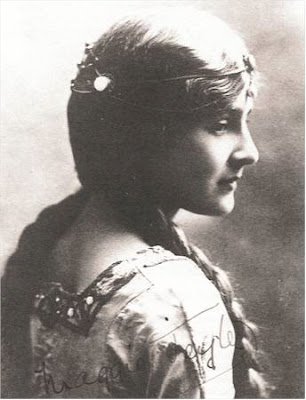
This Mélisande, too, isn’t a pallid victim, but, portrayed by Ingrid Perruche, a sexually vibrant woman. Maggie Teyte, one of the great Mélisandes, said that in her time “the characters were so STRONG (her emphasis)……modern performers (in 1958) have taken out all the blood”. She may be mysterious, but she’s a creature of instinct and feeling, who dares push the boundaries. That’s why she leans, dangerously, over the well (significantly called the Fountain of the Blind) and loses her ring. No wonder Pelléas is both terrified and attracted. Vocally, she has enough richness to bring out the sensuality in the part, and visually, she’s voluptuous. The "Rapunzel" scene with Mélisande’s hair, symbol of erotic power, is almost impossible to stage literally, so it’s hinted at in this production obliquely. Perruche’s hair is long enough, wildly curly and free. In the tower scene, Pelléas follows a golden thread. It’s simple but conveys the musical imagery well. It’s strong, yet fragile, and could snap at any time. Later, on her death bed, Mélisande is covered by a silken blanket in exactly the same shade as her hair. It’s a beautiful detail, implying much about the mystery that surrounds her persona.

Thorbjørn Gulbransøy as Pelléas is convincing as a lover because he can convey Pelléas as a full personality, who can stand up to a strong Golaud. His is a beautiful voice. He’s young, he has good experience and potential. Frédéric Bourreau’s Arkel was extremely well developed too. Although he’s old, he’s mentally sharp, and understands subtleties Golaud can never grasp. He’s seated in a wheelchair, but the voice that arises is steady, firm and clear, drawing attention even when he’s silent – a counterpart of sorts to Mélisande herself. Indeed, Arkel comes into his own in the deathbed scene, where Golaud crumbles. Bourreau gives us a glimpse of what Arkel might have been in his prime, expanding the character by the depth of his portrayal.

And the “surprise” final scene ? As Mélisande breathes her last, four of the women who have been working in the shadows all along appear. “Who has summoned them?” cries Golaud fearfully, but no-one knows. No longer are they mere servants, barely seen. Now they stand around Mélisande like dignified Angels of Death, profoundly powerful and moving. Golaud is an emotional illiterate because he’s like Allemonde as it was, a clockwork mechanism operating on auto pilot. Does it mean change ? These women represent another way of being, more attuned to Mélisande, and they defy the King. Does it mean change ? We know that outside the castle the populace is starving, ready for revolt.

Even the sickly baby materialises as a little girl. Mélisande says “elle va pleurer aussi”, but that could mean many different things. Perhaps the girl will grow up and repeat the mysterious cycle ? Small as this detail may be, it’s an important because it reminds us that we still have no idea where Mélisande came from or who she really was.

Further evidence of Independent Opera’s flair for innovation is the orchestration. This was a specially commissioned instrument version of Debussy’s score, made by the composer Stephen McNeff. Since Debussy’s music is exquisitely detailed, it was a daunting proposition. McNeff was struck by the way Debussy ”creates a constantly moving soundworld by layering and doubling, adding and taking away”, not so different in spirit from chamber music. McNeff reduced the numbers to 35 from 50, keeping the central solo parts intact, so what we hear captures the essential quality of the original. It also means that this opera can, in future, be performed in smaller theatres. Yet again, Independent Opera thinks outside the box. That’s why it’s worth paying so much attention to.

http://www.independentopera.com/index.html

Monday, 17 November 2008

Under the Radar Independent Opera at Sadlers Wells


The Independent Opera Company is "under the radar" for those who think of opera mainly in terms of big name celebrities and high profile "appearances". Yet for those who really love good opera and good theatre they are THE buzz on the streets. Yes, this is top quality opera but so lively, so fresh and so innovative that it draws in a mix of serious cognoscenti and bright young minds. Anyone who saw their outrageous (in a good sense) Elizabeth Maconchy operas last year will know what I mean ! This is utterly hip, utterly creative theatre, imaginatively applied to opera. Brilliant ! Big companies take note !

I've loved their work since their first Handel Orlando a few years ago when they struggled against huge odds to produce a magic. Truly "triumph over adversity", in the spirit of baroque. This summer they did a concert performance of the same at the Wigmore Hall which displayed how good the singing is, too. The star was William Towers who's a fairly big name now but has long been associated with this company. That says lots about them too : they draw a loyal group of enthusiasts who come because they love what's happening. Not at all like the sub West End wannabes that sometimes infiltrate the big houses to show they're "posh"! Independent's director is the charismatic Alessandro Talevi, a very gifted creative but also a great manager - the logistics of running an opera are formidable and he carries it off with such style !

Do not miss their Pelleas et Melisande opening tomorrow night and running for only three days. It's a special chamber version because you can't fit a full orchestra into the Lilian Baylis at Sadler's Wells but that's OK. The shining diaphanous textures of this music might sound all the better for being more intimate.

http://www.musicweb-international.com/sandh/2008/jan-Jun08/orlando2106.htm