Showing posts with label Kaufmann Jonas. Show all posts

Sunday, 24 March 2019

Don Carlos, Paris - Jonas Kaufmann star production


At last - Verdi Don Carlo from L'Opéra de Paris, with Jonas Kaufmann,  Elina Garanča, Sonya Yoncheva, Ludovic Tézier, Dmitry Belosselskiy, Ildar Abdrazakov, conducted by Philippe Jordan, 2017 directed by Krzysztof Warlikowski on arte.tv.  Highly recommended on all counts.  Absolutely wipes the floor on the Royal Opera House (Italian version)  production from 2013 (please read more here).  The more he sings Don Carlo, the better Kaufmann gets into the soul of the character. Here he's supported by a wonderful cast, and superb direction from Jordan and Warlikowski.  Note, I said "direction" from conductor as well as director, because opera is Gesamtkunstwerk : everything operates together to enhance the drama.  If it was just about singing, we wouldn't need opera at all, and line singers up doing scales for comparison.  Unfortunately it takes a bit of thought to figure out how and why a production works as a whole. So much easier not to think !  You can't expect perfection every time, and shouldn't, but this one fires on all cylinders.

Stunning singing, not only from the soloists but supports and chorus, unusually inspired because they seem to be thinking about why and how the drama works.  Perhaps this is what gives this production the edge : everyone' engaged.  Verdi's Don Carlo is a tragedy, human beings trapped in situations they cannot resolve, no matter how privileged they might be.  Not for nothing Don Carlo and Elizabeth de Valois meet in a forest. Freudian symbolism before Freud, extended by the images of horses frozen in immoboility, not living beings.  Don Carlo's collects cuttings from newspapers to learn where he's supposed to stand in the game. He wears a cricket top, but isn't yet a player.  This idea of games and strategems runs throughout the production, for very good reasons. Realpolitik rules, not  human feeling. Religion intensifies the rigidity : the church plays games with souls and minds. Everyone's forced into rules not of their own making. Hence recurring images of walls, some solid, some tantalisingly transparent, like bars in a cage. Prisons with pretty decor are still prisons.

From the libretto, we know that Elizabeth senses her marriage as death.  She can trust no-one, and must be constantly on guard. Hence the image of the women as fencers, dehumanized, forced to be constantly alert.  A typical Warlikowski meme but a good one. This is the backdrop to the relationship between Elizabeth and Don Carlos, underlining the tension and fear that suppresses their natural instincts.  Hence the sub plots with Rodrigue, Marquis of Posa : who dares stand up for the oppressed, and with the Princess Eboli, who misinterprets signals.  Philip II reads the signals right, but his solution, forced on him by the church, is extreme. Only in death can there be justice.  No surprise that the bust of Charles V looks aghast !  He's learned the hard way that mortal status means nothing.  The death of Don Carlos is depicted in a black and white film image like the newspapers he studied in his youth. (Please read my piece Psychological Thriller on Ernst Krenek's Karl V, a completely different opera, but with similar ideas)   

Monday, 9 July 2018

Vintage Audi - Parsifal, Pape, Kaufmann, Stemme


From the Bayerisches Staatsoper Munich, Wagner Parsifal with a dream cast - René Pape, Jonas Kaufmann and Nina Stemme, Christian Gerhaher and Wolfgang Koch, conducted by Kirill Petrenko, directed by Pierre Audi.  The production is vintage Audi - stylized, austere, but solidly thought-through. Audi, veteran of decades on the cutting edge of music theatre, knows what he's doing, even if what he does isn't flashy. So darkness and desolation greeted us on the stage. The Grail community is in trouble, desiccated like the skeleton in the corner beneath which Kundry shelters, a wild, lonely outcast.  Audi's focus on the main characters focuses attention on what they are singing about. Just as in Greek tragedy, there's little need for fancy decoration. In an opera like Parsifal austere is no bad thing, and abstraction will suffice.  This also means more room for the music itself which is hardly a minor distraction. In many ways it is the whole point of the drama, greater than the stars or scenery.  Without the music there'd be no opera !

René Pape is cloaked in black, Amfortas (Christian Gehaher) in white, with Kundry (Nina Stemme) in black/red moiré.  Lest we get caught up, too soon in simplicity, Pape and Stemme remove their "armour". (Lucky for them in this blistering heat)  So when the "Innocent Fool" Parsifal arrives (Jonas Kaufmann),  he's wearing a bizarre breastplate. Minor detail but don't dismiss it yet.  The Grail Knights are in heavy armour. But for what purpose ?  In their fortress they have no enemies to fight but themselves.  The orchestra wells up, magnificently, Parsifal bells booming. Of course Parsifal is impressed. But the children's choir sing of sacrifice. What is this blood ritual that's re-enacted without question ? Amfortas is suffering but the knights look on, but then remove their cloaks to reveal body suits.  Of course they're not "beautiful". It's easy to judge a  production by shocking images but whatb really matters is to figure out why.  Under their armour, they are human, capable of compassion. Though ugly, they are redeemable. Compassion is a greater gift than conventional beauty. As Parsifal wanders off, deep in thought, we should be thinking, too.

The reealm of Klingsor (Wolfgang Koch) is depicted through images of dead bodies, hanging upside down. Again, simple but effective.  The Flower Maidens are seen in fatsuits  Like the dead men, they are Klingsor's victims, creatures of his sick mind, created to trap and deceive. If we judge them on surface appearances we are buying into his game, treating women as objects to be consumed by men.  Besides, listen to their voices - seriously good casting here - Tara Erraught among them.  There is a lot of misogyny in Parsifal, such as the Knight's mistreatnent of Kundry, which needs to be addressed because abuse is the opposite of compassion.   Part of the reason the Grail community is in trouble  is its dismissal of women and the principles they represent.  Kundry, after all, "never lies" as Gurnemanz tells us right out, though the Knights malign her.  Though she's controlled by Klingsor, she's the vehicle through which Parsifal connects to his mother and awakens his conscience.  In this act, Stemme (as Kundry) looks lovely in evening gown and blonde wig, but her lines are forcefully delivered. She's too real to do mock-temptress.  And so the walls of Klingsor's kingdom are rent apart, his victory denied. Kundry reveals how she was cursed : I liked the personality in Stemme's performance.  And thus Parsifal's self-discovery, Kaufmann's voice swelling with magnificent resolution.

"Hier bist du an geweihtem Ort:da zieht man nicht mit Waffen her, geschloss'nen Helmes, Schild und Speer.". Mark those words from Gurnemanz. They explain a lot.  Parsifal creeps back to the Grail Community garbed in strange armour but disrobes, handing the spear - a neat, elegant cross, not a weapon. Instead of violence, bigotry and obsession with outward appearance, redemption comes through kindness.   The steel in Kaufmann's voice gleams, evoking the inner strength Parsifal has learned from years of wandering and searching.  Pape and Kaufmann can do no wrong in this performance, they pretty much steal the show.  As Parsifal baptises Kundry, the stage lights up : utter simplicity and purity, "Wie dünkt mich doch die Aue heut so schön!". The textures in the orchestra open out, with clarity and ineffable sweetness. Kaufamnn's timbre became infused with tenderness.  .

Meanwhile the Knights are back in their formal black armour intoning their ritual dirge. Like Amfortas, they're still acting out guilt, blood sacrifice and immutable agony.  Christian Gerhaher sings a good enough Amfortas though somewhat one-dimensional.   Amfortas carries baggage, he's ridden with conflicts and should ideally be characterized with more sympathy. This is a pity, since Audi's clean, unfussy staging puts so much emphasis on the part.

Mission accomplished, Kaufmann stands with the chorus, one among equals and prays - not with this hands together but over his eyes.  Durch Mitglied wissend mitglied, empathy, kindness, - don't judge people by surface appearances but by what they might be inside.  Instead, listen ! And above all, the imperative of rising above self for higher purposes.  An excellent ending : the focus shifting from the mortals on stage to an abstract depiction of light, more spiritual than specific.  This reflects Wagner's stage direction "Lichtstrahl: hellstes Erglühen des "Grales".   So we don't see a literal dove flying around, but the meaning is clear. The orchestra has the last word, so to speak : we are in the presence of the sublime.
 

Friday, 16 February 2018

Jonas Kaufmann Diana Damrau Wolf Italienisches Liederbuch


Jonas Kaufmann and Diana Damrau, Wolf Italienisches Liederbuch, Goldner Saale, Musikverein, Vienna

Jonas Kaufmann and Diana Damrau singing Hugo Wolf's Italienisches Liederbuch with Helmut Deutsch at the Barbican Hall, London.  Despite astronomical prices, tickets will sell.  Not for Hugo Wolf, but for Kaufmann and Damrau, a good team for music like this. Unlike most of the concerts in the Barbican's Kaufman residency, this one is seriously interesting in musical terms.  Hugo Wolf will always be more specialist taste than populist, but this Liederbuch could be ideally suited to Kaufmann, whose sensually-charged, darker timbre should be pretty much perfect.  Wolf hasn't enjoyed mega profile celebrity status for decades. Kaufmann and Damrau's tour takes in twelve European cities, including Berlin, Vienna, London, Paris, Barcelona and Budapest.  Kaufmann and Damrau's Wolf Italienisches Liederbuch is significant, so chances are that a recording will eventuate. It will be cheaper than shelling out big for tickets/transport ! haha ! Besides THIS is where I went the night before, still high on it.

For the Italienisches Liederbuch, Wolf used texts by Paul Heyse, whose translations of Italian and Spanish poetry appealed to German-language readers, fascinated by "The Dream of the South" a potent theme in Central European aesthetics,  even before Goethe's life-transforming visits to Italy.  Wolf was born in Windischgrätz in what is now Slovenia. Though the family was German-speaking, Wolf's mother played the guitar and had Italian connections.  Dreams of the South cast a spell on Wolf, who would later go on to write the Spanisches Liederbuch and the opera Der Corregidor.  Significantly, though, Wolf never actually made it to Italy.  When his friend arranged for him to visit during his last, troubled years, he refused to go, aware perhaps that nothing could quite match the Italy of his imagination.  The forty-six songs in Wolf's Italienisches Liederbuch form a panorama, each song an individual vignette.  Lovers pine for one another, thwarted by bossy mothers. Serenades, and songs about dirty old men dressed as monks ! Delicate songs of innocence, robust songs of flirtation, and songs of sheer wonder, like Schon streckt' ich aus im Bett die müden Glieder, where a man jumps out of bed to fill the streets with song.  But not just to one girl. "So manches Mädchen hat mein Lied gerührt, Indes der Wind schon Sang und Klang entführt." (many girls hear my song, even when it's been blown away by wind and noise). Images of sunshine, and of the night, of warmth and a sensibility very different to uptight Northern morality (and probably not much like strict Catholic behaviour, either.).

Each song is a miniature opera, telling a story, creating a mood. That's why I think these songs were made for Jonas Kaufmann.  His voice has a smouldering, sexy quality which suits the slightly louche nature of these songs.  His Italianate looks don't hurt, either !  As an opera singer, creating character with his voice comes naturally. Although these songs are Lieder, they aren't as inward or as intellectual as many Lieder can be, so they can benefit from a more impersonal approach as long as the touch is elegant enough not to overwhelm.  Although Dietrich Fischer-Dieskau made so many recordings that the Italienisches Liederbuch is almost (not quite) associated with him,  the collection is also tenor territory.  Peter Schreier and Christoph Prégardien performed it many time, Prégardien sometimes adjusting the song order to group the songs into tighter units. So Kaufmann, with his baritonish richness could create the best of both worlds.

Because Wolf's Italienisches Liederbuch depends so much on the interplay between the many different components in the collection,  in practical performance it needs singers who are  balanced enough to create a natural flow between their voices. Diana Damrau has done the Italienisches  Liederbuch before, so she's a known quality.  The girlish brightness of her youth has warmed to a  maturity,  better suited to this collection, where so many songs describe a worldly-wise woman with such confidence that she can chide her (many) lovers with mocking good humour.  Many of the "female" songs in this set reveal women as stronger personalities than men.  And as for Helmut Deutsch, he's so familiar to Lieder people that we can "hear" him, just thinking about him.

Monday, 16 October 2017

Jonas Kaufmann Tenor for the Ages the Hagiography

+
One giant selfie ! Jonas Kaufman Tenor for the Ages, hagiography not documentary. The Curse of Celebrity.  It's not JK's fault.  When marketing hype takes over, the artist becomes Commercial Product, his art incidental by-product.  Kaufmann truly is one of the greats. "A singer who thinks" as Antonio Pappano "with matinee idol presence". Absolutely. We're incredibly lucky to have JK, he's more than just a singer.  But this film, by John Bridcut, is  embarrassing, catering to a market that thrives on hype.  So, love JK, don't love the promo video.
True fans love the artist, and love the art. They don't bitch if he cancels even if they lose money because they understand voice and don't expect singers to deliver like machines.  They aren't obsessives who push themselves above all else,  it's not good for  mental health.  JK is so charismatic that his personality is magnetic, which is something to celebrate.  Nothing wrong with being sexy, either.  But knicker throwing is daft, and the media types who play it up are cynical manipulators, who care more for clicks than quality.
It was good to see the dressing rooms at the Royal Opera House again and recall the buzz that goes into making a production.  Antonio
Pappano's enthusiasm is always fun. And it was good to hear the clips of the Vienna Tosca where things might not have gone to plan.  JK is a genuine artists whose love for repertoire spurs him on to new challenges.  Taking JK to Aldeburgh struck me more as a thing than a serious attempt on JK's part to take on Peter Grimes. But who knows ? JK has the intelligence to realize that it's always prima the repertoire, and how it can be explored. Sadly not many get that  Please read my piece on  JK's Mahler Das Lied von der Erde. No-one is so expert that they know everything and don't need to learn.  But a lot of the script seemed geared towards the mantra that art can't be taken seriously.. 

 Thank goodness that the show was followed by real opera,  Verdi Otello at the Royal Opera House, good enough to convert anyone to the genre if they care enough to listen and pay attention.  Here is a link to the thoughtful review in Opera Today of the live performance. Please read and enjoy. The range lies low, so it suits JK well : If his interpretation wasn't macho, so what ?  Otello's a much more complex figure than macho man. Delicious singing !

.  

Monday, 17 April 2017

Unique ! Jonas Kaufmann Das Lied von der Erde

Jonas Kaufmann Mahler Das Lied von der Erde is utterly unique but also works surprisingly well as a musical experience.  This won't appeal to superficial listeners, but will reward those who take Mahler seriously enough to value the challenge of new perspectives.  A single voice in a song symphony created for two voices?  Not many artists have the vocal range and heft to sustain 45 minutes at this intensity but Kaufmann achieves a feat that would defy many others. Das Lied von der Erde for one soloist is a remarkable experiment that's probably a one-off, but that alone is reason enough to pay proper attention.

The dichotomy between male and female runs like a powerful undercurrent through most of Mahler's work.  It's symbolic. The "Ewig-wiebliche", the Eternal feminine, represents abstract concepts like creativity, redemption and transcendance, fundamentals of Mahler's artistic metaphysics.  Ignore it at the risk of denaturing Mahler!  But there can be other ways of  creating duality, not tied to gender.  Witness the tenor/baritone versions, contrasting singers of the calibre of Schreier and Fischer-Dieskau.  For Das Lied von der Erde, Mahler specified tenor and mezzo/alto, the female voice supplying richness and depth in contrast to the anguish of the tenor, terrified of impending death.  This is significant, since most of Mahler's song cycles and songs for male voices are written for medium to low voices, and favour baritones. Tenors generally get short-changed, so this is an opportunity to hear how tenors can make the most of Mahler.  .

Kaufmann is a Siegmund, not a Siegfried: his timbre has baritonal colourings not all can quite match. Transposing the mezzo songs causes him no great strain.  His Abschied is finely balanced and expressive, good enough to be heard alone, on its own terms. What this single voice Das Lied sacrifices in dynamic contrast, it compensates by presenting Das Lied von der Erde as a seamless internal monologue. Though Mahler uses two voices, the protagonist is an individual undergoing transformation: Mahler himself, or the listener, always learning more, through each symphony.  Thus the idea of a single-voice Das Lied is perfectly valid, emotionally more realistic than tenor/baritone.  All-male versions work when both singers are very good, but a single-voice version requires exceptional ability.  Quite probably, Kaufmann is the only tenor who  could carry off a single-voice Das Lied.

With his background, Kaufmann knows how to create personality without being theatrical, an important distinction,  since Das Lied von der Erde is not opera, with defined "roles", but a more personal expression of the human condition.  This Das Trinklied vom Jammer der Erde  is unusually intense, since the person involved emphatically does not want to die.  The horns call, the orchestra soars, but Kaufmann's defiance rings with a ferocity most tenors  might not dare risk.  Wunderlich couldn't test this song to the limits the way Kaufmann does. Schreier, on the other hand, infused it with similar courage, outshining the mezzo and orchestra in his recording with Kurt Sanderling.  This heroic, outraged defiance is of the essence, for the protagonist is facing nothing less than annihilation. Twenty years ago, when Kaufmann sang Das Lied with Alice Coote in Edinburgh, I hated the way he did this song, as if it was a drinking song.  Now Kaufmann has its true measure, spitting out the words fearlessly, taking risks without compromise.  No trace whatsoever of Mario Lanza! This  reveals a side of Kaufmann which the marketing men pushing commercial product like the Puccini compilation will not understand, but enhances my respect for Kaufmann's integrity as a true artist.

After the outburst of Das Trinklied, Der Einsame im Herbst is reflective, with Kaufmann's characteristic "smoky" timbre evoking a sense of autumnal melancholy.  This is usually a mezzo song,  so at a few points the highest notes aren't as pure as they might be, though that adds to the sense of vulnerability which makes this song so moving.  Von der Jugend is a tenor song, though no surprises there.  If Kaufmann's voice isn't as beautiful as it often is,  he uses it intelligently.  The arch of the bridge mirrored in the water is an image of reversal. Nothing remains as it was.   In Von der Schönheit Mahler undercuts the image of maidens with energetic, fast-flowing figures in the orchestra. This song isn't "feminine". The protagonist is no longer one of the young bucks with prancing horses. He has other, more pressing things on his mind.  Der Trunkene im Frühling usually marks the exit of the tenor, recapitulating Das Trinklied vom Jammer der Erde.  Though there are tender moments, such as the bird song and its melody, the mood is still not resigned. Kaufmann throws lines forcefully : "Der Lenz ist da!", "Am schrwarzen Firmament!" and, defiant to the end with "Laßt mich betrunken sein!"

Jonathan Nott conducts the Wiener Philharmoniker. creating an atmospheric Abschied with muffled tam tam, woodwinds, strings, harps, celeste and mandolin.  Excellent playing, as you'd expect from this orchestra.  Just as the first five songs form a mini-cycle, the Abschied itself unfolds in several stages, each transition marked by an orchestral interlude.  The dichotomy now is not merely between voice types but between voice and orchestra: altogether more abstract and elevated.  This final song is the real test of this Das Lied and Kaufmann carries it off very well.  Now the tone grows ever firmer and more confident.  There are mini-transitions even within single lines of text, such as the beautifully articulated "Er sprach....., seine Stimme war umflort...... Du, mein Freund".  At last, resolution is reached. The ending is transcendant, textures sublimated and luminous.  The protagonist has reached a new plane of consciousness not of this world.  Kaufmann's voice takes on richness and serenity. He breathes into the words "Ewig....ewig" so the sound seems almost to glow.  Utterly convincing.  This isn't the prettiest Das Lied von der Erde on the market, but it wouldn't be proper Mahler if it were. It is much more important that it is psychologically coherent and musically valid.  Too often, interesting performances are dismissed out of hand because they are different, but Kaufmann's Das Lied von der Erde definitely repays thoughtful listening.

Monday, 13 February 2017

Jonas Kaufmann Barbican £435 ? Sex or art ?


Jonas Kaufmann's Barbican residency, London  Tickets sold out months ago, despite being priced way beyond average. High prices are fair enough for JK, Karita Mattila, Eric Halfvarson and Tony Pappano, but for the piano recital with Helmut Deutsch ? Viagogo advertised one ticket for the last concert at £435, though I've heard a rumour that prices on the black market were much higher.  This is indecent, it's nothing to do with art.  Which raises interesting questions.  Was the series artistic endeavour or celebrity binge ? Or both ?  Why not?  Nothing JK does is "ordinary". Some of my friends, true devotees, travelled for thousands of miles to attend, and had a wonderful time.  Experience of a lifetime!  Most of my friends opted for the Wagner concert, a wise choice, since hardly anyone does Siegmund better than JK, and Mattila was, by all accounts, even more impressive.

The first concert was much less interesting since Kaufmann's done similar programmes before, including at the Wigmore Hall.  Kaufmann's timbre is  quite Italianate, with luscious depth, ideally suited to Britten's Seven Sonnets of Michelangelo  op 22.  Much better than Peter Pears, who sounds like he's singing an alien language. Kaufmann makes the songs breathe sensual richness. Kaufmann's done the Schumann Kerner Lieder op 35 several times, too, as recently in London as 2015.  Nothing obscure about these songs !  Again, they suit Kaufmann's voice. In one of the songs  Stirb'  Lieb’ und Freud”! , a man observes a woman transfixed by religious ecstasy. Beautiful as the image is, it's unnatural to the man, who now can never speak of his love. The tessitura suddenly peaks so high that some singers scrape into falsetto, but no chance of that with Kaufmann, who has the range, and has the technique to make it easy.

It doesn't matter if listeners don't know the songs or who the poet was : the important thing was to pay attention and figure out why Kaufmann likes doing them.  Unfortunately some of the London press tends towards fashion victim. This is a shame, because that does JK no favours. The better audiences understand what he does, and why, the better they'll really value him, but with a press that values hype over substance, how do listeners learn ?.  Schumann's Kerner Lieder are by no means obscure, or difficult to follow.  Think about those images of gold, wine, mystery, lusciousness : JK all over, and making the most of the smoky undertones that make his voice unique.  Read HERE for more about the Kerner Lieder. 

Kaufmann's last concert could well be the most interesting of all, because he's doing something really different, Strauss Vier letzte Lieder, which were written for soprano.  Songs change when they're transposed to a different kind of voice, but there's nothing controversial about that, in principle.  So what Kaufmann will do with them is fascinating. They have been done by men before, even by baritones. But again, I think Kaufmann has the range and stylishness to convince. Moreover, presenting Vier letzte Lieder in the context of other Strauss, and together with Erich Korngold's Schauspeile Overture and Elgar's In the South, also makes a difference.  Again, even if these works are new the challenge is to listen, and appreciate how hearing things in context influences the experience.   Alas, the concert was cancelled at the last minute ! 

There's another concert Feb. 16th 2018, where Kaufmann will sing Hugo Wolf  Italienisches Liederbuch with Diana Damrau.  Tickets reaching £160 !  Again, a wise match between material and voice. Each of these songs tells a little story. While they aren't "operatic", they withstand operatic treatment better than most Lieder.  Kaufmann's voice and Damrau's balance very well, so it's hardly surprising that they've done these songs together before.  Although the Barbican Hall isn't ideal for piano song, it's not bad.  Fischer-Dieskau and Schwarzkopf sold out the Royal Festival Hall when they sang Hugo Wolf, sixty years ago. The RFH is bigger than the Barbican and in those days had a dead acoustic. In the end, it's the quality of listening that counts. 

So Jonas Kaufmann's a sex god ?   Real fans also love him for his art. And for many of us, that's WHY he's so darn sexy !


Sunday, 22 May 2016

Interpreting Meistersinger : Glyndebourne, Munich


Wagner Die Meistersinger von Nürnberg at Glyndebourne. Is it unusual to start a new season with a revival ?  This production premiered on the exact date on which Wagner was born 200 years before.  Fortuitous timing, perhaps, but also a bright start to the 2011 season.  "Sunny but not shallow" I wrote at the time - read my original piece HERE

David McVicar set the production around the time of Wagner's birth, which was appropriate in the composer's anniversary year, but rather less relevant now.  On the plus side, early 19th century designs are easy on the eye.  Perhaps the popularity of this production stems from it being so genteel and non-challenging. But Die Meistersinger isn't about pretty scenery. On the contrary. It says, quite clearly that appearances deceive. The good guy is not the one in the smart black suit.  On the minus side, it gentrified 16th century Nuremburg,  obliterating the context of Reformation and revolt.  It didn't matter so much in 2011 because we were celebrating the start of the season, the production was fresh and it was different. Gerald Finley was a sophisticate, rather than earthy. Because he's a house favourite, it's perfectly reasonable to build a production around him.  There isn't and shouldn't be a "Hans Sachs type" but Finley's voice is on the genteel side, so his Sachs was never going to be gritty or pugnacious.  Hence his Sachs was an Early Romantic poet, from a time when poets were intellectuals, often aristocratic, almost all middle class.  They'd no more make a living fixing shoes than might a hero from Jane Austen. 

True, the Romantic period was a revolution, but the revolution Wagner wrought transformed the music of the past, even if it grew from Romantic values.  I enjoyed the 2011 premiere because Vladimir Jurowski conducted exceptionally well. The orchestra communicated what the set avoided.  There's no reason why Die Meistersinger shouldn't be sunny and gay, in the old sense of the word, because the Nuremburgers are celebrating the survival of their city and the renewalof art.  There is more in the opera, though.  The Meistersingers were happy enough to do as Beckmesser wanted and run Walter out of town, had Sachs not intervened.  Not for nothing, when darkness falls, the townsfolks crap. It's comic but not funny. A crowd can descend into a mob. The Night Watchman is a counterpart to Sachs, restoring sanity.  

And so to  Die Meistersinger von Nürnberg from the Bayerisches Staatsoper in Munich, just down the road from Bayreuth and not far from Nuremburg. Presumably the locals have Die Meistersinger in their DNA, notwithstanding their ancestors' less than worshipful approach to Wagner himself.  Even if they don't, the opera is so familiar that it could be interpreted in a new way, yet still be true to the fundamentals.  Jonas Kaufmann is Munich's greatest asset, and even more popular than Finley is at Glyndebourne. I'm glad I listened to the premiere audio only, in order to get the musical logic behind the interpretation.  Kaufmann is simply head and shoulders above everyone else in the cast, though they are good, and probably better than the Glyndebourne cast.  He's just so good that he changes the balance of the opera.  Jacques Imbrailo did the same with the Glyndebounre  Billy Budd, singing so divinely that some forget that for Britten, the story actually revolves around Captain Vere's moral dilemma.  It's fine to adjust balances in this way because they allow a change of perspective.  Kaufmann's Walter was so good that no one could have mistaken him for an untrained newcomer.  The birds in the woods who taught Kaufmann's Walter must have been pretty amazing.  An interpretation placing more emphasis on Walter than on Sachs would be perfectly valid, if done well, because Walter is the future, as Sachs recognizes.  

Sachs was named after St John the Baptist, who laid the way for Jesus.  Johannisnacht is a Christian festival, but also has connections with prehistory and even the occult.  The tree in the town square, for example is a kind of fertility symbol, and young folk go courting at the fair.  "Holy German Art" was poisoned by Hitler, but it's not actually about Nazism.  The music isn't even demonic, just affirmative, so,playing it up for cheap,thrills is a cop out.  It's time to exorcise that ghost from the opera and from its interpretation. Holy German Art in Hans Sachs's time was an affirmation of native German values, as opposed to the Catholic Church, to the democratization of learning through the printed word.  Before Gutenberg, people didn't have books, and had to believe what they were told.   The real message of Die Meistersinger von Nürnberg  is a lot more radical than some realize. 

Please also read Mills and Boon Wagner -Meistersinger at the Met  and  Stefan Herheim's perceptive Meistersinger, Salzburg and ENO Vindicated : Wagner's prescient warning. 

Wednesday, 18 May 2016

Kaufmann saves Meistersinger, superb Salonen Stravinsky


All quiet on the Live Front, but a glut of good listening links online. For starters :

Wagner Die Meistersinger von Nürnberg - live from Munich :  Jonas Kaufmann is a dream Walter von Stolzing, giving depth and maturity to the role with his now slightly darker timbre.  Definitely an interesting take on the part.   That Prize Song is so ardent that it's not the work of someone new to the game.  Kaufmann is such a singular Walter that this is worth hearing for him alone.  Any new Die Meistersinger is high profile, especially when it is in Munich, so close to Nuremburg and also to Bayreuth, so perhaps I was expecting too much.  At this level, no performance is ever going to be bad, but I would have preferred something less generic. Because Kaufmann is the Bayerisches Staatsoper's greatest asset, you'd think they could have created  the whole thing around him. He's not a typical Walter, but that could have been an ideal opportunity to rethink things musically.  It's not as if the opera is unfamiliar, is it ?  We could cope with something unique, making the most of  Kaufmann's distinctive timbre. Walter Koch is a good Hans Sachs, but everything needs to be stronger and more individual not to be eclipsed by such a powerful Walter.  Despite listening carefully twice over, which takes 10+ hours,  I can't get specially fired up. Meistersinger should be much more than generic. Meistersinger opens the Glyndebourne season on Friday. Munich ought to win hands down; But who knows ? Michael Güttler is conducting. Although he's relatively unknown in the UK, at 50, he is no ingénu and has a reasonably solid background. Please see my latest article Interpreting Meistersinger : Glyndebourne, Munich.

Stravinsky : Myths and Rituals :  Esa Pekka Salonen and the Philharmonia Orchestra continues a fascinating season devoted to Igor Stravinsky.  As usual, Salonen's in-depth explorations with the Philharmonia go far beyond simply presenting "greatest hits". The concert on Sunday May 15th is now available on BBC Radio 3.  It includes Symphonies of Wind Instruments (1947 version). .  Salonen does wonders, bringing out its quirky originality. In the last few weeks I've been immersed in Boulez's recording of the 1920 version. What a joy to compare the two,and with two conductors who really understand.   On the radio, we miss out on the choreography specially commissioned for this performance of Agon, which is a pity since the work is usually heard without the context of dance, but the playing is so vivid, you can use your imagination.  A stunning Rite of Spring, too. On Sunday 21st,  Salonen and the Philharmonia will be doing Oedipus Rex with a good cast and a semi-staging by Peter Sellars.  Not being a Sellars fan, I think I'll stick to the live broadcast.

More to come : Matthias Goerne : Mahler Early Lieder orch.  Berio, Heinrich Schutz from Regensburg, English Song Weekend and much more

Monday, 25 January 2016

Barbican 2016-2017 - Jonas Kaufmann 10 day Residency


Jonas Kaufmann will be Artist in Residence at the Barbican, London.  For TEN days, during February 2017, Kaufmann will give his first major performance of Wagner in London: with Karita Mattila and Eric Halfvarson in Act I from Die Walküre, with the LSO conducted by Sir Antonio Pappano.  Much more unusually, he will sing Wagner’s Wesendonck Lieder in the first half of the concert, and Strauss’s Four Last Songs, a work rarely performed by a tenor. The residency opens with a lieder recital with pianist Helmut Deutsch and also includes a public “in conversation” and a workshop session with Guildhall School musicians.
  
The Barbican's 2016-2017 series features three international orchestra residencies :

The Royal Concertgebouw Orchestra of Amsterdam performs at the Barbican on 16 and 17 December. This residency will be the orchestra’s first London appearance with its new Chief Conductor, Daniele Gatti.  Two concerts featuring Ravel and Stravinsky alongside Prokofiev’s Violin
Concerto No. 2 with Lisa Batiashvili, Wagner, Mahler and Berg.

The Bavarian Radio Symphony Orchestra with Mariss Jansons, who has said .   "For me, as a conductor, it’s like driving a Rolls Royce. The orchestra can cope with everything”. On  11 April 2017 their programme features Prokofiev’s Symphony No 1 Rachmaninov’s Symphonic Dances and Shostakovich’s Symphony No 1.  

The New York Philharmonic Orchestra from 31 March-2 April 2017. These concerts will be Alan Gilbert’s last UK concerts as the Philharmonic’s Music Director. The performances include the European premiere of a new cello concerto by Esa-Pekka Salonen with Yo-Yo Ma. The NY Phil will also mark  John Adams’s 70th birthday with his Harmonielehre, Absolute Jest, and Short Ride in a Fast Machine. 

From the Barbican's regular resident orchestras

The BBC Symphony Orchestra and Sakari  Oramo present showpieces including Messiaen's Turangalîla-sinphonie and the complete works of Varèse.  Lots more of course, since the BBC SO is so prolific  This season finds them giving world and UK premieres of works by Kaija Saariaho, Diana Burrell, Philip Cashian, Michael Zev Gordon, Nicola LeFanu, Wolfgang Rihm and Detlev Glanert. 
 
The London Symphony Orchestra, with Music Director designate Simon Rattle who will do a new staging of Ligeti’s Le grand macabre, directed by Peter Sellars. Rattle also brings us a Mark-Anthony
Turnage world premiere, Remembering; and a programme featuring Lang Lang. The LSO Artist Portrait spotlights Janine Jansen.  


The Academy of Ancient Music presents a  semi-staged production of Purcell’s The Fairy Queen. the first of a three-year Purcell opera cycle  The staging is directed by Daisy Evans with soloists including Mhairi Lawson, Iestyn Davies, Samuel Boden and Ashley Riches with narration by actor Timothy West. Also, Monteverdi’s Vespers, Jordi Savall makes his AAM debut and tenor James Gilchrist, who works regularly with the AAM, directs the ensemble for the first time in a programme featuring Purcell and Bach. 
  

The Britten Sinfonia focuses on Thomas Adès and Gerald Barry, and the world premiere of James MacMillan’s Stabat Mater. 

Massed Voices : Since Simon Halsey’s appointment as LSO Choral Director in 2012, the Orchestra’s choral programme has rapidly gained in scale and ambition and this season sees performances of Mendelssohn’s Symphony No 2, with Sir John Eliot Gardiner and his Monteverdi Choir (16 & 20 October); John Adams’s El Niño, conducted by the composer (4 December); Fabio Luisi conducting Brahms’ German Requiem (19 March); and Bruckner’s Te Deum, with conductor Bernard Haitink (28 May). 


Baroque goodies : Vivaldi Juditha Triumphans with the Venice Baroque Orchestra and a
stellar cast headed by Magdalena Kožená; Andreas Scholl and Accademia Bizantina performing sacred music from Neapolitan operas; The English Concert and Joyce DiDonato in Handel’s Ariodante; and Messiah with Les Arts Florissants.

As always, much, much else !

Thursday, 12 November 2015

Jonas Kaufmann and the Curse of Fandom

Joinas Kaufmann has had to cancel   his appearaances in Carmen at the ROH and the fans go into a rage?  But are these fans at all ?  JK can't help being unwell. Forcing someone to perform when he's not well is cruel.  For a singer, working in such situations can damage the voice long term.   JK went through a difficult patch when he couldn't sing for some months, so why risk that happening? So if fans really are fans, they should realize that singers aren't machines but human beings. Surely they deserve basic kindness? Three years ago, Wise Ruth wrote sensibly about cancellations : her words still hold true.  Even further back, Alfie Boe's promising career was destroyed by his "fans" in much the same way.

Which leads me to wider issues: the curse of fandom.  Healthy fandom is positive,: It supports singers and spurs them on to good things. Everyone's happy. But negative fandom is anti-art.   Recently JK sang Puccini at the Royal Festival Hall, interspersing his arias with orchestral music.  Good for him ! That was a perfectly reasonable thing to do, since placing the arias in the context of the music in the operas enhances appreciation. Singers are not machines.  Concerts are not CD's "live".

But one of the Dirty Little Secrets of the opera world is that a lot of fans don't actually like music.  Negative fans want celebrity, not art.  I adore Jonas Kaufmann, and respect hs art, and so do most of his genuine fans. But marketing controls art these days. Horror of horrors, the market is not always right.

Friday, 14 August 2015

Fidelio Salzburg : depressing, provocative but not wrong


Beethoven's  Fidelio is an opera designed to provoke outrage. Any production that doesn't provoke is a betrayal of the composer. Salzburg's new Fidelio is provocative, but that's exactly how it should be. Fidelio is an opera about ideas.  Like it or not, Claus Guth's production does engage with the ideas and ideals central to any genuine engagement with the opera. He presents an unusual take on the piece, but nonetheless one which is valid and thoughtful.  If we dismiss ideas because they don't fit our own, we're no better than the Don Pizarros of this world.

Leonore (Adrianna Pieczonka) is ogled by Marzelline  (Olga Beszmertna)   Perhaps the scene was written to show that Leonore's impersonation of a man can convince a woman. But one wonders just how much Leonore is a symbol rather than a character. Beethoven related to concepts, rather than to real women.  Thus the minimalist set, where the singers cast huge shadows that take on a life of their own, depending on the angle of lighting and shadow. The dynamic between Rocco (Hans-Peter Kõnig), Jaquino (Norbert Ernst) and the two female roles is interesting. Kõnig's a big man, who literally overshadows Jacquino: even at this stage one wonders if Marzelline could ever commit to marriage the way Leonore commits to Florestan. The music in these scenes is charming, in Singspiele style, but one wonders about the irony.  Like The Magic Flute, charm masks darker undertones.

Guth dispenses with bantering dialogue. Audiences know (or should know) the story well enough to follow the action as drama for its own sake. I liked the shadows, and the costumes of the choruses because they reminded me of Scherenschnitte, so popular in Beethoven's time - black silhouettes against white backgrounds that depict figures in stylized relief, deliberately evading realism.  Period detail does exist in this production, you just have to look closely.  Leonore and Don Pizarro have non-singing "shadows" acting behind them. There's a kind of rationale to this but it confuses things.

Instead of dialogue,  Guth employs strange sound effects. When I first heard this, audio-only, the sounds seemed disruptive because there weren't any visuals to explain what was going on. The sounds made more sense on stage because they suggested whirring and the movement of vast, cumbersome equipment.  Indeed, during the all-important Leonore Overture, we see stage hands changing the scenery. At first I couldn't understand, but then it occurred to me that we were seeing depicted before us the Deus ex machina resolution. Without the sudden appearance of Don Fernando (Sebastien Holecek) how might the story end ?  Hence the Overture which separates the main part of the opera with the elegantly-written postlude, like the Moral in Don Giovanni. But in Fidelio, the loose ends aren't tidied up.  We hear the music, but do we really know what happens next?  In real life political oppression, the bad guys usually win.  Happy endings don't happen unless there are major "scene changes" in society. 

It's quite possible that  the opera is happening in Florestan's head. Can he really only escape the dungeon through ideas and ideals? It's a provocative concept, but certainly not invalid.  In the opera, Florestan does nothing heroic, though we know he's been a hero in the past. Leonore is the protagonist,  the action man/woman who can defy the entire prison system and do what Florestan, trapped in prison, cannot do.  Florestan is an intellectual, a man who uses his mind, so why shouldn't he use his mind to contemplate his dilemma? Florestan (Jonas Kaufmann) doesn't even appear until the Seciond Act, but when he does, it's significant that he's alone, without hope, singing his amazing monologue. 

Thus Pieczonka "sings" without sound during the Prisoners Chorus and gesticulates frantically without saying a word, towards the conclusion.  The giant chandelier hangs oppressively over the stage. The prisoners have glimpsed artificial light but they have not been released.  The minimalism in this staging (designs by Christian Schmidt) support the idea that the drama is happening in Florestan's head, but like the strange mechanical sound effects, the scenes don't translate well audio-only.  In the radio broadcast, Kaufmann had to sing across a vast, empty void, which placed his voice under unnatural strain. Perhaps that's logical, given that he's been starved and deprived of light for two years, but I'd rather hear him do what he does best.  Fortunately, he sang gloriously in his dialogues with Pieczonka and the rest of the ensemble. Then, basking in the illumination of his imagination, Kaufmann's Florestan become a true hero, liberated by his art. 

Franz Welser-Möst conducted. Twenty-five years ago, in London, he dared to upset some entrenched interests, and was given the nickname "Worse than Most".  That was a vicious act of bullying and unfair, yet the abuse continues, perpetuated by many who don't know the original circumstances but repeat things on autopilot. Welser-Möst isn't worse than most and a lot better than many. So he's not demonstrative and doesn't court popularity, but he's a solid musician, who deserves respect. In Fidelio, clear-sighted commitment and dignity are more important than flamboyance.  Furthermore, he has guts.  Last September he quit the Vienna State Opera right at the start of  the season, discreetly not giving reasons. It was a job he loved, and filled for longer than most, but he wasn't alone in being discomforted by Dominique Meyer and the likes of  Sven-Erik Bertolf. 

Please also read my pieces on Claus Guth's soulless  Salzburg Don Giovanni and on his Strauss Die Frau ohne Schatten at the Royal Opera House which everyone seemed to love but I hated. Read Follow the Falcon here. In Fidelio, the action might conceivably be in Florestan's mind, but the action in DFoSch almost certainly isn't.  For a really good Die Frau Ohne Schatten, go to the Salzburg production directed by Christof  Loy. Read my analysis here.  That did seem provocative, but it was infinitely more profound and musically sensitive. Guth's Fidelio works, but it's depressing and doesn't have the ferocious, hard-hitting bite of Calixto Bieito's Fidelio which really engaged with the issues - and the politics of the opera (read my analysis here). Now THAT was so provocative that it was met with near hysteria. But it was a lot closer to Beethoven's intentions than its detractors realized.

Saturday, 1 August 2015

Manon Lescaut Munich Kaufmann Opolais


Puccini Manon Lescaut at the Bayerische Staatsoper, Munich. Some will scream in rage but in its austerity it reaches to the heart of the opera. What is Manon Lescaut really about? The Abbé Prévost's 1731 narrative was a moral discourse. Unlike many modern novels, it wasn't a potboiler but a philosphical tract in which the protagonists face moral dilemmas. In this production,  key excerpts from Prévost are shown at critical points, not just during the Intermezzo. These are important because they underline the origin of the opera, and its deepest values. The staging is black and white, lit like an interrogation room, for such is its fundamental rationale. It's not a potboiler, not sentimental. but an uncompromising warning against the seduction by false values like wealth, glitz and short term shallowness.  It says much about some audiences that they'd prefer things the other way round.

 Hans Neuenfels's  production, with designs by Stefan Meyer, captures the spiritual state of flux that is so much part of Puccini's opera. The action moves from place to place but the underlying theme is bleak. The journey starts at Amiens, a faceless place where everyone's en route to somewhere else. One characteristic of Neuenfels's style is the way he uses crowds.. In his Lohengrin for Bayreuth (read more here), the people of Brabant were shown as rats, since rats conform, but Neunefels treated them not as vermin but with sympathy and warmth.  In Manon Lescaut, the townsfolk have garish makeup suggesting Georg Grosz-like malevolence beneath their well-padded uniforms. Anonymous figures appear, zipped up in body bags.  Not "belle, brune et blonde" but dehumanized creatures, being trafficked, presumably to America. Suddenly, the casual, flirtatious bantering feels dangerous.

Neunfels's use of crowds also serves to highlight the central characters. Des Grieux (Jonas Kaufmann), Manon (Kristine Opolais) and Lescaut (Marcus Eiche) stand out, in sharp black and white, in full focus. This is absolute luxury casting, and so they should shine. Kaufmann and Opolais "own" these roles these days  If anything, they were singing with even greater intensity than they did at the Royal Opera House production last year (read more here).  Kaufmann's portrayal was exceptionally deep, enhanced by Neuenfels's emphasis on the moral and philosophical basis of Des Grieux's dilemmas, which are inherently dramatic in themselves. 

In most productions, Manon's beauty steals the show. When Anna Netrebko pulled out of the part, many sighed with relief, since Opolais has the artistic courage not to need to be seen at her finest. When she sings, she creates a real Manon with all her insecurities and complexities. She dares depict Manon's inner ugliness, because she can also show her true beauty. Opolais may look tense in the first act and ravaged in the last, but that's all the more reason to admire her integrity. As she lies on the hard, bare stage that depicts the spiritual desert that is New Orleans, (where physical deserts don't exist), with her face gaunt and the dark roots in her hair showing, Opolais's voice transcends her surroundings. Manon is a true hero because she changes, develops and learns true meaning.

The staging of the Paris Act makes or breaks any production, since it confronts the obscenity of Manon's situation as, frankly,  a one-man prostitute. The stage shrinks, lit by a frame of light suggesting a prison without bars, with cut glass objets de luxe symbolizing hard but fragile transparency.  All is delusion, the makeup, the madrigals, the dancing. Geronte (Roland Bracht) fancies himself an artist. His friends and Abbé's aren't fooled. They've come to perve at Manon's body.  In London, many in the audience were aghast that the scene was shown as live porm, but that's exactly what it is, a rich man showing off to dirty old men like himself. It's not meant to be pretty, as any reading of Puccini's score makes clear (Read more here). Neuenfels shows Geronte kissing Manon's naked leg. The Dancing Master is depicted as an ape, which adds even more horror. Yet Neuenfels also shows that the Dancing Master and Manon have much in common, both reduced to performing animals by the corruption of wealth. Geronte's friends and, signifcantly, Abbés, supposedly celibate holy men, are dressed as cardinals in fuschia pink. This is not casual detail, for it connects the brutality of a society that reveres woman as virgins, but objectifies them as sexual creatures to be abused and disposed of. 

At Le Havre, Manon is seen in anonymous grey. The gloating crowd with their red wigs now seem demonic,as they are indeed, since they've come to enjoy seeing the degradation of women as prisoners. In contrast, the Sergeant seems more human, since he lets Des Grieux slip aboard, no doubt breaking rules. By the time we reach the all-important final act, all external trappings are disposed of, too.  Manon and Des Grieux are alone, in almost cosmic isolation. All distractions stripped away, Kaufmann and Opolais can release emotions through the sheer power of their singing. Divested of material things  they transcend the world itself.

Superlative conducting from Alain Altinoglu, too,  leaner than Pappano, but more suited to this elegant, austere conception.  Of the three Manon Lescauts in the last two years London, Baden Baden and Munich, this new production is by far the most incisive and intelligent. Good opera goes far beyond the first line in a synopsis. As Manon learns, life isn't about glitzy trappings, but about human emotion.

Tuesday, 24 February 2015

Straitjackets and Jonas Kaufmann

 "'Classical music is run like an artistic catastrophe' says Jonas Kaufmann", so screams a headline in the Telegraph. Are they that desperate for clicks? Read the comments beneath the article, which is not nearly as dumb as other things in the press, though, not only in that paper but in others. But it is worth listening to what Jonas Kaufmann actually has to say on Desert Island Discs (link here)  Kaufmann doesn't actually mention straitjackets himself, but politely acknowledges when the presenter puts the idea to him.  It's a good interview, and we learn how JK thrives on coffee, and can fix dishwashers.  Musical choices safe and predictable. He gets into the desert island spirit well. "I hope the island isn't somewhere cold, like off Iceland".

As for the "catastrophe", he's referring to the way bookings are planned years in advance, because, as he rightly says,  he doesn't know how he'll feel so far ahead. On the other hand, every singer more or less knows the repertoire in his Fach, and has an idea when and if he'll be able to achieve things, so it's not as if Kaufmann will suddenly decide he wants to sing Wotan or drop Cavarodossi.  Parts germinate, slowly, long before you start rehearsing, and things change.. In any case, it's quite common for singers to pull out at the last moment. Long ago, Kaufmann fell ill just before a performance, and Munich had to pull in another tenor who just happened to be singing something else in the house at the time, but luckily knew the part. Bryan Hymel!  Imagine going on when the audience is expecting Kaufmann, the hometown hero.

Minor houses can get away with hiring whoever's available short term, but major league houses do not operate in isolation. So long term planning is pretty much mandatory, if you want the best in the business. .Maybe small town audiences aren't too bothered, but big houses need to plan ahead. In any case, planning is just that - planning. In real life, things are a lot more flexible than they might seem.

Wednesday, 21 January 2015

Jonas Kaufmann redeems Andrea Chénier the Musical


Umberto's Giordano's Andrea Chénier, now at the Royal Opera House,  is no more about history than Jesus Christ Superstar is about theology. "It's more of an opera", said a lady, making a long pause, "......than Fedora." That said, it's so full of catchy tunes and star turns that it would make a great feel-good West End musical.   Basically, it's a  pot boiler even by opera standards. Had it been written 30 years later it would have been a Hollywood extravaganza, complete with dancing girls. But gosh, is it fun in its own camp way!

Jonas Kaufmann redeems the opera altogether, and raises it to an altogether higher level of power and dignity .The part is ideal for his rich, Italianate  timbre with its hints of mystery and sensuality.   Technically, the Big Numbers in Andrea Chénier aren't nearly as brilliant or as beautiful as those in, say, Manon Lescaut, but they provides moments of display stunning even the least musical members of the audience. Fortunately, Kaufmann is a genuine artist, who doesn't do things just for show. He creates the part with his singing, suggesting much more depth and complexity than the composer might have dared to imagine. This Andrea Chénier is a bad boy, a rock star, an outsider who writes poetry in an age of violence, yet he has the finesse to entrance a posh girl like Maddalena di Coigny. . After that "Un dì all'azzurro spazio" I was smitten, too.

Slight as Luigi Illica's libretto may be, the story deals with cataclysmic events. The French Revolution was such a watershed in world history that it creates a powerful backdrop that it saves the opera from itself. Because know what the story, we can fill in the emotional extremes without much effort, but singing this impassioned helps a lot. Eva-Maria Westbroek is a house favourite because she makes all her roles feel personal: her Maddalena  seems full-hearted and full-throated even before she dresses up for the ball. Westbroek  brings out the feisty woman behind the fancy veneer. Giordano may emphasize the love story, but the French Revolution happened for very serious reasons.

Elegant as the  Ancien Régime might have been, it was a system based on inequality and the abuse of wealth. Carlo Gérard  (Željko Lučić) rages against the cruelty that has worn his father down. Lučić's singing was so intense that he made it clear, that, for all the prettified décor of this set (designed by Robert Jones), the past was a hideous sham. The pastoral dance shows the rich pretending to be the peasants whom they exploit: dance is a metaphor for regimented group-think.  The servants have lovely costumes (Jenny Tiramani) but these are uniforms, only prettier than prisoners or soldiers might expect. It's also not for nothing that Bersi (Denyce Graves) is black. These things happened.

This production is visually stunning – chandeliers in the middle of the field of vision,  roccoco mirrors, colour co-ordinated designer clothes even for the mob in the court room. So much for the ideals which Chénier stood for.  This Andrea Chénier is most certainly "Regie" because every production, no matter how banal,  is a form of interpretation of meaning.  David McVicar "decorates" but misinterprets meaning.  The Revolution happened because, for a moment, people realized that superficial appearances deceive. It says much about modern society that people nowadays treasure trappings over truth. A man behind me kept talking loudly, bursting into insincere autopilot bravos and bragging about himself.  Never before have I experienced behaviour as boorish as that, especially not at ROH.  If he really did know opera as well as he claimed to, surely he might have noticed that the implicit values of Andrea Chénier are quite the opposite?

Fortunately, Željko Lučić sang with such dignified fervour that those who go to opera to listen would have appreciated the depths inherent in the drama which this staging did so much to nullify.  Kaufmann gets star billing, for good reason, but Lučić reached the true emotional depths. A big cast, young singers as impressive as the older ones.  

photos : Bill Cooper, Royal Opera House

Tuesday, 25 November 2014

Weber Oberon English, German or Jonas Kaufmann?


Carl Maria von Weber Oberon at Cadogan Hall  with the New Sussex Opera. Like many Weber operas it's not easy to stage because so much predicates on magic. In this case magic plus medieval and exotic "Eastern" fantasy. The New Sussex Opera will be doing a concert performance with Adrian Dwyer singing Sir Huon, Sally Silver (Reiza) and Adam Tunnicliffe as Oberon. Like Felix Mendelssohn before him, Weber turned to England with great hopes.Weber even tried to learn the language so he could set the English text correctly. Unfortunately, he died,  It's important to hear Oberon in English, partly because it emphasizes the Shakespearean connections and also because English is a  language not well served in opera. It doesn't have the fulsome lushness of Italian, or the innate drama of German, nor the elegance of French.  So hearing Oberon in English, the language in which it was conceived, connects better to the natural ambience in the music.

Huon de Bordeaux, Duc de Guienne, has killed Charlemagne's son and is sent on a suicide mission to kill Haroun el-Rashid, Caliph of Baghdad. He escapes with supernatural help from Oberon, King of the Elves. If that's not enough, Huon is marooned on an island with Reiza, the Caliph's daughter, who's captured by Brigands and sold into slavery. Wild tempests, stirring storms, exotic orientalism and more than a touch of forbidden sex with infidels. Also, magic hunting horns and Oberon, rushing to the rescue astride a swan. The story is based on an English translation of a German text based on a medieval French chanson de geste, Huon de Bordeaux. In the 8th century Charlemagne really did exchange emissaries with the Turks, but the love drama and fairy elements are sheer fantasy. What a heady mix! Carl Maria von Weber's Oberon shows how zany the early Romantic Imagination could be, still coloured by the wild, exotic excesses of the baroque.

There are  major recordings notably Keilberth, 1953 available on Opera Today which is not commercially available, and the 1971 version which Kubelik conducts with a big-name cast (Prey, Domingo, Nilsson, Auger, Grobe). These have been reissued in different forms, some without dialogue, but for me, spoken dialogue is an essential part of the experience. There's nothing realistic about the plot. Thus the importance of John Eliot Gardiner's recording, made in London in 1998. It's in English, which fits the ethereal brightnness of Weber's music beautifully. Period-informed practice reveals the originality in the writing.  There's lots of dialogue, as was common for music  drama in 1826, which Gardiner does not sacrifice. The text is hokey, but that's part of its quaint charm. In any case, without narration to hold the plot together, Oberon falls apart and becomes more like a series of disconnected sketches, which is unfair to Weber. Gardiner used a proper actor, Robert Allam, who could declaim in  hyperbolic form, capturing the hammy spirit of the libretto. Oberon is fun, especially if we enter into its improbable fantasy.

Another secret weapon in Gardiner's approach was Jonas Kaufmann. In 1998, Kaufmann was affordable, and was singing a lot of early 19th century work like Loewe operas and  Schumann music drama. Now he commands mega money from mainstream blockbusters.  But in Oberon, his voice is remarkably pure and fresh, ringing with and almost heldentenor ping. Ravishing. Hopefully the recording will bring more Kaufmann fans to Weber and early German opera. In 1998, Kaufmann spoke with a heavy German accent, but that hardly matters. Huon's a strange fantasy character and Charlemange ran the first European Union. Polyglot's fine in the circumstances. Besides, Kaufmann's voice is so utterly, absolutely magical.

Monday, 17 November 2014

Munich Manon Lescaut Kaufmann Opolais listening LINK


Highlight of the Munich season, Puccini Manon Lescaut with Jonas Kaufmann and Kristine Opolais. Saturday's performance was screened live on NDR, but you can catch the FULL audio-only transmission on BR Klassik HERE (click on the tiny little window). The Bayerischen Staatsoper pulled the video off their livestream programme at the last minute, but the film is in the can: perhaps we can hope for a DVD  According to Die Welt, it's pretty good.  Anna Netrebko pulled out at the last minute too, but her absence is no great loss: Opolais is sublime, even freer and more passionate than in London.

The same stars in two very different productions, which will be compared with each other for years to come (Rattle's Baden-Baden Manon Lescaut, despite an excellent Eva Maria Westbroek (reviewed here), doesn't come close). Antonio Pappano has the edge over Munich's Alain Altinoglu, though the latter is much more impressive in Puccini than he was in Don Giovanni (more here). Kaufmann and Opolais, however, are now confirmed as the dream pairing. Not only do they sing gloriously, but they respond to each other so well that the dynamic relationship seems extraordinarily real and personal. There's more to opera than good singing and acting: Kaufmann and Opolais stimulate each other, inspiring each other to ever greater heights. Netrebko is excellent, but she's also artist enough to know how well matched Kaufmann and Opolais are together.

The biggest difference is in the staging. The London production was directed by Jonathan Kent, who also created the ROH's very retro Tosca, and isn't a director known to shock. Yet it was attacked  because it showed Manon in the sex trade. But what were they expecting?  The whole premise of Abbé Prévost's plot is that she goes wrong because she sells sex for money and doesn't value love until it's too late. Please read my review of the London production HERE In Opera Today. 

I haven't seen Hans Neuenfels' production yet, but he, too, is a director whose ideas come direct from the score itself, unorthodox as they may seem at first. Please see my piece on Neuenfels' Lohengrin. Everyone who reads a score "interprets" if they are making any kind of effort at all. The better the composer, the better the opera, the greater the potential for greater understanding. "Trust the composer" anti-moderns wail, but it is they who should trust the music and artistry. From stills (not the best guide to any production) Neuenfels' production seems austere, maybe a good thing since musically it's so strong. Most reports i've read so far are very positive. But some focus mainly on Kaufmann's beard.  In real life, Kaufmann's very sexy and fairly hairy, so why shouldn't he have a beard when he's playing a character with intense sexual feelings?

Wednesday, 18 June 2014

Provocative but Werktreue, Manon Lescaut Royal Opera House

Manon Lescaut at the Royal Opera House, London, brings out the humanity which lies beneath Puccini's music. The composer was drawn to what we'd now called "outsiders. In Manon Lescaut, Puccini describes his anti-heroine with unsentimental honesty. His lush harmonies describe the way she abandons herself to luxury, but he doesn't lose sight of the moral toughness at the heart of Abbé Prévost's story, Manon is sensual but, like her brother, fatally obssessed with material things. Only when she has lost everything else does she find true value in love.

When Antonio Pappano is fired with the passion he feels for this music, few other conductors even come close. He' was phenomenal. He took risks with depth and colour, which pay off magnificently. He wasn't afraid of the way the music at times veers towards extremes of vulgarity, expressing the greed and nastiness of nearly every character in the plot.  In this score, there's no room for polite timidity. Themes of  freedom occur throughout this opera, which Pappano delineates with great verve. Yet there's discipline in Pappano's conducting. His firm, unsentimantal mastery keeps the orchestral playing tight. Manon may lose control of her life, but Pappano keeps firm a moral compass. In the Intermezzo, this tension between escape and entrapment was particularly vivid. No need for staging. Instead, Puccini's quotation from Prévost's text was projected, austerely, onto the curtain.

Kristine Opolais created a Manon that will define her career for years to come, and become a benchmark against which future Manon will be compared. Her voice has a lucid sweetness that expresses Manon's beauty, but her technique is so solid that she can also suggest the ruthlessness so fundamental to the role. The Act Two passages she sings cover a huge range of emotions, which Opolais defines with absolute clarity. In every nuance, Opolais makes us feel what Manon might feel, so intimately that one almost feels as if we were intruding on Manon's emotional privacy. It's not "easy listening" but exceptionally poignant.

In the final scene, Puccini specifies darkness and cold, undulating terrain and a bleak horizon. There are no deserts around New Orleans, which is on a delta.  Opolais lies, literally "at the end of the road", suspended in mid-air devoid of every comfort. Then Opolais sings, transforming Manon from a dying wretch in a dirty dress through the sheer beauty and dignity of her singing. "Sei tu, sei tu che piangi?", she started, building up to the haunted "Sola, perduta, abbandonata, in landa desolata. Orror!"". The glory of Opolais's singing seemed to make Manon shine from within, as if she had at last found the true light of love. I was so moved I was shaking. Anyone who couldn't be touched by this scene and by Opolais must have concrete in their arteries, instead of blood.

Opolais and Jonas Kaufmann are so ideally cast. Their presence might push up the cost of tickets, but think in terms of investment. These performances will be talked about for decades to come. Kaufmann's deliciously dark-hued timbre makes him a perfect Italianate hero.  On the first night, in the First Act, some minor tightness in  his voice dulled his singing somewhat, but he's absolutely worth listening to even when he's not in top form. In the love duets, his interaction with Opolais was so good one could forgive him anything. By the crucially important last scene, his voice was ringing out true and clean again - a heroic act of artistry much appreciated by those who value singing. He'll get better as the run progresses.

Manon Lescaut is very much an ensemble piece although the two principals attract most attention. Christopher Maltman sang Lescaut, Manon's corrupt brother. Lescaut is low down and dirty, a calculating chancer with no scruples who'll gladly set upon his friends if it suits him. Maltman's gutsy energy infused his singing with earthy brio, completely in character. Maurizio Muraro sang an unusually well-defined Geronte, who exudes slime and malevolent power. How that voice spits menace!
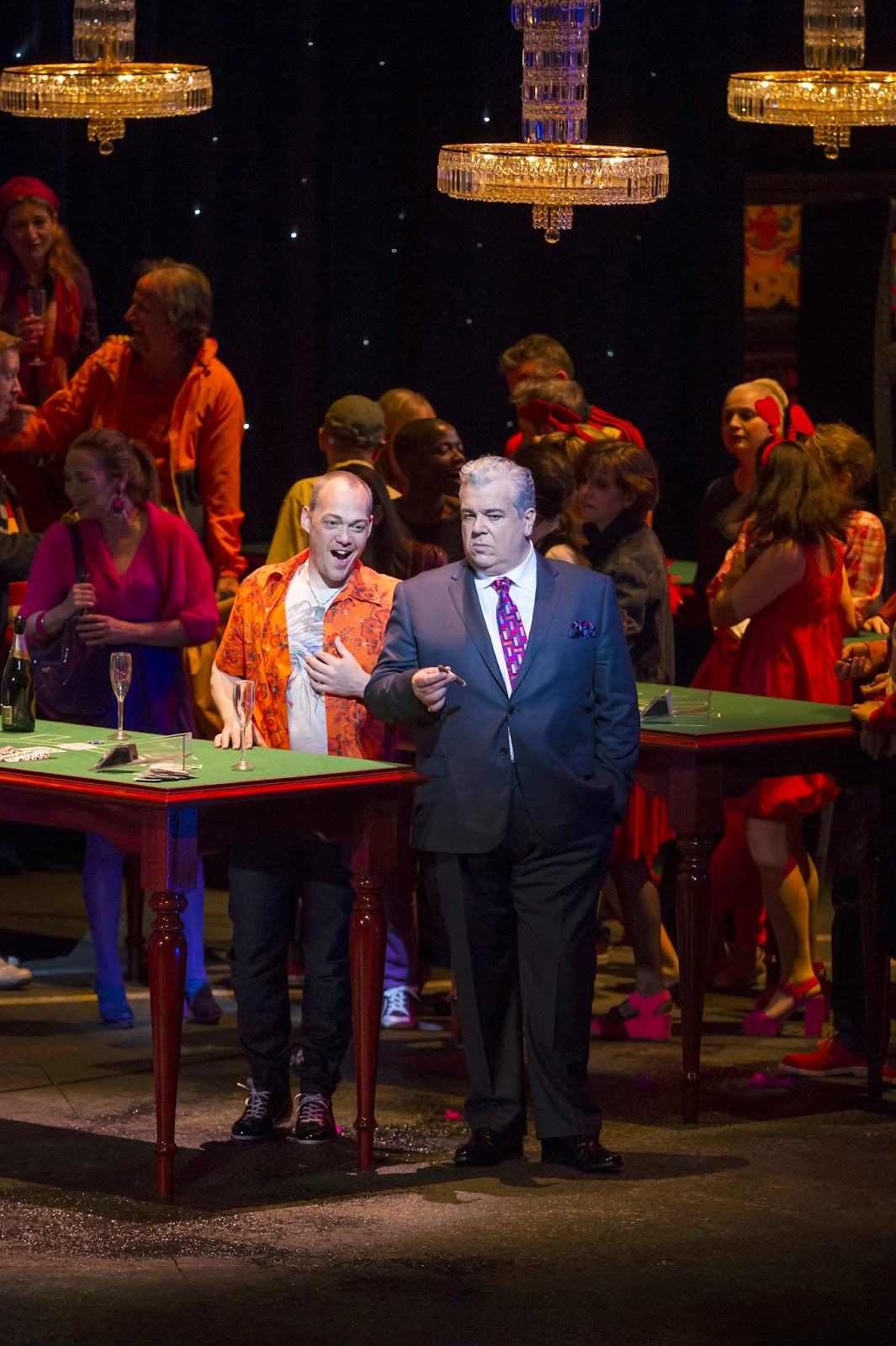
The lesser parts were also extremely well delivered. The Sergeant is a more significant role than many assume it to be. Jihoon Kim sang it with more personality than it usually gets. he makes the role feel like a Geronte who hasn't made enough money to kick people around, but would if he could. Significantly Puccini places the part in context of the female prisoners who are Manon manquées.Benjamin Hulett sang Edmondo, Nigel Cliffe the Innkeeper, Nadezhda Karyazina the Musician, Robert Burt the Dance master, Luis Gomes the lamplighter and Jeremy White the Naval Captain. Good work all round. Although attention focuses on overall staging, the director's input in defining roles should never be underestimated. Jonathan Kent's Personenregie was exceptionally accurate.

This production attracted controversy even before the performances began.  However, it is in fact remarkably close to Puccini's fundamental vision. Those who hate "modern" on principle often do so without context or understanding. So what if the coach at Amiens is a car? How else do rich people travel? So what if Manon wears pink? Puccini's Manon Lescaut hasn't been seen at the Royal Opera House for 30 years, but Massenet's Manon is regularly revived. So Londoners are  more familiar with Manon than with Manon Lescaut. Yet the two operas are radically different. Mix them up and you've got problems.  In Massenet, Manon and Des Grieux have a love nest in a garret. But Puccini goes straight past to Geronte's mansion and to the sordid business of sex and money.All the more respect to Puccini's prescience. Anyone who is shocked by the this production needs to go to the score and read it carefully.


Geronte thinks he's an artist. Because he thinks he owns Manon – so he uses her as a canvas to act out his fantasies. Jonathan Kent isn't making this up. Read the score. One minute Manon is in her boudoir, putting on makeup, talking to her brother. Next minute, musicians pour in and the have to be shooed out. Then  "Geronte fa cenno agli amici di tirarsi in disparte e di sedersi. Durante il ballo alcuni servi girano portando cioccolata e rinfreschi." ( Geronte beckons to friends to stand on the sidelines and sit. During the dance some servos are bringing chocolate and refreshments). The guests know that Manon sleeps with Geronte. They have come in order to be titillated.  It's not the dancing they've come to admire. They're pervs. Geronte is showing off, letting his pals know what a catch Manon is. Hence the dancing: a physical activity that predicates on the body and the poses a body can be forced into "Tutta la vostra personcina,or s'avanzi! Cosi!... lo vi scongiuro" sings the Dancing master. But he has no illusions. "...a tempo!", he sings, pointing out quite explicitly that her talents do not include dance. "Dancing is a serious matter!" he says, in exasperation. But the audience don't care about dancing. They've come to gape at Manon. There's nothing romantic in this. Geronte is a creep who exploits women. It's an 18th century live sex show. Geronte's parading his pet animal.

So Manon concurs? So many vulnerable women get caught up in the sick game, for whatever reason. The love scene that follows, between Opolais and Kaufmann, is all the morer magical because we've seen the brutality Manon endured to win her jewels.  Perhaps we also feel (at least I did) some sympathy for Manon's materialistic little soul. She knows that money buys a kind of freedom.When news of Mark Anthony Turnage's commission for Anna Nicole first emerged, some were surprised. Others said "Manon Lescaut". The story, unfortunately, is universal..At first I couldn't understand what the film crew and lighting booms meant but I think they suggest the way every society exploits women and treats them as objects for gratification. Later, the lighting booms close down like prison bars. Some of the women being transported are hard cases but others are women who've fallen into bad situations, but are equally condemned.  Far from being sexist, this production addresses something universal and very present about society.  I'm still not sure about the giant billboard "Naiveté" but there is no law that says we have to get every detail at once. Perhaps Kent is connecting to  advertising images and popular media, which is fair enough.

 People  wail about "trusting the composer". But it is they who don't trust the composer. Any decent opera can inspire so much in so many. No-one owns the copyright on interpretation. But the booing mob don't permit anyone else to have an opinion and insist on forcing their own on others who might be trying to engage more deeply. It's time, I think, to call the bluff on booers. They don't actually care about opera. Like Geronte, they're into control, not art..


This review appears in Opera Today
photos : Bill Cooper, Royal Opera House.