Showing posts with label Pappano Antonio. Show all posts

Sunday, 14 June 2020

Keeping live music alive - Royal Opera House live from Covent Garden


Lots to listen to this weekend : Live from the Royal Opera House, London, from the Rudolfinium Prague with Simon Rattle conducting the Czech Philharmonic and Magdalena Kožena, Britten from Aldeburgh,  Britten on Camera documentary on BBC TV 4, plus the LSO tonight (John Eliot Gardiner, Mendelssohn) plus much more.

"Doing our best to re animate the spirit of this gorgeous house" says Antonio Pappano in the introduction. And the ROH is glorious - it's heartbreaking to see it empty and its grand traditions silenced for the forseseeable future. That is WHY we need concerts like this, to remind us of what we might lose forever, if we don't take this crisis seriously.  Most musicians are freelance : they can't suddenly end up on the dole or get jobs filling boxes at Amazon. Like athletes, they need to keep training to keep their skills.  All that expertise gone to waste. The Royal Opera House is the second largests arts employer in this country, after the BBC, and contributes greatly to the economy. It is significant that far too many music fans do not recognize the role of live performance in keeping music alive.  Typical sneers on the net from "music lovers"- "we don't do live in my neck of the woods", "too many classics around already", "We only need Youtube" and most shameful of all, "We don't need professional musicians, amateurs are enough".  We're not just up against a pandemic and financial disaster but up against music fans who can't even comprehend the role of live performance in music-making.  

Above all, live performance is a communal activity, which constantly regenerates artistic growth.  The ROH is huge, not particularly suited to chamber recitals, but at least the company is making an effort, not, like the South Bank, giving up and closing down while keeping governments grants. So we might have to pay £4.99 to view later ROH concerts, but so what ? We should all be doing something to help.  In recent years, the notion that everything should be free is delimiting experience and poisoning growth.  The ROH website (as always) is full of petty complaints but it's not hard to access the concert (which starts a few minutes in) and remains online for repeat listening  There is a certain amount of echo at the beginning of the film before the mikes adjust by the time the performance starts.  Louise Alder sings Britten On this Island, and Toby Spence sings Butterworth A Shropshire Lad, and Gerald Finlay sings Mark-Anthony Turnage Three Songs  and Finzi Fear no more the Heat of the Sun.   The pianist is Pappano himself. For opera regulars, "Au fond du temple saint" from Bizet The Pearl Fishers, an opera that's notoriously difficult to stage, and Handel "Tornami a vagheggiar" from Alcina.

Since the ROH is also the home of the Royal Ballet, Francesca Hayward and Cesar Corrales dance the world premiere of a new pas de deux, choreographed by Wayne McGregor to Richard Strauss Morgen! , Louise Alder singing the Lieder.  Listen to McGregor describe why the arts must not be left to desiccate by default.  "And tomorrow the sun will shine again (Und morgen wird die Sonne wieder scheinen)  And that support needs to be coming from listeners like ourselves.

Wednesday, 5 April 2017

Pappano prevails : Royal Opera House 2017/2018


The Royal Opera House 2017/2018 season details are out, a wise blend of old and new.  It's very much a Pappano season. Some years back, Pappano was delegated repertoire which he does best, and revivals.  Now he's conducting all the prizes with little competition, save for Andris Nelsons in a new production of Lohengrin in June/July 2018.  Nelson's Lohengrin at Bayreuth was exceptionally inspired, so no way would ROH miss out on a package that includes Klaus Florian Vogt,  Kristine Opolais and Christine Goerke: a dream team.  Jakub Hrůša will be conducting a new Carmen, and Marc Minkowski, Michele Mariotti and Christian Curnyn will be conducting specialist repertoire. Placido Domingo is conducting a few performances of Tosca, but that's for the fans. The new Director of Opera, Oliver Mears, can't match Pappano's prestige and experience.  Since he's only been in the job a month, and seasons are planned years in advance, this is most certainly not "his" season.  Pappano's position at ROH is now supreme. 

The new seasons starts on 11/9 with a production of La bohème in a new staging by Richard Jones with several different casts, with some very good names among them.   Megastars in the new Rossini Semiramide, 19/11 to 16/12 - Joyce DiDonato,  Ildebrando d'Arcangelo, and Daniella Barcellona.  Seriously classy! This will almost certainly sell out fast, and deservedly so.  A new Bizet Carmen, at last, and thank goodness, 6/2-16/3/18. Good casts, though the budget probably went for Barrie Kosky, whose thing for cheery surfaces makes prurience palatable to audiences who go mad when sex is taken seriously.  No chance of that in Krzysztof Warlikowski's staging of Janáček's From the House of the Dead (7-24/3/18) , with a decent cast, but a conductor whose work so far is unidiomatic whatever he conducts but who is heavily promoted by Sony.  So many strong reasons why Lohengrin (7/6 -1/718) could be the highlight of the season - brilliant cast and conductor - and a new production by David Alden.

George Benjamin's Lessons in Love and Violence receives its world premiere (10-26/5/18)  conducted by Benjamin himself. As with Written on Skin, the libretto is by Martin Crimp and the staging by Katie Mitchell. The cast includes Barbara Hannigan and Stéphane Degout.    Outside the main house, the ROH will also be  presenting the world premiere of Mark-Anthony Turnage's Coralline at the Barbican Theatre and a work so new it doesn't yet have a name, by Tansy Davies.

At the Roundhouse, (10-21/1/18)  a new production of Monteverdi The Return of Ulysses, conducted by Christian Curnyn and staged by John Fulljames with a very good cast - Roderick Williams, Christine Rice, Susan Bickley, Samuel Boden, Andrew Tortise and Stuart Jackson.    This year's ROH concert performance will be presented by Opera Rara:  Donizetti, L'Ange de Nisida conducted by Mark Elder with Joyce El-Khoury heading the cast.

Kasper Holton has left the Royal Opera House at the end of his contract, but his five-year tenure has left a positive legacy. The greater emphasis on new works and new venues, for example, but also the core repertoire he directed. The vindictive hysteria of the booing mob hijacked attention, poisoning any chance of rational analysis. In the new Zeitgeist, be it politics or art, the mob knows everything and all else must be suppressed. But opera is art, and art means learning. Without learning, civilization die.s

Perhaps common sense will prevail. Damiano Michieletto's Cavalleria Rusticana and Pagliacci is back (29/11-13/1/18). Please read my review of the premiere HERE.  It's extremely good and well thought through, though the raging mob, still inflamed by seeing two seconds of tit in Guillaume Tell might have been too worked up to notice. Seeing that Cav and Pag again will be one of my priorities: highly recommended.   I also want to attend Les Vêpres siciliennes again.  Bryan Hymel! Like so much in Verdi, the plot predicates on concealment : things aren't supposed to be blatantly obvious.  Please read my review of that premiere HERE.  I'm also going to Holten's Don Giovanni (29/6-17/7/18) because it's a production that deals extremely well with the ideas of sudden change and illusion that make Mozart's opera so richly rewarding. So Holten used modern technology instead of painted flats? Someone told me he couldn't keep up with the action. Perhaps he didn't really know the opera.  Please read my review of the premiere HERE. 

Friday, 20 May 2016

Pappano Mahler 6 LSO Barbican

Publicity at the Barbican Hall last week had advertised "Pappano Violin Concertos" leading one to think that Antonio Pappano had added another string to his bow. Pappano did conduct Shostakovich Violin Concerto no 1 with Viktoria Mullova, but for me the question was: what would Pappano do with Mahler Symphony no 6 ? Answer : he'd do Pappano Mahler.

Given that Mahler is so ubiquitous these days, there's no reason we can't come up with Mahler of a very different flavour. Pappano is a brilliant conductor of Italian operatic repertoire, but he's also no mean conductor of symphonic work, Indeed some of his finest moments have been with the Accademia di Santa Cecilia in Rome. He's introduced a new series of orchestral concerts at the Royal Opera House, too, an excellent idea which complements the operatic fare. Surprisngly enough, some opera fans  don't often listen to music without singing or celebrity stars, so Pappano's intiative enhances their experience. (Read my review "Text Sublimated" of Pappano's first ROH orchestral concert here

In his day job, Mahler conducted opera, so Pappano's Mahler was certainly interesting in that context.  Pappano does Mahler with flair, though he has far too much taste and good sense to overdose on theatrical histrionics. Good solid playing from the LSO, with whom Pappano has worked many times. Altogether enjoyable enough, though not as illuminating as one might expect from Mahler specialists. Pappano won't go down in history as a Mahler conductor. Some will never get his Wagner, either.  Pappano's Mahler was certainly much more rewarding than Sinaisky and Karabits, who've both done Mahler this week. At the end of the day, being a really good conductor, as opposed to a good conductor, pays dividends.

Tuesday, 30 June 2015

Guillaume Tell ROH - audience back Gesler, not Tell.


What kind of sadistic regime would force a man to shoot an apple off the head of his own child?  Terrorist tactics, which ISIS might adopt to silence opposition. Schiller and Rossini might want us to sympathize with the Swiss, but a sizeable part of tonight's audience at the Royal Opera House Guillaume Tell clearly sided more with Gesler and his politics of intimidation.  As if orchestrated on cue, vociferous booing and shouting erupted, followed by shouting,  which continued during the music. At one point someone shouted as William Tell was taking aim. Luckily, the apple was wired to explode. If Gerald Finley had been firing a real arrow, he might have flinched and poor Jemmywould have been killed. Perhaps the booing mob think that's funny. Let's have no illusions that booing has anything to do with art. A lot of these booers take pleasure in inflicting pain. 

Forcing a man to shoot an apple off a child's head is an act of grotesque cruelty. Yet these booers didn't seem to mind. What drew their ire was a short sequence in which a woman is bullied by drunken soldiers, who tear her clothes off. The scene lasts but a few seconds, but the booers must have been waiting for it all evening. But as we know from Boko Haram and ISIS, women get raped. That's what we should get upset about, not the depiction thereof. In any cse, the scene is not gratuitous, but follows in from many sequences  which show how savage Gesler's men can be. As a friend observed, a rustic dance in the midst of war would be silly. The antimodern crowd are always demanding "Trust the composer". So here are Rossini's stage directions :

"Gesler's men force the Swiss women to dance with them. The people show by their gestures their indignation at this violence. At the conclusion of the dance they all prostrate themselves before the
trophy. Some soldiers drag forward Tell and his son whom they have noticed still standing in the middle of the scene"
 

During the Overture, Jemmy (Sofia Fomina) is seen playing with toy soldiers. We see his face close up on a screen. he's completely caught up in his game. If only more adults still had such powers of imagination!  Jemmy picks up a comic book, "William Tell by Frederick Schiller". and gets engrossed.  Perhaps the booing mob would prefer a comic book production, where everything is simplified in simple outlines. Fortunately, director Damiano Michieletto has put more thought into this production than the comic book crowd could comprehend.  Using the dance sequences as dramatic narrative allows Michieletto to develop Jemmy into a fully fledged personality, every bit as much a hero as his Dad, only smaller.  At one stage, the boy mimics his Dad's every move, as kids do.  The villagers' community seems as close knit as extended family. This emphasized Jemmy's, youth and innocence, which makes the horror that descends on his family and community even more poignant. It helps that Sofia Fomina is a wonderful character soprano, a rare and special breed. She stays in role even through the curtain call.

When the Austrians arrive this vernal purity is shattered. A vast uprooted tree dominates the stage. Perhaps it was uprooted in a storm or an avalanche, Nature's way of inflicting change.  Jagged, twisted branches and roots suggest cataclysmic trauma, yet,  as mountain folk know, uprooted trees  support a fertile ecosystem. The villagers will eventually triumph, the invaders will be repelled. The storm at sea scene in the final act is almost impossible to depict literally, so Michieletto and his designer, Paolo Fantin, come up with a brilliant imginary solution.  Jemmy, in his anguish, grabs the comic book to see how the story will end.  The cartoons are projected above the stage, so we can follow them as avidly as Jemmy does. For a moment, we too are back in the innocence of childhood. And so the village mothers bathe their children, cleaning away the pollution that Gesler's men have inflicted on their land.

House favourite Gerald Finley sang Guillaume Tell with depth.  John Osborn sang the fiendishly difficult part of Arnold, with the Asile héréditaire. Delicious singing, to match Pappano's passionate conducting.  If only I didn't have such vivid memories of Michael Volle and Bryan Hymel who sang the opera in Munich a year ago!  On the other hand the Munich production was awful, though it did try to engage with some of the underlying ideas, like gun violence. Malin Byström sang a good Mathilde. Sofia Fomina was an excellent Jemmy.  Eric Halfvarson sang Melcthal, Nicolas Courjal sang Gesler, and Michael Colvin sang Rodolphe, an extremely well-characterized performance which made a much bigger impact than the amount allocated to him in the score.  And as for Antomio Pappano?   As always, tops in this repertoire, to the manner born. 

PS Re the supposedly controversial scene. I'd wondered why one woman was singled out, instead of the group hiding under the tree.  Then I realized that seeing one woman focuses on her movements. In a strange way this was "choreographed" in the sense that the movements matched the music. For example, a little flurry in the woodwind, and one of the men grabs at her but pulls away. Thus the scene takes time because it respects the music. The actual moment of nudity is very brief indeed, and there's no actual sex. Rape isn't about sex, but about bullying. 


BBC Radio 3 will broadcast Guillaume Tell live from the Royal Opera House on 14 July 2015
Photos by Clive Barda, courtesy ROH

Tuesday, 3 December 2013

Wagner Parsifal, Royal Opera House

Any new production of Wagner's Parsifal would be welcome, if only to banish memories of Klaus Michael Gruber's staging from the 1990's where the Knights of the Grail were so comatose they had to be wheeled across the stage on a conveyor belt. But the Knights wore Knight suits and it was a "traditional" production so no-one dared demur.  I'm glad that I went to this new Parsifal at the Royal Opera House, even though my initial misgivings weren't far off the mark. Aft6er watching the HD, I['ve cjhanged my minsd ona lot of things ! read my latest here.

Antonio Pappano saved the day. Parsifal seems to have unleashed something in him. He's not an idiomatic Wagner conductor, but he knows what turns abstract music into drama. The notes, of course, are the same, but he intensifies colours so they seem to shimmer, taking on invisble extra richness. The music seems to exist as a living organism, the Grail Made Real. Bernard Haitink's final performance of the Gruber Parsifal stretched tempi to the point of disintegration, Pappano's approach isn't faster so much as more visceral, and well, red-blooded. We don't see Amfortas fight Klingsor, but the music suggests titanic struggle, and a panorama of cosmic extremes. Pappano feels the emotional pull so instinctively that he imparts his enthusiasm to the orchestra, and to us. Wagner as Verdi, perhaps? The better the music, the more interpretations it generates.
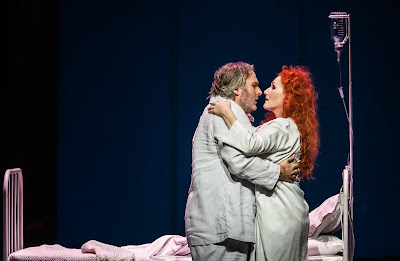
Jonas Kaufmann's Parsifal (more here) was miraculous : no-one else comes close. Parsifal comes from nowhere and finds his identity by struggling with himself. In that sense, Simon O'Neill's Parsifal worked. There are three Parsifals in Parsifal, each at a different stage of spiritual development. As the young Parsifal, O'Neill's harsh metallic tone suggests steel being forged by fire. Parsifal embodies the spirit of the Spear. O'Neill's best moments come in his encounter with Kundry, when the hero finds himself, and the singer's strengths reveal themselves in moments of gleaming power. O'Neill's voice is so individual that it's  difficult to cast. His Siegmunds are good, but he's not a natural Parsifal version 3, where the character emerges into transcendant light, becoming a Jesus substitute. Becuase this new staging underplays the transformation, it sidelines the singer - any singer - reducing the pressure on him to shine.

When I last heard Parsifal , in August (see here), John Tomlinson sang Gurnemanz, or rather acted his way through the part, his experience informing the performance though the voice was tired. This time, René Pape sang the part, bringing out its urbane elegance.  Gurnemanz is one of Nature's aristocrats. Amfortas screws up: Gurnemanz survives to tell the tale.  Pape sang the long first act monologue with elegant poise - beautifully shaped phrasing that shaped the long text into music, rather than words alone. This time, the staging let him down. While it's true that Gurnemanz doesn't do direct action, here he was relegated to the sidelines, barely distinguishable  even in the orchestra stalls. I tracked him with my ears.

Angela Denoke's experience as Kundry stood her in good stead, for here the character seemed woefully under-directed. Denoke hits her notes like arrows aimed at targets. Perhaps this connects to Parsifal shooting the swan, but that's almost certainly far too esoteric for a production as simplistic as this. A different production, with more emphasis on the way the role works as drama, would show Denoke in better form.
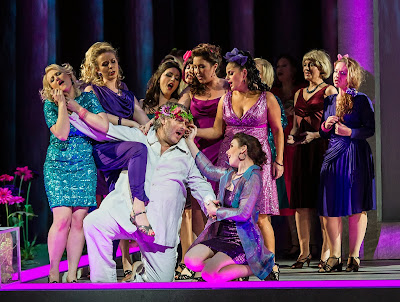
Gerald Finley's voice has been through rough patches, but now seems to have settled well. His Amfortas was lucid: nice rich tones, a king rather than a man dying  slowly from wounds that cannot heal. Again a case of good singing, without direction.  When Robert Lloyd sang Titurel, it came as a shock. An extremely loud and sudden outburst, far too forceful for the role. Perhaps Titurel hates Amfortas for denying him the Grail, but it goes against the musical line. Willard White sang Klingsor, who has existed, like a dark angel from the beginning of Time. Audiences love famous names. White's Klingsor delivered enough to appeal, but sounded tired. Fresh. lively singing from the Flower Maidens , especially the one in the pink shift, who might be Celine Byrne. O'Neill looked very happy with them, and so he should, they were so vivacious that they almost stole the show.

This year, The Royal Opera House brought Stefan Herheim, at last, to London. His Verdi Les vêpres siciliennes (more here) was, like his other work, exceptionally erudite and well conceived, growing in stature with each new encounter. It would have been too much to expect another Parsifal from him while his Bayreuth Parsifal is still so fresh, but he's not the only good Wagner director around. Perhaps Stephen Langridge was chosen because he's so very different to Herheim. Previously, I've only seen his staging of Harrison Birtwistle's The Minotaur.(much more on that on this site)., so I had a completely open mind.

Langridge dispenses with the pseudo-religious claptrap that bedevils Parsifal and distorts its true meaning, whatever that might be. Titurel, Klingsor and Kundry are figments of the imagination. The Knights make a fetish of the grail, imbuing it with supernatural  powers. For them Good Friday has similar magical qualities. Yet Good Friday is the one day in the Christian calender when bread isn't turned into the body of Christ. Read my piece on Religion vs Religiosity in Parsifal – Wagner subverts Christian theology so thoroughly that Parsifal could be read as blasphemy.

Susan Chitty's set is dominated by a large box-like structure. It's an extremely effective device for bringing together different planes of action neatly on stage. It also serves as a metaphor for the Knights' Grail fetish. The box is empty! Instead a young boy emerges, semi-naked as if coming out of a sauna, not that we should be too specific about images. There's even steam. As a concept this is perfectly valid, because material objects like a physical Grail don't confer spirituality. A squeaky-clean boy is a perfectly good symbol of a pure, Holy Fool. In the Final Act the boy comes back older but by this stage he's served his purpose, just as Freia drops out of the Ring. The Gods of Valhalla won't die without their fix of golden apples, unless, like Titurel, they're so hung up on ritual that they can't live without it...Compassion isn't a material object.
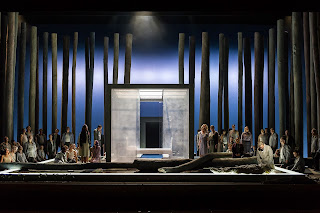
That insight redeems Langridge's Parsifal.  Otherwise, the production is pretty static, and the characters underdeveloped. It will be very successful, though, for precisely that reason. Audiences seem to prefer one-dimensional productions where they don't have to engage with complicated ideas. They scream at the word "Regie" as if it were a fetish like the Grail. It does not carry the connotations of "regimentation"  that scares people who speak only English.  All the word means, and it's the same in French, is "directed", pure and simple So all the hysteria about "Regie" is a meaningless crock. There are good productions and bad, but that depends on what's in them  Those who really care about opera are, one hopes, mature enough to get something out of many different approaches. Productions which ignore depth of interpretation, like Warner's Eugene Onegin  or the painfully shallow ENO Wozzeck are the real "Regie" villains because they ignore the real depth and complexity in a good opera.

That said, though, Langridge's Parsifal is a good show. because it at least attempts to deal with the ideas. It's infinitely better than the Met Parsifal, stage-wise, with its overstated blood fetish.  Without the Met's classy cast, that production belonged in a minor provincial house, though it might have seemed radical to Met audiences. Langridge's Parsifal will, like the hero, grow and mature, especially if he fixes the characters. Give me real "Regie"like Herheim any time :

 photos copyright Clive Barda, courtesy Royal Opera House

Wednesday, 16 October 2013

Britten War Requiem Pappano Bostridge Hampson Netrebko

The new EMI  recording of Britten's War Requiem with Antonio Pappano, Ian Bostridge, Thomas Hampson and Anna Netrebko could re-shape the way the piece is heard. That's not necessarily a bad thing as we get into lazy habits if we expect to hear the same thing done the same way all the time. All too often, performance practice smothers music under a fire blanket of false familiarity. Instead of listening to the music, we end up listening to what we think the music "ought" to be, which is not at all the same thing.

Britten's War Requiem is specially prone to that kind of non-listening. It's dangerous. With so many performances of the piece coming up, it's high time to ditch the baggage that's accrued to the piece and listen to it on its own terms.  What IS the War Requiem ? Everyone knows it was written to mark the rebuilding of Coventry Cathedral, but what does it really mean?

First piece of baggage to ditch: it's not part of the British choral tradition, unless we assume all choral music is "British" and traditional. Britten uses the Requiem Mass format, just ass hundreds of composers have done before and since. But is he using it in a traditional, religious way? Yes, in the sense that the piece concludes with virtues Christianity espouses, in theory. The Mass gives the piece structure but it's a starting point, not an end in itself. Far more original is the way Britten creates the piece as a paean to Wilfred Owen.

Wilfred Owen came from a family who had aspirations far greater than their actual income. He couldn't afford public school or university so his route to education was to enter the church. It wasn't a vocation. He suffered what seems like a massive breakdown and went to France - before the war. Joining the army came later. Not at all a steady career progression. Owern was middle class, "new" Britain, gay and an outsider, who made his own way. A lot like Britten himself. So approaching the War Requiem as music, and through Owen, suggests very different interpretations from than conventional performance practice - a "tradition" of only 50 years.

Antonio Pappano's Britten War Requiem is electrifying. He approaches the piece as drama, ditching the baggage of piety. Pappano understands the violent climaxes and sudden, shattering cut-offs into silence. This is "modern" music, just as Coventry Cathedral was rebuilt as modern architecture. Angularity, strength, unsettling discordance - much closer to meaning. Ditch Abraham's willingness to sacrifice, and Isaac's meek subservience. If people break the cycle of blind obedience, they can stand up to society's dependence on war as a means of resolving conflict. Pappano conducts the Choir and Orchestra of the Academia Nazionale di Santa Cecilia, Rome, who aren't subservient to British and Brittenish baggage. This orchestral playing and choral singing is exceptionally intense, so the piece re-emerges vividly and violently anew. I'm reeling from the impact. I don't know where this was recorded, but it puts paid to the myth that the War Requiem "needs"church acoustics. Packaging doesn't make a piece work. Performance (and intelligent listening) does.

Soloists are Ian Bostridge, Thomas Hampson and Anna Netrebko. Bostridge is the ne plus ultra of Britten performance. His voice evokes the elusive qualities that make Britten so unique - qualities so disturbing that society in his time might not have been able to cope with. Britten's a hard nut to crack because he's oblique, evading easy scrutiny, even perhaps to himself. Now perhaps times have changed and we can begin to grasp his true originality. Bostridge's Agnus Dei suggests a terrifying image, glowing with surreal, apocalyptic light.

Hampson's anti-war credentials run very deeply indeed, and here he sings with sincere commitment, striking even in a career full of intense, passionate performances. He's too honest to attempt to sound German though he probably could since he sometimes slips into the accent when he's not singing, since he speaks German all the time. For Wilfred Owen, "war" meant the Somme. First World War propaganda was crudely racist. By connecting to The Boche as human beings rather than as barbarians, Owen was making a powerful statement. What Coventry suffered was minimal compared with what was happening elsewhere, but it was symbolic. Dietrich Fischer-Dieskau's presence at the premiere was essential. This is a performance practice worth respecting because it embeds meaning on a very deep level. On the other hand, it's not easy to sing, so if top German soloists like DFD or Goerne aren't available, it's better to use a good non-German, and Hampson is as German as any native English speaker could be.

Anna Netrebko, a Britten specialist?  I wouldn't expect her to sing The Governess or Les Illuminations but here's she's excellent. Britten's championship of Shostakovich and Rostopovich gave them an international profile that protected them from the full force of Soviet repression. A Russian soloist is also valid performance practice, though the text is in Latin. The soloists doesn't have to sound "Russian" whatever that might be, as long as she can create the part musically. It functions at the pinnacle of the choir, surrounded by other voices, much in the way the Archangel St Michael stands out from other angels. St Michael is a warrior who, in the Book of Revelation, defeats Satan and heralds the End of Time when the dead shall be raised. He's also one of the few angels in the Old Testament. The part brings Russia and the Holocaust into the War Requiem, otherwise so much a memorial to the Western Front. Netrebko sings with fiery, operatic intensity, absolutely in keeping with what the part may mean.  One reason why the War Requiem is often misunderstood is because listeners are more attuned to conventional big displays rather than to the real narrative of the piece which pivots around the quirky, surreal settings of Owen's poems and on the two male protagonists. The female soloist and the choir(s) serve as illuminating backdrop. The female soloists shouldn't dominate, but Netrebko' projects such strong personality that she makes you want to cheer.

More on Britten here than on any non dedicated site

Monday, 6 May 2013

Verdi Don Carlo Royal Opera House London

Is it possible to upstage Jonas Kaufmann? Kaufmann was brilliant in this Verdi Don Carlo at the Royal Opera House, London, but the rest of the cast was so good that he was but first among equals. Don Carlo is a vehicle for stars, but this time the stars were everyone on stage and in the pit. Even the solo arias, glorious as they are, grow organically out of perfect ensemble. This was a performance that brought out the true beauty of Verdi's music.

Act One started a little tentatively. Perhaps it takes time for the drama to unfold and Kaufmann knew how much was yet to come. His pacing was deft: when he needed to stun, his voice rang out with ferocious colour. This was a Don Carlo one could imagine defying the Spanish Empire, its violence and tyranny. His vocal authority was matched by physical energy. Kaufmann embodies the part perfectly. His interactions were outstanding. His voice balances well with Anja Harteros (Elisabetta) and Mariusz Kwiecień (Rodrigo), and he allowed the duets and trios to work seamlessly. No big name ego dominance.
 
Verdi  prepares us from the start for the turbulence that will meet Elizabeth of Valois. Even before she leaves home, Elisabetta experiences extreme changes of mood within a compressed period of time. Anja Harteros delineates these intense feelings deftly, without exaggeration, so they arise naturally from her singing.  When she bids goodbye to the Countess of Aremberg (Elizabeth Woods), Harteros sings as though she were bidding farewell to life itself.  Indeed she is, for Elisabetta is now alone, trapped in an alien world. Harteros creates Elisabetta with such conviction that she dominates the drama even when she is silent. Her presence is felt even when others are singing about her. When Harteros sings "Tu che le vanità", we feel that Elisabetta has reached valediction, after a long and tortured journey. She sings of Fontainebleau and her brief day of happiness so tenderly that the agony of "Addio, addio, bei sogni d' or, illusion perduta!" becomes truly overwhelming. Harteros and Kaufmann have taken these roles before together. Here, in London, they achieved transcendence.

Ferruccio Furlanetto was equally outstanding as Philip II. His years of experience in the part give him authority. Verdi writes the part to reflect the personal austerity for which the historical Philip II was known. A solo cello introduces his big aria "Ella giammai m'amò", emphasizing the King's loneliness., despite the trappings of wealth and power around him. Later, violas and basses extend the mood of melancholy. Furlanetto sings with force, but with colour and tenderness. Because he makes us feel the man beneath the public persona, we realize that the tragedy involves Philip as well as his wife and son. Furlanetto makes us realize that the king is just as much trapped by the system as they are. "Beware the Grand Inqusitor!" he cries, for the Grand Inquisitor is perhaps the only truly evil character in this opera.

Verdi introduces the Grand Inquisitor with music that exudes menace. Slow, low rumbling sounds, suggesting a snake slithering, oozing poisonous slime. Eric Halfvarson was indisposed with a cold, but this didn't affect his singing. The Grand Inquisitor is supposed to sound diseased.  "Did God not give his only Son to save the world ?". Theology is twisted for evil purposes.

Mariusz Kwiecień  was a clean voiced, muscular Rodrigo, and a perfect complement to Kaufmann's Don Carlo. The dynamic between them is very good: they're both relatively youthful and fresh. This similarity is important, for it reinforces the tragedy, and the theme of sacrifice. When  Kwiecień sings Rodrigo's last aria, "Per me giunto è il di supreme", he infuses it with warmth and love, so it connects with Elisabetta's farewell to life.

One of Béatrice Uria-Monzon's signature roles is Carmen, so when she sang the Pricess of Eboli, she brought a Carmen-like sharpness to the role, which was entirely in order. Her Veil Song was a showpiece, but the song is a mask, since the princess's true feelings are also hidden behind a veil. When she realizes her mistakes, her personality disintegrates. When  Uria-Monzon sings of the convent, she suggests the horror of living death.

Dusica Bijelic sang a sprightly Tebaldo. Even the Flemish Deputies made an impact greater than the size of their parts: extremely tight ensemble, yet individually characterized. Robert Lloyd sang the apparition of Carlo V credibly. The Royal Opera House Orchestra and chorus, always excellent, were on even better form than usual.  Verdi is Antomio Pappano's great strength. He's inspired towards a highly individual but vivid reading which emphasizes dramatic detail. He's also a singer's conductor, who lets voices breath, as we heard so admirably.

This would have been an almost perfect Verdi Don Carlo, but is lamentably let down by the production. Originally directed by Nicholas Hytner and revived this time by Paul Higgins, it was first seen at the Royal Opera House in 2008.  The designs (by Bob Crowley) feel outdated, serving little dramatic purpose. Huge expanses of space are filled with grids of holes. Perhaps these represent windows, walls or even the spying eyes that are ever present in tyrannical regimes. If the image had been developed well,  it might have enhanced the paranoia that runs through this opera. Instead, the image lies inert,  like a weak joke endlessly repeated.  In the scene where the ladies of the court listen to the Veil Song, there's a wall of red plastic cubes which look like they've descended from Legoland for no obvious reason. 
 
The greatest weakness of this Don Carlo was that the staging missed the deeper, more challenging levels of the opera.  The monastery of Yuste is depicted by the tomb of Charles V with the name "Carlos" engraved in huge letters so they can't possibly be missed.  Charles V, the Holy Roman Emperor, renounced his power and retreated into the monastery where he died ten years before the Revolt of the Netherlands.

Opera isn't history. But when a composer like Verdi adapts history for art, there is a reason. In this production, the political aspects of the story are downplayed. Even the asceticism of Charles V and Philip II is sacrificed to decorative imperative, although the words " addio, bei sogni d' or, illusion perduta!" pertain to more than Elisabetta. This is the kind of production that gives modern staging a bad reputation. Yet because it's comic book cute, it's probably popular. Staging is much more than decor. Like every other element in a production, it should contribute to meaning and drama, rather than distract. A cast of this exceptional quality deserved better.

A longer version of this review with full cast details will appear in Opera Today. 
 Photos : Catherine Ashmore, courtesy Royal Opera House