Showing posts with label Petrenko Kirill. Show all posts

Saturday, 24 August 2019

Petrenko, Berliner Philharmoniker, Beethoven 9 live from Brandenburg Gate


Live from the Brandenburger Tor (Brandenburg Gate), Kirill Petrenko conducted the Berliner Philharmoniker in Beethoven's Symphony no 9 to an audience of thousands. It's been just over four years since Peternko was appointed Chief Conductor but this is his first official appearance. Massive publicity, which is fair enough - the Berliner Philharmoniker was among the first to pioneer orchestra-led online performance. Now, it's fairly standard practice. Anyone, anywhere in the world, can listen in. The Berlin Phil is effectively everyone's "local" orchestra, bringing world class playing to anyone who wants to listen in.  This raises the bar for everyone - audiences, musicians  - but I think people respond better to upmarket than to dumbing down.  Live broadcasts are also increasingly important because they reset the balance in favour of musicians and music, in an era when the delivery of music, such as streaming, increasingly divorces product from performance. Music is a human art, made by human beings for other human beings.

Thus the value of mega-scale open air extravaganzas like this concert by the world-famous Brandenburger Tor, literally in the backyard of the Philharmonie.  Until 1989, that massive square was No Man's Land, covered in weeds and barbed wire.  The Brandenburg Gate is significant, too. With its grand columns and Quadriga above, it was built to commemorate the apogee of Prussian culture, which celebrated learning, enlightenment, the arts, science and business enterprise.  When the Nazis came to power bthat heritage was bastardized. The great grandson of the architect, a relative of Henning von Treskow, who was executed by the Nazis for taking part in the plot to assasinate Hitler, observed wryly that the horses in the statue were placed so their metaphorical droppings would land on the heads of rulers who lost touch with reality. And so the Quadriga has witnessed the comings and goings of despots of all kinds.  That symbolusm, in the context of Beethoven's Ninth, cannot be stressed enough. ""Alle Menschen werden Bruder,Wo den sanfter Flugel weilt".

And so the new season of the Berliner Philharmoniker should be celebrated on a grand scale : it represents the triumph of music and musicianship against the odds. A good season ahead - lots to look forward to. I'm less sure about the PR.  Deutsche Welle calls it "Petrenko Fever" thoughn that might be popular journalism.  Yet it shouldn't be forgotten that he wasn't the first choice  when the oircheestra originally sought a new Chief. They were so evenly divided between choosing Thielemann and Nelsons that they called off voting for several months. Suddenly, Petrenko's appointment was announced out of the blue. Orchestra members said that they'd been eager to work with him since he'd conducted them twice several years before. But since he's based in Munich and Berlin, it wouldn't have been hard to fit him in somehow. No-one turns down a gig with these Berliners.  Petrenko is good, but his reputation is largely based on opera.  Every new Chief brings something new to an orchestra. Karajan created it as a recording orchestra,  Abbado, a completely different personality, focused on musicians and musicianship. Rattle broadened the repertoire and did good outreach (the Digital Concert Hall happened in his era). So what will Petrenko bring that will be unique ?

Anyway, back to the open air livestream at the Brandenburger Tor . It's not a "first" as some media are saying. Barenboim conducted Beethoven's Symphony no 9 in 2017 outside the Staatsoper unter den Linden, to a crowd estimated at around 10,000.  The Brandenburg Tower is just at the end of Unter den Linden, so the idea wasn't original at all.  Open air concerts get done in many major cities - London included, when Trafalgar Square is packed out and London traffic comes to a standstill.   The Berliners have been doing open art at theWaldbühne for ages. No point in comparing performances, since the Berliner Philharmoniker is the classiest band in town and does orchestral all year round.   Very brisk tempi. Barenboim's concert started earlier in the day and was family-friendly, celebrating the city as much as the band itself,  Petrenko's aimed at a more formal concert-going audience which is fair enough. That's what the Berliner Phil does !

Tuesday, 4 September 2018

Unsung heroes : Kirill Petrenko Berliner Philharmoniker Proms London

Unsung Heroes : the Berlin Philharmonic on the move (photo: Roger Thomas)
Kirill Petrenko and the Berliner Philharmoniker, Proms 66 and 68 at the Royal Albert Hall (plus another at the Cadogan Hall today).  An opportunity to ponder how the music business works.   From the media hype, you'd think Petrenko was a discovery. He's even being hailed as  the next Carlos Kleiber, which is a curious non-compliment if you actually know how screwed up Kleiber was.   From the hype, you'd also think he was unknown, which says more about the media than about the man himself. He was Chief at the Komische Oper in Berlin fifteen years ago and Chief at the Bayerisches Staatsoper and a regular at Bayreuth - hardly low profile.  In many circles, he was so unknown that many confused him with Vassily Petrenko and even Mikhail Petrenko, the singer.   You can't really blame audiences, since he hadn't recorded much and was, at the time his appointment was announced, almost non-existent on Youtube, though that changed overnight.The orchestra itself declared that they loved himn so much that they'd been waiting years to hire him again since his two performances some time back, which is odd since they could have scheduled something.  Petrenko is good, and sometimes extremely good (read about the Munich Parsifal HERE),  but we need to assess him for himself, not by the media image.
The same goes for any speculation about what the Petrenko era in Berlin might mean.  Just as in any business, chiefs are chosen for what they can do to develop the brand. Karajan made the Berlin Phil tops in the recording industry, Abbado's non-dictatorial style developed them as musicians, and created the panoply of assocuated orchestras.  Rattle's gifts as commincator opened up community-oriented outreach.   Though it's not unusual for the Berliner Philharmoniker to choose wild cards, as Karajan, Abbado and Rattle were in their time,  what matters is to think where the orchestra might be heading in future. Thus the photo above. Who are the unsung heroes who make an orchesatra move?  Not just the truck drivers but the organization as a whole, musicians, management and support systems, not just the star at the helm.
Petrenko's two Proms in London exactly replicated recent concerts in Berlin, the first of which was in April, the second on 24th August. (both available on the Digital Concert Hall).  The main difference is Yuja Wang's evening gown, a perfectly good reason to enjoy watching.  On Saturday I was at Prom 66 for Franz Schmidt's Symphony no 4 in C major, (1933) new to the BBC Proms perhaps but again, hardly unknown.  Indeed, Britain is one of the Franz Schmidt hot spots, since his friend, Hans Keller, was extremely influential in British music circles.  Schmidt's reputation has been plagued by trying to fit him into pigeonholes.  Listen to the interval talk on BBC Radio 3 where Eric Levi and Nigel Simeone, who know what they are talking about, demolish notions about Schmidt's place in music history.   If music is good on its own terms it doesn't matter what box it falls into: judging anything by arbitrary assumptions gets in the way of real listening.  Schmidt is not Mahler, nor Bruckner, he's himself.  That said, Schmidt's Fourth reminds me a bit of Berg's Violin Concerto, not because both were written in memory of a dead woman, but for their chromatic inventiveness.
The long, expansive lines seem to quiver, as if seeking out resolution from unnswerable questions. The lone trumpet  sings, plaintively, but with dignity, quiet percussion behind it, like footsteps in a funeral procession.  The theme is taken up and developed by solo cello,  the strings and winds behind it rising ever upward. The lines are expansively extended, as if the composer didn't want the thread to end, but is cut short by a fast-paced section, which briskly sweeps away what has gone before.  Now the instruments rush forth in tight, angular staccato, ending in flaring crescendo.  The cor anglais sings a long, mournful line, taken up and expanded by the strings and other winds, on this occasion sounding warm and somewhat serene, Then a last big surge in the orchestra before the trumpet re-appeared, ending with poignant suddeness.   Before Schmidt's Fourth, a rather straightfoward account of Paul Dukas's ballet La Péri, which could have been both wackier and lusher, and Prokofiev's Piano Concerto no 3 with Yuja Wang, which was great good fun: a party piece before the funeral.
Petrenko and the Berliner Philharmoniker rested up for the day while Andris Nelsons and the Boston Symphony Orchestra did Mahler Symphony no 3 in the afternoon.  Please read my review of that HERE. Their Monday Prom, Prom 69, with Shostakovich Symphony no 4 which was even better! Pity it was paired with  a lesser work by Bernstein, though well played, with soloist Baiba Skride.  It's a pity that the BBC's obsession with tickbox themes has resulted in more Bernstein than anything else, espcially if you include the often uninformed commentary from presenters who seemed to be spouting party line.  But back to Petrenko and the Berliner Philharmoniker for Prom 68 with Beethoven Symphony no 7 and Richard Strauss Don Juan on Sunday  night.  Utterly solid and reliable : an orchestra like the Berlin Philharmonic does not do anything less, ever.   Nothing wrong with that per se, but nothing revelatory either.  So one does wonder what lies ahead. 

Sunday, 9 October 2016

Die Meistersinger von Nürnberg - Bayerische Staatsoper Munich


Die Meistersinger von Nürnberg from the Bayerische Staatsoper, Munich:  so dark and disturbing that it makes uncomfortable viewing. But truly great works of art operate on many levels, the greater the piece the greater the possibilities.  It is a measure of Wagner's greatness that the ideas he dealt with nearly 150 years ago apply, almost frighteningly,  to the present.  This Meistersinger provokes more questions than it gives answers, exactly what we need at the present when assumptions about art, politics and society are in unprecedented flux.

Who are the Meistersingers? Wagner makes a point of describing them as distinct individuals, with different backgrounds, united more or less by their love for art.  All of them have other day jobs: art is something they choose to place their faith in.  Although Hans Sachs and Sixtus Beckmesser dominate, it is wise to consider the Meistersingers as a group of personalities resolving the inevitable conflicts of diversity through compromise.  Rules help them muddle through by providing a kind of framework in which to regulate their art. But the rules are, in fact, made up ad hoc.  Beckmesser is so obessesed with finding fault that he runs out of space on his marking slate.  He works himself into crazed frenzy. Reality is never quite so extreme.  Yet the Meistersingers, supposedly wise representatives of common sense, get caught up in Beckmesser's hysteria and hate.  How easily civilized society can disintegrate when demagogues take control! Were it not for Hans Sachs and the voice of reason, Walter von Stoltzing, and what he stands for, would have been driven out of Nuremberg forthwith. How easily society descends into mindless, repression and group think.  What kind of society cannot cope with change and must suppress new ideas?

The Meistersingers here are depicted as ordinary men, to whose credit have worked hard to make something of their craft. Ordinary men, who've meant well. They think they're in control, but are easily manipulated into forgetting the very fundamentals of art, that art should enhance life, and must, like Nature itself, constantly refresh. Hence the urban landscape.  Walter learned his art from the birds in the woodland, who are free. Birds don't survive in these grim conditions.  As Wagner clearly stated in his stage directions, angles in the Church are distorted. Something's askew. Eva (Emma Bell) participates in formulaic rituals but recognizes Walter (Robert Künzli) as a fellow free spirit right from the start.  The apprentices, being young, are also still untamed, but how is their energy directed.  Just as each of the Meistersingers is defined as a distinctive personality, this David (Benjamin Bruns) isn't a stereotype but a well-characterized combination of worthiness and weakness, not a youth but not yet an artist until the end.

In the First Act, the staging sets the personalities. In the Second, the staging focuses on the community. Sachs (Wolfgang Koch) operates out of a van marked "Schuhe".  It reminds us that Sachs is out in the open, in the night air. Is he a Wanderer, who sees all yet can't easily intervene?  There's no tree in this square, but a cherry picker crane that can be cranked up and down if needed, a stage idea that's more effective than it looks. Beckmesser can reach great heights, but by artificial means, reflecting the idea of an elder tree and its connotations of delusion.
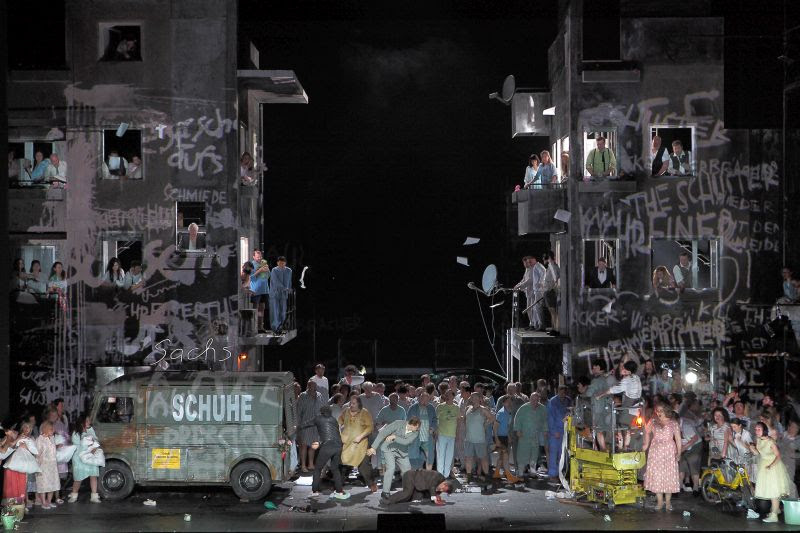
The citizens of this Nuremberg live in anonymous housing blocks, as we'd see in any desolate city where conditions are hard, and expectations are limited.  These are the universal disenfranchised, the kind of people whose horizons are curtailed, and who make easy prey for populist demagogues that make them feel they are "taking control" when they are, in reality, being manipulated.   Given the events of 2016, and the rise of Pegida and other right-wing extremists, it would be easy to make connections with 1933, but David Bösch, the director, deliberately avoids easy answers. He makes us feel sympathy for these dislocated souls, despite the violence with which they express themselves. To counteract such evil we need to understand and analyze, though not condone. Thus Beckmesser gets beaten up, and savagely. Nothing scenic about this brutality. The Nightwatchman (Goran Jurić) is an ordinary German policeman, a symbol of order, but one who cannot reverse the insanity once it's been released. The mob bully him back into his squad car. They wield poles, like knights n the past would have wielded spears : the romance of the past revealed as petty crime.

Similarly, this Beckmesser (Martin Gantner) isn't a caricature, but is interpreted as a weak but opportunistic personality who assumes that playing the right games gets you ahead.  He's very nearly right. Were it not for Sachs, his gold lamé suit and string vest might make him a superstar in some eyes, though his instrument is minute.  Walter, in leathers, looks like a thug but is the true artist, rough edges and all.  David could go either way, meaning well but prone to fudging corners.   Wolfgang Koch's Sachs impressed: although he's grimy (as the real Sachs probably was), intelligence shines out of his eyes. His movements are sharp and he takes in all that's happening around him, as a good Sachs should.  Koch is so experienced that authoritative singing comes naturally to him: no need for exaggerated folksiness.  His "Wahn! Wahn! Überall Wahn!" sounded genuinely perplexed, as if he were trying to make sense of what's going wrong, rather than just sighing in despair.  As he sang, his voice warmed with resolve.  Sachs can, and will, stand up for reason.

No open meadows in the final scene. Perhaps the Pegnitz no longer flows, or has been diverted underground.  We still see flags but these are flags of a more sinister kind. We're indoors, in a closed auditorium, cut off from the real world. On a hot Johannisnacht, the atmosphere would be stifling. And so, perhaps, a commentary on the nature of guilds and competition, of the channeling of diversity into an apparently cohesive celebration. "Brought to you by Pogner", a sign declares, for Pogner (Georg Zeppenfeld) was the agent who created the situation through which Eva was auctioned off to the highest bidder, bringing out the worst in Beckmesser, who might not otherwise have dared  to move. Pogner's white suit isn't as pure as it might seem.  The mob in the square covered the city walls in graffiti. Here, the "promoters" cover the meadow with commercial slogans.  Either way, defacement, and the defacement of culture as sacred mission.

The guilds come together in a show of  unity, but how much of this unity is real, and how much controlled by convention. Each guild flaunts its superiority. Listen to the music: "Streck'! Streck'! Streck'!" and "Beck! Beck! Beck!", violence channelled into ostensibly cheerful chorus. The Tailors hold up the tools of their trade: giant scissors which could cut a man in two, stained with blood.  In some shots the blades of the scissors appear above the tailor's heads as if they were the horns of the devil.  The Prize scene is a Prize Fight, but the wider scene suggests a kind of Party Rally, with the crowds cheering as if on cue. Alas, Nuremberg has yet to live down 1936, even though not all the good folk of the city were participants. But at least the memory serves to remind us how dangerous Party Rallies can be, when people can be manipulated into unthinking frenzy and violence. Even decent, ordinary people who let themselves be fooled by soundbites.  No wonder Walter doesn't want more of the same.  Beckmesser gets beaten yet again, and brutally, this time shooting himself.   Fortunately, though, Walter does win, and wins Eva, the two of them offering hope by renewal.  What Walter will learn from Sachs will determine the direction of Holy German Art.

How much have audiences learned from Wagner, and from Die Meistersinger von Nürnberg, though, I wonder ?  In the dark clouds gathering around us in 2016, have we learned  anything from history?  Can art save civilization? Or is human nature so venal that the ideals of enlightenment must be destroyed in a wave of ever-narrowing bigotry and the resurgence of fascist values?  In this production, the bust of Wagner comes in a box marked "fragile".  Fortunately in Munich, the cheers were louder than the boos, a cause for hope.  Kirill Petrenko conducted a very good cast even without a megastar like Jonas Kaufmann.  For that, I was glad, for Die Meistersinger von Nürnberg is about ordinary people doing extraordinary things.   This production, directed by David Bösch, is finely detailed and will probably reveal its depths as time goes on. It's different, but its insights come from the opera itself.  It's not easy. But the issues it confronts are not easy and need to be confronted with courage and with Hans Sachs's fair minded common sense.  

Monday, 22 June 2015

Kirill Petrenko Chief Conductor Berlin Philharmonic


Kirill Petrenko has been named Chief Conductor of the Berlin Philharmonic Orchestra. A surprise, to those who know who is he (as opposed to those who mix him up with Vasily and Mikhail, who is a buddy of Kirill but not of Vasily).  It's also a surprise because Petrenko has only conducted Berlin three times, the last time being in 2012. The choice was made, according to the publicity material, because the orchestra loved working with him and were eager to have him back as soon as possible. But Petrenko is based in Munich, hardly a major commute to Berlin, and his Munich schedule, even allowing for Bayreuth, isn't so onerous that he couldn't have fitted something in during the last three years. The Berliner's schedule is tight too, but is it really that tight that they couldn't fit him in if they liked him so much ?

Moreover, he's primarily an opera conductor. Perhaps the Berliners want to move more in that direction, as they have been doing so under Rattle, and the two main contenders for Chefdirigent were Andris Nelsons and Christian Thielemann, true masters of the genre. He's no Furtwängler either. There are dozens of conductors who can make an orchestra feel good and sound good, but Berlin is already one of the best in the world: It doesn't need ego massage, quite the contrary. Rattle brought exceptional gifts of communication and outreach from his years of experience in Birmingham. The situation doesn't apply in |Munich, which has in some ways become a duller place since Nagano left. So why Petrenko?  To most of the world, he's a blank sheet, and will be loved precisely because he's not a Nelsons or Thielemann. Safe is fine, and usually popular, but it's not quite the same as artistic vision.  A blank sheet is easiyto remodel to suit a brand image. The repackaging has already started, for better or worse.