Showing posts with label Puccini. Show all posts

Thursday, 22 December 2016

Madama Butterfly - the grim original, Chailly La Scala


Puccini Madama Butterfly at Teatro alla  Scala, Milan, but not in the famous version, but the original so reviled at its premiere that it was immediately revised by its composer for a second premiere four months later on 28 May 1904, in Brescia, not Milan, the modern "standard" being the score published in 1907. The original Madama has never been lost, but has remained in the archives of Ricordi ever since.  Puccini continued revising the opera until 1920 : Riccardo Chailly included parts of that last revision when he conducted the opera ar La Scala in 1996.  The February 1904 version, which Chailly conducted this month at La Scala with Bryan Hymel, the Pinkerton of choice these days,   was broadcast live all over the world. Alas! I missed it having endured the appallingly awful Magic Flute (Adam Fischer/Peter Stein) but this "new" Madama Butterfly is available audio only on BR Klassik HERE.

Hymel is,  of course, outstanding, especially since, in the original, Pinkerton is unsympathetic, a callous cad, with no "regret" aria to redeem him and soften the narrative.  He also mocks the locals and calls them scum.  The beauty of Hymel's singing underlines the venality of the character he portrays.  The "love duet" is thoroughly creepy.  Such glorious music, such depraved morals.  This is infinitely closer to the way things were in an era when imperialism and racism went unchallenged.  All the more respect to Puccini for seeing past the "romantic" surface and through to the fundamental brutality in the story.  Please read my other pieces on Madama Butterfly, on Asian stereotypes and race issues by using the buttons at right and below.  Maria José Siri sings Cio-cio San. (Full cast list here)

Saturday, 1 August 2015

Manon Lescaut Munich Kaufmann Opolais


Puccini Manon Lescaut at the Bayerische Staatsoper, Munich. Some will scream in rage but in its austerity it reaches to the heart of the opera. What is Manon Lescaut really about? The Abbé Prévost's 1731 narrative was a moral discourse. Unlike many modern novels, it wasn't a potboiler but a philosphical tract in which the protagonists face moral dilemmas. In this production,  key excerpts from Prévost are shown at critical points, not just during the Intermezzo. These are important because they underline the origin of the opera, and its deepest values. The staging is black and white, lit like an interrogation room, for such is its fundamental rationale. It's not a potboiler, not sentimental. but an uncompromising warning against the seduction by false values like wealth, glitz and short term shallowness.  It says much about some audiences that they'd prefer things the other way round.

 Hans Neuenfels's  production, with designs by Stefan Meyer, captures the spiritual state of flux that is so much part of Puccini's opera. The action moves from place to place but the underlying theme is bleak. The journey starts at Amiens, a faceless place where everyone's en route to somewhere else. One characteristic of Neuenfels's style is the way he uses crowds.. In his Lohengrin for Bayreuth (read more here), the people of Brabant were shown as rats, since rats conform, but Neunefels treated them not as vermin but with sympathy and warmth.  In Manon Lescaut, the townsfolk have garish makeup suggesting Georg Grosz-like malevolence beneath their well-padded uniforms. Anonymous figures appear, zipped up in body bags.  Not "belle, brune et blonde" but dehumanized creatures, being trafficked, presumably to America. Suddenly, the casual, flirtatious bantering feels dangerous.

Neunfels's use of crowds also serves to highlight the central characters. Des Grieux (Jonas Kaufmann), Manon (Kristine Opolais) and Lescaut (Marcus Eiche) stand out, in sharp black and white, in full focus. This is absolute luxury casting, and so they should shine. Kaufmann and Opolais "own" these roles these days  If anything, they were singing with even greater intensity than they did at the Royal Opera House production last year (read more here).  Kaufmann's portrayal was exceptionally deep, enhanced by Neuenfels's emphasis on the moral and philosophical basis of Des Grieux's dilemmas, which are inherently dramatic in themselves. 

In most productions, Manon's beauty steals the show. When Anna Netrebko pulled out of the part, many sighed with relief, since Opolais has the artistic courage not to need to be seen at her finest. When she sings, she creates a real Manon with all her insecurities and complexities. She dares depict Manon's inner ugliness, because she can also show her true beauty. Opolais may look tense in the first act and ravaged in the last, but that's all the more reason to admire her integrity. As she lies on the hard, bare stage that depicts the spiritual desert that is New Orleans, (where physical deserts don't exist), with her face gaunt and the dark roots in her hair showing, Opolais's voice transcends her surroundings. Manon is a true hero because she changes, develops and learns true meaning.

The staging of the Paris Act makes or breaks any production, since it confronts the obscenity of Manon's situation as, frankly,  a one-man prostitute. The stage shrinks, lit by a frame of light suggesting a prison without bars, with cut glass objets de luxe symbolizing hard but fragile transparency.  All is delusion, the makeup, the madrigals, the dancing. Geronte (Roland Bracht) fancies himself an artist. His friends and Abbé's aren't fooled. They've come to perve at Manon's body.  In London, many in the audience were aghast that the scene was shown as live porm, but that's exactly what it is, a rich man showing off to dirty old men like himself. It's not meant to be pretty, as any reading of Puccini's score makes clear (Read more here). Neuenfels shows Geronte kissing Manon's naked leg. The Dancing Master is depicted as an ape, which adds even more horror. Yet Neuenfels also shows that the Dancing Master and Manon have much in common, both reduced to performing animals by the corruption of wealth. Geronte's friends and, signifcantly, Abbés, supposedly celibate holy men, are dressed as cardinals in fuschia pink. This is not casual detail, for it connects the brutality of a society that reveres woman as virgins, but objectifies them as sexual creatures to be abused and disposed of. 

At Le Havre, Manon is seen in anonymous grey. The gloating crowd with their red wigs now seem demonic,as they are indeed, since they've come to enjoy seeing the degradation of women as prisoners. In contrast, the Sergeant seems more human, since he lets Des Grieux slip aboard, no doubt breaking rules. By the time we reach the all-important final act, all external trappings are disposed of, too.  Manon and Des Grieux are alone, in almost cosmic isolation. All distractions stripped away, Kaufmann and Opolais can release emotions through the sheer power of their singing. Divested of material things  they transcend the world itself.

Superlative conducting from Alain Altinoglu, too,  leaner than Pappano, but more suited to this elegant, austere conception.  Of the three Manon Lescauts in the last two years London, Baden Baden and Munich, this new production is by far the most incisive and intelligent. Good opera goes far beyond the first line in a synopsis. As Manon learns, life isn't about glitzy trappings, but about human emotion.

Thursday, 23 July 2015

Black in Britain - musicians and stereotypes


Good article "From slavery to singing star: celebrating Thomas Rutling, by Ronald Samm, who is a singer himself. Samm is starring in a piece on Rutling's life at Harrogate, where Rutling settled down. Samm was also one of the security guards in Tansy Davies' much misunderstood  Between Worlds  at the ENO. What must it have been like to be black in Britain in late Victorian times when any kind of non-white person was an exotic alien?  Rutling is seated above, middle row left. In his tux he could pass for a banker or a patron of the Royal Opera House. But look at the banjo and guitar in the foreground. The Fisk Jubilee Singers were admired but they still had to conform to stereotypes. No way was the public ready for blacks  as equals in "serious" music.

Rutling (1854-1915) was a contemporary of Samuel Coleridge-Taylor (1875-1912), whose blackness was an accident of birth, and who grew up in an all-white environment, admired by Elgar and feted at the Three Choirs Festival. To Coleridge-Taylor's credit, he set out to learn about black identity, writing music influenced by generic "African" ideas and Black American music. Being a proper English gentleman meant he was received by the President of the United States. Ordinary black Americans  didn't get invited to the White House except as menials.  To Coleridge-Taylor's credit, he went out of his way to learn about black culture and meet black American artists and intellectuals, Coleridge-Taylor's music is possibly better known in the US today than in Britain. Read my article "Who really was Coleridge-Taylor ?" HERE, and my other pieces on him by clicking the label below.

Coleridge-Taylor's music is fascinating because he was genuinely trying to come to terms with non-white western aesthetics, much in the way that French composers from Bizet on explored exotic themes. Imagine if he'd worked with Ravel and developed a whole new musical language?  But he's also important as a perspective on race in late colonial times. Jeffrey Green's biography Samuel Coleridge-Taylor:: a Musical, Life is  essential reading. It's based on exhaustive first-hand research, presented with genuine knowledge of background and the composer's position in society. Even now, black people are exploited for novelty value, an approach which is fundamentally racist even if it's not intentional.  Jeffrey Green's sensitive book gives Coleridge-Taylor the dignity and respect he deserves.

William Grant Still (1895-1978) grew up in a black community in the South, so his experiences of black identity were more acute than Coleridge-Taylor's, and very different indeed to the prettified fantasy of Delius's Koanga. Grant Still was middle class and educated, but had to adapt to a certain amount of stereotype to make a living.  Fortunately, he lived long enough to be recognized as a musician and part of the Harlem Renaissance.

Back to Ronald Samm and his ideas on the role of black singers today. If this really was an equal world, the issue wouldn't arise, but the fact is, the number of black people in classical music doesn't reflect demographic reality.  Like it or not, classical music is perceived as being elitist. The myth reinforces prejudice, intensifying the problem.  One of the stupidest things in current arts policy is the idea that music can somehow change society, but in reality, unless society itself changes, we aren't going to get more blacks on stage and in the audience. Non-white people get patronized all the time. More talking down doesn't help. Besides, being non-white can sometimes be an artistic advantage. Last year, Eva-Maria Westbroek sang Puccini Manon Lescaut.  Westbroek's lush blonde voluptuousness was nicely set off by Lester Lynch as her brother. In a sense having a black guy as lowlife feeds stereotype, but the dynamic between Westbroek and Lynch was electric. Brother and sister, enthusiastic parters in crime, enjoying every moment.

Tuesday, 3 February 2015

Sex Worker’s Opera, Arcola Theatre - BRILLIANT critique


Thoughts on the Sex Worker’s Opera, Arcola Theatre, London, January 26-30, 2015  by Mark Bridle

Challenging assumptions about both prostitution and opera, the Sex Worker’s Opera is a polemical union of art form and real life. It’s perhaps closer to anti-opera than High Art, though anyone familiar with the stagings of Calixto Bieito’s work as a director, which mashes-up Mozart into a psychedelic vision of semi-pornography and violence, would have recognized a similarity in how opera can be deconstructed. Largely using sprechgesang as its expressionist medium, and eschewing lyricism as voices teeter on the edges of a tonal super-structure, the model is operatic Weill or Berg.
 
 Weill’s Die Dreigroschenoper isn’t a peripheral influence, though. That opera’s Socialist critique of a capitalist world could be said to infiltrate the libretto and narrative of the Sex Worker’s Opera. Each and every story, including those which are related on walls via projectors from global chatrooms, tell a universal tale of exploitation, of relationships between the oppressed and the oppressors and of that ultimate capitalist transaction: the exchange of money. The amoral, anti-heroic, unsentimental diaphragm of Weill’s opera coalesces neatly with the human bondage, real and implied, of the Sex Worker’s Opera so the work becomes part comedy, part satire, part political commentary, part moral outrage and part aesthetic entertainment.

Opera, of course, is an almost ideal medium to expose the hidden underbelly of prostitution. Almost as long as opera as an art form has existed, composers have drawn on its victims and anti-heroines. Verdi’s La Traviata, from 1853, scandalized audiences, less from its subject matter rather than the sympathetic portrayal of Violetta - and the fact audiences identified with her. Condemned largely by the Catholic Church (which in its hypocrisy both condemns prostitution as well as using it for its own ends) offers a neat contrast to the over-sentimentalized glitzy portrayal of prostitution in the 1990s that so drew the ire of feminists - Pretty Women. Puccini turned to prostitution twice in his operas - firstly in Manon Lescaut (1893) and finally in La Rondine (1917). Magda, the heroine of La Rondine, is in many ways the antithesis of Verdi’s Violetta: Magda relinquishes love in order to return to the profiteering of other relationships. The choices she makes are much closer to the narratives of the Sex Worker’s Opera than the dewy-eyed sentimentality that brings salvation to Violetta. Tortured, damaged bodies, unwanted pregnancies, broken relationships, fantasies and fetishes, miscommunicated dialogues - these are the everyday realities of Sex Worker’s Opera and they bring us closer to our final composer, and one of the most tragic figures in all opera - Berg’s Lulu.

 Lulu is the antithesis of every other prostitute in opera - she marries multiple times, never finds true love, assumes a number of identities, murders her second husband (but escapes imprisonment with the help of her lesbian companion, Countess Geschwitz). In Berg’s (incomplete) third act Lulu becomes a streetwalker and picks up a serial killer, Jack the Ripper. There are no happy endings for her - not even death by grief. Berg’s opera is the closest we get to Victorian Whitechapel (though it applies equally to modern day Santiago, or any other city), the existential hell of society’s hypocrisy towards the capitalist bargain, and the sexual predator and oppressor as murderer. In one narrative from the Sex Worker’s Opera a statement is read out listing the number of victims of prostitution during 2014 - just under 150 globally underlining the murderous endgame that is often the mass grave of its victims. The political polemic of the opera may skew towards a feminist critique, despite the fact that today prostitution is a universally genderless profession, but that doesn’t expiate the message of the opera that prostitution can be violent and has its own holocaust of victims. The fictional Lulu has never seemed more real when seen within the context of what the Sex Worker’s Opera challenges us to see with open eyes rather than defined prejudices. There is no room for sentimentality or passiveness in this staging (that act of passiveness challenged from the very opening with a call to riot and protest against the staging of the opera itself by the ‘mother’ of one of the sex workers.)

 The astringency of both the singing and the orchestral accompaniment works mostly to the opera’s advantage. Whilst there are conventional operatic set-pieces, such as a duet and a trio, and the sex workers themselves act as a kind of chorus, they lack conventional meaning in an operatic sense. The duet, between a client and sex worker, and which utilizes the only male singer in the cast, is distinguished by some genuinely lyrical singing - but how much better it would have been to have challenged the stereotype of the male/female client relationship if the male had been the sex worker. A trio, at the opera’s close, is accompanied by ever more violent whipping, linking bondage and vibrato in an uncommonly imaginative way.

The orchestration itself, scored for clarinet, violin, cello and piano, recalls in its instrumentation Messiaen’s Quatuor pour la fin du temps and it shares with Messiaen’s chamber work a degree of vulnerability and emotional engagement. Messiaen’s piece was written in a concentration camp (and utilized what instruments he had available) and if his work is imbued with a more Catholic, harrowing sense of reflection the Sex Worker’s Opera uses the instrumentation differently. Whilst Messiaen is both more plaintive and more emotional in his use of the clarinet, for example, here it is used more as a voice to add depth to the singers’ stories, and it’s often embellished with a cruder (though no less affecting) tonality. Where Messiaen doesn’t use the clarinet for large stretches of Quatuor (the last ten minutes, for example) here it is a central performer in its own right. The orchestration seems just right, it has to be said; anything larger and it would overwhelm many of the voices. There’s a pungent resonance to much of the orchestration and one gets the impression improvisation is a key element of it.

The Sex Worker’s Opera is engaging, often funny, and raises a fundamental question about how we treat sex workers in society. I doubt it claims to scale the artistic heights of works by Verdi, Puccini and Berg but on its own terms it is a challenging and provocative production.

Marc Bridle

Monday, 17 November 2014

Munich Manon Lescaut Kaufmann Opolais listening LINK


Highlight of the Munich season, Puccini Manon Lescaut with Jonas Kaufmann and Kristine Opolais. Saturday's performance was screened live on NDR, but you can catch the FULL audio-only transmission on BR Klassik HERE (click on the tiny little window). The Bayerischen Staatsoper pulled the video off their livestream programme at the last minute, but the film is in the can: perhaps we can hope for a DVD  According to Die Welt, it's pretty good.  Anna Netrebko pulled out at the last minute too, but her absence is no great loss: Opolais is sublime, even freer and more passionate than in London.

The same stars in two very different productions, which will be compared with each other for years to come (Rattle's Baden-Baden Manon Lescaut, despite an excellent Eva Maria Westbroek (reviewed here), doesn't come close). Antonio Pappano has the edge over Munich's Alain Altinoglu, though the latter is much more impressive in Puccini than he was in Don Giovanni (more here). Kaufmann and Opolais, however, are now confirmed as the dream pairing. Not only do they sing gloriously, but they respond to each other so well that the dynamic relationship seems extraordinarily real and personal. There's more to opera than good singing and acting: Kaufmann and Opolais stimulate each other, inspiring each other to ever greater heights. Netrebko is excellent, but she's also artist enough to know how well matched Kaufmann and Opolais are together.

The biggest difference is in the staging. The London production was directed by Jonathan Kent, who also created the ROH's very retro Tosca, and isn't a director known to shock. Yet it was attacked  because it showed Manon in the sex trade. But what were they expecting?  The whole premise of Abbé Prévost's plot is that she goes wrong because she sells sex for money and doesn't value love until it's too late. Please read my review of the London production HERE In Opera Today. 

I haven't seen Hans Neuenfels' production yet, but he, too, is a director whose ideas come direct from the score itself, unorthodox as they may seem at first. Please see my piece on Neuenfels' Lohengrin. Everyone who reads a score "interprets" if they are making any kind of effort at all. The better the composer, the better the opera, the greater the potential for greater understanding. "Trust the composer" anti-moderns wail, but it is they who should trust the music and artistry. From stills (not the best guide to any production) Neuenfels' production seems austere, maybe a good thing since musically it's so strong. Most reports i've read so far are very positive. But some focus mainly on Kaufmann's beard.  In real life, Kaufmann's very sexy and fairly hairy, so why shouldn't he have a beard when he's playing a character with intense sexual feelings?

Saturday, 4 October 2014

ENO Girl of the Golden West Puccini


At the ENO, Puccini's La fanciulla del West becomes The Girl of the Golden West. Hearing this opera in English instead of Italian has its advantages, While we can still hear the exotic, Italianate Madama Butterfly fantasies in the orchestra, in English, we're closer to the original pot-boiler melodrama. Madama Biutterfly is premier cru: The Girl of the Golden West veers closer, at times, to hokum. The new ENO production gets round the implausibility of the plot by engaging with its natural innocence.

Bright lights greet curtain up, startling the audience. More fun to come as the music evolves. In The Girl of the Golden West we're enjoying Arcadia in Wild West costume, the stuff of childhood dreams and simple homilies. The men at the Polka love Minnie for her good nature and rough edges, but they turn savage without much provocation. So much for her teaching the Bible.  Perhaps there's a reason why Ramerrez (not Ramirez) is a Mexican.  As soon as Minnie reappears the would-be killers turn back into lambs. Where will Minnie and Ramerrez go when they leave California? Both are now displaced from a place where they belonged. But let's not bother ourselves with too much detail. Richard Jones's production, with designs by  Miriam Buether,  presents the opera as plain good fun, rather like Minnie herself, not in the least bit sophisticated but with her heart in the right place. As usual, Jones takes his cue from the music. In this opera, Puccini employs special effects, like wind machines and "gunshots" in the percussion, There are many good moments in the music, like 'Ch’ella Mì Creda Libero', Ramerrez's big 'Un bel Di' moment. But in general, this music works well  as pure, uncomplicated fun. Not for nothing I've been calling the opera has been called the first Spaghetti Western for the last 40 years..

Casting Susan Bullock as Minnie is a stroke of inspiration. Bullock is a Wagnerian, so she has the timbre of a Brünnhilde charging into action to protect the wronged. Puccini doesn't give Minnie long heroic passages to develop her personality, since after all, she's plainfolks, who falls for Mr Johnson because he treats her like a lady. So Bullock's innate sense of style does for Minnie what fancy clothes and tight shoes can't do. Bullock's words ring out with desperate heroism. Minnie has seen an alternative to the life she leads. Like Senta, she's prepared to risk all for her man. Bullock's portrayal adds wonders, bringing out humorous levels in this opera that might get missed in too prosaic a reading. The effect would be heightened even more if she sang with her normal English accent, but English audiences, much given to literal fake accents, probably wouldn't understand why. Bullock's natural good nature warms Minnie's personality and creates a convincing character.

Peter Auty sings Ramerrez/Mr Johnson. The fit is good.  Auty's experience adds authority and depth. In the second act, Minnie tries, ineptly, to seduce Mr Johnson, Auty shows how Ramerrez's nobler instincts motivate his actions. Auty's resolve suggests why Minnie is drawn to the stranger, so different from the rabble around her. Again, this isn't obvious in the libretto but a sign of sensitive directoral interpretation. Richard Jones's staging is far more perceptive than meets the eye, but probably too subtle for some.

Craig Colclough  sings Jack Rance. His voice is technically secure, but the portrayal is relatively straightforward, allowing greater definition to Minnie and Mr Johnson/Ramerrez. It was good to hear Graham Clark again, albeit in the fairly small part of the bartender. Clark is a national insititution, and a long-term stalwart of the ENO. His very presence makes a statement.

The cast included Nicholas Masters, Leigh Melrose, Adrian Dwyer, Jonathan McGovern, Richard Roberts, Sam Furness, Alexander Robin Baker, Nicholas Crawley, Jimmy Holliday, Clare Presland, George Humphreys, Trevor Eliot Bowes, and Daniel Mullaney.  Good singing, good chorus: proof that the ENO nurtures talent in a way no micro mini company ever could.  The conductor was Keri-Lynn Wilson, making her ENO debut.

Thursday, 2 October 2014

The Girl of the Golden West

Puccini The Girl of the Golden West at ENO tonight. The world's first Spaghetti Western ?  A tasty teaser, not ?  For my review of the ENO production, please see here.


Wednesday, 18 June 2014

Provocative but Werktreue, Manon Lescaut Royal Opera House

Manon Lescaut at the Royal Opera House, London, brings out the humanity which lies beneath Puccini's music. The composer was drawn to what we'd now called "outsiders. In Manon Lescaut, Puccini describes his anti-heroine with unsentimental honesty. His lush harmonies describe the way she abandons herself to luxury, but he doesn't lose sight of the moral toughness at the heart of Abbé Prévost's story, Manon is sensual but, like her brother, fatally obssessed with material things. Only when she has lost everything else does she find true value in love.

When Antonio Pappano is fired with the passion he feels for this music, few other conductors even come close. He' was phenomenal. He took risks with depth and colour, which pay off magnificently. He wasn't afraid of the way the music at times veers towards extremes of vulgarity, expressing the greed and nastiness of nearly every character in the plot.  In this score, there's no room for polite timidity. Themes of  freedom occur throughout this opera, which Pappano delineates with great verve. Yet there's discipline in Pappano's conducting. His firm, unsentimantal mastery keeps the orchestral playing tight. Manon may lose control of her life, but Pappano keeps firm a moral compass. In the Intermezzo, this tension between escape and entrapment was particularly vivid. No need for staging. Instead, Puccini's quotation from Prévost's text was projected, austerely, onto the curtain.

Kristine Opolais created a Manon that will define her career for years to come, and become a benchmark against which future Manon will be compared. Her voice has a lucid sweetness that expresses Manon's beauty, but her technique is so solid that she can also suggest the ruthlessness so fundamental to the role. The Act Two passages she sings cover a huge range of emotions, which Opolais defines with absolute clarity. In every nuance, Opolais makes us feel what Manon might feel, so intimately that one almost feels as if we were intruding on Manon's emotional privacy. It's not "easy listening" but exceptionally poignant.

In the final scene, Puccini specifies darkness and cold, undulating terrain and a bleak horizon. There are no deserts around New Orleans, which is on a delta.  Opolais lies, literally "at the end of the road", suspended in mid-air devoid of every comfort. Then Opolais sings, transforming Manon from a dying wretch in a dirty dress through the sheer beauty and dignity of her singing. "Sei tu, sei tu che piangi?", she started, building up to the haunted "Sola, perduta, abbandonata, in landa desolata. Orror!"". The glory of Opolais's singing seemed to make Manon shine from within, as if she had at last found the true light of love. I was so moved I was shaking. Anyone who couldn't be touched by this scene and by Opolais must have concrete in their arteries, instead of blood.

Opolais and Jonas Kaufmann are so ideally cast. Their presence might push up the cost of tickets, but think in terms of investment. These performances will be talked about for decades to come. Kaufmann's deliciously dark-hued timbre makes him a perfect Italianate hero.  On the first night, in the First Act, some minor tightness in  his voice dulled his singing somewhat, but he's absolutely worth listening to even when he's not in top form. In the love duets, his interaction with Opolais was so good one could forgive him anything. By the crucially important last scene, his voice was ringing out true and clean again - a heroic act of artistry much appreciated by those who value singing. He'll get better as the run progresses.

Manon Lescaut is very much an ensemble piece although the two principals attract most attention. Christopher Maltman sang Lescaut, Manon's corrupt brother. Lescaut is low down and dirty, a calculating chancer with no scruples who'll gladly set upon his friends if it suits him. Maltman's gutsy energy infused his singing with earthy brio, completely in character. Maurizio Muraro sang an unusually well-defined Geronte, who exudes slime and malevolent power. How that voice spits menace!
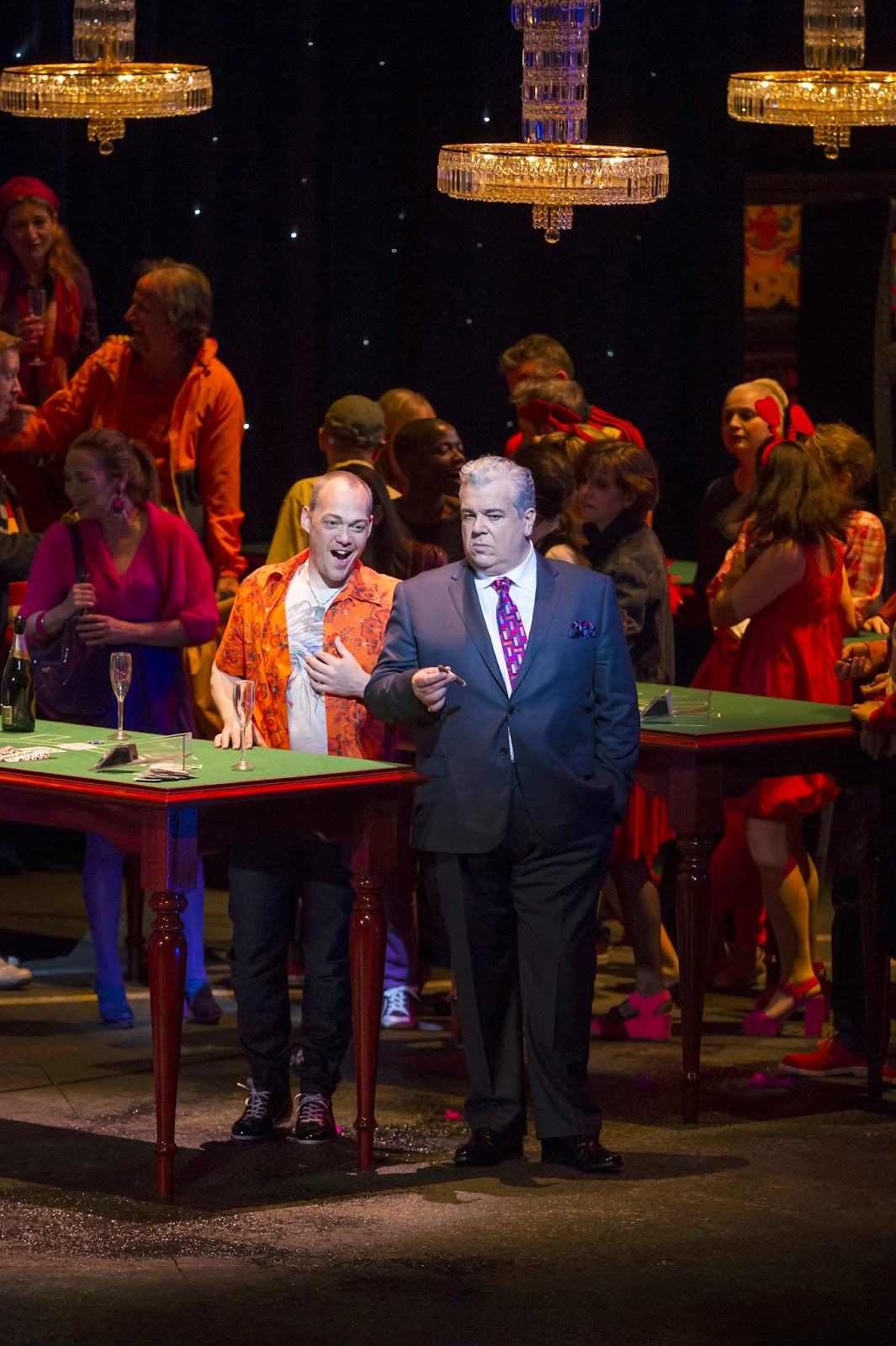
The lesser parts were also extremely well delivered. The Sergeant is a more significant role than many assume it to be. Jihoon Kim sang it with more personality than it usually gets. he makes the role feel like a Geronte who hasn't made enough money to kick people around, but would if he could. Significantly Puccini places the part in context of the female prisoners who are Manon manquées.Benjamin Hulett sang Edmondo, Nigel Cliffe the Innkeeper, Nadezhda Karyazina the Musician, Robert Burt the Dance master, Luis Gomes the lamplighter and Jeremy White the Naval Captain. Good work all round. Although attention focuses on overall staging, the director's input in defining roles should never be underestimated. Jonathan Kent's Personenregie was exceptionally accurate.

This production attracted controversy even before the performances began.  However, it is in fact remarkably close to Puccini's fundamental vision. Those who hate "modern" on principle often do so without context or understanding. So what if the coach at Amiens is a car? How else do rich people travel? So what if Manon wears pink? Puccini's Manon Lescaut hasn't been seen at the Royal Opera House for 30 years, but Massenet's Manon is regularly revived. So Londoners are  more familiar with Manon than with Manon Lescaut. Yet the two operas are radically different. Mix them up and you've got problems.  In Massenet, Manon and Des Grieux have a love nest in a garret. But Puccini goes straight past to Geronte's mansion and to the sordid business of sex and money.All the more respect to Puccini's prescience. Anyone who is shocked by the this production needs to go to the score and read it carefully.


Geronte thinks he's an artist. Because he thinks he owns Manon – so he uses her as a canvas to act out his fantasies. Jonathan Kent isn't making this up. Read the score. One minute Manon is in her boudoir, putting on makeup, talking to her brother. Next minute, musicians pour in and the have to be shooed out. Then  "Geronte fa cenno agli amici di tirarsi in disparte e di sedersi. Durante il ballo alcuni servi girano portando cioccolata e rinfreschi." ( Geronte beckons to friends to stand on the sidelines and sit. During the dance some servos are bringing chocolate and refreshments). The guests know that Manon sleeps with Geronte. They have come in order to be titillated.  It's not the dancing they've come to admire. They're pervs. Geronte is showing off, letting his pals know what a catch Manon is. Hence the dancing: a physical activity that predicates on the body and the poses a body can be forced into "Tutta la vostra personcina,or s'avanzi! Cosi!... lo vi scongiuro" sings the Dancing master. But he has no illusions. "...a tempo!", he sings, pointing out quite explicitly that her talents do not include dance. "Dancing is a serious matter!" he says, in exasperation. But the audience don't care about dancing. They've come to gape at Manon. There's nothing romantic in this. Geronte is a creep who exploits women. It's an 18th century live sex show. Geronte's parading his pet animal.

So Manon concurs? So many vulnerable women get caught up in the sick game, for whatever reason. The love scene that follows, between Opolais and Kaufmann, is all the morer magical because we've seen the brutality Manon endured to win her jewels.  Perhaps we also feel (at least I did) some sympathy for Manon's materialistic little soul. She knows that money buys a kind of freedom.When news of Mark Anthony Turnage's commission for Anna Nicole first emerged, some were surprised. Others said "Manon Lescaut". The story, unfortunately, is universal..At first I couldn't understand what the film crew and lighting booms meant but I think they suggest the way every society exploits women and treats them as objects for gratification. Later, the lighting booms close down like prison bars. Some of the women being transported are hard cases but others are women who've fallen into bad situations, but are equally condemned.  Far from being sexist, this production addresses something universal and very present about society.  I'm still not sure about the giant billboard "Naiveté" but there is no law that says we have to get every detail at once. Perhaps Kent is connecting to  advertising images and popular media, which is fair enough.

 People  wail about "trusting the composer". But it is they who don't trust the composer. Any decent opera can inspire so much in so many. No-one owns the copyright on interpretation. But the booing mob don't permit anyone else to have an opinion and insist on forcing their own on others who might be trying to engage more deeply. It's time, I think, to call the bluff on booers. They don't actually care about opera. Like Geronte, they're into control, not art..


This review appears in Opera Today
photos : Bill Cooper, Royal Opera House.


Manon Lescaut, ROH - first thoughts


First thoughts on Manon Lescaut at the Royal Opera House. Genius Kristine Opolais, genius Pappano, and Kaufmann genius after the first Act.  This production is so powerful that it's bound to shock. But why not? If we aren't horrified by what happens to women like Manon Lescaut, the fault lies with us. Anyone who can't be moved by that final scene must have cement for blood. My full review is HERE. - Provocative but Werktreue - Manon Lescaut, Royal Opera House

Why is the production controversial? Puccini's Manon Lescaut hasn't been seen at the Royal Opera House for 30 years, so Londoners are probably much more familiar with Massenet's Manon, revived at least twice in the last 5 years.  But they are radically different operas. Mix them up and you've got problems.  In Massenet, Manon and Des Grieux have a love nest in a garret. No wonder those familiar with Manon expect Manon Lescaut to be similarly romantic. But Puccini is not sentimental. He goes straight to Geronte's mansion and to the sordid business of sex and money. Anyone who's shocked ought to read the score, instead of imposing their own expectations. 

Geronte thinks he's an artist. Because he thinks he owns Manon, so he uses her as a canvas to act out his fantasies. Jonathan Kent isn't making this up. Read the score. One minute Manon is in her boudoir, putting on makeup, talking to her brother. Next minute, musicians pour in and the have to be shooed out. Then  Geronte fa cenno agli amici di tirarsi in disparte e di sedersi. Durante il ballo alcuni servi girano portando cioccolata e rinfreschi. (Geronte beckons to friends to stand on the sidelines and sit. During the dance some servos are bringing chocolate and refreshments). The guests know that Manon sleeps with Geronte. They have come in order to be titillated.  It's not the dancing they've come to admire. They're pervs. Geronte is showing off, letting his pals know what a catch Manon is. Hence the dancing: a physical activity that predicates on the body and the poses a body can be forced into "Tutta la vostra personcina,or s'avanzi! Cosi!... lo vi scongiuro" sings the Dancing master. But he has no illusions. "...a tempo!", he sings, pointing out quite explicitly that her talents do not include dance. "Dancing is a serious matter!" he says, in exasperation. But the audience don't care about dancing. They've come to gape at Manon. There's nothing romantic in this. Geronte is a creep who exploits women. It's an 18th century live sex show. Geronte's parading his pet animal.

So Manon concurs? So many vulnerable women get caught up in the sick game, for whatever reason. The love scene that follows , between Opolais and Kaufmann is all the morer magical because we've seen the brutality Manon endured to win her jewels.  Perhaps we also feel (at least I did) some sympathy for Manon's materialistic little soul. She knows that money buys a kind of freedom.When news of Mark Anthony Turnage's commission for Anna Nicole first emerged, some were surprised. Others said "Manon Lescaut". The story goes on an on.

At first I couldn't understand what the film crew and lighting booms meant but I think they suggest the way every society exploits women and treats them as objects for gratification. Later, the lighting booms close down like prison bars. Some of the women being transported are hard cases but others are women who've fallen into bad situations, but are equally condemned.  Far from being sexist, this production addresses something universal and very present about society.  I'm still not sure about the giant billboard "Naiveté" but there is no law that says we have to get every detail at once. Perhaps Kent is connecting to  advertising images and popular media. Suddenly the billboard reverses and we see behind the facade. By the way, there are no deserts near New Orleans, so anyone screaming for "realism" should remember that opera is art. Manon and Des Grieux are in a metaphorical desert, literally at the end of the road. I'm still reeling with emotion at that last image of Opolais  and Kaufmann suspended in  mid air, "orizzonte vastissimo, cielo annuvolato".  Only boors could boo after that.

People  wail about "trusting the composer". But it is they who don't trust the composer. Any decent opera can inspire so much in so many. No-one owns the copyright on interpretation. But the booing mob don't permit anyone else to have an opinion and insist on forcing their own on others who might be trying to engage more deeply. It's time, I think, to call the bluff on booers. They don't actually care about opera. Like Geronte, they're into control.

Review to follow in Opera Today
photo : Bill Cooper, Royal Opera House (details embedded)

Thursday, 17 April 2014

Puccini Manon Lescaut Rattle Westbroek Baden Baden


The very idea of the Berliner Philharmoniker playing Puccini operas  should raise a wry smile when one thinks of the orchestra's magnificent past.  But why not? Their artistry gives this Manon Lescaut a musical grandeur not often heard in an opera house. Sometimes, shifting the walls between sub-genres in music can be a good thing. Antonio Pappano plans to do much the same thing in reverse by getting the Royal Opera House orchestra to do more symphonic repertoire.  Read my review of Pappano's far superior Manon Lescaut HERE. Simon Rattle and the Berliner Philharmoniker have been venturing to Baden Baden and into opera for some time, so their Puccini Manon Lescaut may or may not be interesting as a portent of things to come.

Thumbs up for Rattle and the orchestra, and most certainly for Eva-Maria Westbroek's singing.  In Massenet's Manon the heroine (or anti heroine) suffers for love in a dingy garret. Puccini's Manon indulges in physical and material excess. Her family may be packing her off to a convent for her own good. Westbroek's voice is lusty and her interpretation is well rounded in every sense. She creates a Manon who embraces pleasure with such feral enthusiasm that when she dies of thirst in the desert, Westbroek makes it feel like soul murder. Massenet's Manon sails off to an unspecified fate, but Puccini's Manon is destroyed to her very core. Westbroek's singing in the final act rises to heights of intellectual intensity one doesn't often encounter with "popular" Puccini. Westbroek may never sing a put-upon Cio Cio San, but her Manon is a creation of genuine originality.

Westbroek's lush blonde voluptuousness is nicely set off by Lester Lynch's Lescaut.  Thank goodness that we're now mature enough to face race without having to be coy, negative or embarrassed. Westebroek and Lynch are truly brother and sister, soul twins, so to say. They sing with similar physical intensity, so the dynamic between them works extremely well.  Puccini's Lescaut plays a much greater part in this opera than in Massenet's, so Lynch's portrayal adds a great deal to meaning. If only there were more roles which Lynch could do with Westbroek!

Nonetheless, the Romantic Hero in this opera is the Chevalier des Grieux.  Massimo Giordano sings the part effectively, though he doesn't quite have the quirky charisma of the Westbroek/Lynch combination, and is eclipsed by Bogdan Mihai's superb Edmondo and even Liang Li's Geronte de Ravoir. In the final act, though, Giordano lets loose. His singing becomes more impassioned, and he emphasizes words with greater force. In death, his Des Grieux seems to find himself.  Magdalena Kozena sings one of the musicians, not normally a huge part but she sings it with personality and flair.

The Baden Baden Festspielhaus is the biggest and most modern (1997) in Germany, and caters to a wide range of activities. It doesn't have the traditions of, say, the Vienna State Opera or Bayreuth, but every house fills a different niche.  Last year Baden Baden presented a very good Don Giovanni with Anna Netrebko, Erwin Schrott and Luca Pisaroni, which would have been welcome anywhere.  This Manon Lescaut was staged by Richard Eyre, whose greatest moment was the ROH La Traviata (1994) . Thirty years later, not much seems to have changed. This new production sports art deco angles but otherwise is rather provincial. Given the high standards Westbroek and Rattle achieve, it's a bit of a lost opportunity.  Admittedly the Lousiana scene is difficult to stage, especially as there aren't many deserts in New Orleans - so much for the myth of "historical accuracy".

Another interesting thing about Baden Baden is that it seems to be modelling itself on the Met. Alas,  they've copied the ludicrous interval interviews , though the interviewer herself is infinitely more articulate.  It's sad that an intelligent woman should have to mimic the Met's airhead gushing. If Baden Baden wants to make a name for itself it should do something more upmarket.
Watch this in full on the Berliner Philharmoniker website. 

Needless to say, this will be TOTALLY OUTCLASSED by OPOLAIS, KAUFMANN and Pappano at the Royal Opera House in  June

Saturday, 13 July 2013

Ermonela Jaho Magda, La Rondine ROH

Ermonela Jaho, who sang the wonderful Suor Angelica at the Royal Opera House, returns to sing Magda in Puccini's La Rondine. 

"Magda knows that she can’t be the kind of woman Ruggero needs. So she tells the truth. In those moments, you can see Ruggero’s face change with disappointment and shock. He is losing his dream, too. But he is young, he might have a different future. So she sings tenderly, like a mother soothing a child. ‘Quando sarai guarito, te ne ricorderai. Ti ritorni alla casa tua serena, io reprendo il mio volo e la mia pena”......

"Magda a truly noble soul. She is strong because she could make that choice. She will be empty, a long, slow sadness in her life, but she also knows that Ruggero will be happy. That is the proof of her love. She doesn’t have a physical death, she doesn’t have a catharsis. But her pain makes her stronger and more mature.”

“Every time I sing this role, even in rehearsal, it takes a lot out of me. I need to be totally honest with my emotions. When I sing those last lines, I feel my heart and vocal cords pulling. If we are human beings, it’s impossible to become detached. Puccini closes the opera with pianissimo, but for me that is not a beautiful sound. It is the sound of Magda’s heart screaming from deep inside her soul.”

Read the full interview here in Opera Today

Saturday, 6 July 2013

Gheorghiu vindicated - La Rondine Royal Opera House

La Rondine isn't Puccini's finest moment. As drama it's a retread of La Bohème. The music resembles out-takes from Madama Butterfly. What holds it together is Magda. So when an artist like Angela Gheorghiu revives the role, she brings a much-needed extra dimension to the opera. This is the role that helped propel her to stardom together with Roberto Alagna. Now they're having a bitter divorce, fanned by media sensationalism.

Art imitates life. Ironically, that human background adds poignancy to what is essentially, a fluffy vacuum of an opera, despite its surface charm. Magda sings of her first love, and the kiss that sealed their passion. When she sang this with Alagna the extra-musical frisson must have been intense.It must take incredible courage to revisit this role now, when every note tears open old wounds.  For that alone, Gheorghiu deserves respect. So what if her voice isn't at its resplendent peak? She creates a far more accurate Magda because she accesses the underlying pain that animates the character. Gheorghiu shows that there is more to Magda than her fawning, false friends realize. Pretty and superficial might apply to them. but not to her. When Gheorghiu sings the long sequence "Ore dolci et divine" the strain isn't vocal, but emotional. She breaks off the last lines a little abruptly, rather than letting them linger. But that's far truer to Magda's true personality.

Some might prefer mechanical songbirds, who churn out mindless perfection, but for me a true artist has emotional intelligence. Artists are not gladiators in an arena. They exist for their art, not for the mob. Some singers attract nastiness that goes far beyond artistic criticism, and descends into vicious personal abuse. Perhaps that's how some people get their kicks. If they saw someone leaning over a parapet, they'd scream "Jump!", then righteously tut tut when the body hits the ground. It's a form of bullying, and usually the abuse of women, worse than anything Alagna may or may not have done. . If opera is based on human feelings, sensitivity is essential. If we care about opera as art, we should respect the human beings who sing and create it. The last thing they need is to go on stage, knowing that the media has fanned the flames of frenzy against them. Gheorghiu is in a difficult position at the moment, so it's all the more to her credit that she went on at all.

For an intelligent and humane discussion of cancellitis please read this, written by a serious opera fan and singer.

Having braved the personal demons Act One would have awakened, Gheorghiu settled into the role ever more comfortably as the opera continued. Her Ruggero, Charles Castelnovo, supported her well. If his voice isn't quite as lovely as many who have done the part before, he compensated by being a solid foil to Gheorghiu. Perhaps the all-important kiss worked its magic, for Gheorghiu's Magda blossomed again, like the roses in the song. Castelnovo seems genuinely nice, so Magda's eventual renunciation seems quite natural.  Magda has come to terms with her past and doesn't need illusions of youth and love. Gheorghiu seems to find strength in Magda's maturity. For once the ending convinces, even though it's not written with the depth Puccini might have given to his other heroines.

.Sabina Puertolas sing Lisette, Magda's maid.  The rapport between Gheorghiu and Puertolas seems genuinely affectionate: they bounce off one another merrily, singing with palpable warmth. The dynamic lifts the opera , defusing the mood. Some of the wittiest musical passages illustrate Prunier's attempt to turn Lisette into what she can never be. Edgaras Montvidas sang a very good Prunier. He made us hear the "Poet" who thinks in terms of dreams, not reality, casually changing names and identities.  Ultimately, La Rondine is a warm-hearted, humane opera where pretensions are overturned. Lisette goes back to being a maid, and Magda (presumably) goes back to being Rambaldo's good friend.  Good nature prevails over delusion.

Marco Armiliato conducted. The production is the Nicholas Joël perennial, as flashy as the life Magda and her friends seem to live. It's telling that when Magda and Ruggero share their brief happiness that the backdrop shows fake flowers. The real beauty in La Rondine lies in the portrayal of Magda as a human personality. As such, Angela Georghiu is truly vindicated.

A full review and cast list will appear shortly in Opera Today.
photo by Catherine Ashmore, courtesy Royal Opera House

Friday, 22 June 2012

Puccini Suor Angelica on TV

Nuns with illegitimate children committing suicide? Suor Angelica, the second opera in Puccini's Il trittico  was broadcast on BBC TV4 tonight, and wl be rebroadcast at 330 am. For me it was by far the most moving of the triptych because it dealt with complex human feelings, not more conventional emotional situations. On stage, you could hear how well Ermonela Jaho characterized the part with her voice. On film you can see the fine detail in her acting as she expresses Suor Angelica's tortured emotions. Jaho speaks of how much she puts into the role, and it shows. Such sincerity and committment! She's truly a star. Anna Larsson as the Princess is excellent too.

A plot like this could invite a maudlin, pseudo-religious setting, but here it's more matter of fact. Suor Angelica, like the Virgin Mary, lives for her son whom she loses. She kills herself to be with the kid in heaven, til she realizes, oops, suicide is mortal sin. That's a sign, I think, of how uncalculating and instinctive she is. Maybe that's why the Virgin Mary shows her grace, becuase Suor Angelica is a good person at heart.

Convent/Christian life is fundamentally unnatural because it demands the suppression of earthly desires, however innocent. To 19th century Catholic Italians, what Puccini is implying was blasphemy. Can the Virgin Mary overturn the laws of God? Assuming that there is a god at all, and that religious life isn't just another scam like the one the Princess is planning. It's a wonder that the Church didn't turn on composer and librettist.  Please read what I wrote about the prima last September (ReNUNciation : Puccini Il trittico) All three operas have been filmed and are now available on DVD. Highly recommended.

Monday, 7 May 2012

ENO Madam Butterfly - preview, analysis

It's almost exactly seven years since the Anthony Minghella production of Puccini Madam Butterfly premiered at the Coliseum, London for the ENO. Minghella himself has passed on, but this time round the principals are the same. Mary Plazas sings Cio Cio San, Gwyn Hughes Jones sings Pinkerton and thge Puppets of the Blind Summit Theatre will be doing their thing. I caught the production first time round, the first night of the first run.

Madam Butterfly is perhaps even more relevant in our Global Village where cultures and races mix more fluidly than ever before. Minghella’s vision pits Puccini's gloriously Italianate score with the stylization of Japanese theatre. A woman dances with the black clothed figures of the men who manipulate Bunraku puppets. Gradually they tear her obi and it unravels like a river of blood. It’s a great image: woman as puppet, controlled by men. Its violence also hints at the tragedy to come. Bunraku may have a history of love suicide dramas but that’s lost on the average western audience. Fundamentally, Madam Butterfly isn't about Japan at all.

So the "neon Shanghai Tang" colours (as I called them then) of the production are there to entertain. They impart an exotic glow, so the real meaning of the plot is disguised.  Beneath the sentimental cherry blossoms and images of women as dolls, Madam Butterfly is a shockingly brutal story. Pinkerton's a sex tourist, exploiting the power he has to screw a little girl (in every sense of the word). Absolutely to Puccini's credit that he saw through the colonialist values of his time. He had no illusions about the superiority of western culture or Christianity.  Pinkerton is a weak man, supported by gunboats and consuls.  Indeed, it's an anomaly that Madam Butterfly was set in Japan at all, since Japan and Thailand were the only countries in Asia to remain independent and not become colonies. All over Asia and Africa, local populations became second-class citizens in their own countries. As Puccini implies, imperialism does not equate with civilization.

Until westerners stop seeing Madam Butterfly as a portrait of Japan, they're not going to deal with the real issues, which are only too relevant today. While it's no longer acceptable to sneer at blacks, Jews, women or gays, Asians (yellow, brown or olive) are fair game. Unconscious racism exists, and sadly among people who should know better. Perhaps it's ignorance, or fear, but it won't be eliminated until people stop making assumptions, and allow that just maybe, Asians know what they're doing, and western mores don't always apply.

Nagasaki, where Madam Butterfly is set, was an "international" port from the 16th century, where western influences reached Japan and from which Japanese esxports reached Europe. It's interesting that Puccini shows that Cio Cio San isn't merely a passive plaything. Long before Pinkerton arrives, she's already aware of the west and swallows the myth of western superiority since she thinks that through Pinkerton she'll get a new life. When she realizes her dreams were delusion, she kills herself. Anyone who has seen Japanese horror movies Takashi Miike’s Audition or Hideo Nakata’s Ring will be familiar with the idea of traumatized young women who are quite capable of hiding ferocity under a demure mask. Cio Cio San fights back, though she ends up hurting herself. You could read 20th century Asian history as a response to colonialism. Certiainly, Japanese modernization inspired other countries in Asia, many Asian leaders studying the Japanese model. Ironically, the Japanese succeeded in ridding Asia of colonialism, though not quite in the way they intended. (the photo show Tamaki Miura, a Jaoanese singer in a Japanese production of Madam Butterfly in 1922)

What troubles me about this production is the portrayal of the child Sorrow. He's shown as a puppet with a skull for a head. These days child protection laws work against having real children in  roles like this, late at night. Hence puppet. But is Minghella telling us that the child is just another puppet in a wider game? In the opera, his role is to be the innocent, loving being who inspires love from everyone, even in Mrs Pinkerton. So why should he be portrayed as an ugly miscreant? Are mixed race people somehow not human? (click on photo to enlarge).

Conversely, Minghella confirms how important this non-speaking part is to the whole story. What is to happen to this boy, taken from his environment and raised in a monocultural society where he'll always be an outsider? Given US racism towards Asians well into our generation, there would not have been a happy ending. All over Asia and Africa, there were huge mixed race communities, bridging cultures. Thousands of real life Madam Butterflys and certainly not all products of prostitution. Ironically, Japan was one of the few places where there weren't big mixed race communities. Nowadays there are lots of first generation mixed marriages, and also lots of Asians growing up in non-Asian environments. It may be fashionable to think that heritage doesn't matter, but I'm not so sure. So enjoy Madam Butterfly at the ENO and think about the wider context.
LOTS on this site about Nagasaki, Japanese and Chinese culture, Chinese stereotypes, modern Asia, cross culture, Puccini and Madam Butterfly. Please use search labels.


Wednesday, 14 September 2011

Suor Angelica full download + broadcast


Here's a link to a full download of Puccini Suor Angelica, a recording not commercially released at the the time, with big names - Barbara Frittoli and Mariana Lipovsek! Chailly, Teatro alla Scala 2008 ! Full text, too. 

Broadcast on BBC Radio 3 this Saturday of the wonderful Royal Opera House production! Catch it. Please see my review here. When this gets to DVD, get it. Better still, go!

Tuesday, 13 September 2011

reNUNciation - Puccini Il trittico, Royal Opera House

A fabulously enjoyable evening of Puccini Il Trittico marks the start of the new Royal Opera House season. What fun, what flair! What's more, it's shockingly original. Catch this for Suor Angelica alone if needs must - Richard Jones brings out levels in Suor Angelica that completely overturn the bad press the opera usually gets. This is the kind of hit any house needs to kickstart a new season (infinitely better than yet another pointless Jonathan Miller revival).

The central premise of Suor Angelica is that holiness comes with renouncing all desire, even if it's as innocent as wanting to see a lamb. After all, The Lamb of God is better than any gambolling future cutlet. In this convent, the nuns are cut off from the real world, even though they run a hospital - no doctors, no parents, kids who don't cry. Miriam Beuther's antiseptic set reflects the unnatural orderliness of this situation, where healthy young woman waste away, substituting visions and miracles for normal life. Maybe they're happy, but achieving this rarified state of grace takes more courage than most of us can cope with. Richard Jones and Miriam Beuther manage to decry the arid regimentation of religious life and yet celebrate the spiritual liberation of those who truly believe. Quite miraculous!

Forget, then, the maudlin pseudo-morality that attaches to this opera's usual image. Suor Angelica has been locked up and her inheriutance taken from her to make her atone. She's had a child out of wedlock. Not all so different from the Virgin Mary herself. No wonder this convent is dedicated to the Mother of God.  Po-faced productions don't get this at all, but you can just bet that Puccini knew what he was doing. But Suor Angelica has such spirit that she fights back, despite appearing meek. As if she didn't know suicide was a mortal sin? But she acts on her instincts (which is why she got pregnant in the first place). Golden lights shine outside the spartan ward, and the nuns speak of mysterious signs the Virgin sends of divine mercy. Sure enough, Suor Angelica beats Hell, and her hypocritical aunt, and gets reunited with her son. Conventional piety turned on its head!

Conventional opera conventions turned on their head too. Gianni Schicchi is the most popular of the triptych Il trittico, and this production (Jones/John MacFarlane) is famous for its high spirited farce on 50's materialism. Yet there was a small exodus after Suor Angelica. Maybe people wanted an early night, but quite probably, they thought it wise to leave on a high after this wonderful Suor. The best singing of the whole evening, even though there aren't any showy male parts. Ermolena Jaho sang a superb Suor Angelica. She had the part so well characterized that moments of vulnerability only enhanced the sense of her youth and heartbreak. I've only heard Jaho once, as Mimi in 2009, and wasn't overwhelmed, but friends who heard her on subsequent evenings said she was wonderful. No First Night nerves this time.

Jaho would have stolen the show (and the whole evening) but for Anna Larsson's Princess. Now that's a mezzo voice with real drama and womanly sensuality, no prissiness at all. Costumed by Nicky Gillibrand, Larsson moves like a a snake, another potent religious symbol, and suggests that Angelica's racy nature might be hereditary, except that auntie didn't get caught. Wonderful characterization - don't take the Princess as dried-out spinster again. Excellent smaller roles - Anna Devin's Sister Genovieffa so charming you wonder why she didn't make it to the Wigmore Hall Song Competition finals. Very inspired playing from the pit, too. Antonio Pappano seemed exhilarated, so the music was energetic and even...dare I say... wickedly witty.

Why the full triptych? The three operas together make a huge impact, greater than on their own. The dark, claustrophobic Il tabarro (foreboding grim and grey) made the supernatural glow of Suor Angelica even more surreal. The Princess's greed makes way for petit-bouregois greed in Gianni Schicchi. Thematically, plenty of links, too, like sex and greed, frustration and thwated dreams. Please read this account of the Frankfurt Opera's Il trittico in 2008. Length apart, it's a pity that the three operas don't get done together more often. Each feels like a movement from a much larger work - what happens next in Il tabarro, for example? It's like a trailer for a film noir. What does Gianni Schicchi do with his ill-gotten gains ? Ironically, it's only Suor Angelica that works best as a stand alone, though interpretively it's the most complex of all.

Each of these three mini operas was beautifully realized and well sung (especially the tight ensemble in Gianni Schicchi)  Together they're unmissable. The Royal Opera House offerings this year looked solid rather han exciting on paper, but it just might prove to offer more surprises than we'd expect. Please see my article "Synchronized Swimming" - ROH 2011-2)  The ENO year looks more exciting in theory, but they are the ones starting the year with yet another meaningless Jonathan Miller revival.

PS -  Special mention of Ji-min Park's Songseller in Tabarro - outstanding voice. Time after time he does amazing things but in parts so small they get no attention. Everyone asks, who is this guy? He's an asset the ROH should use more often.

PS2 - delightful kid in Suor Angelica who acted up during the applause, trying to get the other boys to rebel, though they didn't. He was a natural ham, and irepressible. Was he doing an epilogue to the opera itself, where Suor Angelica herself doesn't conform?

Friday, 15 July 2011

La Rondine - Opera Holland Park

Glorious production of Puccini La Rondine at Opera Holland Park. This is the sort of thing that makes OHP worth going to.  Please read Ruth Elleson's review.

I'd never thought costumes could make an opera, but the designs here recreate the heady mix of grande luxe and heady abandon that fits the period and the characters. Magda and her friends don't wear corsets in any sense. They're not buttoned up, but others are. Hence the tragedy. I wish I could find a photo of one of Poiret's famous "Grecian" dresses with dozens of tiny pleats, designed to skim the body so it moves like a zephyr.  Freedom in clothing, freedom in spirit and the arts. Puccini firmly in the vanguard of the modern age. And so much fun!

What I'd give for the dress with mock bustle and ombre shadings from white thru grey. Or the eau de nil "Empire cut" dress, or almost best of all the trio of black and white outfits that Georgette, Lolette and Gabriela wear at Bulliers! Congratulations to the designers, Peter Rice and Chrissy Maddison.

Performances, too, were highly credtable. Kate Ladner's Magda looks splendid, and sings well, so carries the principal role well. But it's the secondary roles that catch the irreverent joie de vivre. Nearly everyone in this plot is outside society and owes nothing to the received order of things. Hence Bulliers which is raffish and louche. Perversely, Magda stands out in this crowd because she's trying to look incognito. but that's part of the impishness of this opera.

Which is why the spicy alternative roles matter so much. The cabaret girls are talented women who make an independent living and presumably aren't kept, like Magda..Sean Ruane's Ruggero limps mysteriously - has he been in other wars? If so, it's extra tragic that he's going back, perhaps to die, after his brief chance of love.  Hal Cazalet's Prunier is too healthy to be Erik Satie, but just as alternative. And Hye-Youn Lee's Lisette epitomizes the whole gaudy, naughty, vivacious spirit of the opera. She, too, has dreams, but accepts setbacks graciously. When she sings about the whistles of the crowd, she makes the episode seem funny even though it ended her hopes. At least, one thinks, for the time being.

If you're going to do country house opera in the west of the city as Opera Holland Park does, you have a lot of competition. The facilities in a municipal park are never really going to be quite as glamorous, though the OHP crowd is dressier than Glyndebourne.  Lots of money about, but I suspect different values. There's more room to manoeuvre artistically. Productions like this La Rondine come pretty close to the polish of The Royal Opera House, but can OHP pull off such wonders every time? At least OHP is approaching the major league. There's so much fuss made of pub opera these days, though it's always been around. But with pub opera, you always have to make enormous allowances. So much so that while pub opera can be amusing, it can't be taken seriously as art. As a vision, OHP is unique, and worth supporting on principle.

Sunday, 3 July 2011

Madame Butterfly broadcast and real Japanese response

That excellent Puccini Madama Butterfly from the Royal Opera House is now available online, internationally and on demand on BBC Radio 3.  It's a must-listen because Kristine Opolais is singing - she's the sensation of the production! Liping Zhang will be on the film that's being made, so this is your chance to hear why most of us were stunned by Opolais. Read review HERE. (There's an announcement before the show that Opolais is unwell, so not in best form.) You'll need to go to about 20 minutes to cut the chat, most of it uninformative (though Andris Nelsons talks well about the music at 15 min)

When are western commentators going to realize that the Japan Puccini portrays is not the real  Japan? Madama Butterfly tells us no more about Japanese society than The Mikado. Puccini uses the exotic setting to emphasize the idea that westerners like Pinkerton know kaput about other civilizations. Puccini writes about what happens when one culture sees others only in its own context. Unfortunately too many westerners still think Madam Butterfly "must" fit their conception of what Japan ought to be.

The lady in the photo is Hamako Watanabe 渡辺はま子(1910-1999) There's an article about her in Japanese Wiki, but little in English. She was one of the big singing stars in Japan in the 1930's, 40's and 50's. HERE is a clip of her singing in 1939. A real Japanese song on the theme of Nagasaki and Madama Butterfly. Please listen as it's a genuine Japanese response to the opera.  Translation, help please ! Listen to the snippets from Puccini.  Nagasaki means different to Japanese than it does to most westerners. It was where the Potuguese in the 16th century, and later the Dutch, traded with Japan, so placing the opera in this city means a lot more than to those who know Asia. The idea that there was any single "Butterfly" original is sheer nonsense. There must have been hundreds of contacts, even though foreign communities in Nagasaki were closely monitored.

HERE is a link to a Japanese TV documentary about Ms. Watanabe, and shows her singing Shina no Yori (China Nights) in her 80's. Shina no yori is a story worth telling in more detail, so I'll write more another time.

Thursday, 30 June 2011

One Fine Day in new context!


Grace Chang (Ge Lan) sings Un bel di Vedremo in Mandarin. But what makes it a really big deal is the context. The clip is from the film Wild, Wild Rose  (described in detail here). Rose is obviously extremely well educated through she went on the streets aged 14. But that was during the Japanese invasion and Chinese civil war. Millions of tragedies like that, which is the point of the film.  She's become a popular nightclub suinger whose forte is western opera arias. Not a crooner. Read the whole story on the link for context. At this point in the story, she's forced to go back to work after having tried a stretch as a "nice girl" but everything's gone wrong and she's broke. So it's deeply ironic that she has to play at being a subservient geisha. The words are poignant because ex pimp came back from prison and her lover went to jail for knifing him. Rose's friends know the story, which is why they're proud of her comeback.  She ends up dead, like Carmen, but this Madama Butterfly isn't a passive victim. The pianist looks weedy but even he has a story to tell. (read the synopsis)

Wednesday, 29 June 2011

Intelligent Puccini Madama Butterfly - Royal Opera House


When the current production of Puccini's Madama Butterfly premiered in 2003, I remember being startled at how stark the production seemed, with its clean horizontal lines and open spaces. Very different indeed from the over-stuffed, over-fussy clutter of fin de siècle clichés about Japan. Western Japonisme as decorative wrapping has little to do with reality. Madama Butterfly is a powerful opera because it deals with real human dilemmas, by no means unique to Japan or to the early 20th century.

Instead, this production, directed by Moshe Leiser and Patrice Caurier, uses the Japanese context intelligently so it works with the drama. Japanese art is stylized, blank spaces part of the design, so key details stand out in sharp focus. The sets in this production, designed by Christian Fenouillat, are clean and open, so there's no irrelevant distraction. The backdrop of shoji screens allows quick scene changes, contrasting the interior with the vast panorama outside. It's a telling comment. As Goro points out, changing the walls changes perspective. This opera isn't really "about" Japanese society as much as about the way people don't perceive things in the same way.

As Caurier and Leiser said in a recent interview, Madama Butterfly is "not a beautiful story, it’s awful, it’s violent. Yes, you see the flowers but you must have the smell of blood running through them”. Throughout history, those with wealth and power have always been able to exploit those who don't. Pinkerton buys a package, house, servants, mock family and  girl to use as sexual covenience. He's infatuated temporarily by Butterfly's beauty but he's under no illusion that he's interested in her other than as an object to gratify his ego. Perhaps that's why he takes the child. He can't concieve that its mother or culture mean anything.

Butterfly is so desperate to escape her background that even before she meets Pinkerton, she's obsessed about becoming an instant American. She invests so much in her delusion that she can't cope with reality. She kills herself, not simply because harakiri "is" custom, but because she's invested so much into her fixation that she can't live with reality. "....nulla, nulla, fuor che la morte".


Although this is the third revival of this production since 2003, the performace felt fresh because it was directed, not by substitutes but by Leiser and Caurier themselves. Every performance has to be "new" because casts change and circumstances change. Patricia Racette, who has sung Cio Cio San many times before, pulled out at the last minute, but in some ways that was fortunate, because Kristine Opolais, making her Royal Opera House debut, throws herself so convincingly into the part that she makes it her own. She's young enough to convey Butterfly's innocence but has strength of personality, which comes through in her singing. She sings the love duet with such intensity that you wonder how a 15 year old could find such passion, especially for a stranger she's just met. This emphasizes Butterfly's single-minded determination. Reality doesn't get in the way of imagination.

Opolais's Butterfly is wonderfully varied. After the Bonze's curse, her voice takes on a tense edge, showing that Butterfly is deeply traumatized. Then she switches quickly back to sweetness when she turns to Pinkerton. Swift reactions, for Cio Cio San is always adapting, and living intensely in the moment. Opolais genuinely interacts with Dolore (Niklas Allan). She's not singing to an object, or a puppet, but as real mother to real child. Madama Butterflies stand and fall on Un bel di vedremo, and Opolais conveys complete emotional engagement. She's not merely describing a sequence of events, but how they feel to her. An interesting voice, with good range, and a natural acting singer. She's a regular at the Berlin Staatsoper, where she'll be singing Butterfly in March 2012.

James Valenti as Lt. Pinkerton is rather less successful, although he has had the role in his repertoire for years. Arguably, Pinkerton is emotionally more buttoned up than many men, but Puccini builds a lot more into the part than repression. Perhaps further into the run, Valenti's voice may blossom, and hopefully be preserved at its best in the film that's being released on BP Big Screen and cinemas on 4th July. Anthony Michaels-Moore sang Sharpless with warmth, for the Consul is a figure of reasonableness in this claustrophobic world of extremes.

From the vigour with which Robin Leggate sang Goro, it was hard to believe that he's retiring after the end of this production, his 909th performance at the Royal Opera House, since 1977. This Goro is directed so he moves swiftly, reflecting the character's quick wits and cunning. Leggate sings with unflagging energy, despite having to be fleet of foot.

Similarly, Helene Schneiderman's Suzuki was vibrant and expressive. There's a lot more to this role than mere servant. Suzuki can be cocky, although she's loyal. Cio Cio San isn't completely the mistress even at home. Schneiderman intones her prayer to the gods so forcefully that when she sings with Butterfly, you pick up on the undercurrent of tension even that exists in their relationship. Suzuki's gods will win, Cio Cio san hasn't a chance.

Buddhists don't normally curse people, and in Japan, Buddhism co-exists with Shinto quite happily. Buddhists have a lot in common with Christians too. This Bonze is a figment of Puccini's imagination, created to inject extreme panic, smashing forever Cio Cio San's links with her past. Perhaps that's why in this production, he appears all-white, like an apparition of a ghost from a Japanese horror story, not as a living monk. Jeremy White's Bonze bursts onto the scene, screaming violently, striking terror. Great theatre, as Puccini must have intended.

Zhengzhong Zhou sings Prince Yamadori and Daniel Grice sings the Imperial Commisioner. Both impressed, proving how the Jette Parker Young Artists Programme nurtures singers in good directions. Yamadori is an interesting role which could be developed more than it usually is. Why would a prince marry a second-hand geisha, and one who's been cursed for consorting with foreigners?  He rides a carriage up the steep hill, whereas everyone else in this opera walks. Why would a man of that status humiliate himself by divesting all his other wives? Zhou sings the part with tenderness, creating a sincere Yamadori who is emotionally honest and vulnerable though he has all the trappings of power. Pinkerton in reverse?

Over the years, I've grown to appreciate this production for its depth and sensitivity, and would heartily recommend it to anyone who really wants to understand the human - and political - story Puccini might be trying to tell us, beneath the surface gloss. FULL review with photos and cast details, etc in Opera Today