Showing posts with label Christopher Nupen. Show all posts

Monday, 24 February 2014

Alice Sommer Herz "Everything is a present"

From Alice Sommer Herz's Facebook page:

"On behalf of Alice’s family, we thank everyone for all the words of affection and admiration rightly attributed to her. She passed away peacefully surrounded by her family.
Much is being written and broadcast, but not from many who truly knew Alice. The only fitting tribute to her is the film she loved the most, “Everything Is A Present”. Christopher Nupen was the one film maker who actually knew her well and who shared the same passion and understanding for music as she did. Most importantly, it was the only film she asked to watch again and again until her last days. So it is only appropriate we share with everyone what she loved most."

Sincerely,
Alice Sommer's family


Alice is gone, but I will gift her "present" to some I care for, so the good she represented can live on. HERE is a link to "Everything is a present".   


Friday, 19 October 2012

Jacqueline du Pré remembered

Jacqueline du Pré passed away quietly on 19 October 1987, aged 42. The world Jackie lived in may have passed into history, but in our media-manipulated times, what she represented may, if anything, be even more important.

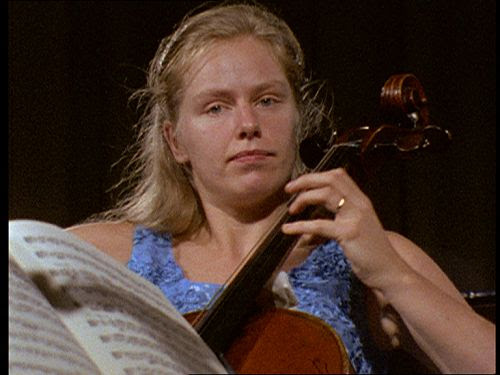
Christopher Nupen met her when she was still in her teens. He and Bill Pleeth, her "cello Daddy", were holding her hands at the end. Nupen’s first encounter with Jacqueline du Pré was quite surreal. One winter evening, he’d come home late to his flat in New Cavendish Street. The house was still, but a streetlight outside shone through the window. The glass was Victorian, so it had imperfections which refracted light onto the wall inside in strange, unworldly patterns. The radio had been left on, still playing in the darkness. "As I walked in", he said, "I saw those strange patterns on the wall and heard sounds the like of which I had never heard before. I didn’t know it then, but it was Jackie playing Bach in a live broadcast from Fenton House. I said "Wow!" I couldn’t put the electric lights on.  I sat down and contemplated those magic patterns on the wall and listened to those magical sounds. At the end, the radio announced ‘That was a young cellist called Jacqueline du Pré’. It was 1961, January, I think, she was barely 16. Then, just a few weeks later she walked into that same flat!"

She’d come to his home because he shared it with John Williams, the guitarist. "She was about to make her first gramophone recording for EMI and they had had the idea of recording her accompanied by several different people, Gerald Moore on piano, Osian Ellis on harp, John Williams on guitar. So she’d come to our flat to rehearse with John. The minute she walked in the door – Boom! I saw this strange creature striding in like an Amazon! Jackie was a big girl, tall and solidly built. She had a huge, long stride and she held her cello high as she strode down the corridor. But, at the same time, I could see that she was tremendously shy. Of course she didn’t know John and she didn’t know me which might explain the shyness - but not the confidence. I thought to myself, ‘How is it possible for a girl to be simultaneously Amazonian and shy? I’ve never forgotten that impression, it was so striking." "And it applied to her music also … I remember a rehearsal in the Royal Albert Hall where she introduced a tremendous glissando. They all stopped and the conductor said, ‘That’s a bit over the top". And Jackie said, ‘Yes, oh yes, of course!" and modified her playing accordingly. I couldn’t attend the concert, only the rehearsal, and asked later how it had gone. She smiled and said, ‘Well, I did it anyway, and it was SUMPTUOUS" As Nupen recounted this, his face lit up, and his voice warmed. It was almost as if Jackie was present, pronouncing the word "sumptuous" with delicious glee. "That was what Jackie was like", he continued.

"She was shy, she was reticent, she didn’t have a lot of faith in herself, but there was some inner dynamic in her, so that when she felt something was artistically right, you could not stop her with wild horses. It just came from the inside. And how powerfully it reached the audience! There must have been thousands of people there, and I expect that it reached all of them. It’s an amazing thing which you cannot explain in words. You can’t explain it but thank the heavens you ‘CAN’ film it while it’s happening!" In the early 1960s Nupen worked in radio at the BBC. While making his first radio programme, a feature about the Accademia Musicale Chigiana in Siena, he met his first wife, Diana, secretary to Christopher Sykes. Huw Weldon heard the Siena programme and called Nupen at 9 o'clock the next morning to say that he should be in television, which was then in its infancy. Nupen claims to have learned just about all he knows from the Features Department writers in BBC radio and was reluctant to leave. In those early days, the Nupens were able to wander in and out of the studios at all hours of the night, even carrying tapes out to work on at home. He nevertheless bowed to Huw Weldon’s wishes and in 1966 made a television film with Daniel Barenboim and Vladimir Ashkenazy when they appeared together for the first time playing Mozart’s Concerto for Two Pianos with the English Chamber Orchestra. The film was shot in three days and edited in three weeks - no mean feat for the time. Barenboim and Nupen had been friends for some time and had made radio programmes together, Nupen sometimes accompanying Barenboim on tour and turning pages for him. Barenboim, ever the perfectionist, bought him a Savile Row suit so he’d look right on stage. Despite having many friends in common, Barenboim and du Pré didn’t really connect until December 1966. Within minutes of meeting, they were playing Brahms together. "The effect on them both was like dynamite", Nupen recalls.
 
Months later, he was able to capture that extraordinary energy in the film Jacqueline du Pré and the Elgar Cello Concerto, where she plays her signature Elgar Concerto with Barenboim conducting. If anything, the dynamic between Jackie and Pinchas Zukerman was even more electric, since they are both string players. "Zukerman tells amazing stories about the way Jackie communicated her intentions by something like telepathy", says Nupen. "They seldom put marks in the parts but Daniel being the pianist and conductor often did. They would generally follow his markings, but sometimes they’d depart, and astonishingly, always in the same direction, without any pre-agreement or even any conscious intention. They just took off together and it worked. To this day Pinchas Zukerman is amazed at some of the things that happened."

In 1970 Nupen had heard the Barenboim, Zukerman, du Pré trio in an unforgettable performance of Beethoven’s Ghost Trio in Oxford. When plans to film Segovia in St John’s Smith Square fell through at short notice, with the venue and the crew already booked, he telephoned Barenboim in Brighton and asked "What are you doing on Tuesday?" (12 May 1970). "They came up on the first train from Brighton that morning, and went back on the last train that same evening. In between we had shot The Ghost." "We didn’t think that the filming had gone too well because of the shortage of preparation time", says Nupen, "So when we finished the editing and presented the film to them, I started by saying, ‘I’m sorry that the film cannot hold a candle to that wonderful performance in Oxford, but we have done the best we can with material that we shot at rather too short notice." ‘When the screening ended, before anybody else had said a word, Jackie suddenly said, ‘You’re wrong!’. I hadn’t the faintest idea what she was talking about, so I said, ’What’s wrong – don’t you like it?’ Then she said, ‘You’re wrong because you said it was not as good as the concert in Oxford’. I said ‘Jackie, please! You were so busy on the stage that night that you don’t know what you did in the hearts and minds of those people in the audience, the film cannot be better’ And then she said something so deep-seeing that it took me years to understand it in full. She was teaching me my job. She said, ‘It’s better on the film because you can see what’s going on and it adds another dimension’.

"She was referring to the visual communication between the players which says so much about their artistic intentions and the "telepathy" that Pinchas spoke about but couldn’t explain in words. She had seen that it is there, captured on film and she saw it more clearly than any of the rest of us." The same thing operated on a larger scale when Jackie, Daniel and Pinchas were joined by Itzhak Perlman and Zubin Mehta for The Trout. "We shot their rehearsals and the concert when they played Schubert’s Trout Quintet at the Queen Elizabeth Hall in August 1969. The film shows them just as they were, inspired by the joy of making music together and it captures something about the experience of music making at its best. That film and the earlier Jacqueline du Pré and the Elgar Cello Concerto have brought huge numbers of people to music for the first time in their lives. As Jackie said of The Trout nine years after she stopped playing, "We were five friends, united by our youth and the pleasure we had in making music together. When we played the Trout, it would have evaporated as all concerts do, but Christopher Nupen saw a film in it and suddenly, there was a statement of our happiness forever and when I see the film it gives me back something of that feeling which will always be so precious to me".

In those carefree years, Nupen and his wife Diana used to travel with the Barenboims when they could. "We were all young and rather unthinking. We just tagged along and it all seemed like such a natural thing". The Barenboims moved in the upper echelons of the music world, far removed from anything Jackie had known as a girl. She’d grown up outdoorsy, rather gauche, in a wholesome English way. The cultural divide between their lives was hard to bridge, like the many contradictions in her life. She once told Nupen that she "wasn’t ready to move in these elevated circles", but he contradicted her because he could see how much people loved her. "She was so tremendously loveable and loved. It was no accident that she was taken on so warmly by sophisticated people". She mixed a lot with people whose first language wasn’t English, and the mid-European accent she sometimes used was probably a result. It was a way of blending in and helping others to feel at ease.

 "She could adapt very easily to people but also transform them" says Nupen, "People felt elevated by her, and she changed them". Tragically, soon after those films were made, Jackie’s health declined. In 1971, she withdrew from her punishing international touring schedule. She had withdrawn once before, when she was 15, though at that time it was, according to Nupen, associated with self-doubt. In the film, her father explains how she used the time positively to develop other interests, such as yoga and fencing. Then, in her own time, she decided to return to playing. "She was her own person", says Nupen, "but the disease overpowered her. I suppose she shouldn’t even have tried that Brahms Double Concerto in New York, but she did, that’s how courageous she was. She hoped it would be alright because she had always been so technically secure. She managed so well that some people thought it was just a lack of practice. She couldn’t feel anything in her fingers. It wasn’t a lack of confidence, it was physical, multiple sclerosis, affecting the nerves." "Jackie was supremely adaptable", says Nupen, "but she did find touring a strain and it got to her. She wasn’t the kind of person who wanted to travel all the time and play concerts every day, other things also mattered to her, even though playing for people was the most important thing. She enjoyed company and teaching so she took on students, including Nupen’s wife, Diana, because she loved to communicate what the cello meant to her. "Diana died of cancer in 1979, aged only 39. Jackie died in 1987 aged 42. They were two of the kindest, gentlest most constructive people I have ever known. How do you even try to understand that?" Nupen’s voice deepens, as he quotes Andrés Segovia who loved them both, ‘Ay, Christopher, my dear, I do not understand and never will, the cruelty of nature." (photo credit Allegro Films)

Watch any of the many Jacqueline du Pré films by Allegro - they are pioneer works and a valuable archive created by people who knew Jackie well and loved here. To read the full interview look here

Sunday, 18 September 2011

Paganini's Daemon - DVD from Allegro Films

Bigger than Elvis, bigger than the Beatles - Niccolò Paganini the first megastar of popular music (before it became labelled as elitist and classical). Thousands poured into concert halls to hear him. Promoters audaciously increased ticket prices, which further fuelled demand. So extreme was Paganini's technique, and the flamboyance with which he used it, that there were rumours that he was in league with the devil. Paganini cannily used notoriety as part of his image, becoming the richest and most talked about performer of his time.Sex, scandal and pizzazz - Paganini was the rockstar of his era.

Christopher Nupen's documentary Paganini's Daemon: a most enduring legend is being released by Allegro Films on DVD from 26th September. It's a study of how Paganini was driven by demons in his personality, pushing himself to extreme limits. In the process, he created the concept of soloist as showman. Liszt was mesmerized, as was Chopin. Modern superstars are part of a tradition that dates all the way back to Paganini.

Excellent musical values. Gidon Kremer plays satisfyingly sizeable extracts of music Paganini would have played with great verve and freedom, as if he's thinking in Paganini mode. There's a bonus track, in which Kremer talks about perfectionism and the 13th Caprice. Kremer believes in discipline and technique, though communication doesn't come from strict rules. But he's "infected with the virus of perfection", ever striving to excel.  It's a tantalizing hint of what is to come with another Nupen/Allegro film, Gidon Kremer: Man of Many Musics (First Come the Sounds).

All Christopher Nupen films are meticulously researched and presented objectively, and this is a classic. The film is elegant and stylish, but a tremendous amount if work went on behind the scenes. Wonderful archive material, much from the Paganini Institute in Genoa, some familiar and some not so well known.  Strong scholarly values combine with strong film-making skills. The opening sequence, for example, is shot in a church with a shadow of a violinist superimposed on a fresco. In 1801, Paganini was given an unprecedented invitation to play an interlude at a papal mass. He took 28 minutes. Already, at 19, Paganini was doing things on his own terms.  The sequence captures Paganini's background, future and personality in a few brief moments. It helps, too, that the "talking heads" are people like Goethe and Heine, given to succinct expression. Quotations move briskly, and illustrations are well chosen. A series of charcoal sketches are edited together imaginatively (Peter Heelas) so the drawings seem to move. Paganini comes alive on the screen !

Most of Nupen's films deal with the artistic personality. What makes a person do what he or she does, and why? Just as we'll never know what Paganini's playing sounded like, we can only speculate on what drove him, but it's an intriguing process. Why did he push himself to extremes, long after he had all the money and success anyone could cope with? Wracked with frustration and illness, Paganini kept starting new ventures. The demonic image pursued him in death, for he was not laid to rest for many years after he died. This is a very stimulating film because it raises all kinds of questions about celebrity and its effects on art and on artists. When does success become its own nemesis? Is success a Faustian pact? Nupen films challenge because they don't provide easy answers but make us think and feel.  That's why DVD instead of one-off TV screening. The more attention you pay, the more you get.

More on the art of documentary making :
Surviving Hitler: A Love Story
The Prince and the Composer : Hubert Parry Back to the Ghetto

Paganini's Daemon : a most enduring legend with Gidon Kremer, John Williams, Orchestra della Svizzera Italiana, conducted by Lawrence Foster. Allegro Films 1 hr 19 mins.

Wednesday, 27 January 2010

Theresienstadt Terezin Orchestra


Today marks the liberation of Auschwitz, but Holocaust Day commemorates all people destroyed in that madness, and by extension, those destroyed in other madnesses. I steeled myself to watch the propaganda movie made in Theresienstadt, to show the world what a "fun" place it was. There are shots of obviously urban people merrily digging vegetable plots, looking healthily suntanned and smiling. And shots of women working at menial factory jobs (though you can tell even from these glimpses that was not how they would have been in normal times). You want to scream because you know what was really going on and what was going to happen. I won't show the film, it's awful, but the photo above is a still from it.

Then, the propaganda film shows the Theresienstadt Orchestra. Alice Sommer Herz was one of those musicians. When her mother was deported in one raid, Herz, left behind, defiantly played her piano even though some other tenants in her building were Nazis. Eventually her time came, too. As she was being taken, one of her neighbours told her "I am eternally grateful to you" he said, for the music had helped his family, too. Music saved her life, literally, for in Theresienstadt she became one of the musicians in the camp orchestra, playing over one hundred concerts. She said that even though she was starving, the idea of looking forward to playing music in the evening kept her mentally healthy. Alice Sommer Herz is still alive, aged 106.

Jacques Stroumsa arrived in camp and was asked to play a violin. He was astounded because he could not believe that music and the evil of concentration camps could coexist. But play he did, and everyone around was moved. The Nazi said he hoped Stroumsa would not die for he played so well. "I'm not planning to" said Stroumsa boldly. "You don't know", said the Nazi, "what a concentration camp is".

Anita Lasker-Wallfisch was the cellist in the camp orchestra, whose conductor and leader was Alma Rosé, niece of Mahler, and a great musician in her own right. She describes the "crazy group" of music they had to play, operettas and above all marches for the slave labourers. Once Josef Mengele visited and asked her to play Schumann's Traümerei.

Camp guards used to step in and listen on breaks from their work. Yet, Lasker-Wallfisch says, there was never any doubt that they could all be suddenly killed, and would leave the camp "as smoke". I met Mrs Wallfisch once, and told her how she'd inspired me. "Nuts" she said, "I'm not trying to inspire anyone, I'm just telling it like it is". (or words to that effect).

Read HERE about We Want the Light, a much better modern film where Herz, Wallfisch and Stroumsa speak. Please see other posts on this site about Theresienstadt Terezin music and related subject

Update: see Alice Sommer Herz, in footage made when she was 98, on the BBC IPlayer for the next seven days. (there's a lot in the archives, still unreleased). Much of this film is footage not used in the longer film. Two things she says, she learned from her mother : to be "always learning" and to "be grateful". Learning is taking on board new ideas, new experiences. Being grateful is to welcome life, "Everything is a present"
Read more about Alice Sommer Herz (A Garden of Eden in Hell) and Anita Lasker Wallfisch. (Inherit the Truth)

Thursday, 21 January 2010

Sibelius - exceptional film on BBCTV4

Most music documentaries are bland things, but Christopher Nupen's films are on an altogether more complex level. They probe deeply into the very nature of creativity, into the influences that shape each individual artist. Nupen himself is a musician, so these films are unusually well informed musically. Unlike most documentaries, Jean Sibelius is something you can watch over and over and still get pleasure from. This is a work of art in itself, a poetic elegy that penetrates more perceptively yhan mere words can ever do. It's being broadcast in two parts on BBCTV4 (also available online) on Friday 22 and 29 January.

It's exquisitely beautiful. There are scenes which at first seem like abstract studies in black and white: then they reveal trees, rivers, clouds. This is nature's own chiaroscuro, not simple monotone, but myriad gradations of colour, form and texture. Nature filmed in this way is like a symphony : complex and nuanced, yet ordered. What seems still, like snow, teems with particles and movement.

In one powerful image, a 1930’s car drives out of the forest, its lights preceding it ominously. There are panoramic shots of the lakes of Karelia, dotted with islands and swathed in mist. Horizons melt into sea, the sky laden with frozen fog. Sometimes the images are close-ups of water, intangible yet evocative. Like music.

Because film can express unspoken ideas, through opaque images, it is particularly sensitive about intangibles, such as Sibelius’s crises of confidence. It mentions obvious causes of anxiety such as debts and alcoholism, but hints at something more complex. It was the very fertility of his imagination that propelled him towards new ideas. The greater his aims, though, the greater his self-criticism. Earlier works like Kullervo were suppressed, and the Violin Concerto did not achieve quite the heights he had hoped for. His hopes for the Eighth Symphony were high. "It is going to be wonderful … what I am doing in this symphony only a few people in the world can know". Although it reached the printers, Sibelius withdrew it: it ended up in the bonfire in the oven at Ainola. Perhaps that was Sibelius's curse: he could imagine music so wonderful it wasn't possible for anyone to notate it properly. The more he imagined such music, the more frustrated he became.

Interspersed with the wonderful landscapes are performances of Sibelius's music, some made specially for the film. There's also archive footage of Sibelius himself in one of his final moments of public glory, when he came out of seclusion to conduct the Andante Festivo in 1939, being broadcast to the United States. Finbland was under threat from Russia, and Sibelius knew he had to get support from the Am,erican public. The intensity of this performance reflects the darker side of his success. Sibelius knew that the world expected him to represent Finland for much more than music, and it placed him under even greater pressure.

But what made Sibelius a composer in the first place? His childhood dream was to play the violin. Yet by the age of 10 he’d already composed a piece called “waterdrops” for violin and cello. Towards the end of his life, he confided in his diary “I dreamed I was twelve years old again, and a virtuoso”. It's sensitive details like this that make these films so good.

Like a poem, this film speaks obliquely through subtle, indirect images. It is breathtakingly atmospheric, capturing the spirit of Sibelius’s music and motivations by implication rather than direct comment. For me, the most haunting image is of Elisabeth Söderström, singing the song, “Since then I have questioned no further”. In a strikingly spare and dignified way, Sibelius sets Runeberg’s understated lines

“ Why is Spring so quickly over, why must summer flee so soon ?
Thus I used to wonder often, and my mind could find no answer…..
Since then I have questioned no further, while my heart fills with sorrow at the passing of beauty, at the fickleness of fortune”.

It expresses so much, beyond the mere words. At the very end of the two films, it is played again, wordlessly, on solo piano.

Saturday, 21 November 2009

Elisabeth Söderström passes away


Elisabeth Söderström passed away yesterday 20th Nov. Here is an obit written by Alan Blyth some years ago. So many memories ! Strangely enough, in the last few days, I've been thinking about her rendition of Sibelius's Se'n har jag ej frågat mera. (Since then, I have asked no more). It was odd, as I haven't thought about it in ages. But I pulled it out again, and it's marvellous, and a great way to remember Söderström.

It is a wonderful song, one of Sibelius's greatest and most intense. Yet so understated and dignified. In youth a woman used to ask why summer ended so soon. Then, when she learned of life, she questioned no longer. "Deep in her soul", she has "come to know that beauty is transient, and that happiness does not last".

On the DVD, she sings against a filmed landscape of mid winter, with heavily snow laden trees reflected in the waters of a lake, a symphony in grey and white, as abstract as a painting. It is incredibly poetic, a poignant way of expressing music in visual images - a five minute masterpiece of the art of filming music. When Söderström appears, she's filmed in soft focus, lit with luminous shimmering light. She's quite mature, about 55 but this adds to the depth and dignity of her performance. We are fortunate that Söderström lives forever on recordings.

Monday, 11 May 2009

Sensible solutions for the South Bank Show

So the South Bank Show is folding after 32 years. To those outside the UK or under the age of 50, this was a ground breaking arts magazine on British TV for many years, covering a broad spectrum of interests in a lively way. Now it's being canned. Hordes moan, especially, it seems, people who didn't watch the show anyway, and were part of its decline.

So it's good to read some practical common sense from Rupert Christiansen in the Telegraph. (I finally caught up reading). His solution is to put the best programmes on an online archive, so those who really want to watch it can do so as and when they can. Much better than being forced into a specific timeframe and never seeing the show again. Plus it would generate a decent income.

The arts won't be damaged by the show's demise. No way, when there are so many other factors around. The real problem is that technology has moved on. Way back in the early 70's, sitting in front of the box watching whatever was on worked because there was no other game in town. Thus, thousands of people who might never have consciously chosen to watch arts programmes became hooked on the Jacqueline du Pré documentaries. Suddenly, the world discovered that classical music was fun. Those Nupen films probably did more for music in the long term than most other things in the media. But television is no longer a medium of choice. The Jacqueline du Pré films are now available on DVD, where they can be watched at will, and repeated as often as one wishes. That's probably the way to go, cherry picking the best of the hundreds of SBS back issues and making them available. Then if people still don't watch, it's on their own heads.

Friday, 14 November 2008

Why we need to know who Karim Said is


Who is Karim Said, and why is he the subject of tonight's BBC4 TV film at 7.30, the last in the current series of Christopher Nupen portrait films ? Watch the show - it's never been screened on TV and isn't out on DVD. It's extremely inspiring. and suggests answers to the universal questions - why do we love serious music? what pushes people to devote their lives to it?

This is such a motivational film it should be seen by anyone interested in human nature, well beyond classical music, because Karim is a case study in what makes interesting people tick.

PLEASE READ ABOUT KARIM'S PROMS DEBUT HERE
It's much more detailed than this and tells lots more about Karim as a musician. Personally, I think he's superb !
Karim was just ten when he started attending the Weimar workshops organised in connection with the West-Eastern Divan Orchestra and sixteen when he played with them and with Daniel Barenboim. Barenboim, who had been a child star himself, recognized in Karim something quite special. To get anywhere in music you need to be in a big city, so, still a lad, Karim had to leave home and study in England. The real star of the film in many ways is his mother, whose love for him is so deep that she wants him to do what he loves, even if it means not seeing him, This is a film for anyone who's been a mother or anyone who's been a child, for that matter!

Filming was made over a period of seven years, following Karim's life without being intrusive. He also became closely involved with the process – the film is titled "by Christopher Nupen and Karim Said". It certainly makes no claims or predictions. It is enough that we get to see a young person doing what he loves and sticking to it. Everyone can get something from this film even if they don't care anything about music. This is genuine and motivational. Karim's remarkably down to earth and unassuming, a lovely personality who will have something to give whatever he does. I was lucky enough to go to a recital he gave where some of his friends from school were present. They really did love him, he's truly charismatic. And he plays extremely well, too.


Thursday, 30 October 2008

Gay Rights and Itzhak Perlman


Another reason to respect Itzhak Perlman ! His love for his family has shaped his whole life. Love, in fact, is core to his personality - love for music, love for humanity, love of God's creation, whoever that God may be. Alas, many who espouse the love of what they believe apply it only sparingly, to what they want and deny it to others. So Perlman has stood up and be counted against those who would restrict the rights of gay people. Good for him ! There is a description of the film about Perlman's remarkable life on this blog - scroll down the list of subjects at the right and click "Itzhak Perlman" or"music on film".

Tuesday, 28 October 2008

Nathan Milstein, last of the great Russian violinists, caught on film


On Nathan Milstein’s death, Harold C. Schonberg of the New York Times wrote: “There can be no argument about Nathan Milstein's exalted place in the hierarchy of 20th-century violinists.” He was “probably the most nearly perfect violinist of his age”. S0 why doesn't he sell millions and make greatest hit albums ? Because he came from that rare breed of musicians for whom artistic merit was everything, far more important than popular success. Chasing publicity was vulgar, corrupting the purity of art. This message is perhaps even more relevant now than when aged 7 he played for Glazunov himself. Later he played with Heifitz and Horowitz, with whom he had a close, lifelong friendship. So how did he come to make one of the finest ever movies about performance ?

For several years, Christopher Nupen had tea with Milstein every Sunday at his home in Chester Square. One day Nupen said that a film of Paganini had been found in a film archive. “Why do you tell me such nonsense!” said Milstein. “Ah, but if the film existed, you’d be the first to want to see and hear what he did!” said Nupen. “It was a great moment of silence in my life. We both drank tea and I knew that he knew what I was up to”. Milstein realized then that film would be a unique way of preserving art for generations to come. “You win”, he smiled, and the documentary was made. He realised that film has a unique way of capturing performance no mere recording can ever match. Milstein wanted to see Paganini's personality, the way he expressed himself while playing. There's lots more to music than mechanical technique.

So in 1986, after 73 years on stage, Milstein made a film, playing the Kreutzer Sonata and the Bach Chaconne. It's being shown on BBCTV 4 on Friday 31st October, one of the absolute "must sees" in this series. It's won prizes all round. It's a beautiful performance, but even more significantly, this film is perhaps the last visual record of a master in the grand Russian tradition. It very nearly didn't get made because on the morning the concert was due to take place Milstein woke with an extreme pain in his arm. But he knew how important the film would be for posterity. So he spent the whole day working out alternative fingerings to ease the burden on that critical first finger. That might seem almost impossible, but Milstein had superlative technique. “He experimented with fingerings all the time”, says Nupen, “because he felt that if you always used the same fingerings, you’d lose spontaneity”. Often he’d play an opening in a certain way and when the recapitulation came, he’d play the same theme in the bar, but with different fingerings. It was a facility that he’d enjoyed polishing over the years until it came instinctively. On the film, he can be seen doing so. He doesn’t spare his painful finger entirely, because it’s important. But as Nupen says “His finger can be seen held up while the second, third and fourth fingers are busily playing away with tremendous virtuosity.” The performance has a vivacity that belies the pain the performer must have undergone.

What Nupen loved about Milstein was his eagerness to keep learning and developing. Film-making is a complex process and there are many technical imperatives that have to be followed. Many artists might not appreciate this, but Milstein immediately understood. “There he was, at the age of 82, knowing hardly anything about television”, says Nupen, “but so willing to learn that he understood immediately what he needed to do to make the film work”. A lovely moment is captured on the film, when Milstein tunes his violin, but before he starts, you see him quietly looking down on the floor to see if he’s on the mark he’d been given to stand on to give the best angles for lighting. He knows the mark is there to make the film more accurate, so he moves into the right position and starts to play. “I find this immensely touching and impressive”, says Nupen. “There is so much temptation for someone in his position to be demanding but Milstein had absolutely no egotistical pretensions. He was willing to learn what was completely alien to him, if it would help the ultimate result”. He was courteous to even the most junior member of the film crew, respecting their art as well as his own. “When you stop learning”, he used to say”, quotes Nupen, “That’s when the trouble starts”.

Next week, the second part of the film will be shown, tracing Milstein's career from his childhood in Russia to America and eventually to London. But for now, watch the film of the performance on BBCTV4 and/or get the DVD from Allegro Films. Highly recommended !

Friday, 17 October 2008

Russian soul - Ashkenazy Rachmaninov on TV tonight

Brand new film about Vladimir Ashkenazy on TV tonight - ! BBC4TV at 7.30, posssibly also live streaming online. This film was only released on October 1st. Ashekenazy plays Rachmaninov's Corelli Variations, a late piece written in exile. Ashekenazy says this isn't the usual expansive, ebullient Rachmaninov we're used to. Rachmaninov's identity was so connected to Russia that when he was forced into exile, something in him broke. "The Corelli Variations have “idiomatic eloquence”, but the “Harmony closes in and becomes darker”, says Askenazy on the short commentary film. He then plays the main lyrical part, but even this ember of happiness is tinged with melancholy. “There is not a shred of hope”, he comments. The piece was inspired by a legend about a shepherd committing suicide because he lost the one he loved. Perhaps for Rachmaninov, exile was a kind of creative suicide. But it's a lovely piece - listen..

Fortunately exile isn't quite as traumatic for Ashkenazy, but he too feels the pull of the Russian soul. Again, watch the film and see why. Read more here :
http://www.musicweb-international.com/classrev/2008/Oct08/Ashkenazy_a09cnd.htm

Thursday, 9 October 2008

Itzhak Perlman on TV Friday

On Friday October 10th BBC 4 TV will be screening a film about Itzhak Perlman. Perlman wanted to be a violinist from age 3 but then he got polio which was often fatal in the late 40's. He survived but was left severely limping, which in those days people couldn't deal with. They assumed he couldn't appear on stage, travel etc. Things were very different then before people became aware of disability. Yet he persisted and went to the Juilliard and then on the Ed Sullivan show, just like the Beatles ! This film shows how he's built up inner resources to sustain a successful career. Perlman is self-effacing, but his warmth and innate decency mark him out. If anything, his modesty restrains the film, for much could be made of his stellar career, his campaigns for the disabled, his numerous awards, his connections with royalty and the White House and so on. But you won’t find them in this film. Instead, we see him as a person first, then as a consummate artist. He has remained true to himself as to his music. That is the achievement of this lovely, intimate film, because it reveals how an ordinary human being can achieve great things through integrity and faith … and talent and hard work. As Perlman says, as a child he often had to play late in the evening, after dinner parties when people weren’t actually listening. It taught him to find ways of getting attention, but to his credit, he learned to do so on his own terms.


http://www.musicweb-international.com/classrev/2008/Feb08/Perlman_a08cnd.htm

Friday, 19 September 2008

Jacqueline du Pré on TV Friday !


This time, next Friday evening, on BBC4, Jackie Du Pré will light up our screens again. Jacqueline du Pré in Portrait opens a season of Films by Christopher Nupen, which starts on 26th September. A great reason for staying in Friday evenings !

The Jackie du Pré film was revolutionary. Up til then, filmed music was a stiff, formal affair. Then, suddenly, along comes this vivacious young woman who plays pizzicato on a train, humming a tune cheerfully. The starched suits hated it, but thousands of people came to classical music after seeing how exhilarating music can be. Jackie's enthusiasm and generous spirit adds a whole new dimension to the experience of music making, and to listening. Film captures, like no other medium, the "whole personality". Jackie is immortal through these films. She continues to move, inspire and illuminate.

Because the Nupen films are being shown together as a group, it deepens their impact. All theses films deal with the idea of performer as creative and human. What makes a person become an artist ? How do they develop their unique gift ? What goes into a performance ? With each film, different aspects emerge. The films on Nathan Milstein (to be shown 31 Oct and 7 Nov) are exceptional. Milstein was a virtuoso who eschewed popular success and didn't want to be filmed. Nupen teased him. " I have a film of Paganini." "What !" says Milstein. Then he, too, realized how film could preserve aspects of performance mere audio can never fully capture.

Make a special effort to watch the Jacqueline du Pré film if you possibly can as it's a classic and a masterpiece. But if you do miss it, get the DVD. But most of all, tell other people, especially those who they think they don't like classical music. It could change their lives.

http://www.allegrofilms.com/home/
For details of the TV series, and info on the films.
Photo of Jackie's big, whole hearted laugh courtesy of Allegro Films.

Monday, 28 July 2008

Christopher Nupen films on DVD

Why do people become what they come to be ? what makes a person interesting ? Jacqueline du Pre bounded into Christopher Nupen's life when she was just 15. One day he started filming her, almost by chance, capturing her singing a folk song while playing pizzicato on a train. Music on film has never been the same. Nupen's films explore the way people come into themselves. His film about Sibelius is not a simple biography by any means, but a sensitive, musically astute look at the nature of Sibelius's creative gifts - it's one of the best ever films "about" music, a symphony on its own way. Then there's his wonderful documentary about Nathan Milstein. That won numerous awards on release last year -it's wonderful. His film about Vladimir Ashkenazy is soon to be released on Allegro DVD. Watch this space ! Google these below for more

Nathan Milstein Nupen
Karim's Journey Nupen (this is a sleeper but will come into its own one day)

and here's the Sibelius film link in full :
http://www.musicweb-international.com/classrev/2006/Sept06/Sibelius_Nupen_05CN.htm