Showing posts with label Wagner. Show all posts

Monday, 22 April 2019

Wagner Rienzi, Last of the Tribunes revived in Berlin


Wagner : Rienzi, der letzte der Tribunen at the Deutches Oper, Berlin,  reviving the production by Philip Stölzl, with Torsten Kerl reprising the title role as he did ten years ago.  Wagner and Verdi were born within 6 months of each other : two completely opposite strands of opera? Rienzi, der letzte der Tribunen comes from 1840 - same year as Schumann Dichterliebe - but the soundworlds could hardly be more different. Rienzi could be Wagner's Simon Boccanegra - massed chorus, heroic arias and a remarkably similar subject.  Rienzi isn't done too often, for many reasons,  but this production is very good indeed. It's well worth seeking out the 2010 DVD. In the DVD of this Rienzi - the first ever- from Deutsche Oper Berlin, the overture is outstandingly well staged. Rienzi is alone looking out at a giant panorama of the Alps. The majesty of the mountains overwhelms : this is real power. In comparison, Rienzi's nobody despite his status. At first he looks out imperiously, then does an amazing backflip. He starts to "conduct" the music he - and we - hear. Then he crumples into an inept  all.  The whole story, told in simple images against a stunning backdrop. Don't assume this is Berchtesgaden. The Alps can be seen just as clearly from parts of Northern Italy.

Strictly speaking, Rienzi isn't really Italian, since the text is based  on an English novel by eminent Victorian Edward Bulwer-Lytton.  The subject's universal - a  "man of the people" versus established order  who himself gets corrupted by power. Throughout this production, directed by Philip Stölzl, there are references to the early 1920's, to early film and design. Futurism started in Italy long before the First World War. It's preoccupation with technology and mass movements found fruit in Russia after 1917. Indeed, it's the first truly "modern" art theory,long before German Expressionisn, art deco and Triumph des Willens.That's Mussolini at right. Even the costumes in this production reference the Fascist Italy. Limit the ideas in this production to simplistic Hitler and you miss its really profound insights. Rienzi is about power and the abuse thereof. It could happen anywhere. And the idea of designer style as a tool of politics is utterly relevant in our new age of mass media manipulation. Hence the references to film and propaganda. As Rienzi becomes more caught up with power, his hold on reality loosens. Image-building takes over. The man of the people becomes a huge face projected above the regimented, conforming masses. Theatre becomes a substitute for real life. See how the stage becomes divided. "Public" on top, "private" bunker below, where Rienzi and his intimates function pretty much alone. This split screen effect is particularly good as the lower part resembles film cells rolling on loop. Personality-cult dictatorships have always known the power of theatre, from Napolean to Mao Zedong to Sergei Eisenstein for Stalin and Leni Reifenstahl for Hitler.

Torsten Kerl is an excellent, charismatic Rienzi : plenty of forceful volume, yet able to convey the character's inner virtues. He's no simplistic stage villain. Wagner builds humanity into the part so Rienzi's sympathetic. If he were truly ruthless, he'd have wiped out the Colonnas. Kerl's Allmächt’ger Vater is particularly delicate,but throughout the opera, the non-vocal parts are surprisingly contemplative, almost dreamy, as though Wagner understands the value of being visionary. The long non-vocal ppassages are by no means background, but part of the story. This production illustrates them without being intrusive, respecting their obliquenature. Kerl plays with "toy" houses (like empire builders and town planners do). He doesn't have to sing but his boyish innocence suddenly breaks through the iron man exterior. At the end, Rienzi's faith seems to rest in the ultimate good of mankind, even though he's destroyed.

Sebastien Lang-Lessing conducts knowing how important these almost symphonic interludes are in shaping meaning - deft, understated but not overshadowed by the big vocal numbers. Kate Aldrich is an outstanding Adriano Colonna, agile, vibrant, passionate. What a part this is wavering from one loyalty to another, always on the brink of extreme sacrifice! Aldrich's voice expresses intensity, her acting the mercurial frisson in the part. This opera is Adriana’s tragedy almost as much as it's Rienzi's. Camilla Nylund does well as Irene, though the role is less demanding, and Ante Jerkunica's a solid Colonna. But it's the crowd scenes that impress. They're wonderfully costumed and choreographed. Sometimes the singers march like automatons, the "ideal machine" of Futurist iconology. Sometimes they're grotesques with masks straight out of caricature. Or Carneval, gone wrong. The singing is equally good. Mechanical precision, even in the mad scenes, the crowd as mindless monster.
At 156 minutes, this poerformance is obviously  cut from the four hour original, but that may not be a bad thing.  Obsessive "purists" can wait another century. The Sawallisch recording with René Kollo is a standard, but this performance is edgier and tenser - much closer to the horrible truths in the drama. Kerl's excellent, making the purchase worthwhile for his sake alone. This performance (filmed live) is also so vivid, it's a brilliant introduction to an aspect of Wagner that might have been had the composer chosen another direction. For all we know, this Rienzi could convert diehard Verdians to Wagner. Haha !
production photos : Joachim Feiguth, Bettina Stöẞ

Friday, 8 February 2019

Stéphanie D'Oustrac Sirènes - Berlioz, Wagner and Liszt

Stéphanie D'Oustrac Sirènes, with Pascal Jourdan, songs by Berlioz, Liszt and Wagner, from Harmonia Mundi. After D'Oustrac's striking success as Cassandre in Berlioz Les Troyens (Please read more here), this will reach audiences less familiar with her core repertoire in the baroque and grand opéra.  Berlioz's Les nuits d'été and La mort d’Ophélie,  Wagner's Wesendonck Lieder and the Lieder of Franz Liszt are very well known, but the finesse of D'Oustrac's timbre lends a lucid gloss which makes them feel fresh and pure.

D'Oustrac's Sirènes is also valuable because it demonstrates different approaches to the art of song for voice and piano. Berlioz's Les Nuits d'été op 7, to poems by Théophile Gautier, initially completed in 1841, was exactly contemporary with the works of Schumann's Liederjahre  Later, Berlioz would expand the accompaniment for orchestra, effectively creating a new genre, orchestral art song, which would be developed later in the century by composers like Mahler and Hugo Wolf.  Nonetheless, even in the original form for voice and piano, these songs are highly individual, quite distinct from the songs of Schumann and Mendelssohn.  "I only wish people to know that [these works] exist", wrote Berlioz, "that they are not shoddy music . . . and that one must be a consummate musician and singer and pianist to give a faithful rendering of these little compositions, that they have nothing to do with the form and style of Schubert’s songs"

These mélodies of Berlioz are characterized by elegance and restraint. In "Villanelle", for example, the repeating patterns in the piano part might evoke Schubert, but there's an effervescent gaiety in them that is matched by graceful flow of the vocal line.  In "Le spectre de la rose", the more languid pace allows the voice to curve sensuously.  Berlioz clearly understood the carnal undertones in Gautier's poetry.  The piano part is gentle, but persistent, like an embrace. When D'Oustrac's tone deepens with the phrase "Ô toi qui de ma mort fus cause", one can almost sense the  perfume rising from the petals of the doomed rose. Although Les Nuits d'été is not a song cycle in the strictest sense of the term, recurring themes of love, and death and perpetual change give it a coherence which is particularly clear when it is performed with the intimate focus that a single singer and pianist can achieve.  The three songs, "Sur les lagunes : Lamento", "Absence" and"Au cimetière: Clair de lune", form a unit, sombre with the stillness of the tomb, which is then broken by "L'île inconnue" where the ebullient high spirits of "Villanelle" return. Les Nuits d'été begins with promise of Spring and new  life, and ends with adventure. "La voile enfle son aile, La brise va souffler.", D'Oustrac breathing buoyancy into the word "souffler". Though Heine inspired Mendelssohn and Schumann with dreams of the East, Gautier and Berlioz are tapping into an even deeper vein in the French aesthetic : ideas of freedom, change and new frontiers in exotic settings.  D'Oustrac and Jourdan extend Les Nuits d'été by following it with Berlioz's La mort d’Ophélie, from Tristia op 18, a setting of a ballade by Ernest Legouvé, who, like Berlioz himself, adapted Shakespeare for French theatre.  Ophélie, who dies for love, floats upon a torrent, depicted in the rippling piano part.  "Mais cette étrange mélodie passa rapide comme un son". Though the voice imitates a lament, this is not so much a song of mourning but a transformation through music.  The stream carries "la pauvre insensée, Laissant à peine commencée Sa mélodieuse chanson.

This recording is titled Sirènes, tying Berlioz's songs together with Richard Wagner's Wesendonck Lieder, both inspired, in part, by women who awoke strong emotions.  Sirens, who attract but aren't necessarily positive, though they generated great art.  With full orchestration, the Wesendonck Lieder showcase Wagnerian flamboyance. But, as with Les Nuits d'été , voice and piano versions  concentrate focus on a more intimate scale.  Even more pertinently, this highlights Wagner's place in the context of the Lieder of his time, and in relation to Schumann and Franz Liszt.  "Der Engel" is gentle,  and  the dramatic declamation of "Stehe Still !" more human scale.  D'Oustrac and Jourdan are particularly impressive in "Im Treibhaus", the sensitivity of their expression reflecting the intense inwardness that makes Lieder as powerful a genre as opera.  

One of the most iconic siren figures of 19th century Romanticism was the Loreley. This recording begins with one of the most beautiful Loreley songs of all,  Liszts's Die Loreley S273/2, a setting of Heine's poem.  D'Oustrac's silvery timbre illuminates the song, accentuating its mystery.  She and Jourdan include another other Liszt setting of Heine, Im Rhein im schönen Strome, S272/3 and four settings of Goethe, of which Über allen Gipfeln ist Ruh S306/2 works particularly well with D'Oustrac's lucid style. 

Monday, 6 August 2018

Comic book shallow Lohengrin, Bayreuth

photo : Bayreuther Festspiele : E Narwath
 When Piotr Beczała jumped in for Lohengrin at Bayreuth, I breathed a sigh of relief. If Roberto Alagna couldn't be bothered to learn the part for the highest profile Wagner mecca in the world, he should stick to other things. Though there were a few moments when his voice sounded pushed - hardly surprising since he jumped in at short notice - Beczała is a natural Lohengrin, with the right purity and ping.  He's at least thought about who Lohengrin might be, which ought to be the starting point of any production.  Why is Lohengrin so touchy about revealing his identity ? If he believes in love, should't he at least acknowledge Elsa's need to know who she might be sleeping with  "If" might be the operative word. Lohengrin carries cosmic baggage.  Beczała created a "human" Lohengrin, ethereal and sublime, but also a man with conflicts.  Wagner poses questions : it's up to us to figure out possible answers.  Alas, this production, directed by Yuval Sharon, goes out of its way to avoid depth of thought or understanding.

Is Wagner without ideas Wagner at all  ?  Sharon gives us comic book shallowness, cutesy visuals that resolutely defy anything more than surface engagement.  Lohengrin isn't a fairy tale. Though parts of the plot are fantasy, the drama unfolds against a background of tension and metaphysical disintegration. King Heinrich comes to Brabant to mobilize Christendom against the barbarians of the East, and Ortrud represents a tradition even older than Christianity.  Replace that with faux-medieval costumes, origami collars and cartoon psychology and reduce the opera to picture book emptiness.   Blue light does not in itself tell the story, even if it fulfils the modern diktat that opera should above all be pretty to look at in isolated stills. How can  Lohengrin be merely "beautiful" when horrific cosmic forces  are being unleashed all round  ? 

Christian Thielemann's conducting is divine, but even with a good cast,  he's not a magician. We now live in times so bombarded by TV-realism and audio-only listening that we may have lost the art of visual literacy.  Visual literacy is like poetry.  Just as music is more than the markings on page, you have to engage with the oblique and ambiguous, one way or another. there's never any single answer.  Refusing to think in the first place is no answer at all.   As in poetry, meaning reveals itself slowly, and evolves.  Modern audiences, used to judging things from single images, like photos, are conditioned to think like Beckmesser, marking their slates as fast as they can, without really paying attention.  Sachs was different.

So we see Elsa (Anja Harteros) with moth wings on her back ?   Of course she's vulnerable, but she's a lot more than anonymous cipher.  What's that coil behind her ? If Sharon is suggesting Elsa's a bug drawn to bright light, it's an image that doesn't go very far and isn't developed.  So we see swords embedded in the ground. Vaguely phallic, but there's more to Lohengrin than sex.  On the 3Sat broadcast, we could see Telramund (Tomacz Konieczny) and Ortrud (Waltraud Meier), lit up against the darkness, which might either have been a comment on their situatiion or a chance to get away from the cutesy staging.  Ortrud is an unsympathetic part, especially in contrast to Elsa. But there;s a lot more to it, which Meier in her prime might have made more of.  Here, she's fine to listen to, but she doesn't inhabit the part as she she would have done in the past, and isn't helped by the non-directing. Harteros is a fine Elsa, but why the grey wig. Images should hint at something, not merely exist as decoration. Why is a guy painting in oils before the entry of the Herald ?   Another possible image that goes nowhere.  Even more telling, Georg Zeppenfeld's King Heinrich, so well characterized in the recent Royal Opera House Lohengrin (please read more here), seemed sidelined in Bayreuth.  Butterfly wings appear on Ortrud and also on Lohengrin, for no apparent purpose.  the insect imagery seemed a direct steal from the Neuenfel's rats Lohengrin, which was much better thought through. (Please read more here)

Wonderful orchestra and chorus for the wedding scene, but I couldn't understand the brightly coloured pillars.  You don't need to get everything at once, and good stagings can take a while to digest, but this baffled me.  The coils again   The rope might signify the ties that bind, but as we know, this isn't a marriage that will last, and the violence against women in this opera doesn't come just from Lohengrin, but more so from the people of Brabant.  Thank goodness again for Beczała singing sublimely, clear, ringing tones warmed with sincerity and tenderness. Magnificent orchestral, playing for the scenee of the banks of the Scheldt, but comic book staging again, complete with cardboard cut-outs.  Later Lohengrin's sword becomes a thunderbolt and Lohengrin shows Elsa a box with a light, by way of explainging who he is.  The feeble electric coil/moth imagery again !  It's cute, but delimiting. Then little brother Gottfried wanders in, a green Lego figure against Elsa's orange and the blue all round.  This Lohengrin should be popular with audiences who prize fairy tale prettiness but arguably that isn't what Lohengrin, or Wagner, for that matter, might be about. Thank goodness, all the more,  for Piotr Beczała, Thielemann and the rest of the cast for saving the show.

Monday, 9 July 2018

Vintage Audi - Parsifal, Pape, Kaufmann, Stemme


From the Bayerisches Staatsoper Munich, Wagner Parsifal with a dream cast - René Pape, Jonas Kaufmann and Nina Stemme, Christian Gerhaher and Wolfgang Koch, conducted by Kirill Petrenko, directed by Pierre Audi.  The production is vintage Audi - stylized, austere, but solidly thought-through. Audi, veteran of decades on the cutting edge of music theatre, knows what he's doing, even if what he does isn't flashy. So darkness and desolation greeted us on the stage. The Grail community is in trouble, desiccated like the skeleton in the corner beneath which Kundry shelters, a wild, lonely outcast.  Audi's focus on the main characters focuses attention on what they are singing about. Just as in Greek tragedy, there's little need for fancy decoration. In an opera like Parsifal austere is no bad thing, and abstraction will suffice.  This also means more room for the music itself which is hardly a minor distraction. In many ways it is the whole point of the drama, greater than the stars or scenery.  Without the music there'd be no opera !

René Pape is cloaked in black, Amfortas (Christian Gehaher) in white, with Kundry (Nina Stemme) in black/red moiré.  Lest we get caught up, too soon in simplicity, Pape and Stemme remove their "armour". (Lucky for them in this blistering heat)  So when the "Innocent Fool" Parsifal arrives (Jonas Kaufmann),  he's wearing a bizarre breastplate. Minor detail but don't dismiss it yet.  The Grail Knights are in heavy armour. But for what purpose ?  In their fortress they have no enemies to fight but themselves.  The orchestra wells up, magnificently, Parsifal bells booming. Of course Parsifal is impressed. But the children's choir sing of sacrifice. What is this blood ritual that's re-enacted without question ? Amfortas is suffering but the knights look on, but then remove their cloaks to reveal body suits.  Of course they're not "beautiful". It's easy to judge a  production by shocking images but whatb really matters is to figure out why.  Under their armour, they are human, capable of compassion. Though ugly, they are redeemable. Compassion is a greater gift than conventional beauty. As Parsifal wanders off, deep in thought, we should be thinking, too.

The reealm of Klingsor (Wolfgang Koch) is depicted through images of dead bodies, hanging upside down. Again, simple but effective.  The Flower Maidens are seen in fatsuits  Like the dead men, they are Klingsor's victims, creatures of his sick mind, created to trap and deceive. If we judge them on surface appearances we are buying into his game, treating women as objects to be consumed by men.  Besides, listen to their voices - seriously good casting here - Tara Erraught among them.  There is a lot of misogyny in Parsifal, such as the Knight's mistreatnent of Kundry, which needs to be addressed because abuse is the opposite of compassion.   Part of the reason the Grail community is in trouble  is its dismissal of women and the principles they represent.  Kundry, after all, "never lies" as Gurnemanz tells us right out, though the Knights malign her.  Though she's controlled by Klingsor, she's the vehicle through which Parsifal connects to his mother and awakens his conscience.  In this act, Stemme (as Kundry) looks lovely in evening gown and blonde wig, but her lines are forcefully delivered. She's too real to do mock-temptress.  And so the walls of Klingsor's kingdom are rent apart, his victory denied. Kundry reveals how she was cursed : I liked the personality in Stemme's performance.  And thus Parsifal's self-discovery, Kaufmann's voice swelling with magnificent resolution.

"Hier bist du an geweihtem Ort:da zieht man nicht mit Waffen her, geschloss'nen Helmes, Schild und Speer.". Mark those words from Gurnemanz. They explain a lot.  Parsifal creeps back to the Grail Community garbed in strange armour but disrobes, handing the spear - a neat, elegant cross, not a weapon. Instead of violence, bigotry and obsession with outward appearance, redemption comes through kindness.   The steel in Kaufmann's voice gleams, evoking the inner strength Parsifal has learned from years of wandering and searching.  Pape and Kaufmann can do no wrong in this performance, they pretty much steal the show.  As Parsifal baptises Kundry, the stage lights up : utter simplicity and purity, "Wie dünkt mich doch die Aue heut so schön!". The textures in the orchestra open out, with clarity and ineffable sweetness. Kaufamnn's timbre became infused with tenderness.  .

Meanwhile the Knights are back in their formal black armour intoning their ritual dirge. Like Amfortas, they're still acting out guilt, blood sacrifice and immutable agony.  Christian Gerhaher sings a good enough Amfortas though somewhat one-dimensional.   Amfortas carries baggage, he's ridden with conflicts and should ideally be characterized with more sympathy. This is a pity, since Audi's clean, unfussy staging puts so much emphasis on the part.

Mission accomplished, Kaufmann stands with the chorus, one among equals and prays - not with this hands together but over his eyes.  Durch Mitglied wissend mitglied, empathy, kindness, - don't judge people by surface appearances but by what they might be inside.  Instead, listen ! And above all, the imperative of rising above self for higher purposes.  An excellent ending : the focus shifting from the mortals on stage to an abstract depiction of light, more spiritual than specific.  This reflects Wagner's stage direction "Lichtstrahl: hellstes Erglühen des "Grales".   So we don't see a literal dove flying around, but the meaning is clear. The orchestra has the last word, so to speak : we are in the presence of the sublime.
 

Monday, 11 June 2018

Outstanding Parsifal-aware Lohengrin Royal Opera House

Klaus Florian Vogt and Thomas J Mayer, copyright Tristram Kenton, Royal Opera House
Wagner Lohengrin at the Royal Opera House.With some of the finest Lohengrin, most experienced specialists in the business - Klaus Florian Vogt,  Andris Nelsons and Georg Zeppenfeld - this was guaranteed to be an overwhelming musical experience.   Outstanding richness and depth in the orchestra,  with the scene on the Scheldt materializing in the music with such dramatic power  that anyone, even the most anti-war, could believe, for a moment in what was later to be called the "First Reich".   Horns and trumpets blazed from all round the Royal Opera House building, most appropriately from the Royal Box itself, bringing a vast, invisible army into the semi-civilized confines of an opera house. "Für deutsches Land das deutsche Schwert! So sei des Reiches Kraft bewährt!". 

Brabant is in turmoil, but only part of a wider struggle of cosmic proportions.  Heinrich der Vogler might have been a real person but Lohengrin is opera, not history.  For Wagner, Lohengrin isn't "just" a war story but the continuation (in advance, given that Lohengrin came before Parsifal) of a struggle between pseudo-Christianity and demonic forces.  If Lohengrin descends (somehow) from Parsifal, then Ortrud and Telramund connect to Klingsor and Kundry, their sexes reversed.  Hence the paranoia that underlies this opera and its strange, mystical resolution. And in times of extremist hysteria, the individual is suppressed. Elsa needs a super-hero, but when she gets one, he turns out not to be quite the man of her dreams.  The people of Brabant are conformists, easily swayed. Not so different from the modern world.  So it's nonsense to call David Alden's production "updating" or even semi-Third Reich. Grandiose manias, grandiose buildings and monotone masses have gone together since the dawn of history.

Thus the Prelude, conducted by Andris Nelsons with sublime purity, so the sounds seemed to shimmer with ethereal light. If Nelsons can do richness, he's even better at creating subtle atmosphere. Gradually, the mists give way to light, and the drama can begin. The King listens to Telramund's accusations and Elsa's strangely inert defence. But  lo ! Alden's staging (sets Paul Steinberg, video Tal Rosner, lighting Adam Silverman) creates the entry of the Saviour (for that is what Lohengrin is).  Huge, dark ripples projected over the stage suggested the movement of waves, concentric circles stretching outward, with flashes showing the wings of a large flying bird.   In this opera, it is not the swan boat per se that counts, but the imagery of water, and the theological connotations thereof. Again, think Parsifal.  The pettiness and intrigure of Court wiped clean away by the appearnce of the champion.

Significantly, Lohengrin is first seen with his back to the audience, his voice projecting to the back of the stage, intensifying the sense of mystery.  This is an interpretive insight, for Lohengrin isn't here "for" Elsa but for an unknown higher purpose.  Veiling Klaus Florian Vogt's magnificent voice in this way also serves to stress the character's innate humility. Unlike kings and intriguers, Lohengrin is above petty power games.  When Vogt turned round, his voice grew with the strength that comes from absolute confidence. "Ein Wunder ! Ein Wunder!" indeed.  Vogt has done Lohengrin so many times over the last 20 years (including with Nelsons)  that his voice should be familiar to all, but yet again, I was astonished by its flexibility and beauty.  Almost superhuman purity, so natural and unforced that it seems to come from within., not merely from technique. This is true artistry. Vogt is a Lohengrin for the ages: How blessed we are to hear him. 

Lohengrin spares Telramund, who confronts Ortrud, who set him up in the first place. The relationship between Ortrud and Telramund suggests the relationship between Klingsor and Kundry, this time the dominant partner female rather than male (though Klingsor isn't male any more). Ortrud is the last of the ancient house of Radbod, Telramund drawn to her by his greed for power, though he blames her when he fails. They  are important characters, not quite as secondary as they might seem, so deserve the attention they are given in this production.  Thomas J Mayer is a good Telramund, and  Christine Goerke is a magnificent Elektra amongst many others: particularly good in roles where the character is strong and proactive, if misunderstood.  Ortrud is forced by fate into dangerous measures.  We're not supposed to like Ortrud but Goerke develops the part so we can sense the woman behind the monster, sensuality behind piercing steel, her voice her sword.  Elsa always takes centre stage, but Ortrud is a far more complex personality, and needs singers like Goerke who can express the depths in the otherwise thankless part.  To some extent, sexuality is involved, as so often in Wagner.  Telramund had wanted to marry Elsa, but married Ortrud instead, and sex is very much part of their alliance.  But more pointedly, why does Lohengrin, a pure knight, want to marry ? The big bed, the wedding songs etc hint at the procreative purpose of marriage. Maybe it's convenient that Elsa asks the forbidden question  and needs to know who he really is. Like his father, Lohengrin doesn't follow through but returns to his higher mission.  Gottfried, the true heir of Brabant, will arise again at the end of the opera, resurrected from the non-dead without much explanation.

The entry into the bridal chamber was introduced with such vitality by Nelsons and the ROH Orchestra that the staging, for once, did intrude. With music as gloriously performed as this, there was no need to distract by having actors run in between the seats. In the orchestra stalls, where we were seated, it was annoying and would probably have been missed by anyone further above.  Jennifer Davis sang Elsa at short notice in place of Christina Opolais (who's getting divorced from Nelsons). In the Second Act, she showed her mettle, singing with more volume and colour than she had in the First Act. While she doesn't have the depth of, say, Annette Dasch or Anna Netrebko, two fairly recent Elsas with robust personalities, she's still young and will develop over time.  In this Third Act, in the bridal gown, Davis's good looks expressed the part impressively.  Vogt looked genuinely protective, the luminosity of his singing taking on warmth andmasculine  tenderness.   As Elsa became more petulant, Lohengrin became more alarmed, and in Vogt, we could hear heartfelt regret.  Telramund breaks in - symbolically breaking the hymen in this staging - Lohengrin impaling him on his sword, handed to him by his bride. (Lest anyone query the imagery, it's in the plot).

Significantly, Wagner immediately moves the action back to  the armies assembled on the banks of the Scheldt, the conflict between East and West taking precedence over personal tragedy.  Earlier above I described the phenomenal impact of the musical introduction to this scene.   Nelsons led the orchestra with such intensity that the musical logic carried all before it. Whatever questions may be embedded in the plot,  "Wir geben Fried und Folge dem Gebot!", just as Wagner intended.   Intensity of a different, otherworldly kind, when Lohengrin explains what is about to happen. Vogt has sung "Im fernen Land" many times, and, if anything, his delivery glows with maturity. We forget that it's a "hard sing" testing range and heft, but Vogt illuminated it as if transfigured., yet still tinged with human suffering. The conjuction of Lohengrin, Parsifal and Christ may be theologically way off beam, but in Wagnerian terms, it's perfectly apt.  The King in this opera isn't a fighter, but a judge, almost a Pilate figure, hence the excellent characterization by Georg Zeppenfeld, delivering with real authority. No glitz and gold, but a man of depth.  Notice, neither Wagner's Heinrich nor Lohengrin are men of impulsive violence. Toward the end, Vogt walked quietly to the back of the stage.  Gottfried appeared, and Nelsons ended the performance with a magnificent final coda.

Cast and conductor made this a memorable experience, but the production itself will be worth reviving because it’ss well thought through and true to meaning. Infinitely more  conducive to inspired performance that the old production where the singers were trapped in dalek suits. 

Wednesday, 25 April 2018

Matthias Goerne - Wolf Pfitzner Wagner Strauss - Wigmore Hall


Matthias Goerne and Seong-jin Cho at the Wigmore Hall, London, in a demanding programme - Hugo Wolf Drei Gedichte von Michelangelo, Hans Pfitzner songs,  Richard Wagner Wesendonck Lieder and Lieder by Richard Strauss. From Goerne we can always expect the unexpected, presented with musical intelligence, and Wigmore Hall audiences are well up to the challenge.  Since I last heard him live, Goerne's voice has grown richer and more burnished, without losing the tenderness at the top he's so famous for.   Astonishing mastery of nuance and phrasing, helped by a new ease of line.   Ironically, as Goerne shades closer to bass baritone than befiore, he can still deliver songs usually the preserve of female voice, so convincingly that you wonder why they aren't done more often this way.

To begin, standard Goerne territory, the Drei Gedichte von Michelangelo of Hugo Wolf.  He's done these often enough in the past, but this performance was something else.   Goerne shaped the lines with such authority that the phrases seemed sculpted from solid marble. The fluidity of line suggested the sensuality of Michelangelo's work, where fingers pressed on flesh seem alive even though the moment is frozen in time.  Formidable as these songs are, they are erotic though not in "love song" fashion.  Perhaps the love object is life itself . hence the profundity of the central song Alles endet, was entstehet with its steady dignity.

The darkness in Goerne's timbre brought out the drama in the six Lieder by Hans Pfitzner (1869-1949). Though in later life, Pfitzner was to embrace Hitler and the values of the Third Reich, these songs, written between 1888/9 and 1916, represent Pfitzner while still in relative youth, heavily influenced both by Wagner and the almost Expressionist Zeitgeist of the time. A good link between Wagner, Wolf and Strauss. 

Seong-jin Cho

These Pfitzner songs are expressive, with piano parts so elaborate that they feel scored for full orchestra, though only piano is present.  Goerne's pianist was Seong-jin Cho, a young concert pianist of great flair.  He won First Prize in the 2015 Fryderyk Chopin Piano competition.  Goerne has always liked working with concert pianists  (Brendel, Andsnes, Pressler and Gage, for starters). It's a different approach to the usual relationship between singer and specialist in piano song : riskier, but very rewarding.  Cho is assertive, with a very individual personality in his playing which brings out the best in Pfitzner's settings where the piano is more flamboyant than the vocal line.  Cho's pedalling rumbles and roars : dramatic introductions that set the stage for songs that want to be music theatre, figures flying across the keyboard adding commentary on text, and postludes that make the pianist protagonist as well as partner.  Pfitzner may not get the subleties in the Heine settings Wasserfahrt op 6/6 and Es glänzt so schön die sinkende Sonne op4/1 but wow, does he paint a thrilling picture !  Quieter songs like An die Mark op 15/3 (1904), Abendrot op 24/4 (1909) and Nachts op26/2 (1916) give the singer more of a chance to sing, and Goerne shapes them sensitively, bringing out the atmosphere in the texts.

Goerne has had Wagner's Wesendonck Lieder in his repertoire for around 15 years, and his interpretation has matured. While these songs are beautiful with female voice,  Goerne connects to the deeper undercurrents.  The dangers of sexuality !  Tristan und Isolde in a villa in 19th century Switzerland, the composer literally on the run from the ,police at home.   Thus the tension in Stehe still ! much tenser and  more troubling with a male voice which resonates with muscular physicality.  The headiness of Im Triebhaus lets Goerne's tone stretch with barely suppressed excitement before sinking into the pain of Schmerzen.  Goerne has been singing King Marke in concert, which added frisson given the context behind the Wesendonck Lieder.  Jonas Kaufmann sings these songs too, but the more obvious Tristan connection isn't nearly as disturbing as the idea of Marke or Otto Wesendonck watching what was going on.

Four songs by Richard Strauss - Traum durch die Dämerung op29/1 , Morgen ! op27/4,  Ruhe meine Seele! op 27/1 and Freundliche Vision op 48/1 (1900) were followed by Im Abdendrot from Vier letzte Lieder, forming an arc between early Strauss and Strauss nearing death, looking back on the past.  Though these songs are usually - but not exclusively - heard with female voice, they transpose well enough. In any case the emotions they deal with are universal, which a singer as good s Goerne has no trouble expressing whatsoever.  As so often in Goerne's ingenious programmes, this selection formed a mini-cycle.  The shadows of twilight give way to sleep and to dreams, refreshing the soul, for dawn and a vision of hope.  As the last notes of Freundliche Vision faded away, Im Abdendrot  returned us full cycle, to sunset.  

Sunday, 28 January 2018

Das Rheingold Jurowski, RFH and van Zweden Hong Kong


For sure I would have loved to have gone to Vladimir Jurowski's Wagner Das Rheingold at the Royal Festival Hall with the LPO. Very good cast, good orchestra and a conductor who's done quite a bit of Wagner in chunks over the years.  When I used to go out five times plus a week, I'd have been there in a flash. I drooled over the tickets as late as December when there were good seats available for £60, but  instead booked the whole Debussy series (MORE HERE)  at the Barbican (and a few other pricey things coming up soon).  No way was I spending £300 plus for an unstaged performance !  I'm not bothered about signed programmes and/or dinner with the stars.  Been there, done that, for free.  Fortunately, most of my friends went, which was good.  So what I did instead last night was to listen again to the Jaap Van Zweden Rheingold  in Hong Kong in 2015.  Last week Van Zweden conducted Götterdämmerung  in Hong Kong, which a lot of my friends there attended too, and loved.  How lucky I am to have an international network ! 

The Hong Kong Ring is pretty good, easily equal to many other Rings, and much better than some.  Recommended ! The Rheingold cast was upmarket, and included stars like Michelle DeYoung (also in last week's Götterdämmerung ), Matthias Goerne,  Kwangchul Youn, Oleksander Pushniak, Eri Nakamura, Stephen Milling and others (link here)  And the Hong Kong Philharmonic Orchestra is pretty impressive.  Decades ago I did backstage support for them - wow, am I ever proud. For Hong Kong, this Ring was a coming-of-age statement. The city sits on the edge of a massive hinterland, its potential market not only China but the world. In Asia, people don't sneer at classical music for being elitist. They see it as aspirational : the sign of cultivated minds and souls.  In the west, people don't realize how advanced the Asian market really is, and how long it's been active.  I would have enjoyed Jurowski's Rheingold in London but van Zweden's Rheingold in Hong Kong was more than compensation.  

Wednesday, 24 January 2018

Bayerisches Staatsoper Wagner Ring 2018 : Die Walküre

In Munich, the Bayerische Staatsoper struck gold with its current  revival of the Ring, with an astonishingly good cast in this Die Walküre - Nina Stemme, Anja Kampe, Ekaterina Gubanova, Simon O'Neill, Ain Anger and John Lundgren, and Kirill Petrenko conducting with more intensity than ever before.  A good cast of Valkyries, too, some of them significant names in their own right - Daniela Köhler, Karen Foster, Anna Gabler, Michaela Selinger, Helena Zubanovich, Jennifer Johnston, Okka von Damerau and Rachael Wilson.  Wonderful singing, and playing, so delicious that you savour every moment.   The unique character of O'Neill's voice expresses Siegmund’s tortured soul with psychological insight - extraordinarily moving. Kampe (O’Neill’s other half)  interacted well with him, the pair clearly "twins" with old souls, in contrast Anger’s virile Hunding. Anger sings gloriously, and sounds fresh and full of vigour. But we know what is about to happen. Stemme is a striking Walküre Brünnhilde. The part is very different to Brünnhilde in Siegfried and in Götterdämmerung, so relies on more subtlety, which is Stemme's forte. Lundren is a powerful Wotan.  In the saga of the Ring, he, too, eventually gets sidelined and morally upstaged by his daughter, but for now, like Anger’s Hunding, he's very much a potent force , which makes the interpretation tragic.  Musically, this  Die Walküre is ace, but anyone can write about that, so I'll write about the interrelationship between music and ideas.

This Munich Die Walküre proved the value of the production by Andreas Kriegenburg.  An uncluttered, unfussy staging throws focus on the drama, extending the depth of the music, connecting what we see to what we hear.  Staging is a lot more than mere decorative effect.  Dramaturgy connects drama to its wider cultural context. In Wagner's time, that context was taken for granted.  Unfortunately these days some audiences expect opera to be as non-demanding as TV — which is a travesty. Wagner without intellect isn't Wagner.  Superb dramaturgy, by Marion Tiedke and Miron Hakenbeck which addressed Wagner's ideas on society and human interaction.

Siegmund battles through a storm.  The storm is psychic, not just physical : effectively he's been battling turbulent forces since childhood, forces beyond the realm of Nature.   Here we see the "storm" in human terms - anonymous warriors pushing Siegmund to and fro until he breaks free.  Hunding's home seems a haven, yet the World Ash Tree grows in its midst. No building can stand long when a tree this size takes root, nurtured from sources deep in the earth.  The tree doesn't sing but its presence dominates the drama. So what does it symbolize ?   Hunding is a bully who controls the people around him.  In these designs, by Harald B. Thor,  the World Ash Tree resembles the Hanging Tree (1633) by Jacques Callot,  that famous symbol of war and mass destruction.  As we look closely, we can see the bodies of warriors hanging from its branches.

Who is Hunding ? Is he a small time, small, scale Wotan ?  Sieglinde  (Anja Kampe) stands out from her anonymous handmaidens, but who are they ? Later, we see the Valkyries, identical and conformist.  On the battlefield, scattered with bodies of dead warriors, an orgiastic dance suggests primeval  ritual.  Quite a lot of good ensemble movement in this production, choreographed by Zenta Haerter.  The Valkyries' horses are invisible, like the supernatural forces of the storm.  Although they pull the reins, the Valkyries are not free.  When Wotan encases Brünnhilde in a ring of fire, the Valkyries are glimpsed crouched in submission, in the flames.

This creates a tension which reflects the tension throughout the Ring between rulers and the ruled, individuals and groups, and to Wagner's socio-political dynamic of power and powerlessness. .  Alberich is an arch-capitalist browbeating the Nibelungs, but so is Wotan.  Here we see his underlings hold papers on their backs for him to sign. Most bosses use desks. Wotan's desk is empty, which perhaps means something. For all his importance, Wotan's a shabby dealer who has cheated on his builders just as he cheats on his  wife, Fricka (Ekatarina Gubanova).  In the end, Brünnhilde restores to the Rhinemaidens the gold they lost because they didn't look after it properly.   But along the way, a lot of people (and gods) get sacrificed.  "Kinder, macht Neues!" in every sense. At a pinch, you could transpose Wotan and Alberich to Wagner, the flawed creator, and Cosima the obsessive non-creator. The magic of Wagner's Ring is that you can't separate music drama from conceptual,ideas, nor from life outside, in the world.

Monday, 10 July 2017

Abendstern Tannhäuser - Bayerische Staatsoper Munich


Wagner Tannhäuser at the Bayerische Staatsoper, Munich,  with Klaus Florian Vogt, Christian Gerhaher, Anja Harteros and Georg Zeppenfeld, conducted by Kiril Petrenko.  That the singing was brilliant is no surprise, since these singers are so familiar that what they do isn't "news", though I'll write more later.  What was a surprise was the staging, or rather the thought that went into the dramaturgy.  The Overture seemed to make no sense at all. Venusberg represents unbridled sexual excess. Wagner's description is unashamedly explicit - Sirens are bathing - naked - in waters pouring from a cave hidden by cliffs, lit in lurid flesh tones. A vagina !  Modern audiences couldn't cope. Yet here we saw maidens in Grecian garb, as elegant as marble figures.  An Abendstern Venusberg? "Wie Todesahnung, Dämm'rung deckt die Lande,umhüllt das Tal mit schwärzlichem Gewande". Venusberg aping Wartburg? Upside down, I thought, at first.  But maybe that was the point. Venusberg and Wartburg represent opposite poles. Venusberg symbolizes sex, creativity, and life: Wartburg symbolizes denial and death. Which, in fact, is more "pure"?  Thus the Cupids around Venus's couch are unformed blobs of flesh: a shocking image, but again that might be the point.  Venusberg is tainted. Tannhäuser needs to get away if he is to develop.  

In Tannhäuser, Wagner develops his ideas on the role of art in life. Tannhäuser is a precursor of Walter von Stoltzing, the two Siegfrieds and Parsifal, who don't spring fully formed from the start.  Hence the Sirens at Venusberg, firing arrows, an image that doesn't make sense til we journey a while with the production.  If you don't know what you're shooting at, don't shoot! You might just be wrong. Wagner's heroes start out thinking they know everything. They only grow when they learn to learn.  Nothing wrong with that, as Wagner shows.  In our own time, when anti-intellectual populism prevails, Wagner's message is frighteningly prescient.  Like the Knights of the Grail, the Knights of Wartburg are aggressively insular, blocking out ideas other than their own, resenting dissent.  Tannhäuser could have an easy life playing their games, but he chooses not to, striking out on his own. He searches for truth whatever the forces against him. And Elisabeth sides with him, sacrificing herself.  Tannhäuser may never unlock his Grail, but redeems himself because he has vision. For Wagner, religion "is" art, so the quest for artistic integrity can never end.   An artist seeks enlightenment, not playing to the crowd.  Thus the Grail Knights desiccate until they learn compassion. What will happen to Wolfram and the Minnesingers of Wartburg with their sterile dreams and inhibitions? An insular community based on denial, and hatred of women in particular, isn't conducive to creativity. 

The best Tannhauser I've ever heard live was Johan Botha (read my tribute here)   Klaus Florian Vogt comes pretty close: two voices of exceptional beauty and purity.  In fact, I can't think of any time when I haven't loved what Vogt's done, even outside opera.  Fortunately, the action in this production was understated  - "Abendstern" stillness - so we could savour the voice and its subtle nuances.  Vogt's voice is glorious, but he can convey Tannhauser's weariness, suffering and, at last, humility."0 Wolfram, der du also sangest, du hast die Liebe arg entstellt!"  and later "Hör an, Wolfram, hör an! Inbrunst im Herzen, wie kein Büsser noch sie je gefühlt, sucht' ich den Weg nach Rom"  When Tannhauser sings like that, Wolfram is eclipsed.  Even in small, trelatively unobtrusive moments, Vogt excels: "Heilige Elisabeth, bitte für mich! "  The voice is luminous, Vogt;'s face glowing as if lit from within. . 

Christian Gerhaher is the Wolfram of choice these days, after his  astonishing breakthrough in the part seven years ago.  He's had his ups and down in recent years, so it was good to hear him back on form here: much better than in Vienna in 2015 though not quite as astounding as in London.  I've been listening to him since he was young and unknown, nearly fifteen years ago and have his first CD.  He's an opera fan's idea of a Lieder singer, better in opera than in art song, though it would be nice if he'd broaden his repertoire.  I'd like to hear Matthias Goerne as Wolfram in the alternative cast, with a darker, more mysterious timbre.  Anja Harteros we hear a lot of live, too.  So what if she doesn't do the Met ? The European market is huge, the population's coming up to 750 million.  Rich as her voice is, there's a sensitivity to her singing that suits houses like Munich and London (ROH capacity 2200). She's an unusual Elisabeth, but interesting. Elisabeth's a strong, independent-minded person who stands up to the bullies in her community.  Harteros's Elisabeth is no warrior. Her weapon is prayer. Hence the air of humility which Harteros brings to the part expand characterization, and makes the role even more sympathetic.  Georg Zeppenfeld, another much-loved regular, creates a forceful Hermann, Landgraf von Thüringen.  Unlike Wolfram and the other Knights, The Landgraf is decisive: a Gurnemanz, a leader among conformists.  Elena Pankratova's Venus was full-throated and voluptuous. As always, minor parts and chorus at the Bayerische Staatsoper are wonderfully cast.

Kiril Petrenko conducted. The Overture and other orchestral passages were written to accommodate dancers, so a certain amount of rhythmic liveliness is in order, In many productions, the dancing is much more exuberant : Venus hosts orgies, and her sirens dance in order to seduce.  Petrenko's tempi were on the slow side, more langorous than orgasmic, but coolness works better with the "Abendstern" imagery, and the idea of the Moon. (Wagner would,of course, have been familiar with Goethe and his relationship with the Duchess of Weimar.)  The orchestral playing was well judged and rather elegant, again matching the marble and silk stylishness of the staging.  I would have liked more punch in the Pilgrimage music to emphasize themes of movement and physical travail.  Still, in music as good as this, there's plenty of room for interpretation.

Excellence from Munich is pretty much the norm. What's "news" is the staging,. It's controversial because it's not simplistic, and can be unsettling. Lots of stylized symbolism and abstraction, but also a lot of detail to reward careful observation.  Plinths with key words like "Kunst" spell things out to make things clear.  Amidst the sterile orderliness, a glass case with squirming, indistinct objects, like trapped life forms.   Rocks are seen, from which gold can be extracted - a metaphor for Tannhäuser's development as man and artist. The Minnesingers seen wrapped in white, like nuns and curtains like shrouds. This is by no means as strange as it seems, since they are a mystical order, vowed to purity and self denial.  To Wagner and to Tannhäuser, asceticism is living death, a rejection of creative growth.  The Minnesingers don't know what they're missing because they block out the world.  That's why they're so scared when Tannhäuser praises Venus.  Tannhäuser and Elisabeth sing to each other in front of tomb-like structures with the names "Klaus" and "Anja" carved thereon. An interesting if quirky way of reinforcing the idea that art is an act of creative imagination, made by living people. 

The director, Romeo Castellucci, is new to me. He seems to do a lot of theatre work, hence perhaps the formal, stylized abstraction of the designs, costumes and lighting.  Much more intriguing, though, is the thought that clearly went into the dramaturgy, by Piersandra Di Matteo and Malte Krasting. Opera is more than ear candy. Especially opera by Wagner, for whom ideas, drama and the human condition were inextricably linked.  These days the word "concept" is used as a swear word, but all it means is joined-up thinking, connecting different ideas, examining things from different perspectives. Di Matteo and Krasting understand how the music connects to ideas, and how this opera connects to Wagner's other work and even extra-musical concepts like classical antiquity. The staging is a lot closer to the libretto than meets the eye.  Tannhäuser is allegory, a fantasy, a work of art about art.  How else does a medieval German hook up with a Greek Goddess? And as Tannhäuser discovered, an artist needs to create to live, to keep learning and keep developing.  He chose the more difficult path to Rome. The Pope didn't understand, but too bad.  His loss, not Tannhäuser's.

Monday, 16 January 2017

Visionary Der fliegende Holländer Kasper Holten

The Flying Dutchman confronts Daland : Johann Reutter and Gregory Frank, photo Heiki Tuuli, Finnish National Opera

An exceptional Wagner Der fliegende Holländer, so challenging that, at first, it seems shocking. But Kasper Holten's new production, currently at the Finnish National Opera, is also exceptionally intelligent,  a thoughtful approach to the  deeper levels in the opera. Why is the Dutchman doomed ?  Why does he need the love of a woman to break the curse ?  Wagner without ideas isn't Wagner, and this opera is no sea shanty. Holten connects  Der fliegende Holländer to Der Meistersinger von Nürnberg and even to Parsifal by bringing out sub-texts on artistic creativity and metaphysics.  And what amazing theatre this is, too, and very sensitive to the abstract cues in the music. .

Just as the Overture begins quietly with woodwinds, we encounter The Dutchman  (Johan Reuter)  in a contemplative mood.  He's in a studio, possibly a painter who makes portraits. A woman is lying on his bed. Model, lover or muse, we don't now, but as tempi increase, and the orchestra swells like the ocean, Reuter moves outside, exposed to the elements of the storm that is breaking.  Huge figures loom over him, suggesting storm clouds and crashing waves. Darkened figures scurry past, like the cross- currents in the score. Back in his studio, the Dutchman is confronted by female dancers, who writhe as the music does, tantalizing him yet pulling away.  The Overture reaches a crescendo, then decelerates.  We glimpse the private Dutchman, as Reuter's face contorts in agony. He's having a panic attack. Far more moving, and human, than Dutchman-as-Demon. 

Daland (Gregory Frank) and his crew have survived the storm unscathed.  Unlike The Dutchman, Daland is a public person, who likes status and wealth. Here, he's in what might be an art gallery reception, where the rich pose. They don't actually "do" art. Amidst this sophistication, the Steuermann's song seems unsettling, too sincere and too simple to fit in with the pretentious setting. But so it should be, for the Steersman (Tuomas Katajala)  represents earthier values. Significantly, in the libretto, Daland passes responsibility for his ship to the lowly sailor. "Gefahr ist nicht, doch gut ist's, wenn du wachst."  He doesn't realize that the Dutchman has quietly entered the party unnoticed.  Low winds and brass moan, and suddenly the Dutchman materializes and the crowd clears. "Der Frist is um", sings Reuter.  Gold means nothing. "Ew'ge Vernichtung, nimm mich auf!" with intense agony. The party crowd repeat the phrase, but still don't get the full import.  Daland thinks he's been through the same storm. If only he's paid attention to the music Wagner wrote around the Dutchman!  He doesn't even realize what he might be letting his daughter in for. The Dutchman brings out a portrait. Drums beat in the orchestra, but Daland's laying around with his i-pad, oblivious.

The women are seen spinning, their movements reflecting the circular figures in the music though their cheerful singing parodies the infinitely grimmer cycles the Dutchman has to keep repeating.  Pottery classes are middle class, producing nice objects, not necessarily functional, or artistic. Senta (Camilla Nylund) has her sights on greater things. She grabs the clay on her wheel and squishes it up into a shape that vaguely suggests a penis, reminding us that sexuality, in some form or other, is implicit in the true meaning of this opera.  Shen then dons a white painter suit and paints with huge, dramatic brush strokes as she sings her keynote monologue, without missing a beat or inflection in her singing: quite a feat.  The other women look on, uncomprehending. It's interesting how Wagner sets their chorus as quasi-religious chorale.  Nylund jumps bodily into the painting, getting dirty.  The women grab their bags, preparing to flee. Mary, (Sari Nordqvist), the only woman with individual flair, pays attention.  When Erik (Mika Pojhonen) comes with roses, he flinches.  Hes a land person not someone who faces the open seas.  The Steersman's song is exquisitely beautiful because he lives: Erik's music is sincere, but dreams are the only time he lives in the imagination.
 
Senta and the Dutchman meet, and gradually their music builds up towards intense passion. In this production, we see their connection grow as the Dutchman sees a painting Senta's created. He takes out his camera, in deep appreciation. The use of a revolving stage allows the action to flow, marking the subtle gradations in their relationship.  Eventually, the Dutchman and Senta end up, embracing tenderly in bed, but almost immediately the Sailors' chorus intrudes upon their dream  This time, the innocent song sounds frantic, the rhythm clipped with near ostinato violence.   Alcohol fuelled sexuality and fundamental antagonism between the living and the dead. This isn't a party in the normal sense.  Senta sleeps on, but the Dutchman has been through this before. The nightmare's coming back, as it does every seven years. The ghostly chorus surround the bed, their faces masked and menacing, flashing their phones, to blind the Dutchman. When he's encircled, they point at him accusingly.  This staging also emphasizes the way the Norwegian chorus parallel the chorus of the Dutchman's crew, and both adapt the Steersman's tune in brutal new ways.  The village women dance with the Dutchman, but their coldness has a Flower Maiden surrealism.  He tries to make sense by painting on them, as an artist does, but he's doomed, pursued by the singing, the music and the storm that's building up. Demonic lighting effects, sharp angles match visuals to music  Modern technology can whip up cosmic storms of truly metaphysical force.

The music stills, for a moment, and the Dutchman wakes. Senta's still there, asleep. Has he broken the curse.  Erik enters, scolding, showing Senta clips of their happy past on his i-phone. .  For the Dutchman, the nightmare descends again. "Verloren! Ach! Verloren! Ewig verlornes Heil!" The Dutchman sets sail, in his mind. Everything's turning in dizzying circles: we see closeups of Reuter's face as if taken from a small handheld, projected across the entire stage.  "Du kennst mich nicht, du ahnst nicht, wer ich bin!". Reality disintegrates. Do we see the Dutchman shoot himself  We know he cannot die. But suddenly we're back in the art gallery, Senta is showing an installation she's made in which the Dutchman's last moments are preserved forever on endless tape loop.  Has the Dutchman sacrificed his dreams to save Senta? Or has Senta sacrificed herself, after all, to redeem him?  Nylund turns away from the crowd, and we see her, "as" Reuter, her features contorted in agony, as if her soul were disintegrating within.  Is the Dutchman free, or has the curse fallen on Senta in his place ? A tantalizing but brilliant ending, which suggests that being creative is a vocation, where vision matters. Sacrifice and redemption, through art.  Holten's  Der fliegende Holländer  is true Wagner.

Watch this production, conducted for the Finnish National Opera by John Fiore, on Opera Platform only until 17th February. When his Wagner Meistersinger reaches London, no doubt the hate mob will rise in fury, but Kasper Holten absolutely deserves respect for his integrity.

Monday, 9 January 2017

Der fliegende Holländer Madrid Kwangchul Youn


Wagner Der fliegende Holländer from the Teatro Real in Madrid, with Kwangchul Youn as Daland, Samuel Youn as the Dutchman, Ingela Brimberg, Nikolai Schukoff, Kai Rüütel and Benjamin Bruns,  conducted by Pablo Heras-Casado, recorded live 23/12 and now on Culturebox, To read about the visionary Kasper Holten Flying Dutchman at the Finnish National Opera, please click HERE

The presence of Kwangchul Youn and Samuel Youn (not related) made this performance particularly moving. Kwangchul Youn is an Elder Statesman, a Wagnerian of commanding presence and great depth,  while the younger Samuel Youn represents the next generation.  In the context of this opera, this role reversal brought added piquancy to the inter-relationship between The Dutchman and Daland,  The Dutchman has roamed the seas for hundreds of years, and in the process has learned things no mortal should eperience. Daland, with his fixation on worldly goods, cannot comprehend the metaphysical.  What will happen to Daland after he loses his daughter, his greatest treasure?  Will he learn from the Dutchman that there are things in this world and beyond that matter more than status and success.  One measure of really good performances is their ability to generate deeper insight into the meaning of the opera.  Youn and Youn did this themselves by the dynamics between them without changing a word and without help from the staging.  That's true artistry, and it lifts this performance well above routine. 

It's a fallacy that performances need to be ranked: the vast majority are neither very very bad nor very very good  Only pseuds "need" to rank things. It's much more important to identify the good and less good within a performance.  This one was an interesting mix. Kwanchul Youn carried the show; Samuel Youn complementing him well,  There were some very good cameos indeed, especially Kai Rüütel as Mary, so distinctive that her voice alone commanded presence, though she was costumed in unflattering drabness.  She made me understand why Wagner, who didn't waste time on triviality,   made the part significant.  Mary is a leader, not a conformist, and protects Senta though Senta lets down the other women because she doesn't work  As I listened to Rüütel 's firmly assertive yet womanly singing, I thought of Mary and Martha in the gospel of St Luke.  Martha works hard, while Mary dreams.  But Mary focuses on spiritual ideals. When Senta (Ingela Brimberg) clings to the portrait  of the Dutchman, she hopes to save him from his fate, A rather bigger responsibility than spinning. In this production, Rüütel is seen polishing a light casing, then opening it uo to reveal a light bulb.  Such a telling detail!

This production, by Alex Ollé and La Fura dels Baus premiered in 2014 in Lyon, and bears the hallmark of the Fura dels Baus style. Massive structures, dwarfing the characters but providing dramatic visual impact, which in an opera like  Der fliegende Holländer is fundamental, for the Dutchman's ship is much more than a ship. It looms over the villagers like a malign presence. Like the storm it's a creation from hell, not a normal part of Nature.  Daland and his men are seen walking down an extremely steep ladder whose steps are so far apart they probably won't meet industrial safety standard.s The singers seemed to descend with uncertainity, and for good reason: they are in a dangerous situation. A compartment high above the stage is lit to reveal the Dutchman's crew, high above the mortal plane. 

In another typical Fura dels Baus touch, the designs by Urs Schönebaum and  Alfons Flores are monumental but simple, detail added by changes of light and video projections. These are ideally suited to an opera like this where scenes like the storm and the ghost ship are hard to stage by conventional means.  These waves, and the flashes of lightning, were so vivid that they were discomforting. Exactly as they should be, in dramatic terms. Some scenes were less successful, such as the depiction of the women in vaguely Indian or Middle Eastern garb. There's no reason why the action needs to take place in Norway, or Scotland, or wherever, but there's not a whole lot of point transposing it somewhere largely irrelevant except, perhaps, to bring in the idea of the women working on the beach, close to the sea like their menfolk.   The party scene worked rather better, since the singers and chorus "danced" with formalized gestures, the men  enacting movements like launching sails, and the women more fluttery gestures, like spinning.  In contrast, the ghostly sailors don't do anything: they just stand still, apart from one another, lit in mysterious blue.  Like Senta, separate from her peers, thinking, instead of working.

The final scene was particularly effective : demonic shifts of light and texture, obscuring normal boundaries of form,  the undulating sand dunes disintegrating in images of the sea, reflecting the turbulence in the music. Senta puts her hand into the sand, then covers her face in white, powdery paste so that she ends up looking like the Dutchman.  A wonderfully ambiguous ending: Senta's body seems to dissolve in the sea, if it is the sea, or something more demonic. Is the Dutchman redeemed, or is Senta's sacrifice in  vain?  Pablo Heras-Casado conducted enthusiastically. If the brass sounded a bit strange, and the percussion hollow, that worked well in connection with meaning.

Sunday, 9 October 2016

Die Meistersinger von Nürnberg - Bayerische Staatsoper Munich


Die Meistersinger von Nürnberg from the Bayerische Staatsoper, Munich:  so dark and disturbing that it makes uncomfortable viewing. But truly great works of art operate on many levels, the greater the piece the greater the possibilities.  It is a measure of Wagner's greatness that the ideas he dealt with nearly 150 years ago apply, almost frighteningly,  to the present.  This Meistersinger provokes more questions than it gives answers, exactly what we need at the present when assumptions about art, politics and society are in unprecedented flux.

Who are the Meistersingers? Wagner makes a point of describing them as distinct individuals, with different backgrounds, united more or less by their love for art.  All of them have other day jobs: art is something they choose to place their faith in.  Although Hans Sachs and Sixtus Beckmesser dominate, it is wise to consider the Meistersingers as a group of personalities resolving the inevitable conflicts of diversity through compromise.  Rules help them muddle through by providing a kind of framework in which to regulate their art. But the rules are, in fact, made up ad hoc.  Beckmesser is so obessesed with finding fault that he runs out of space on his marking slate.  He works himself into crazed frenzy. Reality is never quite so extreme.  Yet the Meistersingers, supposedly wise representatives of common sense, get caught up in Beckmesser's hysteria and hate.  How easily civilized society can disintegrate when demagogues take control! Were it not for Hans Sachs and the voice of reason, Walter von Stoltzing, and what he stands for, would have been driven out of Nuremberg forthwith. How easily society descends into mindless, repression and group think.  What kind of society cannot cope with change and must suppress new ideas?

The Meistersingers here are depicted as ordinary men, to whose credit have worked hard to make something of their craft. Ordinary men, who've meant well. They think they're in control, but are easily manipulated into forgetting the very fundamentals of art, that art should enhance life, and must, like Nature itself, constantly refresh. Hence the urban landscape.  Walter learned his art from the birds in the woodland, who are free. Birds don't survive in these grim conditions.  As Wagner clearly stated in his stage directions, angles in the Church are distorted. Something's askew. Eva (Emma Bell) participates in formulaic rituals but recognizes Walter (Robert Künzli) as a fellow free spirit right from the start.  The apprentices, being young, are also still untamed, but how is their energy directed.  Just as each of the Meistersingers is defined as a distinctive personality, this David (Benjamin Bruns) isn't a stereotype but a well-characterized combination of worthiness and weakness, not a youth but not yet an artist until the end.

In the First Act, the staging sets the personalities. In the Second, the staging focuses on the community. Sachs (Wolfgang Koch) operates out of a van marked "Schuhe".  It reminds us that Sachs is out in the open, in the night air. Is he a Wanderer, who sees all yet can't easily intervene?  There's no tree in this square, but a cherry picker crane that can be cranked up and down if needed, a stage idea that's more effective than it looks. Beckmesser can reach great heights, but by artificial means, reflecting the idea of an elder tree and its connotations of delusion.
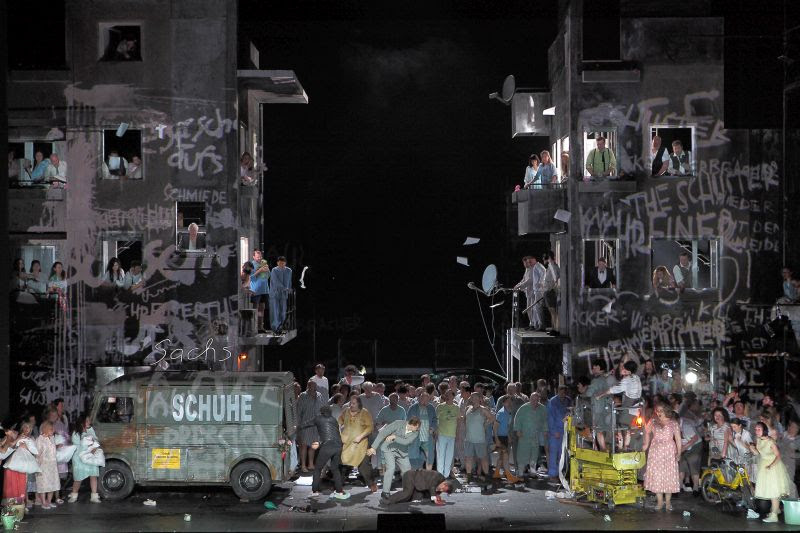
The citizens of this Nuremberg live in anonymous housing blocks, as we'd see in any desolate city where conditions are hard, and expectations are limited.  These are the universal disenfranchised, the kind of people whose horizons are curtailed, and who make easy prey for populist demagogues that make them feel they are "taking control" when they are, in reality, being manipulated.   Given the events of 2016, and the rise of Pegida and other right-wing extremists, it would be easy to make connections with 1933, but David Bösch, the director, deliberately avoids easy answers. He makes us feel sympathy for these dislocated souls, despite the violence with which they express themselves. To counteract such evil we need to understand and analyze, though not condone. Thus Beckmesser gets beaten up, and savagely. Nothing scenic about this brutality. The Nightwatchman (Goran Jurić) is an ordinary German policeman, a symbol of order, but one who cannot reverse the insanity once it's been released. The mob bully him back into his squad car. They wield poles, like knights n the past would have wielded spears : the romance of the past revealed as petty crime.

Similarly, this Beckmesser (Martin Gantner) isn't a caricature, but is interpreted as a weak but opportunistic personality who assumes that playing the right games gets you ahead.  He's very nearly right. Were it not for Sachs, his gold lamé suit and string vest might make him a superstar in some eyes, though his instrument is minute.  Walter, in leathers, looks like a thug but is the true artist, rough edges and all.  David could go either way, meaning well but prone to fudging corners.   Wolfgang Koch's Sachs impressed: although he's grimy (as the real Sachs probably was), intelligence shines out of his eyes. His movements are sharp and he takes in all that's happening around him, as a good Sachs should.  Koch is so experienced that authoritative singing comes naturally to him: no need for exaggerated folksiness.  His "Wahn! Wahn! Überall Wahn!" sounded genuinely perplexed, as if he were trying to make sense of what's going wrong, rather than just sighing in despair.  As he sang, his voice warmed with resolve.  Sachs can, and will, stand up for reason.

No open meadows in the final scene. Perhaps the Pegnitz no longer flows, or has been diverted underground.  We still see flags but these are flags of a more sinister kind. We're indoors, in a closed auditorium, cut off from the real world. On a hot Johannisnacht, the atmosphere would be stifling. And so, perhaps, a commentary on the nature of guilds and competition, of the channeling of diversity into an apparently cohesive celebration. "Brought to you by Pogner", a sign declares, for Pogner (Georg Zeppenfeld) was the agent who created the situation through which Eva was auctioned off to the highest bidder, bringing out the worst in Beckmesser, who might not otherwise have dared  to move. Pogner's white suit isn't as pure as it might seem.  The mob in the square covered the city walls in graffiti. Here, the "promoters" cover the meadow with commercial slogans.  Either way, defacement, and the defacement of culture as sacred mission.

The guilds come together in a show of  unity, but how much of this unity is real, and how much controlled by convention. Each guild flaunts its superiority. Listen to the music: "Streck'! Streck'! Streck'!" and "Beck! Beck! Beck!", violence channelled into ostensibly cheerful chorus. The Tailors hold up the tools of their trade: giant scissors which could cut a man in two, stained with blood.  In some shots the blades of the scissors appear above the tailor's heads as if they were the horns of the devil.  The Prize scene is a Prize Fight, but the wider scene suggests a kind of Party Rally, with the crowds cheering as if on cue. Alas, Nuremberg has yet to live down 1936, even though not all the good folk of the city were participants. But at least the memory serves to remind us how dangerous Party Rallies can be, when people can be manipulated into unthinking frenzy and violence. Even decent, ordinary people who let themselves be fooled by soundbites.  No wonder Walter doesn't want more of the same.  Beckmesser gets beaten yet again, and brutally, this time shooting himself.   Fortunately, though, Walter does win, and wins Eva, the two of them offering hope by renewal.  What Walter will learn from Sachs will determine the direction of Holy German Art.

How much have audiences learned from Wagner, and from Die Meistersinger von Nürnberg, though, I wonder ?  In the dark clouds gathering around us in 2016, have we learned  anything from history?  Can art save civilization? Or is human nature so venal that the ideals of enlightenment must be destroyed in a wave of ever-narrowing bigotry and the resurgence of fascist values?  In this production, the bust of Wagner comes in a box marked "fragile".  Fortunately in Munich, the cheers were louder than the boos, a cause for hope.  Kirill Petrenko conducted a very good cast even without a megastar like Jonas Kaufmann.  For that, I was glad, for Die Meistersinger von Nürnberg is about ordinary people doing extraordinary things.   This production, directed by David Bösch, is finely detailed and will probably reveal its depths as time goes on. It's different, but its insights come from the opera itself.  It's not easy. But the issues it confronts are not easy and need to be confronted with courage and with Hans Sachs's fair minded common sense.  

Tuesday, 6 September 2016

Alberich not! Secrets of really creative people

"Schläfst du, Hagen, mein Sohn?" Hagen is asleep, but Toxic Dad invades his mind, controlling him from beyond the grave (assuming Alberich is dead, which is unlikely).  Hagen has no beef with Siegfried but a billion resentments agaist Gunther and Gutrune who have by rights what Hagen has not.  So Toxic Dad worms his way into Hagen's subconscious. "Hasse die Frohen! Mich Lustfreien, Leidbelasteten liebst du so, wie du sollst! ".  Alberich, the ultimate non-creative person who can only cheat and steal.

What are the secrets of genuinely creative people? Just now a friend sent me an image from source I'd like to reproduce but can't. So here's the gist of it, and many thanks to whoever did it in the first place.  Seeing it made me so happy ! And by sharing, maybe I can make others happy, too.

Visualize two poles. Creative People and Non-creative.

C's compliment. Non-c's criticize

C's talk about ideas. Non-c's talk about people
 
C's embrace change. Non-c's fear change

C's learn, continuously. Non-c's know everything, always

C's accept responsibility for their own failures.  Non-c's blame others

C's have a sense of gratitude for their blessings. Non-c's wallow in entitlement. 

Will Hagen be c or non c ?  Will he "Hasse die Frohen!" like Toxic Dad ?  Siegfried's no hero because he can't think past his own needs. For Wagner, the real hero of the Ring is Brünnhilde who returns to the Rhinemaidens what Alberich stole.