Showing posts with label Complicite. Show all posts

Thursday, 6 February 2014

A Dog's Heart - Lyons

"If satire is your thing you will not want to miss this opera about human testicles grafted onto a dog."

writes  Michael Milenski in Opera Today about Coeur d'un Chien, or A Dog's Heart in Lyon.

"Raskatov made vulgar music (snorts and farts) and he made music vulgar incorporating liturgical hymns and famous old folk songs into the musical flow of his sensational text (the last line of the first act, shouted by the dog transformed into Communism's “new man” is “get fucked!” in the libretto, and “lick my dick” in the supertitles). The composer recognizes that contemporary ears are accustomed to an infinity of musical and random sounds thus he has no compunction in raiding Monteverdi’s recitative, using extreme voices (shrieking higher-than-you-can-imagine sopranos) or making hoarse, coarse sounds through megaphones (the opera ends with sixteen players shouting vowels through megaphones into the faces of the audience. Underlying all this is Raskatov’s basic musical language heard from time to time which seemed to be more or less Webernesquely minimal."

HERE is what I wrote when A Dog's Heart ran at the ENO London in 2010

Friday, 8 November 2013

Audacious Mozart Magic Flute ENO

Mozart The Magic Flute at the Coliseum could give the ENO a welcome boost. Simon McBurney's production is audacious  but absolutely true to Mozart's cheeky, irreverent generosity of spirit. Tamino and Papageno find Enlightenment (and the girls of their dreams) because they dare face the tests before them. Each takes the journey in his own way: the saga transcends time and place.  From Greek myth to Parsifal, even to Star Wars, the allegory refreshes itself in endless retelling. It is a universal voyage of self-discovery.

Simon McBurney and Complicité create dazzlingly imaginative theatre. Their A Dog's Heart was astonishingly vivid. The opera was a mess but the staging turned it into art. With Mozart, McBurney has infinitely better music, and rises to the challenge. As wer hear the Overture, we see a hand write words in chalk on a blackboard.  As the opera evolves we learn its significance. Words communicate. We see images of books on shelves, and  up to the moment mobile devices. The stage above the stage is a laptop or Notebook. It's suspended on wires from the roof and looks dangerously fragile, but that in itself has meaning. Finn Ross's' video projections are among the best in the business, and  extremely well integrated into the drama. Technology may change the ways we express ourselves, but if we don't communicate, or refuse to engage with each other, we're lost. At the end, chalk figures proclaim "WISDOM LOVE". Simple and austere but all the more powerful for that.

Technology changes in theatre, too. Film and computer-generated images break down physical restraints of production and free imaginative possibilities. The Magic Flute IS magic after all, not realism. It cries for cosmic flights of fantasy. McBurney's designer, Michael Levine, gives us the night sky in all its glory : myriad sparkling stars in the firmament. The Queen of the Night (Cornelia Götz) in this production isn't spectacular but the forces she commands most certainly are. Extra-terrestrial sound effects amplify the sense of cosmic spaciousness. Off-stage noises are a natural part of staging. Here they rumble at the edge of consciousness. Gergely Madaras seems spurred to conduct with strong, dramatic flair. This highlighted the quiet moments when the Flute (Katie Bedfiord) emerged.  The flute felt all the more magical and fragile. The Flute is more than an instrument. It is fundamental to the meaning of the opera. Like Papageno's bells, it evokes something pure,  primeval and plaintive. McBurney's staging was musically as well as visually astute. The "birds" that fly in these woods were pieces of paper fluttering like the pages of books. Like the Flute and the bells, economy of gesture expresses deeper meaning.
 
This staging is beautiful, revealing its charms obliquely, much as the Singspiel tradition  is more subtle than later forms of grand opera, and McBurney respects the vibe. The scene where Tamino and Tamina float, apparently suspended in space, surrounded by "birds" is magical.  The English dialogue is genuinely witty. Papageno (Roland Wood)  quaffs a bottle of Chateauneuf du papageno!

The singing and acting were also above average for the ENO, hamstrung as it is by the need to do operas in a language other than those for which they were written.  This cast delivered with panache, communicating their enthusiasm with style and wit, obliterating the lumpen ENO Die Fledermaus, killed not by the staging but by the performance.

Ben Johnson sang Tamino. He has stage presence..He even looks right, and creates a Tamino with  personality, doggedly battling the situation he's in. His firm, assertive singing showed that Tamino is not a spoiled princeling but a man of  character and resolve who can face what Sarastro, and the world, throws at him.

Roland Wood sang Papageno, ostensibly the lesser, low-born character in the opera but fundamental to its meaning. Princes abound in classical art, but Mozart gives us Everyman as non-hero in a strikingly modern way. From Papageno we can trace a line through to Siegfried and even to Wozzeck, a role taken by many good Papagenos, and one which Wood is  surely destined for. The Papageno songs are harder to carry off than they seem because a singer has to express the role's innate nobility while acting the inept Fool. Spontaneous applause after the Papageno/Papagena duet., and very well deserved indeed.  I didn't like the fake provincial accent and Little Britain connotations which English theatre is obsessed with, but Roland Wood's true personality shines through the disguise.

Mozart's arias for Sarastro are so resoundingly written that they evoke the idea of Sarastro as a figure beyond time, an acolyte, perhaps, of Egyptian gods. James Cresswell sang the part well, though he didn't quite suggest the complexity of the character: Sarastro has very dark sides. He's an unforgiving judge rather than a father figure. Cornelia Götz sang The Queen of the Night.  Here, she's no Darth Vader vamp, as in some stagings, but a surprisingly vulnerable woman. Her Ladies (Eleanor Dennis, Clare Presland, Rosie Aldridge) extend her part. Monostratos (Brian Galliford) conveys the  Alberich-like animalism, suggesting that he's a dark cousin of Papageno, gone bad.

 Devon Guthrie sang a lovely Tamina and Mary Bevan a spirited, lyrical Papagena. The Three Spirits were Alessio D'Andrea, Finlay A'Court and Alex Karlsson, costumed as ancients, whose Norn-like purpose they serve.

This Magic Flute might confound those who want their Mozart vacuous, but those who truly love the opera will get a lot from this highly individual, perceptive approach.

For more details check the ENO website . The production runs til 7 December - you'll want tickets!
This review also appears in Opera Today. 

Thursday, 9 February 2012

Complicite McBurney Barbican Bulgakov

Anyone who liked Complicite's staging of A Dog's Heart at the ENO might like their latest theatre adventure, this time at the Barbican. Like A Dog's Heart, the drama is based on a novel by Mikhail Bulgakov. This time it's his magnum opus, The Master and Margarita. 

The Master and Margarita is a huge, sprawling panorama where time, place and genre keep swapping. One moment we're in the Soviet Union in black and white. Next moment, the screen turns technicolour and we're at a trial in the Middle East where the criminal is Jesus. A mysterious stranger appears. He seems so reasonable. But is he the Devil? He presents as nice old gent,  as a master of ceremonies, the compere of a mad circus and demented fashion show.  Animals and apparitions appear. Then he meets Margarita, a woman so wild even he's flummoxed. For a while.

If anyone's going to be able to stage this within a few hours it's Complicite.  The novel is so off the wall it will be fun to see how they digest it. The show starts 15th March and runs til 7th April. Booking details HERE. Read the novel (it's loooong) or see the Russian TV series. But don't be too literal. This isn't the kind of world where anything is quite what it seems.

Sunday, 21 November 2010

ENO A Dog's Heart - Review

In this era of safe, timid opera, A Dog's Heart at the ENO might just be the tonic to liven things up. It's guaranteed to provoke extreme reactions. From Complicite and Simon McBurney, we couldn't expect anything less.

Mikhail Bulgakov's novel  The Heart of a Dog disturbed the Soviet authorities so much  they banned it for 60 years  The plot's seditious. Professor Preobrazhensky (Steven Page) is an eminent surgeon who adopts an abused mongrel from the street. The professor's apartment is a haven in a world that's disintegrating all round.  Everyone is scavenging to survive. Dog eat Dog, "Something's not right here" thinks the dog, hardly believing his luck. The Professor rejuvenates his patients by transplanting animal organs into them. Now, he wants to create a New Man from a dog.  Dog made Man becomes Poligraph Poligrafovich Sharikov (Peter Hoare) a beast, slovenly, venal and brutal. (Please read a more detailed synopsis HERE)

With a plot as surreal as this, don't expect conventional opera or theatre. All art is an expression of how an artist responds to something. We're there to listen to someone's point of view, however outrageous. A Dog's Heart is a new opera, yet we can still come to it carrying baggage about what things "ought" to be, Yet the whole plot plays with the idea of species, genre and gender bending.
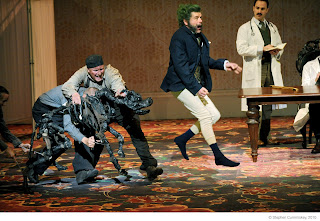
For a start it wasn't written in the usual way. Alexander Raskatov, the composer, worked with Simon McBurney and Complicite from the start so music, text and action are symbiotic. Raskatov's music isn't demanding so have no fears on this score. Its bark is worse than its bite. The presence of several big name composers in the audience is no indication of Raskatov's status in the avant garde. He's best known for completing Alfred Schnittke's Ninth Symphony. What he does do well is link music to text.
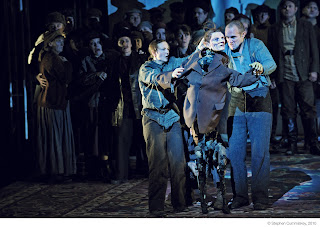

Because Sharik/Sharikov is an unstable chimera. so too is his music, constantly wavering in pitch  and volume, the vocal line unnaturally distorted. He's unnatural, after all, at any moment threatening to change form. He has two voices, one ostensibly "pleasant" (countertenor Andrew Watts) and one   "unpleasant" (soprano Elena Vassilieva, a "dramatic soprano"). On film, Sharik/Sharikov isn't hard to create but live theatre presents  unique challenges. No actor could shape shift that quickly or effectively. Hence the puppet dog, created by Blind Summit the cutting edge puppet company. Like Sharik, the puppet is manipulated into different forms, constantly changing. At one stage one puppet version is discarded for another. But realism is hardly relevant here,

Singers double in different parts. It's disconcerting as you recognize a voice but can't recognize the persona. But that's the story. Characters come and go, adding to the sense of instability, throwing the idea of narrative askew. Unless you know the plot already, it's confusing. But in real life, none of us really know the plot, either.
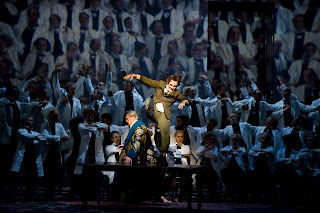
What this production misses is the strong political context of the original. Shvonder (Alasdair Elliott) and his agitators are reduced to ciphers. In theory that's valid because the basic drama is the Professor's Faustian misuse of knowledge, but the revolutionaries, grubby as they are, add dramatic tension. On the other hand, if the production were more overtly political, the pervading surrealism would be lost. What McBurney and Complicite emphasize instead is the fundamental idea of existential instability. They create the Professor not as a loner but as a representative of another mass, not as grubby as the proletariat, but no less certain of their Rights. The scene where the Professor explains himself to his peers (see photo) is very well done - this mob have white coats but they're also barking demented.
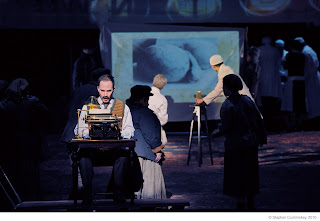
Similarly, McBurney downplays the incident where Sharikov unplugs the tap in the toilet and floods the apartment.  It's a powerful metaphor, but difficult to stage. Here, it's a weakness that adds nothing to the drama. Perhaps it should have been left out altogether, like some of the  minor incidents, like the Professor''s patients. Interesting as they are they aren't central to the drama. McBurney does, however, extend other elements in the plot in subtle ways. Dr Bormenthal (Leigh Melrose)  is seen meticulously typing up his reports, oblivious to the basic madness of their subject. Sitting at his desk, he's propelled across the stage from side to side the way old fashioned typewriters leap when you press return. Maybe that's lost on audiences brought up on PCs, but it's a good idea: Man as Machine, like Dog as Man. Similarly, Zina the Maid (Nancy Allen Lundy) becomes a big part. She shrieks, leaps and jitters. Woman as Puppy, just as disruptive as Sharikov the dog, which is perhaps why he tries to mate with her. On a deeper level, Zina is the "new woman" that appears in the novel, a hybrid that threatens the oligarchy the Professor and his peers maintain. Or isd she a comment on shallow modern society,? (Excellent performance despite the part being mad).

ENO's A Dog's Heart has its flaws, but its energy is a purgative for stodge. The anarchy of A Dog's Heart is an antidote. This is what ENO does best, shaking up complacency, freeing new ideas. A Dog's Heart is by no means Great Art but it's irreverent and fun, and better than much else on offer.

Photos Copyright : Stephen Cummiskey, courtesy ENO, details embedded.
Please read my other posts on A Dog's Heart the Movie and A Dog's Heart Preview