Showing posts with label Moongrunt. Show all posts

15 November 2025

Udvar-Hazy Aircraft Museum - Part 2

Following on (apologies for the delay) from Part 1 here:

https://tasmancave.blogspot.com/2025/09/udvar-hazy-aircaft-museum-part-1.html

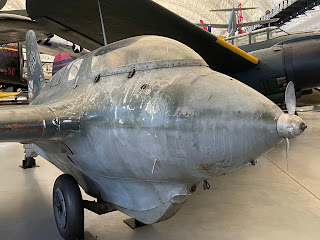
The German WW2 collection had lovely Focke-Wulf Fw 190 F-8/R1 and a Me 163 B-1a Komet on display, but their V1 "buzz bomb" and BF109 G-6 were under restoration. 
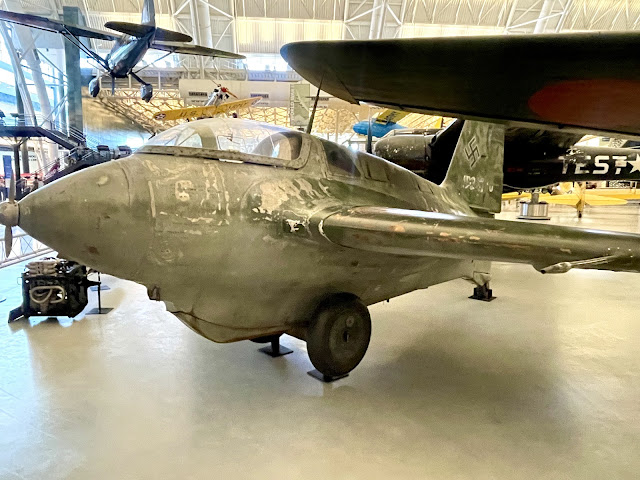

Me163 Komet - I've only previously seen one at the Australian War Memorial

Then they had some unique artefacts, including:

Dornier Do 335 A-0 Pfeil (Arrow), a heavy fighter with an usual dual nose/tail propeller design in a push/pull configuration that gave it an impressive 800mph speed. This is the only surviving example.


Arado Ar 234 B-2 Blitz (Lightning) - the world's first turbo jet bomber, fielded by the Luftwaffe from Sep 1944. This design was used predominantly for aerial reconnaissance (though at least 2 missions were sent to destroy the famous Remagen Bridge after its capture) and as the last German aircraft to overfly the UK during hostilities, in April 1945.

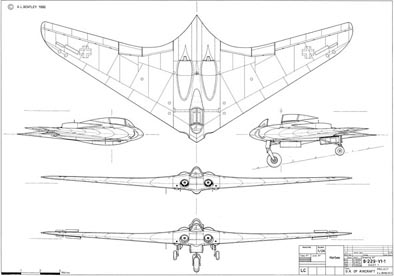
Horten Ho229 v3
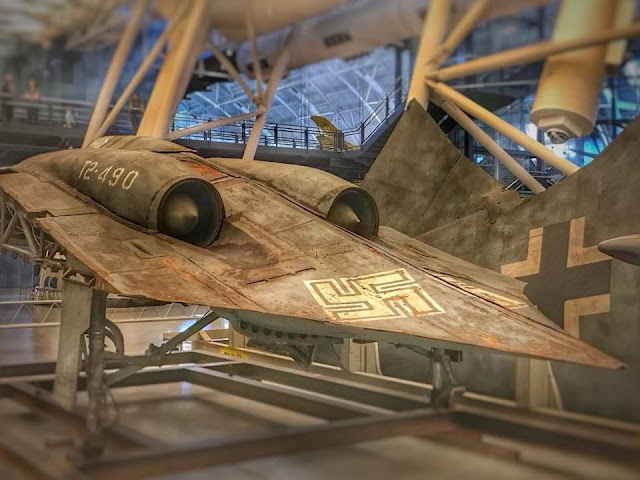

This 'flying wing' design was commenced in 1943. A single crewed, twin-engine fighter/bomber, it was one of the earliest jet aircraft and had a design speed of 1000mph, significantly outpacing Allied fighters.
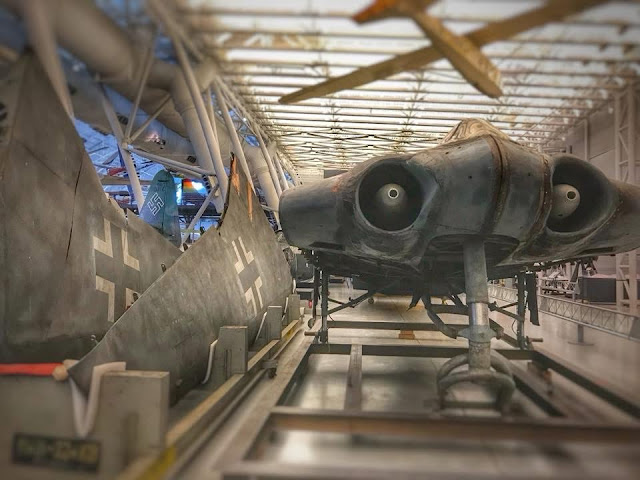
A prototype flew in early 1945, 3 months before the war's end but was far from ready for production when Germany surrendered.This aircraft was captured by the advancing US Army in April 1945 and is the only remaining example in the world.
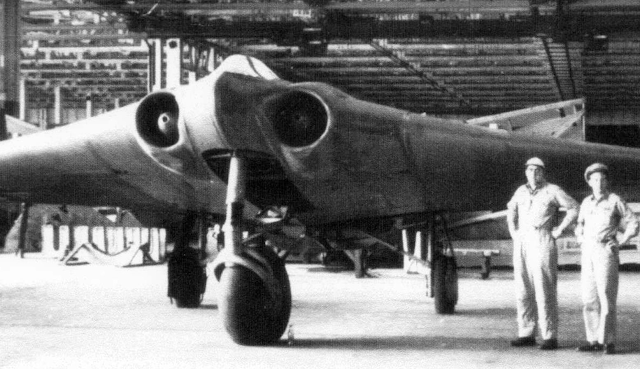
This was the first in a series of large 'flying wing' designs, some of which were included in the 'Amerika Bomber' projekt


But my favourite in the collection was the recently restored Heinkel He 219 A-2/R4 Uhu (Eagle Owl) - probably the best nightfighter (nachtjager) of WW2.
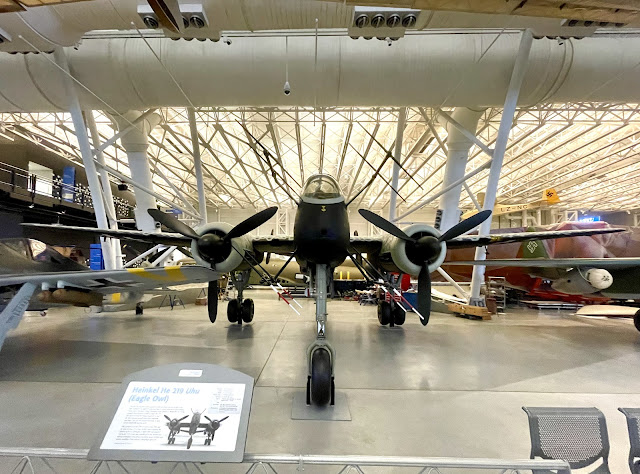
Thats the FW-190 on the left and the Arado Blitz off to the right


This aircraft design made its combat debut in June 1943, sporting a pressurised cockpit with twin ejection seats (the first military aircraft go be fitted with them), Lichtenstein SN-2 advanced VHF-band intercept radar, and six Mauser MG 151/20 20 mm autocannons - two in the wing roots inboard of the engines and four more ventrally. Later versions (model A-7 onwards) were fitted with the iconic Sträge Musik which fired 2 x 30mm upwards at 65 degrees.

 
This aircraft is one of 3 captured by the US Army Air Force at the end of WW2 (Operation LUSTY) from the Luftwaffe's 1st Night Fighter Wing at Grove, Denmark, and is currently the only one on display in the world.
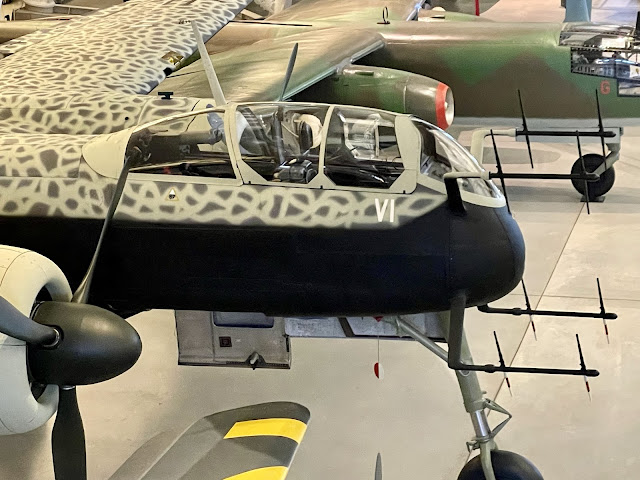

Amazing crew vision from the cockpit

Closeup of the nose mounted Lichtenstein radar:


And was it really my favourite? Well lets just say its the only one I made video footage for :-)


In comparison the WW1 section was small, though boasted 3 'string-bags' of fame:

Nieuport 28C.1  


Spad XVI

Halberstadt CL.IV


Definitely a"must see" spot when travelling through Washington DC!

13 September 2025

Udvar-Hazy Aircaft Museum - Part 1

Off on another work trip this week, this time to DC- and I got a chance to visit the National Air and Space Museum's Udvar-Hazy Center near Dulles Airport. Think of it as the Smithsonian's overspill storage spot!

https://www.si.edu/museums/air-and-space-museum-udvar-hazy-center

Starting with the Queen of the collection: OV-103 Space Shuttle Discovery, the third operational and most flown of the Shuttle orbiters whose key achievements include deploying the Hubble telescope, 2 missions to MIR and 13 to the ISS. Retired in 2012 after 39 missions.


I have now seen all but one of the surviving shuttle orbiters :-)

My most artistic shot of the day!

Two other gems in the collection were striking.  This first ever nuclear strike bomber needs no introduction. And as you can see, she dominates her Wing of the Museum


And the inimitable SR-71 Blackbird needs no introduction either!

An F4U Corsair hangs from the ceiling like my old Tamiya models (without the glue splodges). Famous in the Pacific War and piloted by legends like Major "Pappy" Boyington, USMC of the "Black Sheep" Squadron


A B-17G "Shoo Shoo Shoo Baby": undergoing preservation.


For Korean War MiG Alley affectionados is the duelling duo of a USAF F- 86A Sabre and the MiG-15bis FAGOT-B.  


Similar but not quite the same as those I saw seen recently at Ford Island Aviation Museum in Hawaii. This MiG-15 is a Chinese Ji-2 modification but its history prior to being bought by an American collector in the 1980s in not known.


The elevated walkway through the main halls allows you to get some unusual aspects from above


This Sabre is one of the aircraft that was assigned to the 4th Fighter Interceptor Group at Kimpo in December 1950.


Thats probably enough pics for this post - standby for a Part 2 followup!


17 August 2025

A visit to Rocket City USA

An AMAZING day yesterday at the NASA Marshall Space Centre in Huntsville, Alabama - also known as "Rocket City" for being the engineering powerhouse of the US Space Race and the Saturn project in particular.

How's that for a poetic shot!

To make the trip even more special, I went with a posse of colleagues which included two current rocket scientists, and met two living legends who worked on the Saturn V project back in the day. They told us "Houston only worried about the human part of the system - we did the real work" :-)

And so, this post is unapologetic pic spam! (and is about 2% of what I took)

This is the US Army Redstone Rocket - the first derivative from the German V2 rocket by the German team (BTW we met another NASA guy who was in the Shuttle program, who told me that as a lad he lived next to Dr von Braun in Huntsville, where all the German team were located. With such inspiration no wonder we became a rocket engineer!)

This is the PGM-19 JUPITER Medium Range Ballistic Missile which was used my NASA for suborbital biological test flights with monkeys.  And from these two was derived the Mercury-Redstone Launch Vehicle


The first successful launch was in late 1960, and Alan Shepard was taken aloft as the the first American astronaught in May 61. "The Mercury 7 were great guys but really just rode it as ballast' the Saturn V vets told us! :-)

The heavy lift capability program commenced in 1958. Initially called the JUNO V, the team at Huntsville just started referring to it as SATURN because "its the one after JUPITER" and it eventually became official!

"You use what you've got to solve problems" our 87yr old NASA veteran told us. "So to save retooling costs and time, we strapped a bunch of Redstone rockets around a Juno fuel tank to make a first stage and it seemed to go ok". The first Saturn 1 was launched in late 1961.  


The "rocket park" was inspiring and the exhibits are in showcase condition 


The Marshall Centre has other exhibits including US Army missiles designed and built at the Defence facility next door, including the "Nike Hercules", "Corporal", "Honest John" and "Spartan". 


Not in quite the same condition and while interesting, something else had caught my eye and was drawing me in....


OK, this one is a 1:1 scale replica standing proud outside but inside the building next to it...


This was originally built for the Apollo 19 Mission and is one of only three Saturn V Launch Vehicles remaining in existence - the others are a Kennedy Space Centre (Cape Canaveral) and Johnson Space Centre (Houston). Now I've seen two - one to go!
Pic of this Rocket from Wikipedia to give a different perspective


The business end! The outer R1 engines could gimble up to 5 degrees each while the centre one is fixed. Together they burned 6,000 pounds of fuel per second!


These were our hosts for the day and we were amazed for 3 solid hours as they rattled of data, design principles and many personal anecdotes. I feel very lucky to have had the chance to shake their hands and hear their stories.

One such story went along the lines of "It was getting very busy to control the spacecraft and manage all the inputs, so we decided to invent the first digital computer" (!) Partnered with IBM, it was designed with electromagnets, where North orientation was 1 and South was 0. So the first digital computer was made by employing local seamstresses to sew magnets with copper wire to build a whopping 144kb capacity weighing 88lbs.


As if that wasn't enough, there is also this treasure - Command Module Casper from the Apollo 16 mission and which orbited the moon 72 times in 1972


This capsule and its crew, John Young, Ken Mattingly and Charlie Duke, were recovered by USS Ticonderoga in the Pacific Ocean near Kiribati


The collection of astronaught training equipment here was also outstanding


Closeup of the driver's console and instrumentation


The LEM trainer was also very cool - I hadn't seen this before. This first pic is a close up of the instrumentation, while the second puts it into context.


Now imagine you're trying to move around, with your crew buddy, in a full space suit!


And finally, as you exist; where it all began - the V2 rocket


Cool mockup in the carpark next to the adjacent "Space Camp". I like that its called Pathfinder, which was used in the Apple TV Series For All Mankind 


An unforgettable and inspiring day

https://www.nasa.gov/marshall/