Showing posts with label Black Powder. Show all posts

Wednesday, June 19, 2013

Napoleonic AAR - Black Powder Blast

Present! Fire!
Hello again to the followers of the Analogue Hobbies Blog!  I was fortunate to host Curt in my neck of the Canadian Prairies last week.  In addition to fun food and wine we were able to throw down some really great gaming.   For old times' sake we had a game of Epic 40k during the Fawcett Avenue Conscripts' regular get-together.  Then on Saturday night Curt was kind enough to put his stunning 28mm French Napoleonics on to the table to challenge my stubborn, charming and poorly-led Austrians and run a game of Black Powder.

Austrian line before battle is joined
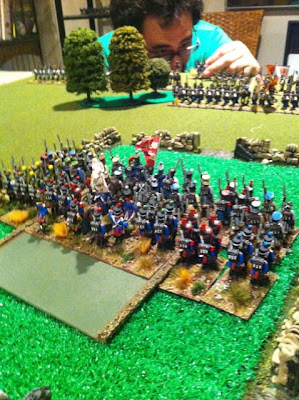
French commanders Byron and Bill get instructions from Curt and scheme to overload the Austrian flank
Attack columns anyone?
We did not busy ourselves with undue application of background.  It was the 1809 campaign.  A French force was looking to open the way forward by knocking an Austrian blocking force out of the way.  The road to Eggmuhl? Teugen-Hausen? Aspern-Essling? Raab? Wagram? Why worry about it? Sometimes it is fun to just throw down and play, even in a period as "serious" as Napoleonics.  The French would have eight turns to break the Austrians. That was that!
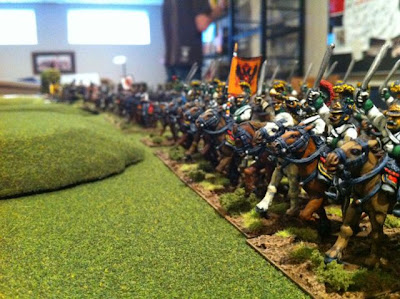
Austrian dragoons at the far left of the Austrian line
The French advance, led by infantry on their left
French officers blunder their way forward...
To determine victory Curt adjusted the victory conditions process somewhat. The army break point would be determined by the removal of various units through battle, as usual, but we applied the Army Morale feature from Sam Mustafa's "Maurice", where the effect of this would be somewhat random.  An excellent mechanic that fit well with the scenario.

We also tilted the initiative mechanic on its head - it would be harder to maneuver near the enemy, not easier, so free initiative moves were limited to units at least 24" away from the enemy, not within 12" of the enemy.

A dire and ominous concentration of French troops assault along the flank of the table

Another view of the French assault.  Behind the lines, Cam contemplates just how small Dallas' chance for success is...
The French force consisted of six battalions of infantry, a regiment of Carbiniers, a regiment of Cuirassiers and an artillery battery.  The Austrians met them with a similar force - six battalions of infantry, a regiment of Cuirassiers and a regiment of Dragoons.  They would face off along the opposing long edges of a 5' x 8' table.

Curt's 28mm French are a sight to see on the table!

The extreme right of the Austrian line - Dallas holds out...

Some Hungarians in Dallas' brigade hold out under heavy French pressure
To further reflect the national attributes of the forces involved, the French troops were rated as "Superbly Drilled", meaning they could always count on some kind of action even in the event of a flubbed command roll by an officer (although they could not charge on their own).  The Austrians had some command penalties to reflect the indecisive nature of their command structure, but their battalions were large and ready to accept some abuse in stoic defence of the Holy Roman Empire!

The assault is joined! Dallas' infantry goes down fighting...

My artillery battery provided limited support to the Austrian line...but made the C-in-C feel better....

Mike's assault in the centre moves ahead
Byron and Bill took command of the French, while the Austrian command, true to the flavour of the period, was a touch top-heavy, with Dallas taking command of an infantry brigade on the right, Mike F. taking command of an infantry brigade in the centre, and visiting Conscript Cam leading the cavalry brigade on the Austrian left, while I played the role of Austrian C-in-C, with direct control of the artillery (and a pressing concern for a lute I may have left in Vienna).

Dallas' right is broken

Dallas' remaining troops under pressure.  The French gun on the left is about to unlimber...
The French, being the squeezers they are, overloaded their infantry toward the Austrian right.  Dallas looked a little forlorn as his thin spread of three infantry battalions faced five french battalions, supported by artillery, racing to crush his men.  His troops held on grimly, with Dallas hot-rolling numerous saving throws to hold back the French.  Ultimately, in a slight departure from Hapsburg character, he sent his right-most battalion directly forward into the advancing French, thinking it was better to go down in flames charging rather than waiting for the inevitable.

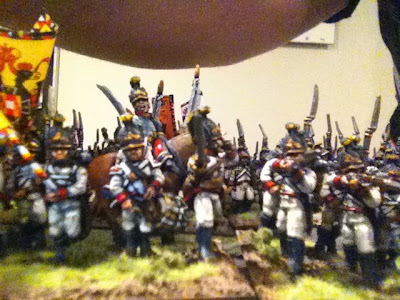
Curt's stunning French Carbiniers

When you roll like this, you will never, ever charge....
Dallas' troops held out for a long time (considering what he was facing), but at the end of the day it ended in tears, and over the space of three turns two of his battalions were routed.  His stand was prolonged by the French command's tendency to roll blunders, slowing their advance through some random, awkward movements.  Dallas also hit hard with his musketry, and my desultory artillery fire added a little support.

French Cuirassiers run over the Austrian dragoons
On the left flank we braced for an epic cavalry clash.  In between bouts of Hapsburg vapours, I was careful to remind Cam on multiple occasions that the fate of our whole stand depended on his horsemen.  Cam was thankful for the pressure (he may have referred to it as "pre-blame", I can't exactly recall) but he embraced the role with a suitably Austrian vigour.

Victorious French heavy cavalry threaten the Austrian left flank
And the results were...very Austrian...a prolonged standoff, extended by multiple failed command rolls, multiple failed "Follow Me!" attempts...it was really something!! For several turns, the four regiments stood there nose to nose, waiting for someone - anyone! - to get a damn charge roll off the ground.  In the end I was successful first - but only via a blunder!!!
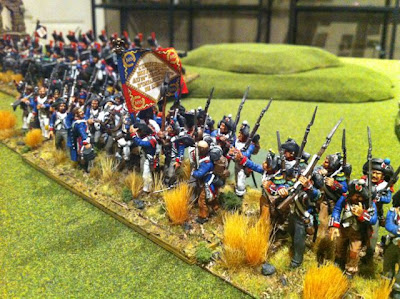
This lone French battalion held the French centre
But once unleashed, it was a hard core battle!  Cam's Austrian heavy cavalry were able to break the French Carbiniers after two rounds of hard fighting.  It did not go so well for the Dragoons, who proved to be little more than a speed bump for Napoleon's Cuirassiers.

Mike rolls out against the Austrian centre
In trouble on the left, and in trouble on the right.  It was pretty dire....but in the centre - wow! Mike's Austrian infantry brigade steadily and methodically shredded the French battalions in front of them.  He did so well he was able to advance forward into the middle of the French line, threatening the flank of the French infantry blocks on the Austrian right, and safe from the dreaded French cavalry on the left.

Mike's three battalions had solid momentum
The Austrian high command was jazzed about the possibilities of this advance, but in true, cautious, conservative fashion, we withdrew.  Remember those army morale rules we mentioned? Well, we rolled high when checking for the demise of each Austrian unit lost to that point, and rolling high is bad.  Our army morale broken, the Austrians ceded the field, leaving the French a little bloodied and a little baffled...

The French centre faces disaster...those Carbiniers at the top of the photo are already beaten....
It was great fun to play Black Powder again, but in the Napoleonic context it is easy to see the numerous irritations - saving throws from artillery, aaarrrrgh so stupid! - which motivated Curt and his crew to develop their own variant for the period.

Mike's successful assault moves to threaten the French main thrust, just visible to the right
Nonetheless, the game looked awesome, the company was great, and it was a real thrill to get my Austrian lads on to the table against Curt's stunning French troops.

Only Austrians would maneuver to this point, and then fall back...
I want to thank Curt again for putting on the game - he had done a presentation at a conference that morning, made it back to my place just in time to get the game set up and then helped us bludgeon our rusty way through the game.  That takes a lot of energy, and it was greatly appreciated!  Thanks very much dude.  I look forward to the next game!

Tuesday, February 19, 2013

Guest Post AAR - Battle In The Sudan - 28mm Black Powder Colonial


Hello once again to the Analogue Hobbies gang.  I am here to interrupt with another guest post AAR from our wonderful visit to Regina this past weekend.  This report features action set in the searing heat of the Sudan in 1884 as the troops of the British Empire face off with the fanatical followers of the Madhi. 

The Mahdist rebellion in the Sudan is a favourite period of mine and the relevant collection of 28mm figures from Perry Miniatures is one of my favourites to paint.  This current Analogue Hobbies Painting Challenge has spurred me into finishing several long-overdue figures from this range and they saw action for the first time on the gaming table in Regina this weekend. 


Newly painted figures meeting their inevitable fate...
The setting was 1884 near Suakin on the Red Sea coast.  This was the initial period of action against the Madhists as British troops sought to bring rebel leader Osman Digna to heel and secure the sea coast in order to protect the shipping lanes to India.  This campaign included actions like El Teb, but I was looking to represent something a little smaller - a skirmish-type encounter with some local Emirs who were probing the British forces.

The 6' x 4' table was set to imagine a dry tributary of the Atbara river and an abandoned commerce/trade station of the previous Khedival administration - since captured, looted and wrecked by Madhists.  Graham has sent a detachment of Yorks & Lancs, Camerons and Hussars, supported by a gatling and some naval ratings, to clear out the Madhists.  The British detachment totaled about 40 men. 


I say Ramsay, how can I observe the horizon if its blotted out by raving mahdists?


The local Mahdist Emir is keen to hold on to his ruins and test the will and resolve of these foreign devils.   He had two large blocks of warriors with spears, two small blocks of skirmishers with Remington rifles, a captured Krupp gun crewed by Egyptian "volunteers", a small group of camel riders and a party of cavalry.  In all it was about 120 warriors. Game length would be 10 turns.


Curt and I played this game twice - once trying to apply the Bolt Action rules engine for the colonial setting, and a second time using the wonderful Black Powder rules.  

The Bolt Action experiment did not work out well.  I thought I had cleverly adapted the rules engine as needed - I particularly like the pin the markers - but overall the game experience was sluggish, to put it politely.  


Camels - the 'Bolt Action' equivalent of Hanomags...
It is a testament to Curt's friendship that he played through nine turns with me at this before I finally admitted my bold plan kind of sucked.  Too many dice had to be rolled to generate a result that should have been straightforward. The flow of the game was wrong for the period. Not very good gaming...

This is in no way meant to criticize Bolt Action. After all, it was written for WW2 for Pete's sake! I have had a lot of luck adapting different rules systems to different periods and settings, but this one did not work out. On the plus side, the table looked great and we had great fun hammering Madhists with gatlings and rifle fire, while the naval ratings ran for their lives in the face of a charge from 20+ warriors.


Curt suggested Black Powder as the way to go - and in fact Black Powder is intended to actually capture this period.  I had read through Black Powder, but not tried it before.  I didn't think my individually based models would work - but therein lies one of the brilliant bits of Black Powder - the game doesn't really care how your stuff is based.  


We racked up the figures again - once again I took the Mahdist side and Curt played the British.  This time the game has WAY better flow and fun.  The action was dominated by my Madhist cavalry attacking back and forth along the flanks while the bulk of their warriors endured volley after volley of musketry.  


Both of us flubbed some important command rolls, but I managed to do this twice at very, very critical junctures!!! One failure allowed the British Hussars to escape obliteration (although I would still get them in the end). 


The second saved the skins of the Yorks & Lancs - already suffering from the effects of harassing fire by Mahdist riflemen and the captured Krupp gun - they would have been charged in the flank! But you can see from the photo what happened...


Later that turn Curt used the Gatling gun to finish off my cavalry, and their loss was sufficient to break the Madhist force.  But it was a close run thing for the Brits - the Hussars had been seen off - with their commander in tow - and the Yorks & Lancs were on the brink.  


The game was fast and fun and gave a great flavour for the period.  The British cavalry was roughly handled (as occurred so often in the Sudan) but steady musketry and a gatling carried the day. 


I will now scramble to order some sabot-style bases to make moving the troops blocks around a lot easier to play Black Powder colonial games in the future!  And I will try and fire up a Black Powder game for the fellows back in Winnipeg.   

You will also see Curt's awesome wound markers in action in the photos here (note the particularly huge blot in front of the gatling - RIP Madhist infantry charge).  This is another thing I really want to try out - a very cool effect. 


Addendum - In discussion with Curt, I have decided that coming to Regina for a game during any painting challenge period is also worth points - in this instance, about 100 points per game :-)... (200 points if you let Curt win. - ed)  Now, if I could just figure out a way to hack that scoring chart...

Sunday, June 19, 2011

Battle Report: 'Ney on Ice' - Part II (using 'Food for Powder': a Black Powder variant)


As described in my last post, this scenario set an 'allied army' of Russians and British against a French division commanded by Marshal Ney. 

The game started with the British deployed in one corner of the table to which they had to move across the long length and exit the other side. They were composed of four highly trained infantry battalions, a battery of Royal Horse Artillery, two sections of rocket artillery and two squadrons of Light Dragoons.

The Russians...

Tuesday, June 14, 2011

Napoleonic Battle Report: Poland, 1806 or 'Ney On Ice' (using 'Food for Powder': a Black Powder variant)


I hosted a Napoleonics game for the guys this past weekend that was another one of my hypothetical 'what-if' scenarios - as JohnB was kind enough to bring down his beautiful Russian collection from Saskatoon, this game was set in Poland around Christmas 1806.  

First, the 'true-to-history' bit:  
October 1806 had seen the French crush the Prussian army at the twin battles of Jena-Auerstaedt and by December Napoleon his Grande Armee was encamped in Poland, preparing to bring the Russians at bay in the upcoming spring campaign.

Wanting to catch the French unprepared while they were scattered in their cantonments, the Russians decided to initiate a surprise winter offensive. Nonetheless, by pure coincidence, at that same time Marshal Ney unilaterally decided to move his corps forward into a better foraging area. So the two forces began to move very near to one another, close to the Baltic coast.

In London, with the defeat of the Prussians and the subsequent advance of the French army into the Baltic region, the British were becoming very concerned that Denmark, with its significant navy, was at risk of being annexed by France or worse, would be convinced into a French alliance. Accordingly, discussions had been going on between Britain and Denmark with the British 'offering' to quarantine the Danish navy until the end of hostilities with Napoleon. Not surprisingly the Danes were not interested. 

Now, my hypothetical premise (i.e. 'made-up tosh'):
 ...

Tuesday, May 31, 2011

Gaming Vacation and Introduction to 'Food for Powder'


Last December my lovely wife and some of her girlfriends bought tickets to the U2 concert scheduled for Winnipeg this past weekend and so we made the pilgrimage for her to see The Great God Bono late last week. Don't get me wrong, I really like U2, but I have about as much interest in watching a rock concert with 50,000+ sweating, intoxicated, screaming fans as I have with sticking pencils in my eyes, so I quietly bowed out of the 'experience'. (Its funny as 20 years ago I would have probably given a kidney to see them...) Nonetheless, I tagged along so I could visit family and, like a complete geek, game my face off with some of my old pals from The Fawcett Avenue Conscripts

I played two games of 28mm Napoleonics: a largish Anglo-French scenario that I put on for the Conscripts and a smaller Austro-French scrum between Greg and I. (I apologize in advance for the crap photos - I was preoccupied with running the games and so just snapped these shots off when I both had a spare moment and thought of it.)

Here we have two battalion columns from a French infantry brigade negotiating around a muddy field in an attempt to deploy out into line.
After some initial success the French brigade meets a withering fire from British battalions supported by artillery.
For both of these games I used our new rules, Food for Powder which were originally inspired by our modification of Black Powder, but have since evolved beyond that premise to include an assorted mashup of interpreted game mechanics from Shako, Republic to Empire, Lasalle, In the Grand Manner and several other rule sets. Sort of a cafeteria pick-list of Napoleonic rules which together has created an entirely new beast. In point form, Food for Powder features:
  • interleaved player activations to replace the common IGOUGO mechanic;
  • streamlining of play by doing away with both shooting and close combat phases and instead incorporating them within the shared command phase;
  • a reaction mechanism to allow both defensive interdiction fire and countercharges during the opposing player's activation;
  • removal of any annoying (well, to us) saving throw mechanic;
  • rules which allow cavalry the power to harass enemy formations as much by their threat as by their use in pitched melee;
  • replacement of the D6 with a D12 to better smooth the results curve
  • a Quick Reference Sheet with ALL pertinent rules that fits on ONE double sided page.
The rules have been playtested quite a bit over the winter and they seem to hold together quite well, though I'm still coming across areas where some adjustments are required. Nonetheless, from the guys' feedback I noted that they particularly liked:
  • the interleaved activations as it adds tension and requires both sides to be watchful to exploit or react to developing situations;
  • the reaction mechanism as it prevents units from moving into or through a 'beaten zone' with impunity;
  • the casualty system, along with how rallies are handled.
An Austrian advance column catching the French on the move. The cavalry has forced a French battalion into square while the infantry advanced up the center in successive lines.
Grenzers moving into position to screen the advance of the rest of the brigade.
The French are seen here trying desperately to better deploy and break out. Notice the two sections of 12pdrs moving past the village to support the infantry.
The final push for the Austrian infantry who are on the verge of forcing the French brigade to withdraw.
French medium artillery who have just 'convinced' a regiment of Austrian Hussars to withdraw.

This week I'm going to update the rules with some the recent additions and changes with the idea of giving them another 'crucible' of playtests over the coming month. I am hoping to have a digestible copy of the rules ready sometime this early summer for those who may be interested in checking them out for themselves.