Showing posts with label 1990s. Show all posts

Friday, June 6, 2014

DARNA! THE RETURN (...ang pagbabalik, 1994)

This is what some people probably think superhero movies should still look like. It certainly looked primitive compared to the most contemporary American attempt at the genre, Joel Schumacher's Batman Forever, but given how the genre has evolved under the influence of Bryan Singer, Christopher Nolan, and the corporate mind of Marvel Studios, the similarities of the superhero films of 1994 look more significant than the differences -- and that's not a rip on Joel Schumacher, no matter how deserving of one he is. His Batman films, however overblown in scale, were retreats from the darker "operatic" vision of Tim Burton, reflecting Schumacher's own more colorful and positive experience of comics. Despite all the choking or chortling over the nipples on men's costumes, they were more innocent films, more in keeping with a default archetype of superhero movies. Darna ang pagbabalik is that archetype in simpler and perhaps purer form.


Co-directed by Peque Gallaga and Lore Reyes, it's the most recent feature film about the Philippines' most popular superheroine, though there have been two TV series about the character since then, most recently in 2009. Created in 1950 by writer Mars Ravelo, who always gets a proprietary credit, and artist Nestor Redondo, Darna is a cross between Wonder Woman and the original Captain Marvel -- let's split the difference and say she's the Philippines' Mary Marvel. Rather than go into recently digested detail from the internet, I'll stick to what our movie tells us about Darna. She has a Shazam-type relationship with a young woman named Narda who becomes Darna when she pops a magic stone in her mouth and yells Darna's name. Darna has superhuman strength and the power of flight. How powerful she is exactly is hard to say, though at the climax of this film she pulls off a super-feat worthy of Superman or once-and-future TV star The Flash. She can change back to Narda by shouting that name, at which point Narda coughs up the magic stone. One suspects that many Darna stories involve Narda losing the stone somehow -- she loses it twice in this picture -- much as Billy and Mary Batson tended to get their mouths gagged so they couldn't say "Shazam." That may be the only way to give the villains a fighting chance.


The follow-up to a 1991 film, "The Return" opens with a flood forcing the people of Narda's village to flee to Manila while Darna (the heroically endowed Anjanette Abayari) beats up some mercenary-looking guys for the government. After the fight and the transformation, Narda is mesmerized by a snake and clobbered by a woman in a turban who steals the magic stone. The trauma reduces Narda to a childlike state, forcing her younger brother Ding to look after her in the big city.


The turbaned woman has set up shop there as well. She is Dr. Adan (Cherie Gil), a kind of televangelist prophesying the destruction of Manila by a terrible flood from which the faithful will be saved in a kind of rapture. She has a corps of backup dancers (but no dance music) and a turban that sometimes seems to have a life of its own. She is also, if I understood correctly, the daughter of Darna's arch-enemy Valentina, a gorgon-haired snake woman currently in a withered state. She needs the energy from the magic stone to keep from deteriorating further, and when Ding steals it after crashing one of Adan's live sermons, Valentina withers further, with the aid of early CGI, into little more than a pink wrinkled worm. It looks ludicrous yet there's some genuine naive pathos in Adan's wailing grief over her mom's pitiful state.


The re-powered Darna takes on a criminal gang in league with Adan's cult, but Narda eventually loses the stone again so Valentina can be re-energized. This sets up the big showdown as Darna goes hand to hand with her old foe before saving Manila from a tidal wave. As I said, "The Return" is an old-school superhero movie, so the tidal wave does not hit. The filmmakers lacked the budget to stage such a disaster, and the thought of letting it happen probably never occurred to them. No "destruction porn" here. The nearest thing to porn of any kind is the close attention often paid to Darna's cleavage.


The effects are a mixed bag, reflecting the filmmakers' willingness to try for authentic comic-book action. Darna flies via process shots, occasional crane work and crude traveling mattes, though the directors do one clever thing without effects to sell her flying. They stage several scenes on top of buildings, from Darna landing after a joyride with Ding to her fights with the gangsters and Valentina. Doing this gets Darna high up where she belongs, and that's somewhat of a reasonable substitute for more convincing flight scenes. Abayari definitely looks good in a Darna costume, though her action-hero skills are nothing special by modern standards. I doubt she learned any martial arts for this role. It was more important to strike the right superhero poses, particularly for the flying scenes. The music is generic superhero stuff of the period, or just before, with a main theme influenced more by John Williams's Superman march than by Danny Elfman's Batman or Darkman music. By 21st century standards it looks and sounds like kiddie fare, but probably no one ever thought of it being anything else. Its redeeming quality is its enthusiasm; that willingness to try, even with inadequate means, rather than not make an all-out superhero movie, is key. It helps this kind of movie to have an over-the-top villain, and Cherie Gil saves the day in this respect in a role that seems intended partly as a send-up of real-life counterparts of Dr. Adan and the people who believe in them. In other words, there was probably something for all ages to enjoy. Depending on how weary you've grown of the scale and sophistication of American superhero movies, you may be won over by Darna's primitive charm. On the other hand, the Mars Ravelo estate could be sitting on a gold mine if they can think of a way to go global with Darna, while Warner Bros. struggles to finally put Wonder Woman on the big screen for the first time. But if going global with Darna means "Nolanizing" her in some way, it might be better to leave well enough alone.

Thursday, November 28, 2013

DVR Diary: BEAU TRAVAIL (1999)

The French Foreign Legion was an obsessive subject of pop culture for generations. P. C. Wren's oft-filmed story Beau Geste was but the tip of the iceberg -- or the tip of the sand dune, to keep the right atmosphere. Foreign Legion stories were a staple of the good old pulp magazines; authors like Georges Surdez (best known for inventing or at least popularizing the concept of "Russian roulette" in a Legion story), Robert Carse and J.D. Newson made the subgenre their specialty in the pages of Adventure, Argosy, Blue Book and Short Stories. The Legion archetype lent itself to parody, particularly the notion that men joined "to forget." In the pulps, service in the Legion was a proving or redemptive ordeal, a test of both courage and discipline. The Legion could be a nightmare of discipline, but that discipline, often combined with the discovery of camaraderie, usually made a story's protagonist a better man. The main motifs of Legion stories were the harsh discipline and the threat of savage enemies wherever the troops were deployed, be it in Morocco against the Rifs or against the first generations of insurgents in Indo-China.

For the pulps' adolescent or young-adult target market, the Foreign Legion was an allegory for rites of passage to come, from work to war. But the protagonists of those stories were often older men, people with pasts for whom the Legion offered escape and exile as well as ultimate regeneration. And because director Claire Denis populates her Legion story almost exclusively with young men, a viewer who knows the Legion mainly through pulp fiction or pop cinema might not recognize the troops of Beau Travail as the French Foreign Legion. The pulp archetypes of Anglo-American fiction have little to do with Denis's film, though it's probably no accident that her film is called Beau something. Ironically, however, Denis sees the Legion through an American prism -- specifically the prism of Herman Melville and more specifically Melville's sea story Billy Budd, if not also Benjamin Britten's operatic adaptation of the story, excerpts of which are heard on Denis's soundtrack. For those familiar with Billy Budd it will suffice to stay that, while converting the sea tale to a Legion setting, Denis has also shifted to make her Claggart figure, the officer Galoup (Denis Lavant) the main character. For those less familiar -- and I've only seen the Peter Ustinov film of Billy Budd and haven't read the Melville myself -- Galoup is a conflicted disciplinarian who grows jealous of a handsome, popular new soldier (Gregoire Colin), whom he sees as a rival for the regard of the commanding officer of the troops stationed in Djibouti. In Billy Budd, Claggart basically drives the title character to kill him, despite Billy's essential innocent nature, as if hoping that the act would ensure Billy's destruction -- as it does. In Beau Travail, Galoup goads his nemesis into striking him, but lives to take revenge by leaving the legionnaire in the desert with orders to find his own way back -- with a damaged compass. It's the Claggart figure, Galoup, who ends up facing the doom of a court-martial, if he doesn't release himself and all his repressed impulses the easier way first....

Beau Travail is probably most noteworthy for the way Denis subjects the Legion to the female gaze, though she also arguably follows a homoerotic thread in both Melville and Britten. Rather than the hard-boiled boot camp environment of pulp fiction, Denis's Legion is more like a frat house full of hunky young men. Despite occasional reminders of the dangers of their work, the legionnaires' routine often looks more like play than work. Denis focuses on their workouts as they run obstacle courses in a manner preminiscent of the notorious al-Qaeda training videos and practice underwater hand-to-hand combat. There's more dancing and chanting than one recently immersed in pulps expects to see in the Foreign Legion, and a much more casual environment. There may be something sinister or psycho in Galoup's attitude, but he hardly compares to the martinets one encounters in Beau Geste and other Legion stories of yore. Instead, he contributes to an illusion of domesticity with his obsessive attention to ironing his uniforms, while underwear hangs from clotheslines conspicuously. Something seethes beneath his gruff surface; Denis hints at it repeatedly with scenes from some Djibouti dance club (or whorehouse?) Galoup frequents. The easy answer to everything is that Galoup is a repressed homosexual, but that doesn't necessarily get to the heart of his issues. The characters motives remain essentially mysterious and monstrous, especially after Denis closes the film with a moment less revelatory than transcendent. Galoup is back in France awaiting his court-martial in a bedroom with a pistol. Then he's in a dance club as the dance-club standard "The Rhythm of the Night" plays. Out of nowhere Galoup starts a frantic yet expressionless breakdance. Denis cuts away from this to show us the acting credits, then cuts back as the acrobatic Denis Lavant throws himself about before finally exiting the screen. It's a tremendous moment of release that may symbolize Galoup's suicide but could just as easily be a mental release or breakdown, and is certainly an enigmatic catharsis worthy of (or influential upon) Paul Thomas Anderson's most recent films, while the way Lavant's personality seems to shift instantly may well have helped inspire Holy Motors, the recent showcase for Lavant by his most consistent collaborator, director Leos Carax. Beau Travail definitely wasn't the sort of Foreign Legion movie I had expected, but Denis follows her own influences and impulses to make her film an indelible pictorial experience.

Saturday, August 24, 2013

What a brat': BROTHER (1997)

Danila Bagrov is one of Russia's holy fools. The protagonist of Brother, directed by the late Aleksei Balabanov, is a remorseless killer who seems entirely free of malice. I might describe him as an amiable sociopath except for his obvious though not quite overpowering yearning to fit in to his country's pop culture. A veteran of the Chechnyan war -- he tells people he served his tour at headquarters but his skills make you wonder -- Danila's most prized possession as a civilian is his Discman -- his trust is not misplaced, we'll learn -- and his favorite band is the real-life rock act Nautilus. We first meet him blundering onto a music video shoot, and he spends the rest of the movie trying to track down the CD with the song from the video. Balabanov sets us up to see Danila as a dolt, and Sergei Bodrov Jr. looks the part, but there's more to the man than meets the eye, and maybe less in some respects.


Returning to his mother's home, Danila is urged to move to St. Petersburg, where his brother Viktor has taken their dead father's place as a provider for the family. Viktor (Viktor Sukhorukov) turns out to be a small-time gangster who promptly takes advantage of his brother's military experience. For reasons of caution or cowardice, he gets Danila to do a hit originally assigned to him in a public marketplace. Danila does the job with unquestioning competence but gets wounded escaping the target's goons. His escape vehicle is a symbolically hollow freight tram driven by Sveta (Svetlana Pismichenko), whom he befriends in his almost automatic fashion.


Viktor farms another hit out to his brother, but this one goes wrong as our hero gets distracted by a party going on above the apartment where he and two gangster handlers are to ambush their target. The actual lead singer of Nautilus is among the partygoers and Danila, whose entry was a request for aspirin, sits rapt amongst the musicians and artists before remembering his task downstairs. Remembering that the goons had taken hostage an innocent man who'd stopped at the wrong floor and knocked at the wrong door looking for the party, Danila abruptly kills the goons rather than have them kill a witness. I'd call it a suicidal act if I thought Danila had any consciousness of the potential consequences. He may not, or he simply may not care.


Worse than suicidal, his betrayal of Viktor's boss endangers not just Viktor but anyone who knows Danila in Petersberg. The gang tracks down Sveta and brutalizes her to get information. They invade Viktor's apartment and force him to lure Danila into a deathtrap. But if Danila is a holy fool, he's not that kind of a fool. He gets himself a shotgun (one million rubles!), saws it off, customizes the shot, and goes in guns blazing. But while his brother has proven sort of a Fredo, Danila is no Michael. Viktor cries for mercy and gets it. In a comic close to this storyline, Danila sends his brother home to look after their mother while he seeks his fortune in the wider world.


If Danila seems sometimes to live in a bubble, that might be true of everyone else in Brother's Russia. His efforts to connect with people are often rebuffed. People seem reluctant to accept his gifts of money, perhaps thinking there are strings attached. His great romantic gesture of the picture is to rescue Sveta from her abusive husband, but her first reaction when he shoots the man in the leg is to rebuke Sveta and comfort her abuser. The problem may be with Danila himself, however; he gives people things and does things for them, but his self is a virtual void (that he tries to fill with music) with nothing to offer on a personal level. He may have been imagined as a post-communist blank slate, with pop music his substitute for tradition or cultural heritage. He may want to be part of that milieu but he clearly isn't one of them, and he may not be one of anything. Danila is an easygoing embodiment of the anomie that characterized the Yeltsin era for some observers. There's something blackly comic about his adventures but something unsettling as well. Bodrov, son of a director and eventually a director in his own right who died while shooting a movie, has a guileless if not affectless presence that seems just right for the character. He makes Danila a perfect enigma, allowing you to wonder whether there's more than meets the eye or if there's simply no there there. Bodrov and Balabanov reunited for a more broadly comic sequel that takes Danila to the U.S., and on the strength of Brother I owe that film a look someday.

Saturday, June 22, 2013

DEAD MAN (1995)

Lance Henriksen discovers a corpse in the woods. The body has fallen so that the head is haloed by the radiating branches of a campfire. "He looks like a goddamn religious icon," Henriksen observes -- and when we saw the man die earlier, many of us probably noted the resemblance. Henriksen proceeds to crush the decaying head under his boot. That about sums up Jim Jarmusch's approach to the western.


The gesture is at once an implicit criticism of the genre and an implicit self-criticism. Jarmusch has caught himself aestheticizing violence, and the only remedy is more extreme violence. Dead Man is a revisionist western but in 1995 it comes too late in the game for any plausible appeal to offended idealism. Jarmush is left with revisionism's minimal proposition -- that the principal fact of the West was its violence rather than any civilization the violence midwifed into being. The tone can only be blackly comic, the violence senseless. Yet the temptation is always there to see it as something more -- if not as a means to a noble end, then as a phenomenon of perverse beauty. Jarmusch could not help making a beautiful film. Nearly 40 years after Day of the Outlaw, Dead Man is the last great black-and-white western, at least for now. Cinematographer Robby Muller deserves much of the credit, but the vision is Jarmusch's.


Stripped of political outrage, the revisionist western sees the West as the land of war of all against all. The pretense of civilization under construction is mocked. The territory is riddled with individual seekers. If the subset of revisionist western called "acid" or "psychedelic" invokes an altered consciousness under extreme conditions, Dead Man can be seen as a synthesis or summation envisioning the West as a whole as an altered state of consciousness where everyone seems crazy.


It can also be seen as a Tarantinian western nearly a generation before Tarantino got around to making one. Dead Man is an act of genre homage ("My name is Nobody!" a character declares by way of introduction) and genre deconstruction at the same time. In the Tarantino style, which was arguably the Jarmusch style well before, there are loquacious, digressive characters, the most obnoxious of which is the bounty hunter Conway Twill (Michael Wincott). You may want to applaud when Twill's companion Cole Wilson (Henriksen), accused by Twill of incest, parenticide and cannibalism, finally grows tired of his company and kills him. Is that Twill Wilson's chewing on by the fire later? Twill may have been a bullshitter but in Jarmusch's West you can believe anything might happen.


The bounty hunters are after Bill Blake (Johnny Depp), a price having been put on Blake's head by John Dickinson (Robert Mitchum in his last American theatrical film), the patriarch of the town of Machine. For some the West may be a refuge from industrialization, but not for Jarmusch. Blake has just arrived from Cleveland to take a clerk's job, but he arrives late and the position is already filled. Befriending a flower girl, Blake avenges her when her ex (Gabriel Byrne) bursts in shooting in a fit of jealousy. Blake just happens to be uncanny with a gun, but he's killed Dickinson's son and the old man wants revenge and can afford to have others carry it out for him.


Wounded himself, Blake barely escapes and finds himself rescued by a fat Indian. This is "Nobody" (Gary Farmer) -- his real name identifies him as a liar -- who was kidnapped by white settlers while still a boy and taken to England to receive a civilized education. It didn't entirely take, but Nobody acquired an appreciation of poetry and so assumes that the William Blake he's rescued is the visionary English poet -- which means he should be dead. Nobody is part fan, part spiritual guide, assuming the task of returning the late poet where he belongs. On their quest, they encounter many strange people and kill most of them. Meanwhile, Wilson kills off his annoying colleagues and keeps on the trail until he catches up at the Pacific coast, in a native village that looks like part amusement park, part Apocalypse Now.


Here is the rare movie where Johnny Depp is the most normal or sane character. Blake is more Nobody than his faithful Indian companion, however; a nebbish who just happens to be an instinctual killer. But we shouldn't expect to find fully-rounded personalities in Jarmusch's West. His West is a magnet for the opposite type, incomplete people singlemindedly seeking themselves or their fortunes and ready to destroy anything in their way. This West is a vision quest (and hence an ordeal) for everyone who enters. It's also an homage to the visionary screen West that Jarmusch presumably grew up on, a world that was a trip whether he saw it stoned or not. Like spaghetti westerns, it debunks old myths only to spread new ones. But Dead Man seems like a loving debunking, not a work of anger like some of the original revisionist westerns or the more political spaghettis. Jarmusch takes too much pleasure in violence and madness, while Neil Young strives to make it all sound cool with his electric guitar score.  Jarmusch is committed to a kind of truth through his unflinching portrayal of brutality, but he is perhaps too enamored with an idea of outlawry to take his horrors seriously. Dead Man is a dark jest that despite its revisionist trappings ultimately sides with cinema against humanity -- but it is only a movie, after all, and quite an entertaining picture for those who can stand it.

Thursday, September 20, 2012

THE DEMOCRATIC TERRORIST (Den demokratiske terroristen, 1992)

Pound for pound, or proportionate to its size, Sweden may be the world's superpower of mystery fiction. In the U.S. we see countless translations of Swedish mystery and crime novels, with the "Girl with the Dragon Tattoo" series just the tip of the iceberg. My impression is that we don't see so much of Swedish spy fiction. Maybe the Swedes don't write so much in that genre, or maybe their attitude toward the Cold War made their stories untranslatable in the U.S. Nevertheless, Sweden has its own pop spy fiction, and if not the Swedish James Bond, Jan Guillou's Carl Hamilton seems to be one of the country's most popular fictional spies, adapted often into TV and film. Per Berglund's film is the second adaptation of the second novel in Guillou's series, and you can see why, despite the effort to film as much of this movie in English as possible, Carl Hamilton might not appeal to Americans. Democratic Terrorist has a familiar enough story: the spy must infiltrate a leftist terror cell of the German Red Army Faction to prevent an attack on the American embassy in Stockholm. But Hamilton himself (Stellan Skarsgard) has a reputation as a leftist, and one of his greatest exploits before this was to wipe out an Israeli hit team that had attacked a Swedish office of the Palestine Liberation Organization. While this makes him an ideal infiltrator, it raises the risk that he might go native, if you will.


Democratic Terrorist nevertheless seems aimed at a U.S. audience, if only because English is spoken more than Swedish or German. In story terms, that's because Hamilton knows only "ein bisschen" of German, and the Germans know even less Swedish. English thus becomes a kind of lingua franca of Europe, since it seems to be everyone's second language. Skarsgard handles the task easily enough; the future Dr. Selvig of Avengers fame had already made inroads in Hollywood by this time, and it's fun to see him kicking ass in his prime here. The other cast members may all be dubbed, for all I know.


Whatever Guillou's novel was like, Berglund's movie offers a campy caricature of Germany, from the sleaze and grunge of Hamburg's red-light district to the dilletante fanaticism of the young guerrillas Hamilton seeks out. Knowing that they're looking for a Swede to aid them in setting up their plan, he takes a room in a no-tell motel and lurks the mean streets while the director observes the freaks and slobs around him. After Hamilton picks a fight over a pinball machine and shows off his fighting prowess and his Swedishness, he's approached by the RAF people and taken to their spacious pad. After promptly taking charge and chiding them all for their amateurishness, he solidifies his credentials by leading them in a bank robbery. Before long, he's falling in love with one of the pretty young terrorists who has a wealthy background. He's also entrusted to accompany two of the gang on a weapons-buying trip to Syria (played here by the Kingdom of Morocco) that goes sour when the PLO gets wind of what the Germans are up to. The Palestinians feel, as Hamilton does, that the attack on the Americans in Stockholm will only damage the international anti-imperialist cause. Worse, it'll probably be blamed on them. Their solution is to kill the Germans, but to save himself Hamilton blows his cover, explaining that only he can thwart the attack at this point. The Palestinians check his references and respect his way with Israelis, but insist that he prove his sincerity on this occasion by killing his German companions. As they curse him as a traitor, he cuts the Germans' throats; Berglund illustrates this with a suggestively gruesome shot from Hamilton's hip as blood suddenly gushes from above. But that's not the end of his Syrian sojourn. To convince his marks back in Germany that he'd been tortured but escaped, he has to let the Palestinians shoot him and otherwise mess him up.


What follows is fairly predictable as far as both the spy and romance plots are concerned, but the film's main point has been made. All institutions, even ostensibly revolutionary entities, act according to self-interest first before considering principles. The Palestinians readily sell-out their German sympathizers and justify that betrayal of solidarity with appeals to realpolitik. Individuals are expendable, as Hamilton will learn when he tries to spare one from the retribution the German police are planning. This is espionage as tragedy rather than romance. Nations may win, individuals may not. Beyond that, Berglund's movie is nothing special. The plot is by the numbers except for that PLO twist, and the script has too many terrorists to deal with to develop many of them adequately as personalities. But I found it worth watching if only for the different perspective it provided on terror wars back. The Hamburg scenes are amusing in a way that may not have been intended, but Skarsgard gives just the performance the material demands. He does enough to get you empathizing with him despite the film's faults, and you can see why Hollywood grabbed him. And if the novel's in English somewhere, I might even read it someday.

Saturday, December 24, 2011

BATMAN RETURNS (1992): a film for Christmas

It'll be twenty years and one month, approximately, after Tim Burton's second Batman movie opened when Christopher Nolan's third will roll out. Nolan's idea of a Christmas present to the moviegoing public has been a limited-release IMAX prologue to The Dark Knight Rises featuring his and actor Tom Hardy's interpretation of Bane, while the less fortunate can settle for a trailer that throws some of the spotlight on Anne Hathaway's turn as Selina Kyle. Some people have already chided Nolan for daring to stage a scene between Hathaway and Christian Bale at a costume party, as if the idea could only have been borrowed from Batman Returns. If so, it's probably the only thing Nolan will borrow from Burton's sequel. Watching Returns again for the first time in a while was a stark reminder of how different Burton and Nolan's visions are. The starkest reminder of all has probably been the year of hype for Rises. If a Batman fan felt that Nolan had one great task to do after his second film, that task would most likely be to give us his Catwoman. Yet Nolan has appeared far more interested in Bane, a preference he justifies (without disparaging or really saying anything about Catwoman) by his desire to give his Batman an antagonist actually capable of beating him up. I haven't been able to shake a feeling that Catwoman is an afterthought for him, and maybe even something imposed on him by the studio. Nolan keeps his cards close to his vest, however, and for all we seem to know about Rises much remains mysterious. Consider the speculation raging among comics fans that "Miranda Tate," the character played by Marion Cotilliard, must really be Talia, the daughter of Ra's al-Ghul and Batman's other great love interest in the funnies. We probably won't know until someone sees the finished film. My own view was that, had Nolan openly introduced both Talia and Selina Kyle in the same film, his film could have been an anti-Twilight, with fans of the two femmes fatales forming "Teams" to assert each favorite's superior worthiness as a Bat-mate -- though I must acknowledge that, for many comics fans, Batman's ideal woman is "None of the Above." In any event, Nolan has little interest in simply reproducing comics mythos -- no more than Burton had. His purpose has been to translate the Batman mythos into an almost-real 21st century context, which means going in the opposite direction from Burton. I could probably go on about Nolan, but I'm going to save most of that, and many of my thoughts about Batman and Catwoman, for next July. We have a film for Christmas to look at first.
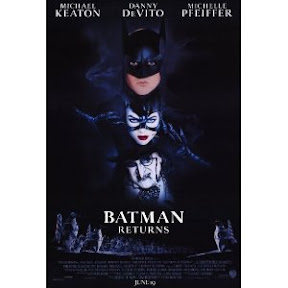
Actually, I can't leave Nolan behind for the moment without questioning whether he'd ever want to set a film at Christmastime. By comparison, Batman Returns can be seen as the middle film of a Tim Burton Christmas trilogy, following Edward Scissorhands (in which immortal Edward assures Winona Ryder of a white Christmas every year) and the more obvious Nightmare Before Christmas. So there's probably more of a point to setting Returns at Christmas than there was for Die Hard, to offer at least one similarly set summer movie. While there's some of Burton's sometimes tiresome epater le bourgeoisie attitude in play, the most obvious motivation I can see is that Christmas is a season when lonely people are likely to feel lonelier -- an ideal time for the revenge tragedy Burton stages. At the same time, there's something almost subliminally blasphemous about Burton's Christmas story. Apart from the mockery of the Moses legend, Returns can be seen as pitting Batman against a collective, trinitarian antagonist -- three aspects of evil or sin.

1. The Father.
 

This is Max Shreck (Christopher Walken), in name an homage to the star of Nosferatu, in image an homage to The 1,000 Eyes of Dr. Mabuse. A department-store magnate and aspiring energy monopolist, Shreck is "the man who runs things," Gotham City's "mover and shaker," a Langian supervillain with the power to lift the accursed subterranean into the light of day and cast souls from the heavens, as well as a concerned parent. Evil incarnate otherwise, Max is always ready to sacrifice himself to protect his son Chip, if only because the youth is his legacy, his only continuity after death. He's a pharaonic figure in the movie's mock-Mosaic context, but his menace is undercut by his underwritten role. Walken's dialogue is sometimes literally reduced to a shrug, and as with all the villains, Shreck is too often reduced to speaking flippant if not infantile one-liners that make them sound stupid rather than sinister -- his response to one taunt from Bruce Wayne is "Yawn." I've always felt that Walken could have done a lot more with the part if Waters and Burton didn't turn Shreck into a moron at crucial moments. His behavior at the climax defies common sense; having just learned the secret identities of both Catwoman and Batman, and having his life threatened by the former, he might be expected to sit back and let Bruce Wayne eliminate the main threat, and then blackmail Wayne into compliance with his power-plant plans and perpetual stoogery thereafter. Instead, he shoots Wayne, wasting a bullet that might have saved his life if aimed elsewhere. Maybe Shreck ends up weak just because he's a Langian villain in what is, despite appearances, not a Langian film, thematically speaking.

2. The Son.
 

I remember reading an interview in which Burton confessed to being frightened as a kid by Charlton Heston's transformation from prince to prophet in The Ten Commandments. It's not hard to see Batman Returns as the byproduct of that primal fear, as its top-billed villain, The Penguin (Danny DeVito) is a child cast upon the waters, only to return with an agenda of biblical revenge upon his fellow firstborn. As a manufactured hero and candidate for mayor (a trope borrowed from the 1960s TV show) Oswald Cobblepot arguably becomes a kind of antichrist, with Max Shreck as his satanic sponsor. Early versions of the script established Shreck and Cobblepot as brothers, but the writers made the right call by turning Shreck into a kind of substitute father figure for the malevolent mutant. Burton's vision of the Penguin is a drastic departure from the dapper, fussy figure of the comics. You can dress him up to look like Dr. Caligari, but he remains an animal, cold-blooded but comically randy. Waters writes contradictory dialogue for him, sometimes utterly vulgar, sometimes verbally pretentious, that seems appropriate for Burton's stated theme of duality -- maybe Schreck pales in comparison because there's no real duality at play in him.
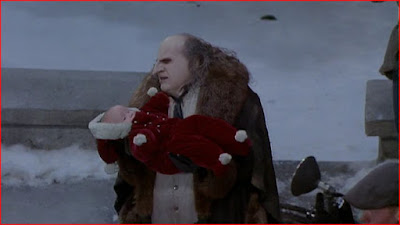


In any event, the Langian Schreck is eclipsed by Cobblepot, who despite his Caligarian formalwear is a classic Lon Chaney Sr. villain -- the grotesque outcast with a grudge against society and an occasional hint of a soul. There's not much hint of a soul in Burton's Penguin, but the director does make him an object of absurd pathos throughout, never losing sight of Cobblepot's desperate desire for acceptance (and sex) while reminding us that probably only the penguins ever really loved him. De Vito gives a performance worthy of Chaney, working the suit and the makeup for all they're worth. Even though he was certainly cast for his physical attributes and abrasive persona, he succeeds in making Cobblepot a distinct personality, or at least an ideal embodiment of Burton's dualist-animalist vision.

3. The Holy Ghost.


A few weeks ago I bought the Japanese ghost story Kuroneko during a Barnes & Noble Criterion Collection sale. I haven't watched the film yet, but the synopsis was a twenty-years late "a-ha!" moment. In Kuroneko a mother and daughter are raped and murdered by marauding samurai, but are revived by -- you guessed it -- cats licking their wounds. In the Japanese film, apparently, it's clear that the the women are undead, animated by cat spirits but retaining their human memories. We can assume that Burton, Waters or Sam Hamm either saw this 1968 film or were aware of the cat-spirit concept from Japanese folklore and applied it to Selina Kyle. Michelle Pfeiffer's character is an even more drastic departure from her comics template, since the movie's Penguin is at least still the leader of a criminal gang. Burton's Catwoman is an all-out avenger, even pausing before her campaign against the Shreck empire to play vigilante, if only to rebuke the victim-to-be for being a version of her own former mousy self. Burton seems uninterested in crime as such, the nearest thing to a conventional criminal in Returns being the businessman Shreck. But his approach allows him to cut to the quick in the matter of Selina Kyle and Bruce Wayne. He can dispense with the questionable notion that opposites (criminal and crimefighter) attract. As Bruce Wayne himself says, he and Selina are essentially the same. His tragedy is his failure to realize that their exact sameness makes a happy ending impossible. They're both "split, right down the center," but the split makes it impossible for either, despite Wayne's own desperate proposal, to go home to a fairy-tale castle together -- leaving aside the likelihood that Selina doesn't even belong on this earth, that her kingdom is no longer of this world.


In a way, neither does Bruce. His commitment to his avenging path had already cost him a lover before Returns even starts, and it has left him a kind of living ghost -- not the strutting playboy Christian Bale has portrayed -- brooding in darkness before the Bat-Signal stirs him into action. His romance with Selina belies his claim that his romance with Vicki Vale failed because she couldn't accept the "two truths" that define him. Selina comes to understand them all too well. If anything, she's split more profoundly than Bruce, as her crudely sewn and instantly fraying costume illustrates. After indulging a cruel streak we'd seen even before her trauma, she interrogates herself in a shop window, asking, "Why are you doing this?" In the end, she sees no choice but to do it. When she says she couldn't live with herself if she accepted Bruce's proposal, does she mean only that she can't accept leaving Shreck alive or, worse, that she doesn't deserve the happy ending Bruce self-deludingly offers? A supernatural reading of Returns would require her to follow through and destroy Shreck, that being her sole mission on earth as the wrath of God. An animalistic reading of the sort that Burton preferred at the time -- Selina as essentially a cat -- wouldn't be inconsistent with the supernatural reading of her as a cat-spirit. The dualistic reading is tragically pessimistic about the possibility of harmony between any two people. A part of each of us yearns for it, but another part always seems to want something else. That's why Bruce ends the first Burton film alone atop a tower while Alfred chauffeurs Vicki below -- and why Selina ends the second equally elevated and equally alone (in a late yet appropriate addition) while Bruce rides dismally in the limo. Christmas only heightens the pathos, but Burton's refusal of reconciliation, his insistence that love can't conquer all, makes Batman Returns an anti-Christmas movie, as might befit a June release -- unless indulging your pity is your idea of a holiday exercise.


Christopher Nolan's great project has been to modernize Batman, to release the character from the grip of retro sensibilities. If the beloved animated series that began shortly after Batman Returns seemed to lock Batman in a film-noir world, albeit with superscience enhancements, Burton's sequel looked further backward to the sensibilities of silent cinema. Apart from some early CGI (including a well-publicized "stunt Batman" for flying scenes) and a song by Siouxsie and the Banshees, Returns may as well be eighty rather than twenty years old next year. It's a monumental relic of the era of massive handmade sets -- Bo Welch's cityscapes are an improvement on Anton Furst's Oscar-winning abstractions. Too much CGI in the intervening generation gives me an even greater appreciation for the craftsmanship on display here. Danny Elfman's music should be making the transition from dated to timeless any year now. He was practically a musical genre in his own right for a while, if not a cliche, and the Returns score remains one of his best. Speaking of The Ten Commandments, did anyone else ever notice a similarity between Elfman's four-note Batman motif and Elmer Bernstein's Wagnerian opening notes (DUH, duh duh-DUH!) for the DeMille film? Finally, I can't leave the subject of Burton's Batman without doing justice to Burton's Batman. Cating Michael Keaton was a casting masterstroke, making clear that Bruce Wayne would not fight crime primarily with brute force while investing the character with that tense introspection of which comedians are often capable. I also happen to think his Returns gear is the best movie Batman costume to date. Keaton is the actor least burdened with clunky one-liners here, and his scenes with Pfeiffer in and out of uniform are extraordinary. The "two truths" speech is especially good and Keaton leaves an enduring impression of a deeply troubled, if not disturbed, yet essentially good man -- despite Burton's neglect of Batman's traditional code against killing. It's too bad that Keaton never got many acting opportunities afterward. I've never bought the idea that he or Bale have been eclipsed by their more flamboyant co-stars, and despite all the attention I've given to his antagonists Returns is still essentialy a film about Bruce Wayne, what defines him and differentiates him from his apparent peers, and why he'll remain as we found him here.


Returns is still my favorite Batman movie (Nolan's Dark Knight is the runner-up), sometimes in spite of itself. Waters's clunky dialogue pales in comparison to the screenplay's awkwardly edited chronology. Consider this: Selina Kyle has to go to Max Shreck's office at night to prepare the paperwork for Shreck's meeting with Bruce Wayne the following morning. That night, Shreck throws Selina out the window and she becomes Catwoman. The next morning is when Shreck stages the kidnapping and Penguin's rescue of the mayor's baby. We see Bruce Wayne watch news reports of the event. Penguin is set up at the Hall of Records to research his parentage, and one night a now-suspicious Batman cruises past the place. In another daytime scene Cobblepot visits his parents' graves and talks to the press. We see newspaper coverage of the scene. That night, presumably, Catwoman makes her first appearance to save a woman from a mugger. The following morning is when Bruce Wayne finally arrives at Shreck's office. Between the night of Selina's "death" and "next morning," an unlikely minimum of four days have passed, and it was probably quite a few more. How hard would that be to fix? For a long while, and maybe still, narrative wasn't considered Burton's strong suit. Returns often moves forward by laborious contrivances. Why, in the middle of a fight with Catwoman, does Batman remark that "mistletoe is deadly when you eat it?" The answer is that Burton needs a way for Bruce Wayne and Selina Kyle to discover each other's secret identities at the same moment, and the mistletoe couplet (answer: "A kiss can be even deadlier if you mean it") provides that. This is not a well-made plot, but the payoffs often justify the contrivances. The Max-querade Ball scene, where Bruce and Selina are the only guests not wearing masks, yet are unmasked to each other via the mistletoe couplet, is a poignantly devastating moment, no matter what it took for Burton to get us there. Burton's purpose was to give us visual and emotional spectacle, and against the odds he succeeded on both counts.
Compared to Nolan, Burton had what now seems a healthy reticence toward making Batman relevant to the contemporary world. Burton's Batman films are unrepentant fantasies unbound by any reality principle. Nolan has done great things with the concept, but he seems to sacrifice a lot of its potential in doing so. The two directors have profoundly different notions of what Batman is all about, and that's bound to influence each man's notion of what Catwoman is all about. For Nolan, time will tell and the clock is ticking. Burton has set the standard, but let's reconvene in seven months and consider this all again. For now, come what may, Merry Christmas and goodwill toward men ... and women.


Straight from the source -- WarnerBrosPictures presents the trailer for The Dark Knight Rises.

Friday, December 23, 2011

OSSOS (1997)

Pedro Costa is probably the best director in Portugal under the age of 100. I first started noticing his name a few years ago when film critics were touting his Colossal Youth as one of the greatest yet little-seen films of the decade. That film is now canonized in the Criterion Collection as the final installment of a trilogy of films set in the impoverished Fontainhas section of Lisbon. That trilogy began with Ossos ("Bones"), which reminded me in content of the tales of lowlife youth made by the Dardenne brothers in Belgium. It's the story of the people caught up in a young, poor couple's crisis over a newborn baby. Neither mother (Mariya Lipkina) nor father (Nuno Vaz) has any real idea of what to do with the baby, whom Costa often shows lying around like a piece of junk or mislaid clothing. The most the dad can think of is to carry it around as a panhandling aid. He begs for money to get food for the baby, then spends it on booze. The baby ends up in a hospital, pried by force from the father's hands, and its treatment brings a nurse, Eduarda (Isabel Ruth), into the story. She's more capable and probably more willing to take care of the baby than either of its parents, but the father is determined to make money off the transaction. If he can't sell it to Eduarda, he'll try someone else. The plot is such that the young mother ends up working a day as Eduarda's cleaning lady, finishing her shift by attempting suicide via the kitchen oven. The compassionate nurse tries to befriend this wretch, only to discover the connection between the girl and the guy with the baby who uses her apartment as a crash pad. This connection is already all too well known to the girl's friend Clotilde (Vanda Duarte, a real-life slum dweller and heroin addict who would play herself in Costa's follow-up film), who also figures out that oven's destructive potential....


It's squalid stuff, but Costa aestheticizes it to an almost alarming degree. He and cinematographer Emmanuel Machuel have maximized the slum's picturesque potential; you can tell that they've combed every corner to find the best camera angles, the most cinematic colors and textures of buildings. Ossos has a paradoxical beauty that's perhaps intended as an aid to compassion, and the actors often become icons of mood, frozen in long, mute close-ups. Costa clearly has a powerful pictorial sense, but his film left me wondering whether his painterly compositions honestly represented the experience of living in Fontainhas or the way its people see their slumscape. A rougher, less thoroughly composed style might have been more appropriate, but that depends on Costa's ultimate purpose. Whatever my qualms, Ossos was a beautiful film to look at, and often effectively so. Costa works in a European style that requires attentive viewing, and his direction is assured enough that your attention is usually justified. It's also worth suggesting that Costa himself may have had second thoughts about his approach, since the later Fontainhas films, In Vanda's Room and Colossal Youth, abandon the widescreen format while reportedly retaining a distinctive aesthetic identity. I was impressed enough by Ossos to see how those other films look.

This trailer uploaded by CineLuso is much more edit-happy than the film itself -- those opening shots of the guy walking down the street are from one long tracking shot -- but it does give you an idea of what goes on in the film. Check it out.