Showing posts with label Carradine. Show all posts

Tuesday, December 5, 2017

THE OREGON TRAIL (1959)

During the late 1950s, before he was rescued by Walt Disney and redeemed by Billy Wilder,  Fred MacMurray had been relegated to B-western stardom. To be fair, his films probably qualified as B+ westerns, but they were definitely programmers. The Oregon Trail, the last of that run of films, was a collaboration between writer-director Gene Fowler Jr. and co-writer Louis Vittes, who had worked together on their own run of movies including I Married a Monster From Outer Space, the early Charles Bronson vehicles Gang War and Showdown at Boot Hill, the juvenile delinquency drama The Rebel Set and the aviation adventure Here Come the Jets. That's a pretty eclectic filmography, and Oregon Trail has a few idiosyncracies of its own, as well as serious structural flaws.


The film is inspired, in a peculiar way, by Francis Parkman's travelogue of the same name, which is credited in the script with inspiring people to take the dangerous westward journey to Oregon. The filmmakers overstate their case just a little. Their film, set in 1846, opens with the aftermath of an Indian attack on a settler family. Amid the wreckage is a scorched copy of Parkman's book. The problem with this is that while Parkman had already published his narrative in serial format, The Oregon Trail wouldn't appear in book form until 1849. Parkman, who isn't a character in the film, is denounced by newspaper editor James Gordon Bennett, who perceives a greater danger on the trail to Oregon. He assigns ace reporter Neal Harris (MacMurray) to join a wagon train and investigate whether the U.S. government is infiltrating troops into Oregon for a showdown with Great Britain, which disputes the border between Oregon Territory and Canada. As it turns out, Bennett is right. President James K. Polk assigns Captain George Wayne (William Bishop, who was dead within months of the film's release) to make his way to Oregon with the very same train in which Harris is traveling. So far, so nearly the stuff of Seventies conspiracy films.


Harris and Wayne meet a variety of characters in the train, including a potential love interest for either man in Prudence Cooper (Nina Shipman), the grizzled guide Seaton (Henry Hull) and the eccentric Garrison (John Carradine), for all intents and purposes the legendary Johnny Appleseed. There's also the obnoxious Brizzard (Tex Terry), who likes to pick fights with Harris and favors a bullwhip. As Harris grows suspicious of Wayne and his sidekick, who can't help calling Wayne "Sir," the party encounters the grisly remains of the massacred family from the prologue and has to go on short water rations when a waterhole Seaton depends on finding turns out to have gone dry. Brizzard goes berserk when he sees Garrison watering his baby apple trees, assuming that the old crank is stealing water when he's actually sacrificing his own ration to keep the trees alive. Harris comes to Garrison's defense and brawls with Brizzard until a sudden rainstorm resolves the matter. The scene closes with an amusing, almost Brueghelian moment as the pioneers scramble to catch rainwater in any available basin while Harris and Brizzard, still brawling, roll obliviously through the fresh mud in and out of the frame, until Garrison finally breaks things up with a swat to Harris's rear.


After a while you wonder what the film is building up to, what the consequences might be of Harris exposing Wayne and the stealth American military buildup. The filmmakers themselves seem to have wondered about that before finally giving up and starting a virtually new story for the last half hour of the picture. At Fort Laramie, the troops are leaving to take part in the newly-declared Mexican War ("What's an Alamo?" a fur trader left behind asks) just before the sinister squaw man Hastings (John Dierkes) arrives with his half-breed daughter Shona (Gloria Talbott) in tow. The film doesn't hold anything against squaw men as a class; Seaton was one and a good guy, but Hastings, brusque with his daughter, quickly proves vicious, offering to shelter Harris, who'd been driven from the wagon train by Wayne, among his Indian friends, only to leave him to be tortured (alongside erstwhile enemy Brizzard) while pocketing the reporter's bankroll. Hastings decides that the cavalry's departure creates a perfect opportunity to play the red man's champion by organizing a massacre of the fort's civilians. However, he hasn't reckoned upon Shona's rebellious, righteous nature, expressed by stabbing an Indian guard in the back and freeing Harris so he can warn the fort of the impending attack. Despite the warning, Wayne and the handful of soldiers left behind at the fort are fooled by the reappearance of Brizzard, pressed into driving a Trojan wagon full of Hastings and hostiles through the gates to start the slaughter.

For much of the film Henry Hull guides the brave pioneers through the dangers of the great outdoors (above) 
and the perils of the 20th Century-Fox soundstage (below).


The Oregon Trail is an often brutal picture that doesn't flinch from the idea of showing children getting killed, though much of its grim spectacle is only suggestively gruesome. It has a maddeningly erratic look, mixing some effective location work -- and, I assume, some stock footage from more expensive westerns -- with miserably unconvincing studio sets with painted backdrops. The film's biggest problem is a screenplay that, unlike the pioneers, set out with no clear destination in mind. While Dierkes makes a good maniacal villain in his brief time onscreen, you could believe that his whole storyline was added just so Harris could get a girl of his own, Shona, after Fowler and Vittes decided to keep Wayne and Prudence together. While Oregon Trail has its moments and MacMurray was at worst a serviceable western star in this period, it's ultimately too much of a mess to recommend in good conscience.

Saturday, June 18, 2016

DVR Diary: HILLBILLYS IN A HAUNTED HOUSE (1967)

From the director of The Devil Bat and The Abbott & Costello Show comes a film that lives in infamy as the humiliating final film of Basil Rathbone, even though he made one more film in Mexico. This sequel to Las Vegas Hillbillys -- I believe the producers had to use the illiterate plural to avoid confusion with The Beverly Hillbillies -- better fits a narrative of tragic decline, especially when you see how far down in the billing Rathbone is, below not only the title characters but fellow horror men Lon Chaney Jr. and John Carradine, who presumably were more accustomed to such work by this point in their careers. It's not merely the badness of this Woolner Bros. production but the mere idea of these beloved actors stooging for second-rate hillbilly actors -- and that's being too generous -- that offends fans of the horror genre and classic cinema in general. Seeing it offered in one of Turner Classic Movies' eccentric moods, I expected something dreadful, and got it. A trio of protagonists returns from Las Vegas Hillbillys, the entertainers Woody (Ferlin Husky) and Jeepers (Don Bowman) and "girl singer" Boots Malone, originally played by Mamie Van Doren but now incarnated by Joi Lansing. They're on their way to Nashville but interrupt their trek to allow the allegedly agitated Jeepers some r & r. Told that there are no hotels or boardinghouses in the small town where they stop for gas, they decide to squat in a mansion recommended to them. This is our haunted house, but it's actually infested by spies for Red China who intend to steal an important formula from a nearby military base. The spies seem to be divided into two factions. Gregor (Rathbone) and Himmel (Carradine) are straightlaced, almost effete characters, compared to their handler Madame Wong (Linda Ho), her henchman Maximillian (Chaney) and his sidekick, Anatole the gorilla. Tension flares up constantly between Himmel and Anatole, escalating from insults to banana stealing and, finally, murder. Into this volatile setting blunder the hillbillys, who stand their ground despite the spies' best efforts to scare them away, and in spite of the fact that hillbillys scare very easily. There's a twist to come, however, that upends everyone's plans....

Hillbillys may be the worst haunted-house comedy I've ever seen. The reason has nothing to do with the performances or misuse of the horror stars, and everything to do with Lansing, Husky and especially Bowman being without doubt the worst scaredy-cat comedians I've ever seen. The singers have no comic timing at all, and while Lansing at least can scream when required, the men seem incapable of emoting in any way, and Duke Yelton's script leaves them helpless like fish on a haunted beach. Here's his idea of something either funny or scary. Jeepers tries to soothe his alleged nerves by watching some television. Luckily for him, some station is showing a performance by Merle Haggard. The spies are able to interfere with the broadcast, so that Haggard's singing is intercut with random shots of Rathbone, Chaney, Carradine and Ho staring at the camera or making faces, while Bowman tries to indicate in his stunted way that he's frightened. Maybe a laugh track would have helped.

Of the horror men, Carradine probably does the best with what he's given. He gets to have mood swings from his mounting rage at Chaney and the gorilla to his friendly, familiar banter with Rathbone. One of the few interesting things about the picture is the way Rathbone and Carradine seem to be competing over who can underplay better in their scenes together. Carradine in particular is unusually relaxed and casual in those moments, and the veteran actors succeed, at this if at nothing else, in convincing you that Gregor and Himmel are longtime partners and friends for whom this preposterous mission is just another day on the job. By comparison, Chaney is on autopilot at best, and at worst has a pathetic scene when Maximillian, in all the actor's sodden, grizzled splendor, infiltrates the military base and must convince a talkative janitor that he's a scientist with high security clearance. It's hard to tell whether his obvious unfitness for the task was meant to be a joke in a comedy picture or not, but Chaney's actually a sadder sight than Rathbone for most of the picture.

While most viewers will resent the lack of comedy or terror in Hillbillys, the producers seemed most concerned that audiences would think there wasn't enough music. Thus, after the spies are defeated, we get a square-up reel that finds the Hillbillys finally in "Nashville" hosting a variety show with guest performances by Haggard and other possibly-popular singers of the moment, as well as a comedy song by "the Great Jeepers," all before a stock-footage audience, apart from occasional insets of about a dozen people. Because it's a performance setting, the echo-chamber effect you get in all the film's musical numbers -- including Lansing's pathetic "Beautiful Dresses," in which she's supposed to be an 18th century aristocrat in a bouffant hairdo --  isn't as glaring, but this musical epilogue is strictly for country-western fans of the old school. For the rest of us, it simply keeps a terrible film going for another twelve minutes or so.

Thursday, October 31, 2013

DVR Diary: BLUEBEARD (1944)

John Carradine spent nearly a decade making a name for himself as character actor in A pictures, mainly as a contract player for Twentieth Century-Fox, but threw his reputation away to pursue a dream of classical showmanship. To raise money for a touring acting company, Carradine made himself available to Poverty Row, where he might at least get the satisfaction of occasional top billing. One early foray into this territory, Hitler's Madman, even got picked up for distribution by a major, M-G-M. Ultimately, Carradine didn't seem to care what roles he took, hitting an early career low as Bela Lugosi's stooge in Voodoo Man. Still, his name probably gave some prestige to these cheap pictures, and Edgar G. Ulmer's Bluebeard was clearly PRC's idea of a prestige picture. PRC was a company best known for Buster Crabbe westerns. Its best known films today are Ulmer's. The German-born director had a knack of making the most of very little, as Bluebeard illustrates.

Ulmer's picture aims for the psychological-horror niche established by the Spencer Tracy version of Dr. Jekyll & Mr. Hyde (1941) and occupied by contemporary pictures like The Lodger and The Picture of Dorian Gray. The title character isn't one of the historical recipients of the "Bluebeard" title but a fictional character, the painter/puppeteer Gaston Morrell. With Carradine's identity as a serial killer, established early, the film quickly becomes a cat-and-mouse game as the French authorities try to lure the suspect into compromising himself. The early hints of a procedural format and the killer's resort to sewers as an escape route seem to anticipate He Walked By Night, but Bluebeard is eventually as much interested in the why of the killings as it is in the how of stopping them. The analysis isn't exactly sophisticated: Morrell idealized and fell in love with an early model, strangled her when he learned her true nature, then saw every future model as the first returned to torment him. The idea is nothing special, but its illustration in a flashback sequence is Ulmer's stylistic highlight, allowing him to resort to odd camera angles and other tricks both to establish the scene as not-the-present and to suggest the off-kilter perspective of the mad narrator. Apart from that, Ulmer's team works overtime as usual to make the cramped sets (now obscured by muddy prints) look as well-dressed and atmospheric as possible. The really interesting thing about the story to me wasn't the killer's psychology -- Carradine and others have done basically the same thing many times over -- but the idea that Morrell is exploited and enabled by another man, an art dealer (Ludwig Stossel) who knows of the killings and their cause but insists that Morrell paint because the murderous impulse allegedly results in fine art. While the movie may write off Morrell as a sick man, the art dealer looms as a genuinely evil figure, playing both sides (killer and police) against the middle to get one more painting out of his protege, even if it means one more victim for the killer. The type Carradine plays may still have been a novelty in 1944, but it's so commonplace now that Stossel nearly steals the picture from the star. But in the end there's no way Stossel can compete with Carradine's extraordinary presence, amplified by period costume and makeup, and his arguable empathy with the ruthlessness of art and its costs.

Monday, October 28, 2013

THE BLACK SLEEP (1956)

I could understand someone wanting to make a movie in the style or spirit of Ed Wood in our time, after his posthumous canonization as a cinematic outsider artist and long after he made the films that made his name. What's harder to fathom is someone wanting to make a film in the style or spirit of Ed Wood back in 1956, when Wood himself was toiling thanklessly behind the camera. Of course, I'm sure that comparisons with the likes of Wood were the last thing the producers of The Black Sleep wanted at the time. Posterity makes its own judgments, however, and comparisons between Reginald Le Borg's all-star poverty row horror film and the Wood canon are not necessarily flattering to Le Borg. To be fair, the resemblances between Black Sleep and a Wood film are a matter of common influences, not of any conscious or unconscious imitation by Le Borg, producer Howard W. Koch or writer John C. Higgins. The common reference point is the poverty row horror cycle of the 1940s, the films of Monogram and PRC, though Black Sleep is ambitious enough to beg comparisons with Val Lewton's more upscale B productions, and Le Borg himself directed for Universal toward the bitter end of that studio's great horror cycle. While Wood looks forward, adding more sci-fi elements to the poverty-row formula, Black Sleep looks backwards. It's a period piece in the manner of House of Wax and The Mad Magician, not to mention Lewton's Body Snatcher and Bedlam. But at heart it's a monster rally in the late Universal style, only with has-been horror stars as the real attractions, rather than the monsters they play.


A young doctor (Herbert Rudley) is condemned to death for a murder he did not commit, but is saved from the gallows by a fellow physician, Sir Joel Cadman (Basil Rathbone). Dr. Ramsay doesn't know that he will live; Cadman only promises him a narcotic so he won't disgrace himself. Soon, however, he awakens in his coffin to find Cadman and Udu the gypsy (Akim Tamiroff) leering at him. Cadman had administered nind andhera, the "black sleep" drug that simulates death, and then claimed Ramsay's body. He has done this because Ramsay, a promising surgeon, has skills Cadman needs for his own experiments on the human brain. Like many a mad doctor of the 1940s, Cadman has a sick wife and wants to cure her. He must try different brain surgery techniques on live human subjects before choosing a procedure. The earlier experiments, as Ramsay discovers to his mounting horror, have not gone well.


The Black Sleep is probably best known as the last film Bela Lugosi completed before his death. It was Lugosi's comeback after his highly-publicized drying-out from drug addiction, but he was clearly cast for name value, as a matter of exploitation. His role as a mute servant -- a victim of one of Cadman's experimental surgeries -- wasn't exactly a vote of confidence in Bela by the producers. Lugosi himself admitted in an interview that even without lines it was a struggle to get through the picture due to his age and ailments. He shuffles sadly through the picture, sometimes vacantly, though there are occasional reminders that he's actually giving a performance. He uses pantomime to relay information to Rathbone, and in a few shots the indulgent director invites him to steal scenes. Here's an example:
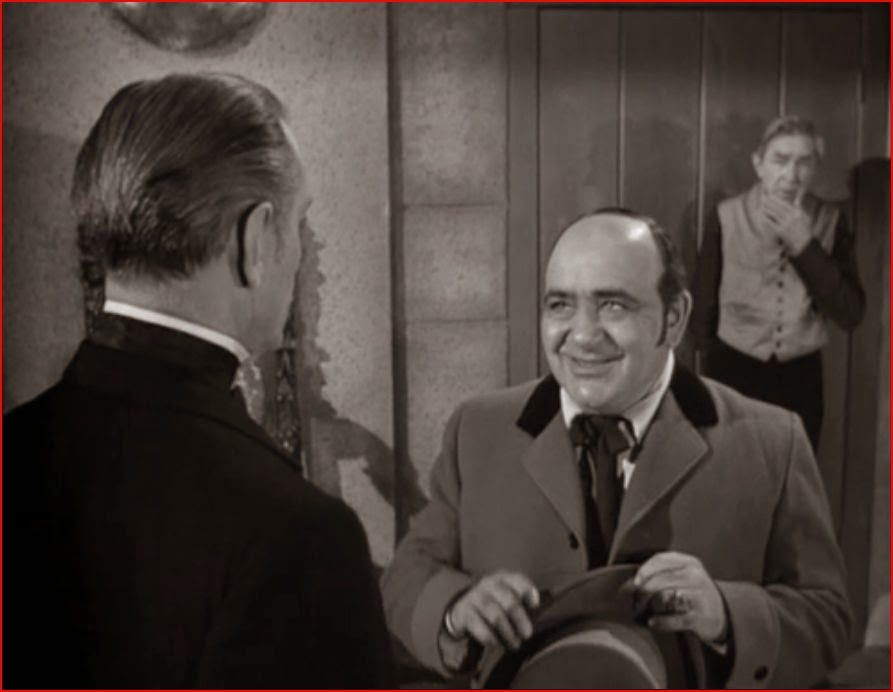

This is supposed to be Tamiroff's scene, as you can tell from the setup, but note how Le Borg keeps the upper right corner of the screen open over Tamiroff's shoulder so we can see Bela respond to the tale the gypsy's spinning. Lugosi doesn't do much, scratching his chin every so often, but moving at all while Tamiroff talks is scene-stealing -- and the theft is more blatant now when, with no offense intended to a great character actor, no one is interested in Tamiroff when the moribund Lugosi's on the screen.
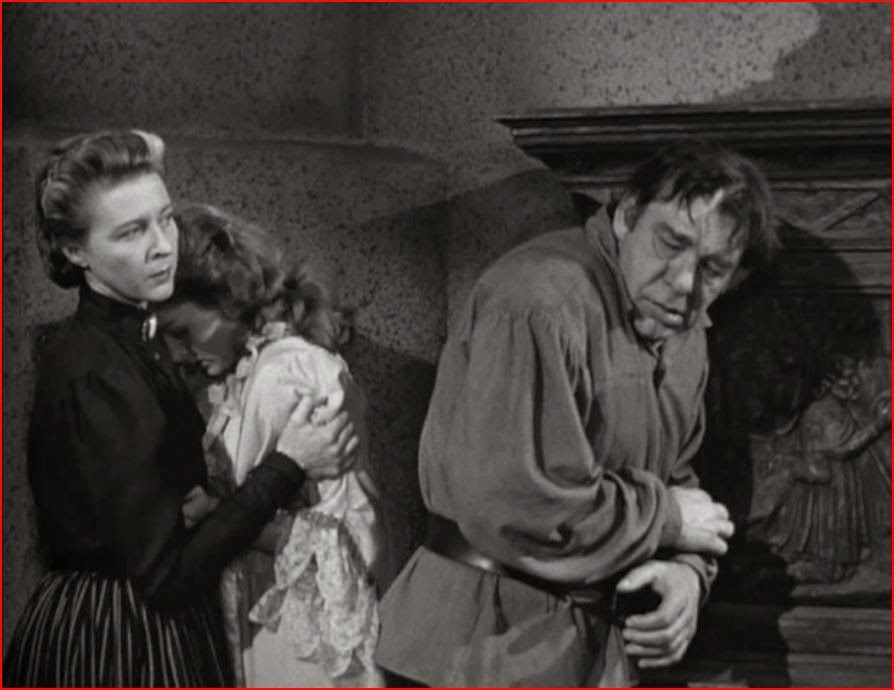

By comparison, Lon Chaney Jr. is sadly docile as another mute, though he most likely does exactly what the director asked of him. Creighton gets a weird backstory explaining how Mongo, one of the insane inmates, was once Dr. Monroe, a colleague of Cadmon's who ends up one of his experimental subjects after suffering a stroke. Cadmon actually cured Monroe's paralysis but destroyed his reason. Monroe's daughter lives at Cadmon's house and works as an assistant nurse, despite her dad's newfound urge to kill her. For some reason, only Daphne (Phyllis Stanley), Cadmon's head nurse, can control Mongo. Her voice reduces him from mania to a crestfallen sulk that probably came easily to Chaney. He'd gone mostly without dialogue in The Indestructible Man, released in the same year, arguably a career trough for the actor. Both better and worse were in the future for him.

Mongo's troubles are more described than demonstrated, and The Black Sleep works as if the producers thought it sufficient to show the old horror stars to jolt the audience or tickle their nostalgia bones. Once it becomes clear that Lugosi and Chaney -- not to mention Rathbone, who may have modeled his cold, stiff performance on The Body Snatcher's Henry Daniell -- are rather boring, Le Borg takes us into Dr. Cadmon's dungeon, where our hero discovers more failed experiments. One is the very man the good doctor was accused of killing; instead, Cadmon has turned him into Tor Johnson -- I really should have screencapped the ID photo of a toupeed Tor as this character's former civilized self, as it's one of the funniest sights in the picture. Johnson can hardly make an impression, however, once Le Borg unleashes John Carradine, who has been vivisected into believing that he is the Crusader king Bohemund, awaiting news of the fall of Jerusalem. Long John was fresh from the set of The Ten Commandments and has prophetic fury to spare here, though contemporary viewers would most likely have been reminded of the old man who'd been guarding Jack Benny's vault since the Civil War. You see, the further back in time you think you're in, the scarier rather than funnier it is. Current viewers who don't know Jack Benny will more likely believe that Le Borg sent Carradine onto the set and told him to wing it.
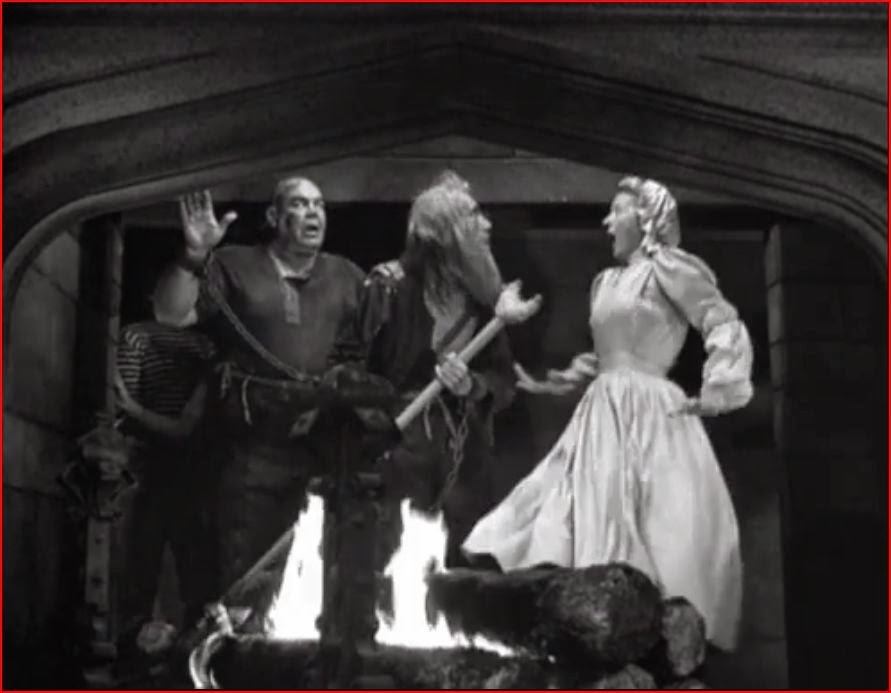

Everything breaks down once our hero accidentally leaves a key to the dungeon where Tor, though blind, can reach it. While Tor takes the initiative, Carradine naturally assumes leadership of the breakout; he's a king, after all! These two, along with a laughing lady covered with random tufts of hair and a disfigured dude whose makeup figured prominently in the advertising, run amok on the upper level, Carradine bopping first Daphne, then Mongo on the head in regal rage. It takes three lunatics to drag the mighty Mongo down, sans any payoff his backstory may have made you expect, while Cadmon, carrying his sick wife, takes a dive off a railing-less stairwell. Scotland Yard takes over soon afterward, and while Tamiroff and Lugosi are taken alive, the fate of the more dangerous lunatics is left unclear. Maybe someone had a sequel in mind, since Tamiroff reminds the detectives that like his feline namesake he may have nine lives. Carradine and Tor Johnson rampaging through the Victorian countryside: who wouldn't pay to see that???
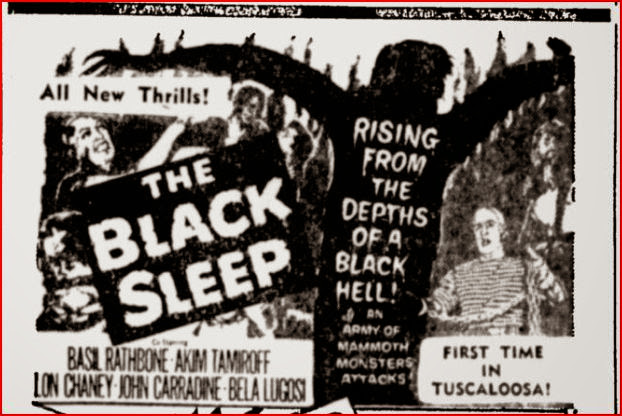

While The Black Sleep has superficial resemblances to an Ed Wood film -- Bela, Tor, cheap sets -- it lacks any of Wood's naive authenticity. Wood's films are dramatic in their incompetence and by virtue of that incompetence bear an unmistakable auteurial stamp. They are as much about the struggle behind the camera to render his vision on film or speak through his actors as they are about their stories. There's no such struggle in The Black Sleep, and thus no drama worth seeing, not to mention no horror worth remembering. Koch, Higgins and Le Borg seem to have believed that their film could make itself if they assembled all the pieces on screen that had worked in the past. They depended on our thrill of recognition of the old stars, the old situations -- as if they thought the audience would make the film work.  Technically they outclass Wood easily, but unlike him, they made a completely soulless horror film. That may sound horrific in its own right, but not in any entertaining way.

Thursday, February 7, 2013

Ingmar Bergman's THE SERPENT'S EGG (Das Schlangenei, 1977)

The cinema of Weimar Germany is inimitable. You scoff, recalling all the movies over the past eighty years or so that have imitated the style or sensibility of Fritz Lang, F. W. Murnau, and the other "German Expressionist" masters. The style is imitable, eminently so, Lang's especially. Two generations of Batman movies testify to Lang's lingering stylistic influence; The Dark Knight Rises is almost as much Metropolis as it is A Tale of Two Cities. So what did I just say? Basically that it's one thing to translate Lang's style and sensibility to different eras and subjects, and another thing altogether to make a movie inspired by Weimar Germany and set in the Weimar Republic. Consider Woody Allen. His homage to Weimar, Shadows and Fog, may be his worst movie. It'd be easy to say that Allen should have stuck to imitating Ingmar Bergman, until you realize that he had.


Bergman had exiled himself from Sweden after suffering a humiliating arrest on tax-evasion charges that were eventually dropped. He moved to Germany and got financing from Dino De Laurentis for an ambitious project that may have represented an expansion of his storytelling horizons. Not quite epic in scale, it still has the look of a prestige period piece with detailed recreations of Germany during the great inflation of 1923, the year of Hitler's failed Beer Hall Putsch in Munich. In Bergman's Weimar there seem to be three classes of people: those who go to cabarets, those who perform in them, and the wretched of the earth. One such wretch is a fish out of water, the American circus artist Abel Rosenberg, who drops in on his brother only to find him a suicide, his brains blown onto a bedroom wall. Abel (an odd name for the surviving brother) crashes with his sister-in-law Manuela, an emotionally needy cabaret performer, while the police question him, first about his brother's demise, and then about a series of mysterious deaths. Hovering nearby is the mysterious Dr. Vergerus, an obnoxious acquaintance of Abel's past who shows unsavory interest in Manuela. Abel is an alcoholic, aloof and slightly paranoid, and more so as the film progresses. Because he's packing dollars he has a privileged position in a country where paper money is eventually measured by weight rather than face value, but he drifts like the bum that he is in what becomes a paranoid picaresque, as much a film of the time of its making as it is of the time of its setting.


The Serpent's Egg should be a quintessential Seventies movie. Only in those years, you'd think, could you ever see Ingmar Bergman and David Carradine join forces. Maybe we should have expected such a volatile mix to have troubled results, but Das Schlangenei is sadly less a bad film in any interesting way than simply a lame one. Blame Carradine for much of the lameness. He was just coming off his greatest Hollywood triumph in Bound for Glory, but something closer to Kwai Chang Caine showed up in Germany. Don't get me wrong; I love the old Kung Fu show, but Carradine's impassivity, sometimes bordering on inertness, seems wrong for the role Bergman wrote for him, and it makes Abel's occasional outbursts of whining hysteria seem more forced and artificial. Not that Liv Ullmann does much better as Manuela. She's there mainly as a Bergman trademark, but the master seemed to have no good idea of what to do with her. That he wrote and she acted in a second language didn't help. Interviews prove Bergman a fluent English speaker, but that doesn't mean he can be Ingmar Bergman the cinematic auteur in that language. Serpent's Egg is actually his second feature in English, but since I haven't seen The Touch, an Elliot Gould picture, I can't tell you whether the later film is an advance or a regression. But it should be clear that a Swede making a homage to German cinema in English is a potentially toxic compound. As for the homage, Bergman easily out-nerds Woody Allen with the stunt-casting of Gert (Goldfinger) Froebe as a police inspector. Froebe had been the inspector in Fritz Lang's last picture, a Dr. Mabuse reboot from 1960, and his character in the Bergman picture references the Inspector Lohmann character from Lang's 1932 Testament of Dr. Mabuse, mentioning that Lohmann is working "on an even stranger case than mine." That tells you where Bergman's heart was, but where was his mind?


Two factors complicate any modern attempt at a Weimar pastiche: Hitler and Kafka. Bergman falls into both traps. The paranoid storyline that emerges during Abel's adventures is as much Kafkaesque as it is Seventies, and Abel's temporary employment as a file clerk shifting papers from one set of envelopes to another is all Kafka, in the shallowest way. As for Hitler, it's easy in retrospect to see foreshadowings of the Third Reich all over the place in a Germany where contemporaries did not. Bergman plays with expectations a little by having his actual menaces have nothing to do with Hitler -- Vergerus calls the future Fuehrer a "scatterbrain" who'll soon be forgotten -- but he's only having an ironic joke at his villain's expense. He can't help seeing the Third Reich as the inevitable sequel to Weimar, and in doing so he misrepresents the cinematic Weimar he may have meant to honor. Cinema itself comes in for some suspicion here in a way that suggests that Bergman may have been paying homage to Michael (Peeping Tom) Powell along with the auteurs of Weimar. He manages to make science fiction of it by giving his villain a Vitaphone style sound-film system several years ahead of time, so that the film maintains that Langian flavor, or would if Bergman could sustain any narrative momentum. The film picks up the pace in its last third as Abel moves through a visually dazzling contrast of settings, almost living up to its invocation of expressionist cinema, but my final impression was that Bergman had a kind of montage of episodes in his head without figuring out a narrative framework for them. While Serpent's Egg is a pictorial hit thanks to cinematographer Sven Nykvist and art director Erner Achmann, its closing narration of Abel Rosenberg's disappearance only underscores the film's essential emptiness. Watching it is a frustrating experience because the makings of a better film are mostly there in front of you, but you share Bergman's own bafflement over how to put them together properly. Should it have been so hard for such a master, with at least one masterpiece still to come? I leave that to the Bergman experts, who'd know better how this fails to be a proper Bergman film.

Sunday, October 23, 2011

FRONTIER MARSHAL (1939); or, Wyatt Earp Meets the Monsters

One of the first cinematic versions of the Tombstone legend, Allan Dwan's movie takes advantage of still-widespread unfamiliarity with the Wyatt Earp story to take giant liberties with it. We're already dealing with a remake, as Stuart N. Lake's biography, based partly on self-serving interviews with Earp, had already been put on film just five years earlier. Dwan's film is an improvement in that it calls Earp by his right name instead of "Michael Wyatt." That seems to be about the end of its fidelity to history. Some Western historians claim that Lake's book is a whitewash of Earp, but Sam Hellman's script pretty much tears Earp down completely and puts up a new streamlined structure in his place. It relates to history only to the extent that a man named Wyatt Earp did some shooting of folks in the town of Tombstone, but it gets lost almost as soon as you ask who he shot. Consider: this is a Wyatt Earp film in which the name Clanton is never spoken. Since then the Clantons have become an inextricable part of the Tombstone legend, but the story still wasn't well known in 1939 despite Lake's publicity, so Twentieth Century-Fox could get away with creating an almost entirely original cast of villains for Earp to dispatch. Instead of a gang of "Cowboys" lurking outside town to rustle cattle and hoorah the place every so often, Frontier Marshall roots the Tombstone evil in the Palace of Pleasure saloon, whose proprietor Ben Carter is in cahoots with a gang of stagecoach robbers led by Curley Bill (Joe Sawyer), one of the few authentic names in the story. The robberies recede into the background, however, as the script focuses on Carter's feud with the more refined Bella Union, which can hire high-class entertainment like "greatest comedian in the world" Eddie Foy (Eddie Foy Jr.).  Attempting to keep the peace is Earp (Randolph Scott), who earns his star by volunteering to subdue the drunken Injun Charlie when the current marshal (Ward Bond) chickens out. Wyatt has come to town alone, without brothers or wife, and stays to impose order despite the machinations of Carter and a spiteful saloon girl (Binnie Barnes). Complicating matters is the arrival of temperamental and tubercular gunman Doc "Halliday" (Cesar Romero -- and I didn't misspell "Holliday," the movie did), a man with a fondness for handkerchief duels and a general death wish. An appalling amount of screen time is dedicated to the efforts of Halliday's long-suffering wife (Nancy Kelly) to recall the murderous lunger to his original vocation -- not merely dentistry but a full-scale general practice, including on-the-fly surgery. The climax of the picture is Doc's rally to perform life-saving surgery on a bartender's son accidentally shot by Earp. Following this redemptive triumph, Halliday strides out of the Bella Union and is instantly killed by Curley Bill, who informs Wyatt that he can be found at the O.K. Corral, about three doors down from the saloon. So Wyatt Earp fights the famous gunfight by himself, though help arrives at the end from an unexpected source. As the curtain falls, law and justice triumph, though one character notes that Tombstone is no longer truly safe, now that the Palace of Pleasure has been replaced by a savings bank.

The challenge for a historian or history buff when faced with something like Frontier Marshal is to distance oneself from history and judge the film on purely dramatic and cinematic terms. Cinematically, Dwan directs some crisp action and the film has some nice production values overall. But the script is a disaster that leaves Earp a bystander for much of the plot while Halliday forms a triangle with his wife and Jerrie the saloon girl. As Earp, Randolph Scott is adequately heroic but has little to work with in terms of personality, while Romero only left me wondering what Anthony Quinn could have done with the role -- the closest Quinn ever came was the Holliday a clef role in Edward Dymytryk's Warlock.  Worst of all, this Tombstone movie can't come up with a proper antagonist for Earp. Carter is set up early as the "big bad," only to be eliminated two-thirds through the picture. His assistant, Pringle, seems poised to step in, but in the very next scene Earp goads him into a fatal gunfight. That leaves the barely sketched out Curley Bill as the ultimate antagonist in an O.K. Corral fight that really feels like an anticlimax after all the storm and stress of the surgery scene. That's all a double shame, not just for the movie itself but for genre movie fans, given who plays the villains.

Frontier Marshal appears to be the first true team-up of John Carradine (Carter) and Lon Chaney Jr. (Pringle). Chaney had done bits in some earlier Fox films in which Carradine had more prominent parts (e.g. Jesse James), but Pringle is one of Junior's more prominent supporting roles before his breakthrough in Of Mice and Men. It's definitely an improvement for him on his labors for Cecil B. DeMille, who left almost all of Chaney's performance in Union Pacific on the cutting room floor, reducing the struggling young character actor to a few shots as a bystander despite being a named character in the end credits. For Carradine, a rising character actor at Fox, this film was just another day at the office; he contributes nothing special to a standard villain part. By comparison, Chaney's participation in an A picture is virtually a showcase, though he only has a couple of big scenes. In the first, Pringle has kidnapped Eddie Foy and forced him to perform at the Palace rather than the Bella Union. He stands just offstage twirling his two guns menacingly as Foy attempts to entertain the crowd. While Earp charges in through the audience to rescue Foy, Halliday appears in the wings to keep Pringle covered. In a priceless moment (perhaps) for Chaney fans, Doc decides that the audience expects entertainment and shouldn't be disappointed. He forces Pringle to dance, keeping time with bullets aimed at Chaney's feet as the big lug does a desperate soft-shoe routine. It may be the only time Lon Chaney Jr. ever dances on film. His other highlight is his shootout with Scott, his one scene as leader of the Palace gang. At first, Pringle has no intention of shooting it out with Earp, promising the marshall that Curley Bill will take care of him soon enough. But Earp's casual insult provokes a foolhardy attack, punctuated by Chaney's effective pantomime (in lieu of modern effects) of taking a bullet to the head. Thus pass Chaney and Carradine on their way to their destiny as horror men. They'll next encounter each other in The Mummy's Ghost, when Carradine plays the latest priest to revive the hapless Kharis. By that time, Carradine will already be past his peak of prestige, while Chaney will be in a thankless holding pattern as Universal's "master character creator." Frontier Marshal may be worthless otherwise, but it catches the pair as a team before either man had an inkling of his actual acting destiny. As that, it's a film of historical and maybe even sympathetic interest.