Showing posts with label Crown International. Show all posts

Monday, May 10, 2010

WILD RIDERS (1971): Don't F*CK with Classical Music!

"I'll show you what nothing can do!"

That's the defiant vow of Pete, a renegade biker and the main character of Richard Kanter's quasi-biker film. He and his sidekick Stick (Alex Rocco) have been exiled from their motorcycle gang after they raped and crucified a girl for sleeping with a black man. They set out on their own, a George and Lenny for the Savage Seventies, romping like children in a park in a just vaguely homoerotic vignette, busting each other's chops and scheming to score some bread. Stick is the Lenny of the pair, not quite as simple as the original but still the sort who's happy to eat lunch out of a trash can. He can be quite friendly but freaks out if he thinks people are insulting him. Pete tries to keep Stick out of trouble but gets into plenty on his own. It's his idea to crash a mansion where a classical musician's wife, Rona, is hosting her old sorority girlfriend Laurie while hubby's at a recording session for a movie score. There's something just vaguely homoerotic about their friendship, too, but once our biker pals settle in Pete and Rona pair off for some occasionally romantic coupling while Stick and Laurie get down to rape, Stick's naturally aggressive playfulness aggravated by his belief that a frog figurine is a personal insult to him. Wild Riders finds its tone in the scene in which Rocco flips out over the frog, demanding that Laurie tell him what it is and whether it looks like him. Rocco, best known as Moe Green from The Godfather, is the only real name in the cast and takes advantage of his top billing to give a performance of barnstorming barbarism, just the kind that a bad movie like this needs to keep you interested.

Alex Rocco earns his top billing in Wild Riders, and director Richard Kanter's camera clearly loves him, even if the women in the film (like Sherry Bain, below) don't.


The film's title leads you to expect a full-scale biker film, but while the old gang does reappear briefly, Wild Riders has little to do with the motorcycle lifestyle. It's mainly a four-player captivity psychodrama somewhere between Of Mice and Men and The House at the Edge of the Park. Kanter tempts you to sympathize with Pete and Stick and their two-against-the-world attitude, but cures you of it once they start roughing up the ladies while increasingly feeling sorry for themselves. Stick avenges his ugliness by raping women, while Pete resents the rich for getting all the breaks he feels he was denied. By forcing themselves on Rona and Laurie, they're playing a game of role reversal, and as Pete says, "There's only one law in this game and that's power, and I've got it all."

Wild Riders "introduces" Arell Blanton as Pete, above meeting cute with Elizabeth Knowles while coming on more forcefully below.

Despite Rocco's outbursts, Wild Riders starts to drag as it struggles toward the 90-minute mark. It looks like Kanter is setting up a twist as the women try to turn Stick against Pete while the latter is out trying to sell some antiques from the house. The twist comes when Rona's husband finally returns to the house. Stick subdues him and is happy to see that Pete's come back after all instead of abandoning him to take the rap for an earlier murder. Pete seems ready to kill all the hostages, but he wants to hear hubby, a cellist, play his instrument first. Hubby is defiant at first, determined to play only for those who can appreciate it, but he finally complies. Pete's impressed but wants hubby to slow down so he can study the fingerwork. He muses that he could have been as good on his guitar as hubby is on the cello had he enjoyed the same opportunities in life. Opportunities? Hubby's parents died in a death camp. This fact is established as a warning that the man of the house is one not to be trifled with. And as he builds to a musical crescendo, so the film builds to a sudden crescendo of violence as our virtuoso takes the offensive. As Pete intently studies the cello, hubby puts the bow through his eyeball! And as Stick stumbles to his friend's defense, the cello itself becomes a devastating weapon, at once a blunt instrument and a lethal stabbing tool as the man of the house reestablishes his mastery.


Damn! Whoever has a whole orchestra of men like that could conquer the world. Wild Riders is in some ways a generic biker-roughie-captivity film, but it definitely gets extra credit for that finale. There's little to see otherwise apart from Alex Rocco, but he may do just enough to tide you over until the deadly cellist arrives. This letterboxed edition is from the latest collaboration between Mill Creek Entertainment and Crown International, a 12-film Savage Cinema collection that also includes such beloved items as The Pink Angels and Death Machines. Given what I paid for the set at FYE, Wild Riders cost me not quite sixty cents. It's worth at least that.

Here's a TV spot for the film, including some of the cello attack, uploaded to YouTube by psychotronictv.

Monday, October 19, 2009

BLOOD MANIA (1970)

Mill Creek Entertainment is moving up in the world. Our favorite purveyor of public domain oddities is now selling licensed properties, including some of the library of grindhouse stalwart Crown International Pictures, acquired from the defunct BCI Eclipse. One of Mill Creek's first Crown offerings is a 12-film collection called Gorehouse Greats. Blood Mania shares one side of a DVD with Al Adamson's Blood of Dracula's Castle. Is that worthy company?

Here's Mill Creek's synopsis of the film: "A nightmare of unspeakable terror, this Gothic-like horror tale is about a young doctor who's haunted by a questionable past and entrapped in a hopeless present by jealousy, blackmail and finally, murder!"

Here's the trailer Crown International made for it. Plenty horrific, yes?


Here's another poster advertising the film. The co-feature is apparently a 1961 Most Dangerous Game knockoff being revived as a cannibal film. Blood Mania itself appears to have been offered in some sort of Taste-O-Vision process from what the poster copy suggests.


Crown was only the distributor of this Jude production, and that fact makes me wonder whether Jude or Crown had the bright idea to sell Blood Mania as a horror film or, for that matter, to call it Blood Mania. That title does not prepare you for what you finally see, and, admittedly, neither does the credit sequence, a spooky episode featuring a blond in a diaphanous outfit on the run, stalked by a mysterious and colorfully lit menace seen only in close-up who seems intent on strangling the woman. Gary Graver is listed as one of two cinematographers for this film, and I suspect that this opening bit is his work.


What follows looks less like a nightmare of unspeakable terror than like a Lifetime Original Movie, only with lots of boob shots. The vision turns out to be the nightmare of Ridgely Waterman, an ailing millionaire, doted on by his daughter Victoria and treated by Dr. Craig Cooper, the object (I should say an object) of Vicki's lust. The poolboy is another object of said lust, but he's heard of women like her and doesn't like her. Dr. Cooper also resists; he seems to be happily married, but a shadow crosses his life in the form of a blackmailer (identified in the credits as "Blackmailer") who wants $50,000 from Cooper in order to stay quiet about his sordid past as an abortionist. Roe v. Wade was still three years away.

Maria De Aragon puts the moves on Peter Carpenter (below) and the audience (above) in Blood Mania.


While Mrs. Cooper selflessly offers her body to the blackmailer in return for his silence, the doctor offers his body to Vicki Waterman, who offers a shortcut to $50,000 in the form of a murder plot against her father. She eliminates him with a fatal dose of amyl nitrate, though there is a sort-of-horror movie moment when he suddenly bolts upright in his death throes. And now comes the reading of the will by Alex Rocco and the crushing revelation that the bulk of the Waterman estate will go to younger sister Gail Waterman (future Playmate Vicki Peters)-- the blond from the opening credits. To this point, Maria De Aragon has played Vicki as a rampant tramp. Now she gets an all out mad scene, screaming, rolling her eyes and pulling faces in a tantrum of hatred worthy of notice by all aficionados of bad acting. Her most famous subsequent performance, if IMDB can be believed, is in the role of Greedo in Star Wars! I don't think Lucas got full value from her.

Greedo must have seemed like a natural next step for De Aragon following "Greedy" in Blood Mania.

So Vicki doesn't get the money, and now it looks like she isn't going to get the doctor, either. Having shaken off all remaining scruples against sex for money, Craig now goes after Gail, despite a hint from her older female companion that he may have a rival already. All seems to go well, however, as he treats the blond to a day at the Renaissance Faire, a romp on the beach, and a romp in front of the fireplace, interrupted only by Gail's inexplicable inheritance of her late father's nightmare vision of her violation. All the while, amateur artist Vicki paints with broad red strokes.


The trailer has told you about the last fifteen minutes. Psycho may have its shower scene, but Blood Mania stakes out its own territory with a definitive bathroom-sink scene in which Vicki commits sororicide with a statuette.


She calls Craig over so she can have the satisfaction of showing him Vicki's bloody corpse. She only sneers when the blubbery doctor whimpers, "Why???" then makes him dump the body in his car for future disposal. Then she draws him into her triumphant embrace before the moment of supreme horror that climaxes this tawdry affair.


Blood Mania was the one and only produce of Jude Productions. The director, Robert Vincent O'Neill, may be best known for the Angel series of vigilante-prostitute films from the 1980s. Our male lead, Peter Carpenter, co-wrote the film and would pull the same double-duty once more before an untimely demise in 1971. I can't help but believe that they all had something other than "Blood Mania" in mind when putting this together, but since there really wasn't such a thing as the "erotic thriller" genre yet, they must have thrown in some horror elements to make their project more exploitable, if Crown International didn't do that for them. Whoever's responsible, they did the right thing, for the shock and horror bits are the only elements of interest, apart from the toplessness and Maria De Aragon's histrionics, in this mostly mundane movie. I put it into the machine expecting a proper horror film for the season, so I'm naturally a little disappointed in Blood Mania, but people who watch it with a better idea of what to expect may be gratified by the more campy or sleazy aspects of the story. I hope this helps.

Thursday, March 12, 2009

KILLPOINT (1984)

Back in 1995 I crossed the continent to visit Riverside, California, to serve as best man at a friend's wedding. I took in such sights as there were, most notably the theater where Gone With The Wind had its first preview showing. It seemed an ordinary, past-its-prime town, but I had little inkling of its secret history. For according to Frank Harris's movie, about a decade earlier Riverside was the murder capital of the United States.

The trouble began when a man in soldier's fatigues robbed a military arsenal of its guns and ammo. The perpetrator was "Nighthawk," the right-hand man of local crimelord Joe Marx (Cameron Mitchell). Nighthawk then carried out a daring attack on rival arms dealer Leo DeJulio in a crowded Chinese restaurant, instructing his men, "There should be no witnesses, and everyone has to die. Have fun." His orders were carried out; 15 people died in the eatery.
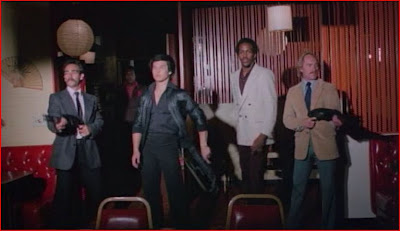


The ATF soon learned from Snake the snitch that Marx and Nighthawk were behind the robbery and the massacre. Agent Bryant (Richard Roundtree) was assigned to supervise the Riverside investigation. Capt. Skidmore of the Riverside PD, noting the stakes involved ("We think we've got a real problem with this thing.") assigned Lt. James Long (Leo Fong) as Bryant's liaison, despite reservations from ATF higher-ups. Wasn't Long the officer whose wife was raped and killed recently? Is he all right? "No, he's not all right. Would you be?" Skidmore told the Bureau, "But I'll tell you one thing. He's going to get the job done."

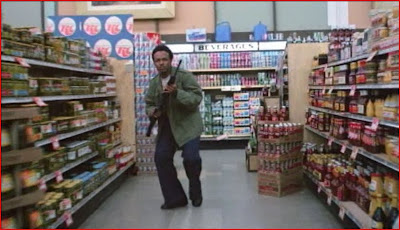
Nighthawk was soon handing out guns as if they were free samples. Gangbangers were soon shooting up grocery stores, bumping off another 15 people in one robbery.


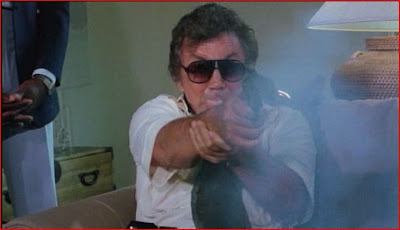
The film portrays Joe Marx watching news reports linking the two massacres and shooting his TV set. Marx had a love-hate relationship with his pet poodle, adoring the animal despite the fact that it "poos and pisses all over the living room." He fussed over the dog while arranging with his procuress, Anita, to have a new girl visit him.


Candy is shown telling Marx, "This really isn't me....I'm really a singer." To which Marx responds, "Girly, when you know Joe Marx long enough, when this old son of a bitch tells you to sing, you better sing before I get physical with you. Sing! Anything!" The filmmakers believe that Candy's voice failed her due to nerves, and that when she refused to strip on Marx's order, he murdered her and had her body dumped in a river.

Lt. Long took over the murder investigation when the police learned that a burn mark on Candy's left breast matched the m.o. in an unsolved New Jersey homicide in which Joe Marx was a suspect. The autopsy clearly depressed Long, who is shown in a montage working out furiously, recalling his own dead wife, and staring into space.


Having discovered Anita's address in Candy's home, Long interviewed her to no avail until he explained that Candy had been murdered. Anita then apparently went to Marx's home to denounce him as the gunrunner tried to feed his dog a cigarette. The song Cameron Mitchell sings is probably dramatic license.


Sparky is a friend of mine.
She will do it any time,
For a nickel or a dime.
Twenty cents for overtime.


The film contends that Anita's first guess was mistaken, and that Nighthawk killed Candy. It shows Anita wounding Nighthawk before he killed her, after which Marx complains, "Now you're bleeding all over my carpet!" Sparky is the dog, by the way.

As the investigation intensified, Long and Bryant pumped informants for new leads on the gunrunners. One likely prospect was gunned down in a tavern men's room before Long could meet with him. Nighthawk subsequently shot the gunman. Meanwhile, the gun trade continued, Nighthawk delivering arms to the Sanchez gang (with his lady chauffeur on hand for "insurance"), who subsequently massacred members of the rival Ramirez gang.
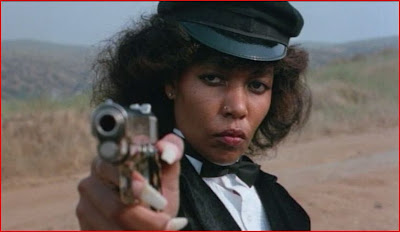


The first major break in the case came after Long kung-fued the snot out of the Sanchez crew and arrested their leader. After breaking up a gas station robbery by a black gang, the Riverside police played the gang leaders against each other, locking them in a bare cell to kung-fu one another until one is willing to rat out the arms dealers -- as long as the other is blamed.
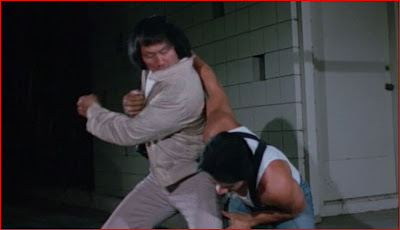


Using the fresh lead, Long arranged to meet Marx and Nighthawk, pretending to be an Asian gangster interested in rocket launchers. James Long's origins are unknown, but to account for Leo Fong's incongruous Southern accent, Long claims to come from Arkansas, where the China-born Fong was raised from the age of five. Long didn't realize when meeting with Nighthawk that the gunrunner had just killed Agent Bryant. It's an oddity of the film that Bryant dies without his liaison, Long, ever really taking notice of the fact. But there were more than enough ATF guys to go around in Riverside, even if Marx and Nighthawk wanted to start their own religion.

Marx suspected that Long might be a cop. He tested his theory by having four of his men beat Long up. He was satisfied of Long's good faith because "If you'd been a cop you'd have back-up all over the place." Paranoia, however, wasn't Marx's main problem. A breaking point came in his partnership with Nighthawk when Marx went berserk in a diner where the waitress kept a crying baby.


This apparently convinced Nighthawk that Marx was no longer a viable partner. He also had reason to think that Marx no longer trusted him, since the boss was wont to wander about talking to himself, saying such things as "From now on it's me alone, nuts or otherwise, against the whole world." Soon afterward, while picking Marx up in his limo, Nighthawk cut his mentor's throat. That left Nighthawk to consummate the big arms deal with Long, while the ATF surrounded the rendezvous point in an abandoned factory complex....
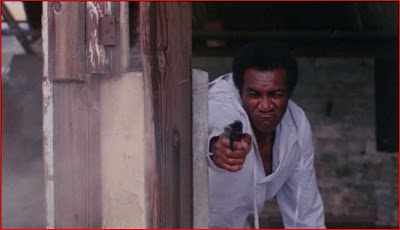


If Joe Marx didn't exist, Frank Harris and Cameron Mitchell would have to invent him. Mitchell gives one of his patented eccentric performances, fussing over the dog as much as he plots evil. But such is the quality of the man that Marx comes across as convincingly nutty, capable of completely unpredictable behavior. There's weird psychosexual tension between Marx and Nighthawk, whom Anita accuses of being gay. In turn, Nighthawk insults Marx while the boss wallows in a hot tub: "Look at you, wearing scarves, flowers in your hair, talking to a dog. Business going downhill and you're still turning into a raving faggot." Mitchell and Stack Pierce as Nighthawk make an effective team of misfits. Their interplay is the most entertaining thing about Killpoint apart from the sheer volume of gunplay that erupts every few minutes. This is a film that kills for the love of killing. Why does a criminal gang need to kill 15 random people in a grocery store? Because they're evil and the violence looks cool is my best guess.

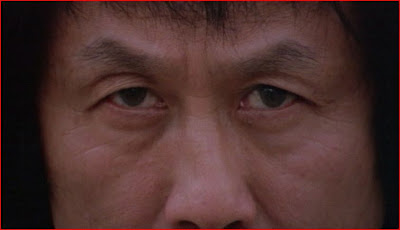
Mitchell may steal the film, and Richard Roundtree may recede into the background for no good reason, but this is Leo Fong's show. The overaged (56 when this was filmed), mop-headed master of redneck style kung fu is a spectacle even if he couldn't act his way out a door. He spends a lot of time receiving very detailed orders from Capt. Skidmore, because taking the initiative might require him to open his mouth, and Director-Screenwriter Harris apparently wanted to delay the awful moment when Fong's accent revealed itself for as long as possible. Now, an Asian man has just as much right to a Southern accent as anyone else, but in Leo Fong's case it's just the icing on the cake that makes him an avatar of '80s bad taste. Only in that decade would anyone have thought of making him a star.
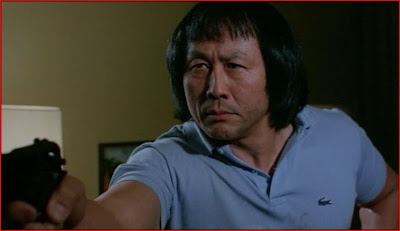


Harris is capable of creating dynamic moments, especially the grocery store attack, and he keeps things busy during the drawn-out climactic siege, crosscutting the ATF blasting thugs with Leo Fong going hand to hand with various foes until his showdown with Nighthawk. But there are also lots of flat moments of telephone conversations, pointless helicopter shots and instructions from the authentically dull Capt. Skidmore to pad out the picture. Throw in some convincing sleaze, some country music and a lot of bloody shirts and the end result is approximately 90 minutes of mindless action candy, Crown International Pictures style. You can find this one nicely letterboxed on BCI's Maximum Action set, which includes another Harris-Fong-Mitchell exploit, Low Blow. But if you want to see lots of people get shot, Killpoint should probably be your first stop in that collection.