Showing posts with label John Ford. Show all posts

Friday, January 5, 2018

SEAS BENEATH (1931)

There's still a strong early-talkie flavor in John Ford's World War I sea-chase picture. The film isn't really edited to the pace of dialogue-driven movies; many shots are held longer than seems right by modern standards. The idea, usually, is to show off the authenticity of Ford's location shoot at sea, including real submarines in action. The long takes give a sense of reality and scale. Ford enhances that feeling with a mobile camera that figuratively cranes its neck to see the crow's nest of the story's "mystery ship" -- an old-style schooner equipped with modern artillery, designed to lure German U-boats into firing range. In command is Ford's protege George O'Brien, whom the director made a star in The Iron Horse, though he's best known today as the star of F. W. Murnau's Sunrise. Murnau and Ford were Fox Film stablemates in late silent days and Seas Beneath retains much of the Murnau-inspired house style despite the transition to sound. Ford's conservative enough with camera movement to make moments when the camera takes flight special.


There's a simple but remarkable shot midway through the picture, when one of the mystery-ship officers (Gaylord Pendleton, the younger brother of present-but-unbilled Nat) awakens from a night's drunk on a Spanish island to find that his ship is leaving him behind, and that a German sub is readying to attack it. We see him watch the schooner from a city wall, a picturesque setting we've seen several times earlier in static shots. When the officer turns and bolts down a flight of stairs, the camera pivots to follow, achieving an almost 3-D effect.


The officer tries to redeem himself by sabotaging the sub's refueling, but only earns an honorable death. It's typical of World War I films of this era -- one year after All Quiet on the Western Front -- that the Germans themselves honor him by putting his body in a life jacket so his own crew can find him. The Germans of Seas Beneath are antagonists without being villains. Ford takes an equal-time approach to their preparations for battle, as if to show that they're just men doing their job, so to speak, just like the Americans. There's even a melodramatic star-crossed romance between O'Brien's commander and the German commander's sister (Marion Lessing), who acts as a spy on the island, pretending to be Scandinavian while speaking perfect English. Interestingly, Ford remains committed to the couple's romantic potential while maintaining their wartime enmity. Annemarie is forced into a lifeboat by the doomed officer's sabotage and is rescued by the mystery ship. On board, she does everything in her power to warn her brother and his crew of the ship's true identity and purpose. Again, Ford doesn't treat her as a villain, but makes clear that she's doing what any German patriot would do in similar circumstances. O'Brien himself recognizes this and offers her the prospect of marriage as an alternative to internment for the duration. She prefers to stand with her brother -- most of the sub crew is taken alive -- but leaves open the prospect of reconciliation after the war.


Seas Beneath starts unpromisingly with a lot of Fordian service shenanigans with lunkheaded comedy relief from Warren Hymer and others, while Nat Pendleton does everything in his power to call attention to himself, presumably with Ford's connivance. Here he is trying to horn in on his brother's impassioned tango with another German spy.


George O'Brien's understated authority as the commander keeps the picture from going full cartoon, as does its evenhanded attitude toward the enemy. The film benefits throughout from nice location photography and camerawork from ace cinematographer Joseph August. Toward the end, Ford develops some nice tension as the mystery ship takes a beating from the sub's guns without responding -- we're told the Germans prefer to use guns instead of torpedoes on small-fry like this -- in order to lure the skeptical German captain into the trap O'Brien and his own submarine colleague have set. It ends rather abruptly once the worm turns, and if anything Ford overcommits to reconciliation by sparing the main Germans and teasing further romance in the future. But overall Seas Beneath is a fascinating piece of work from that moment when war could be treated without propaganda, well after the imperatives of World War I and before the imperatives of World War II.

Sunday, April 30, 2017

THE BATTLE OF MIDWAY (1942)

So I'm watching Five Came Back, Laurent Bouzereau's three-part Netflix documentary adapting Mark Harris's recent book about the World War II adventures of five canonical directors: Frank Capra, John Ford, John Huston, George Stevens and William Wyler. Sporting a bombastic kickass theme by Thomas Newman, the series, scripted by Harris himself and narrated by Meryl Streep, assigns five current directors as guides to its protagonists: Francis Coppola for Huston, Guillermo del Toro for Capra, Paul Greengrass for Ford, Lawrence Kasdan for Stevens and Steven Spielberg for Wyler. I'm not sure what criteria determined these assignments but the modern directors' comments are usually interesting, particularly when Coppola defends Huston faking battle footage for his San Pietro. Anyway, the first episode climaxes with Capra's intellectual masterstroke of detourning Leni Riefenstahl for his Prelude to War and Ford's baptism of fire when the Japanese attacked Midway Island. Greengrass is understandably a big fan of the short documentary that resulted, even if Ford's shaky-cam effects are purely involuntary. The documentary does a grand job of hyping The Battle of Midway as cinema verite if not avant-garde for Ford's willingness to show the film's rough edges, including frame jumps, as proofs of its authenticity. Netflix has conveniently made the documentaries mentioned in Five Came Back available for streaming alongside it, so I took advantage of the opportunity to watch Midway whole. It's only 18 minutes long but manages in that brief time to be very different from what Five describes.


The incredible footage Ford shot while being bombed (he was slightly wounded in the process) is there, but so is a lot of stuff that Five Came Back deemed not worth mentioning, revealing Midway as an uncomfortable mix of radical realism and Hollywood hokeyness. It must be remembered that Midway is primarily a propaganda rather than a documentary film; Ford's purpose was as much to manipulate public opinion as to record the events of the battle. As a propagandist Ford was learning on the run, puzzling out what his film needed to say as well as show. There's a note of humor early as he shows some birds that are Midway's only native inhabitants and his narrator -- there are several, including Donald Crisp of  How Green Was My Valley, as well as other guest vocal artists we'll mention later -- notes sardonically, "Tojo has promised to liberate them." Then the film threatens to spiral down into Fordian folksiness with a sentimental accordion solo and the most bizarre part of the film, when suddenly we hear voices (including Henry Fonda) discussing one of the soldiers onscreen, identifying him by name and hometown. The idea, I guess, was to anticipate or simulate the voices one might hear in a theater, should they recognize any of the soldiers as one of their own. We then take a quick jaunt to the soldier's home town, where we're shown his father working in a railyard and his mother knitting with one of those special banners honoring her boy's service. The voices will come back in and out of the film wishing the soldiers well or urging medics to help them during the battle. To we moderns these interventions are as jarring as the rough editing of the bomb attack must have been to the original audiences. They may well take you out of the picture, so corny do they seem now. Likewise, after the battle Ford returns to those birds and has a voiceover express their presumed opinion of the situation: "We're just as free as we ever were!"

You can see a bomb dropping from the Jap plane at far left above.
Below, a bomb impact nearly blows the film out of the camera
(the dark line near the top is the frame divider)


Of all the documentaries made by the Five directors, Midway probably has the most obvious directorial signature. That may be a matter of retrospection, since I'm struggling to recall how many funerals Ford filmed before Midway. The documentary may well have helped make such scenes specifically Fordian, and they must have had a strong impact on audiences at a time when many more such funerals could be anticipated. The government apparently feared that the burials of sea would have too strong and too wrong an impact, so that Ford had to butter up President Roosevelt by adding footage highlighting the proximity to battle of one of FDR's sons in order to ensure the film's release on his creative terms. Five Came Back emphasizes ironically how many of the films it covers flopped at the box office, but Midway went over big. It probably helped that Ford followed those grim scenes with a bombastic coda racking up the score of Japanese naval vessels taken out in the battle.


My one reservation about Five as a book and show is that its biographical focus on the big five directors overshadows a more complex account of movie propaganda during the war, but I'll concede that the way these masters (Huston was a comparative neophyte but had just made The Maltese Falcon) tried to work with the biggest story of their careers, and one they could never hope to impose creative control upon, is compelling in its own right. It's interesting to learn, for instance, that while Ford made it through Midway more or less with flying colors, D-Day broke him, driving him to a bender that ended his career as a wartime documentarian. Perhaps he no longer had the confidence in his ability to process what he saw with the Hollywood devices he'd used before.

Wednesday, March 2, 2016

DVR Diary: FOUR MEN AND A PRAYER (1938)

This 1938 picture is one of the more obscure items in John Ford's filmography -- little known, I suspect, before its DVD release as part of the monumental Ford at Fox collection. That may be because it's an atypical Ford film, more Anglophile than Irish. I suspect it's also because the film's message became politically incorrect very soon after it was released. Based on a Cosmopolitan magazine serial by David Garth, from the days when that magazine was far more literary than it is today, the globetrotting story reflects a then-popular suspicion that the world's wars could largely be blamed on the world's "merchants of death," the arms and munitions manufacturers. You initially expect something reminiscent of The Four Feathers as the sons of the disgraced Col. Loring Leigh (C. Aubrey Smith) reunite to restore his good name after his own attempt to do so is aborted by murder. Leigh is framed for a battlefield blunder in India, when the real question is how did the insurgents he fought get up-to-date firearms. His sons -- barrister George Sanders, diplomat Richard Greene, aviator David Niven and student William Henry -- aided by the diplomat's American girlfriend (top-billed Loretta Young) split up to pick up the pieces of the mystery, two brothers going to India, the other two to South America, where a revolution is brewing. The South American section is the best part of the picture, combining the brutal spectacle of a revolution betrayed and slaughtered and the introduction of the merchant of death himself (Alan Hale Sr.) Hale rarely played villains but when he did so his normally affable manner only seemed to make the bad guys more cunningly dangerous. There's a great suspenseful scene, just after we've seen him throw a client to the wolves, in which he has to b.s. his way through an encounter with Greene and Niven. He excuses himself to fetch something out of his closet. Inside the closet is a servant who silently hands him a pistol and grabs one for himself. Hale pockets the gun and returns to show his guests some of the benign rubber product his perfectly innocent firm manufactures in the region. If anyone says something wrong our good guys, as yet none the wiser about Hale's character, are sure to be killed. Ford and his writers maintain the tension while leavening it with comedy as Niven, playing a bit of a ninny, grows fascinated with Hale's rubber toys. A different kind of tension develops as our heroes' suspicions turn toward another arms manufacturer who happens to be the Loretta Young character's father. Finally, in true thriller fashion -- this film looks forward to the later international spy genre in some ways -- the reunited brothers raid the villain's yacht off the Egyptian coast. Four Men is neither a characteristic nor canonical John Ford picture, but it shows him an expert studio craftsman earning his keep by making an often-exciting and just about always entertaining movie.

Tuesday, December 8, 2015

Pre-Code Parade: BORN RECKLESS (1930)

It's called a "John Ford Production" but who directed it? We're told that it was "staged" by Andrew Bennison. What this seems to mean is that Bennison played that short-lived role of the early talkie era, the dialogue director. Folks at Fox Film apparently weren't sure of Ford's ability to direct dialogue, or else Ford, more interested in free-range camera movement in the manner of his erstwhile studio stablemate F. W. Murnau, couldn't be bothered with the dialogue scenes. There's definitely some impressive camera movement here for a 1930 film, along with the sort of dense set design typical of Fox's late silents. The camera lurks through the narrow, crowded streets of the main city set early on to establish the protagonist's milieu. The art direction is impressive without quite being convincing, and that goes for the story, too.

Ford and Dudley Nichols adapted what apparently was a popular novel by Donald Henderson Clarke. Louis Beretti was well enough known that star Edmund Lowe could be identified as the novel's title character in some movie advertising, though Fox didn't see fit to name the film after the novel. Beretti is a neighborhood hood who goes to war and survives to make a fresh start back home. He keeps his criminal career secret from his old-world parents, switching from dapper gangster duds into a worker's overalls before coming home for spaghetti dinner. The cops aren't fooled so easily and Beretti is brought in for questioning. At the suggestion of a drunken reporter (Lee Tracy, shortly before his brief breakout to stardom) the authorities give Louis and his buddies the option of enlisting -- it's 1917 and bands are playing "Over There" everywhere -- with the promise of pardons if they make good as soldiers. The real idea is to burnish the police chief's reputation as a patriot, but whatever the ulterior motives involved Beretti is willing to give war a shot.

The next section is a botch that nearly cripples the film and can probably be blamed all on Ford. War is supposed to change Louis Beretti in some way, but Born Reckless never follows him into combat. Instead, we get a lot of Fordian shenanigans in boot camp and behind the lines featuring some of the usual suspects like Ward Bond. John Wayne is supposed to be in the picture somewhere, historians claim, but I didn't notice him. A subplot is set up in which Beretti befriends a wealthy young man determined to prove himself in combat despite coddling from his parents, but after the establishing scene we don't get the payoff until Beretti narrates it to his friend's widow after the war. The military sequence plays like the road to a dead end, and having reached it Ford and Bennison simply give up and go back to the U.S.A.

Beretti has a longing for the widow, whom his dead buddy apparently talked up quite well, but before our hero can make a move we learn that Joan Sheldon (Catherine Dale Owen) has already hooked up with a new beau. While I missed John Wayne's passing presence in this picture, there was no mistaking an unbilled Randolph Scott as the new beau. At 32, Scott is as young as I've ever seen him. He's still paying his dues here, playing little more than a handsome profile who has no more than a few words of dialogue in his few scenes. But enough of him. Beretti goes more or less straight, opening up a niteclub whose presumed violations of Prohibition appear to bother no one. But his old friendship with the local underworld big shot, cleverly named Big Shot (Warren Hymer) deteriorates as Beretti is torn between respectability and his old crowd.The plot threads tie together when Big Shot, returned from a stretch in stir, makes a new racket of kidnapping, snatching Joan Sheldon's child. Beretti rescues the kid before a final showdown with Big Shot. Both scenes are nicely shot, the rescue introduced with a tracking shot of Beretti walking across a field to the kidnappers' hideout. The showdown is a slow burn leading to an explosion, Lowe and Beretti chatting at a bar with an odd, evasive formality that distantly anticipates the technique of Leone and Tarantino before they abruptly open fire on each other as the camera retreats through the bar's swinging doors. There are definitely pieces of a superior gangster film here, but it looks like Ford didn't know how to put them together. Part of the problem is Edmund Lowe's much too laid-back performance as Beretti, but you can't blame him for the film's faulty construction; he may have had as little proper direction as the movie as a whole did. Despite any ambiguity in the credits, Born Reckless is often unmistakably, and in this case unfortunately, a John Ford film.

Tuesday, November 19, 2013

DVR Diary: John Ford's UPSTREAM (1927)

A contemporary reviewer for the trade press thought it necessary to inform readers that Upstream was not an outdoor adventure picture. Blame Fox Film for the confusion; having promised a picture of that title, co-starring Dolores Del Rio and Walter Pidgeon, only to have the project fall through, they slapped the label on a story originally titled The Public Idol. Knowing John Ford as we think we do, we might have expected an outdoor picture as well, but Upstream, long thought lost until a copy was found in New Zealand a few years ago, seems Fordian just the same. The setting of a boarding house catering to actors proves to be quite the Fordian environment. The westerns we know him best for were often filled to overflowing (some might say infested) with eccentrics whose personalities were essentially theatrical. Here no one is normal, broadly speaking. Everyone's an entertainer, all of them down on their luck -- "at rest" is the genteel way to put it, but those in that category are expected to pay in advance. Some are in decline, others still young and aspiring; both groups get their due. Our main focus falls on a romantic triangle: a knife thrower (shades of The Unknown!) and his two assistants. The male assistant (Earle Foxe) has little enthusiasm but carries a storied theatrical name. It's that name a high-powered producer is after when he calls at the boardinghouse, briefly getting everyone's hopes up. The sudden offer to star in Hamlet terrifies young Brasingham, but an elderly acolyte of the Bard -- he lights candles in front of a bust of the playwright -- gives him a quick tutorial that leads to the lad conquering London and earning a nod of the head from the royal box. Success goes to his head, however, though the now-Great Brasingham gets his comeuppance when he crashes the wedding of the knife-thrower (Grant Withers) and his female assistant (Nancy Nash) at the old boardinghouse, cluelessly thinking that the celebration put on there is in his honor.

Upstream finds Ford between two phases of his career. He had recently made his name with the western blockbuster the Iron Horse and followed up with Three Bad Men. He would next enter a more self-consciously artistic phase, influenced like his fellow Fox directors by the arrival of F. W. Murnau to make Sunrise. The influence would become apparent in films like Four Sons, released in 1928. Upstream was Ford's only 1927 release, which makes it hard to excuse the slapdash nature of the story. He seems confused over whether Brasingham is the main character or whether he was making an ensemble piece. I suspect he'd rather have done the latter, but he's stuck following Brasingham to London, where a vision of his momentary mentor inspires his to triumph, and then back to America and a closing humiliation that makes this one-hour feature feel more like a slapstick short subject where the star acts out a fantasy only to be kicked back into his rightful place. Actually, Brasingham isn't kicked into his rightful place, since he'll go on being a star, but since the other two legs of the triangle haven't gotten an equal share of development, Upstream feels like a star vehicle for the otherwise-unknown-to-me Earle Foxe -- whom Ford used as late as My Darling Clementine. I often credit early movies for telling stories efficiently, but for once this is one that really does feel too short. Still, there's a certain indisputable charm to the film that isn't just the glamor of discovery. Upstream isn't really an unearthed treasure, but there's a pleasant shock of recognition to it when you realize that, however an unlikely setting this seems for a John Ford picture, the director really does seem to be in his element. Watching it is like removing a layer of his legend, getting past the man who made westerns to the essential showman at heart.

At least one reviewer at the time saw this pretty much as I did. 

Wednesday, August 28, 2013

Pilgrimage: NOW PLAYING, 1933

Three Cornered Moon plays Milwaukee this week. Paramount has a pretty extensive ad campaign for this proto-screwball comedy.


The comparison to the Marx Bros. (whose Duck Soup is coming soon) is weird. I mean, the Marxes were real-life performers, so yes, they're "paid to be goofy," but it's not as if the Rimplegar family is real. Colbert, Arlen, et al were being paid to be goofy just as much as the Marxes were. But maybe we have here a hint at the difference between screwball comedy and the Marx Bros. style. With the Marxes, it's impossible to suspend disbelief; regardless of what the brothers are called in any given picture, they're their standard selves every time and we all know it. But with screwball, perhaps, we're encouraged to believe in and empathize with the characters, even if we know they're played by familiar stars. That's not the whole picture, but it's part of it. Discuss it amongst yourselves.

At the Warner, William Powell is snooping around.


Based on my short study of the advertising for John Gilbert's talkies, I take it as a warning sign whenever movie ads talk about the sort of role that made the star famous. You can probably infer that the star isn't quite as famous as he was. Fortunately for Powell, his greatest popularity was yet to come, but it would take a different studio to set him right.

However it fits in Powell's career, this Michael Curtiz picture looks like prime Pre-Code material. Here's the original trailer from TCM.com


The Veterans of Foreign Wars were in Milwaukee for a convention this week, and some of the big theaters programmed accordingly.


Here's a weird way of promoting your picture while barely saying a word about it.


John Ford's Pilgrimage had been sitting in my DVR queue for nearly a year before this week's article gave me reason to give it a look. I wonder what an audience of veterans made of it. Indeed, I wonder what Ford fans today make of it, since here the old sentimentalist gives us one of cinema's most hateful mothers. Henrietta Crosman gives an alarming performance as a crabby old lady who at first won't let her son fight in the Great War, then practically pushes him into it rather than have him marry a girlfriend she considers trash. The boy suffers a brutally ignominious death while the girl gives birth to his son, condemned to be a bastard because they didn't have time to marry. After the fact, the old lady still shuns the girl, and her own grandson, as if blaming them for her son's death. Then the picture becomes a fish-out-of-water comedy as Crosman reluctantly joins a delegation of Gold Star Mothers on the title trip to France to see their sons' graves. An ominous tone hangs over the comedy as the mother remains crabby while we suspect that a terrible catharsis is coming. Even though Ford predictably softens in the second half, having Crosman save a young Frenchman from suicide so she can see the error of her ways by learning his story, a mirror of her son's, and setting things right, the first hour of Pilgrimage probably struck many 1933 viewers, even those grown cynical about the war, like a punch in the face. I can imagine how Milwaukee audiences might have felt if that goofy ad drew them to the picture. But maybe I should give them more credit. Problematic as it is, Pilgrimage is an admirably ambitious picture, the first half especially showing Ford in his High Art mode, and Crosman's is a convincing, compelling performance. It's certainly a unique way of addressing people's ambivalence about World War I, and it's hard to imagine Ford or anyone else updating it for World War II. Vietnam, maybe.

Thursday, March 29, 2012

Book into Film: THE SEARCHERS (1956)

In 2009 Leisure Books, one of the leading publishers of paperback westerns, issued "The Classic Film Collection" of novels that had inspired great western movies. Titles included Max Brand's venerable Destry Rides Again, T.T. Flynn's The Man From Laramie, Forrest Carter's Gone to Texas (filmed as The Outlaw Josey Wales) and two by Alan Le May. The Unforgiven was filmed by John Huston with Burt Lancaster, Audrey Hepburn and Audie Murphy in 1960. Four years earlier, John Ford had made Le May's The Searchers into a film widely regarded as the greatest of all western movies. The film's reputation made the novel worth a read. It would at least be interesting to see how much Ford and his screenwriter, Frank S. Nugent, deviated from the original text, and whether the book could stand comparisons to the film.
The first thing a reader notices is that Le May starts his novel at approximately the 14-minute mark of the movie. He opens with Aaron Edwards noticing suspicious signs near his homestead while his visiting brother rides with Martin Pauley and the locals in search of cattle thieves. He cuts from the Edwards homestead to the men on the trail and back, until the family sends little Debbie out back to hide near Grandma's grave. Le May does not show an Indian discovering the girl and blowing a horn. For the moment, Debbie's fate is even more mysterious than in the movie. But the important fact for comparison's sake is that the first scenes of the Searchers movie are complete inventions of Ford and Nugent. What do they add to Le May's story?


Some people may know that Aaron Edwards's vengeful brother is called Amos, not Ethan, in the novel. The change seems like one of those infuriatingly arbitrary Hollywood decisions, though you might speculate that Ford liked the alliterative sound of "Ethan Edwards" better, or that he thought the name Amos too evocative of Amos n' Andy to be taken seriously. There are a lot of arbitrary changes for the film. The novel's Mose Harper is a garrulous old man with grown sons, a bit of a bore when he bloviates about the past but neither crazy nor stupid by any means. But there's a character named Lije Powers who becomes more important late in the story and wants no more payment for his help in the search than to have a bunk to sleep in for the rest of his life -- and a rocking chair. Ford and Nugent merge the two characters into a personality suited to stock-company stalwart Hank Worden. The neighbor family to the Edwardses is the Mathisons in the novel. Ford makes them the Jorgensons for no better reason than for John Qualen to do his Swedish accent. Qualen could do perfectly well without the accent; his greatest performance, arguably, is done without it in The Grapes of Wrath and was directed by John Ford. But one suspects that Qualen's Swede schtik makes The Searchers more superficially Fordian, as does the expansion of a Texas Ranger commander's role to suit the bluster of Ward Bond. But the transformation of Amos into Ethan Edwards is more than superficial, more than Fordian gimmickry.


Amos Edwards "had served two years with the Rangers,and four under Hood, and had twice been up the Chisholm Trail. Earlier he had done other things -- bossed a bull train, packed the mail, captained a stage station -- and he had done all of them well. Nobody exactly understood why he always drifted back, sooner or later, to work for his younger brother, with never any understanding as to pay." He is prone to "deadlocks" that may explain his restlessness. Such a deadlock leaves him torn between rushing back to Aaron's land once convinced that the raiders may strike there and continuing with the chase of the presumed cattle thieves lest he seem a coward to the other men. But this is only what Martin Pauley assumes. In the novel, Amos is seen entirely through Martin's eyes. The novel itself is Martin's story more than anyone else's. The film is Ethan's. That's why Ford shows him arriving at Aaron's place and establishes his relationships with the people there, from the three-way tension with Aaron and his wife Martha to his casual hoisting of little Debbie into the air. If the novel always shows us Martin watching Amos, the film strives for balance, giving us Ethan's perspective as well as Martin's. The film is full of powerful reaction shots of John Wayne's Ethan as he despairs or seethes with rage or gazes with revulsion at some new horror. The part probably had to grow to fit Wayne's stardom, but as is well known, Ethan Edwards is someone quite different from the typical John Wayne hero role.
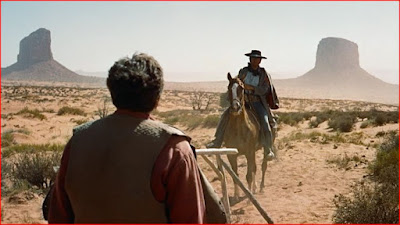
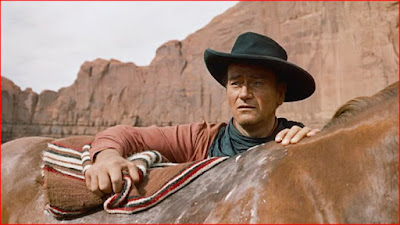


If Le May presents an existentially indecisive Amos, tormented by his failure to claim the woman he loved, who dies his brother's wife, Ford gives us an all-too decisive Ethan. The mystery about Ethan Edwards isn't why he never sticks with any job, but whether he's robbed a bank or a train. Ethan's problem isn't indecision; it's an irreconcilable nature that doesn't believe in surrendering (he professes continued loyalty to the defunct Confederacy) and doesn't accept contradiction. His relationship with Martin has sharper edges. In the novel, Martin is described as dark, but he doesn't appear to have as much Indian blood, if any, as the movie Martin. He bristles in the book when someone says he looks like a half-breed. In the movie, his mixed ancestry gives Ethan reason to despise him. Much of their banter is carried over verbatim from book to film, but it comes across meaner in the movie. Partly that's because the movie Martin is a much weaker character than the original. Ford and Nugent make him much more of a tenderfoot than he is in the novel. While Martin is clueless in the picture about Ethan's intention to use him as bait to lure Jerem Futterman into an ambush, in the novel he argues with Amos about how much of a dumb "old flim-flam" the idea is. If the movie Martin is more naive, Ethan is more masterful than Amos. In the movie, he shoots down a Ranger's idea of stampeding the ponies of the murder band by noting the old Comanche trick of sleeping tied to your fastest pony. In the novel, stampeding the ponies is Amos's idea, and it's shot down by Charlie MacCorry (portrayed as an imbecile in the movie). As the difference in skill and power appears more vast in the movie, so Ethan appears more intimidating to Martin and the audience.

Above, Jeffrey Hunter and John Wayne. Below, this scene is as defiant as Martin Pauley gets in the picture. In the novel, he cooly tears up the will and warns a healthy Amos that he'll kill him if he gets Debbie killed -- and Amos backs down. That'll be the day.... 


Make no mistake: Amos Edwards is as much of a menace as Ethan as far as a grown-up Debbie is concerned. Amos is just as ready to destroy her rather than see her degraded as a squaw, but his attitude is taken as a given, explained only by Martin's speculation about the man's grief over the woman he loved but never had. His attitude doesn't even seem to be exceptional: Laurie Mathison tells Martin that killing the adult Debbie would be the right thing to do and something her mother would have approved. But because Ethan Edwards is the central character of the Searchers movie, Ford feels a need to explain the depths of Ethan's hatred. He had Nugent write an original scene, one of the most controversial scenes in the picture, in which Ethan and Martin inspect some white women liberated from Indian captivity. They appear to have been driven mad or retarded in their mental development. Their behavior is infantile or subhuman. And Ford makes sure with a dolly shot moving in for a close-up that we see Ethan take it all in and let it stew in his mind. Ford shows us what Ethan is thinking in a way Le May never directly shows us Amos thinking.


Ford's Searchers is recognized as a critique of one man's racism but also widely viewed as itself racist given scenes like that one. How racist the film really is might be measured by comparing it with the novel. The savagery of Indians is more of an overriding topic of Le May's novel. Le May's racism isn't genocidal, but it is judgmental. He attributes to Native Americans the classic characteristics of the savage enemy or "unlawful combatant." They abuse the good will of naive humanitarians. They push the envelope constantly to see what they can get away with before the military cracks down. Above all, they lie and lie and lie. The author's viewpoint, as best as I can tell, is that they need to be tamed, not exterminated. His characters see things differently.

"Look," Martin's accidental Indian wife, is one Native character treated with more respect in Le May's novel than in Ford's film -- but Ford milks her demise for more pathos and more outrage against his usually irreproachable U.S. Cavalry.


"I see something now....I never used to understand. I see now why the Comanches murder our women when they raid -- brain our babies, even -- what ones they don't pick to steal. It's so we won't breed. They want us off the earth. I understand that, because that's what I want for them. I want them dead. All of them. I want them cleaned off the face of the world."


The speaker is Martin Pauley, and what provoked this wasn't some fresh massacre or any act of violence. His comments to Charlie MacCorry come after he has finally found Debbie and she has urged him to go away. It's a much more protracted scene than in the movie, and the gist of it is that Chief Scar's Comanches have brainwashed Debbie. They've convinced her that Scar rescued her after other Indians or white rustlers killed her family. They have her believing that all white people lie. This concern with brainwashing or indoctrination, on top of Le May's contemptuous account of all attempts to appease the Indians, gives the Searchers novel a sort of Cold War quality, with the Comanches standing in as much for Communists as for archetypal savages. Stories of Indian captivity probably seemed especially relevant at a time when "Better Dead Than Red" was a watchword. Indian stories probably gave Cold War audiences a politically safe way to ask and answer whether dead was better than red after all, though The Searchers leaves open a none-of-the-above option. For the record, the novel allows readers to believe that Debbie may still be a virgin when the heroes find her. Scar is her "father," not her husband, and is unwilling to trade for her because he's already arranged a marriage for her that will net him a fortune in horses, and reneging will cost him face in his tribe. The movie, meanwhile, never refutes the assumption that Debbie has been "living with a buck," and thus states more firmly that it could never be too late to rescue her. "Better Dead Than Red" in the other sense of red is not an option in the film. In any event, for both book and film it might be helpful to distinguish between racism and bigotry. That distinction might also help us resolve the apparent contradictions in the film. A story might be racist while indicting bigotry if the latter is defined as an individual's irrational hatred while the former merely presupposes superiority, inferiority, conflict and conquest. More so, arguably, than Amos, Ethan is a bigot. Hatred is a personal issue that he has to overcome. In Ford's film, that overcoming becomes the central dramatic event, more important than whether Debbie is ever found since, if he doesn't overcome himself, Debbie will surely die.
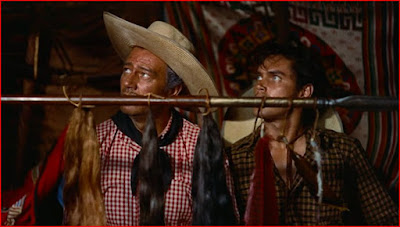
Ford's build-up to the big reveal of Natalie Wood as the grown Debbie is something film can just do better than writing. Max Steiner's outstanding score helps a lot.


The stakes aren't that high in the novel. The biggest departure the film makes from the novel, after all, is that Ethan spares Debbie. In the novel, Amos never gets the chance. After a much more elaborate battle scene than in the movie, Amos prepares to ride down a fleeing squaw he presumes to be Debbie while Martin calls out for him to stop and actually takes a shot at him. At the last moment, Amos simply grabs the girl -- at which point she reveals herself as a Comanche and shoots him to death at point blank range. It's up to Martin to find Debbie wandering in the desert well after the battle, with the slightest closing hint that they might form a couple later. Martin is available because, in the novel, Laurie Mathison marries Charlie MacCorry after all -- you couldn't expect her to wait forever, could you?


The end of the novel can't help but seem anticlimactic in light of the movie because Le May doesn't really give us a redemptive moment. We do not see Amos overcoming his hatred -- he may simply have had one last deadlock of indecision and paid for it. In the film, however, Ford has prepared us for the supreme moment from the start, from the early shot when Ethan hoists little Debbie in the air. When he lifts Natalie Wood's adult Debbie the same way, our memory of the earlier scene allows us to assume a similar memory at work in Ethan himself. She is the child once more, not the squaw. But Ford's famous finale, in which Ethan turns and walks away instead of joining the big reunion at the Jorgenson place, could be his act of fidelity to the novel, his admission that the Edwards character has been destroyed by his quest after all, despite his apparent redemption, reduced to walking between the winds like a living ghost -- as Debbie does in the novel's closing pages before Martin finds her. Maybe -- maybe -- Ethan felt a twinge of remembrance of Martha Edwards, too, and could not stay under the same roof as an adult Debbie with that feeling in him. The way Le May subtly sets the stage for a quasi-incestuous union of Martin and Debbie makes such a reading of Ford's adaptation slightly more plausible.
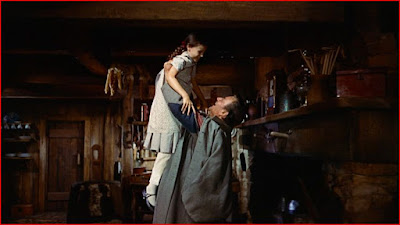


Alan Le May's The Searchers is a crisp read, largely free from purple prose. His sound ear for dialogue is honored by Nugent's echoing of almost entire paragraphs of dialogue from the novel -- though sometimes different people say the words. A well-known speech given to Olive Carey's Mrs. Jorgenson about the ordeals and resilience of Texans, for instance, was originally uttered by Amos Edwards, in an especially pensive mood, after he discovers (as we learn in retrospect) Lucy Edwards's body. For all his apparent disdain for Indian cultures, Le May doesn't write comic-book Indians; his Native characters always feel like distinct individuals within the parameters of unprincipled barbarism. The Searchers isn't the best western novel I've read -- that's still Oakley Hall's Warlock -- but I'd still recommend it. I'd even say it'd be worth someone's while to make another movie of it. It worked for True Grit, after all. Honestly, it'd be interesting to see the story shot from Martin's perspective as it is in the novel, and there are scenes in the book that Ford never filmed but are nevertheless potentially cinematic. Above all, there's an amazing scene in which Amos and Martin race for shelter as a blizzard bears down on them that was probably beyond Ford's resources but could certainly be done justice now -- probably only Akira Kurosawa could have done it justice in the past. But the point of a remake would not be to top John Ford, and I don't mean to imply that his Searchers inadequately represents the novel. In fact, it's an exemplary cinematic enhancement, a classic of creative adaptation. Ford and Nugent tighten the story effectively in many spots, reducing the number of visits to the Mathison/Jorgenson farm, for instance, to maximize the dramatic impact of each return. Since there's no time limit on reading a novel, Le May can take his time and work through more false leads than a movie audience might tolerate. He can't match Ford at his best for dramatic editing, ingenious framing of action, and the overwhelming power of those Monument Valley locations in VistaVision. Le May doesn't have Max Steiner's score to underline and highlight key moments, either; the veteran composer's old tricks work as well as ever here. Le May may be a formidable storyteller, but Ford is simply a better picture maker than Le May is a wordsmith. Many of the memorable words in the movie may be Le May's (though not "That'll be the day..."), but the indelible images of The Searchers, and the life they give to Ethan Edwards, are Ford's alone. His film may not be the greatest western (let me get back to you on that), and it may be too "Fordian" for its own good in some ways, but it is a masterpiece and would remain so no matter how many times the novel is filmed.

Saturday, March 17, 2012

Pre-Code Parade: FLESH (1932)

In the Coen Brothers' Barton Fink, a pretentious playwright is lured to Hollywood and tasked with making a "Wallace Beery wrestling picture." If you believe the Coens -- and that's a big if sometimes -- they didn't know at the time they wrote their picture that there was such a thing as a Wallace Beery wrestling picture. Yet to someone at M-G-M in 1932, it may have seemed natural to follow up Beery's big success in a boxing picture -- he won an Oscar for The Champ -- with a film about wrestling. But the natural-seeming follow-up doesn't follow The Champ's formula -- Jackie Cooper is conspicuously absent, as is any hint of father-son pathos. Instead, Flesh is much more of a true Pre-Code movie, at least on paper -- and can you beat that title? Actually, in retrospect, Metro should have thought twice about it. No matter how beloved Beery had become, I can only imagine that advertising a film called Flesh on the understanding that most of the title substance on display would belong to Beery might have sent even his most devoted fans in headlong flight from the nearest theater showing the picture.

That title isn't the only thing not quite right about the project. This is an M-G-M picture directed by John Ford during a period when Fox let him work for other studios -- Air Mail for Universal, Arrowsmith for Samuel Goldwyn, etc. It is, in fact a "John Ford Production," but Ford refused to take credit for directing. That is, he repudiated a picture that still bears his name. But I can't blame him. Flesh is one of those rare occasions -- the silent Four Sons is another -- when he indulges a certain Germania-mania. His is a vaudeville Germany where the natives sometimes speak their local lingo and sometimes speak English -- to each other. Ford never figured out a neat Judgment at Nuremberg type trick to transition us from German to English. They just start out auf Deutsch, vacillate a while, then stick to comic-strip dialect. In this milieu flourishes the great Polokai (Beery), king of the beer-hall wrestlers like Hitler was king of the beer-hall orators. But Polokai is more than a wrestler -- he's a wrestling waiter. He'll bring the beer barrel to your table to fill your mug. But he is mighty without being a brute -- he's shy, unworldly and simple -- Ford seems to suggest that the last is a national trait. In short, he's a sap. Or as one of the ads says of Beery, "The Champ becomes the Chump!"


Polokai proves easily manipulated by a pregnant expatriate American ex-con (Karen Moley) who's been ditched by her boyfriend/baby-daddy and needs money to get back home. When the boyfriend (Ricardo Cortez) finally appears, he pretends to be the woman's brother because he sees an angle to exploit Polokai, who has become the German wrestling champion, and sees a better chance for himself if Polokai keeps his romantic hopes up. Polokai's own plan has been to follow his emigrating employers to America, where they intend to open a biergarten in spite of Prohibtion. Now the Cortez character (a smooth-talking sleazebag, as usual) figures to promote Polokai in the big-time world of American professional wrestling. He explains the title by declaring his intention to make millions pushing "a hunk of flesh." Ford and his writers (reportedly including William Faulkner -- do the Coens really want us to believe they never heard of this?) don't have the surest grip on what wrestling was about at this point. They seem to understand that wrestling was what wrestlers call a work, but they seem to see this as the moral equivalent of fixed fights in boxing. That is, when Cortez suggests that it's sometimes the smart thing to lose instead of win, he seems to mean that Polokai should take a dive at some moment of his choosing, as a corrupt boxer might. Of course, German wrestling is totally real -- a shoot, as they say, so Polokai's honor is offended by the suggestion that he lose on purpose. His career is stalled a little by rigged decisions after time-limit matches, but he finally gets a title shot. As his career approaches its peak, his life falls apart as he discovers the truth about the sleazy Cortez and the repentant Morley and kills Cortez with his bare hands for hitting Morley. He proceeds to the arena and wins two of three falls before turning himself over to the police. There remains a tearjerker moment during visiting hours when Morley finally admits her love, for all the good it'll do Polokai in stir.


There's little Fordian about this picture, though the director does manage to hustle Ward Bond on screen for a minute or so as a wrestler. The ethnic aspect enables Ford's worst impulses, and the comedy in general is stupid. Typical is the German championship bout, where Polokai seems to be losing until he hears that the Morley character has given birth, at which point, after having chatted inanely with his corner men while suffering in a leglock, he promptly squashes his foe so he can get to the hospital. The one time I laughed out loud was when Polokai was learning English out of a phrase book, reading aloud, "That is a warm donut. Step on it." A glimmer of redeeming absurdity in a leaden melodrama. This is the part where I usually say that some film in the Pre-Code Parade is of interest as a historical document, at the very least, but Flesh is less than even that. It's probably one of the most forgettable items in both Ford and Beery's filmographies, and as such it does teach a historical lesson or two. First, not every great director flourished under Pre-Code conditions; 1929-34 was not a peak period for John Ford. Second, and corollary: Pre-Code didn't prevent anyone from making crap -- here's proof.