Showing posts with label Castellari. Show all posts

Friday, October 5, 2012

COLD EYES OF FEAR (1971)

I'm trying to get into a Halloween mood, but this wasn't a very good start. I launched Enzo G. Castellari's Gli Occhi Freddi Della Paura (the English title is a literal translation) expecting something like a giallo, but the closest we get to that is an opening gag that seems to give us what we're looking for -- a scantily clad woman menaced by a man with a knife -- only to pull back and reveal one of those morbid cabaret shows that Europeans were fond of in those days.


Karin Schubert stars in the live giallo within the film

This is England, actually, and Cold Eyes of Fear is yet another Italian film that imagines the sceptred isle as the land of dark doings. My hunch is that we're seeing the influence of Edgar Wallace and the German films (often themselves set in England) made from his novels in these Italian movies. In many ways, Cold Eyes is an old-fashioned thriller, if not necessarily the kind Wallace wrote.


In any event, among the audience for the sex-&-violence show are young lawyer Peter Flower (Gianni Garko) and an expatriate Italian prostitute, Anna (Giovanna Ralli) who romp through Swinging London a while before heading to the home of Peter's uncle, a highly respected judge (Fernando Rey). Little do they know that an intruder has already broken in and killed the butler. Julian Mateos plays the intruder, but the dominant performance is by whoever dubbed the role into English. While the rest of the dub artists play things straight, or dull, Mateos's dubber heads straight for cartoonland, issuing the sort of Cockney accent you might hear from a drunk anglophobic American.


The intruder is only setting the stage for his partner and mastermind, who arrives disguised as a policeman, having taken the uniform from a victim sent to the house by the judge to give Flower instructions for finding certain documents. It becomes apparent quickly that the home-invaders are working at cross purposes. Quill (Mateos) is only after money, while Welt (Frank Wolff) is after different kinds of papers. As delusional flashbacks reveal, Welt was sent up the river by the judge while his accomplices got off. Ever since, he has suspected that the accomplices bribed the judge to escape justice, and he hopes to find the proof in the judge's house. At the same time, he has booby trapped the judge's office to blow up should the official pull his door open to leave. Presumably he intends to publicize whatever evidence he expects to find to show the world why the judge deserved to die.

 
The majesty of the law: Fernando Rey presides; Frank Wolff protests
 

Cold Eyes is basically a cat-and-mouse story made occasionally interesting by the contrast between a fearless, defiant Anna and the feckless weakling Flower. Take Gianni Garko out of his Sartana costume and he's a lot less formidable, but his character hardens the more he comes to believe that Welt might be right about the judge, until he's at last ready to take violent action against his tormentors. Death by JB bottle is sure to be a highlight for certain fans of Italian genre cinema. Meanwhile, there are strong insinuations that Quill is a misogynist homosexual, though it's unclear whether Welt is that kind of a partner with him. This sort of story really isn't an ideal vehicle for an action specialist like Castellari, who entertains himself with Welt's fantasies of destruction and his persecution-complex flashbacks. The film definitely becomes less linear once Welt takes center stage, as if giving in to the villain's madness, but that description may make the film sound more interesting visually than it actually is. I dug the neon-lit night scenes actually shot in London, but otherwise it's a fairly uninspired film. Not even Ennio Morricone can do much to jazz it up. It must have seemed like an old-fashioned film even at the time it came out, because there's something timelessly tired about it.

Tuesday, June 28, 2011

STREET LAW (Il cittadino si rebella, 1974)

Vigilante movies are a peculiarly American genre but it comes as no surprise to see Italians making them as well during the 1970s. It may surprise some to learn that Enzo G. Castellari didn't make Il cittadino si rebella ("The city rebelled") not in response to Michael Winner's Death Wish but just about simultaneously, and that the Italian film is in many ways a more realistic portrait of vigilantism. One major difference off the bat is that Franco Nero's protagonist Carlo Antonelli is not an avenger, except of his own wounded pride. He loses money, not a loved one, to criminals, having picked the wrong time to make a bank transaction. The robbers having made their entrance just as he was at the teller window, Carlo's money sits tauntingly at the counter. I don't know if Italians had deposit insurance at the time, but Carlo clearly isn't taking any chances. He reaches out to grab his money and gets into a scuffle with one of the robbers that results in his being beaten up and taken hostage. Fortunately for him the vicious but stupid criminals leave him alive and largely intact in the countryside despite having taken their masks off in front of him. They presumably hope that Carlo will be too scared ever to identify them.


Getting robbed and beaten is all Franco Nero can stands -- he can't stands no more!


Predictably, the Italian criminal justice system only enrages Carlo more. Just as the cop heroes of the polizio genre complain about bureaucratic restraints on their ability to wipe out criminals, Carlo complains that the system seems to care more for criminals than for their victims, who are treated with condescension at best. Defying his girlfriend's skepticism, and invoking his dead father's involvement in the resistance to Fascism, Carlo acquires a gun and attempts to track down the robbery gang on his own. He proves an incompetent investigator, strolling into a seedy pool hall like a character in some other, more gratifying movie and asking with pseudo-subtlety for "information." He manages to flee without getting the beating his idiocy probably deserved, but the scene makes clear that vigilantism won't be as easy as Carlo may have thought.

Somehow, Carlo finally figures a way into the underworld. He manages to take photographs of two small-timers robbing a jewelry store and uses the pictures to blackmail one of the culprits. Carlo's notion is to arrange an illegal firearms purchase through this hapless perpetrator, and then tip off the cops so they'll raid the scene of the sale. When the cops prove too slow and the crooks seem to have been tipped off, the furious Carlo attempts riskier transactions and only endangers himself. He finally meets the three robbers again, but only gets beat up again. He only survives this time because his own victim, the petty crook Tommy (Giancarlo Prete), decides to help him escape. Tommy's no killer and can't stand the thought of someone getting killed. The great irony of the picture is that only with a criminal's help does our vigilante have a chance in the underworld. Some viewers may find it more ironic that Carlo actually befriends Tommy and encourages him with promises of a partnership in a garage -- the social reform approach to crime -- while relentlessly pursuing his original tormentors.


Castellari can be depended on for effective action scenes, and Nero does some heroic stuntwork as his character takes a picture-long beating. By Castellari standards Street Law is almost a chamber piece that concentrates on suspense rather than escalation in its cat-and-mouse climax in a vast warehouse. The suspense is well-earned since Nero and Prete's vulnerability has been well established already; whether either will survive their final showdown with the three robbers is entirely open to question. Castellari and his writers, along with Nero and Prete, not to mention a distinctively moody rock-inflected score by the De Angelis brothers, put together a very different movie than what I originally expected -- and a much better one.

Here's an English-language trailer, uploaded to YouTube by YOcke:

Wednesday, January 6, 2010

1990: THE BRONX WARRIORS (1982)

My recent viewing of The Road inspired me to crack open Shriek Show's Post-Apocalyptic Triple Feature box set and take a fresh look at how Italian genre directors imagined the collapse of civilization nearly thirty years ago. Enzo G. Castellari's action film is an early example of the Italian sub-genre, and reflects the influences available to him at the time. It's possible that Castellari could have seen Mad Max 2/The Road Warrior before filming this, but you can't really tell from the product. The Mad Max influence is arguably more apparent in The New Barbarians/Warriors of the Wasteland, also from 1982, but 1990 is more obviously influenced by more non-dystopian movies like The Warriors and the controversial Paul Newman cop film, Fort Apache, the Bronx.

For starters, Shriek Show's box cover lies brazenly when it describes 1990's setting as "Post-nuke New York City." There's no evidence of a nuclear attack, as all the landmark skyscrapers (including the World Trade Center towers, of course) are still standing, the better to lend epic scope to Castellari's location footage. Nor is 1990 about scarcity or the depletion of resources, as The Road Warrior is. There's no evidence of shortages and over in Manhattan civilization seems to be still puttering along quite nicely. The real problem, as a title card explains, is that government has lost the will to enforce the law and defend public safety in its worst neighborhoods. We may be meant to assume that New York can't afford to do so anymore, but it's just as dystopian to imagine a wealthy elite deciding to leave the rabble to their fate while shoring up their defenses in gated or otherwise segregated enclaves. We've seen this kind of dystopia as recently as George Romero's Land of the Dead, and we're likely to see it again.
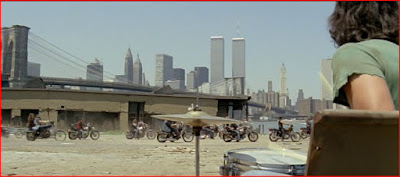
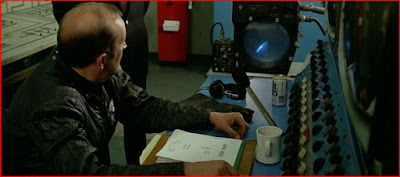
1990 often leaves you wondering how post-apocalyptic things really are in a more-than-intact New York City (above) but if you want an explanation of societal breakdown, look no further than the malt liquor can on this stooge's desk (below).
By 1990, the script says, law and order in the Bronx has been left to the gangs. The situation is a little confusing, since the film portrays a gang leader played by Fred Williamson as the "King of the Bronx" who can allocate resources to different neighborhoods, while the title card claims that the real law in the benighted borough is the motorcycle gang known as the Riders. This is an utterly generic gang, as the name should have told you, lacking any kind of uniform compared to the pimpadelic Tigers (led by Williamson) and the hockey-fetishist Zombies (led by beloved Italo-brute George Eastman as "Golan," --which sounded like "Golem" to me). The Riders -- could they really not come up with a more intimidating name? -- look for leadership to a man named Trash, the hero of our film.
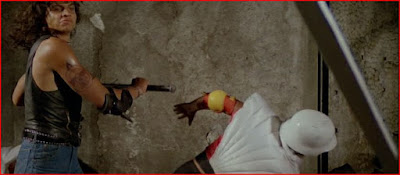
Trash is played by Mark Gregory, a Castellari discovery found in a gym. He's arguably the most post-apocalyptic thing about 1990, because -- I don't know, maybe it's just me -- he doesn't seem quite human. He looks misshapen, top-heavy. He walks in a very careful way, stiff-backed, chest out, and arms stiff at his sides, as if profoundly uncertain of what to do with his hands or concerned that if he didn't step just so the top half of him might topple forward and fall off. On the DVD, Castellari explains that he had to choreograph Gregory's movements very carefully; the result looks like a giant imbecile child's halting emulation of militant adulthood. Here is a man born (made??) to play Frankenstein's monster or a denizen of Goon Island in a Thimble Theater movie. His performance is riveting; watching him, you're in constant anxiety that he'll suddenly malfunction or come to a dead halt. And when he talks, from the mouth of this atavism comes a dese-dem-dose dubbed delivery that sounds about as futuristic as 1970: The Bronx Warriors, at the service of such dialogue as, "We were born dead. Life means nothing. Death walks with us....We carry its smell under our skin." Speak for yourself, Trash.
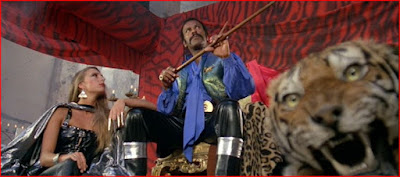
It's good to be the king, even of the Bronx, as Fred Williamson proves in this strangely interactive shot from 1990

Gregory isn't the only thing that's just sort of wrong with 1990. Frankly, the entire cosmic order is out of whack when Fred Williamson is in a movie and a character named Hammer is played by someone else. While Fred is assigned the role of "the Ogre," and attended by a tall blond whip-wielding "Witch," "Hammer" is the handle of the actual star of the film, Vic Morrow. Hammer is a Bronx-born mercenary (Trash: "He's an asshole who thinks he's God") who's under contract to the Manhattan Corporation, the firm responsible for 60% of world arms production. All that power comes into the hands of an heiress, Anne, on her eighteenth birthday, but she's run away to the no-mans-land of the Bronx, where she seems to be the only civilian apart from the occasional comical drunk. Assaulted by the rollerskating Zombies, she's rescued by Trash, whose consort she becomes. Hammer has to retrieve Anne and deliver her back to Manhattan despite her disinterest in warmongering. His plan includes provoking a general gang war, though I suspect the real reason to do that is so he can lead a flamethrowing cavalry into the Bronx to destroy them all.
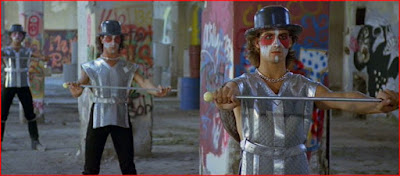
The heroes of 1990: The Bronx Warriors fight mercenaries, "Zombies" and all ... that ... jazz!

So Hammer wanders around the Bronx assassinating folks and planting gang spoor to sow distrust, despite Trash's judicious skepticism ("You fuck," he answers one hothead, "it could be a pile of shit out of someone's asshole."). When the Zombies finally succeed in snatching Anne and all too easily laying out Trash, Hammer tries to buy her from Golan (I still like "Golem" better) while an all too rapidly recovered Trash goes on an anabasis to the Tigers, fending off subhuman Scavengers and Fosse-ite dancing fighters along the way, to recruit Ogre and Witch for a rescue operation. But Anne's rescue by Trash and the Tigers is only the prelude to Hammer's blitzkrieg, codenamed Operation Burnt Earth, the nearest thing to an apocalypse we'll get from this movie and, actually, a genuinely inspired gonzo gotterdammerung presided over by a transfigured, barking mad Morrow, for whom only The Twilight Zone was left after this. It turns out that Trash was right about this Hammer person, who we last see howling, "HAMMER! HAMMER IS GOD!" before being proven wrong.
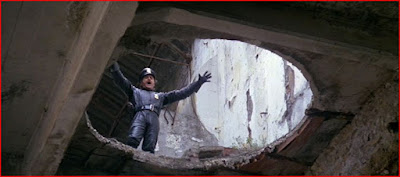
Hammer commands! The horsemen of the post-apocalypse obey!
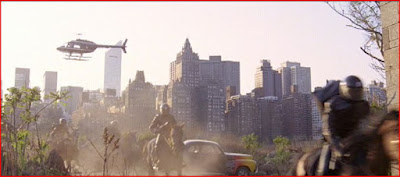
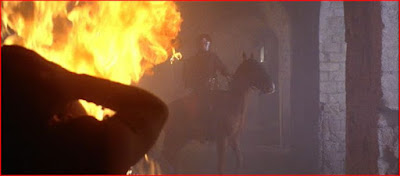

The final ten minutes of 1990 have an exhilarating and sometimes hilarious intensity that exposes just how halfhearted and misconceived most of the movie was. Castellari seems uncertain of the tone he wants to set and clearly had a hard time taking much of the story seriously. There are moments when he apparently wanted to impose a kind of musicality on the film, editing to the beat of a drummer who just happened to turn up at his location during a gang summit and opening the film with an almost glamorous montage of gang weapons, makeup and fashion. You could believe that the film he really wanted to make was Streets of Fire. As it is, there's an obvious artistry to 1990, which is really a meticulously art-directed picture thanks to Sergio Salvati's cinematography and Massimo Lentini's production design. It's pictorially ambitious in a way that later genuine post-apocalypse films wouldn't be. But as far as the genre goes, Castellari's New Barbarians (which I've seen only in its grungy American form) is a more aggressively imagined and more viscerally disturbing film than this one. I intend to watch the better version from the Shriek Show box set soon. Until then, I'll restrict my recommendation of 1990 to those looking for a lark through the slums of the post-Seventies collective consciousness on a purely tourist basis.

Here's an English language trailer (with Dutch subtitles), uploaded to YouTube by aylmer666:

And here's a sample of Mark Gregory walking and talking, sort of, uploaded by grumblenonymusbosch. Anne is played by the director's own little girl, Stefania Girolami:

Sunday, November 29, 2009

ONE DOLLAR TOO MANY (I Tre Che Sconvolsero il West, 1968)

Here's the fourth film and fourth Spaghetti western by the young Enzo G. Castellari, who'll go on in the 1970s to be identified with tough-cop movies and earn a once-removed place in film history as the director of The Inglorious Bastards. In 10,000 Ways to Die Alex Cox gives Castellari a thumbs-up for his next film, Johnny Hamlet, but this one is the sort of thing Cox doesn't care for as a rule: a comedy western. As such, it doesn't even rate a mention in Cox's survey, but it turns out to be fairly entertaining, thanks to Castellari's dynamic direction and the enthusiasm of his three stars.

Frank Wolff plays Edmund Kean, an actor like his English namesake who has turned to crime in the Old West. Disguised as a preacher, he's won the confidence of a stagecoach team who'll be carrying a big shipment of money out of town to the Springwood Bank. The harmless minister asks them to carry along a Bible for the congregation in Springwood. Inside is a time-bomb set to blow somewhere outside town; afterwards, Kean plans to collect the strongbox from the ruins. But he hasn't reckoned on Moses (Antonio Sabato), the generic lone Mexican bandit who holds up the stage before the bomb goes off. Not knowing about the cash shipment, he takes the mailbag (containing the bomb) and sends the stage on its way. Moses rifles through the bag impatiently, finding a few bills and a necklace, and tosses the Book away moments before it blows. Kean arrives moments later and decides to hang Moses for ruining his plans. But once Moses understands the situation he tells Kean that he knows how to break into the Springwood Bank and get at the money.

Kean spares Moses and the film briefly becomes a caper movie. While the actor distracts the populace outside the bank with an impromptu morning sermon, Moses gets the cash after tunneling into the bank overnight and surprising the bank president. When Kean's suddenly dragged off to officiate at a funeral, Moses absconds with all the loot. Kean prepares to give chase but has his plans complicated by Clay (John Saxon), a gambler whom the bank president owes a fortune after a night at the card table. The way Clay sees it, a good chunk of that money belongs to him, so he wants to join the chase for Moses. Kean doesn't want more partners and is willing to fight for his principles, but the arrival of a posse compels the men to join forces to get out of Springwood.


The stars of One Dollar Too Many all have gimmick weapons, but you're meant to laugh at them. John Saxon's gun (below) has a built-in music box that plays after he shoots. "It's a German tune," he explains.

A pattern emerges. As the trail leads to a Mexican village, a train station, a raging river, etc., our three protagonists will switch sides and form different two-vs-one factions depending on who's got the money. Ultimately they have to team up to keep the loot out of the hands of a bandit band and the U.S. Army while making sure not to confuse the valise it's in with a lookalike bag belonging to a comedy-relief henpecked tourist. This gives Castellari plenty of chances to film sprawling, brawling action scenes. Some work better than others. The best is Saxon's battle to escape the Mexican village. He leaps, dives and climbs walls in the manner of Douglas Fairbanks while slugging anyone in his way. Saxon certainly didn't do any of the jumping, but he can throw a punch like a cinema champion.

Saxon slugs Hercules Cortez (above, playing the Bolo Yeung of Mexico) while fighting his way through an angry village.

Less successful is a fight pitting Kean and Moses vs the bandits in a cantina kitchen. Some of the action is good, but the scene simply goes on too long with too many gags about people getting covered with flour or soot. Also overdone, or simply misconceived, is a climactic struggle for the loot on the river that ends up looking like a game of water polo. Castellari was clearly trying to do something original here, but the water simply doesn't give him a good stage for stunts or comedy, and his stuntmen simply flail about in it. He must have realized that he'd botched the climax, because he brings his three stars back for one more running fight scene that at least has plenty of energy before closing the film with the addition of a fourth partner for the team.

The ending still doesn't seem right. The theme of One Dollar Too Many (also known as Vado, Vedo e Sparo -- "I came, I shot and I stole," while the original title translates to "The Three Who Upset the West") is greed, and the characters exhibit greed on a near- epic, Mad Mad Mad Mad World level. Given the cartoonish antics of our protagonists, it might have made more sense for their chase never to end rather than letting them all finally win as Castellari does. But the movie runs on such high spirits, and the actors look to be having such a good time, that you can't hold these debatable failings against it. I can hold Carlo Rustichelli's goofy score against it, but after a while I could tolerate that, too. It's no masterpiece, but it's simply too much fun to dislike.

Videoasia goes too far in proclaiming One Dollar "the first comedy of the genre" on the box cover for Spaghetti Western Bible Vol. 3: The Fast, The Saved and the Damned. Cox reports Franco and Ciccio had already done a parody of the Leone films by 1966. It's possible that Castellari's was the first one (or even the last one) to be good, but I'd need to see more spaghettis before drawing that conclusion. In any event, the Videoasia copy could be sharper, but it looks to be letterboxed correctly. It's one of ten films in the new set (I've already reviewed The Price of Power), and you shall hear from it again before long.

Earlier this month, Mr. Spaghetti Western posted the original Italian-language trailer to YouTube. The picture quality is actually better than the DVD.