Showing posts with label violence. Show all posts

Saturday, November 2, 2013

Pre-Code Parade: THE BEAST OF THE CITY (1932)

Ominous opening credits over a sinister image symbolic of the title are followed by an upbeat patriotic march as a written prologue by the President of the United States scrolls up the screen. It was supposedly at Herbert Hoover's instigation that Metro-Goldwyn-Mayer and William Randolph Hearst's Cosmopolitan production company initiated The Beast of the City. Hoover (no relation to his crimefighting employee J. Edgar) was one of the first to express alarm at the supposed glorification of gangsters in movies. In a movie meant to glorify the police, the President expressed his belief that gangsterdom could be routed if public opinion got behind the cops. At the creative end, the first strange decision was to get an original story from W. R. Burnett. He was the author of Little Caesar and would go on to write High Sierra and The Asphalt Jungle. These works give an idea of where Burnett's sympathies really sat. But if the movie of Little Caesar glorified Edward G. Robinson, presumably The Beast of the City, as scripted by John Lee Mahin (and an uncredited Ben Hecht), would glorify Walter Huston's policeman hero. If so, the writers had, to say the least, an interesting idea of glory.

Charles Brabin's direction is unusually modern, at least early on. The picture opens with (for the time) a realistic observation of police techniques. Brabin's camera pans across a dispatch office, catching a lot of overlapping dialogue and sound effects. It takes several minutes for a plot to get started but Brabin keeps things interesting until then. When the cops finally find evidence of a gang murder, the camera follows Huston's ambitious police captain as he makes his way through Sam Belmonte's nightclub to the lair of Belmonte himself (Jean Hersholt is a strangely Germanic Italian) to bring the gang chief in for questioning. At headquarters, Huston wants to give Hersholt the third degree but is held back by superiors until it's too late and the lawyers arrive to spring their client. Huston is a family man; we see him at breakfast, attended by a son (Mickey Rooney) and twin daughters who make terrible pancakes. The weak link in the family chain and the police force alike is Huston's brother and brother officer (Wallace Ford). If the object of this picture was to glorify the police, no one told Ford, who plays his part in full loser mode. Possibly owing his position to nepotism, Ford hopes for advancement as his brother rises through the ranks, yet falls into the clutches of a vamp. From the advertising, you might think that Jean Harlow had the title role in this picture; it's certainly her most outright evil role. As one of Hersholt's molls, she seduces Ford and gets him to collaborate in crime, disgracing Huston's family.

 
Harlow supported the release of Beast in person in select cities

Let's get to the glorification. They must have wondered about the glorification angle at the studio until someone had the idea of a blaze of glory. Here's the set-up: Hersholt gets acquitted of murder because Ford is too much of a loser to testify about what he knows. Ashamed, he tries to make it up to his brother by tipping Huston off that the Belmonte gang is celebrating their court triumph at Hersholt's nightclub. I don't know what Ford had in mind, or thought that Huston had in mind, but our hero has had enough of criminals getting away with murder and so on. He leaves his life insurance policy out for his wife to see in the morning and gathers a picked team of similarly sick-and-tired cops outside the nightclub. Inside, the gang (with Harlow) revels, mocking an effigy of the Huston character set up in uniform as the guest of dishonor. Ford appears to tell Hersholt off once and for all. Just as he's about to get his ass kicked, Huston and his men appear. As for what follows, actions speak louder than words, so I'll show you the clip. David Inman uploaded it to YouTube.


For pure volume of violence only the battle scenes in All Quiet on the Western Front top this, and I don't think it would be equaled until The Wild Bunch, which is what this sequence reminded me of the most, from the mocking revelry of the villains to the ensuing war of annihilation. Supposedly, the brass at M-G-M realized that their little armageddon had fallen short of the glorification goal, and as you've seen they promoted it as a Jean Harlow picture. In a way, however, they hadn't failed. The Beast of the City works as a counterpart of the seminal gangster films, adopting an equally hard-boiled attitude (including lots of Pre-Code references to "hop"), only from the police point of view. The apocalyptic imagination at work must have faithfully represented a widespread frustration at the waxing power of organized crime and the apparent inadequacy of established means of dealing with it. Beast is a preview of the quasi-"fascist" films of the following year or so -- including Walter Huston as a possessed President in Gabriel Over the White House -- that imagine extraordinary, extralegal measures against unprecedented criminality. Those films are an essential if not pretty part of Pre-Code cinema, while The Beast of the City, if not the pro-police propaganda President Hoover envisioned, is a respectably intense crime drama in its own right.

Monday, August 27, 2012

Hideo Gosha's VIOLENT STREETS (1974)

The Toei studio promoted Hideo Gosha's picture as an all-star "new style" yakuza picture, which makes you wonder whether Japanese audiences were getting tired of Kenji Fukasaku's style of yakuza picture while his classic "Battles Without Honor or Humanity" series was still in progress. Gosha's movie definitely is different. While Fukasaku aims at chaotic immediacy by filming violence with a handheld camera, Gosha takes a more carefully pictorial approach. His stages many of his violent set pieces in bizarre settings, most notably a junkyard amid a pile of mannequins and twice over in a chicken coop. In contrast with many of Fukasaku's films, Gosha's makes no pretense, as far as I could tell, of recounting actual events. Gone is the narration that opens and closes many Fukasaku flicks, as well as the captions identifying characters and their places in the yakuza hierarchy. In that respect, Gosha achieves a different kind of immediacy, but his real goal seems to be a greater intimacy, albeit in the more salacious sense of the word.


I don't know if poultry's a big part of the menu at Noboru Ando's place, but I wouldn't recommend the special he serves up to the unhappy patron below.

The star is Noboru Ando, who as a former yakuza presumably had the same sort of credibility that gangsta rappers often claim for themselves. Authenticity gave Ando an advantage as an actor; he rarely had to prove he was tough with the sort of bluster other actors employed. With his almost sleepy eyes and laid-back demeanor -- he reminds me just a little of Jet Li -- he's often the calm center of a storm. That's especially true here, where the storm breaks around him without his character knowing it. He plays Egawa, once boss of his own family who's been eased into retirement with the usual consolation prize of a niteclub. His is the Madrid, and the Spanish gimmick, including flamenco music in the floorshow, is another way for Gosha to individualize his film. The Madrid is a hangout for his former gang, many of whom feel like they were kicked to the curb by the reigning yakuza group, which has its tentacles in many areas of business, including the entertainment industry. Without consulting their own boss, despite their constant protestations of loyalty, these guys try to muscle in on the entertainment side, kidnapping a popular young TV singer and demanding 100,000,000 yen ransom. They get the money but leave a corpse behind; one of the gang accidentally strangled the girl while trying to rape her.


This goes down just as the local yakuza, who control Tokyo's Ginza district, face a growing challenge from the Western Japan Association, which dominates most of the rest of the country. The locals initially assume that the outside interlopers are behind the kidnapping and the escalating gang war brings in some exotic players, including a cross-dressing hit-person with a razor fetish who performs in live sex shows on the side. As the major parties jostle for position, the Madrid club looks more and more like a useful pawn. The people who gave it to Egawa want it back, claiming that they retain the original lease. With his position under siege and his old cronies getting slaughtered, Egawa finally has to take the fight to the enemy.


Violent Streets' cross-dressing killer is a kind of mannequin him/herself.
Is Gosha making a point about disposable humanity?

Toei also promoted Violent Streets as a "Big 4" film featuring many of the studio's top yakuza stars. Along with Ando, the film features Akira Kobayashi as a friend of Egawa's who grows steadily disillusioned with the business, Tetsuro Tanba as the boss of the Western Alliance, and Fukasaku's main star Bunta Sugawara in a cameo role. Sugawara is hilarious as a gun smuggler who supplies Egawa with ordinance and insists on accompanying him on a raid on a rival niteclub. I've never seen Bunta as mellow, or practically stoned, as he is in his brief turn here. He has headphones on throughout and spends most of the attack lounging in the back seat of Egawa's car drinking, chewing on a sandwich and listening to whatever, stirring occasionally to shoot someone. In mid-getaway he asks to be let out on some nondescript street and makes his exit with boombox in tow, living in his own world. It's a wonderful comedy-relief bit that doesn't compromise the grim edge of the main story.


Ando goes on the attack while Bunta looks on.


Gosha's Ginza is full of eccentrics and dysfunctional people. Egawa has to deal with an alcoholic hostess and sometime lover while pining for another woman, which only provokes the hostess's jealousy. Our hero seems like the nearest thing to a well-adjusted person in his semi-retirement, but any vision of stability he has is certainly doomed. He remains a man of violence, as Gosha establishes in the very first scene when he roughs up some rowdy customers. Had he been different, he might have sold out early and escaped the fate he ends up choosing for himself. Yakuza films are often bleak affairs, especially after Fukasaku replaced a myth of underworld chivalry with a more cynical vision. Violent Streets isn't very different in that respect. In the long run, what distinguishes it isn't Gosha's grotesque set pieces as much as the convincing performances from Ando and the rest of the cast. They're not necessarily better for Gosha than they were for Fukasaku -- Sugawara in particular is definitely at his best with the latter director -- but they're somehow liberated here by not having to pretend that they're re-enacting history. Fukasaku's yakuza films are great movies, but Violent Streets arguably comes closer to pure cinema and is definitely a more self-conscious work of violent art.

Monday, January 23, 2012

On the Big Screen: HAYWIRE (2012)

Here is Gina Carano in her element: the fenced confines of the mixed martial arts battleground. The video was uploaded by ginacaranodotorg.


A star was not born last weekend after Steven Soderbergh's Haywire opened weakly at the box office. It was telling that more people wanted to see Kate Beckinsale fight than went to see a real woman fighter -- but who goes to movies to see a real fight? Soderbergh's error in thinking he could make a star of Carano, at least in the film Lem Dobbs wrote for her, becomes apparent when we think about movies and mixed martial arts. MMA has been the backdrop for several films by now, but Haywire may be the first non-exploitation, non-straight-to-video movie to cast an MMA fighter as an action hero. While MMA promoters would like you to imagine the sport as a constant battle of kicks and punches, most people realize by now that grappling and "ground and pound" prevail much of the time -- and ground-and-pound just isn't cinematic. Granted, Soderbergh doesn't film Carano using much ground-and-pound technique, though she does get to choke out at least one of her co-stars. Nevertheless, the director is part of the problem. He undercuts Carano's credibility somewhat by resorting to heavy editing, perhaps to accommodate such opponents as Channing Tatum, Michael Fassbender and Ewan McGregor. Watching it reminded me of the way insensitive directors of musicals disrupt the virtuoso flow of dance by impulsively cutting within a number. If you think about it, people like Hermes Pan and Yuen Woo-ping are in the same business. Like dance, cinematic martial arts is all about choreography, but Soderbergh, perhaps out of some misguided commitment to realistic fight techniques, gives us fight sequences with occasionally impressive bursts of Carano's indisputable power but none of the sustained physical spectacle that make great martial-arts scenes memorable. Again, doing that might not have been true to Carano's true talent, but that brings us back to the question of MMA's cinematic potential, and around to the larger question of whether Soderbergh, despite his stated intention of making this MMArtist a star, actually meant to make a "martial arts" movie.

Soderbergh and Dobbs last teamed up for The Limey, and like that film Haywire is a revenge story. But while the earlier film's title Brit was avenging a lost daughter, Carano's Mallory Kane is only avenging herself. She's an "added value" operative for some sort of private espionage contractor hired to rescue a kidnapped Chinese dissident journalist in Barcelona. Moving on to Dublin, she learns that the same journalist has been murdered, and she's been framed on the assumption that she won't leave Ireland alive. As in The Limey, this is all told in flashback. The film actually opens somewhere in upstate New York with the shock sight of personable Channing Tatum throwing a cup of fresh hot coffee in Carano's face. The subsequent flashbacking explains how she got there, though Tatum's role (he was one of her partners in Barcelona) remains ambiguous. Echoes of The Limey persist in the hilltop mansion of Mallory's military-buff dad (Bill Paxton) and a climactic confrontation on a beach. But Haywire has none of the gravitas Terence Stamp brought to Limey because we know next to nothing about Mallory Kane's past, how she got to be (and got to be accepted as) a super-agent fighting machine, while neither the dissident's death nor the collateral corpses that accumulate along the way weigh on the heroine's conscience the way the Limey's daughter's death did on his. Nor does Soderbergh ever really give Carano the kind of awe-inspiring badass spotlight that shined on Stamp. Her story is simply too irrelevantly complicated. I found myself not caring who was ultimately to blame (McGregor? Antonio Banderas? Michael Douglas?) for setting Mallory up. Once the story proved uncompelling, the film's shortcomings as martial-arts spectacle became more glaring. What this film needed above all was a scene in which Mallory faced someone we could believe as her equal or possible superior. It never happened, and if we were to understand that the Tatum or Fassbender characters are her martial peers, Soderbergh does nothing to establish their credentials.

Haywire is a weak rather than bad film. It's technically competent and well-acted overall -- Carano herself is at least adequate for her role. You might not gripe if you don't have to pay first-run prices to see the thing. It may be a victim of misplaced expectations, since I may have been expecting a different movie from the one Soderbergh intended. But if you declare your intent to make Gina Carano a star, that creates a certain expectation immediately whether Soderbergh realizes it or not. The most I can say is that I saw enough of Carano onscreen to think she should get another chance. It's a shame that people might leave the multiplex this week thinking that Kate Beckinsale could kick Carano's ass. But in a medium where Beckinsale can do what she does in her movies, that outcome might be inevitable.

Thursday, January 5, 2012

SUPER (2011)

Common sense would seem to tell us that a movie about a real-life or real-world superhero -- one without actual superpowers or a billionaire's resources -- can end only one way: with the abrupt demise of the would-be crimefighter, especially if he or she plays by the conventional comic-book rule and eschews firearms. On that expectation, a "realistic" superhero movie will not be a long one unless the majority of the film builds to the hero's first (and last) night out or his first (and last) confrontation with superior numbers or firepower. Are there such movies? Their absence shouldn't surprise us, since comic books themselves echo the mentality of movies. Both media tap into a common tradition of burlesque slapstick violence as well as universal power fantasies. That aside, who'd want to see a movie that has nothing to say but, "Don't try to be a superhero; you'll be killed?" Yet we do see movies that try to split the difference by showing us ordinary or less-than-ordinary people emulating comic-book heroes and usually, however improbably, succeeding. We want to see someone make an ass of himself in a superhero costume, but then we want to see him win after all, reversing the old comedy formula of rooting for the transgressor against boundaries but also laughing at his inevitable comeuppance. That results in movies like Kick-Ass, in which the cinematic fantasy of a child killing-machine belied the creators' presumed commitment to the "real" world. It also results in James Gunn's Super, which can be seen as a still-more realistic, raunchier version of Kick-Ass, but would be more accurately described as a cross between Taxi Driver and Rat Pfink a Boo Boo.

Instead of a kid, Super has a grown-up loser for a hero. Frank (Rainn Wilson) is traumatized when his wife Sarah, a recovering addict (Liv Tyler) runs off with Jacques (Kevin Bacon), a glib sleazeball with a posse who we can tell right off is more dangerous than Frank initially realizes. Helplessly enraged, he wants the police to arrest Jacques for "stealing" Sarah when it was self-evident that she left of her own (albeit drug-addled) will. Frank is already deeply disturbed and emotionally stunted: he watches tentacle porn and a Christian superhero show as he broods on his loss. He has a mad vision of alien tentacles removing the top of his skull so he can receive a touch from the finger of God, a visit from the Holy Avenger (Nathan Fillion), the TV hero, and the idea for a mask and a logo. He becomes the Crimson Bolt, initially weaponless but soon armed with a pipe wrench after a clumsy first fight. The Bolt simply whales away on an array of malefactors caught in the act -- drug dealers, child molesters, people who butt in a ticket line -- but the news media and the police see his interventions as random attacks on innocent people.  His career is endangered by the fact that anyone who's ever met the tall and pathologically awkward Frank will immediately recognize him under his mask, but some simple plot complications serve to put the cop who suspects the truth out of action. One person who doesn't see him as a criminal is Libby (Ellen Page), a comic-shop clerk who proves something of a cosplay fetishist with an untapped violent streak. When Frank is forced to reveal his secret to her -- she had already suspected, given his "research" at her store -- Libby dumps her boyfriend and declares herself the Crimson Bolt's sidekick, Boltie, complete with homemade costume. Together, after much convincing of a wounded and worried Frank, the costumed team escalates their war on crime with a trip to the gun shop before a climactic assault on Jacques's mansion, where Frank has learned that a major drug deal will go down and where Jacques uses Sarah as a test subject for dope and entertainment for the dealers....

Taxi Driver is such a part of our collective movie consciousness that Gunn may not have realized how much he'd imitated its structure here. Super may be the most alarming variation on Taxi Driver to date, thanks to its ultimate assertion that the Crimson Bolt's bloody rampage against crime was somehow therapeutic for Frank. At some point, the script evolved from a mockery of superhero wannabees to something symbolic. When the Bolt tells Boltie that though "we'll never be ready" to assault Jacques's compound, they have to do it sometime and preferably now, the film seems suddenly to be teaching us life lessons about taking chances and accepting risks. Although the ending doesn't prove quite as happy as Frank may have wanted at first, Gunn seems to want us to accept that Frank is a better person for having stood and fought, and even for having loved and lost. The last scene, in which Taxi Driver's news clippings are echoed by Frank's drawings of his modestly happier life, could still be seen as proof that Frank is a profoundly disturbed person -- which would make Super still more an echo of the Scorsese film. But I don't think Gunn means us to see them that way. He might concede that Frank is still weird, but I think we're meant to agree that he's weird now in a way less threatening to himself or others.

Since I don't watch The Office, Super is my first real encounter with Rainn Wilson, and I was impressed. He does the most to make Frank's superpowered evolution from infantile inhibition to relative well-adjustedness plausible and amusing, and as a husky man he makes you believe that the Crimson Bolt starts with a minimal fighting chance against his enemies. Gunn's script helps him out considerably; just when you're asking how a wretch like him could have won a Liv Tyler, Gunn delivers flashbacks illustrating Sarah's emotional neediness as a recovering addict and Frank's availability as a co-worker and AA sidekick. Ellen Page comes off less well; her Libby/Boltie is an unconvincing jumble of impulses. She's undermined a little by the art direction of lack of it that gives no indication in her apartment of how much of a superhero geek the character is, but the script doesn't really do much to motivate her sudden violent streak. Super's dependence on actual living spaces also raises some questions about the economics of Frank's city. He and Sarah were apparently able to afford a house on the salaries of a short-order clerk and a waitress, while Libby has a halfway-decent apartment to herself (she can host parties there) on her earnings as a comics-store clerk. Somehow these details seem nearly as unrealistic as the Crimson Bolt's resilience in action. Finally, regarding actors, I have to say that this was Kevin Bacon's best performance as a comic-book villain in a 2011 release. He was cluelessly miscast as a mutant Bond villain in X-Men First Class, but fills the bill nicely here as a nervy scumbag who only confirms the movie's own essential comic-book nature by taunting an injured Bolt instead of finishing him off.

Super arguably outdoes Kick-Ass on the ultraviolence scale, though the gore and other practical effects are almost always used for laughs. Bolt and Boltie giddily massacre Jacques's bodyguards with fire, bullets, bombs and "Wolverine" claws, and we're always meant to laugh, except when Gunn occasionally reminds us of the severity of the stakes for our heroes. There's at least one moment when a character dies violently when we're clearly not supposed to laugh, and that moment probably best illustrates the contradictory messages sent in Super. It's frequently a very funny film, but sometimes you wonder what you're actually laughing at or laughing with. That's not necessarily a bad way to leave this picture. I'm sure Gunn meant it to be funny and disturbing, and whatever other impressions it makes, he succeeded on both counts.

Saturday, September 24, 2011

On the Big Screen: DRIVE (2011)

Late as I am to the party, I'm probably saying nothing new if I mention that Nicolas Winding Refn's new thriller, which has become perhaps the most divisive movie in the blogosphere this year, is very much a backward looking film. If anything, commentary to date has understated Drive's retrospective scope. Masters of the obvious note the film's debts to crime cinema of the 1980s, particularly the works of Michael Mann and Walter Hill, and Mann provides a jumping-off point to trace Refn's influences back to Jean-Pierre Melville, a fellow European. But we can go further back yet. I saw hints of Robert Aldrich's Kiss Me Deadly in the hero's nighttime shoreline showdown with an enemy, for instance, and that takes us back to the 1950s. Beyond that, this is a film so soaked in history that Frank Capra's grandson is one of the producers. But let's draw the line at Capracorn; Drive has none of that, though its hero is, for all intents and purposes, a John Doe. Nevertheless, the Capra family tree takes us all the way back to the silent era, and in the skeleton of its story and its aspirations to pathos, Refn's film, adapted by Hossein Amini from a James Sallis novel, is like a silent film -- like many a silent comedy, to be more precise. A nameless denizen of an underworld pines for a woman and the family life she embodies, but renounces his desires, first to secure a future for the woman and her husband and then, after that doesn't quite work out, solely for the sake of the woman and her son, before he hits the road one more (or last) time -- but not until some spectacular gags (as movie stunts are often called) take place. I don't mean to say that Drive is funny -- it's not even unintentionally so. But it's more evidence for my contention that the modern action film evolved from silent comedy (Buster Keaton's The General being the proto action film). Everyone notes that the anonymous driver, whom I'm tempted to call Scorpion for the design on his jacket, has little to say in the picture, but they trace that to Mann and Melville's brooding antiheroes. I'm just saying you can go much further back to sound the depths of Drive's influences. But to get to the meat of the matter, you might not have to go so far back in time. Refn may have tipped his hand slightly when he (or Cliff Martinez, who's credited with the soundtrack) went to the Tarantino well to score the scene where a masked Scorpion lurks outside a restaurant where Ron Perlman's gangster is partying. I feel certain that I alone in the afternoon audience recognized those lyrics as they played, and I practically marked out. Let me show you why. Take a look at the first three minutes of this clip that dmovie27 uploaded to YouTube.


Riz Ortolani wrote that tune for the late Gualtiero Jacopetti's 1971 magnum opus Goodbye Uncle Tom, a time-traveling trip to the days of slavery in all its squalid and intimate cruelty. Ortolani made a specialty of composing soaringly romantic music that served as counterpoint to cinematic brutality, the other great example of his approach being his sublime theme music for Ruggiero Deodato's Cannibal Holocaust. Including Ortolani on the Drive soundtrack is arguably an assertion of the actual "European" character of Refn's film, as opposed to whatever Albert Brooks's film producer-turned-gangster means when he notes contemptuously that critics had called his '80s action films "European." Like many Euro directors and composers, Jacopetti (with Franco Prosperi) and Ortolani juxtaposed soundtrack lyricism and visceral violence in a manner that remains offputting to many Americans. Likewise, some American reviewers this month have been taken aback by a sudden eruption of ultraviolence in Drive after a relatively non-violent first half. I can understand the objections to some extent because it comes as an abrupt shock, not that the story turns gory, but that Ryan Gosling's driver proves so capable of extreme brutality. It's not that he's too pretty or too bland to be a killer, but that he appeared to have been established as not a killer, just a driver. Had he been shown as a man of violence from the beginning -- had he played a hitman rather than a driver, and had the ultraviolence been a constant rather than a sudden change in the picture -- the violence wouldn't have the jarring and in some cases deal-breaking effect it's had so far. But there seems to be a point to the violence arriving late and suddenly. The scorpion on Gosling's jacket tells part of the story. He alludes to the fable of the scorpion and the frog at one point, but the script assumes our knowledge of the tale, which in moviedom is most identified with Orson Welles. In the fable, the scorpion invites the frog to ride across a stream on his back, despite the frog's fear that the scorpion will sting him. In midstream the scorpion does sting him, which seals his own fate as well. As the frog protests and they both sink, the scorpion reminds him that stinging is simply his nature. In Drive, the driver's (or Scorpion's) nature is violent, even if he could hope otherwise and dream of Hollywood stuntwork, stock car racing, or the love of a good woman. Violence marks the nameless man as the permanent outsider who can never have a settled life, just as it often marked the silent clown who could never avoid trouble with the cops or miss an opportunity to wreck stuff.  The synthesis of aspiration and disillusion is pathos, and pathos is one thing Drive has that can't be traced to the Eighties.

For Refn, as for his European (usually Italian) forebears, extreme violence is a kind of reality principle that subverts the idealistic mood of their films' upbeat, romantic music. A perverse kind of pathos evolves, for instance, when Ortolani uses a more insistent, rocking instrumental of his Uncle Tom theme to score a horrific rape scene. Drive's violence serves the same disillusioning yet deliberately pathetic purpose. We ought to note that the violence here isn't as extreme or blatant as it could be. When Scorpion stomps someone's face in, we get one horrifically suggestive shot when bone appears to cave in, but Refn doesn't keep his eye on the destruction the way Gaspar Noe does when a man's face is staved in with a fire extinguisher in Irreversible. There are other moments when Refn turns or cuts away from the worst we could see. That may have been to avoid an NC-17 rating, but it also tells us that the violence isn't really an end unto itself. It simply signifies the irreconcilability of Scorpion's world with the world he longs to join. Drive isn't a gore film, but a thriller, and it works well as that. Refn (who supposedly doesn't know how to drive himself) stages a number of nice old-school car chases as well as tense moments of pure waiting and anticipation. It has a couple of charismatic yet convincing villains in Perlman (whose buffoonish brute made me think of a Will Farrell assembled from dead bodies) and the stunt-cast Albert Brooks, who continues an honorable tradition of comics-turned-heels that recognizes an inherent viciousness in comedy. As the object of Scorpion's adoration, Carey Mulligan may as well be Edna Purviance, but that's not a rip on the actress; it's just the nature of her role. As for Ryan Gosling, I'm not sure yet whether I really liked his performance or not. He doesn't really look the part, though I'm hard pressed to tell you what Scorpion should have looked like. I guess I can't shake a feeling that Gosling's benign-bordering-on-bland visage is part of a cheat on the film's part, a concealment of its true nature -- but on the other hand, Gosling's character is practicing a kind of self-deception when he dreams of domesticity and fatherhood, though we may not realize this as soon as we should. On some level he's a cypher, on another a pathetic striver, almost Keatonesque in his taciturnity. He's at his most chilling when he covers his already-sort-of masklike face with an actual mask, the bald movie-star mold (Vin Diesel?) he wears when stunt-driving, to become a Michael Meyers-like stalker -- and maybe that scene, in which he drives his enemy into the sea like an implacable figure from some other fable, shows us the driver's true self. That scene is eerily evocative and one of the best in a picture that has a multitude of powerful moments but may not quite add up to the sum of its parts. Few films released this year have been as potently evocative as this one, though, and my experience proves that you don't have to be enamored of Eighties cinema or Eighties culture to enjoy Drive.

Sunday, September 18, 2011

PIRATES OF THE XXTH CENTURY (Piraty XX veka, 1979)

Among the stuff you'll find when you look for free feature films online is a trove of English-subtitled Russian films from the Soviet era and beyond. Mosfilm has its own YouTube channel, while the "PyccoTypucmo" (pronounced "RussoTurismo") channel has even more titles, including Boris Durov's action hit for the Gorky Film Studio (watch it here), a rugged adventure film that compares respectably with grindhouse movies from the capitalist world. Apart from a certain flatness of characters, there's little to mark this as a Communist film, and I'm sure it wasn't made with any propaganda purpose in mind. Brezhnev-era Bolsheviks believed in entertaining folks, and Soviet Man appears to have been entertained by the same stuff that pleased his bourgeois counterparts: violence towards men and women, violence by gun, knife, foot, fist and grappling hook -- the faster paced, the better.

At a few seconds short of 80 minutes, Pirates of the XXth century practices truth in advertsing by showing us modern-day pirates in action. But we start with a Soviet freighter, the Nezhin, picking up a boatload of medicinal opium, bound for Vladivostok and distribution to hospitals. The opening credits promise martial-arts action, as we see a crewmember practicing with his "numbchuks" and breaking boards to entertain his mates. This energetic routine is interrupted when the crew discovers a man adrift in the water. The rescued man, Saleh, speaks no Russian, but some of the crew speak English, and they learn that he jumped a ship whose cargo of cotton caught fire. Next, the Nezhin discovers a disabled ship, the Mercury. Its distress is a deception, as was Saleh's. As he creates havoc on the Nezhin, destroying its radio, pirates from the Mercury -- a crew of terrorists and mercenaries -- storm the ship, slaughter most of the crew, steal the opium and set the vessel ablaze. As the pirates zoom off, a handful of survivors, including two female crewmembers barely saved from drowning, pile into a lifeboat in search of safety.

Fortunately, the survivors find land before long. Unfortunately, they've stumbled upon the Mercury's base of operations. But that actually gives them a chance to recover the opium and bring the pirates to justice. With help from a native girl, the Russians capture weapons and manage to take over the Mercury. But the pirates have mined the bay to deter pursuers, and the Russians can't get out. Worse, their two hapless women -- if anything, the "progressive" Commies were retrograde, on this film's evidence, in their portrayal of women -- have been captured and subject to torture. Happily, the pirates are willing to negotiate and let the Russians leave with their skins intact, though without the opium. The sailors don't trust the offer, since they could obviously lead a navy back to the pirates' lair, but they go along in order to give heroic first mate Sergei (Nikolai Yeryomenko) a chance to take the villains down single-handedly and shirtlessly....


This is undemanding mayhem, impressively staged on locations and on the open sea with real ships. The action is often quite brutal, and the violence against the helpless females is just about as exploitative as anything you might have seen from the "free world," without the compensatory, quasi-empowering revenge. Again, if you think of the USSR as part of a generic global "left," you might expect more female empowerment here, but Pirates is very much an unapologetic "Men's Adventure" type of film, from the modern-piracy theme to the exotic backdrop for torture. It's also indelibly a Seventies film, as the disco-esque score will tell you right away. Wikipedia claims that this was the most popular film of 1980 in the USSR, and I imagine it must be an iconic movie for Russia's Seventies fetishists. It was a great find for me, if not a great film, because I'm always intrigued by what true pop cinema, as opposed to arthouse cinema, looks like in different countries. Pirates of the XXth Century probably isn't the face Soviet cinema meant to show the world, the cinematic commisars probably having something more refined in mind. But it shows us that, even at a low point in the Cold War, the years of the invasion of Afghanistan and the Olympic boycott, moviegoers in the communist and capitalist blocs -- or some of them, at least, spoke a common language.

Saturday, September 3, 2011

HOBO WITH A SHOTGUN (2011)

You have to laugh. There's no other way to deal with Jason Eisener's attempt at an instant-cult film, an affectionate burlesque of 1980s vigilante movies. For my purposes, "burlesque" is a particular type of comedy, something different from parody or satire. While parody makes fun of genre conventions, and satire exposes their unreality, burlesque exploits the artificiality of genre and the artificiality of drama itself without repudiating or negating what it exploits. Burlesque laughs with its material, not at it, sharing with its audience the fundamental joke -- "that's not real!" -- while continuing to play the material with as straight a face as necessary. The core form of burlesque is slapstick comedy, which subjects characters to traumatic violence without truly traumatizing them. Hobo With A Shotgun is a slapstick comedy, as is only proper, since the action movie as we know it evolved from silent comedy. It's the sort of film where a character can have her arm ground to a gory point by the blades of a lawn mower, and can immediately use the sharp stump to stab her tormentor -- all this less than 24 hours after her head had nearly been cut off by a hacksaw. You may not find that funny, but it's meant to be funny. By hyper-exaggerating the already exaggerated violence of vigilante movies -- not to mention post-apocalypse films and spaghetti westerns -- Hobo takes cinematic ultra-violence back to its comedy roots. So it's probably no accident that its hero is what once would have been called a tramp.
The story is an amalgam of spaghetti western, vigilante film and post-apocalypse in a retro, 80s-ish setting. The man known only as the Hobo (Rutger Hauer) arrives in Hope Town, renamed Scum Town by a graffiti artist. The place is far behind the times, assuming the time to be the present and not the actual 1980s. A video arcade is one of downtown's main attractions and stereotypical spike-haired punks lurk in the background. An entrepreneur films bumfights with an old-timey camcorder. There's little evidence of an economy, even a criminal one. The town is ruled by a ruthless, nihilistic and sadistic family, "The Drake" and his two sons, who demand applause whenever they put enemies to death and freely dump sacks of cocaine everywhere to keep the populace dependent. They seem motivated by nothing more than cruelty, and they cultivate cruelty in their followers. Topless girls beat a man dangling upside down with bats like he was a pinata. In the arcade you can hit a homeless man in the foot with a huge hammer as if he was the bell-ringing test of strength at a carnival. Not even children are safe. They are torched alive in school buses and dumpsters, or else molested by Santa-clad predators. The unmotivated cruelty of Scum Town and its rulers reminded me of spaghetti westerns, and the impression would be reinforced by the arrival of a mysterious stranger. But the same lack of motivation costs Hobo much of the contemporary relevance -- apart from its essential compassion for the homeless --  that vigilante films may have had in their own time. It's less Death Wish than Death Wish 3, for those keeping score. Still, it's cool to see an action film with poor folk at its heart.
Once upon a time, Rutger Hauer was such a beautiful man that Anne Rice thought him the ideal actor to play the Vampire Lestat. Now he is a Hobo with a Shotgun, and there's no illusion that this film will do for him what The Wrestler sort of did for Mickey Rourke or JCVD might have done for Jean-Claude Van Damme. Hauer is clearly a limited performer at this stage of his career, but like many a beloved B-movie performer he gives his all here. At his best, he sells the salient point that, for all his heroism, the Hobo is as crazy as a bedbug. He's hobbled sometimes by writer John Davies's desperate attempts to give the character memorable lines, but he gives a completely sincere performance that helps make the Hobo a figure of pathos amid the carnage in keeping with the cinematic heritage of homelessness. To put Hobo in historical perspective, think of it as Chaplin's Easy Street with exploding abdomens, decapitations, and lots of wirework to sell shotgun blasts. Hauer's Hobo even has a girl to pine over, though his relationship with Abby the spunky prostitute (Molly Dunsworth) is more quasi-paternal than romantic. By modern standards, the Hobo's admirably free of backstory baggage; Davies and Eisener resist any temptation to explain why the old man is riding the rails at the start of the show. This sort of hero needs to be a stranger -- or an everyman -- in a way few action heroes today are allowed to be. There's something primal in his anonymity that'd be lost if there were a why to his wandering or his madness. When he grabs the shotgun off the pawnshop rack to stop an armed robbery, abandoning his dream of a one-man lawn-mowing business, it's not to resolve a daddy issue or to redeem himself for some past failure. It's simply the right thing to do, and would be for anyone, as far as this film's concerned.
Hobo With a Shotgun has a lot going for it creatively, from the queasily colorful cinematography of Karim Hussain and suitably grungy location work to a collaborative score that opens with a gloriously overripe pastoral theme that reminded me of Riz Ortolani's beautiful themes for such stuff as Goodbye Uncle Tom and Cannibal Holocaust and closes with a poignant train whistle. It's evocative and allusive in many ways, especially in its use of The Plague, a team of killers who show up like post-apocalyptic menaces and star in their own video game yet look more like robot refugees from a Republic serial.
 
There's a wonderfully gratuitous moment when the Hobo wakes up a captive of the Plague, and sees the duo tending, with considerable effort, to their pet octopus. The moment hints at depths of unsounded weirdness that enrich the film's fantastical feel. On the other hand, the primary villains are Hobo's main weakness. The Drake and his boys seem to see themselves as entertainers keeping the masses docile with dope and deadly circuses, but they're not very entertaining themselves. Neither the roles nor the actors really rise to the level of surreal supervillainy the concept needs to thrive. The weirdest any of them get is to wear hockey skates into battle; they seem pretty mundane otherwise. But there's a lot to enjoy here without them, whether you're a genre buff who recognizes all the influences at play or a fan of over-the-top violence. However, there's not much here for those with over-refined scruples or, alas, for people with purely contemporary taste in action. Hobo's retro approach will seem pointless -- or, worse, simply cheap -- to those accustomed to CGI mayhem and the god's-eye perspectives it makes possible They'll be hard-pressed to understand why Eisener made the film this way, and at that point an exploitation film arguably ceases to be pure exploitation. It may be scandalous to say so, but this gruesome exercise in deliberate obsolescence comes closer to being a work of art. But don't let that keep you away; if you're looking for a wild catharsis to break the tensions of the moment, Hobo With a Shotgun is a mad, epic, hilarious riot that lives up to its hype.

Thursday, March 3, 2011

CRY OF A PROSTITUTE (Quelli che contano, 1974)

As censorship receded around the world in the 1960s and afterward, the U.S. embraced sex while Europe embraced violence. This is a very broad generalization, but I'm still grappling with the importance of cruelty and brutality in European popular cinema and some of its art cinema. In many cases, it seems to be a kind of reality principle, a sign that the filmmaker is trying to tell it like it is. It's a conscious rejection of romantic idealism and enforced optimism, a crude antithesis to the romanticism often expressed in the films' own lush and soaring scores. What were audiences supposed to make of it all? We assume that they got a kick out of the violence, but how did they react to the worldview, the cynicism and pessimism that so often prevail in these films? In historical films, I've described it as an acknowledgment of the injustice that prevailed in the past, whether in medieval Europe or in the savage border country of spaghetti westerns. What about cruel pictures set in the present day? Did audiences accept those as truth-telling exposes of modern injustice? Were these films consciousness-raising exercises or did they contribute to conservative complacency? Did they tell viewers that there was no hope in a violent world, or did they suggest that violence was the only answer?

Watching Andrea Bianchi's brutal Mafia potboiler, whose Italian title translates literally as "Those Who Matter," I couldn't help wondering whether people were meant to enjoy the experience, or whether they were supposed to be satisfied by recognizing some sort of violent truth in the derivative story. In fact, the story is derivative of spaghetti westerns. It has the Fistful of Dollars/Yojimbo/Red Harvest element of a protagonist playing two factions off each other. It also has the Once Upon a Time in the West element of a killer who performs his own theme music with mysterious significance. Instead of playing a harmonica, Tony Aniante (Henry Silva) whistles an enigmatic, strangely amplified tune while enemies stand about stupefied or confused until Tony steps out of cover and shoots them. He's an American gangster sent to Sicily to settle a local squabble over heroin, some of which was being smuggled inside of "cut up babies." He also has an agenda of his own, hinted at by the whistling and the occasional black and white flashback to some scene of uncertain relevance. Tony is not quite a spaghetti western bounty hunter transplanted to Seventies Sicily, however.

Silva gives a laconic, tightly wound, uncomfortable performance. He talks (dubbing his own voice) in a stilted way, as if keeping in sync with the rest of the cast (dubbed with other people's voices). His delivery gives lines like, "I am a damn good driver!" an unintentional mock gravitas. Silva seems to have worn the same yellow shirt through the entire shoot in steamy Sicily, often under a jacket, and you can believe that every sweat stain is real. There's something robotic about Tony Aniante, but you eventually realize that this is self-restraint, that he's keeping something essential about himself in check -- and not just his secret revenge agenda.

Margie (Barbara Bouchet) hints ever so slightly that she's attracted to Tony

Margie (Barbara Bouchet), the trophy wife of one of the rival gangsters, challenges Tony's resolve with some of the least subtle come-ons in movies. She comes across like a character out of a soft-core sex comedy, pouring milk over herself and sucking a banana to get Tony's attention. She gets it, in spades. Tony likes it rough, it turns out, if he can even be said to like it. It's enough to drive her wild the first time, and he can't get her out of his mind. He daydreams of her while her husband plots strategy with him, but he clearly resents his own desire. Maybe it just gets in the way of his job and his secret agenda.

He warns her to stay out of his way but she won't listen. The next time he gives her all he's got. He beats the crap out of her with his fists and both ends of his belt before raping her in a barn. Not long afterward, she kills herself. Notified of this in the middle of a final showdown with her husband, Tony says, "I'm sorry," but by then his own problems have escalated and he's a bloody, sweat-stained mess in his own right. Even if he gets out of this predicament, he still has his own business to settle, and that flashback to explain....

But how can you root for Tony after what he does to Margie? Is it a mitigating circumstance that he has a murder in his past to avenge? I doubt it. But I also question whether Italian (or later American) audiences were meant to cheer as Tony destroys Margie. The rape scene strikes me as an instance of cruelty as a reality principle, a refusal to turn this tough crime picture into a romance. We're supposed to be satisfied to have it confirmed that Tony is a vicious beast, and that such men tend to prevail, however implausibly in plot terms. Tony's behavior probably serves to confirm a worldview viewers already had. They could tell themselves that this film didn't insult their intelligence -- though their sense of cinematic taste might still be a casualty.

It's hard to judge Quelli che contano as a cinematic experience on the evidence of the Substance DVD. This pan-and-scan edition of the American dub looks like a VHS tape that's been dragged out of the earth. The picture quality is on the level of a Mill Creek DVD -- though many Mill Creek editions actually look better. Somehow, the presentation seems appropriate to the content. Cry of a Prostitute is an experience that should be as little aestheticized as possible. Whatever virtues it has shouldn't be dependent on lighting, vivid color or balanced compositions. At its worst, morally speaking, it's riveting in an appalling way, as if part of the point is the way the film dares you to watch. That's in keeping with Italian exploitation, if not with the wider European cinema of cruelty. Whether you care to watch depends on whether you think the truths of these films are worth telling, or whether they're the truth.

Friday, February 11, 2011

SYMPATHY FOR THE UNDERDOG (1971)

No two Kinji Fukasaku yakuza movies that I've seen are alike. To say that any one of them is just another yakuza movie, or that he wasted his time making yakuza movies -- before he stopped making them, that is -- is to miss the point. Fukasaku could work the genre for a wide range of moods and nuances. For this effort, early in his tremendous run of Seventies crime sagas, his subject is a different kind of disillusionment than we identify with his myth-debunking tales of criminal cynicism, inhumanity and dishonor. Sympathy for the Underdog (the Japanese title has something to do with gamblers and foreigners) is about man's inability to recapture or recreate the past -- and it throws in a little of The Wild Bunch in for good measure.

Koji Tsuruta (right) as Gunji

As is often the case, we open with a con getting out of prison. Gunji (Koji Tsuruta) has served ten years for his role in the gang wars on the docks of Yokahama. While he was gone, a corporatized yakuza clan, the Daitokai, moved in, played the smaller local gangs against each other, and eventually took over. He gathers his old cronies together -- each of them is introduced with a vignette showing their miserable civilian lives -- to make a run on the Daitokai, but the war is over almost before it began. Gunji's gang is hopelessly outnumbered and outgunned, and survives to make an honorable withdrawal only because the Daitokai bosses respect Gunji's guts. To avoid bloodshed, they agree to contribute the ridiculously large amount of 5,000,000 yen toward a memorial for Gunji's former gang boss. That money will finance Gunji's next venture, elsewhere.

The way Gunji sees it, there's only one place that's as wide open now as all Japan used to be back in the early postwar days. That's the island of Okinawa. As the original Toei trailer informs us, the U.S. was just about to turn the island back over to Japanese administration, creating the opportunity Gunji sees. His gang will muscle their way onto the island and take over from some of the small timers there.

For the "mainlanders," Okinawa is a doubly alien land. For starters, the natives don't seem to care that much for mainlanders. Secondly, the island is practically the 51st State, supporting a huge American base and servicing its soldiers and their dependence. Most of the signage Fukasaku shows us is in English, and there are lots of American faces, male and female, white and black, on the streets. Ironically, such an Americanized setting serves the same role for Fukasaku that Mexico serves for the makers of American and Italian westerns: a last frontier of outlawry, where a dying generation of outlaws can make a last stand.

The Okinawan opposition: GI gangstas (above) and Tomasaburo Wakayama (the Shogun Assassin himself, below)

Gunji scores some victories over karate-fighting Okinawans and gun-happy Americans while his men suffer casualties along the way. His biggest obstacles are Yonatal (Tomasaburo Wakayama), the "one-armed giant," and his stupidly reckless cousin Jiro (Kenji Imai). They outnumber the mainlanders, but here as in Yokahama, Gunji's grit convinces them that wiping him out isn't worth the blood. In this case, thanks in part to their capture of Jiro and their honorably unconditional release of him, Gunji's crew ends up with a territory of their own, including a lucrative operation selling whiskey smuggled off the American base. They set up headquarters in a luxurious compound. But they don't seem to enjoy it. They seem like penned-in animals sometimes, and sometimes they just seem bored. They don't know the local lingo and can't understand the songs. Gunji himself strikes up a tepidly obsessive relationship with a local prostitute (Akiko Kudo) who looks a lot like the moll who left him while he served his time. He wants the whore to be his girl so badly that we find ourselves waiting for a big revelation from her -- but it never comes. She's sympathetic, but she can't be what he wants.

The fruits of victory, from swimming pools (above) to women (like Akiko Kudo, below), somehow aren't as sweet as Gunji hoped.

The gang is already demoralized by the time Daitokai makes its move on Okinawa. The big clan arrives with bells and whistles and banners flying, like an invading army or the circus come to town. While some of the locals quickly accommodate themselves to the impending new order, Yonatal prepares to fight. He expects Gunji to take Daitokai's side as a fellow mainlander, but is impressed to learn that Gunji hates them, too. Each side thinks about an alliance, but before the thoughts can find expression Daitokai strikes swiftly and wipes out Yonatal's gang. There's nothing to do, it seems, but negotiate another peaceful exit, and Daitokai still respects Gunji enough to fork over another five million. That's still good traveling money, but where's the gang going to go? If they've learned anything in their adventure, it's that there's no place they can go to recreate their Yokahama of ten years ago. Okinawa really is the end of their trail. So after a pensive night, once again it's "Let's go," and "Why not?" in some rough Japanese translation. Daitokai's holding another one of their silly ceremonies to welcome the oyabun to Okinawa. Dozens of them will be there, along with their Okinawan quislings. There is one last place to go, after all....

A mood of melancholy gradually descends over the picture in its second half that sets Sympathy apart from the other Fukasakus I've seen. The movie seems to build toward complete anticlimax before the story takes its final Peckinpavian turn, but it gains gravitas as things slow down. Fukasaku is best known for his almost calligraphic approach to violence, his ability to send bodies flying and blood flowing like brushstrokes of pure mayhem. But he's just as capable of more quiet, moodier moments. A sequence here in which the prostitute explains the meaning of an Okinawan "migrant worker" song to a brooding Gunji while one of his cronies rages at the performer, urging her to play a Japanese song, is one of the director's finest moments. The music itself is worthy of note. Takeo Yamashita isn't Fukasaku's usual composer, and he gives Sympathy a richer, more diverse musical palate than most of the director's or the Toei studio's films of this period, combining jazzy sounds and Euro-style vocalese with austere Okinawan elements like the folk song. The cast is uniformly good; few of the characters are merely caricatures, and Koji Tsuruta is especially good at suggesting hidden depths beneath a no-bullshit exterior. It's not true that Fukasaku could do no wrong during the Seventies, but the more I see of his work, the more I regard him as one of the decade's most consistently superior directors. Sympathy for the Underdog is only further proof of that point.

This English-subtitled trailer, featuring plenty of Yamashita's great music, was uploaded to YouTube by pvehling.

Friday, February 4, 2011

INTIMATE CONFESSIONS OF A CHINESE COURTESAN (Ai Nu, 1972)

Shaw Bros. saddled Chu Yuan's (or Yuen Chor's) remarkable film with a title reminiscent of Victorian erotica, perhaps hoping to sell it as erotica in English-language markets. The film definitely does have its erotic moments, but when it counts, sensuality takes second place to savagery in this revenge epic and, if anything, makes the savagery more savage.

Chinese audiences know the film by the name of its heroine, which is first mentioned at a murder scene. A man is dead in his own home, partly covered in snow falling through a hole in the roof. His butler explains that the victim had just recently entertained Ai Nu, a noted courtesan. An extended flashback follows, forming the first act of the film. Ai Nu (Lily Ho) is one of a number of young women recruited forcibly from the countryside to become courtesans at the elegant brothel of Madame Chun Yi (Betty Pei Ti). Chun wants her girls flawless and virginal. Finding that one of her minions had deflowered one of the girls en route, the madame kills him with her bare hands. She can literally put her fist through your body. She enjoys it, too, especially the taste of blood afterward.
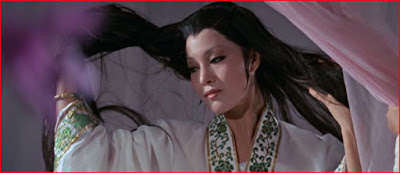
Betty Pei-Ti as Madame Chun

Another thing Chun enjoys is the company of women. This ultimate exploiter of women happens to be a lesbian, apparently keeping some of the girls as her personal concubines, unless all of them take turns at the task. She's a Chinese amazon, stunningly beautiful and masterfully violent. She takes a special interest in the spunkiest and most defiant of the new recruits, poor little Ai Nu. It's not clear how soon her interest becomes sexual, because she doesn't scruple at selling her virginity to the highest bidder among four wealthy old men, regulars at the brothel. The winner submits a blank check; he can get away with it because his son's the provincial governor. All four men get their turn at Ai Nu, tying her up, whipping her, forcing themselves upon her, the brutality of it accentuated by freeze frames and harsh sound effects just before the act is done each time.
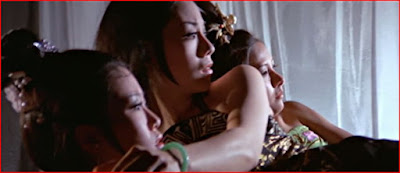
Madame Chun with bed-warmers (Ai Nu not included)

Afterward, Ai Nu tries to hang herself in her cell; the suicide attempt is scored with Leonard Bernstein's music from On the Waterfront. She's rescued by a mute male housekeeper who had tried to show her kindness earlier, after Chun had ordered her flogged. Now he reveals that he can speak, but had taken a vow of silence in atonement for errors that had cost him the love of his life. The hero of the film seems to have revealed himself as he promises to help Ai Nu escape the brothel. But he can't get her past Chun and her private army. The hero has a few skills himself, but he's no match for the madame nor her major-domo Bao Hu (Lin Tung), the master who trained her. Our would-be hero is promptly expiring on the snowy ground, urging Ai Nu not to kill herself or otherwise throw her life away, because then who'd be around to avenge him? As she sobs over his corpse, Chun gives her a simple choice: die now, or live on Chun's terms. Ai Nu chooses life.

Lily Ho (left) gives Betty Pei-Ti a fateful elbow nudge during a training exercise

Chun sets about remaking Ai Nu in her own image, teaching her kung fu and swordsmanship and taking her to bed. Once we learn this, the scene at the murdered man's house repeats itself and we return to the present, following Constable Ji (Hua Yueh) as he investigates Ai Nu's link to the victim. He discovers an imperious, arrogant beauty, far removed from the terrified country girl we first saw. When he demands that she prove that the victim was alive when she left him, she challenges him to prove that he wasn't. Now, we suppose, the hero has arrived, but we'll learn soon enough that this film doesn't have a hero.
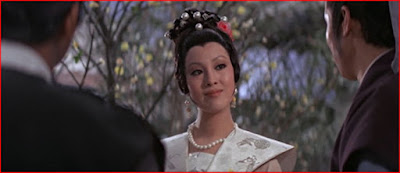
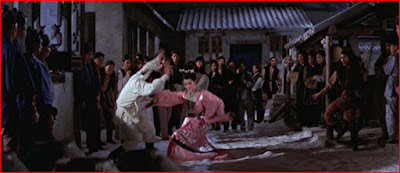
As Ji finds his investigation impeded by the social standing of the victim's circle, Ai Nu carries out a spree of revenge on the four men who first violated her. She varies the m.o. to keep people guessing, tying one up and setting him on fire to avenge his tying her up, but allowing another to love himself to death with three insatiable women and an overdose of aphrodisiacs. Finally, Ji finds her practically red-handed with the fourth victim, whom she'd whipped to death in a room locked from the inside as the constables desperately try to break in. Denying nothing, she only dares him to follow her to the real criminals. She leads the constables to the latest shipment of fresh females for the brothel, which she attacks. Leaving Ji to mop up, she races back to the brothel, where Bao Hu has been warning Chun about Ai Nu's dangerous intentions. Chun won't believe a word of it. She and Ai Nu are like one and the same person! Why not? Chun has created a peer for herself; that may have been the only way she'd ever find someone she could truly love. So when the constables arrive to storm the brothel, and Bao Hu with all his men insists that Ai Nu has betrayed them all, Chun can only stand by her woman at all costs.

There's a moment when the women warriors stand back to back, gravely outnumbered, and one gives the other an affectionate elbow in the side, and the other returns the gesture. It's like William Holden saying, "Let's go," and Warren Oates answering, "Why not?" It's a Wild Bunch moment, or a Sword of Doom moment if you want to keep the context Asiatic. It's the moment before Armageddon as the two women psyche themselves up for an amoklauf.
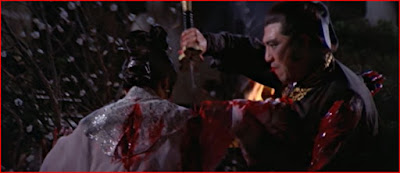
And before long it's down to Bao Hu against the women, a hopeless situation. But he doesn't go down without an epic bloodbath and a crippling blow, slicing off Chun's arm just as she's run it through his body up to her elbow. A bit of a setback, that, but Chun takes it like a trouper, worried only that Ai Nu might stop loving her now that she's a little handicapped. Of course not, Ai Nu coos. She won't stop loving Chun -- because she never did love her. It was -- duh!!! -- all a ruse to set up her revenge against all her oppressors, with the worst one saved for last. It was a nice plan, but for all that revenge is something you kinda have to boast about, this isn't exactly something you should admit so bluntly to someone who still has one good arm....

Ai Nu has an emotional ferocity and a raw romanticism that I've rarely seen in Hong Kong action films. The fantastic martial-arts context takes the transgression of lesbianism and elevates it (or degrades it, depending on your political sensibilities) to the level of a supernatural attribute. Chun and Ai Nu are the most beautiful women and the mightiest warriors in the picture, as if their sexuality (however insincere it may be on Ai Nu's part) gives them extra power, particularly in a setting where no man seems to have a conventional domestic relationship. The men are either patrons of prostitutes like the four old men, or they're emotionally damaged characters like Bao Hu and the erstwhile mute, or else sexlessly ineffectual like the constable. Given the men around them, lesbianism looks less like mere deviance (though its deviance gives the film an extra charge) than the natural recourse of naturally superior women.

The brilliant thing about Kang Chien Chu's screenplay is the way he turns Chun from an outright villainess into a tragically clueless, noirishly romantic antiheroine. The madame -- what a sap! --has clearly fallen deeply and sincerely in love with her deceiving Galataea, and after the women slaughter all around them, you can't help but feel that Ai Nu isn't righteous but just a little mean to hit Chun with the truth at a vulnerable moment. Another moment will come, however, to make us wonder how sincere Ai Nu was about her insincerity -- and there'll be consequences for that, as well. It all works, maybe just because this is my king but also, as I hope any viewing would prove, because Betty Pei Ti and Lily Ho have real chemistry and throw themselves passionately into their roles. Chu Yuan does all he can to make them majestic and malignant all at once while maintaining a suspenseful balance between pastel sensuality and livid brutality.

Intimate Confessions is arguably part of Quentin Tarantino's universe, with the business of lopping off arms possibly having a direct influence on Kill Bill. I think I saw something else here that I saw there as well; the way Ai Nu completes Chun's sentence for her at a crucial moment reminded me of the eerie exchange between The Bride and O-ren Ishii in which one finishes the other's sentence ("Silly rabbit...Trix are for kids") in a way that suggests that the cereal slogan was a shared catchphrase. That moment always leaves me thinking that there was a subtext of something between the two assassins in Tarantino's film, and it may be that Ai Nu is the something, or a key to it. But this is all just stuff for speculation unless Tarantino has actually identified Ai Nu as an influence. Whether it influenced him or not doesn't change the fact that Intimate Confessions influenced me. It's now one of my favorite Hong Kong martial arts films.

The following DVD trailer barely scratches the surface, but it'll do until you see the movie. Triphibian uploaded this copy to YouTube.