Showing posts with label Cameron Mitchell. Show all posts

Thursday, January 11, 2018

IN THE SHADOW OF THE EAGLES (All'ombra della aquile, 1966)

Cameron Mitchell was near the end of his European sojourn and the peplum was near the end of its time as a popular genre when the American actor starred in two films for Ferdinando Baldi, who billed himself as "Ferdy Baldwin." The wintry look of the film, shot by the certainly pseudonymous "Lucky Satson," appears inspired by Anthony Mann's Fall of the Roman Empire, and parts of it may have been filmed on Samuel Bronston's massive sets for that ambitious flop. Mitchell plays a tribune, Marcus Ventidius, tasked with taming the Pannoni, a barbarian tribe that has been slaughtering Roman troops. The Pannoni are torn between the paths of peace and war, between the counsel of elder chieftain Magdo (Vladimir Medar) and hothead Batone (Aleksandar Gavric). Ventidius is torn between his betrothed, the consul's daughter Julia (Gabriella Pallotta) and Helen (Beba Loncar), Magdo's daughter and Batone's intended, whom the tribune brings to Rome with Magdo as a prisoner.


Julia grows jealous and tries to degrade Helen by making her dance for aristocratic entertainment, but this only further alienates Marcus from her. Hoping to get her as far away from Marcus as possible, Julia arranges for her and Magdo to escape and return to their people. Give her credit for not just killing Helen as a jealous Roman more likely might in movies. Still, her scheme has disgraced Marcus, since the prisoners were his responsibility, and that unintended consequence chastens her and effectively ends their relationship. Julia pretty much disappears from the picture at this point, when it could have used more of her smoldering jealousy for fuel.


Marcus can redeem himself by taming the Pannoni once and for all. That means inflicting a decisive defeat on Batone, whose plans for an ambush are thwarted by Helen. There's a big battle, Marcus and Batone fight and the Roman kicks his antagonist off a cliff. For his trouble, Marcus is made governor of Pannonia, enabling him to go off with Helen and, presumably, live happily ever after.


The romantic triangle aspect of the picture is actually stronger than its action spectacle, thanks mainly to Pallotta's performance and her interactions with Mitchell. It's hard to tell whether Baldi was working around some issue with Mitchell or was directing the actors according to his original plan. In some scenes, Mitchell (if not a stand-in) stands or sits in shadow so his face can't be seen. Could this be because they had no dialogue for Mitchell to mouth on the set? Or was Mitchell incapable of reciting it? For that matter, I'm not sure if Mitchell did all of his own dubbing. Some of it sounds like the actor, albeit reading his lines rather flatly; other lines don't quite sound right. Whatever was going on, this approach actually helps convey Marcus's increasing alienation from Julia and, as the dance scene suggests, the whole spectacle of imperial domination. By comparison, the battle scenes are standard, unimaginative stuff. Baldi is better known for spaghetti westerns and apparently had a better grip on mano-i-mano gunplay. While he gets some nice shots of the army on the march, the battle scenes here are by-the-numbers montage, montonously punctuated by warriors jumping on horsemen and dragging them out of the saddle. The climactic single combat of Marcus and Batone has no energy; the leaders practically vanish into the background melee until Baldi cuts to close-ups. While Baldi probably got as much out of Mitchell as was possible, the actor seems stiff in a way that might seem "Roman" but probably indicates his disinterest in the project. Yet he and Baldi would shortly team up again for Massacre in the Black Forest and, despite this film's limitations, I'd still be willing to give that one a chance.

Thursday, June 7, 2012

DVR Diary: INSIDE THE MAFIA (1959)

A dramatic sequence of events in the fall of 1957 made the existence of a national Mafia more difficult for public officials to deny. Reports of the barbershop assassination of Albert Anastasia and the police raid on an apparent crime conclave in Apalachin, NY, whetted appetites for more information about the shadowy crime organization. But before Joe Valachi's 1963 testimony before a congressional committee very little was known about the institutions and inner workings of the Mafia. Into the breach stepped the Premium Pictures company, screenwriter Orville H. Hampton and director Edward L. Cahn, who released Inside the Mafia in 1959. Cahn was a Poverty Row visionary with a vast filmography of hackwork and a handful of primitively prescient pictures. His sci-fi film It! The Terror From Beyond Space has been recognized as a precursor of Ridley Scott's Alien, while the mindless marching masses Cahn directed in Creature With the Atom Brain and Invisible Invaders anticipate the zombie attacks of George A. Romero's films. Does Inside the Mafia similarly anticipate The Godfather and the mafia genre that followed Francis Coppola's film? The answer is a flat no. Working apparently from utter ignorance of the actual Mafia, Cahn and Hampton can't hope to approximate the ritual dynamics and familiar intimacy of post-Valachi movies. Instead, Inside is strange not in any premonitory way but as a work of crass naivete, and insulting in its pretense of telling the true story of the events leading to the Apalachin conference. The tone is set from the start when Apalachin is redubbed "Apple Lake," while Anastasia is replaced in the fatal barber chair by one Augie Martello (Ted de Corsia), who does not die, at least not right away. Secreted from an insecure hospital to a safe house, Augie lives to give his blessing to a plan of his lieutenant Tony Ledo (Cameron Mitchell) to take over the entire national crime organization. Ledo's idea is a decapitation strike against the long-exiled mastermind Johnny Lucero (Grant Richards) -- whacking him when his plane lands at the Apple Lake airport. Lucero is an amalgam of real-life boss Vito Genovese and the already-legendary Lucky Luciano, whose stature as an exile longing to return to America haunts a number of postwar crime films. For Ledo's plan to work, he must take control of the little airport. That means taking the man who runs the place and his family hostage, making them operate as if nothing is wrong so as not to alarm Lucero or anyone else. Instead of a Mafia expose, the picture becomes a rip-off of Suddenly, the picture in which Frank Sinatra takes a household hostage so he can shoot the President from their window. The imperiled family and their unlucky friends are a dull lot, but the gangsters are hardly less dull. The often manic Mitchell, here at the tale end of his peak period of Hollywood stardom and on the verge of a more productive sojourn in Europe, brings little to his role, while Robert Strauss (best known as Animal from Stalag 17) contributes most of the violence, including a few karate chops. The plot twists when Ledo learns from the TV that Augie has finally succumbed to his wounds. His plan takes a 180 degree turn; he now intends to convince Lucero that he's the man best qualified to run the organization in Lucero's name. His ploy seems to work, but there are a few twists left in the tale, while the hostages strive to free themselves, knowing that they must die otherwise. Everything ends in an Apple Lake bloodbath that the film claims "actually happened." Don't you believe them. Their claim is as viable as Criswell's at the end of Plan 9 From Outer Space, and their film is far less entertaining from that one. Inside the Mafia is exploitation of the worst time, completely lacking in inspiration and seemingly guided by the assumption that once their title had you hooked, they owed you nothing more. That kind of filmmaking ought to be a crime.

Wednesday, October 6, 2010

THE TALL MEN (1955)

When Hollywood adopted widescreen processes starting in 1953, Raoul Walsh had a head start on other directors adapting to the new aspect ratios. He'd directed his first widescreen western way back in 1930, using the short-lived Grandeur format to shoot The Big Trail. Best known as John Wayne's first starring role, that film has an archaic grandeur (no pun intended) that's only enhanced by the stilted performances by Wayne and the other actors, while Walsh's widescreen location work makes the movie resemble a window on the authentic Old West. Walsh's next widescreen western, released 25 years later, doesn't have quite the same primitive power, but it has much of the same pictorial sweep -- and the acting is somewhat better.

Adapted from a 1954 novel by the many-named Clay Fisher, now back in print under the author's more familiar Will Henry tag, The Tall Men follows the fortunes of the Allison brothers, Ben and Clint, former raiders with Quantrill now down on their luck in a Montana winter. Reduced (some might say reverting) to outlawry, they propose to ambush a man with a moneybag, but the man, Nathaniel Stark (Robert Ryan) convinces the Allisons that they can make more money if they follow him down to Texas and bring back a herd of cattle for beef-starved Montanans. While hothead younger brother Clint (Cameron Mitchell) would just as soon shoot Stark or any "jasper," levelheaded elder brother Ben (Clark Gable) sees an opportunity to earn his way to owning his own ranch. Early on the way south the trio encounter a group of stranded pioneers, including one woman, Nella (Jane Russell) who seems made of sterner stuff. After dining on "Missouri elk" (mule to you), Stark and the Allisons are on their way again, but Ben insists on turning back to help the pioneers when it looks like Indians are attacking. He finds the pioneers scattered and dead, Nella alone having kept her cool and stood her ground to survive. Ben and Nella find more stable shelter and get it on for a night, but find themselves incompatible. The orphaned daughter of failed ranchers, Nella has contempt for Ben's ambition, while he sees her as a gold-digger. She confirms that impression by attaching herself to Stark once everyone's reunited.

All four main characters end up making the trip back north with Stark's herd, accompanied by a gang of cowboys loyal to Stark and a band of vaqueros loyal to Ben. Along with the perils of the journey -- Indians, jayhawkers and natural obstacles -- there's tension on all sides of the triangle linking Ben, Nella and Stark, while Clint grows more unstable and dangerous the more he drinks. Even if everyone makes it to Montana, there's no guarantee that everyone will leave the territory alive....

The Tall Men belongs to the subgenre of "superwestern" rather than the "adult western" category, though Walsh's film is by no means childish. While lower-budgeted westerns like those of Randolph Scott and Budd Boetticher make the most of imposing locations, for Walsh the vastness of the landscape is just an appropriate backdrop for even more impressive masses of men, horses and cattle. This is a big film, as the title tells you in a manner typical of the era that also gave us The Tall Texan and The Tall T, not to mention Abraham Lincoln as The Tall Target. There's an obsessiveness about tallness in the advertising that makes male height a kind of counterpart to female breast size, as if Gable and Ryan must be giants to share the screen with Jane Russell. Oddly, Walsh seems more interested in Russell's feet than in her more famous attributes, giving her every opportunity to kick off her too-tight boots and have someone massage her naked tootsies. Tarantino probably loves this film. On the other hand, probably because Russell's recent hits had been musicals, she's given songs to sing that I could have done without. Overall, though, she gives a strong, hard-boiled performance that suits her role, while Cameron Mitchell probably could already do a drunken hothead in his sleep -- and maybe he did.

The most interesting thing about The Tall Men is the rivalry between Gable and Ryan's characters. Ben Allison and Nathan Stark are both cool calculators, Stark noticeably the cooler of the two. You'll never take him seriously as a real romantic rival to Ben for Nella's affections, but he retains a dangerous potential in other respects. He proves he can handle himself with a gun, which keeps him fresh in your mind as a threat to Ben and Clint. But the arguable virtue of Walsh's film is its ultimate refusal to make Stark a villain. He's an antagonist, certainly, but he never becomes the bad guy. Remember, after all, that he starts the film as an innocent victim of the Allisons -- a fact the film might have reminded us of more often to maintain more suspense as the drive nears Montana. But his calculating nature is precisely what keeps him from becoming a foolhardy villain. He and Ben are more alike than either think, but Ben has a certain something extra that makes him popular and earns him loyalty that Stark can never claim. At the end, Stark himself realizes this, describing Ben as the kind of man kids dream of being when they grow up and old men wish they had been. Clark Gable embodies that ideal admirably, occupying the middle ground between Mitchell's hothead and Ryan's reserve. He's not the driven obsessive we see in so many Fifties westerns, despite the opening his guerrilla past provides. Ben Allison is just a simple man who can be depended on to do the right thing.

To get a sense of the kind of film The Tall Men is, consider the ending. It's an anticlimax after the huge cattle stampede/Indian battle during the last stage of the drive, but its the climax of the rivalry between Allison and Stark. If this were a Seventies western if would end quite differently, with one or both men dead. Walsh's film has a happy ending, however, as the ultimate proof that, while both Ben and Stark can kill if necessary, neither man is a killer by nature and neither needs to kill on this occasion. That resolution may seem anticlimactic by action-movie standards, but maybe it means that The Tall Men is an adult western after all.

Tuesday, April 21, 2009

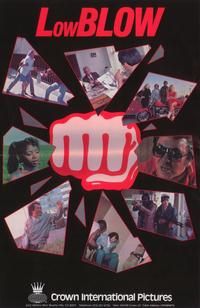
LOW BLOW (1986): "I think you owe me a car!"


Somewhere in San Francisco, a deli robbery disturbs the repose of Joe Wong, private detective. Surveying the scene from his window, he glumly puts on his gun and heads out the door. Where are you going, his secretary asks. "Going to quiet things down," he answers. He strolls into the deli, demanding, "Hey, where's my ham sandwich?" A gunman helpfully conducts him to a table, then resumes demanding money from the cashier. "Okay, here's your money," Joe says. Actually, it's a gun. In moments, the robbers are dead. Joe heads back to his office. "Forget about the ham sandwich," he says.
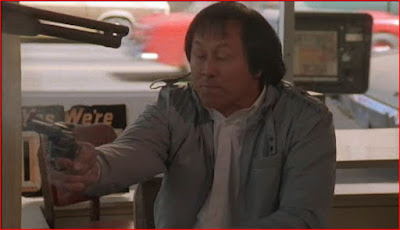

Two years after Killpoint, we're back in the world of Leo Fong, Asian-Arkansan martial arts auteur. Fong is a man of many skills. For this occasion, he stars, acts, and wrote the script, leaving the direction to his Killpoint helmer, Frank Harris. Compared to that minor apocalypse of gangs and gunrunners running amok, Low Blow seems much less inspired, and definitely less well funded. It also hardly seems to merit an R rating; while it wallows in a certain impoverished scuzziness, it never delves to the depths of sleaze you'd want to reach with such a film. It's Fong's fourth film as a writer, but he's still a work in progress, playing with the building blocks of a script but never quite getting one to stand on top of another for long.

The bare description of Low Blow promises more than the film delivers. Joe Wong is recruited to rescue a millionaire's daughter from a cult run by Yarakunda -- played by Cameron Mitchell. The prospect of Mitchell in Jim Jones mode ("It's very much like Jonestown" a cult expert tells Wong) had me stoked for this film, especially since Fong and Harris got a great crazy turn from Cam as the head gunrunner in Killpoint. Two years later, Mitchell seems really out of it, unwell and uninspired. Whether this was because he was on or off the wagon, I just don't know. But it seems like Fong knew something was wrong, so he and Harris build up the role of Yarakunda's exploitative assistant, Karma. One year earlier, Akosua Busia was in The Color Purple. Working for Leo Fong, she camps and cackles away as a cynical con artist with a fetish for Brach's salt-water taffy. It's probably the closest thing to actual acting in the picture.
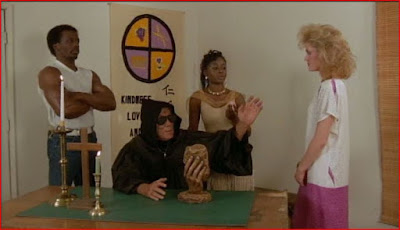
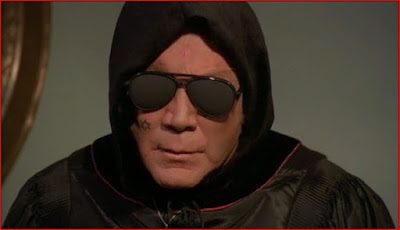

Yarakunda and Karma run Unity Village, where the acolytes till the fields daily and listen to Karma's harangues. Their latest recruit is Karen Templeton, daughter of John Templeton of the vaunted Templeton International. How did Templeton get so rich? We get a sample of his savvy in a scene that has him riding through a seedy street in his limousine. He has the driver stop when he witnesses two muggers snatching an old lady's purse. Joe Wong is enjoying a bowl of chicken feet soup nearby when he hears the woman's screams. Abandoning his repast, he rushes out, chases down the muggers (who'll become recurring comedy relief characters), dodges a vicious purse attack and saves the day, before Templeton's eyes. This man knows talent when he sees it. He braves Wong's slobbovian office to hire the man to rescue Karen, whom the cultists call Purity.
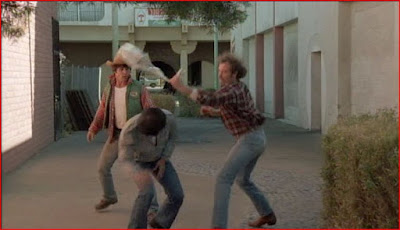
Purse fu is no match for Leo Fong -- and this guy swings like a girl, anyway.
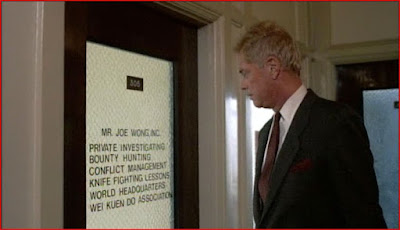
Check out those credentials on the door. And check out Troy Donahue as Mr. Templeton


Purity has given up her jewelry and signed a document of some kind, but even though the cultists know who she is, they make no great effort to exploit their asset. No matter how mercenary Karma is said to be ("She's not just from India, she just got out of prison," says the cult expert), there's no attempt to shake down Mr. Templeton or induce Purity to get more money. Yarakunda seems quite content to have his charges work the fields while he babbles about the river reaching the ocean. Mitchell talks so low so often that Busia has to repeat his words through a bullhorn so the faithful may hear. But I wonder if Fong and Harris had her do this because they knew that they'd be using an incredibly annoying wall-to-wall soundtrack of generic 80s instrumentals. In any event, I'm trying to tell you that there's no urgency to Purity's plight, nor is Joe Wong in a great hurry to save her after an initial foray into Unity Village. Pretending to be journalist "Jack Chan," he's taken on a tour of the minimalist compound. "Right around here I think we've got a nice setup," a guard doubling as a guide tells him, moments before another guard bops Wong on the head. A nice setup -- get it?

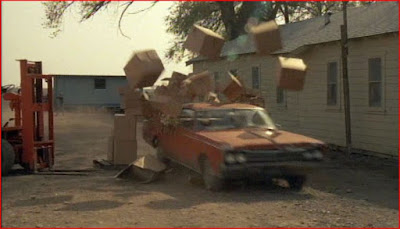
With the help of a disgruntled cultist sharing a cell with him, and after a session of ear biting and hair pulling courtesy of Karma, Joe sets a convenient wastebasket on fire to get a guard's attention. "Hey guard, fire in here," he says. Calling it yelling would give Fong too much credit, as he sounds about as exasperated as if the room were leaking rather than burning. He waves the pyre just under a barred window so the guard will get the idea. Suffice it to say that Joe fights his way out and into his dilapidated car, in which he must brave the dreaded barrier of empty cardboard boxes.

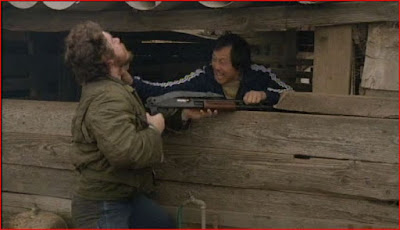
Somehow the cultists figure out "Jack Chan's" true identity and track him down to his house, somewhere in a junkyard. But the garbage and loose planks strewn about everywhere make Joe the master of his terrain, and that means it's "Home Alone" time for his attackers. The ensuing sequence is perplexingly non-violent. Yes, Joe hits people all over the place. But his strategy seems to consist of jumping someone, disarming them, and then leaving them behind and conscious so they can rejoin their buddies. One offender is even subjected to a puppy attack, such is the brutality of the moment. Finally tiring of the monotony, the perps pile into their car to flee, but Joe is just getting started. He rips out their wiring, smashes all the windows with a two-by-four, puts on a pair of goggles and grabs a circular saw. Before our eyes, and sometimes with clearly no one inside the car, he tears up the roof until he can peel it off like the lid of a tin can, at which point all the clowns now back inside the car spill out and run away up the road, presumably with Joe's best wishes.
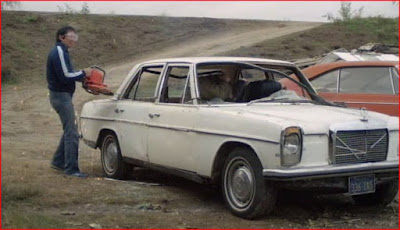


Payback time should be coming, but Joe's approach to taking the offensive is rather like Colin Powell's. He is determined to have overwhelming force on his side. Toward this goal he's been scouting out likely allies like Duke, an overaged boxer, and Fuzzy, a fat guy with professional wrestling moves, and Chico, a stereotypical Hispanic knife fighter. They're still not enough to overcome Unity Village's formidable army of guards. They're led by future Tae-Bo tycoon Billy Blanks, after all. Also, Leo Fong has time to kill if he wants his film to get to the 80-minute mark. But I don't want to characterize what follows as a stalling tactic. Actually, it's at this point that Low Blow achieves genuinely inspired stupidity.


While John Templeton waits with dwindling patience for his daughter's freedom, Joe Wong tells his faithful secretary to call the press and announce a $20,000 toughman tournament. I assume the prize money is coming out of poor Templeton's pocket, since the gate isn't going to be much based on this crowd shot. We should note that the tournament is not a "Toughman" competition, strictly speaking. Those are boxing tournaments for people without professional skills. What Joe Wong stages is more like pit fighting. But what do I mean, "more like?" It literally is pit fighting. They've dug a hole in the earth and thrown people in it to fight each other.
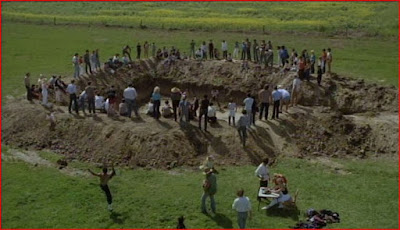


At times, the tournament looks like a prototype of old-school mixed martial arts competitions, or early versions of those Kumite-style affairs that became their own movie genre in the late 80s. It's too bad more people didn't show, because there was something for everyone here.


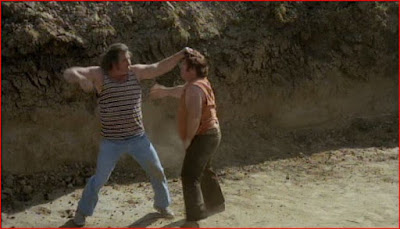
Fat guys!


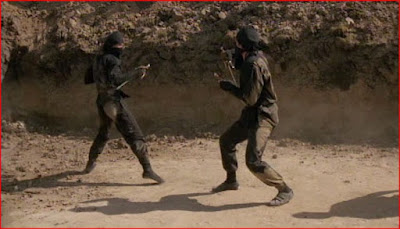
Ninjas!


Intergender!
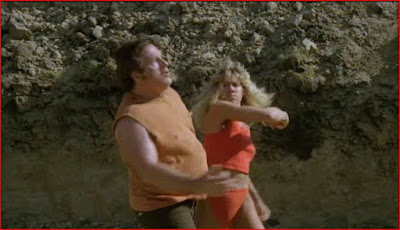


Now Joe Wong has his private army of fighters for the dangerous assault on Unity Village. Strangely, though, considering the need for stealth, he didn't pick any ninjas. Stranger yet that he felt a need to judge their skills in unarmed combat, since they'll spend much of the climactic siege shooting down Yarakunda's guards like ducks in a gallery. The privilege of unarmed combat belongs to the master. He can use guns, too, but he also uses doors and other unorthodox attacks, including the emotionally challenging double handjob.
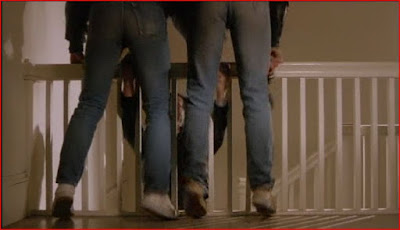


But the supreme moment comes when Joe fights the man whose car he destroyed back at the junkyard. "I got you now, Chinaman," this villain says in an instant of upper-handedness, "I think you owe me a car!" Joe promptly throws the car guy on his back, but the baddie is reaching for the gun in his shoulder holster.

I'll tell you now that Purity is rescued, Karma kills Yarakunda, and her own fate is left a mystery. I do this because the climax of the Joe vs the car guy fight is the real climax of Low Blow. You can tell it's an important moment because Fong and Harris prepared a special effect. The fact that there's a continuity problem between action and follow-through shouldn't affect our appreciation of their effort. Let's break it down shot by shot.


Joe has to act fast to beat car guy to the draw, so to speak. We see him desperately bearing down with his fist to subdue his antagonist.
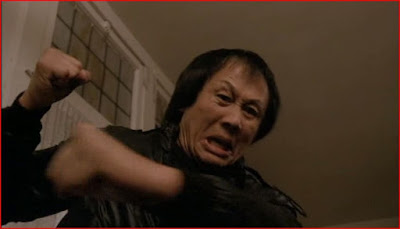


The target: car guy's face. Kinda looks like Michael Medved, doesn't he?
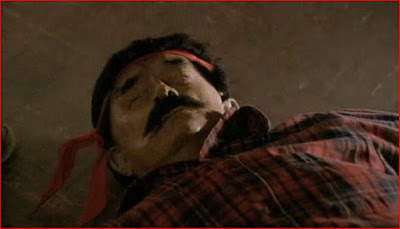


IMPACT: But what's wrong with this picture?
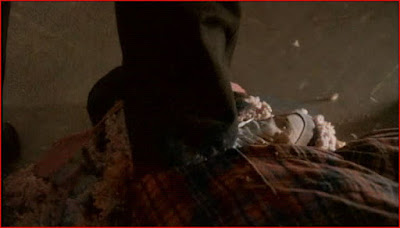


Yes, you guessed it. Joe is destroying car guy's face with his foot rather than his fist. Harris has to take the blame for this one, because Fong was in his moment, getting into his Bruce Lee finishing move trance. Don't knock it: for him, this is acting.
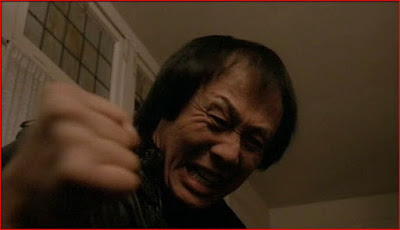


For Low Blow Leo Fong had plenty of ideas that might have made a more effectively comical film in more skilled scripting hands, but he and Harris leave most of them laying on the screen. There are running gags like Joe's awful driving and his always getting a ticket, and the repeated appearances of the two purse-snatchers, who get beaten up by nearly everyone. There's politically incorrect repartee between Joe and Duke the boxer, the black man calling the Asian "Chinaman" and Joe calling Duke "boy." But our filmmakers are not really comedians by temperament, however comical their films turn out regardless. Fong has no sense of pacing, and his dialogue is rarely bad enough to be quotable.

The final third of the picture almost redeems the whole, but my knowledge that this team was capable of better (or "worse") work keeps me from really recommending the film. Low Blow is best appreciated by intensive students of 80s cheese and fans of Leo Fong, whose bland stoicism makes Chuck Norris look like a Method actor. Despite that, Fong's obvious dedication to making movies makes him a sympathetic figure in a period when the odds against getting on the big screen were growing ever longer. He has my respect.


Here's how they sold it back in the day.


Thursday, March 12, 2009

KILLPOINT (1984)

Back in 1995 I crossed the continent to visit Riverside, California, to serve as best man at a friend's wedding. I took in such sights as there were, most notably the theater where Gone With The Wind had its first preview showing. It seemed an ordinary, past-its-prime town, but I had little inkling of its secret history. For according to Frank Harris's movie, about a decade earlier Riverside was the murder capital of the United States.

The trouble began when a man in soldier's fatigues robbed a military arsenal of its guns and ammo. The perpetrator was "Nighthawk," the right-hand man of local crimelord Joe Marx (Cameron Mitchell). Nighthawk then carried out a daring attack on rival arms dealer Leo DeJulio in a crowded Chinese restaurant, instructing his men, "There should be no witnesses, and everyone has to die. Have fun." His orders were carried out; 15 people died in the eatery.


The ATF soon learned from Snake the snitch that Marx and Nighthawk were behind the robbery and the massacre. Agent Bryant (Richard Roundtree) was assigned to supervise the Riverside investigation. Capt. Skidmore of the Riverside PD, noting the stakes involved ("We think we've got a real problem with this thing.") assigned Lt. James Long (Leo Fong) as Bryant's liaison, despite reservations from ATF higher-ups. Wasn't Long the officer whose wife was raped and killed recently? Is he all right? "No, he's not all right. Would you be?" Skidmore told the Bureau, "But I'll tell you one thing. He's going to get the job done."

Nighthawk was soon handing out guns as if they were free samples. Gangbangers were soon shooting up grocery stores, bumping off another 15 people in one robbery.


The film portrays Joe Marx watching news reports linking the two massacres and shooting his TV set. Marx had a love-hate relationship with his pet poodle, adoring the animal despite the fact that it "poos and pisses all over the living room." He fussed over the dog while arranging with his procuress, Anita, to have a new girl visit him.


Candy is shown telling Marx, "This really isn't me....I'm really a singer." To which Marx responds, "Girly, when you know Joe Marx long enough, when this old son of a bitch tells you to sing, you better sing before I get physical with you. Sing! Anything!" The filmmakers believe that Candy's voice failed her due to nerves, and that when she refused to strip on Marx's order, he murdered her and had her body dumped in a river.

Lt. Long took over the murder investigation when the police learned that a burn mark on Candy's left breast matched the m.o. in an unsolved New Jersey homicide in which Joe Marx was a suspect. The autopsy clearly depressed Long, who is shown in a montage working out furiously, recalling his own dead wife, and staring into space.


Having discovered Anita's address in Candy's home, Long interviewed her to no avail until he explained that Candy had been murdered. Anita then apparently went to Marx's home to denounce him as the gunrunner tried to feed his dog a cigarette. The song Cameron Mitchell sings is probably dramatic license.


Sparky is a friend of mine.
She will do it any time,
For a nickel or a dime.
Twenty cents for overtime.


The film contends that Anita's first guess was mistaken, and that Nighthawk killed Candy. It shows Anita wounding Nighthawk before he killed her, after which Marx complains, "Now you're bleeding all over my carpet!" Sparky is the dog, by the way.

As the investigation intensified, Long and Bryant pumped informants for new leads on the gunrunners. One likely prospect was gunned down in a tavern men's room before Long could meet with him. Nighthawk subsequently shot the gunman. Meanwhile, the gun trade continued, Nighthawk delivering arms to the Sanchez gang (with his lady chauffeur on hand for "insurance"), who subsequently massacred members of the rival Ramirez gang.


The first major break in the case came after Long kung-fued the snot out of the Sanchez crew and arrested their leader. After breaking up a gas station robbery by a black gang, the Riverside police played the gang leaders against each other, locking them in a bare cell to kung-fu one another until one is willing to rat out the arms dealers -- as long as the other is blamed.


Using the fresh lead, Long arranged to meet Marx and Nighthawk, pretending to be an Asian gangster interested in rocket launchers. James Long's origins are unknown, but to account for Leo Fong's incongruous Southern accent, Long claims to come from Arkansas, where the China-born Fong was raised from the age of five. Long didn't realize when meeting with Nighthawk that the gunrunner had just killed Agent Bryant. It's an oddity of the film that Bryant dies without his liaison, Long, ever really taking notice of the fact. But there were more than enough ATF guys to go around in Riverside, even if Marx and Nighthawk wanted to start their own religion.

Marx suspected that Long might be a cop. He tested his theory by having four of his men beat Long up. He was satisfied of Long's good faith because "If you'd been a cop you'd have back-up all over the place." Paranoia, however, wasn't Marx's main problem. A breaking point came in his partnership with Nighthawk when Marx went berserk in a diner where the waitress kept a crying baby.


This apparently convinced Nighthawk that Marx was no longer a viable partner. He also had reason to think that Marx no longer trusted him, since the boss was wont to wander about talking to himself, saying such things as "From now on it's me alone, nuts or otherwise, against the whole world." Soon afterward, while picking Marx up in his limo, Nighthawk cut his mentor's throat. That left Nighthawk to consummate the big arms deal with Long, while the ATF surrounded the rendezvous point in an abandoned factory complex....


If Joe Marx didn't exist, Frank Harris and Cameron Mitchell would have to invent him. Mitchell gives one of his patented eccentric performances, fussing over the dog as much as he plots evil. But such is the quality of the man that Marx comes across as convincingly nutty, capable of completely unpredictable behavior. There's weird psychosexual tension between Marx and Nighthawk, whom Anita accuses of being gay. In turn, Nighthawk insults Marx while the boss wallows in a hot tub: "Look at you, wearing scarves, flowers in your hair, talking to a dog. Business going downhill and you're still turning into a raving faggot." Mitchell and Stack Pierce as Nighthawk make an effective team of misfits. Their interplay is the most entertaining thing about Killpoint apart from the sheer volume of gunplay that erupts every few minutes. This is a film that kills for the love of killing. Why does a criminal gang need to kill 15 random people in a grocery store? Because they're evil and the violence looks cool is my best guess.

Mitchell may steal the film, and Richard Roundtree may recede into the background for no good reason, but this is Leo Fong's show. The overaged (56 when this was filmed), mop-headed master of redneck style kung fu is a spectacle even if he couldn't act his way out a door. He spends a lot of time receiving very detailed orders from Capt. Skidmore, because taking the initiative might require him to open his mouth, and Director-Screenwriter Harris apparently wanted to delay the awful moment when Fong's accent revealed itself for as long as possible. Now, an Asian man has just as much right to a Southern accent as anyone else, but in Leo Fong's case it's just the icing on the cake that makes him an avatar of '80s bad taste. Only in that decade would anyone have thought of making him a star.


Harris is capable of creating dynamic moments, especially the grocery store attack, and he keeps things busy during the drawn-out climactic siege, crosscutting the ATF blasting thugs with Leo Fong going hand to hand with various foes until his showdown with Nighthawk. But there are also lots of flat moments of telephone conversations, pointless helicopter shots and instructions from the authentically dull Capt. Skidmore to pad out the picture. Throw in some convincing sleaze, some country music and a lot of bloody shirts and the end result is approximately 90 minutes of mindless action candy, Crown International Pictures style. You can find this one nicely letterboxed on BCI's Maximum Action set, which includes another Harris-Fong-Mitchell exploit, Low Blow. But if you want to see lots of people get shot, Killpoint should probably be your first stop in that collection.