 I
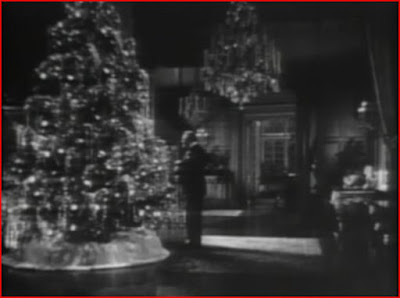
It's Christmas. Let's call it Christmas 1940, with a presidential campaign settled and FDR safely re-elected for a third term after a third-party scare that proved more ephemeral than most. This one self-destructed on the launch pad of Wrigley Field as a national radio audience listened, but there's one loose end that nags at people this holiday season. The blasphemy of it sticks in some minds. Christmas is a celebration of birth and a promise of new birth for everybody, but the third-party movement, despite its rhetoric of neighborliness and good will toward men, was founded on a promise of suicide -- on this of all days. Most people now believe there was no such promise, or certainly not a sincere one, but we all saw it in print, and if you see it in the
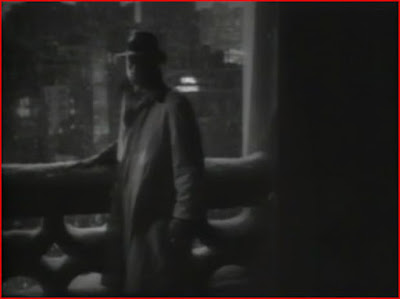
Bulletin it must be so. The man we thought had made the promise has been missing since the summer. Since most folks consider him a con man who did it all for the money, the fact that he remains on the loose, despite being briefly one of the most famous faces in the country, is troubling only because he ought to be in jail. But those who know the truth about what happened at the Chicago convention know that, like Jesus, "John Doe" was traveling the path of prophecy, and this year's Christmas prophecy is one easily fulfilled. With that knowledge it's hard to be soothed by carolers. You won't sleep easily until you've saved the life of the man you destroyed, so he'll stay destroyed. That man, meanwhile, has his holidays backward. He's playing out a Passion in the desperate hope that sacrifice will effect a resurrection. If a broken-down ballplayer dies tonight, John Doe might live again....
 T
The two most ambitious American films of 1941 share an interest in the power of the media. It was a natural subject both for Orson Welles and Frank Capra, for it was
their power. Both men had shaken the nation, Welles with his
War of the Worlds hoax broadcast, Capra with his borderline sacrilegious
Mr. Smith Goes to Washington, which had been criticized by some people in 1939 for besmirching American democracy before a hostile world. More so than
Citizen Kane,
Meet John Doe is the director's troubled meditation on his own power. On another level, I think, it's also about Orson Welles. Capra was the one established Hollywood director in a position to answer the challenge of the wonder-boy newcomer from New York -- the top dog in his own mind, the "name above the title" man who had already established to his satisfaction that a film should reflect the will of the director more than anyone else. Some of the
Doe advertising took the director-as-star principle so far as to include Capra's face alongside those of the stars or the picture. While others presumably sulked enviously over Welles's incredible deal with RKO, Capra made a deal of his own with Warner Bros, breaking loose from Columbia Pictures. It was arguably a better deal than Welles's because Frank Capra Productions would own
Doe. On the other hand, Capra was playing with his own money, while Welles was not. In any event, I assume that Capra's objective, in part, was to top whatever Welles was working on.
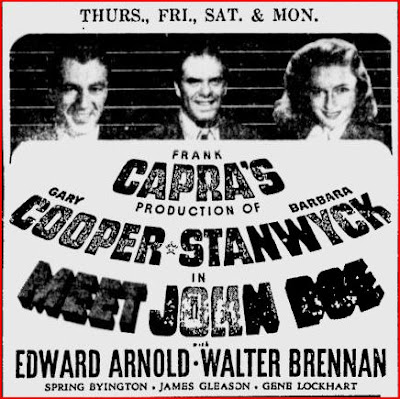
Both productions were top-secret, Capra's title evolving from an original "Life of John Doe" to the more ominous "Life and Death of John Doe" before reaching its final form without the public or the publicists learning much about the story. The advertising remained vague throughout the original release. I've read one 1941 article that paired
Doe and
Kane as the most anticipated films of the year and noted that
Doe was the bigger mystery of the two. Did Capra and Welles know more about each other's projects? I don't know, but I'd be surprised if Capra didn't see himself in competition with Welles. That both men made films about the media may be a coincidence, but probably wasn't an accident. And the plainest proof that Welles was on Capra's mind all the while may be the fact that
Meet John Doe is all about a hoax.
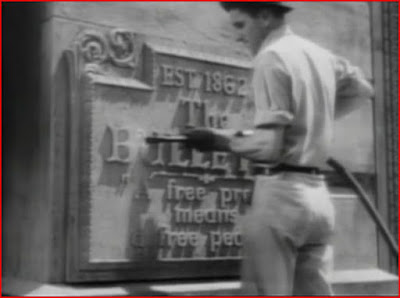
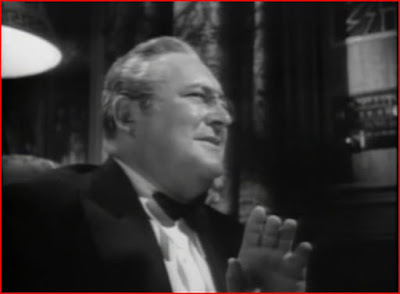
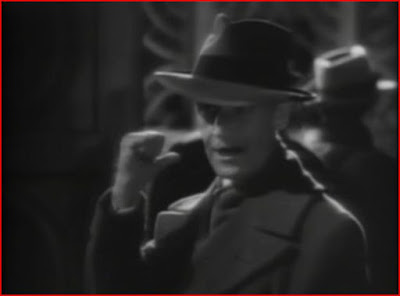
In the 21st century we regard media moguls like Rupert Murdoch with suspicion and distrust, but those feelings were arguably stronger in 1940, when men like William Randolph Hearst had a record of actively pursuing political power. Today, media moguls like Silvio Berlusconi have held power elsewhere, but his American counterparts don't seem likely to imitate him. If anything, in the future politicians may make themselves media stars as an essential step toward power. In 1940, when both Capra and Welles were filming, it seemed all too plausible that people who manipulated public opinion for a living would use their power to make themselves rulers of men. Capra's film addresses that threat more directly, while Welles and Herman Mankiewicz are more concerned with getting inside the head of their crypto-Hearst. Capra and Robert Riskin are less interested in what makes D. B. Norton tick. Their villain is a cypher compared to Kane, with no apparent psychological motivation for seeking political power. He has no compulsion to act as the people's protector or benefactor. Instead, after keeping him cryptic for most of the film, Capra reveals Norton as an outright fascist who hopes to exercise power with an iron hand.
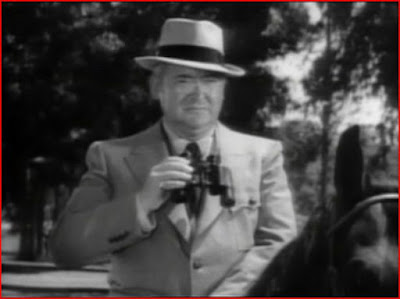
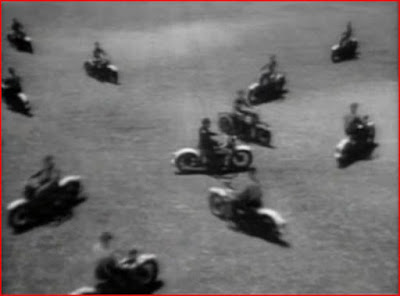
Edward Arnold as D. B. Norton gets a huge buildup as a man of mysterious menace before putting in his first appearance at the 28 minute mark while reviewing the D. B. Norton Motor Corps.
Casting counts.
Meet John Doe is often described as the third film of a Capra trilogy that also includes
Mr. Deeds Goes to Town and
Mr. Smith Goes to Washington, all three being tales of naive "cinderella men" getting crushed by the establishment but bouncing back again. I'd agree that Doe concludes a trilogy, but the first film of the set isn't
Deeds, but
You Can't Take It With You, the film immediately preceding
Smith. This trilogy is defined by the recurring figure of Edward Arnold as the antagonist. In each film he grows more powerful and intractable. In
You Can't he's just a grumpy businessman who finally loosens up for a happy ending. In
Smith he's a state political boss who ends the film at bay due to Senator Smith's persistence and Senator Paine's dramatic confession. In
Doe he's building a national media empire understood by everyone as his gateway to greater political influence. At the climax, D. B. Norton is dared to destroy the Doe movement, and defied by a hero who thinks he can't do it. He can. I think that Capra was working something out in his mind by reusing Arnold and making him more powerful in each film. He may simply have been making the most of a great character actor, but the recurrence and resurgence of the Arnold villain may also illustrate Capra's questioning of his own patented "Capracorn" scenarios.
While
Citizen Kane expresses Welles's narcissism by presenting multiple perspectives of his own title character,
Meet John Doe expresses Capra's narcissism by making its main characters partial reflections of his own creative personality. It takes the cinderella-man formula to the ultimate level as embittered columnist Ann Mitchell (Barbara Stanwyck) creates her cinderella man
ex nihilo as a spiteful practical joke on the new editor who's just fired her. She makes her word flesh by recruiting the starving has-been pitcher "Long John" Willoughby (Gary Cooper), who had come to the newspaper office seeking a job, to be the public face of her suicidal malcontent persona.
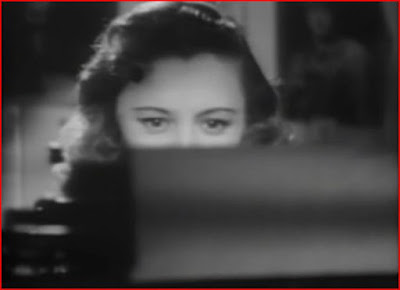
The screen darkens ominously as Ann (Barbara Stanwyck) invents John Doe. Below, things go dark for Long John Willoughby (Gary Cooper) after he's recruited to play Doe.
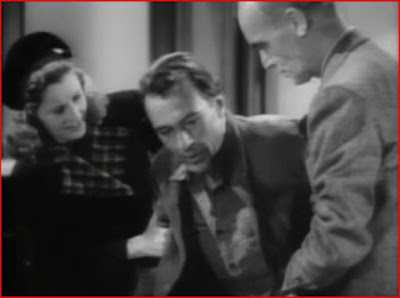
A turning point comes when Ann, on her mother's advice, abandons negativity and invests the Doe character with her dead father's optimistic spirit just as Willoughby must speak publicly as Doe for the first time. But as Norton discovers a potential in the message that Willoughby himself doesn't yet appreciate, he seeks to remake Doe in his own image. It's like the making of an American antichrist by an unholy trinity of the ambitious Mitchell, the initially venal but guileless Willoughby and the ultimately sinister Norton, with the spectre of the dead father offering the only hope of redemption. Ann, reimagining Doe as her father, claims to have fallen in love with her creation, easily confused with its incarnation as Willoughby. Crushing on Ann almost from the start, Willoughby begins to identify with her father to an alarming extent revealed as he recounts a dream in which he is both himself ("The real me, John Doe -- that is, Long John Willoughby") and her father, and both are "whacking" away at an Ann grown from child to bride through dream logic. Long John experiences a euphoric breakdown in order to be remade as John Doe. He resists at first, agreeing to rat out Ann and the
Bulletin on live radio for $5,000 from a rival paper, only to renege and read Ann's speech in order to impress her -- only to be embarrassed and disgusted with himself afterwards. He thinks he made a fool of himself, even though or especially because he got into the reading at points, despite some well-acted awkwardness and mike fright by Cooper. He runs away because he feels like a sap, assuming that the speech was a disaster and knowing not what he wrought.
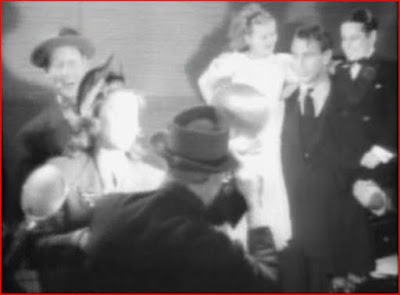
Above, "John Doe" poses with representative "Little People" before his debut speech.
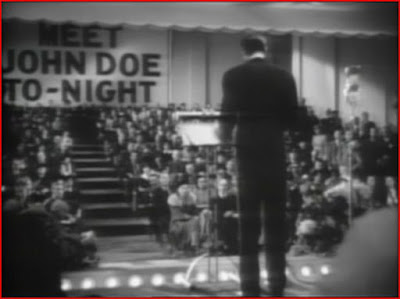
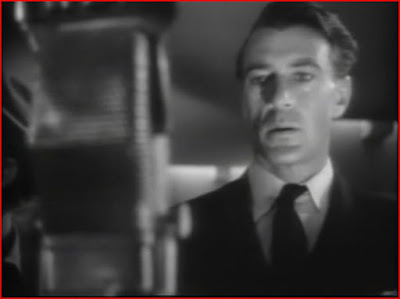
Capra knew that the media sent mixed messages, some unintentional. We know that he knew this because he demonstrated the malleability of message in his next released film, the War Department documentary
Prelude to War, much of which was a dramatic
detournement of Leni Riefenstahl's
Triumph of the Will. What Riefenstahl meant to be inspiring, Capra made alarming and appalling. What she portrayed as
volk solidarity he presented as dehumanized regimentation. In
Meet John Doe, Willoughby's over-enthusiastic, sometimes inept reading of Ann's speech miraculously galvanizes a grass-roots movement into existence. The message got through in spite of the messenger, though Willoughby's lack of polish may have worked in its favor by making him seem sincere. In any event, Capra and Riskin would probably argue that the real message came from Ann's father, channeled through her and Willoughby, and as the film would say with desperate urgency later, "the idea is still good."
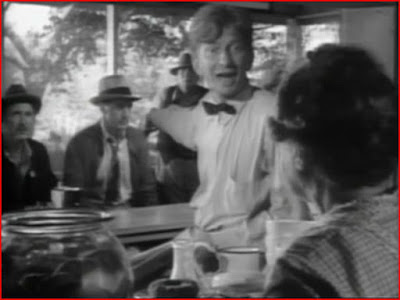
Would it still be good if Norton got his way? Would the John Doe message change substantially once it was dedicated to putting him in power? That bit is actually unclear, and that's a flaw of the film. From the beginning, everyone assumes that Norton has bought the
Bulletin to advance a political agenda. For most of the picture, however, he holds his ideological cards close to his vest. As far as we know, the John Doe philosophy up to the debacle in Chicago is whatever Ann says it is. Not even her hard-boiled editor Connell (James Gleason), who seems to set the
Bulletin's agenda more than Norton does initially, appears to have input in her columns. Connell was hired when Norton bought the paper. One would presume some sort of intellectual affinity between the two, and that Ann's Doe pieces should be consistent with overall editorial policy. Yet Connell abruptly turns on Norton after his question about his boss's political ambitions is rebuffed, and on no more evidence than that, as far as we see, the editor denounces Norton to Willoughby as a "Fifth Columnist." He's proven right, of course, but before that the most fascistic thing about Norton was his sponsorship of a potentially paramilitary motorcycle club. The only other thing we know about him is that his money comes from oil. But would such a would-be fascist simply have let the Doe movement evolve as Ann alone willed it until he decided to order her to endorse him? Is the Doe message the ideal foundation for the election of someone like Norton?
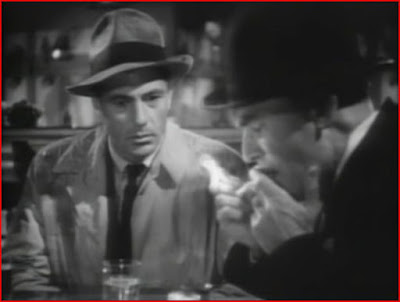
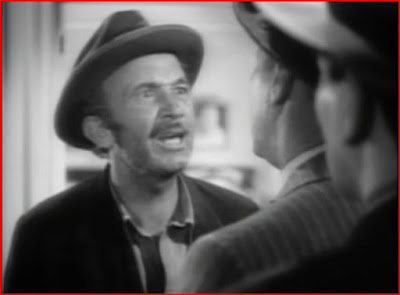
Is the John Doe message itself implicitly fascist? I don't think so, but Capra and Riskin may have been worried. They portray the Doe philosophy as a pretty simplistic, populistic form of neighborliness. It's an appeal to empathy that transforms Willoughby as he transforms his audiences. Willoughby himself has had bad influences, most notably his traveling companion of the last few years, "the Colonel" (Walter Brennan). His title is either imaginary or ironic, since it's impossible to imagine this character giving or taking orders. The Colonel is one of the earliest manifestations of a character type that became more common later in American film: a paranoid loner. While ultimately a sympathetic character by virtue of his loyalty to Willoughby, the Colonel also represents a wrong path for Americans of isolation and distrust. He so completely lacks any sense of entitlement that he feels better off owning nothing. He equates absolute poverty with serenity, since the helots ("a lot of heels") don't bother you if you don't have money. Since other people are such a hell for him, you have to wonder why he sticks with Willoughby, but I leave that for others to speculate about. In any event, it's one of Walter Brennan's greatest performances (and you can say that down the line for the entire lead cast), in which he taps deeply into the dark side of his folksiness for once. While his loyalty to Willoughby may redeem the Colonel, Willoughby himself is set on the road to redemption simply by having the hots for Ann. Despite himself and the suspicions the Colonel probably taught him, Willoughby wants to make good as Doe to impress Ann. More importantly, because he makes a personal connection with her, her words and ideas, which she herself dismisses as platitudes, become newly meaningful for him. In turn, he somehow conveys that meaningfulness to the John Does who see and hear him, and they respond by "tearing down all the fences," metaphorically speaking, and bonding with one another.
In the end, however, for all that Capra hints that the John Doe movement will live again whether Willoughby dies or not, the movie implicitly repudiates that populism that we identify with Capra's own work. Following the familiar Capra archetype, Willoughby is publicly humiliated, and his defeat seems complete. Unlike other Capra heroes, Willoughby is damned by the truth, though he insists that the idea is still good.
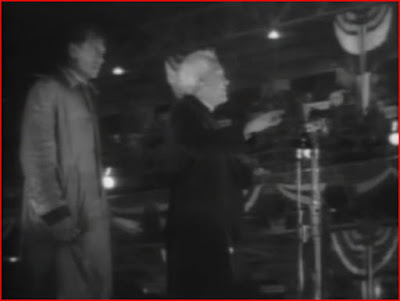
The convention scene is a suspenseful demonstration of Willoughby's failure to master the media that made him. Here, with time running out before Norton arrives to denounce him, Long John is stuck waiting, after having to stand through an anthem, for an well-meaning but oblivious minister to call a moment of silence for the "John Does of the world." By the time the moment is over, so is the John Doe movement.
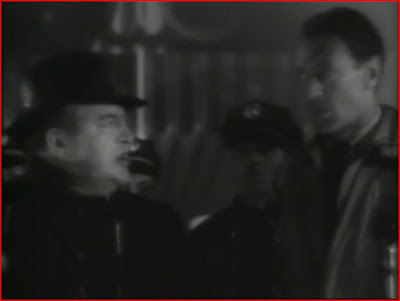
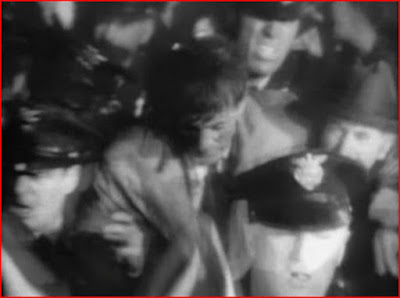
To redeem the idea, he resolves to fulfill the promise that Ann never intended her fictional creation to fulfill. Norton has suspected this and brings men to the skyscraper to thwart Willoughby or erase any evidence of his suicide. Willoughby thinks he has Norton checkmated by making copies of a new suicide note, but Ann intervenes to argue that he doesn't have to die. Here we come to the great controversy about the film's ending. Capra admitted to filming several alternate finishes, and the actual finish was altered after the film opened. According to one contemporary newspaper account, the premiere version included an implausible renunciation by Norton of his evil ways, while I've also read accounts of an epilogue with Long John, Ann and the Colonel starting some kind of charity house. Whatever the alternatives were, Capra himself remained dissatisfied with the finish, and posterity took its cues from him. He felt he had painted himself into a corner by having "Saint George and the dragon" effectively destroy each other at the convention, leaving him no right way to resolve the suicide question.
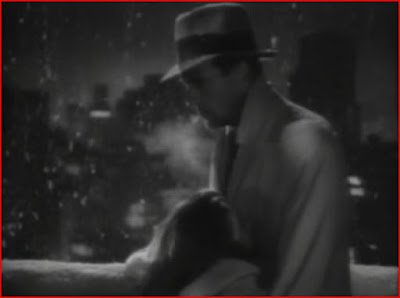
Audiences have been unconvinced by Ann's citation of Jesus as "the first John Doe" whose death makes Willoughby's unnecessary, or by the apologetic reappearance of the small-town Does we've followed since the middle of the picture. I don't think the film would have been improved by anyone going off the roof, and I think the final ending works consistently with the rest of the movie. First of all, neither we nor Willoughby need to be persuaded by Ann's babble about Jesus. Let's not confuse the rhetoric with the message. Long John isn't dissuaded from jumping because he realizes that Jesus is his savior, but because he realizes finally that Ann loves the real John -- Willoughby, not Doe. Secondly, whether or not you believe that Jesus was the first John Doe, the operative point -- the one that repudiates populism -- is that John Willoughby doesn't have to be John Doe to do good in the world, nor does anyone else. The whole exercise of inventing John Doe to represent public discontent was only asking someone like Norton to fill a vessel that was inevitably going to be partially empty with the malignancy of power. The ironic flaw of the movement was that, for all its empowerment of multitudes at the grass roots, everyone still looked to John Doe for leadership and inspiration. Take John Doe out of the equation, Capra suggests, and the idea is still good. Ann may be over-optimistic about her and Long John becoming leaders of a revived movement, but as long as the people reclaim the idea, Connell's mighty closing challenge still stands: "The people, Norton! Try and lick that!"
 Meet John Doe's
 problematic nature is a mark of Capra's ambition at a turning point in his career. If not his masterpiece, it is certainly his epic, and as such it's a major though underrated American film. I can't bring myself to call it a better film than
Citizen Kane, but I like it better for its more expansive political consciousness and its more thoughtful exploitation of the two films' common media-mogul subject matter.
Doe doesn't advance the narrative art of film the way
Kane does, but with Capra still at the peak of his power and with Slavko Vorkapich montages, his film is state of the pre-
Kane art. The two films complement each other quite nicely, though they're rarely seen as peer works. Welles's more humanistic approach has helped
Kane stand the test of time better even though the films share many common concerns of their time. But I won't be the first to note in the era of Tea Parties and alleged "astroturfing" of grass-roots movements that
Meet John Doe might be more relevant now than it's been in a long time. Just right now, however, it's relevant because it's Christmas.