It's not that bad as a whole, but to be honest, the first half-hour of Zack Snyder's new film, with credited co-writing and uncredited reshoots by Joss Whedon, is awful: a jumble of scenes attempting to establish an important trait of parademons (the bug-winged creatures Batman [Ben Affleck] saw in his Dawn of Justice nightmare); remind us urgently that Wonder Woman (Gal Gadot) exists; and remind us more clumsily that the world is worse for the death of Superman (Henry Cavill) in the aforementioned Snyder production. Nothing really flows together and you might believe that several films, not just the Snyder and Whedon footage, had been awkwardly spliced into something crudely approximating a feature film. Nor are things helped much by the introduction of the film's villain. Steppenwolf, here embarking on his second stab at world conquest after millennia of dormancy, is a relatively minor character in Jack Kirby's "Fourth World" mythos, which few at DC Comics have really known what to do with since the King laid down his pencil. His presence here looks like a hedging of bets, as if Snyder, co-writer Chris Terrio and DC producer Geoff Johns didn't want to waste Kirby's actual big bad, the oft-misused Darkseid, on this particular movie and chose Steppenwolf as his proxy. No effort was made to give this substitute villain any personality beyond his generic lust for conquest, but I suppose you could argue that the villain of this piece was never meant to be anything more than a Macguffin, since the real story of Justice League is the formation of DC's in-print precursor and cinematic answer to Marvel's Avengers. Picking up the hints dropped like anchors in the last film, Batman and Wonder Woman set out to recruit the three supposed superbeings discovered by Lex Luthor's researchers: Arthur "The Aquaman" Curry (Jason Momoa), the bastard child of Atlantean royalty and quite the strongman on land; Barry "Flash" Allen (Ezra Miller), the young Central City speedster; and Victor "Cyborg" Stone (Ray Fisher), a man now more than half machine desperately trying to keep up with his evolving alien technology. The real purpose of this movie is to get you interested enough in these three to seek out their solo films as they appear, beginning with next year's Aquaman.
The results are mixed. All three actors succeeded in making their characters interesting, and they establish decent chemistry with each other and the established heroes. But I still question whether any of them can carry a feature film by today's standard of what such films should be. The future of the DC movie franchise now rests on the shoulders of Jason Momoa, and I'm glad to report that, liberated from his grim typecasting, the actor gives easily the best performance I've ever seen from him. But I still doubt whether whatever good will he's earned will make people interested in exploring DC's Atlantis, all too little of which was shown here apart from introducing Aquaman's eventual love interest Mera (Amber Heard). As Cyborg, Ray Fisher does probably as good as anyone could do with Marv Wolfman's character, making him sardonically bitter rather than self-pitying and adding a certain coldness that inclines the character to agree with Batman much of the time. But Cyborg has always been a hard sell as the black face of the DC Comics universe since Geoff Johns gave him that role by putting the character in his "New 52" era Justice League. Popular though he may be as one of Wolfman and George Perez's Teen Titans, Cyborg never seems to have clicked as a solo character despite Johns and other writers' stubborn efforts, and he has so little personal mythos that I find myself wondering what on earth a Cyborg movie would be about. Meanwhile, the development of a Flash movie is an ongoing nightmare for Warner Bros. Laboring in the shadow of the popular CW TV series, which automatically begs that question of what a feature film can do differently other than spend more money, the project can't hold on to a director as everyone struggles to fine-tune the property. The one thing different about Miller's Flash so far is his relative youth and his jittery Spider-Manic personality that makes him Justice League's comedy relief character. I thought Miller was likable enough to get away with it here, but I don't know if he can carry his own movie doing the same stuff. I'd be happy to see all of these guys again in another Justice League film, but despite this film's post-credit scene there are no immediate plans for another that I know of, and the drubbing the film is getting from Snyderphobic reviewers is unlikely to speed the day of their return.
I probably should talk about the story some more. The plot is right out of a serial: an artifact hunt. If Steppenwolf gets all the artifacts he can activate "the Unity," which won't be a good thing for anybody. Despite their being salted away on Atlantis, Themyscira and ... somewhere Cyborg knows about, he gets them. Fortunately, the good guys had just used that last one to resurrect their old pal Superman who, acting true to comic-book form, starts fighting them until Lois Lane (Amy Adams) shows up and tells him that the sun's getting real low, or something along those lines. Honestly, though, even in comics if Superman is messed up and not behaving right, mind-controlled, amnesiac or whatever, Lois is your best antidote. There was this one comic where to snap Superman out of Poison Ivy's mind-control, Batman has Catwoman throw Lois off a building, or at least that's how I remember it. But I digress. Anyway, Supes still needs some work in the shop so Lois takes him back for (ahem) debriefing in Smallville while the rest of the gang goes to some Sokovia-like place where Steppenwolf, his Unity and his army of parademons make life miserable for one humble family -- to, you know, make the situation more real for us, I guess. Determined that this shall not stand, the as-yet-unnamed Justice League -- I think the only person who actually describes them as a "league" is Lex Luthor (our old friend Jesse Eisenberg) in a post-credits secene -- go about delaying the bad guy until Superman is cleared for action, after which point there's really no contest.
Sounds stupid, right? Well, it kind of is, but while this is regrettably one of those films where the whole is less than the sum of its parts, a lot of those parts are quite entertaining. While Fisher, Miller and Momoa held up their end of the deal, Affleck, Cavill and Gadot were once more their reliable selves, though our Batman is much more mild-mannered than in his last appearance, to a degree that's left some again questioning his commitment to the franchise. I actually liked the change of pace and the way some things (like Bruce Wayne's whiskey-swilling) remained the same. So the acting was fine, apart from the helpless Ciaran Hinds, tasked with voicing Steppenwolf. As one might expect from Zack Snyder, some of the action is spectacular. The highlights include an extended battle on Themyscira as the Amazons run a desperate relay race to keep their artifact from Steppenwolf; a flashback establishing Steppenwolf's backstory featuring a super-epic battle pitting Amazons, Atlanteans, Olympian gods, Green Lanterns, etc. against old-timey parademons; and the guilty pleasure of the JL's brawl with the reawakened Superman, who seems capable of matching the Flash's speed (Miller sells this wonderfully) and trading head-butts with Wonder Woman all day. For all its many flaws, the film ultimately entertains. I'd reverse the conventional reviewer consensus and contend that Justice League is marginally worse than Dawn of Justice, and almost the weakest of this year's good crop of superhero movies -- after a second viewing of Guardians of the Galaxy Vol. 2, I'm inclined to leave that at the bottom. Snyder and Whedon have done Warner Bros. no great favors as far as Friday morning reviewers are concerned, but I close with the observation that at my half-full multiplex screening the audience applauded the film.
A randomly comprehensive survey of extraordinary movie experiences from the art house to the grindhouse, featuring the good, the bad, the ugly, but not the boring or the banal.
Showing posts with label Batman. Show all posts
Saturday, November 18, 2017
Saturday, February 25, 2017
On the Big Screen: THE LEGO BATMAN MOVIE (2017)
Lots of comic book fans hate Batman. I'm not just talking about Marvel Comics partisans -- though Lego Batman apparently hates them in return -- but also many DC comics fans who resent the idea, articulated by Lego Batman, that DC is "the house Batman built." For some fans the cult of Batman is a betrayal of everything superhero comics should be about. The idea that Batman, without super powers, can take down the entire Justice League of America singlehandedly --I've seen it done in comics -- really rankles these fans. Batman is a big buzzkill for them; the fantasies that fuel his popularity are antithetical to theirs. For many people the superhero idea is a fantasy of transcendence; what appeals is the idea of overcoming human limitations, to be able to do things literally impossible for humans. Yet here comes Batman to burst all those bubbles. His most hardcore fans, for the most part, like the leveling idea of someone who isn't naturally gifted (unless you count inherited wealth) being able to take out anybody, no matter how gifted they are. The important thing isn't what you (or your fantasy figure) can do, but that anyone and everyone else can be beaten. This Batman is an implacable nemesis, a black hole of ressentiment that sucks in and crushes other people's fantasies. But not all Batman fans see Batman that way. Many, at least a vocal minority over-represented online, have opposed the darkening of the Batman myth since the 1980s milestones of Frank Miller's comics and Tim Burton's blockbuster movie. The Lego Batman Movie is a critique of the "dark knight" myth from the perspective of an older alternate fandom (which acknowledges the character's nearly 80 year history in its sometimes embarrassing entirety) for whom a big part of Batman's appeal was the evolution around him of a "Batman Family," to use the title of a pre-Miller comic. But it's not really a satire of the Dark Knight, which is all too parody-proof, because Lego Batman -- analogous but not really identical to the character from The Lego Movie -- doesn't behave like the largely humorless Batman of modern comics and movies. Instead, Chris McKay's cartoon, from a story by Seth Grahame-Smith, satrizes those Batman fans who, in the view of their critics, have reduced Batman to the stunted creature on display here.
Lego Batman (Will Arnett) isn't much different from the overgrown manchildren of so many live-action comedies, except that he's explicitly even more adolescent in his flailing tantrums defying father-figure Alfred (Ralph Fiennes), who desperately encourages his charge to connect with the world, make friends, and take steps toward an adulthood equated with emotional intimacy. Lego Batman, who'd wear his cowl everywhere he went like El Santo if Alfred didn't prompt him to take it off for Bruce Wayne's social engagements, is entirely absorbed in his hobby of crimefighting, but remains detached even from those who share the hobby, including he criminals he fights. This is a Batman who doesn't get invited to Justice League parties; who breaks the Joker's (Zach Galifianakis) heart by refusing to acknowledge the clown prince of crime as his greatest enemy, or even to work up enough emotion to hate him; who so takes for granted his ability to defeat Gotham's small army of costumed antagonists, even when they all team up against him, that he never bothers taking them into custody. The story of the film is a three-front war to break Lego Batman's shell. Joker escalates his merry war by contriving to be sent to the Lego Phantom Zone, where the big bads of many a mythos are confined (including some shrill "British robots" whose name apparently couldn't be mentioned), so he can lead a mass breakout and invasion of Gotham City. New police commissioner Barbara Gordon (Rosario Dawson) takes a more confrontational attitude toward the local vigilante than her retired father, but only in order to make him cooperate with rather than overshadow the police. Dick Grayson (Michael Cera), adopted absentmindedly by Bruce Wayne and encouraged by Alfred, simply wants to bond with his new father, or with his "second father," Batman. Enemies and would-be friends alike batter away at Lego Batman's emotional barriers, rooted in the founding trauma of his parents' murder (thankfully not reenacted yet again in this kiddie movie). Lego Batman's weakness, as many comics critics and fanfiction writers have long known, is his fear of forming ties that might abruptly be cut, but this only becomes a weakness once he faces a threat that he absolutely cannot defeat on his own, so long as he refuses to acknowledge that. Only when he lets his allies show their colors by wearing costumes as he does -- a "Reggaeman" costume shorn of its trousers becomes the traditional Robin uniform, for instance -- and only when he can own up to this true, deep hatred of Joker can the day possibly be saved....
The Lego Batman Movie adopts the visual style of The Lego Movie -- unlike various made-for-home-video Batman Lego movies, the characters move in the herky-jerky manner expected of Lego objects, and clouds, explosions etc. appear to be made of Legos -- but only intermittently exploits its Lego-ness, as when Batman acts as a Builder to make weapons and devices out of the landscape, or when characters exploit their inherent interconnectivity to make themselves into "human" bridges. Almost inevitably it's more Batman than Lego movie, though it's unique among Batman movies in its critical-though-loving take on the character. Anti-Batman comics fans and anti-"grimdark" Batman fans will enjoy the send-up of the stuck-up mainstream Batman and his pretentious antisocial fans, but both groups may leave theaters feeling that the film shot its wad in a way that makes a sequel difficult to imagine. To be fair, the filmmakers may not have planned on a sequel, but I'm sure Warner Bros. will want one. Only now they've used up Batman's entire rogues' gallery with the exception (I think) of Ra's al-Ghul, who isn't exactly the stuff of a Lego movie, and left it impossible for us to take any of them seriously, even in the context of a cartoon comedy. It always feels like a waste when someone makes an everything-including-the-kitchen-sink movie like this using all the characters in a "universe" at the same time, and I'm sure the particular fans of many classic villains will feel this more acutely. The right thing to do actually might be to spin this off into a TV show of half-hour adventures with individual villains, but the more likely thing is a Lego Justice League movie to make up for the underutilization of Batman's peers here. As an open-minded Batman fan who's enjoyed comics and movies with many different approaches to the character, I enjoyed Lego Batman, even though it probably was impossible for this new film to be the revelation or statement its predecessor was. I doubt it will change many people's attitudes toward Batman. Fans who'd like to see an expanding Bat-Family in comics and movies probably will be disappointed by DC and WB's continued pandering to the isolatos who buy most of the comics, and those buyers probably will dismiss this movie as stupid kid stuff. Given that the very idea of Batman can all too easily be dismissed as stupid kid stuff, that's not really much of a critique, but the fact that Batman's nature and what he means to readers or movie audiences can be so hotly debated suggests that neither the character nor his Lego incarnation should be dismissed quite so stupidly.
Lego Batman (Will Arnett) isn't much different from the overgrown manchildren of so many live-action comedies, except that he's explicitly even more adolescent in his flailing tantrums defying father-figure Alfred (Ralph Fiennes), who desperately encourages his charge to connect with the world, make friends, and take steps toward an adulthood equated with emotional intimacy. Lego Batman, who'd wear his cowl everywhere he went like El Santo if Alfred didn't prompt him to take it off for Bruce Wayne's social engagements, is entirely absorbed in his hobby of crimefighting, but remains detached even from those who share the hobby, including he criminals he fights. This is a Batman who doesn't get invited to Justice League parties; who breaks the Joker's (Zach Galifianakis) heart by refusing to acknowledge the clown prince of crime as his greatest enemy, or even to work up enough emotion to hate him; who so takes for granted his ability to defeat Gotham's small army of costumed antagonists, even when they all team up against him, that he never bothers taking them into custody. The story of the film is a three-front war to break Lego Batman's shell. Joker escalates his merry war by contriving to be sent to the Lego Phantom Zone, where the big bads of many a mythos are confined (including some shrill "British robots" whose name apparently couldn't be mentioned), so he can lead a mass breakout and invasion of Gotham City. New police commissioner Barbara Gordon (Rosario Dawson) takes a more confrontational attitude toward the local vigilante than her retired father, but only in order to make him cooperate with rather than overshadow the police. Dick Grayson (Michael Cera), adopted absentmindedly by Bruce Wayne and encouraged by Alfred, simply wants to bond with his new father, or with his "second father," Batman. Enemies and would-be friends alike batter away at Lego Batman's emotional barriers, rooted in the founding trauma of his parents' murder (thankfully not reenacted yet again in this kiddie movie). Lego Batman's weakness, as many comics critics and fanfiction writers have long known, is his fear of forming ties that might abruptly be cut, but this only becomes a weakness once he faces a threat that he absolutely cannot defeat on his own, so long as he refuses to acknowledge that. Only when he lets his allies show their colors by wearing costumes as he does -- a "Reggaeman" costume shorn of its trousers becomes the traditional Robin uniform, for instance -- and only when he can own up to this true, deep hatred of Joker can the day possibly be saved....
The Lego Batman Movie adopts the visual style of The Lego Movie -- unlike various made-for-home-video Batman Lego movies, the characters move in the herky-jerky manner expected of Lego objects, and clouds, explosions etc. appear to be made of Legos -- but only intermittently exploits its Lego-ness, as when Batman acts as a Builder to make weapons and devices out of the landscape, or when characters exploit their inherent interconnectivity to make themselves into "human" bridges. Almost inevitably it's more Batman than Lego movie, though it's unique among Batman movies in its critical-though-loving take on the character. Anti-Batman comics fans and anti-"grimdark" Batman fans will enjoy the send-up of the stuck-up mainstream Batman and his pretentious antisocial fans, but both groups may leave theaters feeling that the film shot its wad in a way that makes a sequel difficult to imagine. To be fair, the filmmakers may not have planned on a sequel, but I'm sure Warner Bros. will want one. Only now they've used up Batman's entire rogues' gallery with the exception (I think) of Ra's al-Ghul, who isn't exactly the stuff of a Lego movie, and left it impossible for us to take any of them seriously, even in the context of a cartoon comedy. It always feels like a waste when someone makes an everything-including-the-kitchen-sink movie like this using all the characters in a "universe" at the same time, and I'm sure the particular fans of many classic villains will feel this more acutely. The right thing to do actually might be to spin this off into a TV show of half-hour adventures with individual villains, but the more likely thing is a Lego Justice League movie to make up for the underutilization of Batman's peers here. As an open-minded Batman fan who's enjoyed comics and movies with many different approaches to the character, I enjoyed Lego Batman, even though it probably was impossible for this new film to be the revelation or statement its predecessor was. I doubt it will change many people's attitudes toward Batman. Fans who'd like to see an expanding Bat-Family in comics and movies probably will be disappointed by DC and WB's continued pandering to the isolatos who buy most of the comics, and those buyers probably will dismiss this movie as stupid kid stuff. Given that the very idea of Batman can all too easily be dismissed as stupid kid stuff, that's not really much of a critique, but the fact that Batman's nature and what he means to readers or movie audiences can be so hotly debated suggests that neither the character nor his Lego incarnation should be dismissed quite so stupidly.
Labels:
2017,
animation,
Batman,
comic book,
superheroes,
U.S.
Tuesday, March 29, 2016
For the record: Batman movies ranked
To put my review of Batman v. Superman: Dawn of Justice in some perspective I present my rankings of all live-action Batman movies from 1943 to the present.
1. The Dark Knight (2008) - Heath Ledger's performance as the Joker has overshadowed the tragic element of Bruce Wayne's story in the second film of Christopher Nolan's trilogy. This is the one where Wayne (Christian Bale) wants to give up Batman so he can be with his beloved Rachel Dawes (Maggie Gyllenhaal). Almost unconsciously, he sets up Rachel's current boyfriend, D.A. Harvey Dent (Aaron Eckhart) to take his place as Gotham's hero -- a "white knight" to his dark knight -- so he can take Dent's place with Rachel. His plan ends with both Rachel and Harvey destroyed. Having never truly given up the cowl, he now wears it as a matter of penance, not just as the hero Gotham "deserves," but as the hero Bruce deserves to be -- or so we thought at the end until Nolan told us in the next film that Bruce actually just quit. I left Dark Knight feeling that Nolan had said all he needed to say about Batman, and his sequel sadly vindicated that feeling.
2. Batman Returns (1992) - I guess I prefer a tragic Batman, because here's another. Bruce (Michael Keaton) finds a soulmate in damaged, vengeful Selina Kyle (Michelle Pfeiffer) but if anything they're too much alike for a happy ending to be possible. Returns is Tim Burton in ultimate Expressionist mode, mastering his influences in a never-to-be-repeated personalization of a corporate entertainment property. Pfeiffer and Danny DeVito's Penguin follow Ledger as the best Batman villains on screen.
3. Batman (1989) - Marred by the pop imperative of Prince's soundtrack, the first Burton film remains iconic, and I suspect Ledger has never fully displaced Jack Nicholson as the ideal incarnation of the Joker for many people. Michael Keaton remains the template for unpredictable casting that pays off; at the very least he's the right Batman for a Burton film. Danny Elfman's score is a revelation.
4. Batman Begins (2005) - Strange to report, I didn't see the first Nolan Batman film on the big screen. It struck me at first glance as unambitious in its effort to ground Batman in a realistic milieu, but Begins won me over on the small screen.
5. Batman v. Superman: Dawn of Justice (2016) - It should be apparent that Batman fandom biases me in this film's favor a little, but I like Ben Affleck's intensity and the hints of dissolution both he and Jeremy Irons' Alfred display, and I'm interested in seeing more of his interpretation of the character, especially if he asserts more creative control in the future.
6. Batman (1966) - It's a shame Julie Newmar couldn't play Catwoman in this all-star villain jam, but it's a treat to see Cesar Romero's Joker, Burgess Meredith's Penguin and especially Frank Gorshin's Riddler bounce off each other. Many Batman fans still resent this film and Adam West's TV show, and their defensiveness toward their hero has darkened the knight for generations afterward. I felt that way myself for a few years until I came to appreciate that West et al did their thing on purpose, not because they were idiots, and were actually quite good at it. The movie isn't as good as the best episodes -- for me those are the second-season stories with Newmar -- but I still find it entertaining.
7. The Dark Knight Rises (2012) - Nolan concludes his trilogy with a clunk, undermining the tragic message of his previous film by allowing Bruce to escape his destiny and have a happy ending with Selina Kyle (Anne Hathaway), but it takes a plot that makes Dawn of Justice look brilliant and at crucial points apes the rather crappy James Bond film The World is Not Enough. Count me as an admirer of Tom Hardy's eccentric Bane, while Hathaway's "Cat" is likable but not as darkly original and powerful as Pfeiffer's. Too many moments that insult the intelligence almost balanced by some epic action scenes, and ultimately the biggest disappointment of all these films considering what was expected.
8. Batman (1943) - Unapologetic wartime racism, chintzy production values and inept action only add to this Columbia serial's bizarre camp charm. On the plus side, the serial gives us Alfred in his definitive form -- the comics imitated it and abandoned his original roly-poly form -- and I enjoy Lewis Wilson's seedy undercover work as "Chuck White," a precursor of Matches Malone and a personality I'd have Batman play in comics if I ever had a chance. Plus, for all that he's a racist stereotype, J. Carrol Naish's Dr. Daka makes a pretty good serial villain.
9. Batman Forever (1995) - Once upon a time Warner Bros. decided that Batman movies had gotten too dark. The solution to the problem was Joel Schumacher. Be careful what you wish for now. The knee-jerk casting of Jim Carrey as the Riddler and the total botch of Two-Face by future Oscar winner Akiva Goldsman and Tommy Lee Jones sealed this film's fate fast. Worse was to come.
10. Batman and Robin (1949) - Say what you will about the 1943 serial, but it wasn't dull. This one was. I remember almost nothing about it, which is the only reason it doesn't sit at the bottom of this list.
11. Batman and Robin (1997) - I remember Schumacher's second, series-killing film all too well. This movie opened thirty-year old wounds for many Batman fans and scarred some who'd never had an opinion about the old TV show. It probably led to some people doubling down on darkness for Batman, with consequences felt to the present day. Compromise the darkness, they might say, and you start on a slippery slope that ends here. Likewise, some will say that blind flight from camp ends at the opposite extreme of Dawn of Justice. A middle ground ought to be possible, but you can understand why people would want to get as far aesthetically as possible from this disaster.
1. The Dark Knight (2008) - Heath Ledger's performance as the Joker has overshadowed the tragic element of Bruce Wayne's story in the second film of Christopher Nolan's trilogy. This is the one where Wayne (Christian Bale) wants to give up Batman so he can be with his beloved Rachel Dawes (Maggie Gyllenhaal). Almost unconsciously, he sets up Rachel's current boyfriend, D.A. Harvey Dent (Aaron Eckhart) to take his place as Gotham's hero -- a "white knight" to his dark knight -- so he can take Dent's place with Rachel. His plan ends with both Rachel and Harvey destroyed. Having never truly given up the cowl, he now wears it as a matter of penance, not just as the hero Gotham "deserves," but as the hero Bruce deserves to be -- or so we thought at the end until Nolan told us in the next film that Bruce actually just quit. I left Dark Knight feeling that Nolan had said all he needed to say about Batman, and his sequel sadly vindicated that feeling.
2. Batman Returns (1992) - I guess I prefer a tragic Batman, because here's another. Bruce (Michael Keaton) finds a soulmate in damaged, vengeful Selina Kyle (Michelle Pfeiffer) but if anything they're too much alike for a happy ending to be possible. Returns is Tim Burton in ultimate Expressionist mode, mastering his influences in a never-to-be-repeated personalization of a corporate entertainment property. Pfeiffer and Danny DeVito's Penguin follow Ledger as the best Batman villains on screen.
3. Batman (1989) - Marred by the pop imperative of Prince's soundtrack, the first Burton film remains iconic, and I suspect Ledger has never fully displaced Jack Nicholson as the ideal incarnation of the Joker for many people. Michael Keaton remains the template for unpredictable casting that pays off; at the very least he's the right Batman for a Burton film. Danny Elfman's score is a revelation.
4. Batman Begins (2005) - Strange to report, I didn't see the first Nolan Batman film on the big screen. It struck me at first glance as unambitious in its effort to ground Batman in a realistic milieu, but Begins won me over on the small screen.
5. Batman v. Superman: Dawn of Justice (2016) - It should be apparent that Batman fandom biases me in this film's favor a little, but I like Ben Affleck's intensity and the hints of dissolution both he and Jeremy Irons' Alfred display, and I'm interested in seeing more of his interpretation of the character, especially if he asserts more creative control in the future.
6. Batman (1966) - It's a shame Julie Newmar couldn't play Catwoman in this all-star villain jam, but it's a treat to see Cesar Romero's Joker, Burgess Meredith's Penguin and especially Frank Gorshin's Riddler bounce off each other. Many Batman fans still resent this film and Adam West's TV show, and their defensiveness toward their hero has darkened the knight for generations afterward. I felt that way myself for a few years until I came to appreciate that West et al did their thing on purpose, not because they were idiots, and were actually quite good at it. The movie isn't as good as the best episodes -- for me those are the second-season stories with Newmar -- but I still find it entertaining.
7. The Dark Knight Rises (2012) - Nolan concludes his trilogy with a clunk, undermining the tragic message of his previous film by allowing Bruce to escape his destiny and have a happy ending with Selina Kyle (Anne Hathaway), but it takes a plot that makes Dawn of Justice look brilliant and at crucial points apes the rather crappy James Bond film The World is Not Enough. Count me as an admirer of Tom Hardy's eccentric Bane, while Hathaway's "Cat" is likable but not as darkly original and powerful as Pfeiffer's. Too many moments that insult the intelligence almost balanced by some epic action scenes, and ultimately the biggest disappointment of all these films considering what was expected.
8. Batman (1943) - Unapologetic wartime racism, chintzy production values and inept action only add to this Columbia serial's bizarre camp charm. On the plus side, the serial gives us Alfred in his definitive form -- the comics imitated it and abandoned his original roly-poly form -- and I enjoy Lewis Wilson's seedy undercover work as "Chuck White," a precursor of Matches Malone and a personality I'd have Batman play in comics if I ever had a chance. Plus, for all that he's a racist stereotype, J. Carrol Naish's Dr. Daka makes a pretty good serial villain.
9. Batman Forever (1995) - Once upon a time Warner Bros. decided that Batman movies had gotten too dark. The solution to the problem was Joel Schumacher. Be careful what you wish for now. The knee-jerk casting of Jim Carrey as the Riddler and the total botch of Two-Face by future Oscar winner Akiva Goldsman and Tommy Lee Jones sealed this film's fate fast. Worse was to come.
10. Batman and Robin (1949) - Say what you will about the 1943 serial, but it wasn't dull. This one was. I remember almost nothing about it, which is the only reason it doesn't sit at the bottom of this list.
11. Batman and Robin (1997) - I remember Schumacher's second, series-killing film all too well. This movie opened thirty-year old wounds for many Batman fans and scarred some who'd never had an opinion about the old TV show. It probably led to some people doubling down on darkness for Batman, with consequences felt to the present day. Compromise the darkness, they might say, and you start on a slippery slope that ends here. Likewise, some will say that blind flight from camp ends at the opposite extreme of Dawn of Justice. A middle ground ought to be possible, but you can understand why people would want to get as far aesthetically as possible from this disaster.
Sunday, March 27, 2016
BATMAN V. SUPERMAN: DAWN OF JUSTICE (2016) in SPOILERVISION
Medical science remains uncertain whether a cure exists for "superhero fatigue," but 2016 has offered two rival remedies. One is the R-rated irreverent black comedy, manufactured by Twentieth Century-Fox as Deadpool and by Warner Bros. (for release later this year) as Suicide Squad. The other is the DC Cinematic Universe, which actually has the R-rated irreverent black comedy remedy built into it but is prescribed initially on the theory that superhero fatigue is really Marvel fatigue; offer something different from Marvel Studios' now-familiar product, the theory goes, and the problem is solved. Each remedy comes with the usual list of potential side effects, the most daunting of which, should you consider taking Batman v. Superman: Dawn of Justice, is "no fun." This warning is issued by people who seem more certain about what fun is than they should be. When they talk and write about fun in movies, they often mean what should be fun, or what we should consider fun. If I say I had fun watching Dawn of Justice some may judge me depraved or write my opinion off as that of an uncritical comic book fan. But I can just as easily say that many reviewers who haven't had fun at the movie didn't want to have fun, or didn't want to have the sort of fun the film offers. How can you tell? If a reviewer says the two main action sequences run on too long, you know they're not having the fun Dawn of Justice is selling. Now, if they want to complain about stuff running on too long, they should focus on after the big fight scenes, when director Zack Snyder succumbs to epic-itis, the inability to actually end a movie succinctly (see also The Lord of the Rings; The Return of the King, so notorious a case that we could call this condition Jacksonitis). Dawn really does terminate interminably without really setting things up for future films any better than the film had already. That's criticism, folks, and there will be more below, because Dawn, to be honest, has some serious flaws. But it succeeds, or so I think, in establishing a cinematic brand different in tone and scale from what seems by now an over-familiar Marvel product that will next be seen, ironically enough, imitating the perceived essence of the DC film with a desperation justified only by Marvel's historic perception of itself as No. 2 to DC. If Dawn is being judged unfavorably for not being like a Marvel film -- in fact, Dawn may help us clarify what makes Marvel work in its particular way -- then it's a strange moment for Marvel to squander its advantage by aping the competition with heroes fighting heroes.
Marvel certainly tells its stories with more clarity than Snyder, David S. Goyer and Ben Affleck's personal writer Chris Terrio do in Dawn of Justice. I don't recall any Marvel leaving you as uncertain for any period of time of what exactly is going on as Dawn dares to. The connection between Lois Lane's (Amy Adams) African misadventure and the main plot remains mysterious for quite a while, for instance, though one can guess that it has something to do with Lex Luthor (Jesse Eisenberg), who's in a race with Bruce Wayne (Affleck) to acquire a large hunk of Kryptonian mineral that dropped into the Indian Ocean during the events of Man of Steel. Both billionaires want the stuff for the same reason; they want to be able to kill Superman (Henry Cavill). For Wayne it's personal -- when is it not with this guy? -- because a Wayne Financial building in Metropolis was a casualty, along with most of its occupants, of the big fight between Superman and the hostile Kryptonians from the last picture. But it's also a matter of principle; someone with Superman's power is inherently a threat to the world as far as Wayne, an embittered twenty-year veteran of apparently futile crimefighting, is concerned.
Luthor's motivation is harder to pin down. The real weakness of this film's Luthor isn't Eisenberg's manic performance but the writers' failure to give Superman's arch-enemy any agenda beyond destroying Superman. If that sounds weird, let me explain that traditionally Luthor becomes Superman's arch-enemy because Superman was sticking his nose in Luthor's business of mad science and world conquering. His objection to Superman is that Superman is in his way. But there's no sense here that Luthor has any agenda for Superman or anyone else to interfere with. Instead, like Bruce Wayne, Luthor objects to Superman on general principles, as skewed by the unfortunate upbringing Lex hints at: the abused child of a refugee from East Germany who's grown an anti-authoritarian streak of almost Miltonic intensity. "The demons come from the sky," he says, thinking of Kryptonians, yet he thinks of Superman, resentfully, as a God to be overcome by man -- either himself or possibly Batman, so long as mutual destruction is assured -- or by "the devil," by which he means Doomsday, the imperfect clone of General Zod (and hence, to make him three classic villains in one, a Bizarro) further tainted with Luthor's own blood to make obvious that the "devil" is a surrogate or projection of Luthor himself. That's a thin margin of differentiation between Luthor and Bruce Wayne, who may as well be co-villains for most of the picture given Wayne's increasingly pigheaded opposition to Superman, only dimly reflected by reporter Clark Kent's obsession (also arguably a form of projection) with denouncing "the Gotham Bat," whose practice of branding defeated enemies doesn't seem enough to make him a monster in Clark's eyes unless you see Kent's disapproval as an urgent way of saying "That's not me!" I'm not sure it's a good thing to go through most of the picture letting people ask what the difference is between Wayne and Luthor, and it's probably even worse to have the crucial difference emerge in as corny a way as the writers conceive -- it has all too much with the heroes' mothers having the same first name. But the story of the film is Wayne's change of mind, so of necessity he has to start in a dark place where Luthor must remain. In the end, the difference between the two is that Wayne never sees Superman as "God" -- in fact he implicitly sees the Kryptonian as less than human before reconciling with him -- while Luthor, who does see Superman that way, feels compelled to play the devil. But a person could watch the film and see Luthor as a jittery idiot-savant. Since Luthor has a stance rather than an agenda, Eisenberg is left with little to work with but mannerisms. If he is the most-criticized actor in the picture, it's really because he's the one most ill-served by the script. But if he doesn't pull off the miracle that so often chastens the literal-minded comics fans who reflexively criticize unpredictable casting, he may have himself to blame to whatever extent that he refused to imitate the performance in The Social Network that made me, at least, confident in his capacity for Luthor.
While much of Dawn of Justice is a three-way competition of Superman, Batman and Luthor, there's a fourth party lurking at the periphery, one whom the film takes its sweet time identifying but is known to everyone thanks to the movie's generous advertising. Diana Prince (Gal Gadot) is in a race with Bruce Wayne to steal information from Luthor. Luthor has dirt on her, and in the nearest thing to an agenda he ever gets it develops that Luthor has been investigating the existence of "metahumans" all over the world. The film regrettably stops dead just before the first big fight as Diana browses Luthor's files, giving us our first glimpses of characters destined to join DC's Justice League. Diana herself, of course, is sort of a metahuman, though what gets Bruce Wayne's attention is that this hot chick -- the old horndog apparently enjoys one-night stands and claims to have known women like her (since he considers her a thief when he says this you can guess who he means) -- is over 100 years old and a veteran of World War I. Not wanting to answer questions and resenting surveillance, Diana is about to leave the country -- she's actually on the plane -- when hell breaks loose in Metropolis. That looks like a job for Wonder Woman, and Dawn of Justice does nothing better than advertise next year's Wonder Woman movie. I'd read that audiences almost everywhere break out in applause when Gal Gadot appears in full costume, and damned if that didn't happen in my theater, too. Gadot earns that applause. She was easy on the eyes before, and now she kicks ass like a goddess. Based on what I saw in the final fight, I'd like her chances with Doomsday one-on-one. And to be honest with you, it seems pointless to have the final fight end the way it actually does -- remember, this is Spoilervision! -- with Superman sacrificing himself by running Doomsday through with the Kryptonite spear Batman had built -- when Supes should have simply tossed that thing to Wonder Woman and let her finish the beast at relatively little risk. But I suppose the writers thought that if they were bringing in Doomsday they might as well let the other shoe drop like it did in his original 1990s comics. Don't worry, though; Superman's inevitable return is foreshadowed at the end of the picture.
As for Wonder Woman, the only way her solo debut can fail after this build-up is if the period setting -- a generation earlier than her canonical appearance in Man's World, motivated most likely by a reluctance to look like Captain America: The First Avenger -- renders her adventures anticlimactic after Dawn of Justice's epochal battle. For now, I'd like to think a star is born, but if Gadot steals the picture without really being challenged as an actor, the rest of the cast (arguably excepting Eisenberg) hold up their tentpoles admirably. Affleck brings unprecedented intensity to Bruce Wayne, compared to Michael Keaton's introversion, Christian Bale's role-playing and the hopelessness of the two other guys, while his stuntmen deliver the energetic, acrobatic Batman fans have longed to see in earlier tech-obsessed movies. He also has an excellent unpretentious Alfred in Jeremy Irons. While Affleck may get more screen time than Henry Cavill, this is still a Superman movie at heart, and Cavill gives the film that heart, as well as a conscience. As well, kudos to the filmmakers for finding stuff for Amy Adams to do and recognizing that in the scrum of super powers and super wealth Lois Lane remains as canonical and important a figure as any of the heroes.
Dawn of Justice is a far more digressive, self-indulgent (and, yes, self-important) movie than anything Marvel has made.It gets downright eccentric with its preoccupation with dreams and premonitions. Bruce Wayne gets several dream sequences (Clark Kent gets one, sort of), some of which seem intended to be prophetic, most notoriously the dystopian desert scene with soldiers wearing Superman shields, supported by what look like parademons from the evil planet Apokolips, and even Luthor, in his last scene, lapses into prophetic mode, warning that "the bell has been rung" for Someone out there to hear. Awkward moments like these have inspired fresh appreciation for Marvel's efficiency and clarity, but I wonder whether those positive qualities have made Marvel Studios pictures too formulaic for their own good, or recognizably formulaic enough to induce superhero fatigue, in reviewers if not in audiences. Compared to Marvel movies Dawn is a loose baggy monster, but as with Man of Steel Zack Snyder invests the film with a wild, raw power that no Marvel movie, even with the Hulk rampaging, has achieved. The best thing Dawn did to differentiate itself from the Avengers films was to make its final battle a fight with one mega-powerful antagonist instead of having the DC "trinity" plow through faceless video game-style hordes of inhuman aliens or robots. The fight with Doomsday brings Dawn closer to the kinetic energy of authentic comic-book action than ever -- the titular fight has its moments, both impressive and silly, but is eclipsed by the final battle -- and that may be what reviewers don't like about it: the duration, the refusal to be glib, etc. That would be funny, if true. Ever since Man of Steel came out, debates have raged in comics fandom over whether it was true to DC Comics or not, the film's decision to have Superman kill Zod coming in for inquisitorial criticism. Ever since Marvel rolled out its cinematic universe, fans have tried to explain why DC didn't do it first instead of compartmentalizing Batman and Superman movies, aborting every attempt at a "universe" until Marvel had shown the possibility and profitability of doing that. Fans often complain that the current management at Warner Bros. and DC Comics, not to mention Zack Snyder, David S. Goyer and perhaps even Christopher Nolan of not understanding or respecting comic books and superheroes. It would be supremely and, yes, grimly ironic if word of mouth ends up killing Dawn of Justice at the box office after its critic-proof opening weekend because it is, if nowhere near the best superhero movie, arguably, the movie that's truest in design and spirit to superhero comics.
Marvel certainly tells its stories with more clarity than Snyder, David S. Goyer and Ben Affleck's personal writer Chris Terrio do in Dawn of Justice. I don't recall any Marvel leaving you as uncertain for any period of time of what exactly is going on as Dawn dares to. The connection between Lois Lane's (Amy Adams) African misadventure and the main plot remains mysterious for quite a while, for instance, though one can guess that it has something to do with Lex Luthor (Jesse Eisenberg), who's in a race with Bruce Wayne (Affleck) to acquire a large hunk of Kryptonian mineral that dropped into the Indian Ocean during the events of Man of Steel. Both billionaires want the stuff for the same reason; they want to be able to kill Superman (Henry Cavill). For Wayne it's personal -- when is it not with this guy? -- because a Wayne Financial building in Metropolis was a casualty, along with most of its occupants, of the big fight between Superman and the hostile Kryptonians from the last picture. But it's also a matter of principle; someone with Superman's power is inherently a threat to the world as far as Wayne, an embittered twenty-year veteran of apparently futile crimefighting, is concerned.
Luthor's motivation is harder to pin down. The real weakness of this film's Luthor isn't Eisenberg's manic performance but the writers' failure to give Superman's arch-enemy any agenda beyond destroying Superman. If that sounds weird, let me explain that traditionally Luthor becomes Superman's arch-enemy because Superman was sticking his nose in Luthor's business of mad science and world conquering. His objection to Superman is that Superman is in his way. But there's no sense here that Luthor has any agenda for Superman or anyone else to interfere with. Instead, like Bruce Wayne, Luthor objects to Superman on general principles, as skewed by the unfortunate upbringing Lex hints at: the abused child of a refugee from East Germany who's grown an anti-authoritarian streak of almost Miltonic intensity. "The demons come from the sky," he says, thinking of Kryptonians, yet he thinks of Superman, resentfully, as a God to be overcome by man -- either himself or possibly Batman, so long as mutual destruction is assured -- or by "the devil," by which he means Doomsday, the imperfect clone of General Zod (and hence, to make him three classic villains in one, a Bizarro) further tainted with Luthor's own blood to make obvious that the "devil" is a surrogate or projection of Luthor himself. That's a thin margin of differentiation between Luthor and Bruce Wayne, who may as well be co-villains for most of the picture given Wayne's increasingly pigheaded opposition to Superman, only dimly reflected by reporter Clark Kent's obsession (also arguably a form of projection) with denouncing "the Gotham Bat," whose practice of branding defeated enemies doesn't seem enough to make him a monster in Clark's eyes unless you see Kent's disapproval as an urgent way of saying "That's not me!" I'm not sure it's a good thing to go through most of the picture letting people ask what the difference is between Wayne and Luthor, and it's probably even worse to have the crucial difference emerge in as corny a way as the writers conceive -- it has all too much with the heroes' mothers having the same first name. But the story of the film is Wayne's change of mind, so of necessity he has to start in a dark place where Luthor must remain. In the end, the difference between the two is that Wayne never sees Superman as "God" -- in fact he implicitly sees the Kryptonian as less than human before reconciling with him -- while Luthor, who does see Superman that way, feels compelled to play the devil. But a person could watch the film and see Luthor as a jittery idiot-savant. Since Luthor has a stance rather than an agenda, Eisenberg is left with little to work with but mannerisms. If he is the most-criticized actor in the picture, it's really because he's the one most ill-served by the script. But if he doesn't pull off the miracle that so often chastens the literal-minded comics fans who reflexively criticize unpredictable casting, he may have himself to blame to whatever extent that he refused to imitate the performance in The Social Network that made me, at least, confident in his capacity for Luthor.
While much of Dawn of Justice is a three-way competition of Superman, Batman and Luthor, there's a fourth party lurking at the periphery, one whom the film takes its sweet time identifying but is known to everyone thanks to the movie's generous advertising. Diana Prince (Gal Gadot) is in a race with Bruce Wayne to steal information from Luthor. Luthor has dirt on her, and in the nearest thing to an agenda he ever gets it develops that Luthor has been investigating the existence of "metahumans" all over the world. The film regrettably stops dead just before the first big fight as Diana browses Luthor's files, giving us our first glimpses of characters destined to join DC's Justice League. Diana herself, of course, is sort of a metahuman, though what gets Bruce Wayne's attention is that this hot chick -- the old horndog apparently enjoys one-night stands and claims to have known women like her (since he considers her a thief when he says this you can guess who he means) -- is over 100 years old and a veteran of World War I. Not wanting to answer questions and resenting surveillance, Diana is about to leave the country -- she's actually on the plane -- when hell breaks loose in Metropolis. That looks like a job for Wonder Woman, and Dawn of Justice does nothing better than advertise next year's Wonder Woman movie. I'd read that audiences almost everywhere break out in applause when Gal Gadot appears in full costume, and damned if that didn't happen in my theater, too. Gadot earns that applause. She was easy on the eyes before, and now she kicks ass like a goddess. Based on what I saw in the final fight, I'd like her chances with Doomsday one-on-one. And to be honest with you, it seems pointless to have the final fight end the way it actually does -- remember, this is Spoilervision! -- with Superman sacrificing himself by running Doomsday through with the Kryptonite spear Batman had built -- when Supes should have simply tossed that thing to Wonder Woman and let her finish the beast at relatively little risk. But I suppose the writers thought that if they were bringing in Doomsday they might as well let the other shoe drop like it did in his original 1990s comics. Don't worry, though; Superman's inevitable return is foreshadowed at the end of the picture.
As for Wonder Woman, the only way her solo debut can fail after this build-up is if the period setting -- a generation earlier than her canonical appearance in Man's World, motivated most likely by a reluctance to look like Captain America: The First Avenger -- renders her adventures anticlimactic after Dawn of Justice's epochal battle. For now, I'd like to think a star is born, but if Gadot steals the picture without really being challenged as an actor, the rest of the cast (arguably excepting Eisenberg) hold up their tentpoles admirably. Affleck brings unprecedented intensity to Bruce Wayne, compared to Michael Keaton's introversion, Christian Bale's role-playing and the hopelessness of the two other guys, while his stuntmen deliver the energetic, acrobatic Batman fans have longed to see in earlier tech-obsessed movies. He also has an excellent unpretentious Alfred in Jeremy Irons. While Affleck may get more screen time than Henry Cavill, this is still a Superman movie at heart, and Cavill gives the film that heart, as well as a conscience. As well, kudos to the filmmakers for finding stuff for Amy Adams to do and recognizing that in the scrum of super powers and super wealth Lois Lane remains as canonical and important a figure as any of the heroes.
Dawn of Justice is a far more digressive, self-indulgent (and, yes, self-important) movie than anything Marvel has made.It gets downright eccentric with its preoccupation with dreams and premonitions. Bruce Wayne gets several dream sequences (Clark Kent gets one, sort of), some of which seem intended to be prophetic, most notoriously the dystopian desert scene with soldiers wearing Superman shields, supported by what look like parademons from the evil planet Apokolips, and even Luthor, in his last scene, lapses into prophetic mode, warning that "the bell has been rung" for Someone out there to hear. Awkward moments like these have inspired fresh appreciation for Marvel's efficiency and clarity, but I wonder whether those positive qualities have made Marvel Studios pictures too formulaic for their own good, or recognizably formulaic enough to induce superhero fatigue, in reviewers if not in audiences. Compared to Marvel movies Dawn is a loose baggy monster, but as with Man of Steel Zack Snyder invests the film with a wild, raw power that no Marvel movie, even with the Hulk rampaging, has achieved. The best thing Dawn did to differentiate itself from the Avengers films was to make its final battle a fight with one mega-powerful antagonist instead of having the DC "trinity" plow through faceless video game-style hordes of inhuman aliens or robots. The fight with Doomsday brings Dawn closer to the kinetic energy of authentic comic-book action than ever -- the titular fight has its moments, both impressive and silly, but is eclipsed by the final battle -- and that may be what reviewers don't like about it: the duration, the refusal to be glib, etc. That would be funny, if true. Ever since Man of Steel came out, debates have raged in comics fandom over whether it was true to DC Comics or not, the film's decision to have Superman kill Zod coming in for inquisitorial criticism. Ever since Marvel rolled out its cinematic universe, fans have tried to explain why DC didn't do it first instead of compartmentalizing Batman and Superman movies, aborting every attempt at a "universe" until Marvel had shown the possibility and profitability of doing that. Fans often complain that the current management at Warner Bros. and DC Comics, not to mention Zack Snyder, David S. Goyer and perhaps even Christopher Nolan of not understanding or respecting comic books and superheroes. It would be supremely and, yes, grimly ironic if word of mouth ends up killing Dawn of Justice at the box office after its critic-proof opening weekend because it is, if nowhere near the best superhero movie, arguably, the movie that's truest in design and spirit to superhero comics.
Tuesday, March 3, 2015
Too Much TV: GOTHAM (2014-present)
Ever since DC Comics consciously remade its fictional universe -- make that a multiverse -- following the Crisis on Infinite Earths miniseries (1985-6), superhero comics have been in a state of almost perpetual revision. Between full-scale reboots, after which nothing from the printed past may be taken for granted, there are periodic retcons in which the past is revised selectively without disrupting the regular monthly continuity. In the long run it all blends together and a kind of folklore evolves. Bruno Heller's Gotham is a work of folklore in progress. Unlike Arrow, in which Greg Berlanti effectively worked with a blank slate given the relative obscurity of his protagonist, and made his own Green Arrow mythos almost from whole cloth, Gotham is consciously rewriting a history with which most viewers by now are at least somewhat familiar. Heller and his writers are practicing a form of revisionism common in comics that's essentially retroactive. When a character like Batman has been published for more than 75 years, mythos accumulates haphazardly until the present bears little resemblance to the earliest stories. In the post-Crisis era comics readers (and writers) are encouraged to think of the entire published canon as one epic story -- at least until the continuity is rebooted -- when previously, throughout the "Golden Age" and much of the "Silver Age," last month's story rarely had anything to do with next month's story. Looking back on this chaos, the modern imagination dreams of imposing order and, more importantly, dramatic unity all the way back to the very beginning. Hence Gotham.
The three most important supporting characters in Batman's mythos, as it's evolved over all those years, are (in no particular order) Bruce Wayne's butler Alfred, Commissioner Gordon of the Gotham City police department, and Selina Kyle, an arch-enemy in her role as Catwoman but also for many readers the love of Batman's life. We can guess their importance to Batman, as DC now measures it, by their prominence on Gotham. Only one of these characters, Gordon, was present in the first Batman story, which was not an origin story. In his original form, the Commissioner was an elderly, clueless placeholder whom Bruce Wayne pumped for information about crimes that had been kept out of the news, and it was a big joke at the end of that first 1939 episode that Gordon considered Wayne something of a bore while we learned in the last panel that the "bored playboy" was the Batman who cracked the Case of the Chemical Syndicate. Neil Hamilton's portrayal on the beloved/infamous 1966 TV series and Pat Hingle's performance in the Tim Burton/Joel Schumacher movie cycle (1989-97) approximate this original version. Comics gradually moved past that, making Jim Gordon more of a confidant of Batman than a crony of Bruce Wayne and more like a peer as a detective and crimefighter, to the point that comics writers now seem ignorant of what a commissioner of police actually does while imagining Gordon as a hands-on detective-in-chief. As Gordon became a more rounded character -- his role as Batgirl's father contributed to this as well -- his connection with Batman and Bruce Wayne was grounded further back in the character's history. In Frank Miller's post-Crisis reboot story Batman: Year One (1987, now irrelevant after the "New 52" reboot of 2011), Gordon is a veteran cop and incorruptible troublemaker transferred to Gotham as a lieutenant just as Bruce Wayne is going on his first tentative crimefighting patrols. Christopher Nolan's Batman Begins (2005) takes a bigger leap backward. Now Gordon (Gary Oldman in a definitive rendering) is present virtually at the creation, already in Gotham and comforting little Bruce on the night the boy's parents were murdered.
This is where Heller places his Gordon (Ben McKenzie), Gotham's protagonist, but in his own breathtaking bit of retrospective revisionism, he has little Selina Kyle (Camren Bicondova) actually witness the shooting of the Waynes. Selina first appeared in comics in 1940 and didn't even get her name until 1951, and it wasn't until the late 1970s that she was aggressively promoted as The One for Batman, a campaign (against some intense competition) that climaxed with the improbable happy ending of Nolan's The Dark Knight Rises. The logic of retrospective revisionism (retrovisionism?) seems to require the the hero's great love and the hero's great friend (note that this is Jim Gordon and not Dick Grayson or any other Robin) be part of the hero's story from as early a point as seems plausible. In Gotham little Selina has actually lived in Wayne Manor for a short period already, placed there by Gordon as much in the hope of reforming the precocious street thief as in securing her cooperation with the Wayne murder investigation. She has already met cute with little Bruce (David Mazouz) and kissed him, but she's also already dumped him and lied to him about what she did or didn't see that terrible night. Oh well: everyone knows this relationship will take a lot of time.
As for Alfred, Batman's butler was one of the first characters to be retconned. Appearing originally as a roly-poly, clean-shaven man, Alfred quickly morphed into a copy of William Austin, the tall, pencil-mustached actor who played him in the infamous/beloved 1943 Batman serial. Whatever he looked like, Alfred Pennyworth joined the Wayne household well after Bruce began his costumed career, but like Gordon (and like Selina now) he was rooted deeper in Bruce's past. Batman: Year One is the key text here as well; Miller established that Alfred had served Bruce's parents, and Nolan and Heller followed his lead. In the post-Crisis era Alfred also evolved from the fussy British stereotype of early stories, or the Gielgud to Batman's Dudley Moore in Miller's Dark Knight Returns, into a more effective helper in Batman's work by virtue of a shadowy military background increasingly emphasized in comics, Nolan's movies, and Heller's show. No live-action Alfred since Austin (and his successor in the 1949 serial Batman and Robin) has tried to look like Austin, and Heller's (Sean Pertwee) is no exception. Pertwee is as far as we've gone from the traditional Jeevesian or Arthur Treacherish figure; his Alfred wasn't bred for butlering and Heller presents him essentially as a substitute father figure for little Bruce, who really has two when you count Gordon. As a military man, Gotham's Alfred is Bruce's first teacher in the fighting arts, if not the only one if the show doesn't let Master Wayne leave to go on his teenaged wanderings around the world.
Gotham is set about a decade before Bruce Wayne becomes Batman, but is presumably set in our present day. It's an island unto itself in DC's evolving multimedia multiverse, unrelated to Berlanti's current shows on the CW and his forthcoming Supergirl show on CBS, and not a prequel to the Nolan films or the new cinematic universe of next year's Batman vs. Superman: Dawn of Justice. It has two main purposes: to foreshadow Batman's career and to establish Jim Gordon as a long-suffering lone battler (more or less) against relentless crime and intractible corruption whose collaboration with a masked vigilante will be understandable by the end. The show actually has three separate casts of characters: the embryo versions of Batman and his antagonists, ranging from Selina's ragamuffin friend, the future Poison Ivy, to the precocious but socially awkward polce forensic scientist Ed Nygma; the Gotham police force, all of whom are established comics characters, most notably Gordon's inconsistently cynical partner Harvey Bullock (Donal Logue); and the Gotham underworld whose conflicts give the show most of its short-term momentum. Crossing the line between two sets of characters is Oswald Kapelput (Robin Lord Taylor), a verbally pretentious but physically awkward hanger-on destined to become The Penguin, who in comics has evolved from a tuxedoed bandit with an umbrella gimmick into a more conventional crimelord with many of the grotesque traits of Danny DeVito's incarnation in Burton's Batman Returns. By comparison Taylor is a boyishly slight figure who compensates for his unimposing appearance with bursts of brutality. During the first season Oswald, a second-generation immigrant whose mother (Carol Kane) may as well have been Simka from Taxi, has been jockeying for position amid a three-way power struggle involving Carmine Falcone and Sal Maroni, both canonical gangsters, and Heller's major addition to the Gotham mythos, Fish Mooney (Jada Pinkett Smith), Falcone's ambitious protege and Oswald's onetime mentor. Having no destiny we know of from comics, Fish is the show's wild card and one of its most hated characters. That may be partly because she's a stranger to the Gotham of comics, but it's more likely because Pinkett's performance embodies the show's split personality. Fish is capable of a gangster's raw violence, but she also indulges in flights of melodrama or just plain camp that Heller's writers (prominently including Ben Edlund, the creator of The Tick) use to identify Gotham as part of a comic-book world. The contrast in tone between this excess of eccentricity and the procedural formulae of Gordon's scenes is jarring, as if Heller hasn't decided if the show is one thing or another or hasn't figured out how it can be both seamlessly.
It doesn't help that Gotham tries to be a third thing, a "CW style" soap opera focused on Gordon's fragile relationship with Barbara Kean (Erin Richards), the heiress who is the future commissioner's canonical first wife and Batgirl's mom. Barbara is Fish Mooney's main rival for the show's most-hated character because she brings nothing to it but soap opera. An addict from an unhappy home, Barbara bounces between Gordon and another cop, her old flame Renee Montoya (the dreaded gay agenda!!!) while Gordon seeks a safe harbor with Arkham Asylum medico Lesie Thompkins, whose canonical role as Bruce Wayne's first responder Gotham's Jim has usurped. Gordon's troubled love life is foisted on us, it seems, more as a matter of duty than a matter of inspiration. Meanwhile, Heller keeps some extra plotlines simmering on the backburners, including a link between the Wayne murders and dirty dealings at the family megacorporation and the malign influence of the vivisectionist Dr. Dohlmacher, who kidnaps the children of Gotham and the passengers of ships at sea (including a fugitive Fish Mooney) to harvest body parts for medical and other purposes.
Gotham has been fascinating and disappointing from the beginning. The major disappointment has been the stupidity of its writing, from its inane mystery plots to Gordon's leadenly earnest dialogue. It has several compensating features, especially the acting of Taylor as Penguin and Logue as the show's most complex cop, as well as Cory Michael Smith as a strangely likable and plainly fragile Ed Nygma, while the fact that Heller is playing a long game encourages patience as his world unfolds. But my overall attitude toward the show is fascinated pessimism. Heller seems to be painting himself into a corner of a huge room by giving us a main character, Gordon, who seems doomed to years of failure, not to mention personal unhappiness, before Bruce finally suits up to save the day. Gordon must fail to stem the tide of crime or else who needs a Batman? Whatever victories he scores hardly can inspire hope, or else who needs a Batman? The show's own argument may be that Gordon's tenacity against all odds inspires Batman, but will that be enough for us? Gotham promises us a decade of muddling through at best, while leaving us asking such questions as: how can Bruce and Selina fail to recognize each other as adults, no matter what costumes they wear? Whether Gotham will be worth watching over the long haul depends almost entirely on whether Ben McKenzie is worth watching. Fortunately, his acting is better than his dialogue and Gordon has grown on me during the season. The question for the future, since Gotham will have at least a second season, is what we want to see Gordon do, perhaps more than what we want to see Gotham City become. One is inescapably linked to the other.
The three most important supporting characters in Batman's mythos, as it's evolved over all those years, are (in no particular order) Bruce Wayne's butler Alfred, Commissioner Gordon of the Gotham City police department, and Selina Kyle, an arch-enemy in her role as Catwoman but also for many readers the love of Batman's life. We can guess their importance to Batman, as DC now measures it, by their prominence on Gotham. Only one of these characters, Gordon, was present in the first Batman story, which was not an origin story. In his original form, the Commissioner was an elderly, clueless placeholder whom Bruce Wayne pumped for information about crimes that had been kept out of the news, and it was a big joke at the end of that first 1939 episode that Gordon considered Wayne something of a bore while we learned in the last panel that the "bored playboy" was the Batman who cracked the Case of the Chemical Syndicate. Neil Hamilton's portrayal on the beloved/infamous 1966 TV series and Pat Hingle's performance in the Tim Burton/Joel Schumacher movie cycle (1989-97) approximate this original version. Comics gradually moved past that, making Jim Gordon more of a confidant of Batman than a crony of Bruce Wayne and more like a peer as a detective and crimefighter, to the point that comics writers now seem ignorant of what a commissioner of police actually does while imagining Gordon as a hands-on detective-in-chief. As Gordon became a more rounded character -- his role as Batgirl's father contributed to this as well -- his connection with Batman and Bruce Wayne was grounded further back in the character's history. In Frank Miller's post-Crisis reboot story Batman: Year One (1987, now irrelevant after the "New 52" reboot of 2011), Gordon is a veteran cop and incorruptible troublemaker transferred to Gotham as a lieutenant just as Bruce Wayne is going on his first tentative crimefighting patrols. Christopher Nolan's Batman Begins (2005) takes a bigger leap backward. Now Gordon (Gary Oldman in a definitive rendering) is present virtually at the creation, already in Gotham and comforting little Bruce on the night the boy's parents were murdered.
This is where Heller places his Gordon (Ben McKenzie), Gotham's protagonist, but in his own breathtaking bit of retrospective revisionism, he has little Selina Kyle (Camren Bicondova) actually witness the shooting of the Waynes. Selina first appeared in comics in 1940 and didn't even get her name until 1951, and it wasn't until the late 1970s that she was aggressively promoted as The One for Batman, a campaign (against some intense competition) that climaxed with the improbable happy ending of Nolan's The Dark Knight Rises. The logic of retrospective revisionism (retrovisionism?) seems to require the the hero's great love and the hero's great friend (note that this is Jim Gordon and not Dick Grayson or any other Robin) be part of the hero's story from as early a point as seems plausible. In Gotham little Selina has actually lived in Wayne Manor for a short period already, placed there by Gordon as much in the hope of reforming the precocious street thief as in securing her cooperation with the Wayne murder investigation. She has already met cute with little Bruce (David Mazouz) and kissed him, but she's also already dumped him and lied to him about what she did or didn't see that terrible night. Oh well: everyone knows this relationship will take a lot of time.
As for Alfred, Batman's butler was one of the first characters to be retconned. Appearing originally as a roly-poly, clean-shaven man, Alfred quickly morphed into a copy of William Austin, the tall, pencil-mustached actor who played him in the infamous/beloved 1943 Batman serial. Whatever he looked like, Alfred Pennyworth joined the Wayne household well after Bruce began his costumed career, but like Gordon (and like Selina now) he was rooted deeper in Bruce's past. Batman: Year One is the key text here as well; Miller established that Alfred had served Bruce's parents, and Nolan and Heller followed his lead. In the post-Crisis era Alfred also evolved from the fussy British stereotype of early stories, or the Gielgud to Batman's Dudley Moore in Miller's Dark Knight Returns, into a more effective helper in Batman's work by virtue of a shadowy military background increasingly emphasized in comics, Nolan's movies, and Heller's show. No live-action Alfred since Austin (and his successor in the 1949 serial Batman and Robin) has tried to look like Austin, and Heller's (Sean Pertwee) is no exception. Pertwee is as far as we've gone from the traditional Jeevesian or Arthur Treacherish figure; his Alfred wasn't bred for butlering and Heller presents him essentially as a substitute father figure for little Bruce, who really has two when you count Gordon. As a military man, Gotham's Alfred is Bruce's first teacher in the fighting arts, if not the only one if the show doesn't let Master Wayne leave to go on his teenaged wanderings around the world.
Gotham is set about a decade before Bruce Wayne becomes Batman, but is presumably set in our present day. It's an island unto itself in DC's evolving multimedia multiverse, unrelated to Berlanti's current shows on the CW and his forthcoming Supergirl show on CBS, and not a prequel to the Nolan films or the new cinematic universe of next year's Batman vs. Superman: Dawn of Justice. It has two main purposes: to foreshadow Batman's career and to establish Jim Gordon as a long-suffering lone battler (more or less) against relentless crime and intractible corruption whose collaboration with a masked vigilante will be understandable by the end. The show actually has three separate casts of characters: the embryo versions of Batman and his antagonists, ranging from Selina's ragamuffin friend, the future Poison Ivy, to the precocious but socially awkward polce forensic scientist Ed Nygma; the Gotham police force, all of whom are established comics characters, most notably Gordon's inconsistently cynical partner Harvey Bullock (Donal Logue); and the Gotham underworld whose conflicts give the show most of its short-term momentum. Crossing the line between two sets of characters is Oswald Kapelput (Robin Lord Taylor), a verbally pretentious but physically awkward hanger-on destined to become The Penguin, who in comics has evolved from a tuxedoed bandit with an umbrella gimmick into a more conventional crimelord with many of the grotesque traits of Danny DeVito's incarnation in Burton's Batman Returns. By comparison Taylor is a boyishly slight figure who compensates for his unimposing appearance with bursts of brutality. During the first season Oswald, a second-generation immigrant whose mother (Carol Kane) may as well have been Simka from Taxi, has been jockeying for position amid a three-way power struggle involving Carmine Falcone and Sal Maroni, both canonical gangsters, and Heller's major addition to the Gotham mythos, Fish Mooney (Jada Pinkett Smith), Falcone's ambitious protege and Oswald's onetime mentor. Having no destiny we know of from comics, Fish is the show's wild card and one of its most hated characters. That may be partly because she's a stranger to the Gotham of comics, but it's more likely because Pinkett's performance embodies the show's split personality. Fish is capable of a gangster's raw violence, but she also indulges in flights of melodrama or just plain camp that Heller's writers (prominently including Ben Edlund, the creator of The Tick) use to identify Gotham as part of a comic-book world. The contrast in tone between this excess of eccentricity and the procedural formulae of Gordon's scenes is jarring, as if Heller hasn't decided if the show is one thing or another or hasn't figured out how it can be both seamlessly.
It doesn't help that Gotham tries to be a third thing, a "CW style" soap opera focused on Gordon's fragile relationship with Barbara Kean (Erin Richards), the heiress who is the future commissioner's canonical first wife and Batgirl's mom. Barbara is Fish Mooney's main rival for the show's most-hated character because she brings nothing to it but soap opera. An addict from an unhappy home, Barbara bounces between Gordon and another cop, her old flame Renee Montoya (the dreaded gay agenda!!!) while Gordon seeks a safe harbor with Arkham Asylum medico Lesie Thompkins, whose canonical role as Bruce Wayne's first responder Gotham's Jim has usurped. Gordon's troubled love life is foisted on us, it seems, more as a matter of duty than a matter of inspiration. Meanwhile, Heller keeps some extra plotlines simmering on the backburners, including a link between the Wayne murders and dirty dealings at the family megacorporation and the malign influence of the vivisectionist Dr. Dohlmacher, who kidnaps the children of Gotham and the passengers of ships at sea (including a fugitive Fish Mooney) to harvest body parts for medical and other purposes.
Gotham has been fascinating and disappointing from the beginning. The major disappointment has been the stupidity of its writing, from its inane mystery plots to Gordon's leadenly earnest dialogue. It has several compensating features, especially the acting of Taylor as Penguin and Logue as the show's most complex cop, as well as Cory Michael Smith as a strangely likable and plainly fragile Ed Nygma, while the fact that Heller is playing a long game encourages patience as his world unfolds. But my overall attitude toward the show is fascinated pessimism. Heller seems to be painting himself into a corner of a huge room by giving us a main character, Gordon, who seems doomed to years of failure, not to mention personal unhappiness, before Bruce finally suits up to save the day. Gordon must fail to stem the tide of crime or else who needs a Batman? Whatever victories he scores hardly can inspire hope, or else who needs a Batman? The show's own argument may be that Gordon's tenacity against all odds inspires Batman, but will that be enough for us? Gotham promises us a decade of muddling through at best, while leaving us asking such questions as: how can Bruce and Selina fail to recognize each other as adults, no matter what costumes they wear? Whether Gotham will be worth watching over the long haul depends almost entirely on whether Ben McKenzie is worth watching. Fortunately, his acting is better than his dialogue and Gordon has grown on me during the season. The question for the future, since Gotham will have at least a second season, is what we want to see Gordon do, perhaps more than what we want to see Gotham City become. One is inescapably linked to the other.
Saturday, July 21, 2012
On the Big Screen: THE DARK KNIGHT RISES (2012)
"S AFETY NOT GUARANTEED" read the marquee of the Spectrum Theater, but the exhibitors were only advertising the indie time-travel picture that was playing alongside the venue's typical arthouse fare and the new Christopher Nolan film. For one night, at least, those lines might give a moviegoer pause, for not since The Warriors, I suppose, has a motion picture seemed to drive a nation mad, from the hysterical threats made to critics, through Rush Limbaugh's baroque interpretations of it, to the horror of Friday morning in Aurora CO. You could almost believe that the film was evil, that something about the idea of it -- its own apocalyptic agenda and the corporate hype of an ultimate movie event -- was exerting a malignant influence on people. My screening didn't live up to those implications. The Spectrum is an old neighborhood theater far from the malls where most people went to see this picture. A 9:40 p.m. screening last night was about one-third full, though many more probably turned out for the 8:00 show on another screen. I don't know if you're better off watching it with a bigger crowd, though you probably are better off paying extra for the IMAX show at Crossgates Mall, but the picture can be judged separately -- it has to be, eventually -- from this disturbing week in pop-culture history in which it premiered. So here's what we'll do. The next paragraph will be a spoiler-free summary of my opinion, after which, in order to explain myself better, I must give things away.
As a comic-book fan and Batman fan, I enjoyed The Dark Knight Rises, but it probably has the worst writing of Nolan's trilogy. Most of the script's faults are inherent in Nolan's self-assigned task to complete a cohesive trilogy of movies; he could have told the same basic story much more effectively without most of the continuity baggage. On the other hand, Rises easily has the best action of the three films, and Batman's two principal antagonists in this picture are at least equal, combined, to Heath Ledger's already-legendary turn as the Joker in the previous film. Two other new characters, however, are anchors dragging the show down. The ending reinforces a major difference between Nolan's vision and the fundamental Batman concept that ultimately prevents Nolan's films, despite their many virtues, from ever being the definitive Batman movies. For now, however, they stand quantitatively, at least, as the most consistently well done series of superhero films from one director.
And with that said...
WELCOME
TO
THE SPOILERDOME!
"Let the games begin!..."
We last left Batman fleeing from the police and taking the rap for Harvey Dent's brief crime spree at the end of The Dark Knight, and the first surprise of the new picture is that he apparently did not continue fighting crime after that escape. Bruce Wayne was apparently more injured, physically and spiritually, than we realized, and has made himself a limping recluse in the eight ensuing years. He has grown so out of touch that he seems bemused rather than indignant when a cat-burglar in a maid's costume raids his private rooms at Wayne Manor, steals his martyred mother's pearl necklace, and kicks his cane out from under him before backflipping out a window. He's still smart enough to notice something unusual: the cat-burglar, whom research quickly identifies as Selina "The Cat" Kyle, had dusted his safe for fingerprints -- his. Intrigued if not aroused, and also alerted by rumors of a mysterious masked man building an army in the sewers, he decides to don his costume once more despite the entreaties of a panicky Alfred, who fears for his master's life and will take any measure to deter what he sees as a pointless death wish. The cat-burglar and the masked man seem to be working for the same person, John Daggett -- a sinister businessman pursuing a hostile takeover of Wayne's financial empire. Bruce's only ally is Miranda Tate, an investment partner in a massive, money-losing clean-energy project, to whom Bruce turns over control of his empire to keep it, and especially Lucius Fox's arsenal of weapons and vehicles, out of Daggett's hands. Realizing that Daggett isn't dealing square with Selina, Batman tries to flip her to his side but his plan backfires when she delivers him to the masked man, Bane, who's been waiting for an opportunity to break him. Still, her increasing revulsion at the way Bane brutalizes the outmatched Batman leads us to think our hero's gut feeling about her isn't entirely wrong. For now, Bane dumps Bruce Wayne in a deep hole far away while he perpetrates a hostile takeover of Daggetts's scheme, converting it to a hostile takeover of Gotham City, enforced by his possession of a mobile, undisarmable nuclear bomb. Inevitably, however, the Dark Knight rises, joined by an eclectic assortment of allies, to take the city back -- but at what cost?
I hope I've described at least a potentially compelling story, and as filmed it is compelling much of the time. But if the plot seems labored even in my minimal description, bear in mind that I haven't told you everything. On its own, this has the makings of a good third Batman movie. The problem is, Nolan wants to make the last Batman movie. He wants to complete a trilogy by filling his third film with references to the first. That means we're reintroduced to the League of Shadows and to Ra's al Ghul -- Liam Neeson returns for some flashback and hallucination scenes -- when we might have thought that we'd never have to think of them again after Batman Begins. But to reinforce the trilogy nature of his story, Nolan drops two heavy shoes. First, he ties Bane to the League, in a bald burst of exposition from Michael Caine -- since Alfred somehow knows this -- that Bane is an ex-member of the League expelled for being somehow too mean. And the moment the League is invoked, the comics fans in the audience can start waiting for the other shoe, the one many had expected all along, to drop. Boy, does it drop. This plot twist is a dud in three ways. First, Nolan makes a tease of it as fellow prisoners tell Bruce a legend of the one person who escaped from their hole. From these accounts, Bruce assumes that the person was Bane and that he was an unwanted child of Ra's al-Ghul. He is, of course, wrong, and he has to get the correct facts explained to him by someone who's just literally stabbed him in the back back in Gotham. Worse, this backstabbing involves the revelation of a major figure in the Batman legend, but Nolan has actually done nothing to make the naming of this character the tremendous moment he seems to want it to be. The name is spat out, almost as an afterthought or a sop to comics fans who are presumed to be thrilled to hear it -- though they're not supposed to care if Selina Kyle is never called "Catwoman." Worst of all, the abrupt nature of this revelation, contrived so Nolan can have a late plot twist, instantly turns Bane into a stooge. This could have been avoided. If Bane had made clear all along that he answered to somebody, or did what he did in tribute to some mystery person, than there'd be some buildup toward that person finally taking a bow. But the better course would have been to skip the League of Shadows stuff altogether. Nolan's trilogy would be no less complete and cohesive; the films, after all, are about Bruce Wayne, not the League.
What is the story of Bruce Wayne, anyway? For all that The Dark Knight Rises ends with Batman once more revered as a hero, Bruce has spent the last two pictures struggling to squirm his way out of the costume. For him, to live a real life means to be rid of Batman. This was the tragic core of The Dark Knight. In that picture, Wayne selfishly tried to shift the burden of heroism onto other shoulders so he could get the girl, and get her from the very man he appointed Gotham's white knight. The results were disastrous on every level. In the new movie, he can be reckless about re-donning the cowl because, with Rachel Dawes dead, he feels he has nothing to live for. Yet we've already noticed that he's become Batman again at least in part to pursue a woman, one with whom he's also willing to flirt as Bruce Wayne before snatching that necklace off her neck. This woman is also the only person on Earth who dresses in any way like himself -- though Nolan is at pains to deny that Selina's work clothes, if you will, are a superhero costume. A soulmate, perhaps? An ideal woman who would not force a choice between love and crimefighting on him? Not quite, because Nolan's Selina Kyle is also looking for a way out of the life. She expects payment from Daggett in the form of a "Clean Slate" program that would obliterate her criminal record and allow her to make a fresh start -- doing what, exactly? Later, Bruce Wayne (and his "powerful friend") dangle the same enticement before her. If Bruce and Selina are soulmates in this picture, it is not so much because they both enjoy romping on rooftops in hot costumes but because they both want the clean break and the fresh start. This only reinforces Nolan's message that a happy ending for Bruce Wayne is when he is no longer Batman. A comics fans can't be blamed for balking at that idea, though on the alternate-universe level it is well-executed here, thanks largely to the chemistry between Christian Bale and Anne Hathaway and the Nolan Brothers' efforts to condense the classic long arc of redemption that has left Catwoman no worse than an antihero in the comics. That may be strange to say given that Nolan's Selina is an unrepentant killer, but the movies have never been as big on the code-against-killing thing as the comics. Batman snatches a gun from her hand in one scene, but I think he grows more forgiving after she saves his life with extreme prejudice later in the picture. Well, I know he grows more forgiving because I saw the end of the movie, and let's leave it at that. But while a happily-ever-after finish for these two is many fans' dream, it can be said that it also misses the point of Batman, and Bruce Wayne, for whom the pursuit of justice is his life -- a fact that Selina Kyle, paradoxically enough, may be the one woman capable of appreciating.
As Nolan's Catwoman picture, Rises is a success. It also succeeds as an action movie, from the bludgeoning brawls between Batman and Bane to the epic chase scenes through the streets and skies of Gotham in the final act. Visually the film's as fine as the others, though there's some choppiness in the editing, especially early on, that creates the bizarre impression of a 165-minute movie that feels truncated -- I wouldn't be surprised to see a considerably extended edition at some point. Rises is worst in its writing, both in bad dialogue and bad ideas. Sadly, much of the bad stuff focuses on Michael Caine's underutilized Alfred, who's burdened with explaining Bane to the world and with an awful, mawkish scene in which he tells Bruce the truth about the Rachel Dawes breakup letter he burned at the end of Dark Knight. That's part of this film's confused attitude toward lies, the big lie being the legend of the martyred Harvey Dent. Nolan seems to want to deplore a resort to "noble" lies yet also to affirm their occasional necessity, the need for someone to dirty his hands so another's can stay clean. Certain lies are among the film's necessary evils, but they also give occasion for the film's more sanctimonious characters, including Bruce Wayne himself, to throw snit-fits. The worst offender in this regard, and nearly the worst major character in the movie, is its most mysterious, the much-speculated-upon policeman John Blake. Played by Joseph Gordon-Levitt, Blake reminds me of the sort of character fan-fictioneers call a "Mary Sue," a too-good-to-be-true personality with privileged access to legendary personalities. All you need to know about Blake is that in his youth, as an angry orphan, he pegged Bruce Wayne as Batman because he recognized a certain look in his eyes. Yes, indeed. But Blake has only just begun to be insufferable, and the end of his arc seems supremely unmerited. The film could have done without him quite nicely, just as it could have done without many things. Rises is overstuffed and rushed at the same time, which is more likely than it sounds because that simply means it's doubly flawed -- too much of the bad and not enough of the good, or the good done too quickly or abruptly. Someone who isn't a comic-book fan or an action-movie fan could easily and understandably dismiss it as a bloated trifle; they certainly have a right to do so without facing threats of bodily harm.
Even if Rises seems bloated, Nolan still manages his neat trick of not having the epic scale of the action dwarf his strong personalities. Bale has been consistently good, Hathaway and Hardy are terrific, and even the more mundane characters portrayed by Gary Oldman and Morgan Freeman often shine. I can't close without defending Hardy from both the "you're not Heath Ledger" and the "I can't understand what you're saying" critics. His Bane is a tremendous physical presence as well as a classic pompous ass of a villain; he's like Goldfinger and Oddjob rolled into one. I didn't mind the muffler effect of his muzzle, because Bane is so self-absorbed (except when he's ultimately revealed as a loyal puppy) that I felt that he didn't really care whether anyone understood him or not. I found his brutal nihilism not much inferior to the Joker's lethal anarchy -- though I must add that the vaunted political subtext of the new movie isn't all it's cracked up to be. That may be a good thing, since it'll make Bane a more timeless villain down the line, and it'll be in the future, when the madness of this sick week is long past, and perhaps after there are more Batman films for comparison, that Nolan's achievement will get the fair appraisal it deserves.
Thursday, July 19, 2012
The End of Something
Twenty years ago, give or take a few weeks, I took a day off from work to see a matinee of Tim Burton's Batman Returns. This year I felt no need to take time off so I could go to a midnight show of Christopher Nolan's The Dark Knight Rises. That's no reflection on Nolan. I'm eager to see the picture, but can't justify skipping work even if I'm entitled. I'll see it sometime this weekend, barring unforeseen circumstances, but the film is the real event, not the time you see it. If its arrival has the air of a historic event, that's not all hype. Rises is likely to be the last film of its kind: a big-budget brand-name superhero film that takes place in a director's "universe" rather than a comic-book publisher's. Between the premiere of Batman Begins in 2005 and tomorrow, Marvel Studios has changed the game for the genre and altered expectations for fans of comic-book movies. Warner Bros. is expected to emulate Marvel in the future when developing film treatments of its corporate cousins at DC Comics. Next year's Man of Steel will be transitional, brandishing the Nolan brand name while probably aspiring to transcend it.
The film Warners and DC really want to make, everyone believes, is Justice League, the super-team saga that, ironically enough, drove Stan Lee to initiate the "Marvel Age of Comics," including The Avengers, because Lee's boss wanted a similar book for his line -- he got The Fantastic Four. How soon Justice League will get made is unclear, but it seems more certain that the next film adaptation of a DC comic after Man of Steel will be set in someplace recognizable as the "DC Universe." Such a place will be defined by its multiplicity and diversity of superpowered beings, and as such it'll be the antithesis of the imagined worlds of Batman in the seven films made since 1989. The closest any of those movies has come to acknowledging even the possible existence of other superheroes is George (Batman) Clooney's crack in Joel Schumacher's Batman and Robin, "This is why Superman works alone." The irony, of course, is that it's Batman who's worked alone in movies, whose franchise has failed, or rather refused to fertilize a universe of crimefighters and superheroes. Superman has worked alone as well, of course, and much of this compartmentalization was a matter of rights, different producers like Michael Uslan claiming individual characters rather than seizing or receiving a universe. That situation has changed, but it's arguable that Nolan has held back the evolution of a cinematic DC universe by claiming auteurial rights over Batman. If so, he was only claiming his due, much as Tim Burton did. If neither was a household name at the time of his first Batman movie, by each man's sequel the director's personal vision had become a major selling point, and The Dark Knight Rises is being sold primarily as the climax of Nolan's vision. By comparison, how much of Iron Man was Jon Favreau's vision. Whatever the fraction, it was probably greater than Kenneth Branagh's visionary contribution to Thor, or Joe Johnston's to Captain America, or even Joss Whedon's to The Avengers. Marvel has embarked on another series of films, with none of the aforementioned directors returning -- except perhaps for Whedon down the line. Marvel does not want a Christopher Nolan, and while Warners seemingly offered the entire DC Universe to Nolan, one suspects that they wanted the name more than the man.
There really can be no place in the future of superhero movies for an auteur who balks in any way at his characters interacting with characters from other comics or their movie adaptations. Superhero cinema is becoming a corporate art in more than the obvious monetary ways. Making superhero movies will be a collaborative, editorially-supervised practice. The age of the auteur -- the Nolans, the Burtons, the Sam Raimis -- is almost certainly over. Some comics fans will welcome this. The multitudes of superbeings is an essential part of the comics reading experience for these people that only the Marvel movies have begun to translate into film. Even some admirers of Nolan protest that his quasi-realistic vision limited the cinematic possibilities for Batman compared to what can happen to him in comics -- that you're not getting the true Batman experience unless the more outlandishly powerful characters like Mr. Freeze of Clayface can cut loose, or unless Superman or Green Lantern can drop into Gotham for a visit and a team-up. A lot of Batman fans feel differently, but many DC fans are not so committed to Batman's isolation and would welcome a Justice League film. To be blunt, I see no artistic imperative to make that film, but there's nothing automatically preventing such a project from being at least as good as The Avengers. But why couldn't there be a Justice League jamboree and more individual films, in any sense of the word, at the same time? I can't help thinking that one option will preclude the other, however, in a way that makes another Burton or Nolan franchise unlikely -- and that would be a real loss. The imminence of that loss makes The Dark Knight Rises more of an event than it already is -- more than most people watching may realize.
The film Warners and DC really want to make, everyone believes, is Justice League, the super-team saga that, ironically enough, drove Stan Lee to initiate the "Marvel Age of Comics," including The Avengers, because Lee's boss wanted a similar book for his line -- he got The Fantastic Four. How soon Justice League will get made is unclear, but it seems more certain that the next film adaptation of a DC comic after Man of Steel will be set in someplace recognizable as the "DC Universe." Such a place will be defined by its multiplicity and diversity of superpowered beings, and as such it'll be the antithesis of the imagined worlds of Batman in the seven films made since 1989. The closest any of those movies has come to acknowledging even the possible existence of other superheroes is George (Batman) Clooney's crack in Joel Schumacher's Batman and Robin, "This is why Superman works alone." The irony, of course, is that it's Batman who's worked alone in movies, whose franchise has failed, or rather refused to fertilize a universe of crimefighters and superheroes. Superman has worked alone as well, of course, and much of this compartmentalization was a matter of rights, different producers like Michael Uslan claiming individual characters rather than seizing or receiving a universe. That situation has changed, but it's arguable that Nolan has held back the evolution of a cinematic DC universe by claiming auteurial rights over Batman. If so, he was only claiming his due, much as Tim Burton did. If neither was a household name at the time of his first Batman movie, by each man's sequel the director's personal vision had become a major selling point, and The Dark Knight Rises is being sold primarily as the climax of Nolan's vision. By comparison, how much of Iron Man was Jon Favreau's vision. Whatever the fraction, it was probably greater than Kenneth Branagh's visionary contribution to Thor, or Joe Johnston's to Captain America, or even Joss Whedon's to The Avengers. Marvel has embarked on another series of films, with none of the aforementioned directors returning -- except perhaps for Whedon down the line. Marvel does not want a Christopher Nolan, and while Warners seemingly offered the entire DC Universe to Nolan, one suspects that they wanted the name more than the man.
There really can be no place in the future of superhero movies for an auteur who balks in any way at his characters interacting with characters from other comics or their movie adaptations. Superhero cinema is becoming a corporate art in more than the obvious monetary ways. Making superhero movies will be a collaborative, editorially-supervised practice. The age of the auteur -- the Nolans, the Burtons, the Sam Raimis -- is almost certainly over. Some comics fans will welcome this. The multitudes of superbeings is an essential part of the comics reading experience for these people that only the Marvel movies have begun to translate into film. Even some admirers of Nolan protest that his quasi-realistic vision limited the cinematic possibilities for Batman compared to what can happen to him in comics -- that you're not getting the true Batman experience unless the more outlandishly powerful characters like Mr. Freeze of Clayface can cut loose, or unless Superman or Green Lantern can drop into Gotham for a visit and a team-up. A lot of Batman fans feel differently, but many DC fans are not so committed to Batman's isolation and would welcome a Justice League film. To be blunt, I see no artistic imperative to make that film, but there's nothing automatically preventing such a project from being at least as good as The Avengers. But why couldn't there be a Justice League jamboree and more individual films, in any sense of the word, at the same time? I can't help thinking that one option will preclude the other, however, in a way that makes another Burton or Nolan franchise unlikely -- and that would be a real loss. The imminence of that loss makes The Dark Knight Rises more of an event than it already is -- more than most people watching may realize.
Wednesday, July 18, 2012
The Dark Knight's Lady
My earliest memory of Batman is also a memory of Catwoman. Maybe I'm misremembering; I probably watched lots of the old Batman TV show without specific incidents making strong impressions, but I remember it being unusual for one of his enemies to die, and still more unusual for him to regret it. The episode was "Scat, Darn Catwoman," from the second of the show's three seasons. I later learned that it wasn't the first time that Catwoman had seemed to die; she'd fallen into a bottomless pit in Julie Newmar's only appearance of the first season. This second death -- Catwoman had lives to spare -- is still unusual for its build-up. There's nothing like the foot chase, with Newmar and Adam West apparently doing their own running, in the entire series. Maybe it was a form of padding, with no one able to come up with the usual melee gags. But it seems more like a build-up to a dramatic moment, though the moment itself is capped in camp fashion as Batman's mourning is made into a typical Bat-gag.
Newmar's persona isn't fully formed in the "Purr-Fect Crime/Better Luck Next Time" diptych from the first season. In those shows Catwoman is a less appealing (though still undeniably attractive), more ruthless figure, backstabbing her own gang so she can have a whole treasure for herself. It's not until the second season -- and after Lee Merriwether coldly replaced her in the big-screen version of the show -- that Newmar and key Catwoman writer Stanley Ralph Ross came into their own. In that season, with the exception of a story where she was shoehorned in to support a lackluster new villain, Michael Rennie's Sandman, Newmar can do no wrong. Ross had figured out how to ring the changes on Catwoman's love-hate relationship with Batman and make the most of the comic chemistry between Newmar and West. The actors' best scenes together are paradoxically funny, emphasizing the sex-temptation angle while portraying both Catwoman and Batman as overgrown nerds and brats, playing out life-and-death showdowns like schoolyard games. Look at the climax of "The Bat's Kow-Tow," when Catwoman almost abashedly explains, with Batman's encouragement, how her voice-stealing device -- her own invention, apparently -- works. Note also the moment when Catwoman, maybe uniquely among the show's villains, seems capable of defeating Batman single-handedly, yet can't do it.
Newmar and West are at their bickering bratty best in their last teaming, "Batman Displays His Knowledge." Their comic timing over a long take is impeccable as Newmar careens from seductive mode to blustering claws-baring "katrate" stances. This two parter (opening with "Catwoman Goes to College") seems like a missed opportunity as Bruce Wayne becomes Catwoman's probation sponsor. It looks like a perfect setup for the Princess of Plunder to go after Wayne's fortune, yet she promptly plunges into a plot to frame Batman, while Wayne pays attention to his new charge only as Batman. Bruce is a disaster of inaction in his assigned role, but there's a payoff for that in the two-parter's closing scene, Newmar's final appearance in the series. Confronting her one last time in his civilian identity, an uncomfortable Bruce seems to realize that he's screwed up, while Catwoman is a portrait of serene desolation. Showing no defiance, she consoles the warden, reminding him that her recidivism is the exception, not the rule. Then, after telling Batman earlier that reform was hopeless for her without the love of a good man, she tells Bruce that there might have been something between them, except that her heart belongs to Batman. You might not hear it here, but on a proper TV you can hear her say "good-bye" as she exits the frame. The story may be that Newmar didn't return for the third season because she was tied up on a thankless movie shoot (McKenna's Gold), but when I watch this I sense that she knew she was done. There's a last bow quality about it that's undeniable, as if Ross, who would go on to write a very different Catwoman for Eartha Kitt, knew he'd said all he could as well.
These stories were my first meaningful exposure to romance, the first romances that had an impact on me. If there was an overarching story to the Batman series, at least in its first two seasons, his combative courtship of Catwoman was it. I watched those shows before I ever read a Batman comic book, without the comics fans sense of insult over travestied sacred texts. I went through that phase later, when I did become a comics fan and took the books seriously. But the very first Batman comic I bought had a surprise in it. It was Batman 320, if I remember right, from sometime in 1980. The Joker was kidnapping Batman's allies to make them candles in a birthday cake for himself, and one of his stops was Bruce Wayne's residence. I don't recall whether he was after Wayne himself, who was absent, or Alfred the butler, whom he captured, but there hanging out in the mansion was one Selina Kyle, helpfully identified for me by the Clown Prince of Crime as "the sultry Catwoman." I'd never seen or heard the name before. Anyway, resenting the intrusion on Wayne's behalf, Selina Kyle set about clobbering the Joker's minions until he kayoed her with some gag boxing glove. It did not occur to him to make her a candle; he was probably confused, as I was, about what she was doing there.
In time, I learned that Selina, claiming to have reformed, had approached Bruce Wayne, not knowing him to be Batman, in the self-interested hope that he'd fund a cure for some rare disease she'd contracted. Romance ensued. I was intrigued. Ever since then, through "reboots" that reset the DC Universe, Bruce Wayne and Selina Kyle -- the TV character was never called by that name -- have been on again, off again. The tone as actually set slightly before Len Wein wrote the stories I've just described. One of DC Comics's ingenious ideas during the "Silver Age" of superhero comics (roughly 1956-86) was that the heroes of the "Golden Age" of superhero comics' origins lived on a separate planet in a separate dimension from the present-day heroes. DC could thus show slightly-different versions of the current heroes aging and evolving beyond what a monthly comic could tolerate. On "Earth-2," readers learned, the original Batman and Catwoman from the 1940s eventually did marry. After the Crisis on Infinite Earths ended the Silver Age and rebooted the DC Universe, this event presumably never happened, but following the most recent reboot, in 2011, the "New 52" universe once more includes an Earth-2 where a Batman married a Catwoman, or at least had a daughter together. Legends of this sort make a romance between the characters in the current monthly comics a matter of fate. It definitely becomes a temptation and at least twice in the last 30 years editors apparently decided that things had gone too far. After writers in the mid-1980s had made Batman and Catwoman too close -- she had practically become his crimefighting sidekick, a story was concocted in which Selina had her brain fried and rewired by a mad scientist, the results being that she reverted to villainy and conveniently forgot Batman's secret identity. No such contrivance was needed more recently; the 2011 reboot once more stripped Catwoman of that key bit of knowledge and restored some distance between the characters after Ed Brubaker, Jeph Loeb and succeeding writers had developed the Bat-Cat relationship over the past decade. These changes are artificial and jolting to longtime readers, not to mention "shippers" for whom relationships are all, but there's a reasonable argument for them. Unless you, like many other people, including one with a quarter-billion-dollar budget, propose to write "the last Batman story," some respect for basic archetypes are in order. If you bring Batman and Catwoman too close together, you risk losing much of the tension and pathos that made their stories compelling originally. If Catwoman becomes no more than a loyal supporting character or partner of Batman, you may miss what makes her interesting. The potential for a redeeming relationship may make for better comic book stories than a realized relationship. Tim Burton understood this and succeeded, when he used an unorthodox Catwoman -- a supernatural avenger rather than a charismatic bandit -- in Batman Returns, in taking the pathos occasionally invoked on the old TV show to a new level of romantic tragedy.
Christopher Nolan's work with Batman would not really have been done, in my opinion, if he didn't give us a Catwoman. With some cajoling, Nolan himself came around to that view, and the world will see the results this weekend. Not everyone may agree. Batman comics fans have diverse opinions about their hero's love life or his potential for one. The three largest factions might be described as "Team Selina," "Team Talia" and "Team Neuter." In the comics, Selina Kyle's great rival for Bruce Wayne's and Batman's affections for the last forty years has been Talia al-Ghul, the rebellious daughter of assassin-king Ra's al-Ghul. Talia, whom many people still expect to see in The Dark Knight Rises, is the ideal for those who idolize the writing of Denny O'Neil, the scribe who liberated Batman comics from the incubus of the TV show's camp legacy. Many fans find Talia's story more compelling than Selina's -- O'Neil came to the comics with an initial contempt for the costumed villains tainted by association with TV -- and the character simply more attractive. The fact (in current continuity) that Talia is the mother of Batman's only child would seem to make her the woman in his life even though present writer Grant Morrison portrays her as a more implacable enemy than Catwoman ever was. Talia has been central to several great stories over the decades, but for me she's always lacked that primal opposites-attract quality that Catwoman brings to the comics. A smaller fourth faction, represented most recently in comics by Kevin Smith, might argue for Silver St. Cloud, the romantic interest in the small late-70s run of stories by Steve Engelhart and Marshall Rogers that are still considered one of the greatest achievements in Batman history, while no one, I suspect, takes Vicki Vale, the star of comics, 1949 serial and 1989 movie, seriously as Bruce Wayne's great love. "Team Neuter," I hope, speaks for itself. Suffice it to say that some people are happy, or at least more comfortable, with Batman having no strong romance in his life. It's as valid a viewpoint as any, but also less interesting. Had Christopher Nolan a more exploitative mentality, he might have made his new movie a different kind of bonanza by pitching it as a kind of anti-Twilight, with a hero torn between two uber-women -- but for now it's still the official word that there's no such creature as Talia in his movie, despite irrepressible speculation about the role played by Marion Cotillard. The comic-book movie business being what it is, such a movie may yet be made some day.
While I want to judge The Dark Knight Rises on its own terms, I also have to admit that how Nolan treats Selina Kyle -- while he has no problem calling the character "Catwoman" in interviews, she'll never be called by that name in the picture -- will strongly influence my opinion. For the new film to succeed fully, Nolan has to get Catwoman right. That doesn't mean he has to match some ideal I have of the character; Burton and Michelle Pfeiffer triumphed with an interpretation resembling no previous version of Selina. Nolan and Anne Hathaway have deep boots to fill, but I've liked most of what I've seen in the trailers and commercials. Considering what I've just written, there's no point in my attempting a list of what director and actress have to do. They just have to not screw up one of the most important elements of the Batman legend. I won't know whether they have or not until I see the movie. Until then, I hope to have something to say about Rises's prospective place in pop-culture history tomorrow.
Newmar's persona isn't fully formed in the "Purr-Fect Crime/Better Luck Next Time" diptych from the first season. In those shows Catwoman is a less appealing (though still undeniably attractive), more ruthless figure, backstabbing her own gang so she can have a whole treasure for herself. It's not until the second season -- and after Lee Merriwether coldly replaced her in the big-screen version of the show -- that Newmar and key Catwoman writer Stanley Ralph Ross came into their own. In that season, with the exception of a story where she was shoehorned in to support a lackluster new villain, Michael Rennie's Sandman, Newmar can do no wrong. Ross had figured out how to ring the changes on Catwoman's love-hate relationship with Batman and make the most of the comic chemistry between Newmar and West. The actors' best scenes together are paradoxically funny, emphasizing the sex-temptation angle while portraying both Catwoman and Batman as overgrown nerds and brats, playing out life-and-death showdowns like schoolyard games. Look at the climax of "The Bat's Kow-Tow," when Catwoman almost abashedly explains, with Batman's encouragement, how her voice-stealing device -- her own invention, apparently -- works. Note also the moment when Catwoman, maybe uniquely among the show's villains, seems capable of defeating Batman single-handedly, yet can't do it.
Newmar and West are at their bickering bratty best in their last teaming, "Batman Displays His Knowledge." Their comic timing over a long take is impeccable as Newmar careens from seductive mode to blustering claws-baring "katrate" stances. This two parter (opening with "Catwoman Goes to College") seems like a missed opportunity as Bruce Wayne becomes Catwoman's probation sponsor. It looks like a perfect setup for the Princess of Plunder to go after Wayne's fortune, yet she promptly plunges into a plot to frame Batman, while Wayne pays attention to his new charge only as Batman. Bruce is a disaster of inaction in his assigned role, but there's a payoff for that in the two-parter's closing scene, Newmar's final appearance in the series. Confronting her one last time in his civilian identity, an uncomfortable Bruce seems to realize that he's screwed up, while Catwoman is a portrait of serene desolation. Showing no defiance, she consoles the warden, reminding him that her recidivism is the exception, not the rule. Then, after telling Batman earlier that reform was hopeless for her without the love of a good man, she tells Bruce that there might have been something between them, except that her heart belongs to Batman. You might not hear it here, but on a proper TV you can hear her say "good-bye" as she exits the frame. The story may be that Newmar didn't return for the third season because she was tied up on a thankless movie shoot (McKenna's Gold), but when I watch this I sense that she knew she was done. There's a last bow quality about it that's undeniable, as if Ross, who would go on to write a very different Catwoman for Eartha Kitt, knew he'd said all he could as well.
These stories were my first meaningful exposure to romance, the first romances that had an impact on me. If there was an overarching story to the Batman series, at least in its first two seasons, his combative courtship of Catwoman was it. I watched those shows before I ever read a Batman comic book, without the comics fans sense of insult over travestied sacred texts. I went through that phase later, when I did become a comics fan and took the books seriously. But the very first Batman comic I bought had a surprise in it. It was Batman 320, if I remember right, from sometime in 1980. The Joker was kidnapping Batman's allies to make them candles in a birthday cake for himself, and one of his stops was Bruce Wayne's residence. I don't recall whether he was after Wayne himself, who was absent, or Alfred the butler, whom he captured, but there hanging out in the mansion was one Selina Kyle, helpfully identified for me by the Clown Prince of Crime as "the sultry Catwoman." I'd never seen or heard the name before. Anyway, resenting the intrusion on Wayne's behalf, Selina Kyle set about clobbering the Joker's minions until he kayoed her with some gag boxing glove. It did not occur to him to make her a candle; he was probably confused, as I was, about what she was doing there.
In time, I learned that Selina, claiming to have reformed, had approached Bruce Wayne, not knowing him to be Batman, in the self-interested hope that he'd fund a cure for some rare disease she'd contracted. Romance ensued. I was intrigued. Ever since then, through "reboots" that reset the DC Universe, Bruce Wayne and Selina Kyle -- the TV character was never called by that name -- have been on again, off again. The tone as actually set slightly before Len Wein wrote the stories I've just described. One of DC Comics's ingenious ideas during the "Silver Age" of superhero comics (roughly 1956-86) was that the heroes of the "Golden Age" of superhero comics' origins lived on a separate planet in a separate dimension from the present-day heroes. DC could thus show slightly-different versions of the current heroes aging and evolving beyond what a monthly comic could tolerate. On "Earth-2," readers learned, the original Batman and Catwoman from the 1940s eventually did marry. After the Crisis on Infinite Earths ended the Silver Age and rebooted the DC Universe, this event presumably never happened, but following the most recent reboot, in 2011, the "New 52" universe once more includes an Earth-2 where a Batman married a Catwoman, or at least had a daughter together. Legends of this sort make a romance between the characters in the current monthly comics a matter of fate. It definitely becomes a temptation and at least twice in the last 30 years editors apparently decided that things had gone too far. After writers in the mid-1980s had made Batman and Catwoman too close -- she had practically become his crimefighting sidekick, a story was concocted in which Selina had her brain fried and rewired by a mad scientist, the results being that she reverted to villainy and conveniently forgot Batman's secret identity. No such contrivance was needed more recently; the 2011 reboot once more stripped Catwoman of that key bit of knowledge and restored some distance between the characters after Ed Brubaker, Jeph Loeb and succeeding writers had developed the Bat-Cat relationship over the past decade. These changes are artificial and jolting to longtime readers, not to mention "shippers" for whom relationships are all, but there's a reasonable argument for them. Unless you, like many other people, including one with a quarter-billion-dollar budget, propose to write "the last Batman story," some respect for basic archetypes are in order. If you bring Batman and Catwoman too close together, you risk losing much of the tension and pathos that made their stories compelling originally. If Catwoman becomes no more than a loyal supporting character or partner of Batman, you may miss what makes her interesting. The potential for a redeeming relationship may make for better comic book stories than a realized relationship. Tim Burton understood this and succeeded, when he used an unorthodox Catwoman -- a supernatural avenger rather than a charismatic bandit -- in Batman Returns, in taking the pathos occasionally invoked on the old TV show to a new level of romantic tragedy.
Art by Jim Lee
Christopher Nolan's work with Batman would not really have been done, in my opinion, if he didn't give us a Catwoman. With some cajoling, Nolan himself came around to that view, and the world will see the results this weekend. Not everyone may agree. Batman comics fans have diverse opinions about their hero's love life or his potential for one. The three largest factions might be described as "Team Selina," "Team Talia" and "Team Neuter." In the comics, Selina Kyle's great rival for Bruce Wayne's and Batman's affections for the last forty years has been Talia al-Ghul, the rebellious daughter of assassin-king Ra's al-Ghul. Talia, whom many people still expect to see in The Dark Knight Rises, is the ideal for those who idolize the writing of Denny O'Neil, the scribe who liberated Batman comics from the incubus of the TV show's camp legacy. Many fans find Talia's story more compelling than Selina's -- O'Neil came to the comics with an initial contempt for the costumed villains tainted by association with TV -- and the character simply more attractive. The fact (in current continuity) that Talia is the mother of Batman's only child would seem to make her the woman in his life even though present writer Grant Morrison portrays her as a more implacable enemy than Catwoman ever was. Talia has been central to several great stories over the decades, but for me she's always lacked that primal opposites-attract quality that Catwoman brings to the comics. A smaller fourth faction, represented most recently in comics by Kevin Smith, might argue for Silver St. Cloud, the romantic interest in the small late-70s run of stories by Steve Engelhart and Marshall Rogers that are still considered one of the greatest achievements in Batman history, while no one, I suspect, takes Vicki Vale, the star of comics, 1949 serial and 1989 movie, seriously as Bruce Wayne's great love. "Team Neuter," I hope, speaks for itself. Suffice it to say that some people are happy, or at least more comfortable, with Batman having no strong romance in his life. It's as valid a viewpoint as any, but also less interesting. Had Christopher Nolan a more exploitative mentality, he might have made his new movie a different kind of bonanza by pitching it as a kind of anti-Twilight, with a hero torn between two uber-women -- but for now it's still the official word that there's no such creature as Talia in his movie, despite irrepressible speculation about the role played by Marion Cotillard. The comic-book movie business being what it is, such a movie may yet be made some day.
While I want to judge The Dark Knight Rises on its own terms, I also have to admit that how Nolan treats Selina Kyle -- while he has no problem calling the character "Catwoman" in interviews, she'll never be called by that name in the picture -- will strongly influence my opinion. For the new film to succeed fully, Nolan has to get Catwoman right. That doesn't mean he has to match some ideal I have of the character; Burton and Michelle Pfeiffer triumphed with an interpretation resembling no previous version of Selina. Nolan and Anne Hathaway have deep boots to fill, but I've liked most of what I've seen in the trailers and commercials. Considering what I've just written, there's no point in my attempting a list of what director and actress have to do. They just have to not screw up one of the most important elements of the Batman legend. I won't know whether they have or not until I see the movie. Until then, I hope to have something to say about Rises's prospective place in pop-culture history tomorrow.
Bat-clips from The Bat's Kow-Tow and Batman Displays his Knowledge uploaded by captivebatfan; Scat! Darn Catwoman uploaded by Fanof Bats.
Monday, July 16, 2012
Idiots of the Week: Dark Knight Rises Critic-Haters
Idiot of the week is an occasional feature of my political blog, The Think 3 Institute. It's occasional rather than weekly because I feel no need to make a ritual out of it, and I want the idiocy recognized to stand out from the run-of-the-mill stupidity that's encountered all too often in political life. I've moved the feature to Mondo 70 for the first time as an unintended preface to a series of posts I've planned leading up to Friday's release of Christopher Nolan's Dark Knight Rises. As some readers may know, this film is a sequel to a 2008 Nolan movie called The Dark Knight and the conclusion of a trilogy the director began back in 2005, literally enough, with Batman Begins. As both of those films were successful, the second film more so than the first, the third film is rather highly anticipated in many quarters. Many people want Rises to be a good, even great film -- I wouldn't mind that myself. Some people, unfortunately, don't want to hear bad news, even though they strain to hear it amid a mounting volume of hosannas greeting Rises as if it were the Second, or rather Third Coming. Many professional reviewers have seen the film by now and have started to post their reviews on media websites. The Rotten Tomatoes website keeps a running tab of early critical opinion; as I write, it reports that 29 reviewers have rated it "fresh," while 2 have deemed it "rotten." Working with the reviewers' star-ratings, letter grades, and other appraisal systems, it gives Rises a 94% "fresh" rating so far. Impressive, no? No! -- as far as many people are concerned, for those two heretics, and for much of the day a lone heretic, Marshall Fine -- have ruined Rises's perfect score. As a result, numerous Nolan fans have flamed poor Fine, deeming his opinion, after seeing the picture, inferior to theirs, sight unseen.
Part of this results from presumptions of prejudice on Fine's part. He must hate superhero movies, or like Marvel movies better, etc., etc. Superhero-movie fans are perhaps especially defensive against any hint of prejudice against the genre. But so what? If you're a superhero-movie fan, or a Batman fan in particular, or a fan of Christopher Nolan's work in general, are you going to like Rises any less because Fine, whom I'd never heard of before today, disliked it? But perhaps these people are insecure in their anticipation and want no hint from anyone, no matter how prejudiced they assume the source to be, that the film might not live up to their eschatological expectations. My own expectations are pretty high despite my less than rapturous reception of Nolan's last picture, the heavy-handed dream fantasy Inception. My expectations probably differ from those of the people who would hear no criticism as well as those of the critics, since I liked different things about The Dark Knight than most people. Some of my expectations have less to do with Christopher Nolan than with my near-lifetime of Batman fandom. For me, there's a standard that Nolan has to meet, which I hope to elaborate on later this week; Nolan doesn't set the standard himself. That's why I can't accept this idiotic notion, from people who haven't seen the movie, that it's above criticism from people who have seen it, or that any criticism is automatically wrong in some way. It's still possible for Nolan to get Batman, and in this case Catwoman, wrong at the last moment. I don't mean that he might deviate from my ideal of either character. I do mean that he can still screw up as a moviemaker. I welcome any vision that's different but good, especially since The Dark Knight Rises may be the last mainstream superhero movie with license to be "different" -- but that's also a topic for later in the week. For now, let me say to anyone freaking out because they read a thumbs-down review that I hope you like the film better than Marshall Fine or Christy Lemire did, and that once you've seen it you can prove how they saw things wrong. Until then, you're idiots.
Saturday, December 24, 2011
BATMAN RETURNS (1992): a film for Christmas
It'll be twenty years and one month, approximately, after Tim Burton's second Batman movie opened when Christopher Nolan's third will roll out. Nolan's idea of a Christmas present to the moviegoing public has been a limited-release IMAX prologue to The Dark Knight Rises featuring his and actor Tom Hardy's interpretation of Bane, while the less fortunate can settle for a trailer that throws some of the spotlight on Anne Hathaway's turn as Selina Kyle. Some people have already chided Nolan for daring to stage a scene between Hathaway and Christian Bale at a costume party, as if the idea could only have been borrowed from Batman Returns. If so, it's probably the only thing Nolan will borrow from Burton's sequel. Watching Returns again for the first time in a while was a stark reminder of how different Burton and Nolan's visions are. The starkest reminder of all has probably been the year of hype for Rises. If a Batman fan felt that Nolan had one great task to do after his second film, that task would most likely be to give us his Catwoman. Yet Nolan has appeared far more interested in Bane, a preference he justifies (without disparaging or really saying anything about Catwoman) by his desire to give his Batman an antagonist actually capable of beating him up. I haven't been able to shake a feeling that Catwoman is an afterthought for him, and maybe even something imposed on him by the studio. Nolan keeps his cards close to his vest, however, and for all we seem to know about Rises much remains mysterious. Consider the speculation raging among comics fans that "Miranda Tate," the character played by Marion Cotilliard, must really be Talia, the daughter of Ra's al-Ghul and Batman's other great love interest in the funnies. We probably won't know until someone sees the finished film. My own view was that, had Nolan openly introduced both Talia and Selina Kyle in the same film, his film could have been an anti-Twilight, with fans of the two femmes fatales forming "Teams" to assert each favorite's superior worthiness as a Bat-mate -- though I must acknowledge that, for many comics fans, Batman's ideal woman is "None of the Above." In any event, Nolan has little interest in simply reproducing comics mythos -- no more than Burton had. His purpose has been to translate the Batman mythos into an almost-real 21st century context, which means going in the opposite direction from Burton. I could probably go on about Nolan, but I'm going to save most of that, and many of my thoughts about Batman and Catwoman, for next July. We have a film for Christmas to look at first.
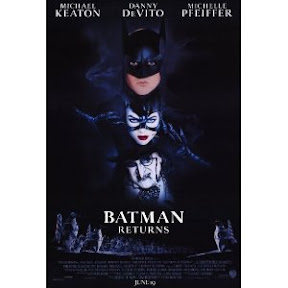
Actually, I can't leave Nolan behind for the moment without questioning whether he'd ever want to set a film at Christmastime. By comparison, Batman Returns can be seen as the middle film of a Tim Burton Christmas trilogy, following Edward Scissorhands (in which immortal Edward assures Winona Ryder of a white Christmas every year) and the more obvious Nightmare Before Christmas. So there's probably more of a point to setting Returns at Christmas than there was for Die Hard, to offer at least one similarly set summer movie. While there's some of Burton's sometimes tiresome epater le bourgeoisie attitude in play, the most obvious motivation I can see is that Christmas is a season when lonely people are likely to feel lonelier -- an ideal time for the revenge tragedy Burton stages. At the same time, there's something almost subliminally blasphemous about Burton's Christmas story. Apart from the mockery of the Moses legend, Returns can be seen as pitting Batman against a collective, trinitarian antagonist -- three aspects of evil or sin.
This is Max Shreck (Christopher Walken), in name an homage to the star of Nosferatu, in image an homage to The 1,000 Eyes of Dr. Mabuse. A department-store magnate and aspiring energy monopolist, Shreck is "the man who runs things," Gotham City's "mover and shaker," a Langian supervillain with the power to lift the accursed subterranean into the light of day and cast souls from the heavens, as well as a concerned parent. Evil incarnate otherwise, Max is always ready to sacrifice himself to protect his son Chip, if only because the youth is his legacy, his only continuity after death. He's a pharaonic figure in the movie's mock-Mosaic context, but his menace is undercut by his underwritten role. Walken's dialogue is sometimes literally reduced to a shrug, and as with all the villains, Shreck is too often reduced to speaking flippant if not infantile one-liners that make them sound stupid rather than sinister -- his response to one taunt from Bruce Wayne is "Yawn." I've always felt that Walken could have done a lot more with the part if Waters and Burton didn't turn Shreck into a moron at crucial moments. His behavior at the climax defies common sense; having just learned the secret identities of both Catwoman and Batman, and having his life threatened by the former, he might be expected to sit back and let Bruce Wayne eliminate the main threat, and then blackmail Wayne into compliance with his power-plant plans and perpetual stoogery thereafter. Instead, he shoots Wayne, wasting a bullet that might have saved his life if aimed elsewhere. Maybe Shreck ends up weak just because he's a Langian villain in what is, despite appearances, not a Langian film, thematically speaking.
I remember reading an interview in which Burton confessed to being frightened as a kid by Charlton Heston's transformation from prince to prophet in The Ten Commandments. It's not hard to see Batman Returns as the byproduct of that primal fear, as its top-billed villain, The Penguin (Danny DeVito) is a child cast upon the waters, only to return with an agenda of biblical revenge upon his fellow firstborn. As a manufactured hero and candidate for mayor (a trope borrowed from the 1960s TV show) Oswald Cobblepot arguably becomes a kind of antichrist, with Max Shreck as his satanic sponsor. Early versions of the script established Shreck and Cobblepot as brothers, but the writers made the right call by turning Shreck into a kind of substitute father figure for the malevolent mutant. Burton's vision of the Penguin is a drastic departure from the dapper, fussy figure of the comics. You can dress him up to look like Dr. Caligari, but he remains an animal, cold-blooded but comically randy. Waters writes contradictory dialogue for him, sometimes utterly vulgar, sometimes verbally pretentious, that seems appropriate for Burton's stated theme of duality -- maybe Schreck pales in comparison because there's no real duality at play in him.
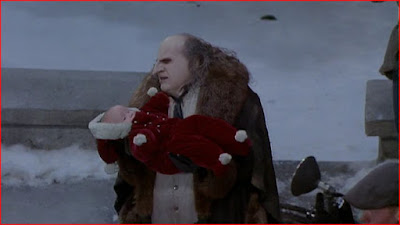
In any event, the Langian Schreck is eclipsed by Cobblepot, who despite his Caligarian formalwear is a classic Lon Chaney Sr. villain -- the grotesque outcast with a grudge against society and an occasional hint of a soul. There's not much hint of a soul in Burton's Penguin, but the director does make him an object of absurd pathos throughout, never losing sight of Cobblepot's desperate desire for acceptance (and sex) while reminding us that probably only the penguins ever really loved him. De Vito gives a performance worthy of Chaney, working the suit and the makeup for all they're worth. Even though he was certainly cast for his physical attributes and abrasive persona, he succeeds in making Cobblepot a distinct personality, or at least an ideal embodiment of Burton's dualist-animalist vision.
A few weeks ago I bought the Japanese ghost story Kuroneko during a Barnes & Noble Criterion Collection sale. I haven't watched the film yet, but the synopsis was a twenty-years late "a-ha!" moment. In Kuroneko a mother and daughter are raped and murdered by marauding samurai, but are revived by -- you guessed it -- cats licking their wounds. In the Japanese film, apparently, it's clear that the the women are undead, animated by cat spirits but retaining their human memories. We can assume that Burton, Waters or Sam Hamm either saw this 1968 film or were aware of the cat-spirit concept from Japanese folklore and applied it to Selina Kyle. Michelle Pfeiffer's character is an even more drastic departure from her comics template, since the movie's Penguin is at least still the leader of a criminal gang. Burton's Catwoman is an all-out avenger, even pausing before her campaign against the Shreck empire to play vigilante, if only to rebuke the victim-to-be for being a version of her own former mousy self. Burton seems uninterested in crime as such, the nearest thing to a conventional criminal in Returns being the businessman Shreck. But his approach allows him to cut to the quick in the matter of Selina Kyle and Bruce Wayne. He can dispense with the questionable notion that opposites (criminal and crimefighter) attract. As Bruce Wayne himself says, he and Selina are essentially the same. His tragedy is his failure to realize that their exact sameness makes a happy ending impossible. They're both "split, right down the center," but the split makes it impossible for either, despite Wayne's own desperate proposal, to go home to a fairy-tale castle together -- leaving aside the likelihood that Selina doesn't even belong on this earth, that her kingdom is no longer of this world.
In a way, neither does Bruce. His commitment to his avenging path had already cost him a lover before Returns even starts, and it has left him a kind of living ghost -- not the strutting playboy Christian Bale has portrayed -- brooding in darkness before the Bat-Signal stirs him into action. His romance with Selina belies his claim that his romance with Vicki Vale failed because she couldn't accept the "two truths" that define him. Selina comes to understand them all too well. If anything, she's split more profoundly than Bruce, as her crudely sewn and instantly fraying costume illustrates. After indulging a cruel streak we'd seen even before her trauma, she interrogates herself in a shop window, asking, "Why are you doing this?" In the end, she sees no choice but to do it. When she says she couldn't live with herself if she accepted Bruce's proposal, does she mean only that she can't accept leaving Shreck alive or, worse, that she doesn't deserve the happy ending Bruce self-deludingly offers? A supernatural reading of Returns would require her to follow through and destroy Shreck, that being her sole mission on earth as the wrath of God. An animalistic reading of the sort that Burton preferred at the time -- Selina as essentially a cat -- wouldn't be inconsistent with the supernatural reading of her as a cat-spirit. The dualistic reading is tragically pessimistic about the possibility of harmony between any two people. A part of each of us yearns for it, but another part always seems to want something else. That's why Bruce ends the first Burton film alone atop a tower while Alfred chauffeurs Vicki below -- and why Selina ends the second equally elevated and equally alone (in a late yet appropriate addition) while Bruce rides dismally in the limo. Christmas only heightens the pathos, but Burton's refusal of reconciliation, his insistence that love can't conquer all, makes Batman Returns an anti-Christmas movie, as might befit a June release -- unless indulging your pity is your idea of a holiday exercise.
Christopher Nolan's great project has been to modernize Batman, to release the character from the grip of retro sensibilities. If the beloved animated series that began shortly after Batman Returns seemed to lock Batman in a film-noir world, albeit with superscience enhancements, Burton's sequel looked further backward to the sensibilities of silent cinema. Apart from some early CGI (including a well-publicized "stunt Batman" for flying scenes) and a song by Siouxsie and the Banshees, Returns may as well be eighty rather than twenty years old next year. It's a monumental relic of the era of massive handmade sets -- Bo Welch's cityscapes are an improvement on Anton Furst's Oscar-winning abstractions. Too much CGI in the intervening generation gives me an even greater appreciation for the craftsmanship on display here. Danny Elfman's music should be making the transition from dated to timeless any year now. He was practically a musical genre in his own right for a while, if not a cliche, and the Returns score remains one of his best. Speaking of The Ten Commandments, did anyone else ever notice a similarity between Elfman's four-note Batman motif and Elmer Bernstein's Wagnerian opening notes (DUH, duh duh-DUH!) for the DeMille film? Finally, I can't leave the subject of Burton's Batman without doing justice to Burton's Batman. Cating Michael Keaton was a casting masterstroke, making clear that Bruce Wayne would not fight crime primarily with brute force while investing the character with that tense introspection of which comedians are often capable. I also happen to think his Returns gear is the best movie Batman costume to date. Keaton is the actor least burdened with clunky one-liners here, and his scenes with Pfeiffer in and out of uniform are extraordinary. The "two truths" speech is especially good and Keaton leaves an enduring impression of a deeply troubled, if not disturbed, yet essentially good man -- despite Burton's neglect of Batman's traditional code against killing. It's too bad that Keaton never got many acting opportunities afterward. I've never bought the idea that he or Bale have been eclipsed by their more flamboyant co-stars, and despite all the attention I've given to his antagonists Returns is still essentialy a film about Bruce Wayne, what defines him and differentiates him from his apparent peers, and why he'll remain as we found him here.
Returns is still my favorite Batman movie (Nolan's Dark Knight is the runner-up), sometimes in spite of itself. Waters's clunky dialogue pales in comparison to the screenplay's awkwardly edited chronology. Consider this: Selina Kyle has to go to Max Shreck's office at night to prepare the paperwork for Shreck's meeting with Bruce Wayne the following morning. That night, Shreck throws Selina out the window and she becomes Catwoman. The next morning is when Shreck stages the kidnapping and Penguin's rescue of the mayor's baby. We see Bruce Wayne watch news reports of the event. Penguin is set up at the Hall of Records to research his parentage, and one night a now-suspicious Batman cruises past the place. In another daytime scene Cobblepot visits his parents' graves and talks to the press. We see newspaper coverage of the scene. That night, presumably, Catwoman makes her first appearance to save a woman from a mugger. The following morning is when Bruce Wayne finally arrives at Shreck's office. Between the night of Selina's "death" and "next morning," an unlikely minimum of four days have passed, and it was probably quite a few more. How hard would that be to fix? For a long while, and maybe still, narrative wasn't considered Burton's strong suit. Returns often moves forward by laborious contrivances. Why, in the middle of a fight with Catwoman, does Batman remark that "mistletoe is deadly when you eat it?" The answer is that Burton needs a way for Bruce Wayne and Selina Kyle to discover each other's secret identities at the same moment, and the mistletoe couplet (answer: "A kiss can be even deadlier if you mean it") provides that. This is not a well-made plot, but the payoffs often justify the contrivances. The Max-querade Ball scene, where Bruce and Selina are the only guests not wearing masks, yet are unmasked to each other via the mistletoe couplet, is a poignantly devastating moment, no matter what it took for Burton to get us there. Burton's purpose was to give us visual and emotional spectacle, and against the odds he succeeded on both counts.
Compared to Nolan, Burton had what now seems a healthy reticence toward making Batman relevant to the contemporary world. Burton's Batman films are unrepentant fantasies unbound by any reality principle. Nolan has done great things with the concept, but he seems to sacrifice a lot of its potential in doing so. The two directors have profoundly different notions of what Batman is all about, and that's bound to influence each man's notion of what Catwoman is all about. For Nolan, time will tell and the clock is ticking. Burton has set the standard, but let's reconvene in seven months and consider this all again. For now, come what may, Merry Christmas and goodwill toward men ... and women.
Straight from the source -- WarnerBrosPictures presents the trailer for The Dark Knight Rises.
1. The Father.
This is Max Shreck (Christopher Walken), in name an homage to the star of Nosferatu, in image an homage to The 1,000 Eyes of Dr. Mabuse. A department-store magnate and aspiring energy monopolist, Shreck is "the man who runs things," Gotham City's "mover and shaker," a Langian supervillain with the power to lift the accursed subterranean into the light of day and cast souls from the heavens, as well as a concerned parent. Evil incarnate otherwise, Max is always ready to sacrifice himself to protect his son Chip, if only because the youth is his legacy, his only continuity after death. He's a pharaonic figure in the movie's mock-Mosaic context, but his menace is undercut by his underwritten role. Walken's dialogue is sometimes literally reduced to a shrug, and as with all the villains, Shreck is too often reduced to speaking flippant if not infantile one-liners that make them sound stupid rather than sinister -- his response to one taunt from Bruce Wayne is "Yawn." I've always felt that Walken could have done a lot more with the part if Waters and Burton didn't turn Shreck into a moron at crucial moments. His behavior at the climax defies common sense; having just learned the secret identities of both Catwoman and Batman, and having his life threatened by the former, he might be expected to sit back and let Bruce Wayne eliminate the main threat, and then blackmail Wayne into compliance with his power-plant plans and perpetual stoogery thereafter. Instead, he shoots Wayne, wasting a bullet that might have saved his life if aimed elsewhere. Maybe Shreck ends up weak just because he's a Langian villain in what is, despite appearances, not a Langian film, thematically speaking.
2. The Son.
I remember reading an interview in which Burton confessed to being frightened as a kid by Charlton Heston's transformation from prince to prophet in The Ten Commandments. It's not hard to see Batman Returns as the byproduct of that primal fear, as its top-billed villain, The Penguin (Danny DeVito) is a child cast upon the waters, only to return with an agenda of biblical revenge upon his fellow firstborn. As a manufactured hero and candidate for mayor (a trope borrowed from the 1960s TV show) Oswald Cobblepot arguably becomes a kind of antichrist, with Max Shreck as his satanic sponsor. Early versions of the script established Shreck and Cobblepot as brothers, but the writers made the right call by turning Shreck into a kind of substitute father figure for the malevolent mutant. Burton's vision of the Penguin is a drastic departure from the dapper, fussy figure of the comics. You can dress him up to look like Dr. Caligari, but he remains an animal, cold-blooded but comically randy. Waters writes contradictory dialogue for him, sometimes utterly vulgar, sometimes verbally pretentious, that seems appropriate for Burton's stated theme of duality -- maybe Schreck pales in comparison because there's no real duality at play in him.
In any event, the Langian Schreck is eclipsed by Cobblepot, who despite his Caligarian formalwear is a classic Lon Chaney Sr. villain -- the grotesque outcast with a grudge against society and an occasional hint of a soul. There's not much hint of a soul in Burton's Penguin, but the director does make him an object of absurd pathos throughout, never losing sight of Cobblepot's desperate desire for acceptance (and sex) while reminding us that probably only the penguins ever really loved him. De Vito gives a performance worthy of Chaney, working the suit and the makeup for all they're worth. Even though he was certainly cast for his physical attributes and abrasive persona, he succeeds in making Cobblepot a distinct personality, or at least an ideal embodiment of Burton's dualist-animalist vision.
3. The Holy Ghost.
A few weeks ago I bought the Japanese ghost story Kuroneko during a Barnes & Noble Criterion Collection sale. I haven't watched the film yet, but the synopsis was a twenty-years late "a-ha!" moment. In Kuroneko a mother and daughter are raped and murdered by marauding samurai, but are revived by -- you guessed it -- cats licking their wounds. In the Japanese film, apparently, it's clear that the the women are undead, animated by cat spirits but retaining their human memories. We can assume that Burton, Waters or Sam Hamm either saw this 1968 film or were aware of the cat-spirit concept from Japanese folklore and applied it to Selina Kyle. Michelle Pfeiffer's character is an even more drastic departure from her comics template, since the movie's Penguin is at least still the leader of a criminal gang. Burton's Catwoman is an all-out avenger, even pausing before her campaign against the Shreck empire to play vigilante, if only to rebuke the victim-to-be for being a version of her own former mousy self. Burton seems uninterested in crime as such, the nearest thing to a conventional criminal in Returns being the businessman Shreck. But his approach allows him to cut to the quick in the matter of Selina Kyle and Bruce Wayne. He can dispense with the questionable notion that opposites (criminal and crimefighter) attract. As Bruce Wayne himself says, he and Selina are essentially the same. His tragedy is his failure to realize that their exact sameness makes a happy ending impossible. They're both "split, right down the center," but the split makes it impossible for either, despite Wayne's own desperate proposal, to go home to a fairy-tale castle together -- leaving aside the likelihood that Selina doesn't even belong on this earth, that her kingdom is no longer of this world.
In a way, neither does Bruce. His commitment to his avenging path had already cost him a lover before Returns even starts, and it has left him a kind of living ghost -- not the strutting playboy Christian Bale has portrayed -- brooding in darkness before the Bat-Signal stirs him into action. His romance with Selina belies his claim that his romance with Vicki Vale failed because she couldn't accept the "two truths" that define him. Selina comes to understand them all too well. If anything, she's split more profoundly than Bruce, as her crudely sewn and instantly fraying costume illustrates. After indulging a cruel streak we'd seen even before her trauma, she interrogates herself in a shop window, asking, "Why are you doing this?" In the end, she sees no choice but to do it. When she says she couldn't live with herself if she accepted Bruce's proposal, does she mean only that she can't accept leaving Shreck alive or, worse, that she doesn't deserve the happy ending Bruce self-deludingly offers? A supernatural reading of Returns would require her to follow through and destroy Shreck, that being her sole mission on earth as the wrath of God. An animalistic reading of the sort that Burton preferred at the time -- Selina as essentially a cat -- wouldn't be inconsistent with the supernatural reading of her as a cat-spirit. The dualistic reading is tragically pessimistic about the possibility of harmony between any two people. A part of each of us yearns for it, but another part always seems to want something else. That's why Bruce ends the first Burton film alone atop a tower while Alfred chauffeurs Vicki below -- and why Selina ends the second equally elevated and equally alone (in a late yet appropriate addition) while Bruce rides dismally in the limo. Christmas only heightens the pathos, but Burton's refusal of reconciliation, his insistence that love can't conquer all, makes Batman Returns an anti-Christmas movie, as might befit a June release -- unless indulging your pity is your idea of a holiday exercise.
Christopher Nolan's great project has been to modernize Batman, to release the character from the grip of retro sensibilities. If the beloved animated series that began shortly after Batman Returns seemed to lock Batman in a film-noir world, albeit with superscience enhancements, Burton's sequel looked further backward to the sensibilities of silent cinema. Apart from some early CGI (including a well-publicized "stunt Batman" for flying scenes) and a song by Siouxsie and the Banshees, Returns may as well be eighty rather than twenty years old next year. It's a monumental relic of the era of massive handmade sets -- Bo Welch's cityscapes are an improvement on Anton Furst's Oscar-winning abstractions. Too much CGI in the intervening generation gives me an even greater appreciation for the craftsmanship on display here. Danny Elfman's music should be making the transition from dated to timeless any year now. He was practically a musical genre in his own right for a while, if not a cliche, and the Returns score remains one of his best. Speaking of The Ten Commandments, did anyone else ever notice a similarity between Elfman's four-note Batman motif and Elmer Bernstein's Wagnerian opening notes (DUH, duh duh-DUH!) for the DeMille film? Finally, I can't leave the subject of Burton's Batman without doing justice to Burton's Batman. Cating Michael Keaton was a casting masterstroke, making clear that Bruce Wayne would not fight crime primarily with brute force while investing the character with that tense introspection of which comedians are often capable. I also happen to think his Returns gear is the best movie Batman costume to date. Keaton is the actor least burdened with clunky one-liners here, and his scenes with Pfeiffer in and out of uniform are extraordinary. The "two truths" speech is especially good and Keaton leaves an enduring impression of a deeply troubled, if not disturbed, yet essentially good man -- despite Burton's neglect of Batman's traditional code against killing. It's too bad that Keaton never got many acting opportunities afterward. I've never bought the idea that he or Bale have been eclipsed by their more flamboyant co-stars, and despite all the attention I've given to his antagonists Returns is still essentialy a film about Bruce Wayne, what defines him and differentiates him from his apparent peers, and why he'll remain as we found him here.
Returns is still my favorite Batman movie (Nolan's Dark Knight is the runner-up), sometimes in spite of itself. Waters's clunky dialogue pales in comparison to the screenplay's awkwardly edited chronology. Consider this: Selina Kyle has to go to Max Shreck's office at night to prepare the paperwork for Shreck's meeting with Bruce Wayne the following morning. That night, Shreck throws Selina out the window and she becomes Catwoman. The next morning is when Shreck stages the kidnapping and Penguin's rescue of the mayor's baby. We see Bruce Wayne watch news reports of the event. Penguin is set up at the Hall of Records to research his parentage, and one night a now-suspicious Batman cruises past the place. In another daytime scene Cobblepot visits his parents' graves and talks to the press. We see newspaper coverage of the scene. That night, presumably, Catwoman makes her first appearance to save a woman from a mugger. The following morning is when Bruce Wayne finally arrives at Shreck's office. Between the night of Selina's "death" and "next morning," an unlikely minimum of four days have passed, and it was probably quite a few more. How hard would that be to fix? For a long while, and maybe still, narrative wasn't considered Burton's strong suit. Returns often moves forward by laborious contrivances. Why, in the middle of a fight with Catwoman, does Batman remark that "mistletoe is deadly when you eat it?" The answer is that Burton needs a way for Bruce Wayne and Selina Kyle to discover each other's secret identities at the same moment, and the mistletoe couplet (answer: "A kiss can be even deadlier if you mean it") provides that. This is not a well-made plot, but the payoffs often justify the contrivances. The Max-querade Ball scene, where Bruce and Selina are the only guests not wearing masks, yet are unmasked to each other via the mistletoe couplet, is a poignantly devastating moment, no matter what it took for Burton to get us there. Burton's purpose was to give us visual and emotional spectacle, and against the odds he succeeded on both counts.
Compared to Nolan, Burton had what now seems a healthy reticence toward making Batman relevant to the contemporary world. Burton's Batman films are unrepentant fantasies unbound by any reality principle. Nolan has done great things with the concept, but he seems to sacrifice a lot of its potential in doing so. The two directors have profoundly different notions of what Batman is all about, and that's bound to influence each man's notion of what Catwoman is all about. For Nolan, time will tell and the clock is ticking. Burton has set the standard, but let's reconvene in seven months and consider this all again. For now, come what may, Merry Christmas and goodwill toward men ... and women.
Straight from the source -- WarnerBrosPictures presents the trailer for The Dark Knight Rises.
Subscribe to:
Posts (Atom)