 R
Reading an account of an African film festival a few months ago, I got the impression that
Mahamat Saleh Haroun's film, a Cannes award winner, represented the great hope of the continent's largely Francophone art cinema at a moment when cheaply and crudely made Nigerian flicks (the product of "Nollywood") threaten to usurp Africa's cinematic identity. It's been acclaimed in Europe and America, but I wonder how many Africans have seen it. It's not "arty" in any alienating way, but as with a lot of what ends up as arthouse cinema in the U.S., I have to wonder how popular this film was, compared to Nollywood or Hollywood, on its home turf. It'd be reassuring to learn that it was popular, because it's good enough to deserve some popularity. But you can't help wondering whether the primary intended audience was the people of Chad, Africans overall, or the global community of movie buffs.
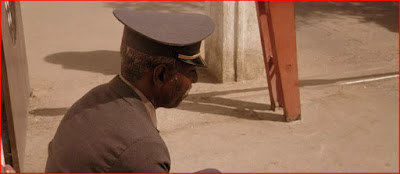
Haroun tells a simple, powerful story. It's about Adam, aka "Champ," a onetime champion swimmer who has long been the pool attendant -- swimming instructor, lifeguard, etc., at a hotel, formerly run by the government, that's popular with tourists. Champ's son Abdel is his assistant, but both men's jobs are in danger with the hotel's privatization, symbolized by a Chinese woman taking charge. Champ's situation is even more precarious in a state of civil war, as the ruling party pressures citizens into further contributions to the war effort. He ends up getting bad news and good news; he loses his attendant job to Abdel but gets to stay on as a uniformed gatekeeper. But even that's not such good news because it means the former gatekeeper, an old friend of Champ's, has been sacked. That aside, Champ still feels degraded and humiliated by his new work of lifting and lowering barriers for cars to arrive or depart. I found his fall from grace oddly reminiscent of F. W. Murnau's
The Last Laugh, but while in that film a doorman is humiliated by losing his ornate uniform, Champ's new uniform is the badge of his disgrace.
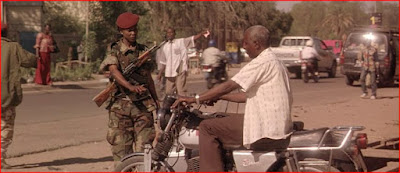
Meanwhile, the neighborhood "chief" keeps pressing Champ to contribute something to the war, noting pointedly that he's sent a son to fight the rebels. The problem seems to be solved by force when Abdel is abruptly conscripted, quite against his will, as Champ watches helplessly. In Abdel's absence Champ resumes his pool job but doesn't enjoy it. He and his wife virtually adopt a pregnant woman who tells them that Abdel's the father of her unborn child. That's just one of the factors that finally compels Champ to confess that he set up Abdel's conscription, to get the chief off his back and perhaps eliminate a rival, and drives him to rescue his son from the perils of war....
The title proves ironic, since Champ never screams. You can infer a lot of silent screaming, though, as he broods over his various misfortunes, and his frequent silences are the best part of Youssouf Djaoro's performance. The less artfully articulate such a character is -- though Champ is fairly chatty in his better moods -- the more universal his emotions for global audiences. We can agree on the swirl of emotions inside him, and each of us can judge their relative weight for himself.

Director Haroun gives us a quick, evocative sketch of N'Djamena and a community under siege on many fronts: from the nebulous rebellion, from the monotonous propaganda of its own government, and from the economic forces threatening Champ's security. The movie doesn't count as the usual visual travelogue of an exotic place, but Haroun emphasizes the telling details: the checkpoints, the unlit neighborhoods Champ rides through at night on his moped. Laurent Brunet's cinematography gives the city an earthy, sunbaked palette that seems characteristically African. They don't go overboard making things look picturesque but their compositions are effective and often affecting. The ending spirals from the melodramatic to the maudlin, but it has the outcome the story seems to require, and aims for a pathos once more commonly welcome around the world. Whether the finale moves you as much as Haroun hopes, you can still admire the overall execution for its lean efficiency, for being austere without becoming abstract. It's the sort of film more people should see everywhere, whether many end up liking it or not, just to appreciate what movies can make of the ordeals of ordinary folk.