Josef von Sternberg's career can be divided into two phases. He's best known for the period when he was identified with his protege Marlene Dietrich. In the earlier stage, he was identified with George Bancroft. There's a contradiction for someone to reconcile. Sternberg became a star director putting burly Bancroft through his criminal paces in
Underworld, and starred him again in his seedy romance
The Docks of New York. He depended on Bancroft, who had since become the
Wolf of Wall Street, to put over his talkie debut. Sternberg reportedly wanted to work as creatively with soundscapes as he had worked with images, and you can hear that in
Thunderbolt's diegetic soundtrack and in occasional thematic devices like a sort of hyena laugh that hovers in the atmosphere of the Black Cat nightclub. Inevitably, however, a Sternberg film works best on the visual level, and to an extent Bancroft's voice limits this one. Most of the time he has an unusually smooth delivery as the title character, a gangster named for his lethal punch, but as I've noticed in other Bancroft talkies, the star has a bad habit of slowing...his lines...down...very...deliberately in his big dramatic moments, to the point that you can imagine him intoning the infamous "Take him ... for ... a ride" line from
Lights of New York. That's a shame because Bancroft gives an interesting performance overall as a rather peculiar gangster.
Above: Thunderbolt enters the Black Cat.
Below: Fay Wray as the woman Thunderbolt has lost, and
Theresa Harris as the dream of another possibility.

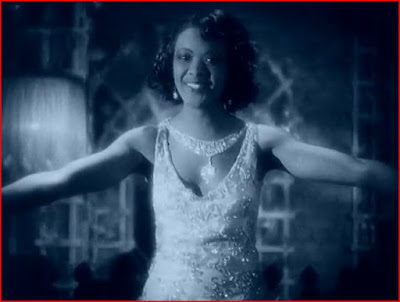
What's peculiar about Jim Lang is his detachment, or his ability to detach himself from his concerns to dwell in moments of pleasure or play. You notice how he hangs out at the Black Cat, apparently an integrated nightclub with black entertainers, and how he lingers before leaving to take in the uncredited Theresa Harris's song, "Daddy Won't You Please Come Home?" Sternberg and Bancroft convey Thunderbolt's appreciation of Harris's voice and figure, but just as interesting as his appreciation of black beauty is his readiness to stop everything and enjoy the moment. Later, Jim enters an apartment building to kill Bob Moran (Richard Arlen), the new lover of his erstwhile moll Ritzy (Fay Wray). He's followed inside by a stray mutt from the street that's attached himself to the gangster. Thunderbolt wants to be rid of the yapping dog and tries to attract it back downstairs by getting on all fours, shaking his rump and sliding with a weird smoothness across the carpet. You get the impression that despite his mission of death Jim will take as long getting the pooch's attention as he needs to, that now all that matters is getting that dog to come to him. And as we'll see, he doesn't really want to be rid of the dog at all, even if the dumb animal gets him pinched. Thunderbolt is used to doing whatever he wants, and in moments like these there's an almost endearing modesty to his whims.

Above, Thunderbolt acts as virtual executioner for "Bad Al" (Fred Kohler).
Below: Bob confronts his enemy at last.
Inevitably,
Thunderbolt is a melodrama typical of its decade. As noted, Thunderbolt wants to destroy Bob, the man he assumes is cuckolding him. Even on death row -- it's unclear what exactly he was convicted of -- he has enough influence to take belated revenge on Moran. He has his men lure Bob to the bank from which he was recently fired -- his relationship with Ritzy came to light and might have harmed the establishment's reputation -- and plant a gun on him while robbing the place. Lives are taken and Bob promptly finds himself on death row across from Thunderbolt, even though you'd think the bank president's testimony would have substantiated Bob's defense that he was lured to the bank by a crank call. Bob is so thoroughly railroaded that he's scheduled to burn before Thunderbolt. Everybody takes for granted (even though no one can prove it in court, presumably) that Thunderbolt framed Bob, but despite entreaties from Ritzy and Bob's mother (Eugenie Besserer, who couldn't be more different from her
Jazz Singer mom in a wonderful scene where she and Bob are playfully roughhousing in their bathroom) Jim refuses to fess up. It's only when Ritzy and Bob have a death-house wedding that Thunderbolt relents and admits to the frame. This is where such stories usually end, with the pathos of renunciation as Jim gives up Ritzy once and for all, but Sternberg and the screenwriting Furthman brothers create fresh suspense by having one of Jim's cronies confide that Thunderbolt is still playing a long game. What he really wants, we're told, is a chance to kill Bob with his super punch, which we've already seen knock another con into a coma. To do this, he needs Bob to stay in his cell (while the paperwork for his release is prepared) until the day Jim himself is scheduled to die. Jim will get a chance to shake hands with all his death row playmates, and when it's Bob's turn, POW! Everything leads to a climactic long take that's both corny and brilliant, as Jim and Bob say their farewells while Sternberg calls our attention to Thunderbolt's deadly hand moving from bar to bar of Bob's cell. Then Bob hits Jim with a final revelation: it turns out that he'd been Ritzy's childhood sweetheart, but that Jim had fairly won her away from him until she tired of gang life. This idea tickles Thunderbolt, and he moves on to the death chamber in good humor.

Watch that hand, Bob!
What happened here, exactly? There's room to see it two ways. It may be that something about Bob's story made Jim relent, but for all we know that other gangster was talking through his hat and Jim never had any intention to kill Bob after the wedding scene. Conceding some ambiguity makes the moment somewhat less corny, and my overall impression of Jim Lang is that he is too easily amused by things to be as deadly as everyone assumes, and that even his frame-up of Bob is little more than a practical joke. At the very end we leave him laughing at a guard having the name Aloysius. You could almost believe that Thunderbolt is tired of his life without actually realizing it. I may question Bancroft's line readings sometimes, but there's a subtlety to his performance that makes my view of Jim's bemused ambivalence seem plausible. Whatever Sternberg's intentions,
Thunderbolt isn't one of his characteristic spectacles, though it is nicely shot. That may be because his camera doesn't really worship Fay Wray the way he'd worship Dietrich, or the way he worships Theresa Harris during her song. In the end, it's Bancroft's imperfect but intriguing performance that makes the film worth seeing.