Showing posts with label books. Show all posts

Wednesday, March 23, 2011

Conversations With Scorsese

Martin Scorsese's motormouthed enthusiasm for movies can be grating sometimes, but the man often has interesting observations to make. That makes Richard Schickel's new collection of conversations a promising volume: you get the observations in reasonable doses without the cartoonish voice. The book is a survey of Scorsese's career up to the surprise hit of Shutter Island (a public endorsement Schickel and to a lesser extent Scorsese himself find "astonishing"), bracketed by reflections on the director's upbringing and education and general comments on his techniques and artistic principles. Memories being what they are, and the earlier canonical works having been well gone over elsewhere, there's less talk about Taxi Driver or Goodfellas than about The Aviator and The Departed. This book is no substitute for a comprehensive artistic autobiography, and the nature of the format makes the book a hit-and-miss proposition, but it's an entertaining read.

With such a project the whole is inevitably less than the sum of its parts, but you probably read it for the flashes of insight (or their opposites) and the odd bits of trivia. You learn here, for instance, that Leonardo DiCaprio considered Out of the Past "the coolest film I've ever seen" when Scorsese screened it for him prior to The Departed. You also learn that Akira Kurosawa panned The Age of Innocence, complaining that "I do not like movies about romances" while chiding Scorsese for using too much music in his films. That news reminded me that I missed a discussion of Scorsese's career as a character actor, including his role as Vincent Van Gogh in Kurosawa's Dreams. The two directors clearly had some sort of artistic relationship that barely gets touched on here.

On his own work Scorsese is most interesting when most critical of himself. Shutter Island is clearly a touchy subject for him, especially since Schickel doesn't seem to have liked it. Scorsese was still smarting from a perceived betrayal by the studio that pushed the release date from Fall 2009 to February 2010, even though he has to admit that they must have had the right idea based on box office. Going back a few years, it seems that Scorsese still doesn't understand what went wrong with Gangs of New York. He tells Schickel that his dream project might have gone over better had he not run out of money while staging the New York Draft Riots. That sounds like a way to blame the money men for his own story problem. He could have filmed the riots with thousands of extras, but it would not have helped the picture as long as the riots remained irrelevant to the final showdown between DiCaprio and Daniel Day-Lewis's gangs. The deeper flaw in the often-brilliant Gangs is its insistence on a hero implausibly innocent of bigotry in such a bigoted age, its option for a generic revenge storyline instead of something more challenging.

Taking a larger view, I was intrigued by Scorsese's acknowledgment that Bringing Out the Dead marked the end of something for him. I didn't think much of the 1999 film, but I'd agree that there remains something essentially Scorsesean about that project that's missing from his films of the new millennium. While he still clearly has a creative passion about the making of images, the passion often seems to have gone out of his stories, leaving them the work of a master craftsman, but without his signature drive. Shutter Island is probably his best film of this period, but it's Dennis Lehane's story, not Scorsese's. While the director says nothing to confirm my hunch, I still feel that he hasn't been the same since 1995, when the public rejected Casino because it seemed too much like Goodfellas, which was like saying you'd allow John Ford only one cavalry movie. The most interesting thing Scorsese says about Casino is that he considers Joe Pesci's death scene the most brutal thing he's ever shot, and doesn't want to do anything like that again.

By the end, I recognized kindred spirits in both Scorsese and Schickel. I mean that almost literally, since it's on page 356 when the following exchange occurs regarding a film I haven't yet seen. I could hardly express better the value of film beyond its aesthetic or literary merit as a mirror of its time and place in history.

Schickel: The artifacts of history in film are terribly important. I mean, the worst movie in the world will contain clues to how we lived, how we dressed, how we talked.


Scorsese: That is what I was pointing out in 1979. There was a film called The Creeping Terror, a silly sci-fi film shot in the Midwest. They got everybody in some town to act in it. So you actually saw the way people dressed. And you saw how they behaved in everyday life. They were 'acting,' but they really weren't. The plot was not the point. What was important to me was what it said about America, and about our culture. It was very moving.


And sometimes so is this book.

Sunday, December 12, 2010

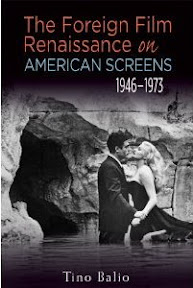
OPEN CITY (1945) and THE FOREIGN FILM RENAISSANCE ON AMERICAN SCREENS, 1946-1973.

Roberto Rossellini's breakthrough style-defining film marks the beginning of the "renaissance" described in Tino Balio's new book. Balio's renaissance lasts 27 years, its endpoint being the last big art-house hit of the era, Last Tango in Paris. But he also notes a fact that makes 1973 an almost too artistically correct end to the era. Open City premiered in New York City at the World Theater on West 49th Street. Twenty-seven years later, the same venue, now the New World Theater, opened Deep Throat.

Consider some other juxtapositions. Balio's book describes the distributors who got into the art-film business. Astor Pictures, for instance, brought Fellini's La Dolce Vita to America and scored a blockbuster hit. If the Astor name sounds familiar to some readers, that might be because some of its other presentations were Robot Monster and Cat-Women of the Moon. By 1961, when Astor released the Fellini film, the company was consciously going upscale. But the relationship between art-house cinema and exploitation doesn't always go in one direction. For instance, Distributors Corporation of America released Henry-George Clouzot's classic thriller, The Wages of Fear, in 1955, along with other foreign product for the art houses. In 1959, DCA distributed Plan 9 From Outer Space.
Independent distributors serviced theaters that weren't part of the major corporate-owned (if no longer studio-owned) chains. They serviced theaters starving for product as the studios reduced production in the age of television. Theaters struggling for survival sought new product for new audiences. The obvious option was to find films that showed what Hollywood would not or could not. You could go art-house to attract an upscale audience or grindhouse to get the kids and the freaks. Art and exploitation should not be seen as opposite extremes flanking the happy medium of Hollywood tastefulness. Instead, they share a zone of exclusion defined by Hollywood tastefulness and prevailing censorship standards -- the Production Code, the Legion of Decency, local censorship boards, etc. Many chain theaters wouldn't show anything missing the Code seal or condemned by the Legion of Decency. Others took their chances with local censors and hyped the transgressiveness of their product, whether art or trash.

Discussing Open City, Balio points out how the film's original American distributor, the Mayer-Burstyn company, sold the Rossellini as an exploitation film in an effort to maximize its audience. It was billed as "Sexier than Hollywood dared to be," while newspaper advertising made the most of a Life magazine blurb touting the film's sexual frankness. The title of the film itself sent a variety of messages. As Italian critic Adriano Apra notes in an interview on the Criterion DVD, an open city in wartime means one exempt from bombing. The title becomes ironic once we're shown damage apparently done by an American bomber, but Apra infers added meanings: the availability of Rome for Rossellini's sprawling location work; the setting at the brink of liberation as metaphor for Italy's "open" future, and so on. To this, Balio adds implicit significance in Burstyn-Mayer's omission of Rome from the American edition of Roma, Citta Aperta. The bald title Open City, he notes, reminded 1940s Americans of what they called a "wide-open city" or "wide-open town," -- one where vice flourished freely due to incompetent or corrupt law enforcement.
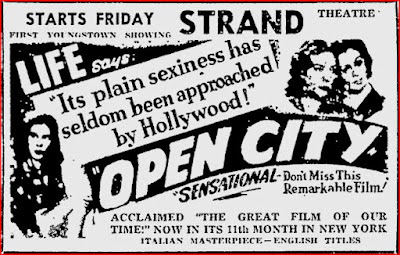

While Joseph Burstyn of Burstyn-Mayer is a hero of Balio's book, a promoter of foreign film and a battler against censorship, Balio's account of the promotion of Open City treats it as, on some level, a misrepresentation of Rossellini's film. He might help his case if his otherwise liberally illustrated book used less movie stills and more of the advertising art whose importance he emphasizes repeatedly. Describing a Burstyn-Mayer Open City ad, he notes "fake publicity stills" of a lesbian embrace and a man being flogged. I'd have to see it to not believe it. After all, a man is flogged in the movie, and there is a lesbian embrace -- fully clothed, alas. Burstyn could have used frame enlargements, but maybe they wouldn't have been provocative enough. In any event, Balio's account begs a question: what sort of movie did Rossellini make? Was it "art" and not "exploitation," or could it be both?

Over the course of his book, Balio answers the question in general terms, noting repeatedly the link of sexual frankness or salacious content that put art and exploitation in a common category outside the Hollywood mainstream. He argues that the renaissance began to sputter out in the late 1960s, once Hollywood abandoned the Production Code and could compete in sexual frankness with foreign product and win with less pretension and greater relevance to the U.S. audience. I Am Curious (Yellow), the first foreign film to top La Dolce Vita's U.S. gross, pointed the way to survival for many remaining art-houses after 1968; by the 1970s, the word "Art" on a theater marquee almost certainly marked it as a porno house. It was that way in my hometown of Troy, New York. The American Theater, initially a second-run house, became the Cinema Art to spotlight foreign films; it survived into the 1990s with triple-bills of shot-on-video porn projected onto a big screen. There was probably purely prurient interest in art-house cinema from the very beginning, or else Burstyn wouldn't have advertised Open City as he did. While we may infer from Balio that there was a synthesis in America of art and exploitation, what about Italy? Would citta aperta have the same additional meaning for Rossellini and his home audience as it did for Americans?
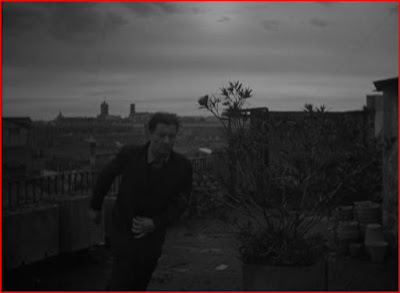
By the time I watched Open City myself, I'd been inspired to buy the Rosselini War Trilogy box set by my reading of Balio's book -- and by Barnes & Noble's half-off sale on Criterion DVDs, not to mention a supplemental coupon that knocked the price down still further. My question going in was whether Burstyn, Balio or the original movie critics who made the film's reputation represented it accurately. What impressed me immediately was the ease with which the film I saw could fit Burstyn's exploitation framework. If the concept of a "wide-open city" didn't necessarily exist in those words in Italy, Rossellini did juxtapose the Italian resistance with a Roman demimonde represented by Marina (Maria Milchi), the nightclub performer (stripper?) who is a drug addict embroiled in a lesbian affair with a German Gestapo officer who keeps her in the junk. Marina will rat out her former boyfriend, Giorgio Manfredi, the fugitive communist whose pursuit by the Germans and their Italian collaborators forms the plot of the film.
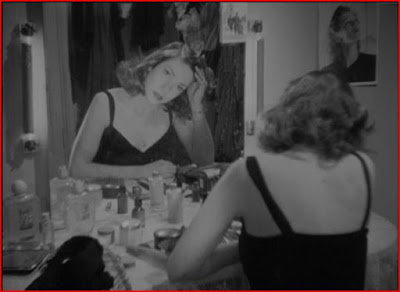
Open City was misrepresented to Americans to the extent that the advertising presents Marina as the main character of the film. But Marina is certainly an important character, and probably the most photogenic. She represents the wrong path Italians could take under occupation. She protests that, by becoming a prostitute, she's only doing what "every woman" has had to do to survive. She's also unrepentant -- until she sees Giorgio's fate -- scoffing at a fellow dancer's advice that drugs are bad for her. Lots of things are bad for us, Marina says, but we do them anyway. It's almost as if the war and occupation were a perverse liberation into licentiousness for her, so that Rome is a different kind of "open city" for her than it is for the other Roman characters. Marina represents a collaborative underground of vice that probably can't help but share space dangerously with the resistance underground. And here's a historical note for those keeping score at home: Maria Milchi would turn up nearly thirty years later in Tinto Brass's Salon Kitty, a key film in the Italian canon of Nazisploitation. An accident? Perhaps not, given her character's alliance with arguably the original lesbian Nazi villain in all cinema, Giovanna Galletti's Ingrid.
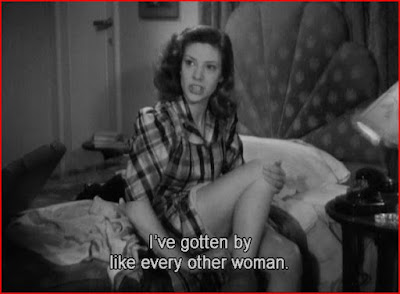
Notice how both these shots were used in the Strand theater ad above.
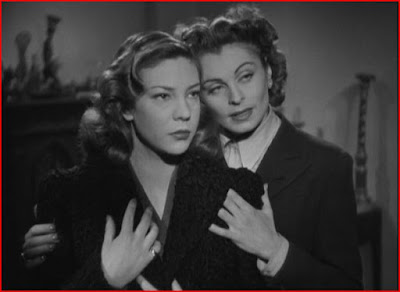
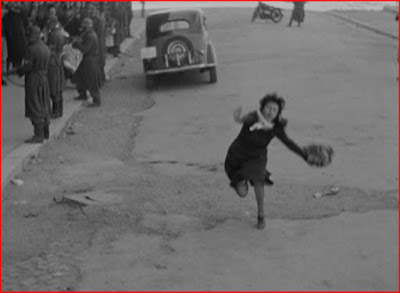
If you resist labelling Open City an exploitation film, you still have to admit that there are lots of exploitable elements in it to which future generations of Italian filmmakers would return. Meanwhile, you can make a case for Rossellini's film as ground zero for all Italian cinema to come, or at least the two great streams, if you must separate them, of art and exploitation. Crucial and formative here is Rossellini's presentation of violence. There are two big moments of violence in the film. One, the most famous for film historians, is the shooting of Pina (Anna Magnani) as she chases a truck carrying her fiancee, Giorgio Manfredi's brother, along with Giorgio and other victims. This scene is the cinematic equivalent of Robert Capa's famous snuff photo of a Spanish Civil War soldier buying it; it has the same out-of-nowhere abruptness and absence of stylization. We never see anyone fire on Pina. We hear a shot, and down Magnani goes in a gross tumble, dead the moment she hits the pavement. This stark, unmelodramatic framing, in a film that is not without melodrama (sometimes painfully highlighted by a score from Rossellini's brother) helped define "neorealism" for Italy and the world. It also comes with a grim irony trailing behind. Francesco will be liberated moments later by a partisan ambush.
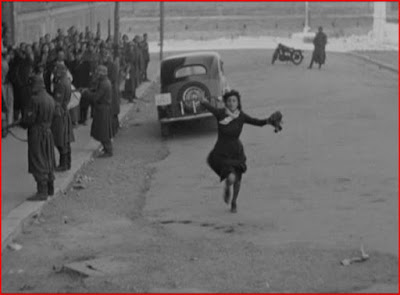
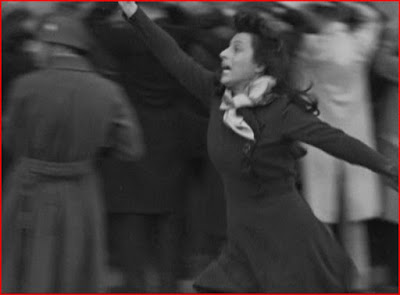
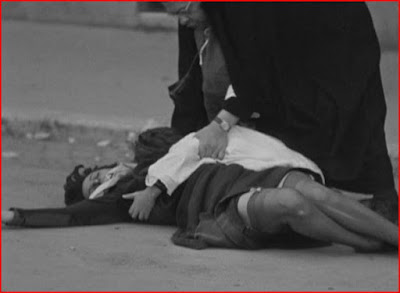
The other big moment is the torture of Giorgio Manfredi, undertaken both to force him to talk and to terrify Don Pietro (Aldo Fabrizi, seen above over Magnani's body), a patriotic priest, into talking. Structurally, this is the climax of the film. Skimming through it a second time to harvest screencaps, I noticed how many times Rossellini films Don Pietro waiting at a threshold for something or someone; at the curio shop where he priggishly moves some statues so a saint isn't looking at a nude; at a printing press, where he will receive books printed with thousand-lira notes for smuggling to the partisans. At the climax, the Gestapo seats him in an adjoining room so he can watch through an open door as Giorgio is beaten, flogged (see!) and burned with a blowtorch. It's as if the priest is meant to wait for Giorgio to break, or for his own turn to be tortured. In earlier scenes he'd been waiting to meet someone or be shown something. Now he and we are shown what is clearly intended as an ultimate revelation of Nazi cruelty.
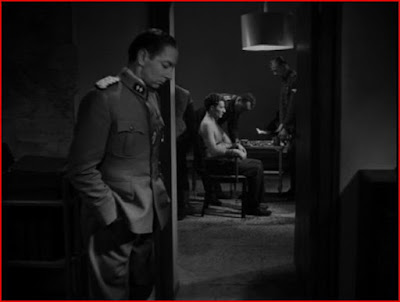

Adriano Apra has something significant to say about this scene on the DVD:
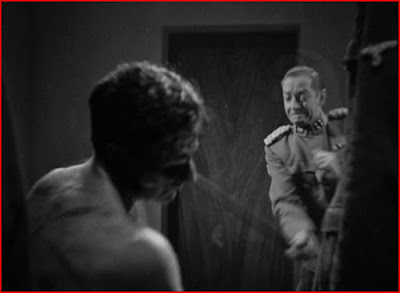


One of the great innovations in this film -- and it's precisely in the torture scene -- is a particlar moment in which Major Bergmann forces Don Pietro to watch the torture ....and this shot/countershot of Fabrizio watching the torture scene marks a new point in cinema. Viewers are no longer called upon to merely observe a world of appearances. They're forced to watch something deeply upsetting, something that wounds them inside. Cinema now wounds us. It's no longer just entertainment we can watch comfortably in our seats. It's something that involves us directly.
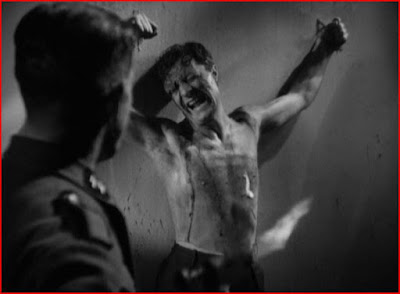

It's as if the torture scene is the fount from which flows not just the neorealist tradition, not just Fellini (a co-writer of the film), De Sica, Visconti, etc., but also the exploitation tradition of in-your-face shock, the tradition of Mario Bava and the giallo directors, of Mondo movies, of Ruggero Deodato and Cannibal Holocaust, not to mention the work of someone like Pier Paolo Pasolini who traveled down both streams at once. If Open City seems to mix art and exploitation, that's probably because it predates any real differentiation in Italy. The country is often said not to have a real horror-film tradition, after all, before the mid-1950s, though it would soon prove a cornucopia or hellmouth of exploitation subgenres, all arguably authorized by Rossellini's show-don't-tell approach to Giorgio's interrogation.

Exploitation is often defined by excess, but for many original audiences Open City's torture scene was excessive. Excess can be determined by prevailing standards of taste as well as by censorship codes; in France, for instance, Balio notes the nouvelle vague's rebellion against a "Tradition of Quality" perceived as oppressively tasteful. The New Wave films, in turn, were sold here on sex appeal as much as possible, with Jean-Luc Godard himself ordered by Joseph E. Levine to add butt-shots of Brigitte Bardot to Contempt. It was easier, after all, to sell sex than style. There were other approaches -- Balio describes in detail Janus Films' successful cultivation of the "brand" of Ingmar Bergman, who'd been subjected to sexploitative promotion earlier in his career -- but the shortcut to success seemed always to be emphasizing what foreign films could show that Hollywood couldn't or wouldn't. In Open City's case there was objective truth to the advertising; Hollywood in 1946 wouldn't show a flame flickering on a man's bare chest. It would not hint so strongly that two women were lesbian lovers. That was the strength of foreign film from the viewpoint of American distributors and exhibitors, and Balio is absolutely right to define Open City as the start of an era when art, if you will, was, if you will, eminently exploitable.

There's more to Balio's story, of course. Along with a survey of important distributors, The Foreign Film Renaissance chronicles the reception of now-canonical imports, emphasizing the make-or-break importance of a handful of reviewers. The book makes a strong case, whether Balio intends it or not, for a reappraisal of the career of Bosley Crowther. For generations, Crowther, the onetime lead film reviewer of the New York Times, was a byword for philistinism, remembered most for finally ruining his career by refusing to endorse that Sacre du Printemps of American cinema, Bonnie and Clyde. Much of the resentment of Crowther I've seen among other critics prior to his 1967 debacle was probably based on his perceived power to close a foreign film with a pan. For Balio, however, Crowther plays a crucial role in legitimizing foreign film as a champion of Open City and a supporter of Joseph Burstyn in his battles against censorship. Whatever he became by the Sixties, Crowther in the Forties was some kind of vanguard figure. Subsequently, Balio recounts a mixed record, noting a social-realist bias on Crowther's part that made him hostile toward stylistic experimentation and an occasionally obnoxious incomprehension of Asian film. To the end, however, Crowther would throw his support behind those foreign films he deemed worthy, doing his part to perpetuate the renaissance even as he seemed to suppress its full scope. Crowther's disrepute is so complete that he was excluded from the Library of America anthology of American film criticism, but Balio's book suggests that at least a partial rehabilitation is in order.

While Balio's is now my favorite film book of 2010, I do have some criticisms. I've already noted the absence of advertising art that would help prove some of his points. I also wish that Balio had put the fate of canonical art films in the context of foreign-film importation in general, including pop and "true" exploitation movies. He nods in that direction by noting the success of Godzilla and Brigitte Bardot, but I missed any in-depth discussion of Hercules films, spaghetti westerns and other genre efforts as part of the massive Italian onslaught on U.S. screens during the 1960s. It would have been instructive to see statistics on the number of foreign films released in the U.S. year by year, broken down by nationality, to learn what Americans were really interested in from abroad. Space limitations as well as a bias in favor of "art" over "exploitation" probably determined Balio's priorities.

At the same time, Balio's book tempered my appreciation of the Criterion Open City. Understandably, the DVD represents a heroic reconstruction of the film from "disastrous" source materials and looks as good as possible. But it was the version released by Burstyn Mayer that made history in America, and for historical reasons that version, if it still exists, ought to have been included in an admittedly ample Rossellini package. The original reviewers probably saw something that didn't look as good as the disc, and their conflation of visual defects with spartan virtues may have influenced the American understanding of neorealism. A full-scale cleanup arguably strips a layer of romanticized grit that actually defined the film for generations, making it perhaps as controversial a project as those cleanings of paintings from the original Italian Renaissance that make them look too clean or bright for some eyes. Again, including the U.S. release version would have given buyers cakes for having and eating as far as comparative aesthetics go. As it is, the movie was a surprise for me, since I expected from its reputation something much more stark and minimalist than what I got. Indeed, the original reviewers often commented on how conventional or derivative the actual story was, while I've already noted the banal soundtrack. I actually give the story more credit, but I've seen far fewer Nazis-vs-good guys pictures recently than 1946 reviewers had, so I'm less jaded about the subject than they probably were. For viewers possibly jaded by modern levels of violence or sexual frankness, the Criterion supplemental materials do a good job of clarifying the film's historical importance, but I think most people would still consider it a good film, if a bleak one, anyway.

Balio admits that foreign films can still make a mint in America, though it's hard to say whether Crouching Tiger, Hidden Dragon tops La Dolce Vita when you adjust for inflation. What's lost now, he claims, is the movement of film buffs that helped fuel the 1946-73 renaissance, the sense that milestone films could change the way we see the world, or even change the world itself. Balio's renaissance was a romantic era for American art-film fans who could consider themselves ahead of the pack, above the rabble, for appreciating more sophisticated or exotic fare. Those who feel similarly edgy today, Balio notes, have ready access to DVDs, but as with every trend toward the privatization of experience, something seems missing at the home theater, just as reading this article isn't an exact substitute for us flocking out of the theater together to talk about the new film at the bar or the cafe. Maybe we can add an additional level of meaning to Open City by saying that it opened Americans to a cinematic cosmopolis they could visit regularly, claiming citizenship of the world in a way. If Balio is right, the films remain but the city is dead. Decide for yourselves.

Tuesday, February 9, 2010

Return of the Worst Movies Ever Made

In the year 2007 Australian screenwriter, film reviewer and occasional actor Michael Adams fulfilled a new year's resolution by watching more than 365 of the reputed worst films ever made, maintaining a pace of at least one film a day. Showgirls, Teen Wolves, and Astro Zombies recounts Adams's ordeal and presents his findings, naming what he claims as of October 2009 to still be the Worst Movie Ever Made.

Adams prepared for his task by creating scores of categories, assigning each to a Bingo ball and allowing his Bingo machine to set his viewing assignment for each night. This gives a randomness to his viewing that invests his narrative with some suspense. For several months, four films are tied for the Worst. That invites the reader to wonder whether any film will "top" them and whether Adams will watch your personal Worst film. He grades films on a 100-point system, breaking the grade down into five 20-point categories: production, script and direction, acting, themes and enjoyment value. However, he doesn't quantify his grades for each film, probably due to production limitations. It's a cheap book: no pictures, since book publishers doing for-profit projects can't get away with the kind of "fair use" screen caps we bloggers use. It may disappoint the true list-monger for these reasons, as well as for being the Julia & Julia of bad movie books. The chronicle-of-a-year format allows Adams to tell us about his own career as a reviewer and sometime TV personality, his wife's employment ups and downs, and their daughters first words. But Adams wins points for not taking cheap shots at the easy targets and for delving fairly deep into bad cinema within his pre-arranged constraints (no foreign-language films, no porn, 60 min. minimum length, etc.). Nor does he run with the herd. Among the current favorites for Worst Film, The Room makes his "top" twenty but falls out of the running because Adams finds it wildly entertaining, while Troll 2 ranks as a "guilty pleasure" and Adams never gives us its actual score.

A spoiler warning would probably be appropriate here. Since Adams strives to create suspense about which film ends up Worst, I wouldn't want to deprive those who intend to read the book themselves of the temptation I felt to flip to the end. So I'm going to open up a little space here and then discuss a ranking that goes unpublicized on the book's covers before revealing the author's five worst films.


* * *
Adams's book is no Golden Turkey Awards. Apart from naming the Worst film, the only other achievement he notes is the career of the Worst Director of all time. In fact, I didn't even know there was a competition until Adams forced the thorny crown upon the brow of Uli Lommel at the end of August. There's an element of moral outrage to this award, which Lommel earned more for his exploitatively fictionalized serial-killer movies of this decade (Green River Killer, Curse of the Zodiac, etc.) than for the infamous ripoff of Boogeyman 2. For Adams, Lommel is the Worst because he's the most cynical of directors, as well as one of the least talented. Three of his films (the two aforementioned plus B.T.K. Killer, Green River being the worst) made Adams's top twenty. If there's a runner-up in the director category, it would be Donald G. Jackson of Demon Lover fame, who earns his spot with his later films like Roller Blade Seven and Big Sister 2000. Honorable mention would probably go to Jackson's collaborator and successor Scott Shaw, a fellow practitioner of "Zen filmmaking," a style described by Adams as "turn up with a camera, make it up as you go."
So what are the Worst films in the learned opinion of someone who watched quite a few in his purposefully limited time? I'll summarize his fatal five in degenerative order, saving the Worst for last:


5. The Weird World of LSD (10/100). It turns out that I've seen some of this one, because Something Weird Video included a little clip of it in the intro to its Image DVDs. This drug expose features trip sequences that "haven't the slightest resemblance to any reality, LSD-suffused or otherwise," Adams writes, ranking it worse than all the 1930s drug films because of its "utter inanity and ineptitude." The clip was uploaded to YouTube by ModModWorld:


4. Ax 'Em (10/100). Eli Roth recommended this one to Adams. Made by Michael Mfume, the son of a former NAACP president, it was filmed in 1992 as The Weekend It Lives. Adams actually takes Roth's word for it, mostly quoting the director directly before adding his own awful pun: "Ax for it by name." Roth describes a practically illiterate film about a mad urban slasher, while Adams notes further incompetence in Mfume's staging of action. It's hard to tell from the description how bad this really is, since Roth mostly describes his own and other people's reactions to it, but Adams saw it in December so he had a lot to compare it with.
Cykwill2000 uploaded this murder clip; Roth found the old man's dying words hilarious.


3. Ben & Arthur (9/100) is offered as a gay companion piece for The Room that eclipses the more famous stinker in outrageous ineptitude. Producer Sam Mraovich is the write-director, the cinematographer and editor, and also provided the film's score. He stars as Arthur, eager to marry Ben in Hawaii and menaced by his religious-fanatic brother Victor. Adams says it's "as over-the-top insane as it is ludicrously executed," with production values "as bad as anything I've seen."
This trailer was uploaded to YouTube by reelsiriuspwnage.


2. Vampire Blvd. (4/100), from the aforementioned Scott Shaw, is "like porn without the sex scenes, skit without comedy, action-horror with neither." It features Shaw as a demon-fighting 'Nam vet along with ninjas, Robert Z'Dar as a robot, zombie girls created by science, a singing Joe Estevez, etc. "No one knows what they're doing in any scene or how it relates to any story," Adams deduces, putting "scene" and "story" in scare quotes. This film was the last straw in a pack of Shaw films that figuratively broke Adams's brain. But there was Worst to come.

No trailer available for this one, but one box cover may be worth a thousand frames.


1. Dark Harvest 2: The Maize (4/100). Adams writes that he saw this on December 30, the equivalent of having four seconds left on the time-bomb mechanism before conceding "victory" to Vampire Blvd. In his opinion, it's "for people who thought The Blair Witch Project didn't have nearly enough aimless wandering around captured on grainy video." Multi-threat auteur Bill Cowell hunts for his missing daughters in a corn maze, finds them, loses track of them again, and is stalked by a murderer. It has an eight-minute sequence in which Cowell digs a hole. Interviewing Cowell later, Adams learns that the director didn't mean for it to be released publicly, but that Lionsgate thought they could exploit it and paid him to do so, slapping the Dark Harvest tag on the once-humble The Maize: The Movie. You'll see that it has the same score as Vampire Blvd, but Adams gives it the nod because it's 26 minutes longer.
And here's the trailer, uploaded by itndistribution.


* * *

Adams should know better than to expect anyone to accept his verdict as the last word of bad movies. I'm sure he knows that there's still a lot more out there, and he reports that he's still watching stinkers, albeit at a less frantic pace. But as far as I know he hasn't yet seen the film I consider the Worst, the unspeakable Midnight Movie Massacre. On the other hand, I haven't sat through any of his fatal five, so I suppose we're even.
Any book like this brings up the problem of how to rate bad cinema. You could argue that Adams gives too much compensatory weight to unintentional entertainment value. Like many bad-movie buffs, he believes that a film you can laugh at (rather than with) is better than a film that bores or baffles you. I buy into that reasoning somewhat myself, having claimed in the past that the Worst film would have to be a failed comedy (as Midnight Movie Massacre is) just so no one could claim to be entertained by laughing at it. But I sometimes wonder whether we laugh too easily these days, at bad movies or bad things in real life, or whether we'd rather just laugh at things than feel outrage, compassion or anything that might motivate us to make things better. But I should stop myself right now lest I sound like someone making a speech in a bad movie.
I'm just saying that if we didn't let some filmmakers off the hook for making us laugh, whether they meant to or not, lists like these might look a lot different. That's for each of us to decide individually, of course. I don't think there can be an objectively Worst film that everyone would have to agree on, and there may not even be an objective ideal of moviegoing experience that would require us all to agree on some films' pure badness. After all, identifying a truly Bad film is just a way of saying that it's interesting in some distinctive way that an objectively Bad film shouldn't be. The perfect Bad film, perhaps, would be the one you forget as you're watching it and can't describe afterward. We've all seen films like that, but they'll never be written up in books and unlike those movies memorialized in Adams's and other tomes, they'll take every new generation by surprise.

Monday, November 23, 2009

10,000 WAYS TO DIE

Alex Cox will probably be remembered, whether he likes it or not, as the director of Repo Man. He's a well known fan of spaghetti westerns and wrote a thesis on the subject in college. His new book, "A Director's Take on the Spaghetti Western," is a book of criticism rather than a history of the genre, but it proceeds in chronological order from 1963, when Sergio Corbucci made his first western, Red Pastures, to 1977, when the last great spaghetti (according to Cox), Michele Lupo's California, was released. Along the way he offers detailed reviews of 51 key films. Appropriately, many are good, some are bad, and some are ugly in interesting ways.

Cox has some interesting insights on the genre's evolution. He sees Marlon Brando's One-Eyed Jacks, with its revenge-minded, serape-wearing hero, as just an important precursor of the genre as Kurosawa's Yojimbo, and notes that both 1961 films have in common heroes who waste time going about their business and get their butts kicked badly in mid-story. He traces the idea of the "tardy" avenger back to Hamlet, and sees the spaghettis as a modern version of the 16-17th century English revenge-tragedy genre, which he's adapted into film in Revenger's Tragedy. Cox likes both genres because their violence challenges official mythologies of social order and offer audiences models for rebellion against injustice. They have in common a way of disguising contemporary context by setting stories in alien locations. The English tolerated revenge tragedies as long as they were set in Italy, while Italian moviemakers could invoke social conflicts at home by disguising them as American westerns.

What makes a good spaghetti western for Alex Cox?

1. Social consciousness. This is most obvious in the "tortilla westerns" set during the Mexican revolution, but it's also increasingly apparent in American-set films where the villains are bankers or big landowners. This sets spaghettis apart from the decrepitude of American westerns as of the 1960s, which Cox identifies with patriarchal ranch-based TV shows like Bonanza, where the landowner is the hero. He points out something I hadn't really noticed: when spaghetti heroes are Civil War veterans, they are almost always Union rather than Confederate vets. That's because Europe never romanticized the Confederacy the way Americans did until rather recently, and because Confederates symbolized the highly-publicized racial violence in Sixties America. I was surprised, however, that Cox describes a recurring spaghetti motif of Confederates hoping to restart the Civil War without noting a U.S. film that beat the Italians to the punch: Gordon Douglas's underrated Rio Conchos, a product of the same year as A Fistful of Dollars that is very brutal by American standards of the time and may have set a standard for the Italians to match.

2. "Sadistic" violence. Cox is all for creative ways of making people suffer, up to a point. Violence is cathartic for him, but it shouldn't be sugar-coated or romanticized. It's important to show people suffering (while again avoiding the temptation toward misogyny in rape scenes) and spaghettis start to go wrong for Cox when they start emphasizing creative ways to kill people rather than the raw violence of death or torture. He cites If You Meet Sartana Pray For Your Death as the advent of what he calls the "circus western," which trivializes violence through gimmickry and acrobatics. For Cox, cruelty underscores the injustice of the spaghetti world and should remind viewers that the struggle against injustice will be no tea party. He likes those films like Quien Sabe? that portray revolutionary violence warts and all without idealizing the leaders.

3. Anticlerical violence. Cox is only half-joking, if that, whenever he applauds a film for showing priests being killed. He notes that the original target audience for spaghettis, the poor people of southern Italy, saw the clergy as part of an oppressive social structure. If you see any sentimentality expressed toward priests in an Italian western, Cox suggests, it probably represents a compromise with American distributors. Merely sacrilegious violence (e.g. crucifixions) also counts. On the other hand, Cox is happy to see radical priests take up arms for the revolution (e.g. Klaus Kinski in Quien Sabe?), though I think he'd still like them to end up dead. In any event, pacifism is not an option.

Sergio Corbucci is the hero of this book. Appropriately, he's a flawed and finally defeated hero. Cox shows sympathy for an underdog here, since Corbucci remains overshadowed by Sergio Leone. It's also been long known by spaghetti fans that Cox considers Corbucci's The Great Silence (he prefers The Big Silence) the genre's greatest achievement. He credits Corbucci with raising the bar of sadism and "baroque" violence, but he also sees the title character of Silence as the most genuinely heroic character in the entire genre. That's because he goes to certain death with no real hope of success, but because he knows it's the right thing for him to do. Overall, Corbucci is a more cynical filmmaker than Leone, a fact that almost guaranteed his decline in the Seventies as he grew disgusted with the genre, but Cox sees him as somehow a more authentic figure than the anxiety-ridden Leone. Cox admires Leone's films (For A Few Dollars More most of all) but for him Corbucci gets to the essence that distinguishes spaghettis from their American precursors.

A book like this is supposed to be opinionated, so I shouldn't have been surprised to find some disagreeable opinions inside. Cox has something against Clint Eastwood. It may be director's envy in part (in that role Cox finds him "uniquely uninspired"), but he also indirectly blames Eastwood for The Great Silence never getting released in the U.S. and implies that Joe Kidd is the remnant of what was once meant as an American remake of Corbucci's film. He goes on about Eastwood's supposed obsession with mercy killing, dating back to a scene from Fistful of Dollars, the punchline being a pretty uncharitable description of the climax of Million Dollar Baby. I don't know if Cox's animus toward Eastwood has a political motive, but his own radical beliefs lead him, in an admiring review of The Price of Power, to endorse a hare-brained LBJ-did-it conspiracy theory of the Kennedy assassination. As someone who's read Vincent Bugliosi's Reclaiming History (which Cox dismisses as "parroting" the Warren Commission line), Cox's commentary on a tangential topic insults my intelligence, but now I also digress.

In fairness, I should note my pleasure in his endorsement of two spaghettis I like a lot: Blood at Sundown (a.k.a. $1,000 on the Black, the proto-Sartana movie with Gianni Garko as the villain) and a once-guilty pleasure of mine that Cox deems a late treat, To Kill or Die, i.e. The Fighting Fists of Shanghai Joe. Remind me to review that genre-mix masterpiece sometime.
Most importantly, Cox has pointed me towards numerous spaghettis that I hadn't heard much about but now want to see fairly urgently, like Requiescant, Tepepa, Cemetery Without Crosses and that last-mentioned California. That's what'll define the book's ultimate worth for any given reader. You may not agree with his opinions, whether on the movies themselves or on other topics, but he gives you detailed descriptions of the films and knowledgable commentary on a lot more than the direction. You can accept his recommendations or you can decide from the information he gives you that you want to see something whether he liked it or not. While I wouldn't recommend this as a history of the genre, I think it's a worthwhile supplement to the major English-language studies of Christopher Frayling and Howard Hughes. Maybe the highest recommendation I can give is that 10,000 Ways to Die now has me interested in seeing Walker and Straight to Hell -- Cox's most spaghetti-inspired films -- to see if he lived up to his own ideals.