Showing posts with label Africa. Show all posts

Wednesday, October 18, 2017

BEYOND MOMBASA (1956)

Here's an unpretentious but colorful programmer George Marshall directed for Columbia Pictures that features a fun star turn by Cornell Wilde, one of Christopher Lee's more substantial pre-Dracula parts, and a vivid combination of African location shooting by Freddie Young. The story, adapted by Richard English and Gene Levitt from an apparently unpublished story, is pure pulp. Wilde plays Matt Campbell, an amiable boor who arrives in Kenya to learn that his brother, a uranium miner, had just been killed. He was the victim not of the Mau-Mau, those predictable villains of a contemporary cycle of African movies, but of a resurgent cult of leopard men, sacred killers who don leopard skins for their dirty work. Matt wonders whether that's the truth of a story someone else made up, as his brother had some questionable business associates, particularly the sleazy white hunter Gil Rossi (Lee) and fellow miner Hastings (Ron Randell). Possibly more dependable are the missionary Ralph Hoyt (Leo Genn), an expert on the leopard cult, and his anthropologist neice Ann Wilson (Donna Reed). Rossi, Hoyt and Wilson take Matt to the site of the mine, which "clicks" according to the last letter from Matt's brother, which means whoever owns it has a fortune. Matt's his brother's heir, Hastings was his partner and Rossi was a 1,000 pound investor in the project. Matt instinctively looks on the other men with suspicion, but they're not the only people he has to worry about, as the leopard men seem to be all too real...

Cornell Wilde flirts with Donna Reed in Beyond Mombasa


Once Ralph Hoyt admitted he was only a lay missionary you could add him to the list of suspects, especially since Genn gives the sort of meek-and-mild performance that becomes increasingly suspicious as the film proceeds into the jungle, arriving finally in the ruins of an older civilization where our protagonists end up besieged by the leopard men and a white ally. I will spoil things only partly by letting you know that even before audiences identified him with movie villainy, Christopher Lee made a good red herring.


Wilde, who would famously return to Africa for his own project, The Naked Prey, is easily the best thing about Beyond Mombasa. His Matt Campbell is a bit of a goon, a tough guy who'd been working in Saudi Arabia before this opportunity turned up, a master of drunken fighting but also terrified of the local wildlife, including a chimp the Reed character decks out in a dress for nebulous purposes of scientific observation. Once they're on safari and under fire -- from spears, blow darts and rocks, that is -- Matt becomes more of a standard he-man hero, but his blatantly flawed nature earns our interest and sympathy more than if he'd been too good at everything to be true.


The three-way bickering of Wilde, Lee and Randall keeps things pretty hard-boiled most of the way, and when the film finally goes over the top it has the lurid flavor of men's adventure magazines of the period. I like that in a Fifties movie, and while Mombasa has no delusions of grandeur it does provide 90 minutes of two-fisted fun for those who appreciate that sort of thing.

Friday, October 30, 2015

On the very small screen: BEASTS OF NO NATION (2015)

Cary Joji Fukunaga's movie has been touted as Netflix's first feature film, but the rental and streaming superpower only bought into the project after it had been shot, paying $12,000,000 for distribution rights concurrent with its streaming debut for subscribers. Since few theaters wanted to do Netflix any favors by actually exhibiting the film, I ended up watching it on my trusty e-reader's 7" screen. The picture quality is good, but some urban and jungle scenes probably need a bigger screen to fully breathe. Since it has an intimate focus, the travails of one boy, despite a potentially epic setting, Beasts of No Nation is a fairly device-friendly picture, but that same narrow focus probably limits whatever impact Fukunaga, who adapted Uzodinma Iweala's novel as well as directing, may have intended for it.


The overall feeling is like Apocalypse Now as a boy's adventure film, or if you prefer, a boy's adventure story in the manner of Apocalypse Now. The boy is Agu, (Abraham Attah), a pre-teen citizen of an unnamed African country. Agu is a bit of a rascal; he and his friends are first seen trying to sell an "Imagination TV," i.e., a hollow console behind which they perform in various genres as one boy changes the theoretical channels. It's a state-of-the-art device; call up the 3-D channel and one boy will dive through the empty picture window, right at you! The punch line comes unexpectedly some time later, when we learn whose TV has been dismembered for this purpose. This early comedy is meant to make the radical change in tone more abrupt and stark.


The enemy is coming. They have a name, but the fact is, there are lots of enemies, lots of militias with a bewildering variety of initials. Is it the People's Front of Judea or the Judean People's Front? None of them are taking prisoners, however, and when one particular militia comes to town Agu's childhood, poor but in some ways idyllic, comes to a violent end. The family is broken up, mother ferried out of town with the youngest child, but while Agu was meant to go along he ends up with his father and brother, both of whom are mowed down by the occupying militia. In the confusion Agu escapes into the jungle, where his chances look bleak.


Agu is recruited into another militia, led by the charismatic Commandant (Idris Elba). He has a way with child soldiers and a way with soldiers in general; we see him lead his men to take a well-guarded bridge with little more than his force of personality. Afterward, he orders Agu to kill his first man, telling him that the sobbing wretch at his feet is one of those who massacred his family. It's unclear whether Agu believes this or whether he just wants to make his pathetic victim shut up. His new pal Strika, hardly older than he, joins in the slaughter as the Commandant watches approvingly.


To Agu the Commandant may look like a conqueror in his own right, but he answers to higher powers, to his own chagrin. After suffering repeated humiliations when summoned by his supreme commander, the Commandant decides to strike out on his own, taking his militia with him, but this proves a foolhardy. In time his spell over Agu and the others is broken, but where can they go from there?...


Abraham Attah makes an impressive debut as Agu, while Idris Elba is impressive as ever as the Commandant. They could be a modern Jim Hawkins and Long John Silver, if the old pirate had fed his boy drugs and demanded sex from him. Some see the Commandant as a new Kurtz, somewhere close to the original heart of darkness of Joseph Conrad's story, but a Kurtz less easily eliminated. Beasts of No Nation may well leave audiences wondering whether "Exterminate all the brutes" isn't the right idea, though that probably isn't the response Fukunaga was hoping for. It really depends on whether he intended the film as a consciousness-raising expose of the wars still ravaging Africa, or as an atrocity exhibition. The apparently deliberate vagueness about its setting subverts any educational purpose Fukunaga may have had. Someone watching this film should want to know why these things are happening, and there really can't be even a hope for a solution unless we have such an understanding. Why are all these groups fighting each other? The only hints we get are the sight of the international businessmen waiting on the Commandant's boss and the sinister, authentic slogan occasionally seen and heard: "It's Our Turn to Eat." Politics in Africa seems to be a zero-sum game of tribes and factions for whom war is a natural extension. But it doesn't take much research to learn that there's more in play than that, and any film set in modern Africa, whatever its source, owes it to its audience to show that something more is going on than generic African savagery. I'm sure Fukunaga didn't mean it this way, but I wouldn't be surprised to see Beasts condemned as a racist film, and the writer-director has himself to blame for not the providing the political context that would refute any essentialist inferences audiences might draw. Fidelity to art may limit Fukunaga's options, since the novel requires us to see everything from a small boy's limited perspective. But the director doesn't help his case with a rather generic approach to war and its horrors. The experience of a child soldier is novelty enough to justify the film, but when the child soldier re-enacts a scene from All Quiet on the Western Front late in the picture some of the necessary novelty is diluted by movie memories. Nor is the ending as inspiring or inflammatory as it could be; instead, the film glides to a gradual stop with a promise that Agu can learn to be a boy again and play like other boys in the surf. Everything's okay, then, if he's going to be all right. There's something inexcusably Hollywood about that, as if the survival of the individual excuses the general horror. By now, though, I think I'm guilty of special pleading against the film. I should make it clear that Beasts of No Nation is a fine, often alarming, sometimes horrific film that should have some impact on viewers, and I recommend that people see it.  It ought to make people want to know why such things as they see on screen have happened in Africa, but it will give them very few answers, and by the time it's over audiences' aroused curiosity may have dimmed or died -- and if so, that's a failure.

Saturday, March 28, 2015

On the Big Screen: TIMBUKTU (2014)

Here is a film that might make you want to punch a Muslim, except that its subject is the oppression by Muslims of Muslims, and the director, Abderrahman Sissako, is Muslim himself. What we have instead is what Islamophobes have clamored for: a denunciation by a Muslim of the excesses of Islamism. Timbuktu might end up disappointing hard-core Islamophobes, however, since Sissako makes it fairly clear that those excesses are fueled by selective, self-serving readings of Islamic scripture rather than by something essential to Islam itself. Sissako is also wise enough to remember that Islamism is not an intrusion on otherwise peaceful, innocent communities, since one of the central conflicts in his story has nothing to do with religion or anyone's interpretation of it. Most importantly, he's enough of an artist as a director to make his story pictorially memorable, assuring it of a lasting impact.

Sissako is Mauritanian but his subject is Mali, where the title city is located. In Timbuktu the 21st century exists alongside timeless folkways. Satellite dishes crown the roofs of mud-brick buildings of perhaps incalculable age; nomads communicate with cellphones; a favorite cow is named GPS. To this place the jihadis came with all their absurd chickenshit laws, announced with megaphones in as many languages as the intruders know. Many of the occupiers don't know the local languages, making interpreters essential while highlighting a mutual incomprehension that a common faith can't overcome. In one case a commander requires an underling to inform him in English of what he sees at a crime scene. Yet these strangers claim a religious entitlement to tell the natives how to live. Women have to wear socks and gloves in the marketplace. The idea is so ridiculous and insulting to one of the female fishmongers ("We were brought up in honor and didn't have to wear gloves!") that she's willing to be arrested because she's sick and tired of the jihadi bullshit. Soccer and all sports are banned, even though some of the jihadis are football fans. One moment of comic relief comes when we overhear them talking about how many times somebody won or lost in the last few years. Almost certainly an unspoiled audience will assume they're talking about armies in war, but they're really debating the superiority of French and Spanish soccer teams. A fan of Spain accuses the French of bribing Brazil to throw the 1998 World Cup final; I wonder how he'd explain last year's semifinal. In any event, after a ball is confiscated, local sportsmen console themselves with a pantomime game, though when the hardcore jihadis ride by they revert to innocent calisthenics. Music is also forbidden by these totalitarian puritans, though one of them questions whether they should break in on someone singing praises to God. There's less hesitation when they find a mixed gathering with a woman singing secular lyrics while a man plays guitar. For this they're flogged, the woman defiantly singing the same song until the pain is too great. At least they didn't commit adultery. The penalty for that is stoning, and the jihadis ain't playing. No ducking or dodging for the guilty here; they're buried up to their necks and the rest is just target practice.

From a distance, from his tent, the herdsman Kidane (Ibrahim Ahmed dit Pinto) watches with concern as his nomad neighbors start to move away. He wants to stay, however, even though a jihadi commander is making suspicious visits to his wife and daughter when he's away. He's more concerned with Amadou, a cranky fisherman (who wears western clothes, for what that's worth) who begrudges Kidane's cattle drinking at the lake because he's afraid they'll foul his nets. His fears aren't unfounded, and when the beloved GPS wanders into his nets he kills the cow with a spear. Little does Amadou realize that he's brought a spear to a gunfight, though from all appearances the weapon Kidane brings to their confrontation goes off accidentally during their damp scuffle. Their conflict has had nothing to do with jihad until now, when the jihadis have to act as judges in the case. They set a blood money fine (in kind) that's more than Kidane is able or willing to pay. All that leaves to be decided is whether he'll see his family one more time....

Timbuktu is a photogenic location -- some of the architecture will remind movie buffs of Ousmane Sembene's classic Moolaade -- and Sissako films his story is a classically artful style. He makes brilliant use of the widescreen frame in a way that can only be appreciated on the big screen. Kidane has crossed a shallow lake to confront Amadou. After the gun goes off, he lays in the water awhile in shock, then springs back to life to assure himself that he is alive. Sissako cuts to a wide shot that encompasses both shores as Kidane staggers back to his side. We might almost miss Amadou stirring and lurching upright in the other direction. From this godlike distance we see Amadou struggle for the shore and fail as Kidane plows ahead without a look back. The moment has some of the same cold grandeur of the drowning scene in Under the Skin. At other points you wonder whether Sissako is quoting other filmmakers. The opening scene of jihadis in a jeep chasing a deer, opening with the deer, might remind you of Ran or Hatari!, while genre fans, at least, are tempted to see any shot of a ball bouncing ominously as an homage to Mario Bava's Kill Baby Kill. The director is enough his own man, however, that none of this looks fannish or blatant.

During that opening scene, one of the jihadi deer hunters tells the others not to shoot, but to tire the animal. If there's anything blatant about the scene, it's not any embedded homage but the thematic premonition. Apart from Kidane's storyline, Timbuktu is mainly about the wearing down of resistance through relentless petty regulation. That angry fishmonger ends up wearing gloves after all, and no one really scores a victory over the jihadis except the local madwoman, whose apparent immunity to the new dress code seems to confirm the old pulp chestnut about Muslims fearing to harm the insane.Then again, selectivity and hypocrisy characterize these jihadis. Practically the first order we hear is that smoking is forbidden, yet one of the leaders, the man paying suspicious attention to Kidane's wife, while needing an interpreter to talk to her, goes into the desert to sneak a few drags, only to be told by his driver that everyone knows of his habit, but no one apparently cares. The most damning case of selective rules involves an Anglophone jihadi (Nigerian, I presume?) courting a local girl. The girl's mother turns him down because she barely knows the man, despite his warning that he'll take the girl "in a bad way." The next day, we learn that he grabbed the girl and had his commander marry them. When a local qadi (for want of a more accurate term) protests, the commander first asks why anyone would complain about getting the guy for a son-in-law ("He's perfect!"), then quotes scripture commanding that righteous fighters like this guy should be given brides. One gets a feeling the qadi knows Islam better than the commander does, but the man with the power decides what religion requires. These jihadis claim to be all about religion, but Sissako seems to know better. People who wonder what's the matter with Islam probably should take his word for it. Timbuktu may not be the best of last year's Oscar nominees for Best Foreign Film -- it lost to Ida here while sweeping the year's French film awards -- but it would have deserved to win if a win meant more Americans would see it. If any 2014 film needs to be seen by more people, this may be it.

Sunday, October 19, 2014

DVR Diary: SAFARI (1956)


A white man loses a close family member to hostile natives and pursues a path of vengeance. The Searchers, right? That's the right year, at least, and it's worth remembering that while American movie buffs today may see the John Ford film as a reflection on America's exceptional history of violent settlement and native resistance, audiences in 1956 probably understood that scenes like those in Searchers were taking place in their present day. Terence Young's picture wasn't the first to address the Mau Mau rebellion in Kenya, and Americans could read about it in newspapers and magazines, in fact and fiction. They clearly empathized with the embattled British -- we're more likely to recognize the Mau Mau as freedom fighters not -- or projected themselves facing the tribal charge again. That's why it made sense for the British producers (including future Bond mogul Albert R. Broccoli) to make their hero an American white hunter (Victor Mature). Ken Duffield is on safari when the Mau Mau hit his farm; one of his own workers betrays the rest of the household to the insurgents, and becomes a leader after shooting down Duffield's boy. Ken is ready to go after the Mau Mau himself, but give credit to the British; they don't need a loose cannon like the American running around, so the colonial authorities revoke his hunting license, effectively excluding him from the territory where the insurgents operate.

The power of money threatens to disrupt the shaky order when Sir Vincent Brampton (Roland Culver) uses his influence to get Duffield's license restored. He wants Ken to guide him into lion country so he can take a shot at the legendary "Hatari." Ken, of course, is glad for the opportunity to do some hunting of his own on the side. He finds the arrogant Brampton and his glamorous girlfriend Linda (Janet Leigh) little more than nuisances he must tolerate to further his own mission. Both Duffield and Brampton harken back to literature's great obsessive hunter, Captain Ahab (also the subject of a 1956 film), but Brampton is a trivialized Ahab, interested in Hatari only for the prestige of killing the lion and more like the owners of the Pequod whose mercenary relationship with their captain is subverted by the skipper's too-personal agenda. This analysis can go too far, however, and make Safari seem like a better film than it is. The ingredients of a better film are there but Young and writer Anthony Veiller lose focus while throwing in too many jungle-peril cliches, though now the animals stalk in Cinemascope, while the climactic Mau Mau attacks are implausibly one-sided slaughters, the insurgents charging on foot by the dozens across open ground, armed with no better than machetes, while the whites and their native helpers -- safari workers or local police, mow them down with firearms and finally with Mature's machine gun. An inevitable romance between Mature and Leigh also dilutes the archetype, though Leigh does seem to be having fun with her role and certainly enlivens the look of the film. Finally, like Ethan Edwards, Ken Duffield is saved by having his vengeance denied, as another character takes out his treacherous houseboy. More fortunate than Edwards, he can look forward to starting a new family, complete with a surrogate son, arguably, in a friendly native boy. That's ironic given that British rule in Kenya really was near the end of the line, but Americans may not have suspected that at the time or, projecting their own frontier in the African landscape, they didn't really care. Safari's weakness is that the moral stakes never seem as high as they should be given the revenge setup. Duffield isn't written, and Mature doesn't play him as monomaniacal as he could or should have been. Nor does race hatred become an issue here, as obviously it could have, and as it does so memorably in Searchers. Duffield's profession probably makes it impossible; as a white hunter he can't refuse to have dealings with blacks or abuse those who still work for him. But that lack of rancor leaves Duffield too dispassionate a character to carry the archetypal weight he seems designed for. It may be unfair to compare Safari to Searchers, but there are enough similarities that you can't help thinking that what Searchers did right, Safari should have, too.

I had a moment of recognition when I watched Safari. The theme song, "We're On Safari" rang a bell deep in my memory, reminding me that I had seen the movie several time before when I was a child. I should say that the movie was on TV in my house, since I was usually preoccupied with homework or casual reading, but I remembered that song distinctly and felt the slightest pang of nostalgia on hearing it again. I wish I could put a sound clip up, but I couldn't find it on the internet. You'll have to search it out yourselves.

Thursday, February 14, 2013

THE DOGS OF WAR (1980)

Christopher Walken won the Academy Award for Best Supporting Actor of 1978 for his role in The Deer Hunter. As if often the case when a fresh face wins such an award, an attempt was made to make him a true movie star, if not a leading man. Having made his name as a Vietnam vet in Deer Hunter, he was ideally positioned to take part in the new fad for films about mercenaries following the international success of The Wild Geese. Walken was made the Americanized hero of John Irvin's adaptation of Frederick Forsyth's bestselling novel. The screenplay by Gary DeVore and George Malko strives to turn Forsyth's merc procedural into a late Seventies picture, emphasizing the working-class alienation of Walken's character, Jamie Shannon. Master cinematographer Jack Cardiff maximizes the visual contrasts between the exotic locations where Shannon plies his lethal trade and the drab domestic locations where Shannon lives or looks up a lost love between missions. Irvin aims for some sort of pathos in depicting Shannon's loneliness and his befriending of a black street kid, but there's no real payoff to it. When Shannon, having failed to reconcile with his wife, makes the kid his insurance beneficiary before taking on a new mission, you expect a grim fate that might at least give the kid a future, but our hero makes it through the picture alive.


The plot deals with a conspiracy to overthrow the dictatorship of the fictional African nation of Zangaro. The country once had a troika of independence leaders, but one was imprisoned, one fled into exile, and the last man standing, General Kimba, is a despot with a cult of personality. British business interests want to replace him with Col. Bobi, the exile, who'll sign over mineral rights to them. They want Shannon to scout out the country and judge the prospects for an overthrow. His reconnaissance is slightly sloppy and he ends up beaten and imprisoned. In stir, he befriends the imprisoned leader Dr. Okoye. Released, he decides to make that last try with his wife and start a new life. When that fails, he takes on the task of organizing a small force to topple Kimba and clear the way for Bobi to take power.


The climactic storming of Kimba's garrison should impress viewers more recently captivated by the raid on Osama bin Laden's home in Zero Dark Thirty. Irvin and Cardiff paint the scene in explosive chiaroscuro and the action has that visceral CGI-free vitality that's so refreshing in older films. They frame everything so effectively that you might believe there's more to the picture than there actually is. Actually, the problem isn't so much what's lacking but the extraneous expectations created by what the writers put into the story. The emphasis they give to Shannon's personal character arc seems to point to an inevitable death. Yet Shannon lives to fight another day, though an unexpected action he takes at the end should throw his future as a mercenary into question. This ending apparently follows the novel, but the novel does bring Shannon's career to an end while the movie leaves him locked in life's longest, lousiest commute, less a soldier than a simple working stiff with a license to kill and a target on his back.
 

What to make of Walken? It's shocking to remember how smooth or almost baby-faced he was back then, the eternally dead eyes notwithstanding. He conveys Shannon's alienation effortlessly, but whether his is the alienation of the perpetual (or periodic) soldier or whether his alienation itself seeks such a trade remains an open question. We never really know the character well enough to recognize his alienation as much more than a cliche of the period. Walken's scenes with JoBeth Williams as his wife seem more perfunctory in retrospect, once you lose the feeling that that was his absolutely final chance with her. For all you know, had there been a sequel he might have tried yet again with her. Instead of a tragic or heroic finish the hero seems stuck in some cycle, and a point might have been made more definitely about his perpetual hopelessness if the film didn't seem to just stop at a point.


Dogs of War is less dated than it could have been. Wisely, the filmmakers did away with much of the novel's Cold War trappings. The events could have happened yesterday, one suspects, instead of more than thirty years ago, and Irvin's happy reliance -- admittedly, he had no alternative -- on reality adds to the action's enduring immediacy. In our age of limitless CGI fantasy it can be thrilling simply to see a real plane taking off amid real explosions on the landing strip. If that's how you feel then regardless of any dramatic flaws The Dogs of War is a film for you.

Thursday, November 29, 2012

MANDABI (1968)

Ibrahim Dieng lives off the grid. Born "around 1900," he was around before the grid. His country, Senegal, has been independent from France for less than a decade at the time of Ousmane Sembene's picture. In Africa, you could do worse than Senegal; the country's never had a coup and its first president was a man of letters, albeit one who threw his first prime minister in prison. Whether any of this matters to Ibrahim is unclear. The country is poor and so is he. He struggles to make ends meet from day to day, with two wives and their children to support and no job for four years. He lives off store credit, borrowing from friends and relatives, and favors from politicians and bureaucrats. An unusual windfall comes when a nephew working his way through night school as a Paris street sweeper sends a money order (in Wolof, "mandabi") for 25,000 francs to be divided between Ibrahim and his sister's family. Wonderful news! All Ibrahim has to do is cash the money order and he can pay off his tab at the neighborhood store and keep his family fed for a while.


But to cash the money order he needs identification, and he has none. To get I.D., he needs a birth certificate and a photograph. To get a birth certificate he needs to know the exact date of his birth; "around 1900" won't cut it. To get a photo he has to depend on the drunken shutterbugs in a storefront studio. To travel through town he has to borrow bus fare from people, though the promise of that money order makes the borrowing easier. Meanwhile, people are already lining up to borrow from him, or to borrow the money he borrows to finish all the steps toward getting his I.D. and cashing that money order. At every stage, people are ripping him off. A would-be fixer promises to expedite his cashing a check made out by a patron to tide him over and claims a 300 franc commission on behalf of a bank teller who probably doesn't know who he is. The photographers take his money in advance and blow him off later, telling him the picture "didn't work out" in the developing room. A bureaucrat finally has Ibrahim give him power of attorney so he can cash the money order. Two days later, he tells our hapless hero, "I'm not going to lie to you; I was the victim of a pickpocket." Ibrahim can guess the truth quickly enough, but what can he do? What can anyone do when "honesty is a sin" in Senegal?...

 
Above and below: Ibrahim at the stations of his cross
 
 
(It's just his luck to pick the Dakar franchise of the Freddie Quell Studio chain)
 

There's a temptation to call Mandabi Kafkaesque, but let's remember that "Kafkaesque" is just a label to describe a system of relationships that Sembene, adapting his own novel, perceives directly in social-realist terms. Mandabi is a bitter protest against corruption pervading every level of Senegalese society, but its hero isn't immune from his author's scorn. Sembene starts out making Ibrahim (Makhouredia Gueye) as disgusting as possible, slobbishly eating a gooey meal with his bare hands and belching painfully afterward. I assume he intends his audience to find his domineering attitude toward his wives contemptible as well, though the women aren't saints, either. After Ibrahim gets his nose bloodied in a scuffle with the photographers, they start wailing as if he'd been beaten to the brink of death and his precious money order stolen outright, in order to reap the charity of sympathetic saps in the neighborhood, and they're unrepentant when Ibrahim rebukes them afterward. Everyone looks for every opportunity to take advantage of everyone else. As a whole, Ibrahim is presented as a loser, and hardly a lovable one. At the same time, we can't help asking how hard it should be for the poor dope to get that money order cashed. That Ibrahim is mostly an unsympathetic character makes Mandabi a kind of black comedy, yet you can't escape the conclusion that he's been treated unfairly, that his predicament isn't necessarily his just desserts for being illiterate and shiftless, but definitely proof of all-encompassing injustice of which he's certainly not the only victim.


Mandabi is appropriately raw looking, though I don't think the prominent boom mike shadow in one important scene was strictly necessary. Sembene's story doesn't need to be told in any flashy fashion; his biggest indulgences are the Paris scenes of the industrious nephew at work and one use of a wipe between scenes. The film's points of appeal are the universality of a poor man's plight in an increasingly complicated society and the novel immediacy (for the global audience) of its portrait of urban Senegal in the country's formative years. In the lead role, Gueye runs an emotional gamut impressively, from arrogance to abjection, begging for bus fare at one moment and blowing off panhandlers at another. He pulls off the film's necessary trick of getting you to pity its unappealing protagonist. Like some of Warner Bros's pre-Code pictures, a damning or cynical portrait of poverty and corruption in Mandabi is marred slightly at the end by a mini-lecture delivered by one of the rare virtuous characters, a postman who tells a despairing Ibrahim that "we" should change their corrupt society, but Sembene redeems the moment and keeps the hero in character by having Ibrahim respond in self-pitying bafflement. Sembene's film -- his first in his native language -- may attract us as an authentic window into 1960s Africa, but his story has a timeless relevance that gives Mandabi more than merely historical value.

Tuesday, June 19, 2012

DVR Diary: SIMBA (1955)


Recent histories of the Mau Mau uprising in 1950s Kenya emphasize the unsavory tactics employed by the British colonial government to keep a restive population under control while suppressing an anti-colonial revolt. In light of the current historical consensus, the 1955 film by Brian Desmond Hurst, best known for the Alastair Sim version of A Christmas Carol, can't help but seem, on a first judgmental glance, like a racist rationalization of atrocities against a "savage" enemy. That the Mau Mau fighters committed atrocities of their own isn't disputed, but the Hurst film, and still more the advertising for it, sensationalizes Mau Mau violence in a way that can't help triggering politically correct reflexes today, just as many Hollywood tales of Native American uprisings do. Yet while Simba probably couldn't be expected to come out against British rule, it does take a critical stand against widespread racism among the British in Africa. When one white farmer makes the usual arguments describing Africans as "children," the audience isn't meant to approve. We know better because the film shows us proof to the contrary, the heroic Dr. Karanja (Earl Cameron), who struggles to overcome both the condescension of whites and the pressures of family loyalty to make a stand against the often-senseless Mau Mau violence. Yet the film also tempts us to suspect him of secret sympathy, possibly even leadership of the uprising; the nature of the genre probably makes such suspicion inevitable. That suspicion is part of the personal drama of our white protagonist, Alan Howard (Dirk Bogarde), who comes to Kenya to learn that his brother, one of the farmers, has died at Mau Mau hands -- we see his demise in a pre-credit shock sequence. Despite his own loss, Alan initially seems to disapprove of the white settlers' attitude toward the "Cukes," the native Kikuyu people. But as the conflict intensifies and more whites die, he seems adopt an angry racism of his own. A macho subtext to it may be his jealousy of Karanja's close working relationship with Alan's girlfriend Mary (Virgina McKenna), a volunteer nurse. The tragedy of the picture is that Karanja can only seem to prove his bona fides through sacrifice, even after Alan acts to save his life. If Africans like Karanja are as rare as this picture makes them seem, the future won't be very bright -- Simba was released while the uprising was still in progress -- for the Kikuyu child whose pensive face, in massive close-up, is the last thing we see. A lesser tragedy is that Simba is mostly a predictably pedestrian affair. There's something generic in the worst sense in its violence and its earnestness, and the obvious fact that Bogarde did all his acting in a studio, not in Africa, takes most of the life out of the project. Simba will most likely disappoint both action fans and anyone expecting a more critical or questioning account of British colonization. There's a movie to be made about the Mau Mau uprising and the settler experience in the last generation of British rule -- Kenya became independent in 1963 -- but Simba is only a draft of that picture, and probably too close to events to see them as clearly as posterity would like.

Monday, February 20, 2012

Pre-Code Parade: TRADER HORN (1931)

Metro-Goldwyn-Mayer promoted W. S. Van Dyke's African saga as a "miracle picture." Given its troubled production, one wonders whether Trader Horn inspired the familiar movie-movie gag that imagines a studio called Miracle Pictures with the slogan, "If it's a good picture, it's a miracle." Having bought the rights to the best-selling memoir of Alfred Aloysius Horn, M-G-M got the ambitious notion in 1929 to shoot the movie in Africa. It then occurred to studio executive Irving Thalberg, halfway through production, that it ought to be a talking picture, too. Now it really was ambitious, but reshoots in Hollywood were inevitable. By the time the movie finally opened in early 1931, a few months before the actual Trader Horn died, it was attended by scandal. Edwina Booth, whose big break this was meant to be, had been sued by the wife of her co-star, future Cisco Kid Duncan Renaldo, for what they used to call "alienation of affections," and returned to America debilitated by malaria contracted on location. Though she was capable of filming two features and two serials over the next two years, Booth later sued M-G-M, claiming that the requirements of her role as a scantily-clad "white goddess" had ruined her health and her career. Contemporary accounts suggest that part of the movie's initial appeal was the challenge of figuring out how much of it was authentic, and how much fake. On top of that was the National Geographic angle: as a pre-Code feature, Trader Horn could show topless African women and excuse it as part of the movie's documentary realism. But the film's main selling point, a year before M-G-M released Van Dyke's Tarzan the Ape Man, was the concept of a distaff Tarzan who proves the opposite of a noble savage.
Long for its time at just over two hours, Trader Horn doesn't shape up as much of a story at first. Horn (legendary western star Harry Carey) is mentoring young Peru (Renaldo), the son of an old friend, on his first African safari. The first section is virtually a travelogue as the whites interact with natives, worry about the risks of "juju," and encounter animals. While some scenes show pretty clearly that Carey and Renaldo were in Africa, there's still a lot of obvious second-unit stuff filmed with doubles wearing the characters' distinctive hats. These are often impressive shots of the hunters in the same frame (albeit with their backs to us) with all kinds of African beasts, with the actors doing voiceover commentary. The artificiality of the assemblage looks obvious to us but might not have seemed that way to original viewers.


Eventually, the hunters, accompanied by bearers and Horn's longtime sidekick Ranchero (Mutiu Omoolu) encounter missionary Edith Trent, who has spent years searching for her lost daughter. Well, I've already told you how this'll turn out. Little Nina Trent has become "the Cruelest Woman in Africa," a white witch, spectacularly blond and barely covered on top, and initially quite happy to see Horn, Peru and Ranchero crucified upside down and burned alive. But Peru's smitten insistence that "white people should help each other" eventually softens the merciless beauty, who orders the trio spared and then has to escape with them. She may not have understood a word Peru had said -- Booth's is one of the great gibberish performances in cinema, but she'd be spectacular in a silent film -- but instinctual race solidarity may have mattered less to her than the fact that Peru is a hunky young guy.
Reputedly based on fact, the Trader Horn film takes place in the same cinematic fantasy land of the early M-G-M Tarzan movies, which is to say as nightmarish a place as anything Universal imagined at the same time. "That's Africa," Horn says, "You're either trying to eat or trying to avoid being eaten." It's a racist dystopia of arrested evolution and a playing field for experiments in noble savagery, Caucasian division. Conspicuously, however, while Tarzan is a very noble savage in books and film, Nina Trent is at first not merely savage but quite possibly evil. Of course, Tarzan is always understood to have been raised not by African people, as Nina apparently was, but by a peculiar breed of apes, but you have to wonder whether there's a gendered double-standard regarding white children raised in a "savage" land. To a so-called chivalric imagination the white female was presumably more susceptible if not automatically subject to "the fate worse than death," the concept that still underpins "honor killing" in some parts of the world and motivated American cinema's most famous attempted honor killing in The Searchers. Men didn't seem to be eligible for a similar fate or a similar death; they aren't defiled by savagery in the manner women were presumed to be. Of course, pop culture promptly invented noble female savages, most notably Sheena Queen of the Jungle, but hers were tales for children. But Trader Horn itself backs off from the idea of defilement, presenting Nina as a redeemable character likely to be civilized by the love of a strong, virtuous man.

The idea of a double-standard lingers, however, in the film's treatment of the relationship of Horn and Ranchero. For the most part it's a straightforward bwana-servant relationship; Horn readily praises Ranchero as "the best gunbearer in Africa" but often berates the stoic, sensible guide. For his part, Ranchero appears selflessly devoted to Horn, and the great hunter responds to this and to his guide's other self-evident virtues in a remarkable moment when they and Peru wait to be put to death by Nina's tribe. Horn is determined not to crack under torture and expects his companions to show like resolve. As he puts it, "We won't disgrace the white race -- no, none of the three of us." At the moment of truth, he elevates Ranchero to the status of an honorary white man. Ranchero repays this acknowledgment by refusing to save himself by running off with Peru and Nina while Horn offers to sacrifice himself by leading a pursuing tribe on a chase. He sticks with Horn instead and, inevitably, takes a spear intended for the hunter. Afterward, Horn's bereavement inspires a curious coda. The film has sporadically suggested that Horn is Peru's rival for Nina's affection, despite a great difference in age. At the end, Horn packs the two young people on a boat for civilization, while he stays on to start another safari, and the last we see of the old hero is him staring at the sky and seeing an image of Ranchero -- a shot that may have influenced the denouement of Gunga Din. It'd be a stretch to say there was something homoerotic between Horn and Ranchero, but the implication seems to be that virtue forms emotional bonds between the true men of Africa stronger than the conventional ties of romance. Ranchero, not Nina, is the noble savage of the picture -- to an extent, gender trumps race.

A lot of Trader Horn will look familiar to people who have never seen it. The picture provided plenty of stock footage for M-G-M's Tarzan pictures, from the crocodiles crawling into the water to the charging rhino. It also sports that snazzy, jazzy theme title music used in the early Tarzans, which you'll hear in the re-release trailer below -- for all I know it was composed for Horn. Because Trader Horn isn't as pure pulp as Tarzan, the former film doesn't quite get into the realm of wild jungle terror that the latter dwells in. Pygmies, portrayed as horrific torturers in Ape Man, prove benign in Trader Horn. While Tarzan could be seen as a knock-off of Trader Horn, in movie-history terms Trader Horn is just a rough draft for the jungle fantasies Hollywood would more regularly make. Its more of historical than aesthetic interest, I'm afraid, but it's still an essential document of the Pre-Code era.

And here's that trailer from TCM:

Monday, February 6, 2012

BLACK JESUS (Seduto alla sua destra, 1968)

The Italian title of Valerio Zurlini's African allegory means "Seated on his right," but the U.S. blaxploitation title, coined for a 1971 American release, gets to the point clearly enough. We're in central Africa, presumably the Congo or a thinly disguised equivalent. White troops fight for a black ruler against dissident followers of one Laloube, the price on whose head grows from four to six figures in a course of months. At first we don't see this mystery man. Like the Jesus in many an early biblical epic, his presence is established only by his smooth voice -- in the English dub rather like a solemn radio pitchman -- and the awed gaze of his acolytes. The authorities can't lay hands on Laloube until an African Judas rats him out for a reward, and for personal reasons he keeps to himself. The white troops shoot their way through a village to reach the rebel, leaving carnage in their wake, but Laloube himself puts up no resistance -- and it's only when the soldiers find him that we see, for we couldn't tell it from hearing, that the man is played by Woody Strode.


Despite his college education, Strode is not the actor you think of casting as a nonviolent politician, yet Laloube, more than his presumed prototype Patrice Lumumba, abhors violence. Yet throughout his acting career Strode projected a stalwart stoicism that seems right for this role. He had played a kind of martyr before in Spartacus, as the gladiator who casts his spear in vain at Crassus rather than kill the title character. For Zurlini Strode's resistance will be entirely passive, his martyrdom a transparent Passion.

Laloube is questioned by the white commander (Jean Servais), to whom the prisoner reveals strange intuitive powers. Laloube simply knows that the commander is Dutch rather than Belgian or French, and knows the exact number of children he has. It's curious, and perhaps a little troubling, but neither here nor there. The immediate business at hand is to get Laloube to sign a statement repudiating the rebellion, but this he will not do. The commander defends the continued European role in Africa, predicting a lapse into barbarism should his kind pull out of the continent. If that happens, Laloube replies, it proves either that you taught us nothing or that what you taught was worth nothing.

Meanwhile, a European, Oreste (Franco Citti), is being interrogated for his alleged role in the theft of a truck. Suspected of ties to Laloube, Oreste is beaten brutally, but is left in an unlocked cell as everyone rushes to see Laloube brought in. By the time Oreste gathers the courage to sneak out, he's caught again and driven back to his cell. Laloube hears Oreste's screams during his chat with the commander and pleads for the stranger not to be beaten. Shown Oreste, he attempts to exculpate him, claiming never to have saw him. It does neither man any good. Soon they're sharing a cell; Laloube has an hour to sign the document or else face the torturers. In that time he befriends Oreste and convinces his fellow captive of a better world they could both live in.


Laloube is tortured; we don't see too many details in the American cut, which seems to be ten minutes short of the original version, but the ordeal seems to involve nails being driven into his fingers or fingernails. His screams are worse than Oreste's, and when Laloube is returned to his cell Oreste barters desperately with a guard for ointment to treat his friend's hands. A third prisoner joins the pair and watches indifferently as Oreste struggles to comfort Laloube. Oreste begs this newcomer to give up his shirt so he can bind the wounds on Laloube's hands. Instead, the third man beats the crap out of Oreste, knocking over the oil tin. The battered Oreste gathers as much of the oil in his hands as he can and lets it drip back into the tin.


The commander meets with the ruler, who insists that Laloube be killed despite the usual pragmatic warning against making martyrs out of people. If the commander can't bring himself to do the deed, someone else can be found for the job. There's nothing to be done, and the three prisoners are conveyed in a jeep to a remote village, where the man who betrayed Laloube waits with a dagger in a hut. Oreste races to the hut to witness the scene, sealing his own fate. The third prisoner simply lounges in the jeep, but that won't save him. He may not have seen anything, as he insists, but he heard the shots and has to go. That leaves a small boy, garbed in white. The soldiers open fire on him with a machine gun, but the child -- I fear the adjective is necessary -- miraculously escapes. Why the soldiers don't simply chase him down, if they're so concerned about witnesses, I can't say. Maybe that was a miracle too.

Take a look at that poster above and imagine how disappointed American audiences must have been when Black Jesus played ghetto grindhouses. With the tag, "He who ain't with me is against me," audiences may well have expected an American film in an American setting. What they got was a rather dubious vindication of non-violence -- but should we share in their presumed disappointment? I'm afraid I do. I've admired the other Zurlini films I've seen -- the WW2 coming-of-age drama Violent Summer and the existential military drama The Desert of the Tartars. But while Seduto alla sua destra is handsomely shot (evident even on YouTube) and Strode is effectively sensitive in what's effectively a pantomime performance for the twice-dubbed actor, Zurlini is left with a high concept and little more. Restaging the Passion in Africa, with new emphasis on Jesus's interplay with the two thieves, does little to enhance our appreciation of political conditions in Africa or the relevance of Christianity to the continent's conflicts. It may work for some viewers as a plea for plain compassion for suffering humanity, but did we really still need Jesus in 1968 to teach us that? If anything, the story's allegorical nature undercuts its relevance by making everything seem more mythological than immediate. It's even arguable that reducing war-torn Africa to a backdrop for a Passion Play is as patronizingly exploitative of the continent's agony, at least, as Jacopetti and Prosperi's infamous yet infinitely more eloquent shockumentary Africa Addio. I don't doubt that Zurlini's heart was in the right place, but I fear his head was elsewhere.

Wednesday, November 30, 2011

Wendigo meets a Nollywood Vampire: VAMPIRE'S CALL (2005)

At long last, our tour of the Wild World of Cinema arrives in Nollywood -- Nigeria, land of what's reputed to be the world's second-most prolific national film industry. Second only to India, it reportedly produces at least 30 new feature films a week, or somewhere between 1,000 and 2,000 features annually. Nollywood is the bane of African art cinema; mostly anglophone while the most honored African auteurs hail from francophone lands; largely if not entirely shot on video on short schedules and sold direct to DVD or other formats instead of playing in theaters; aimed squarely at the LCD of superstition and reactionary family values. While "Bollywood" has earned grudging respect for sticking to a distinct cultural aesthetic, Nollywood is widely reviled as the bottom of the cinematic barrel, except by the avid consumers who spend hundreds of millions of US dollars on the stuff and have made cinema the second largest employment sector in Nigeria, after government.

Accompanied by my intrepid friend Wendigo, I made my first foray into Nollywood by stumbling across Vampire's Call during a YouTube search for vampire movies available for free online. Wendigo proved willing to examine another culture's take on vampires, especially since the film would be in English. What we found was a sometimes compelling, sometimes repelling experience in many ways reminiscent of the lower rungs of U.S. exploitation in the Seventies and Eighties, at least in terms of story structure if not in gore or sleaze. It's hard for us to say whether Kasat Esosa Egbon's film is typical of Nollywood or whether it's above or below the norm, but we have learned that female lead Stephanie Okereke is one of Nigeria's more popular actresses, an award-winning performer who has since gone on to study film in the U.S. and write and direct a film on her own. Vampire's Call, however, does not appear on her IMDB filmography.


Okereke plays Lisa, a medical student returning from Britain to visit her grandparents in her home village. We learn that she's been having strange dreams that she suspects have something to do with the old country, and we note early that her avuncular elders don't want her to wander around the village after dark. A few years earlier, her cousin Vera had gone against that advice and had become one of many human and animal victims of a mysterious killer. The people have all been bitten in the neck and drained of blood, and no one in the village can imagine why.


Lisa's dreams are crudely spooky. She first encounters a CGI skeleton with a glowing heart. Later, she meets a man who grows telescopic fangs and causes the sky to grow dark -- and it seems that she's seen this person before. She dreams of dancing with the mystery man in a haphazardly red-draped, throne-furnished room fit for a low-rent Count Yorga. Awake, she finds her way to the actual room, and finds the man himself sleeping in an adjoining room. Who is he? Having lived in Britain and imbibed its pop culture and superstitions, she suspects that he must be a vampire; the idea seems to have occurred to no one else in the village, despite the teeth marks.


Lisa investigates a home-decorating atrocity in her native village.


Her grandfather (Justus Esiri) finally tells her a local legend that might explain her dreams, her discoveries, and all the recent deaths. Once upon a time, in the 18th or 19th century (the villagers have firearms), the community was plagued by a strange "wild animal". How strange? Well, it's one of the crappiest CGI critters we've seen in quite a while, with a sickly repetitive bleat to match; it wouldn't even pass muster for a video game.


Despite appearances, it's a frightening enough beast for the elders to call out all the able-bodied young men to fight it and promise the powerful village priestess, Atunma (Miltex Ogiri), to the man who slays it. A good sized band of fighters dances its way toward the creature's stomping ground, but only one wounded warrior, Chioke (Muna Obiekwe) survives the battle. He's nursed back to health by an outcast female, Chioma (Okereke) who slowly loses her resolve never to consort with men. Chioke persuades her to return to the village with him, where he intends to marry her. But that plan slights the fierce Atunma and offends the elders who arranged for her marriage to the monster-slayer. The modern-minded Chioke, determined to marry and live for love, decides to share Chioma's exile instead. Their idyll lasts until Atunma goads a gang into beating a pregnant Chioma to death, but the victim doesn't die until she's given Chioke a son. Atunma promptly curses the child, then kills Chioke when he seeks revenge for his wife's death....and somehow the boy survives and founds a line that carries the curse to the present day. The sons of Chioke will be vampires until a woman in Chioma's image will make a sacrifice of blood to wash away Atunma's curse.
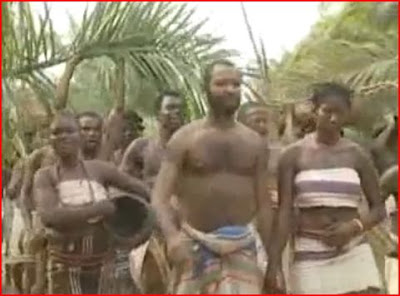


The man of Lisa's dreams is Max (Obiekwe), the cursed, murderous descendant of Chioke and Chioma. The second half of Vampire's Call (it was released in two parts, adding up to approximately three hours total) is Max's Bram Stoker's Dracula/Beauty & The Beast/Phantom of the Opera/You Get the Idea courtship of the strangely enthralled Lisa. That courtship is complicated by the arrival from Britain of Richard, Lisa's fellow medical student, erstwhile boyfriend and aspiring Ralph Bellamy of Nollywood. Lisa is torn between two lovers, or is just plain fickle. Ultimately, however, Max means to force the romantic issue, though he's more reluctant to claim the blood necessary to lift his curse. He follows the couple to Lagos and spooks the hapless Richard away, but can't bring himself to take Lisa's blood. But when he resorts desperately to attacking a stranger at the wrong place and time, whether Lisa will live or not won't be his decision to make....


He's actually quite nice if you get to know him.


Objectively speaking, Wendigo has to say at the start that Vampire's Call is not a good film by any standard. He gives the creative team credit for ambition, but they simply lacked the talent to make their concept work. The most obvious problem with the movie is its obvious padding. To stretch the story enough to justify the two parts (Hollywood seems to be copying Nollywood lately) the director fills the film with extended scenes of people walking and watching local scenery that simply isn't scenic enough to hold our interest. The camera wanders occasionally, abandoning characters to follow a car that seems to have passed through randomly. The romantic scenes between Lisa and her two suitors go on far too long without actually evolving cinematically or building to anything like a climax. The big dance scene between Lisa and Max is interminable. A lot of these tricks reminded Wendigo of the way grindhouse exploitation films, or Seventies porn films, were padded -- but those films were padded to reach a minimal feature length. Doing the same thing to make a film three hours long is inexcusable. In some cases, he concedes, letting dialogue scenes linger long past their relevance, or showing extended folk dances, adds a feel of authenticity to the proceedings. But practically every scene rambles on longer than it should. Even worse, while Egbon wastes time on irrelevant stuff, he flagrantly omits some of the most potentially dramatic bits from the Chioke legend. We see the warriors dancing down the road, but we don't see them fight the monster. Instead of showing us the showdown between Chioke and Atunma, Egbon has grandpa flatly tell us that Chioke was killed.  Did his budget determine what he could and couldn't show, did censorship determine it, or did he simply make profoundly wrong narrative choices? It's hard for us to say. We will say that he lacks much sense of pace. That's proven when he breaks off Part 1 smack in the middle of one of Atumna's rants. Rather than give us a cliffhanger -- and it may not have been necessary, depending on how the two parts were marketed -- he doesn't even climb the mountain.


Wendigo found the first half better than the second because the slow buildup toward the revelation of the Chioke legend gave him an interesting puzzle to put together. The film succeeds somewhat in establishing the mystery of how the Chioke legend explains Lisa's dreams and the village murders, but it quickly loses momentum after the flashback ends. At its heart, Vampire's Call is a standard modern melodrama of reincarnated lost love and a reluctant monster, but Egbon found some interesting ways to transplant those motifs into an African setting. He does also manage a few effectively creepy moments in Part 2, especially when Max appears to be in two hotel rooms at once, holding separate chats with Lisa and Richard. By the time that scene happens, however, Wendigo worries that you may be ready to gnaw your arm off from boredom. The end may annoy some viewers since evil seems to go unpunished, even if it isn't evil anymore. It's almost as if Egbon forgot about all the murders he'd shown earlier -- it is a long movie, after all. Maybe he also thinks that Max isn't responsible for the killings because he'd been cursed -- but I'd like to see that defense tried in a court of law.


The acting is probably the best element in Vampire's Call. Both Okereke and Obiekwe succeed, sometimes in spite of the script, in creating two distinct characters in their respective dual roles, and Wendigo found Obiekwe as Max quietly menacing in a sometimes-unnerving way. As Chioke, the actor has a likable swagger as a man with attitudes ahead of his time. Even he's upstaged, however, by Miltex Ogiri as Atunma. She's built up as a formidable villainess, and you wish the writers had found a way to give the actress a character in the modern story, because she commands the screen in a way that really stands out. Overall, the actors (especially Esiri's likably grouchy grandpa) have a casual, natural style that makes some of the lengthy dialogue scenes somewhat more palatable. Some of the dialogue itself achieves a sort of poetry, e.g. Atunma's curse: "Chioke will seek tears, but they will not drop." Nollywood may simply have a more easygoing or patient approach to dialogue and character development. It's too bad that Egbon's technical skills are nowhere near the artistic level of his actors. Not only are the few attempts at effects uniformly awful, but the sound mixing may well be the worst we've ever heard in a motion picture. Library cues of howling wolves, tolling bells, crying babies are used to the point of abuse, and often drown out dialogue.


These technical shortcomings make Vampire's Call not bad in the cult sense of inspired stupidity, but simply amateurish. But while Wendigo can't call it a good film, and can't really recommend it to vampire fans, he did find it compelling enough to stick with the film to the end, despite the endurance test of Part 2. He doesn't regret the experiment with Nigerian pop cinema, and neither do I. Tourists in the Wild World of Cinema will probably find enough here that's odd, over the top, or simply strange to justify future forays into the Nollywood netherworld.