Showing posts with label Lino Ventura. Show all posts

Thursday, April 10, 2014

MONEY MONEY MONEY (L'aventure c'est l'aventure, 1972)

Claude Lelouch's L'aventure c'est l'aventure is France's answer to Otto Preminger's Skidoo: a heavyhanded comedy about oldschool gangsters adjusting to a radically new world. In less obscure terms, Lelouch's film is a send-up of radical chic. A bunch of dimwitted crooks -- Lino Ventura, playing an art forger, is the most high-functioning of them while singer-songwriter Jacques Brel is the other big name in the cast -- emerge from prison to learn that bank robbery, art forgery and other old standbys aren't where the action is anymore. The real action is political; all the old stuff is finished. Even the prostitutes are planning a general strike. Lino's son tells him that even cars are finished. Finding the lad's Molotov cocktail in his car, Lino accepts the premise and blows it up.


Lino's gang takes a crash course in radical politics, hearing talks from such extremes as uniformed Maoists to Salvation Army officers. The thing to do, they learn, is kidnap people in the name of some revolution or other. They start by pulling pop star (and eventually a movie tough-guy in his own right) Johnny Hallyday off the stage at one of his concerts after he sings the title song; Hallyday proves a most cooperative hostage. The gang then gets involved in an archetypal Latin American revolution, turning on revolutionary commandante Ernesto (Juan-Luis Bunuel, the director's son and a director in his own right) when he doesn't pay promptly. They kidnap a diplomat and impulsively play Russian Roulette with him while waiting for the ransom. They stage a successful hijacking, complicated only by their inept reading of an English ransom note. Finally they're living the high life until they're lured into a trap -- the bait's a boatload of topless girls -- set by the vengeful Ernesto, who wants his money back from them.


Eventually we return to the framing device of the gang's trial in Paris, but it's only a brief pause before the big finish as the boys make their break and flee to Africa, where they're feted as radical heroes. Each man takes a turn making nonsensical speeches as the masses cheer indiscriminately, living up to one character's early announcement that they were Groucho Marxists -- Skidoo covered this base by casting Groucho himself as a mob leader. Finally, there's no rest for revolutionaries, and our heroes are last seen sedan chair-napping the Pope, carrying their captive through the jungle and on to further adventures.


There are some funny ideas here and some decent moments of visual humor -- Ventura's facial expressions are priceless as he listens painfully to his cohort's labored rehearsals of his English for the ransom note -- but I suspect that a lot of L'aventure's humor is lost in translation. The whole point is the culture clash of gangsters and political radicals so the way the different sets of characters talk has to be a big part of the comedy that the DVD's subtitles don't really convey. The main point of the crooks' stupidity is made effectively enough with their compulsive gambling -- they take bets on which of them will crack as Ernesto tortures them one at a time -- and their idiotic attempt to seduce girls on the beach with their silly macho walks. But the comedy is silly rather than satiric and the film is fun but forgettable -- David Thomson didn't even list it on Lelouch's filmography for The Biographical Dictionary of Film. L'Aventure doesn't really deserve that sort of neglect, but it isn't exactly a vital document of its time, either. The impulse to satirize radicalism sometimes results in instant camp; if that intrigues you, this film will, too.

Saturday, February 15, 2014

GREED IN THE SUN (Cent mille dollars au soleil, 1964)

In 1964, when Italians imagined frontier action and adventure they didn't think of their erstwhile empire in Libya but of America and Mexico, and the spaghetti western was born. France's frontier imagination ranged closer to home; the French had a bigger empire in modern times and got more adventure out of it. Deserts and dollars meant different things to different countries. Instead of westerns the French made films like this Henri Verneuil picture, a post-colonial romp through parts of Francophone Africa where Europeans still do much of the work. Rocco (Jean-Paul Belmondo) and his buddy "Bumpkin" (Lino Ventura) drive trucks for Castagliano (Gert "Goldfinger" Froebe), but one day Rocco takes the initiative and drives off on his own with a mystery cargo believed to be worth $100,000, and the boss orders Bumpkin to track him down in another truck. Riding shotgun with Rocco is a femme fatale (Anne-Marie Coffinet) who tipped him off to the valuable cargo. Riding with "Bumpkin" is a suspicious mercenary type (Reginald Kernan)with whom he has issues from the recent past.


The cargo is a Macguffin: Rocco doesn't know what it is and only cares that it can be turned into money. With little sense of urgency in the chase the viewer basks (or burns) in the location atmosphere. Verneuil wasn't the first director, of course, to find a desert ideal for widescreen filming, and even in black-and-white the vistas are often impressive. Cent Mille Dollars is arguably overlong but over its length the impression of grit, heat and sweat sink in convincingly. If it has a handicap it's that Belmondo and Ventura don't share the screen through the big middle of the picture. Once Bumpkin finally catches up with Rocco, only to get his own truck commandeered, the screen crackles with the stars' macho chemistry. Bumpkin's promise of revenge gives the story some momentum it had lacked, and the payoff comes with a comic twist that defines the picture as a buddy movie above all.


It could have been a western. That could have been a stagecoach full of rifles for the Indians, and you would have had a desert either way. But the French still saw their modern world as full of adventure, even as they retreated from empire, in a way the Italians apparently didn't but the Americans still did. If Frenchmen driving trucks makes Greed In the Sun seem like a low-stakes comic riff on The Wages of Fear (recall also that film's exotic setting), it also reminded me of American adventure films from the same time set in far-flung locales, and of the whole "men's adventure" genre in American magazine publishing, down to the dancing girls at the chase's destination. Verneul and his stars give the film a swagger that retains its virile vitality after fifty years. Its modern setting doesn't make it superior to spaghetti westerns by any stretch of imagination, but for those interested in 1964 rather than 1864, or in frontiers other than the archetypal West -- not to mention fans of Belmondo and Ventura -- Cent Mille Dollars is definitely worth a look.

Tuesday, July 23, 2013

DVR Diary: THE SICILIAN CLAN (Le Clan des Siciliens, 1969)

Thanks to the Fox Movie Channel, which is still worth watching in the morning but turns to crap in prime time, I've just seen a French crime movie I've wanted to see for a long time. While dubbed in English, the Fox Movie edition is widescreen and apparently uncut. The dubbing is inevitably a disappointment; it sounds like Alain Delon may have done his own dubbing, but Lino Ventura definitely didn't, while Jean Gabin, at the time the grand old man of French movies, ends up sounding a little like the High Chaparral star Leif Erickson talking out of the side of his mouth. As you see, what we have here is an all-star picture, and with ex-con turned author Jose Giovanni co-writing the script just about all the ingredients are in place for a classic. But in the absence of a master like Jean-Pierre Melville behind the camera, Henri Verneuil directs a merely efficient caper picture without the mood or intensity worthy of his stars.

Despite the title, the film is not about the Mafia. The Sicilian clan in question is the Manalese family, led by patriarch Vittorio (Gabin), who helps jewel thief Roger Sartet (Delon) escape from prison -- Sartet is given a miniature circular saw to cut his way out of a paddy wagon during a transfer -- in return for the plans for the security system for an upcoming jewelry exhibition in Rome, which Sartet acquired from the designer, now a fellow convict. Sartet wants in on the prospective robbery but Vittorio doesn't trust him because Sartet is a killer -- and an outsider. After Sartet has to shoot his way out of a tryst with a prostitute, Vittorio keeps him under close wraps until he has a chance to case the Rome site himself, in the company of old criminal pal from America. They discover that the security system is more extensive than Sartet had indicated, and pretty much unbeatable. Here the film shifts direction. Instead of a Rififi-style caper, Sicilian Clan goes ultra-modern when Vittorio's American buddy gets the idea of the Manaleses hijacking a plane carrying the jewels from Europe to the U.S. The American can secure an impromptu landing strip for the captive plane by appropriating a stretch of highway outside New York City.  The caper becomes a matter of getting the clan (and Sartet) on board the plane without the police (led by Ventura playing like the French Walter Matthau) noticing the highly-wanted Sartet, then pulling off the hijacking without the U.S. Air Force blowing the plane out of the sky. All goes well until Vittorio learns about Sartet's beach affair with one of his daughters-in-law and decides that the randy Corsican should die. The old man's brutal assertion of patriarchal authority proves the undoing of the entire gang.

Sicilian Clan has some moments of intelligent suspense, particularly after Sartet boards the plane in the guise of a British security agent, when his cohorts have to deal with the sudden appearance of the real man's wife at the airport. After discovering that her husband is not on the plane, Vittorio tries to throw her off the trail by explaining (using an airport phone, he pretends to be a government offiical) that the man is still at his hotel. Now she wants to call him at the hotel, and it becomes a race against time to get the plane off the ground before she realizes she's been tricked. Verneuil is at least efficient, but to what purpose? It seems like some too-careful balance was struck between Gabin and Delon, with Ventura's flic the odd man out, so that Delon disappears from a large section of the film while Gabin visits Rome. Neither star dominates the film long enough for audiences to identify with one or really understand what they stand for. When Vittorio resolves to destroy Sartet, is this a vindication of old-school values or the self-destructive outburst of an obsolete old man? Is Sartet the wild beast Vittorio thinks he is? We don't see enough evidence to damn him so, nor does the film really make a case that Vittorio is dangerously old-fashioned or simply irrational. The plot ends up looking contrived to set up an intergenerational showdown, reducing the film to an overcooked potboiler. It can probably be enjoyed on its own undemanding terms, but the best French crime films have spoiled me. I expect more of an immersively existential experience along the lines of Melville's Le Samourai, or Claude Sautet's Classe Tous Risques -- but sometimes a caper is just a caper. Dial down your expectations and Sicilian Clan may still satisfy.

Monday, December 19, 2011

THE MEDUSA TOUCH (1978)

"I have a gift for disaster," says Richard Burton, late of Exorcist II: The Heretic and The Klansman, among others, and from that point -- probably as soon as the trailer started playing --  Jack Gold's movie was a sitting duck for reviewers. Burton plays John Morlar, a man seen mostly in flashback after his head is bashed in (shades of The Assassination of Trotsky!) to start the picture. Euro-detective Brunel (Lino Ventura) has to figure out whodunit as a comatose Morlar clings to life. Fortunately, Morlar left plenty of notes. These lead Brunel to Dr. Zonfeld, whom he's shocked to discover is a woman (Lee Remick). Sacre bleu! Are they that backward in France? But in Brunel's defense, Zonfeld was a man in the source novel by Peter Van Greenaway. In any event, the doctor describes a tragic nut who had grown convinced that he had somehow willed the deaths of his parents, a hateful schoolteacher, and so on. Fine, but unless someone believed him, why would anyone try to kill him? There are more plausible suspects, like the client attorney Morlar got convicted thanks to an insulting, unpatriotic rant in court. There's a neighbor who just might blame Morlar for his wife jumping out a window. On the other hand, could Morlar do what he thought he had? To find out, Brunel learns about telekinesis and American and Soviet experiments along those lines. If Morlar had such powers, some superpowers might well be interested in him. But was he telekinetic, merely clairvoyant, or simply insane? If he did have powers, his jumbled notes might prove far more menacing than they seemed at first, especially since they seem to refer to an upcoming royal event. The more Brunel learns, the more that knowledge appears to establish the motive for murder -- and the more tempted he is to become complicit in murder....

Telekinesis was the secular diabolism of the 1970s, a variation on the devil's power to make bad things happen without the baggage of God and his inevitable victory. For every Exorcist or Omen or Holocaust 2000, it might seem, there was a Carrie, or The Fury -- or The Medusa Touch.   Marvel Comics was ahead of the curve here, having cast a telekinetic in its X-Men comics in the 1960s, and that may have been just one expression of the idea of telekinesis as a mutation of modernity. Whatever its sources in pop culture or pseudoscience, telekinesis was a godsend, secularly speaking, to Seventies cinema. But it didn't guarantee you an entertaining movie, and Medusa Touch goes out of its way to diffuse the potential excitement. The flashback investigation format is deadly as Ventura, presumably dubbed and cast on the strength of a similar investigative role in Francesco Rosi's Excellent Cadavers, plods from informant to informant to pick up each discrete anecdote of Morlar's career. It's a rare but perhaps predictably lifeless performance from a hero of French crime cinema, but no less lifeless are Remick as the doctor and Burton himself as Morlar. Supposedly sober at this time, if I remember the biography correctly, Burton still seems disoriented and confused here, but a script that's too coy about whether Morlar is innocently crazy or ultimately malevolent may be to blame. But while it's always good to have stars' names on the poster, acting is secondary to set pieces of death and destruction, from an out of control car flinging a couple off a cliff to a jumbo jet ramming a skyscraper. The effects are hit and miss, but at least the production made an effort, especially for the big climax at the cathedral. Harry Andrews proves more heedful of dire warnings than he would be in Superman, but despite all his efforts as a security man you can't do without a disaster, so down comes the masonry on the early arrivals -- Her Majesty was fortunately warned off in time. The collapsing goes on for maybe a bit too long -- it has to accommodate Ventura dashing to the hospital to confront the supposedly moribund Morlar -- but it's at least carried on with the typical apocalyptic enthusiasm of the era. I was also amused to see how extensive the TV coverage of the cathedral event and surprise disaster were. When Ventura catches the coverage on a hospital set, the camera angles are exactly the same (including views from the ceiling) as those we'd already seen in "real time." The omniscient TV cameras common to movies (and TV shows) are a minor pet peeve of mine, but they come with the territory.  If Jack Gold and writer John Briley could have built things up with the same enthusiasm as they smashed things, Medusa Touch might have been more enjoyable throughout. Instead, it's a curio of Seventies genre cinema and more proof of Burton's unlucky talent for disaster during the decade.

Here's a trailer uploaded to YouTube by hideseek124.

Sunday, November 28, 2010

THE CONTEXT (Cadaveri Eccellenti, 1976)

You'll find Francesco Rosi's paranoid epic on Netflix under the utterly unassuming name of The Context, which turns out to be a literal translation of the original title (Il contesto) of the Leonardo Sciascia novel the film is based upon. The novel itself is available in English as Equal Danger, while the film may be better known to English-speakers as Illustrious Corpses. Rosi's intention, signified by his choice of title, may have been as much surrealist as paranoid, but whatever its meaning in, er, context, Cadaveri Eccelenti is Italy's answer to the great American paranoid thrillers of the Seventies, touching the same themes of conspiracy, surveillance and frame-up, only with more urgency, portraying a nation on the edge of the abyss.

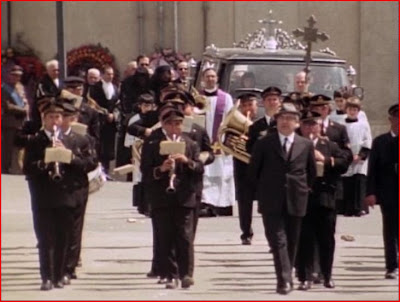
Lino Ventura (who despite the sound of his name acted primarily in French films) stars as Inspector Amerigo Rogas, assigned to investigate the assassination of a judge. The judge is introduced in an eerie credit sequence strolling through a crypt of mummified but presumably exquisite corpses, only to be cut down abruptly once he emerges into the daylight. The crypt has been a popular hangout for politicians for centuries, a crazy old priest tells Rogas, because the mummies make good sounding boards for men with secrets. The killing takes place in a highly charged environment, in the middle of a citywide garbage strike. His funeral is attended by political leaders and mafia dons. Outside, a politician's impromptu oration is heckled by young leftists. When the politician says that the judge was killed by the Mafia, the leftists yell, "He was the Mafia!" before the cops chase them away. The politician tells Rogas that the garbage strike is politically motivated and aimed at him personally. Relevant? Hard to say; harder yet when another judge is shot down, and then a third. Ballistics determine that they've all been killed with the same weapon.
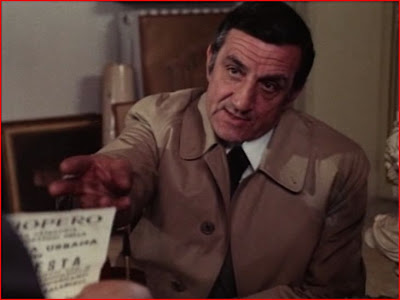
Lino Ventura as Rogas

The case metastasizes before Rogas's troubled eyes, even as he tries to narrow it down to someone with a grudge. The three dead judges shared a jurisdiction for a time, and there are three free men who'd been sentenced to hard time by them. One of these, the pharmacist Cres, seems a very likely candidate, quite possibly framed by his wife for trying to poison her. He's gone off the grid, having clipped his face off all the photographs in his home. His photo is even missing from the government's records of him, and his best friend has a hard time offering a good description of him. But the more Cres falls into shape as the prime suspect, the more extra details complicate Rogas's investigation, making it seem as if the judge murders are part of, or at least somehow related to, some larger, menacing agenda.
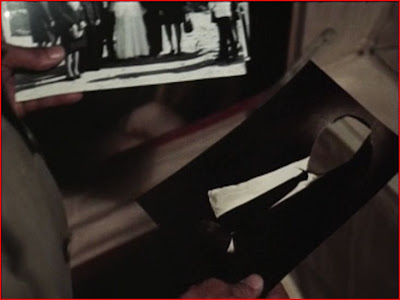
If Cres is the killer, then there's one more likely target, now the chief justice of Italy. Rogas has a hard time arranging a meeting, but notices that the judge (Max Von Sydow) has been meeting with top political and military leaders. Finally granted an audience, Rogas is subjected to a disturbing harangue. When Rogas suggests that Cres may have been wrongly convicted, the judge proclaims that "judicial error does not exist," and compares the judiciary to the priesthood. Their decisions are always right the same way that priests, no matter how corrupt, convert the bread and wine to the body and blood of Christ by virtue of their office. Worse, in our chaotic times exemplary convictions and punishments are useful regardless of their justice. The judge invokes the Roman concept of decimation, literally the killing of every tenth man to punish a military unit for cowardice. Modern society, torn by crime, labor conflict and political terror, could stand such a decimation. The minimal implication is that Cres's innocence is a matter of indifference to the judge. Can we and Rogas infer more? Is another kind of decimation under way? Is Cres really the killer, and if he is, is he only pursuing his own agenda, or is he an instrument, willing or not, of higher powers? The more that Rogas sees criminals and judges, conservatives and communists, mingling together, and the more that he takes advantage of the surveillance technology that initially disgusts him, the closer he comes, if not to the truth, than to mortal peril....
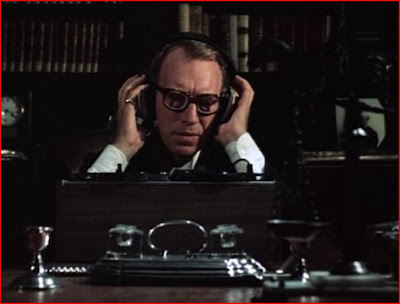
Big Brother is listening: Max Von Sydow in The Context.
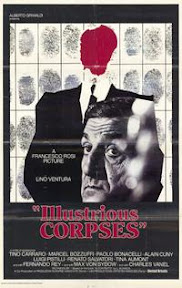
The surrealist "exquisite corpse" is a matter of blind men building an elephant, a collective production with little or no central organizing principle. Calling Sciascia's story an "exquisite corpse" implies a warning from Rosi that we should expect no closure from Rogas's investigation, no revelation of a monolithic conspiracy or power play, even though martial law or a military coup seems to be in the making in the film's apocalyptic scenario. Loose ends are inevitable as plots appear to ravel or unravel just beyond our notice. We never see the sniper, and we never see Cres except possibly as a distorted image in a mirror at a decadent party. Once we think we've figured out the conspiracy, presumed major players are eliminated. They may well have been major players, but there may be no master conspirator, no inexpendable person as events acquire their own murderous momentum. Cadaveri Eccelenti leaves us asking what's more disturbing: a secret power controlling socio-political convulsions or the absence of such a power amid continuing convulsions. The faceless Cres is a perfect metaphor for the nearly disembodied terror set loose on Italy.

Rosi sustains an atmosphere of dread and menacing immensity, dwarfing Lino Ventura with vast interiors and cityscapes. The director is a master of neorealist architectural expressionism, if you'll excuse the mixed metaphors, going back at least as far as his dramatic building collapse in 1962's Hands Over the City. In its staging of public spectacles and rituals like funerals, it may be Italy's closest analogue to the Godfather films, though it isn't really about the Mafia. Those Coppola-esque scenes give the story epic weight and heighten your sense of the national stakes involved in the killings and the investigation.
Unfortunately, you don't get the full effect from The Context since Netflix is streaming a fullscreen version of the film, but you definitely get the idea. The English dub also means that no actor speaks in his own voice except for Max Von Sydow, who apparently performed his role in English on the set. I missed the gravelly voice Ventura had been given in English for Three Tough Guys, but since his performance here is often pensively passive and effectively anxious, befitting a man who knows he's going in over his head, it comes through regardless of the dubbing. Ventura became one of my favorite actor once I saw him in such French classics as Army of Shadows, Le Deuxieme Souffle and Classes Tous Risques, and Rosi's film, even in its compromised presentation, didn't damage his standing. Von Sydow nearly steals the show, however, with that one chilling rant, which should go down as a defining moment of Seventies cinema. As for the soundtrack, Piero Piccioni provides suitably menacing music, while the film manages to make an Astor Piazzola tango sound vaguely threatening. Context is everything.

If ever a film screamed for the deluxe Criterion DVD treatment, it's The Context in its current form. I want to see Cadaveri Eccelenti in a proper widescreen, subtitled print someday, with all the support materials Criterion, which has done Rosi justice before with Hands Over the City and Salvatore Giuliano, can gather. I'll still recommend Context to fans of paranoid political thrillers, Italian crime movies, and Seventies cinema in general; it'll definitely whet your appetite for a more definitive presentation.

Wednesday, September 8, 2010

TOUCHEZ PAS AU GRISBI (1954)

"Grisbi" sounds like the name of a character in an American film noir, but in French it means "loot." The title of Jacques Becker's movie is usually translated as "Hands off the loot!" but I've seen and heard the film referred to simply as Grisbi. One I made it known that I was a fan of French crime films, it was made known to me that I needed to see Grisbi some day. Since it happened to be the film debut of my favorite French crime genre actor, Lino Ventura, it was definitely on my to-do list.

The loot of the title is a load of gold bars stolen from an airport by a two-man gang, Max (Jean Gabin) and Riton (Rene Dary). Max is honored throughout the "milieu," the Parisian underworld; he's in demand as an arbiter of disputes among criminals. Riton isn't quite as well respected. Sometimes Max himself wonders if he's just been carrying his pal in recent years. Riton isn't quite as bright, either. He blabbed about a big score he'd made to his fickle girlfriend Josy (Jeanne Moreau), who blabbed about it to her boyfriend on her side, the drug dealer Angelo (Ventura). Angelo has just made a big show of his respect for Max, but he needs money and wants that loot. From this point the story is pretty simple. Riton eventually falls into Angelo's clutches. Angelo expects Max to give him the loot in return for Riton. Max thinks about letting Riton pay for his foibles, then thinks better of that. He has a plan to save Riton and the loot, but there's no guarantee that he'll get either, or that he'll survive himself....

Lino Ventura (left) meets Jean Gabin, a future frequent co-star; below, Ventura shows Jeanne Moreau the exit.

Grisbi is what modern audiences might call a "bromance." The film's focus is on the friendship between Max and Riton, which has a sort of Mice and Men quality, though Riton's not that dumb. The friendship isn't overstated or milked for excess pathos, nor need anything more than friendship be read into it. These guys just live in a masculine milieu where every girl, almost, is a showgirl or a prostitute, and their friendship is clearly the most meaningful relationship in either man's life. Max's big test comes when he tempts himself to abandon Riton to his fate, and he proves his nobility by doing the right thing, at whatever price that demands.

Gabin wreaks havoc.

I've seen Jean Gabin earlier and much later in his life, but Grisbi apparently set the pattern for the second half of his star career, when he often played masterful criminals or tough detectives. At age 50, he has a middle-aged gravitas that suits his character quite well. Max seems amiable enough, but this is clearly a dude no one should mess with. Rene Dary is a new face for me, so for now he is Riton, as believable in his role as Gabin in his. Ventura gets low billing as a beginner despite playing the villain of the piece. He's charismatically thuggish, though not so much so that he steals the picture, and he gets a spectacular and satisfactory exit.

Jacques Becker has not made a film noir or a thriller in the later style of Jean-Pierre Melville. Despite a tragic finish, there's no oppressive feeling of fatedness or doom, nor does Becker strive for the precisely calibrated tension that Melville cultivates. Grisbi has plenty of suspenseful moments and a nicely shot nighttime car chase, but it's essentially an old-school crime film of the sort Warner Bros. cranked out in the Thirties. From me, that's as much a compliment as comparing it to Melville or noir. I like Melville's best films better, but Touchez pas au Grisbi is a solid, atmospheric, and ultimately moving picture that I can recommend to any crime film fan.

Here's the trailer (with English subtitles) as uploaded to YouTube by jhhvideoteach:

Wednesday, March 18, 2009

THREE TOUGH GUYS (Uomini Duri, 1974)


"International junk of no interest, by far the worst film yet produced by Dino De Laurentis since he left Rome to make movies in this country."
VINCENT CANBY, The New York Times
March 16, 1974.
* * *
On the violent streets of Chicago, crime is the heresy and
Lino Ventura
is a one-man Inquisition.


Who is the former cop
Who fights crime 'cause he just can't stop?
Academy Award winner Isaac Hayes.


Hayes did the same math you just did. The "preacherman" and the "po-lice man" add up to two tough guys. So what did they do, have a kid? No, it just turns out that after the film was shot and Hayes had turned in his score and theme song, Signor De Laurentis and his partners at Paramount Pictures realized that their movie's bad guy, Fred "The Hammer" Williamson, had become bankable. Black Caesar and Hell Up in Harlem had come out the year before, and That Man Bolt was opening around the same time as Duccio Tessari's Italo-blaxploitation combo, 35 years ago this month. So just because the man Tenebrous Kate calls "the Black Shatner" is a bad guy this time, that doesn't mean he's not a tough guy, too. The two qualities sort of go together. So here's how they sold the film.


Williamson is "Joe Snake," the owner of the Red Rooster bar and a pinball arcade/bowling alley in Chicago's grindhouse district. He's harboring Tony Red, a survivor of a robbery of Mob money. It's a tense situation, since the only reason Snake keeps Tony is around is because he knows where the loot is, but Tony won't tell him because "I like living." Unfortunately for everyone, Tony is shot down during a meeting with insurance investigator Gene Lombardo, who dies with him.

Lombardo's demise brings Father Charlie into the story. I didn't catch the name of his church, but let's call it St. Pugnacious, where they hand out beatings like sacraments. The bit you saw with the Father bitch-slapping first a parishioner, then a fellow priest, sets the tone for Lino Ventura's entire performance. Imagine James Cagney playing Father Flanagan of Boys Town as if he were Cody Jarrett from White Heat and you may begin to get the idea. Whatever subtleties Ventura mastered in films like Classe Tous Risques (see below) are set aside like worldly things for this occasion. St. Pugnacious features what a bishop calls an "ex-voto arsenal" of guns turned in by repentant thugs. It's a constant temptation to what Father Charlie calls his "flock of starving wolves," but he's confident that no one would dare steal from him.


For the sake of the widow, Father Charlie decides to find out who killed Lombardo. Nobody expects this kind of inquisition, least of all the Red Rooster bartender. In mufti, the Father invades the bar, shows off his strength by squashing a bottle cap between his fingers, follows the bartender into his office, and strangles the sucker with a phone cord until he gets the answers he wants.


There are thugs waiting for him outside, but his fists and some timely bike fu make short work of them. He's finally overpowered on his way to see Tony Red's girlfriend. The goons put him into a serial-worthy predicament, meaning to feed him to a factory furnace, when the mystery man who's been following the Father around steps in to clean house. This is Tough Guy No. 2, Lee Stevens, a disgraced former police captain. He was blamed for Tony Red's robbery because he had left his post for a woman. Now he lives in poverty, frying eggs on an iron. But he knows everything about Father Charlie: an erstwhile juvenile delinquent on a typical Lino Ventura career track (crime, then death) until a religious experience in prison set him on the priesthood path. The iron also comes in handy to press the Father's pants. In return, Charlie gives Stevens $28 to get his gun out of hock.

Now partners in investigation, the Two Tough Guys find the Red Rooster closed due to the proprietor's death by truck. They take their inquiries to the grindhouse district, making possible priceless footage of Chicago movie houses circa 1973. A local with access to the Tribune and Sun-Times could probably tell us the week when these scenes were filmed from the titles on the theater marquees. Prostitutes provide more local color. Father Charlie fends one off by saying "I played with dolls as a boy." To which the hooker responds, "Good, I have a kid brother. He got to make money too."


Finally they enter the arcade where Joe Snake is keeping Tony's girlfriend Fay (Paula Kelly) -- who just happens to be the woman who seduced Lee Stevens before the heist. Payback time!


After she tells what she can, the TTG face some more goons in a parking garage. This is the bit from the trailer when they force their enemies to jump into the river, sarcastically telling their leader that they're so scared that they'll piss themselves. The punch line: our heroes prove their truthfulness by actually pissing on their victims.

Fred Williamson has a high standard to meet if he wants to be considered a Tough Guy in this picture. But Joe Snake finally asserts himself past the halfway point as he manipulates Fay into recovering the loot (she knew where it was all along), only to take it from her by force. After she desperately calls Stevens for help, Joe clubs him down, shoots Fay, and fixes to frame Stevens for the murder. The cops nearly have him before Father Charlie pedals to the rescue with an "unloaded" machine gun from his sacred arsenal. Pondering Fay's fate, Stevens reflects: "He must have been some kind of freak to shoot her that way."

Fred or Freak?


All that remains is an incredible final showdown at the arcade that obviously influenced the making of There Will Be Blood. Indeed, Lino and Isaac do everything but drink poor Fred's milkshake. He may already have been top-billed elsewhere, but the Hammer was still paying his dues at this point. This film may well have helped convince him to take creative control of his career in order to avoid such humiliation in the future. As it is, he might console himself by noting that it took two tough guys to even knock him out, and then with the use of foreign objects.

* * *

The "Two Tough Guys" theme to Three Tough Guys sets the tone for a film that isn't quite coherent. Tessari, a versatile genre veteran, struggles to please disparate audiences: the Europeans who presumably wanted to see Lino Ventura invade America, and the Americans who almost certainly had never heard of Ventura but were curious to see Isaac Hayes's acting debut opposite Fred Williamson. Ventura is top billed on the poster and in the actual film, while Hayes is named first in the trailer. Hayes was clearly learning a new craft but has a natural authority, while Ventura was most likely dubbed. If so, the voice actor is smart enough to use a foreign accent, but it sounds too scratchy and crabby to match what I've heard of Ventura speaking French. I suspect that Americans didn't know what to make of Lino. While he was close in age to Charles Bronson, then on the brink of long-awaited superstardom, he simply had no history here (apart from playing opposite Bronson in The Valachi Papers) to make him meaningful to grindhouse audiences.

But isn't Vincent Canby's grim verdict just a bit exaggerated? He seems guilty not so much of snobbery but of reverse philisitism, a refusal to recognize any aesthetic values but his own, as if there were only one legitimate way to be entertained by a movie. No interest? By my standards, it has even more interest now than it did then, as a document of its time, an experiment in international genre crossover, and a battle of blaxploitation behemoths. Sometimes you just want junk food, and for me, Three Tough Guys is a roll of SweeTarts: pure cinematic magnesium stearate with colors you can taste, and a Lino Ventura beatdown with every bite.

Of course, my copy of the movie from the infamous Grindhouse Experience collection is more like a 35 year old roll of candy. You can judge for yourself from my screencaps. It looks like it was just hauled out from the basement of one of those Chicago theaters, after it was imploded. But I can't hold my breath waiting for a letterboxed version of this movie. This may be the best edition we ever get, so let's treasure it.

Tuesday, March 17, 2009

CLASSE TOUS RISQUES ("The Big Risk," 1960)


Do the French call their own crime movies films noirs, or do they reserve that label for American films? I know that they refer to their own hard-boiled crime fiction as romans durs (dur=hard or tough), so a film like this one could be a film dur. "Hard-boiled" or "tough minded" pretty well describes the attitude of Claude Sautet's movie. But it's a different kind of hardness or toughness than the American style. Rather than wisecracking irreverence in the face of disaster there's a matter-of-fact fatalism to this movie, and to most of the French crime films I've seen -- an attitude that says, "This is how it is. No use complaining." But there's also a tragic sense to this movie that reminds me of American noirs. It's based on a novel by Jose Giovanni, a onetime denizen of Death Row who also did the source novel for Jean-Pierre Melville's Le Deuxieme Souffle. If anyone's translated these books into English, I want to read them.

This film (the title translates more correctly to something like "Consider the risk") opens in Milan, where Abel Davos is arriving at the train station with a child in his arms. He and his friend Raymond meet Abel's wife and his other son. They send Therese with the kids on board the train and head back up to street level, where a narrator introduces them to us as career criminals, Davos being a fugitive. They have eyes on two security guards transferring money, and make their move in broad daylight.


They evade the Milanese cops by ducking into a subway station as the idiots run past, then popping out and hopping into their getaway car. They divide their 500,000 lira haul and split up at a gas station, Raymond taking a motorcycle and Abel keeping the car. This launches a fast-paced getaway scene as they go separate ways at a roadblock, clobbering cops and carjacking folks along the way until they reunite. "We're the greatest!" Abel says before they inconspicuously catch a bus to next rendezvous.

Now they have to hire a boat to get from Italy to France. With Therese and the boys below deck, Abel and Raymond throw the captain overboard (along with some life preservers) before planning their clandestine landing at Meston. They arrive at night, but blunder right into a customs patrol. Therese and Raymond are killed, as are the guards. Abel and his boys are on their own.


Investigators cover the scene the next morning. The boat captain has been fished out of the sea and gives them a good description of Abel and his kids, who are now on a bus bound for Nice. In the city, he explains to the boys that they have to walk at least ten yards behind him in the streets from now on, since a man and two boys together will attract suspicion. Now he places a call to Paris and waits for his pal Henri Vinton (alias "Riton") to arrange a way to smuggle him up to the capital.

This is where the real story kicks in. Riton and his cronies all consider themselves friends of Abel Davos, to whom they owe various moral or monetary debts. But they all find it too risky to themselves to go down to Nice and fetch their friend. Instead, they seek out someone with nothing to lose to drive a dummy ambulance south, while Abel stews and his boys grow anxious. He's thrown out of one safehouse because it's getting too hot in Nice, but Abel has nowhere to go but Paris, and no way to get there on his own. Finally, the Paris gang finds their man.


Eric Stark is a lone wolf operator who boasts, "Nobody's ever made the decisions for me." For money, he agrees to take the ambulance to Nice, where he manages to find Abel with little trouble. Stark is a spontaneous character. He stops the ambulance along the edge of the woods when he sees a man harassing a woman. He pummels the man and invites the girl, Liliane, along for the ride, telling her that the "patient" in the back is on the lam without telling her why. She's a good sport and an aspiring actress, playing a nurse tending to Abel when cops inspect the ambulance at a checkpoint, while the boys are hidden in convenient trick compartments.


The ambulance makes it to Paris with little trouble, and Abel's friends are happy to see him, but the feeling isn't mutual. He doesn't care for their excuses for the delays. He stuck his neck out for them in the past. Couldn't they do the same. After a rare display of temper, he stalks off in disgust, Stark still trailing behind. Initially uncertain about his driver, Abel is warming toward the one person who was willing to take a risk for him. Stark likes Abel, too, offering him a spare room in his apartment building. Unfortunately, Abel has to turn his boys over to a retired sea captain who was a friend of his father.


As the investigators slowly follow the trail north, it looks like Liliane is being interrogated, too. But it's only a rehearsal for a play as Stark drops by to renew their acquaintance. They look like a promising couple, a vindication of both character's spontaneity. Meanwhile, Abel is going a little stir crazy in the apartment. Stark gets him some fake papers so he can walk the streets, but Abel declines his offer of a criminal partnership. The tragic irony of the film is that while a surrogate family of Stark and Liliane seems to be growing around Abel's truncated family, and while he burns bridges to those who weren't willing to risk anything for him, Abel is sadly reluctant to build closer ties to his new friends because he doesn't want to risk losing them the way he did Therese and Raymond earlier. As his world constricts from the sweeping scope of the exhilarating early sequences to his self-entrapment in a succession of small rooms, Abel Davos is figuratively dwindling away until he says, "Abel is gone. There's nothing left." Finally, as the nets close in on Stark no matter what Abel does, and after a halfhearted stab at vengeance on his former cronies, Abel literally disappears into a crowd (in a scene that reminded me, of all things, of the end of Sam Raimi's Darkman), leaving the narrator to wrap up the story.

* * *


There was a time some years ago when I would see the same trailer every time I went to the Spectrum Theater, Albany's outstanding art-house multiplex. It was for a film called Un Coeur en Hiver, which I decided from the evidence must be one of the most boring films ever made. Back then I had no idea who Claude Sautet was, but this was one of his later films, after he had abandoned the crime genre for romantic dramas. Now, having seen Classe Tous Risques, I'd like to see that other movie. If it has any of the vitality and emotional weight of Sautet's debut, I'll offer a quiet apology for my sneering youthful self. The Criterion DVD is a beauty, with lots of crisp location shooting and the kind of urban detail I really enjoy.


But while credit is due the director, and to Jean-Paul Belmondo, who signed up to play Stark just before Godard's Breathless made him an international star, the reason I wanted to see this film was Lino Ventura.


Ventura was a blunt object of a man, Franco-Italian, a former boxer and wrestler who became a star in the 1950s playing, among other parts, a recurring role as "The Gorilla." He's a badass without being "badass," a modest monster who seems perfectly at home in the milieu of French crime films. He was capable of more, from playing a French Resistance leader in Melville's Army of Shadows to a two-fisted Chicago priest who battles Fred Williamson in Three Tough Guys. He had charisma without glamour, power without overstatement, emotion without emoting. Le Deuxieme Souffle may be his two-gun apotheosis, but Classe Tous Risques is the best work of his that I've seen to date. I've liked him in everything I've seen so far, and there's much more out there -- how much on DVD I don't know. I recommend him to any crime film fan or European films in general.
Here's the French trailer, with English subtitles and a sample of the light yet tense score by Georges Delerue.