From the director of The Devil Bat and The Abbott & Costello Show comes a film that lives in infamy as the humiliating final film of Basil Rathbone, even though he made one more film in Mexico. This sequel to Las Vegas Hillbillys -- I believe the producers had to use the illiterate plural to avoid confusion with The Beverly Hillbillies -- better fits a narrative of tragic decline, especially when you see how far down in the billing Rathbone is, below not only the title characters but fellow horror men Lon Chaney Jr. and John Carradine, who presumably were more accustomed to such work by this point in their careers. It's not merely the badness of this Woolner Bros. production but the mere idea of these beloved actors stooging for second-rate hillbilly actors -- and that's being too generous -- that offends fans of the horror genre and classic cinema in general. Seeing it offered in one of Turner Classic Movies' eccentric moods, I expected something dreadful, and got it. A trio of protagonists returns from Las Vegas Hillbillys, the entertainers Woody (Ferlin Husky) and Jeepers (Don Bowman) and "girl singer" Boots Malone, originally played by Mamie Van Doren but now incarnated by Joi Lansing. They're on their way to Nashville but interrupt their trek to allow the allegedly agitated Jeepers some r & r. Told that there are no hotels or boardinghouses in the small town where they stop for gas, they decide to squat in a mansion recommended to them. This is our haunted house, but it's actually infested by spies for Red China who intend to steal an important formula from a nearby military base. The spies seem to be divided into two factions. Gregor (Rathbone) and Himmel (Carradine) are straightlaced, almost effete characters, compared to their handler Madame Wong (Linda Ho), her henchman Maximillian (Chaney) and his sidekick, Anatole the gorilla. Tension flares up constantly between Himmel and Anatole, escalating from insults to banana stealing and, finally, murder. Into this volatile setting blunder the hillbillys, who stand their ground despite the spies' best efforts to scare them away, and in spite of the fact that hillbillys scare very easily. There's a twist to come, however, that upends everyone's plans....
Hillbillys may be the worst haunted-house comedy I've ever seen. The reason has nothing to do with the performances or misuse of the horror stars, and everything to do with Lansing, Husky and especially Bowman being without doubt the worst scaredy-cat comedians I've ever seen. The singers have no comic timing at all, and while Lansing at least can scream when required, the men seem incapable of emoting in any way, and Duke Yelton's script leaves them helpless like fish on a haunted beach. Here's his idea of something either funny or scary. Jeepers tries to soothe his alleged nerves by watching some television. Luckily for him, some station is showing a performance by Merle Haggard. The spies are able to interfere with the broadcast, so that Haggard's singing is intercut with random shots of Rathbone, Chaney, Carradine and Ho staring at the camera or making faces, while Bowman tries to indicate in his stunted way that he's frightened. Maybe a laugh track would have helped.
Of the horror men, Carradine probably does the best with what he's given. He gets to have mood swings from his mounting rage at Chaney and the gorilla to his friendly, familiar banter with Rathbone. One of the few interesting things about the picture is the way Rathbone and Carradine seem to be competing over who can underplay better in their scenes together. Carradine in particular is unusually relaxed and casual in those moments, and the veteran actors succeed, at this if at nothing else, in convincing you that Gregor and Himmel are longtime partners and friends for whom this preposterous mission is just another day on the job. By comparison, Chaney is on autopilot at best, and at worst has a pathetic scene when Maximillian, in all the actor's sodden, grizzled splendor, infiltrates the military base and must convince a talkative janitor that he's a scientist with high security clearance. It's hard to tell whether his obvious unfitness for the task was meant to be a joke in a comedy picture or not, but Chaney's actually a sadder sight than Rathbone for most of the picture.
While most viewers will resent the lack of comedy or terror in Hillbillys, the producers seemed most concerned that audiences would think there wasn't enough music. Thus, after the spies are defeated, we get a square-up reel that finds the Hillbillys finally in "Nashville" hosting a variety show with guest performances by Haggard and other possibly-popular singers of the moment, as well as a comedy song by "the Great Jeepers," all before a stock-footage audience, apart from occasional insets of about a dozen people. Because it's a performance setting, the echo-chamber effect you get in all the film's musical numbers -- including Lansing's pathetic "Beautiful Dresses," in which she's supposed to be an 18th century aristocrat in a bouffant hairdo -- isn't as glaring, but this musical epilogue is strictly for country-western fans of the old school. For the rest of us, it simply keeps a terrible film going for another twelve minutes or so.
A randomly comprehensive survey of extraordinary movie experiences from the art house to the grindhouse, featuring the good, the bad, the ugly, but not the boring or the banal.
Showing posts with label hillbillies. Show all posts
Saturday, June 18, 2016
Wednesday, March 9, 2011
WINTER'S BONE (2010)
Maybe I wouldn't have noticed the resemblance if I'd bothered to see Debra Granik's Oscar-nominated movie when it played local theaters last summer, but now that I've watched the DVD I can't help being reminded of True Grit. It strikes me that Granik's adaptation of a Daniel Woodrell novel is more the modern version of Charles Portis's story, in either sense of the word, than the Coen Bros. remake of the Henry Hathway movie. It's definitely the darker telling.
Both stories deal with a girl on a dangerous mission. In Winter's Bone, Ree Dolly (Jennifer Lawrence) has a week to find her missing father so he can make a court date, or else her family will lose the home he's put up as bond. At first it looks as if Dad might simply have absconded, being the best meth cook in Missouri and all, but the story gradually takes on a stronger resemblance to the basic True Grit situation. Even so, Ree's got to have proof in order to ward off the bondsmen, even if her own acceptance of the country omerta means giving up hope of justice or even revenge. Like the heroine of True Grit, Ree is a premature matriarch due to the absent dad and an incompetent mother. It's up to her to raise a younger brother and a six year old sister, both of whom she has to teach how to use a squirrel gun for survival's sake. Ree isn't perky or quirky like your choice of True Grit actress; the Oscar-nominated Lawrence seems closer to what the Portis-Hathaway-Coen heroine should or probably would have been like. She is hard, grim and bitter, without ideals and only better than her relatives and neighbors because of her sense of responsibility and the fact that she isn't on the meth yet.
A Rooster Cogburn counterpart even emerges in the form of Ree's Uncle Teardrop (John Hawkes), a hardcase addict feared by the local law and lawbreakers alike who tries early to warn Ree off of asking too many people where her Dad might be. He finally stands up for Ree when her stubborn nosiness puts her in danger of death at the hands of the local meth patriarch and his clan. By doing so, he puts himself in permanent peril, taking responsibility should Ree ever squeal or otherwise betray the community's secrets, including the fate of Teardrop's brother. He warns her never to tell him if she does find out who might have killed her father, but it's unclear whether he refuses the knowledge because it'd make his own life forfeit or because he'd be compelled to make a suicide-run for revenge. It's probably both, and it makes his departure at the end, after he tells a still-ignorant Ree that he's found out himself, a grimly sad moment of abortive redemption.
Forty years or so ago, this wouldn't be so unusual a film, but it would've been quite different. Hillbilly or country crime movies were a popular subgenre in the Seventies, but they were mostly exploitation films. In those days a slightly older Ree might have been Claudia Jennings in cutoffs and there'd be no question about her taking revenge, however unlikely, on all comers. There would have been car chases and explosions and skinny dipping -- the title might've been Summer's Bone to facilitate the nudity. I would've been reminded less of True Grit in that case, but I don't think it was Granik's plan to plant that thought in my head anyway. She's made a hard film about modern American poverty, an unpopular subject in Hollywood these days.
The poverty was taken for granted in those Seventies films, but it only formed a backdrop for fantasies of rural degeneracy -- fun as they sometimes are -- that dated back to Tobacco Road or God's Little Acre. The world of Winter's Bone is still pretty degenerate, but Granik doesn't make a spectacle of it. Hers is a deliberately ugly film portraying an ugly, littered landscape. There are few signs of stylization. Granik's stark approach and Lawrence and Hawkes's terse, convincing performances tellingly portray potential crushed or in the process of being crushed in a ruined socioeconomic landscape. The stuff of Seventies exploitation is now the stuff of 21st century independent cinema. What that tells us about the movie business and the American audience is hard to say.
Both stories deal with a girl on a dangerous mission. In Winter's Bone, Ree Dolly (Jennifer Lawrence) has a week to find her missing father so he can make a court date, or else her family will lose the home he's put up as bond. At first it looks as if Dad might simply have absconded, being the best meth cook in Missouri and all, but the story gradually takes on a stronger resemblance to the basic True Grit situation. Even so, Ree's got to have proof in order to ward off the bondsmen, even if her own acceptance of the country omerta means giving up hope of justice or even revenge. Like the heroine of True Grit, Ree is a premature matriarch due to the absent dad and an incompetent mother. It's up to her to raise a younger brother and a six year old sister, both of whom she has to teach how to use a squirrel gun for survival's sake. Ree isn't perky or quirky like your choice of True Grit actress; the Oscar-nominated Lawrence seems closer to what the Portis-Hathaway-Coen heroine should or probably would have been like. She is hard, grim and bitter, without ideals and only better than her relatives and neighbors because of her sense of responsibility and the fact that she isn't on the meth yet.
A Rooster Cogburn counterpart even emerges in the form of Ree's Uncle Teardrop (John Hawkes), a hardcase addict feared by the local law and lawbreakers alike who tries early to warn Ree off of asking too many people where her Dad might be. He finally stands up for Ree when her stubborn nosiness puts her in danger of death at the hands of the local meth patriarch and his clan. By doing so, he puts himself in permanent peril, taking responsibility should Ree ever squeal or otherwise betray the community's secrets, including the fate of Teardrop's brother. He warns her never to tell him if she does find out who might have killed her father, but it's unclear whether he refuses the knowledge because it'd make his own life forfeit or because he'd be compelled to make a suicide-run for revenge. It's probably both, and it makes his departure at the end, after he tells a still-ignorant Ree that he's found out himself, a grimly sad moment of abortive redemption.
Forty years or so ago, this wouldn't be so unusual a film, but it would've been quite different. Hillbilly or country crime movies were a popular subgenre in the Seventies, but they were mostly exploitation films. In those days a slightly older Ree might have been Claudia Jennings in cutoffs and there'd be no question about her taking revenge, however unlikely, on all comers. There would have been car chases and explosions and skinny dipping -- the title might've been Summer's Bone to facilitate the nudity. I would've been reminded less of True Grit in that case, but I don't think it was Granik's plan to plant that thought in my head anyway. She's made a hard film about modern American poverty, an unpopular subject in Hollywood these days.
The poverty was taken for granted in those Seventies films, but it only formed a backdrop for fantasies of rural degeneracy -- fun as they sometimes are -- that dated back to Tobacco Road or God's Little Acre. The world of Winter's Bone is still pretty degenerate, but Granik doesn't make a spectacle of it. Hers is a deliberately ugly film portraying an ugly, littered landscape. There are few signs of stylization. Granik's stark approach and Lawrence and Hawkes's terse, convincing performances tellingly portray potential crushed or in the process of being crushed in a ruined socioeconomic landscape. The stuff of Seventies exploitation is now the stuff of 21st century independent cinema. What that tells us about the movie business and the American audience is hard to say.
Monday, March 15, 2010
GOD'S LITTLE ACRE (1958)
I'm grown up now, in theory, and Anthony Mann is one of my favorite directors, so when TCM scheduled it for tonight as part of an evening dedicated to Tina Louise, who made her movie debut for Mann, I decided that I owed it a look. It's one of two films Mann produced for Security Pictures (Men In War is the other), and I can see the book's appeal to him. Mann's unrealized dream project was an Old West staging of King Lear, something that could well have been an American Ran. You can see hints of it in films like The Furies, The Man From Laramie and Man of the West, and in Caldwell's story Mann found a patriarch who starts out at least half mad and has the requisite three sons, along with two daughters.
Ty Ty (Robert Ryan) is a cotton farmer who's abandoned his cash crop because of his obsession with a treasure of gold his father supposedly buried on the family property. He's cratered the land in search of the gold, but proudly spurns his sons' (Jack Lord and Vic Morrow are still on the farm) advice that he consult a conjurer. Instead, he takes up the suggestion of Pluto Swint (Buddy Hackett), a candidate for sheriff and for the hand of Ty Ty's remaining unwed daughter (Fay Spain), that he find himself an albino to dowse for the gold. Since albinos have an innate sense for gold, this option strikes Ty Ty as respectably scientific. The infallible willow branch is soon in the hands of Dave (Michael Landon), and in the one other scene I remember from childhood viewings the "all white man" spasmodically stumbles across the pockmarked landscape, finally settling just in front of Ty Ty's front porch. But this is "God's Little Acre," the proceeds of which Ty Ty has reserved for the benefit of the church. However, Ty Ty had only just relocated God's Little Acre to that spot on a whim earlier in the picture, so it's easy enough for him to move it the river's edge now on a fresh divine inspiration.
God's Little Acre has an additional problem for 21st century viewers. While the 1958 ballyhoo billed the Caldwell novel as the best-selling novel of all time, it hasn't stood the test of time since then. The film is now a remnant of an obsolete pop-culture phenomenon. It simply can't resonate with us the way it was meant to do (it flopped) with its original audience. Worse, apart from the novel itself, our perception of hillbilly or Southern culture has changed profoundly since Mann made the film or Caldwell wrote the novel in the 1930s. Back then, with mainstream American culture still officially repressed, hillbillies embodied a titillating regression to a less inhibited state of earthy intimacy and looser morals -- something to deplore for the record yet fantasize about. In the wake of the Civil Rights movement, and after Deliverance (cinematically speaking) the eccentricities and perceived pathologies of the region are harder to contemplate with the kind of wink-nudge complacency displayed in Mann's movie. The film is probably more awkward looking now than it seemed 52 years ago, but I think it's an objective failure no matter how or when you look at it.
Is it Anthony Mann's worst movie? That's hard to say when I haven't seen everything he made, but I think God's Little Acre is the weakest of what I've seen. I have a lot of problems with Fall of the Roman Empire, but that doesn't come close to this film. If anyone's seen worse, maybe I don't want to know.
This YouTube upload from jacklord1920 combines several promos for the film, so forgive some redundancy.
Sunday, January 3, 2010
Silent Psychos: TOL'ABLE DAVID (1921)
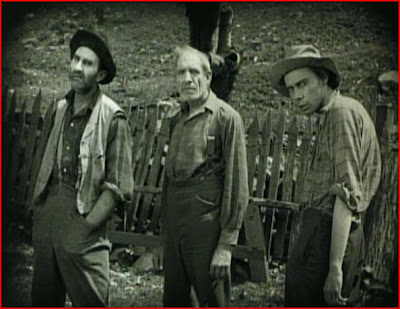
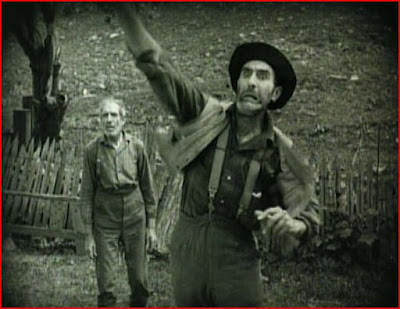
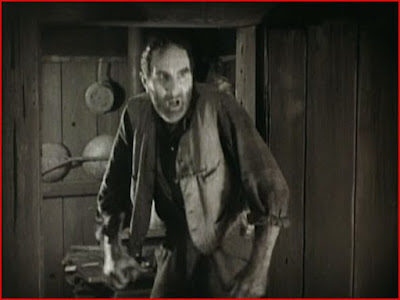
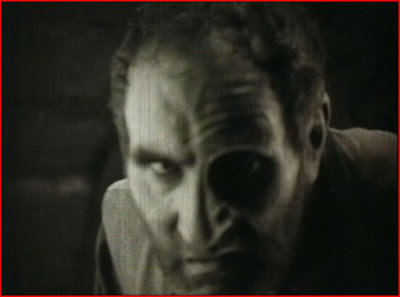
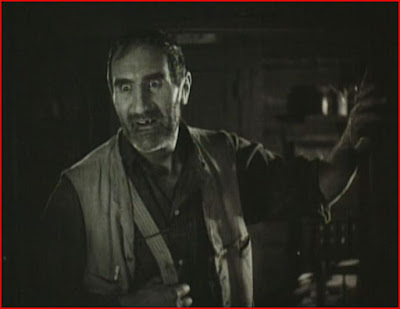
(l-r) Ernest Torrence, Walter P. Lewis and Ralph Yearsley as the outlaw Hatburns. Below, Torrence draws a bead on the law.
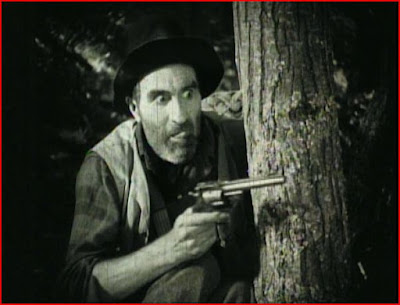
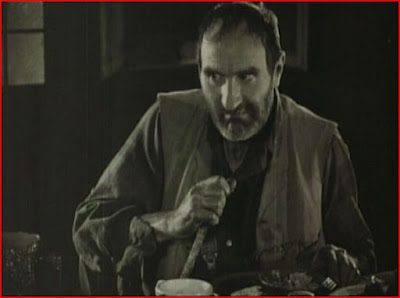
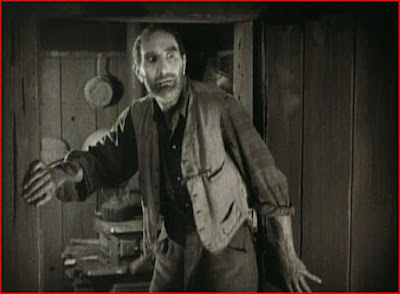
Torrence may be best know to silent film fans as Buster Keaton's dad in Steamboat Bill Jr. Here, in his second film role, he's a hulking hayseed lunatic. In an interview included on the Image DVD, King makes clear that he envisioned Luke Hatburn as a kind of psychopath. He recounts instructing Torrence about his character, explaining that Luke doesn't act out of hate but out of a perverse enjoyment of violence. Having crossed the state line, Luke has to be restrained from shooting the sheriff. He doesn't want to kill the lawman, King told Torrence; he just wanted to see if he could knock the man from his horse. Throughout the film, Luke is a creature of uninhibited impulse, killing David's dog just for running past him, nearly killing David's brother with a rock moments later, and nearly raping his cousin, David's girlfriend, later in the picture. Torrence's facial expressions fit King's conception of the character, which he claims to have come up with independent of Edmund Goulding's screenplay: a savage, scarifying idiot.
The other Hatburns aren't exactly sedate. Ralph Yearsley as little brother Saul is arguably even more of a subhuman than Luke, though mostly less menacing. His big scene comes after Luke has stolen the government mail off David's hack, when David invades the Hatburn house to reclaim it. Saul shoots David in the arm and tells his dad he'd been trying to shoot the boy's ear off. Moments later, David shoots him.
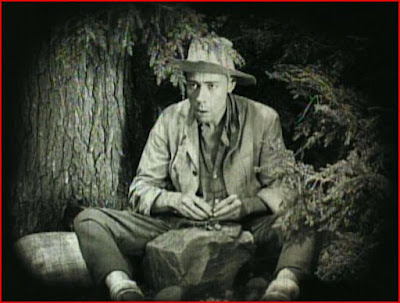
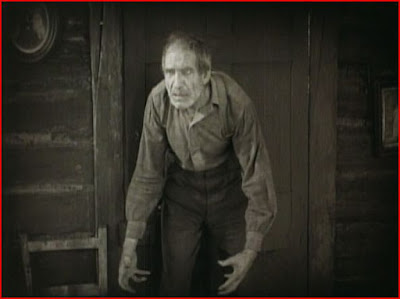
Ralph Yearsley as Saul "Little Buzzard" Hatburn.
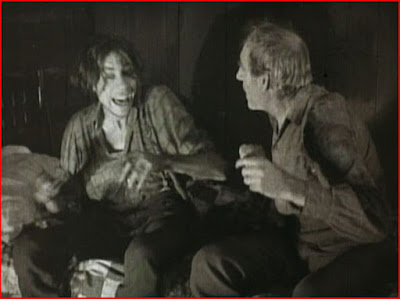
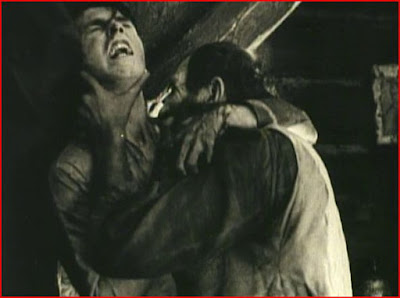
That sets off the patriarch, who had moments earlier smacked Saul for firing the gun. This is Walter P. Lewis's big moment, when he seems to turn from man to beast before our eyes, eyes glazing and arms lengthening like a gorilla's as he prepares to attack David with a chair. King films these moments of violence very well and for maximum emotional intensity.Luke is outdoors chasing his cousin, who faints away in proper silent film fashion, when he hears the shots from the cabins. He starts as if feeling the bullets hit his own heart, then lurches back to the cabin, fearing the worst. Seeing it, it's his turn to go lip-twitchingly berserk as a build-up for one of the best dramatic fight scenes of the silent era, a figurative David-Goliath battle between the looming Torrence and the boyish Barthelmess.
Subscribe to:
Posts (Atom)