Showing posts with label dwarf. Show all posts

Friday, November 2, 2012

GIRL ON THE RUN (1953)

It was just about ten years ago when I bought my first DVD player. It was a golden age when amazing new titles appeared in book stores and electronic stores every week. A dependable highlight of each month was Something Weird Video's multi-feature releases, distributed by Image Entertainment, and it was an early sign that the golden age was ending when Image stopped putting them out and Something Weird reverted to mail order and online sales. So it was a nostalgic, heartwarming moment when I learned that Something Weird and Image had rejoined forces, and I now have one of their new releases, a two-disc, six-film collection of Weird Noir B-movies made between 1953 and 1963. There aren't any incredible supplements or easter eggs like there used to be, but when you figure that you're getting six features for the price of two or three back in the day, I can't complain too much, and I'd rather celebrate this mighty team of yore getting back in the retail game.

The oldest film of the six by a good six years is Joseph Lee and Arthur J. Beckhard's carny noir Girl on the Run. This Astor Pictures release (the company later distributed Plan 9 From Outer Space and La Dolce Vita) clocks in at 65 padded minutes, and what story there is seems like an excuse for carnival cheesecake -- not that there's anything wrong with that.


There is a girl on the run in the picture, but the story is more about her boyfriend, journalist Bill Martin (Richard Coogan), who's just lost his newspaper job after seeing his vice-ring investigation squelched by his editor. When the editor turns up dead, presumed-disgruntled Bill becomes a prime suspect, but girlfriend Janet (Rosemary Pettit) has information that points to a hit ordered by the local political boss, Clay Reeves (Harry Bannister). The good guys need more solid evidence to clear Bill and hope to find it at the carnival. Failing that, they hope to infiltrate the show and cross the state line with it to escape Reeves's police goon squad. Meanwhile, Reeves is in a war of wills with the carnival's dwarf boss, Blake (Charles Bollender), who has dirt from a source close to the mysterious vice boss that implicates Reeves and subjects him to blackmail.

 
Little big man: Charles Bollender rules the carny in Girl on the Run.
 

Our heroes manage to infiltrate the carny, Bill as a volunteer fighter who beats the champ and gets hired as a shill, Janet as a reluctant showgirl. In the claustrophobic, cop-ridden environment the characters circle one another, loyalties are uncertain, and every corner promises a twist in the plot. But who cares about all that when the girls are on?

 
Above: Cat-Women of 1953;
Below, Renee de Milo steals the show.
 

Girl on the Run probably passed for "adults only" product in the innocent early Fifties and probably played at the same theaters that ran the burlesque features collected by Something Weird in the past. For such audiences, the highlights of the film have nothing to do with the plot. The main attraction was more likely Renee de Milo as Gigi, the carny's star dancer, who gets two long solo numbers that get the film over the hour mark. Otherwise, she's a spectator for the main story. The rest of the girls are a motley bunch with realistically mediocre figures and talent. They fit in the semi-documentary environment of the picture, which combines actual carnival footage with a bare-bones set representing the space between the tents where characters lurk and stalk each other. The film's been remastered from a 35mm print and looks almost impossibly good, showing off the cinematography of Victor Lukens in its best possible light and darkness. The acting leaves a lot to be desired, with veteran character actor Frank Albertson the only real name in the cast and a high number of bungled line readings from the rest. Steve McQueen is said to be an extra, but I neither sought him out nor noticed him in the film.

The remaining films in the set were made between 1959 and 1963 and will likely show a different sensibility, coming closer to the "Weird Noir" organizing principle than Girl on the Run. The older film has a quaint appeal, albeit more camp than noir, and to say the very least the dancing girls perform with enthusiasm. Think of it as a warm-up for the deeper weirdness to come, but come back soon to see whether Image and Something Weird really live up to their tremendous heritage.

Sunday, January 16, 2011

TO THE STARS BY HARD WAYS (Cheres ternii k zvyozdam, 1980)

Like many a Soviet sci-fi film, Richard Viktorov's two-part picture reached American audiences in compromised form, condensed into something called Humanoid Woman that later became fodder for Mystery Science Theater 3000. It was probably never going to get the respectful art-house treatment accorded Tarkovsky's Solaris because it clearly wasn't as ambitious a movie -- though its early focus on rustic family life in future Russia reminded me a little of the more famous film. I'm not sure whether Star Wars influenced the thing at all; if it did, it was in the use of comical robots, but the robots themselves look like the sort of creations you'd have seen decades before the Lucas film. Overall, Viktorov's story (the awkward English title translates a Russian tag that itself derives from the Latin motto per ardua ad astra) feels like a Soviet Star Trek, with a benevolent Earth-based interstellar entity setting things right around the galaxy.

Part One, "Niya:an artificial human" opens with a human exploratory vessel discovering an alien wreck in space. The ship doesn't match anything in their space atlas and doesn't respond to hails. Boarding it, the crew discovers dead bodies, some in pods, and one survivor, a female. She remembers nothing but her name, Niya. The commander, Sergei, takes the sullen, nearly mute Niya to the Council on Contacts, which isn't sure what to make of her. When a member tries to touch the young woman, he's repelled as if by a force field or telekinesis. This moves another member to observe, "This girl has the strength of a robot!" The council decides that Niya should acclimate herself to Earth as a guest at the dacha of Sergei's family, the Lebedevs, while council member Nadezhda Ivanova will observe and perform tests on her.

Niya (Yelena Metyolkina) reportedly set fashions for late-Soviet teenage girls in the 1980s. Below, in the future, it's the aliens who get probed.

The Lebedevs are a modern space-age family. Mother and father are scientists, while younger brother Stepan is a literal space cadet awaiting his first mission. They're serviced by all-purpose robot Glasha, who looks like a cross between Rosie from The Jetsons and a Dalek and, like other robots in the picture, spends a good deal of time kvetching. The film is most fantastic when it tries to convince us that Glasha, among other talents, is a demon on the tennis court. Even cooking looks like it'd be a challenge for the poor thing. It seems best suited for simpler tasks, like vacuuming the remains of a watermelon that Niya accidentally destroys off the kitchen floor.

Glasha (left)

Niya is understandably distressed by her sudden immersion in alien culture. Frightened by grass, she only slowly grows friendly if not entirely comfortable. She'll go out for a run or a tumble only to get freaked out by flowers or something else that triggers a partial memory of her past; then she'll run into the house and hide in a closet. Things get out of hand when Stepan, who is obviously cultivating a crush on Niya, brings home his girlfriend Selena, who is instantly jealous. Embarrassments pile up as Niya confusedly throws her clothes off at the beach, only to be ordered to put them back on by Nadezhda Ivanova, who has found a remote control receptor in Niya's brain. Initially apologetic to Selena, Niya abruptly decides that "you should not be" and is about to "carrie" her off a cliff before Nadezhda Ivanova gives a counter-order. Finding this plight intolerable, Niya throws herself off the cliff, but Stepan fetches her out of the water.

I don't often run nudie shots as blatant as this one of Niya (left), but I include this one with the note that To the Stars actually won an award for children's filmmaking.


Eventually, the arrival of diplomats from the planet Dessa triggers more memories. The planet happens to be her homeworld, and Stepan just happens to be making his maiden flight there. Niya stows away, confusing an old-time service robot, Crocodile, by her ability to teleport and leave Niya-shaped outlines behind. Crocodile looks like an overweight Cylon (original series) and needs to be inflated when he runs low on energy.

Crocodile the robot

Fortunately, the film itself is about to hit its stride in the second part, which takes place on Dessa itself -- a planet ravaged by generations of pollution to the brink of complete ecological collapse. While Dessa has called for help from advanced planets like Earth, a powerful faction actually opposes human intervention. Led by the sinister Turanchoks, this capitalist clique has exploited the air-quality crisis by commodifying oxygen. They're suspicious of the humans, whom they accuse of an imperialist agenda of remaking Dessa in their image. They sow distrust of the humans and Niya among the rabble, many of whom where Beneath the Planet of the Apes-style masks to hide disfigurements and project an air of general happiness. As the humans make progress in cleaning the planet, Turanchoks takes more desperate steps. He's also figured out Niya's weakness -- her susceptibility to remote control -- and he intends to use it to destroy her and the human spaceship.


Unwelcoming committees on Dessa

The film founders on the shoals of Turanchoks's master villainy. When a repentant lackey turns on him and blames him and his clique for the conditions that have caused every other birth to be defective, an enraged Turanchoks leaps from his chair to the table top to confront the traitor with the shocking fact that he's a dwarf! -- presumably a victim of his own pollutions. "You've never seen me before!" he concludes from the lackey's stunned expression. Well, the lackey has seen him in his chair, but couldn't venture a guess of his height from the visible evidence. The lackey learns something else important, however, when he tries to stop Turanchoks from activating Niya's remote control: the evil dwarf is ticklish! Tickling nearly wins the day for the forces of good, but a more loyal minion stabs the turncoat in the back. Poetic justice? You decide.

Turanchoks: The Revelation, featuring Vladimir Fyodorov (tabletop left)

With Niya now under his control, Turanchok seems to have the upper hand. However, he never bothered checking whether his former minion had died. Ignored, the victim crawls through corridors until he reaches the lab where Niya's creator had been working on a biomass project. It had been this noble scientist's hope that the biomass, infused with human intelligence, could clean up the planet on its own. For now, mindless, the biomass is a seething, bubbing mass of blecch that the moribund minion releases to avenge him. Set loose mindlessly, the biomass is not only a nemesis for Turanchoks but a threat to the entire planet and the humans on it. It might smother them all in slop if Niya can't come to her senses and use her amazing abilities when they'd count the most....

I'm willing to cut Viktorov's film some slack, in part because I'm charmed by the naive exoticism of the project and in part because it's at least a stab at sci-fi rather than space opera. It doesn't boil down to battling spaceships or even much in the way of physical combat apart from Turanchoks's struggle with his tickling nemesis. But there's no way I can say that it's a good film, though some may find it entertaining for some of the same reasons I did. It seems to have been considered a children's film by someone, despite Niya's nudity in the beach scene, and its accordingly simplistic, a fable with subtle pro-Soviet propaganda (we learn nothing about the form of the future government or its economic system) in its approval of benevolent intervention in another culture's affairs. It may be ironic to note that Cheres ternii was made at an early point in the USSR's occupation of Afghanistan, and that its advocacy of humanitarian intervention could easily be translated as an American neocon fable for the era of our own occupation of the same country. The propaganda, though, is subtle enough that it may only exist in my inference. To the Stars by Hard Ways is a harmless film that's best enjoyed, as many films are by wild-world-of-cinema tourists, as a document of its time and place in history -- one more amusing in retrospect because of how scary it once seemed.

Thursday, December 16, 2010

KILL OR BE KILLED (1977-80)

Netflix is tricky sometimes. I'm sure they don't mean it, but sometimes they offer you one thing and give you another. That's what happened to me last night when I was browsing through their new arrivals. Something seemed funny about that 1950 film noir they were advertising as a free stream. The thumbnail art didn't look right. It looked like a long-haired guy screaming -- definitely not 1950 material. And wouldn't you know? Two reviewers on the actual page for the movie said it wasn't a noir at all. It didn't even have Laurence Tierney in it. Instead, it was a Seventies karate movie with a Nazi and a dwarf. Then the title rang a bell. Memories flooded back of a heavy-duty ad campaign that saturated TV when I was still a kid. They really put that film over as an event, and my curiosity was stoked, but I didn't have a chance to see it back then. But now I did.

Maybe those of you of my age remember the ad campaign. If so, maybe you remember further back to the Berlin Olympiad of 1941. Designed as a show of Axis solidarity and superiority, it ended in controversy surrounding the karate tournament. Baron Von Rudloff, captain of the silver-medal German team, accused the captain of the Japanese gold medalists, Mr. Miyagi (soft g, please) of bribing his compatriots into throwing their matches with diamonds. Unfortunately for the Baron, der Fuehrer wasn't interested in excuses. Rudloff was kicked off the team, stripped of his rank and dishonorably discharged. For more than thirty years afterward, the German nursed his grudge.


"Don't make me come down there!" Norman Coombes presides over the school of hard knocks in Kill or Be Killed.

Sometime in the 1970s, Rudloff reigns over a karate school in the middle of a South African desert from the vantage of the tower of his toylike castle -- the thing looks like it's made of Styrofoam. His most trusted lieutenant and confidant is Chico the dwarf, whom the Baron rescued from the humiliations of circus life. Now he's humiliated by the karate students, especially when he takes out his old circus hand puppet and reminisces about the past. But he humors the Baron's dream of staging a new Karate Olympiad in his own stadium, an exact reproduction of the surprisingly spartan venue Albert Speer designed for the 1941 extravaganza, and avenging his own humiliation at the hands and diamonds of the dread Miyagi.


"We were just sparring, Herr Baron." Chico (Daniel DuPlessis, right) and friend.

One of the Baron's students isn't quite with the program. Steve (James Ryan) apparently didn't have a problem with learning martial arts from a strutting, ranting uniformed Nazi originally, but he's starting to grow impatient and disgruntled with the situation. He wants to know what they're training for, but his attitude only gets him into fights with more loyal students. Steve's feelings for Rudloff's one female student, Olga, are the only thing keeping him in the desert. But once the Baron at last announces the purpose of their training, having lured Miyagi into accepting the challenge with smuggled diamonds, and then tells Olga that she can't be on the team and has to leave, Steve wants to go with her. They manage to flee together, with some sneaky help from a sympathetic Chico, in a battered Volkswagen. But Steve's car fu proves very poor, and the karate couple find themselves stranded in the desert. Their solution: dismantle the car, raise a big, fortunately available hunk of canvas on a mast attached to the chassis and sail to civilization.


Meanwhile, the Baron doesn't yet have a full 20-man team fit to fight Miyagi's picked squad. He sends Chico around the world to recruit the best remaining karate men. The dwarf's journey is filmed with magazine and book illustrations of London, just as Rudloff's hysterical flashback of World War II earlier in the picture was portrayed with cutouts and recordings of Hitler rants. Chico goes straight to the nearest karate school, but the teacher rebuffs him with proverbs. That forces him to recruit more creatively. We find him in a junkyard, where he's ready to make an offer to a dude who happens to be sitting in a jalopy with his pals and can bust a cinder block with his head. Turns out he'd already signed with Miyagi. This happens to Chico a lot, even in New York, when he makes an offer to an acrobatic mugger. Strangely, his quest for the kings of karate never takes him to Japan, but when you consider that he's only offering $5,000 ("plus expenses")to each prospect, his budget, like the movie's, was obviously limited.

At the same time, Rudloff still wants Steve on his side. Once the fact of Steve's attachment to Olga finally sinks in on the old Nazi, he regrets expelling her from his school. A repentant Rudloff now orders one of his goons to kidnap her. The goon surprises Olga in the middle of a lesson from her new, personal, private, female karate instructor -- she'd shooed Steve away for some reason. There ensues perhaps the most gratuitously destructive episode of fight-scene vandalism since the Jonathan Winters-Arnold Stang gas-station battle in It's A Mad, Mad, Mad, Mad World as the goon smashes a piano, a guitar, statuary, a TV set, etc in a protracted effort to subdue Olga. Eventually he succeeds, leaving Steve to discover an empty, devastated house. Rudloff's strategy works -- sort of. Steve enters the tournament, but on Miyagi's team, the Japanese having somehow convinced Steve that it'd be easier to infiltrate the Baron's dungeon and free his girl if he joins the enemy side.


"We were just sparring, whoever you are." Olga (Charlotte Michelle, left) and friend. Below, the Baron's goon perpares to El Kabong himself in an intimidating display of stupidity.

Once the tournament gets under way, after a round of feasting and dwarf entertainment, and proves quite an even affair, with fighters on both sides equally willing to cheat, the Baron decides to make the best of a bad situation. Determined to restore his honor by winning at all costs, he tells Steve to throw his fights if he hopes to see Olga again. Steve is too proud to do that, but Rudloff's prize specimen, the hulking Luke, seems quite capable of beating our hero anyway. Since these are supposed to be death matches -- a detail the film occasionally loses track of -- the Baron would just as soon see Steve die. But Chico, still remembering Steve and Olga's kindness, convinces his master to spare Steve so he can "suffer" more later.


"Gooble gobble, gooble gobble, we accept you..."

Eventually, the tournament gets out of the Baron's control as more fighters on both sides object to his, well, Nazi-like dominance. Tiring of it all himself, Rudloff has his Foreign Legion-outfitted guards herd all the karate men into two adjoining cells. And here he made his great mistake, and an inconceivable one for one so devoted to the power of the open hand. Put a few dozen guys whose hands and feet are deadly weapons in two cells separated by a wall and what are they going to do? They're going to punch and kick that wall into oblivion, of course, and then they're going to combine their strength into approximately one Hercules-unit of power, enough to bend the cell bars so they can all escape. So remember: the next time you stage a karate tournament, make sure your dungeon has solitary confinement for everyone.


The movie won't end this easily...

Seeing a rebellion break out, Rudloff, Chico and Luke pack Olga into their car and flee into the desert. Steve commandeers a vehicle to pursue him, but his car-fu is as bad as ever. In an automotive answer to drunken boxing, however, he turns obstacles into shortcuts, flipping and barrel-rolling his wreck until he blocks the Baron's escape route. Somehow he's capable of crawling out and engaging Luke in a final battle as the Baron watches and Chico holds a gun on the Baron. Strangely, the story ends with the Nazi and the dwarf, with Rudloff given the choice between revenge on his betrayers and the Spellbound finish....

According to Wikipedia, director Ivan Hall filmed Kill or Be Killed in South Africa in 1977 -- belying the ad assertion that it was "The Greatest Hollywood Martial Arts Film Ever Made," --but the film wasn't released for another three years. Then, on the strength of the U.S. ad campaign, the movie went over big enough to justify a sequel, Kill and Kill Again. Having watched it, I can understand why someone might have thought the film unreleasable. Most of what little budget Hall had went to hiring fighters; the castle looks like the sort of thing you rent for birthday parties. The "location" work is worse than a joke. The writing is witless, especially when it aspires to wit.

Rudloff: It seems that Asians never age...
Miyagi: Only today, now, is important.
Rudloff: But my letter reached you in the past.
Miyagi:
To be answered by the present person...


There's also something slightly offensive in the idea that two teams combining the best karate men on earth, one of them coached by a Japanese person (played by a Chinese person who looks just a little like Dana Carvey), don't appear to have a single Asian between them. They manage to have a black man, after all, and this is apartheid South Africa -- one of the few places, I imagine, where unrepentant Nazis could parade about more or less openly. But apart from the black guy, the fact that so many of the fighters look alike confuses the film a bit. It's hard to tell all the shirtless dudes with similar hairstyles apart. On the other hand, they're all legitimate karate men, and they strongly enhance the movie's entertainment value by beating the crap out of one another with gusto. The violence is on a strictly PG level (by 1980 standards), but it looks convincingly brutal when perpetrated by guys who probably beat one another up on a daily basis. The fights are constructed more through editing than choreography, and the editing is often pretty choppy, but the action is consistently energetic enough to keep you watching.


James Ryan is a wiry, acrobatic, intense and loud performer. His accent seems right when you're used to hearing martial artists talk in vaguely Anglo tones, and his amplified battle cries (they often sound like, "YEAHHHH!!!") are almost unsettlingly enthusiastic. He's perhaps too fond of his signature move of leaping, flipping and boxing his opponent's ears, but that does make a cool visual. While Kill or Be Killed was meant to make him a star, Ryan is inevitably overshadowed by the Nazi and the dwarf. Chico is Daniel DuPlessis's only film role, if we can trust IMDB, and he makes the most of it. But he and everyone else is eclipsed by Norman Coombes's instinctively berserk performance as Baron von Rudloff.


The only fault I can find with this sort of exploitation star turn is that Coombes's big scene comes way too early in the picture, as the camera does a 360 around him as he sieg-heils and rants about his past humiliations ("I vas DISHONORABLY DISCHARGED!!!") in a still weed-covered stadium. Looking somewhat like Sean Connery in The Hunt for Red October and sporting a range of costumes from Gestapo chic to suspenders over bared chest for desert training, Coombes is all bonus for a project like this one. You can even forgive the fact that this karate fanatic never actually fights in the picture, so that there's never a proper showdown between villain and hero. Without Coombes, Kill or Be Killed is just another tournament movie, with less variety of fighting styles than most. With him, it's on another heroically weird level, and those who travel the wild world of cinema seeking fresh frissons of weirdness may find some in the White Castle in the desert of Ivan Hall's imagination.

The only vestige of the TV ad campaign I could find online was this 9-second spot uploaded to YouTube by robatsea2009. Maybe it'll jog some memories.

Monday, September 20, 2010

Wendigo Meets FIANCEE OF DRACULA (2002)

Once again, Wendigo meets Dracula, and it should be a big moment, since this is the first time that Jean Rollin, the definitive director of French vampire films, has used Dracula in a movie. Unfortunately, though perhaps not surprisingly, Dracula is probably the weakest element in a film that's otherwise wild with weirdness and really quite entertaining. With vampires, insane nuns, cannibalism and a dwarf, how could it not be?

The concept of Dracula, as we've seen it handed down from Bram Stoker to generations of filmmakers, doesn't really seem to mean anything to Rollin. He brings nothing of Dracula's accumulated mythology to his story. Instead, the blandly handsome creature in the puffy shirt who seems to live in a grandfather clock is "the Master," worshipped by the "parallel people," the strange, happy-go-lucky evil folk who are the true protagonists of the picture. Wendigo sees Rollin's Dracula as little more than a Latin Lover in gothic trappings, that little more being something like the fairy-tale Beast whom Beauty must free from a curse.
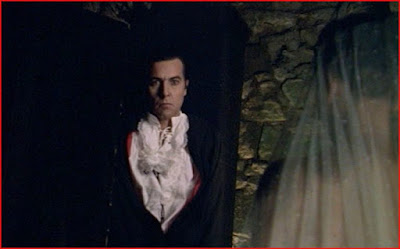
Dracula is imprisoned in the clock, or else the clock is his only portal for communicating with the world, but he can be freed if the parallels can get him married off to Isabelle, the self-styled "Queen of the Sabbath," an attractively insane young woman in the custody of the Sisters of the White Virgin, an order of nuns who find her madness contagious. Their goal is to keep Dracula permanently imprisoned by keeping Isabelle confined in the convent. Presumably sharing their objective are a pair of, shall we say, parallel hunters, The Professor (a modestly imposing old dude) and Eric (a dolt with a Boltonesque shock of hair). We meet them as they watch the dwarf Thibaut,in his jester's uniform, summon the love of his life, "the Vampire Woman," from her tomb to drink some of his blood. Our hunters later interrogate a local madwoman, little suspecting that by night she is "the Ogress," a buxom baby-eating bitch. Dwarf, vampire and ogress are parallels dedicated to getting Isabelle out of the convent and out of the mad nuns' clutches. They're abetted by a couple of elderly witches who try to convince the nuns that Isabelle is their daughter. She may be for all we know.
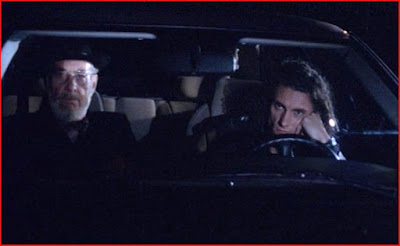
"Are we there yet?" The Professor and Eric wait impatiently while the Dwarfmobile (below) races to get Isabelle to the crypt on time.
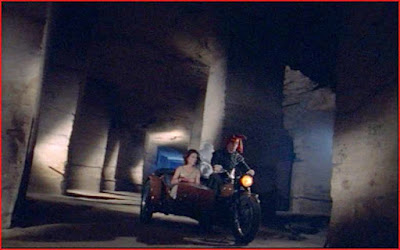
Isabelle manages to break out and is sped by midget-driven motorcycle to some of Rollin's typically picturesque ruins. Thibaut has brought a baby basket along with an offering for the Ogress, who gives them directions (between bites) to a grandfather clock through which Isabelle can communicate with Dracula with the help of "the She-Wolf" (Brigitte Lahaie), a tall lady in a red dress and press-on talons. The hunters have followed and manage to rescue some imprisoned nuns, whom the Professor entrusts to Eric with directions to take them to safety. The next thing we know the nuns are on their own, one gets her heart cut out by the witches, another succumbs to apoplexy after watching Lahaie swallow a Rosary, and another is bitten by a bare-assed Vampire Woman.
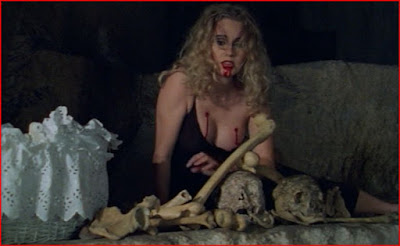
Above, a wounded Ogress -- Shrek never had it so good.
Below, the Butt of the Vampire.
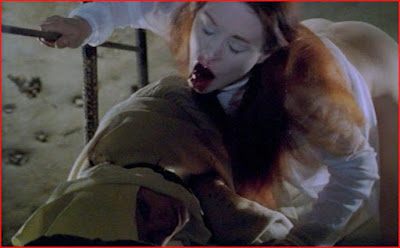
Where's Eric? Why did he leave the nuns in peril? Search us, but he never does seem like the sharpest stake in the coffin. He does manage to shoot the Ogress (a marksman, he puts a hole in each breast) but she manages to recover by allowing the Vampire Woman to drink her blood. They're parallel people, so maybe things work backwards for them; if someone drinks your blood, you gain strength. Maybe we just shouldn't think about it. Instead, think back to that nun we left with her heart cut out. She gets better, sort of. The witches didn't have any particular use for her heart, so they left it sitting on her chest. When she comes to, she gets up, grabs the heart, wanders about the ruins for a bit before finding a fireplace she can throw it in. Well, she doesn't seem to need it, does she?
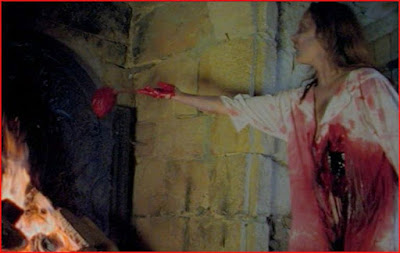
Heartburn

After the parallels went to all that trouble to get Isabelle out of the nuns' clutches, Dracula tells her that she has to turn herself back over to the White Virgins so they can perform a sacrifice to a local Beast. They'll think that doing so will seal Dracula's permanent imprisonment, but he tells Isabelle that going through the ordeal will actually bring her to the place where she can free him once and for all. But first, the parallels have to get her back from the hunters, who took her home amid all the confusion. The female witch heads over and utters the significant incantation of the picture: "The presbytery has not lost its charm, nor the garden its colors." It sounds like the sort of cryptic instruction the BBC used to give resistance fighters during World War II, but if you say it with just the right emphasis and hand gestures, you can knock Eric out cold. Honestly, it doesn't seem like that much is ever required to stop the poor man's brain. With him out of the way, the parallels pack her on a boat and send her to an island where the nuns have been sacrificing their own to the Beast for quite some time. They tie her to some ruined pilings at the water's edge, expecting the high tide to take her.
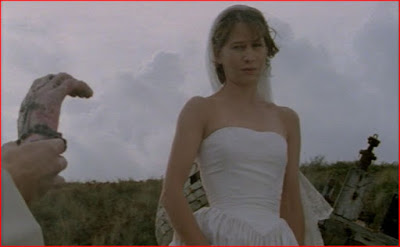
Talk to the hand, Isabelle, or talk to the water.
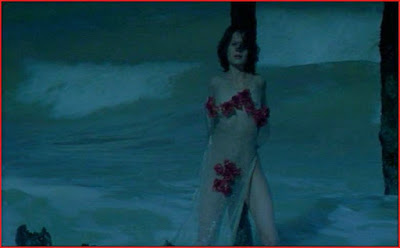
The hunters try to thwart the sacrifice, the Professor storming the scene with a gun while Eric is sent into catacombs to contemplate a chess game between skeletons in bishops' finery. The Prof can communicate with Eric telepathically, we now learn, which probably explains some of Eric's higher functions like driving, shooting and so on. Once the parallels do away with the Professor, Eric's on his own, which means wandering around the vicinity of the Clock Chamber in his natural state of confusion. Meanwhile, just when the tide should carry the diaphanously clad Isabelle away, she vanishes. This irks the nuns, who take their annoyance out on the parallels, who despite their various supernatural abilities are no match for angry women with knives. "Be careful!" Thibaut warns, "These nuns have gone totally berserk!" You know, as opposed to when they were only sacrificing their own and collecting the remains for religious relics. Be that as it may, his warnings are in vain, though while Dracula's parallel minions suffer at the hands of the sisters, Isabelle has made it to her crucial tryst with the Master, which happens just as Eric blunders into the chamber to complicate things, perhaps....

So we have Dracula, sort of, and we have a Vampire Woman (if not the Vampire Woman), but Wendigo deems Fiancee of Dracula less a vampire movie than a fantasy movie that happens to have vampires in it. In simplest terms, it's a Jean Rollin movie, taking place in the director's personal fantasy world. Vampirism as such isn't especially relevant to the story. Dracula does nothing vampiric, and the VW's vampiric behavior isn't exactly crucial. We're not dealing with vampires as cursed or evil monsters. They're really just magical creatures, parallels for the present purpose. Their blood drinking is exploited to kinky effect occasionally, but Fiancee isn't about the lust for blood by any stretch of the imagination. Wendigo's willing to believe that Rollin only used the Dracula name as exploitation, to play on people's diverse images of the legendary vampire.

Wendigo would rather call Fiancee a "dark fantasy," which was what folks read before there was "urban fantasy" or "paranormal romance" in bookstores. The fantasy here is definitely dark, and who the heroes are has nothing to do with goodness or virtue. After all, we're apparently supposed to be rooting for the parallel team, which includes a baby-eating cannibal, for crying out loud. She's no hero, of course, but the charisma is all with her and her pals. This is one of those stories where you have monsters, and then you have real monsters -- the nuns, and to a far lesser extent the hunters. You're invited to empathize with the hunted, the hated, -- "monsters to be pitied, monsters to be despised" as one writer put it. They can't help what they are and, as Wendigo observes, they never really seem mean spirited in their wickedness.

In a way, the parallel world is also the world of the fantastic literature Rollin read as a boy, invoked here like it was in his previous film, Two Orphan Vampires. Isabelle flaunts an old book called La Reine de Sabbat and the Ogress, under hypnosis, recites a litany of fantastic scenarios as the stuff of her dreams. The world of fantasy, of genre fiction overall, pervades our real world, and Rollin may be saying that, just as Isabelle's madness infected the nuns, he himself, through his films, is contaminating us with a similar fantastic madness. Wendigo and I agree that Rollin achieved a more powerful homage to his childhood influences here than in Two Orphans, which had a pretentious, last-testament quality to it that the director has thankfully outlived. The one key thing Fiancee has that Orphans lacks is a strong narrative thread. Rollin does more justice to the power of his fantasies when he makes a story from them rather than a collection of reveries. Orphans suffered in Wendigo's opinion from Rollin's casting of overaged actresses in the title roles; they often seemed retarded rather than childish to him. In Fiancee we're definitely dealing with adult women, and Rollin can dispense with the inhibition that had kept nudity to a minimum in Orphans.

Fiancee looks like a bigger production than Orphans because Rollin uses more locations. As ever, he has a great eye for ruins and relics, often coming up with striking compositions. Wendigo still prefers Rollin's mid-period, comparatively impersonal vampire films, Fascination and The Living Dead Girl, but Fiancee has a strong enough story to lead you through Rollin's world and leave you willing to accept what you see. Wendigo recommends Fiancee as an interesting, idiosyncratic dark fantasy that proves that Rollin can still tell a compelling tale.

For a while while watching the film, we wondered what the hell Rollin meant by "The presbytery has not lost its charm, nor the garden its colors." Wendigo will close for this week by suggesting that Rollin refers to the memories that persist after the presbytery has fallen into ruin and the garden loses its color. In simpler form, he could have said, "We'll always have Paris." At the end of Fiancee, Isabelle tells Eric that he won't be able to follow her until he learns the meaning of the cryptic phrase. She seems to be saying that Eric needs to learn to treasure both memory and fantasy while accepting change. She may also mean that Eric has to learn to go wild or mad in some way beyond his simple capacities for now. She says it all to him, but she's saying it to us as well. Wendigo is actually amazed that he came up with an interpretation for this gibberish. It may only prove him a good BS artist, but maybe he's got a little bit of the old madness himself.

Sunday, November 23, 2008

CROSS MISSION (Fuoco Incrociato, 1987)

Watching Italian films set in Latin America or in the Third World is like stealing a glimpse at the end of the world. The Italians went to places in their collective imagination in the 1970s and 1980s that few others would dare or want to visit. At their best (qualitative standards may vary), these films have an apocalyptic or fin-de-siecle quality, an extremity that other viewers might see as evil. It's probably no accident that when Thomas Harris tried to imagine villains worse than Hannibal Lecter, he included an Italian film crew on the bad guy's side. Some people feel that way about it. But this is only a long way of saying that Alfonso Brescia's Fuoco Icrociato carries a whiff of that Italo brimstone, but distinguishes itself by taking off on its own milder tangent of madness.

With cannibals played out by the late 1980s, the thing to do in the jungle was mercenary movies. So the movie starts with General Romero leading a U.N.-authorized helicopter raid against a reputed drug plantation. The land is set afire, and the international media wants to learn more, particularly Helen, a reporter who doesn't like being stonewalled by the General's press representative. "Manana ain't good enough for us," she protests. Meanwhile, the aide dismisses rumors of a "contra" rebellion in the jungle.

With ominous Stelvio Cipriani music playing, a private plane lands at the local airport. An official greets William Corbin (I think that's the last name) and sets him up in the same Sheraton where Helen's staying. She learns from the desk clerk that Gen. Romero himself reserved William's room for him. Looking for a new angle on the story, she spills some casino chips on him as he relaxes at the roulette table. "Brigitte Porsh," our female lead, will attract men's attention naturally. They go out for a walk and get attacked by some guys for no apparent reason. William is surprised to discover that Helen can hold her own in the fight. "A girl has to know how to defend herself," she explains. Fully seduced, he agrees to secure her an interview with the general following his own meeting.

On their way to his compound, Helen raises some disturbing questions about Romero. William explains that the general calls himself El Predestinado just to make himself sound important. He confirms that El Predestinado possesses psychic powers by virtue of his mother having been a "macumba witch." So he's at least a crazy man, and this intelligence builds our interest in meeting him again.

On meeting Romero, William reveals himself to be some sort of gangster or representative of gangsters who collaborate with the general in the international drug trade. The raid at the start of the movie was all for show, and there are bigger, more lucrative plantations in operation. William warns him not to screw up or else he or his bosses will expose El Predestinado as a fraud -- at least so far as his drug-fighting prowess is concerned.

After dinner, Helen gets her turn with the great man. He scoffs at the so-called liberation movement while boasting of his drug-eradication program. And, yes, he is a psychic with "power I can transmit to other subjects." He actually sells himself short. He has the power to make another subject appear out of nowhere, a little familiar named Asteroth. The general fires a bolt of energy, and there the little guy is! This is one of the rare film appearances of the late Nelson de la Rosa, who's probably most famous for playing Marlon Brando's sidekick in John Frankenheimer's Island of Dr. Moreau remake. He doesn't do much apart from parade about a bit before El Predestinado makes him go away, but the psychic demonstration isn't done. Observing that mechanical lie detectors can give false results, the general announces that his hands are infallible lie detectors with the power to cure or kill. He claps his hands together and energy crackles between them while Helen watches in pure stupefaction.

"That's just the way he is," William explains straightfacedly as we cut to the couple driving back. If you, too, find that transition hilarious, then we share some of the same aesthetic sense -- or whatever that sensibility is that allows us to appreciate "bad" cinema. You'll also appreciate Helen's reply: "Whatever the truth is, he certainly has a complex personality."

The real story of the movie now begins. Our heroes' jeep breaks down, so they have to catch a bus and gripe about the fare. A roadblock soon exposes the fact that guerrillas are on the bus. A chase and gun battle begins. In the crossfire a little girl Helen befriended is killed. This drives her into a killing rage. She grabs an abandoned machine gun and starts blasting away at the government troops. There's some nice stuntwork here as performers fling themselves from moving cars onto the roadside to sell the shots. The army eventually captures the whole group. They subject William to rough questioning, and he tells them to let the general know his whereabouts. Romero slaps an underling around for mistreating his pal, then calculates that public opinion will turn his way if the world learns that an American and a reporter have been killed by the rebels. He decides to leave William and Helen to their fate.

The main guerrilla group learns of the capture and plan a rescue operation. They assume the American is friendly, leading one fighter to reflect on "Americanos -- you know, they have no worries about their own freedom, so they worry about other people's freedom." As this is not 2008, that's apparently meant as a compliment. They intercept our crew on their way to "the gates of paradise," a slave-labor camp where prisoners are worked to death.

Now the rebels start torturing the army guys, but William suggests a more rational approach. For reasons yet unclear, perhaps assuming that Romero has betrayed him, he suggests a more carefully planned attack on the camp. While Helen sneaks around taking pictures and one rebel chews a drug to make himself impervious to pain, William undergoes a lock-and-load, face-painting transformation until he stands in full regalia before the awestruck guerrillas, who must think him a god, or the next-best thing. "A marine!" one says admiringly.

The guerrillas are a co-ed group, and the women will actually lead the way for the attack. They tart themselves up to pass as prostitutes to seduce the guards, then clobber their johns as a full-scale assault begins. Amid explosions aplenty prisoners are freed while Helen pauses to snap pictures of corpses. By the time everyone realizes she's been left behind, reinforcements are closing in and Gen. Romero has personally captured Ellen.

William wants to rescue Helen and the rebels agree to help because "he has taken to heart our suffering" and it's a chance to "cut off the last head of the hydra." How much William himself is suffering is unclear, since he has a makeout session with Myra, the female guerrilla leader, before the final action begins.

Meanwhile, Helen undergoes torture. El Predestinado brandishes a whip and tells her "Every time you don't replay I will stroke my cat and it will purr." Here's a sample of his questioning technique:

Q. Why did you persuade him [William] to help the rebels?
A. I'll never tell!
Q. I'll answer for you. Because you are a whore! You spread your legs to persuade him!

Tiring of handling both sides of the interrogation, Romero summons Asteroth to give Helen a good zapping. Meanwhile, his men bring in a guerrilla who's surrendered with information about the rebel attack. The general decides to verify the information with his bare hands, as only he can, but he doesn't notice the rebel put something in his mouth beforehand....and here I'll stop, since I don't want to spoil the rest of the story for the curious. Can William overcome both the General's shock troops and his shock dwarf? Why is he doing any of this, anyway? Maybe this trailer prepared for Asian markets will give you some clues.


Cross Mission is available as part of Mill Creek Entertainment's Suspense Classics 50-movie, 12-DVD box set. The set is available in stores for as low as $14.95, so this one movie really puts you back approximately 30 cents. Who would say that it's not worth that price? It's a prime example of a "bad" movie by literary or thespian standards that nevertheless goes the extra mile of desperate creativity to entertain us. The only justification something like this has is to show us something we won't see every day, and adding that nutty supernatural element to the mix meets that imperative quite nicely. The Mill Creek edition is cropped, as are the majority of movies in any of their box sets, but has the unexpected extra of the theatrical trailer included before the movie starts. So I didn't get the surprise some audiences must have gotten when Asteroth appears, but on the other half, that trailer is why I went on to watch the movie before most of the others in the set.