Man, I've got a half-dozen Real Life Important things on my plate today and if I don't get this damn post started, I don't know that I ever will. SO, without further ado, let's get down to the deicide!
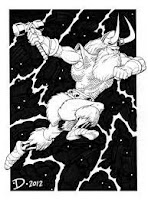
The first god I ever killed in D&D was Thor.
To be clear, I was DM'ing at the time, not playing, but I am far more responsible for Thor's death than any of my players. In fact, I'd go so far as to say I was absolutely responsible. This was circa age 10 or so, on the playground, which meant we were still only a couple years into D&D play; at the time we had not yet discovered there was separation between editions of the game, and I was running my game with a combination of B/X and the AD&D Monster Manual and (occasionally) the DMG. My buddy had just acquired a copy of Deities & Demigods (the post-Moorcock/Lovecraft version) and we were anxious to put it into play. Since one of my earliest PCs in the game had a rather high-level thief who had no problem whupping up on normal challenges, I figured Thor would be the perfect encounter to put the dude in his place.
 |
| Dead duck |
Now, I can't remember the exact circumstances of the scenario (this was some 35 years ago) but I can remember the outcome: Jason managed to piss off Thor (probably after
I had pissed off the PC), whereupon Thor used
Mjolnr to hit the thief with a
100-die lightning bolt. The thief's
ring of spell turning reflected the bolt, Thor failed his saving throw, and was utterly disintegrated by the thing. If I remember correctly, Sneakshadow looted the thunder god of his mystic hammer, but I am 100% certain he never wielded the weapon (he
was a thief after all, and rather small in stature for a human).
I can also recall, later, reading the ring of spell turning description in the DMG and its specific stipulation (unlike the Cook Expert set) that magic item powers could not be turned and thinking: "darn, I screwed that up!" However, at no point do I remember thinking to myself, "hmm, maybe I should not have sent a greater god to fight a player character."
Deities & Demigods isn't a Monster Manual, but it's written like one...it has alphabetical entries for gods, each with a little illustration, a brief description, and a stat block. This is the exact same setup as any of the AD&D monster books. I'm sure I never even bothered to read the instructional text at the beginning of the book (explaining 'this isn't a Monster Manual') because I can remember reading all that for the first time (and loving it) after I purchased my own copy of DDG later in the form of Legends & Lore, sometime around age 11 (i.e. in 1985, before my 12th birthday). By that time, Jason had become a "Born Again" Christian and was no longer allowed to play D&D...though, perhaps, if his mother had been aware of his history with destroying pagan deities, she would have relented a bit.
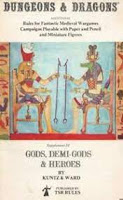
For a kid to make such a mistake is pretty understandable...even older players can probably be forgiven for making lazy assumptions when confronted with a book with a similar format (and thus skipping over the pertinent parts of the introduction). The DDG was written the way it was to update the prior OD&D supplement Gods, Demi-Gods, and Heroes (Supplement IV) for the "Advanced" D&D format, and it is a decent emulation of the style in which Supplement IV was presented. So why did authors Rob Kuntz and Jim Ward provide god stat-lines when ambitious players were certain to treat them as challengeable monsters? The answer is in the Foreward to GDG&H:
This volume is something else, also: our last attempt to reach the "Monty Haul" DM's. Perhaps now some of the 'giveaway' campaigns will look as foolish as they truly are. This is our last attempt to delineate the absurdity of 40+ level characters. When Odin, the All-Father has only(?) 300 hit points, who can take a 44th level Lord seriously?
There it is: the book was meant to be a crack-down on what was deemed to be some of the "excesses" (as they saw it) of certain campaigns. By providing statistical representations for both literary heroes (Elric, Conan, Vainamoinen, etc.) AND the gods of various pantheons, D&D players would have a scale of comparison against which to measure their own characters and campaigns.
Which, I suppose, could be an admirable goal...if D&D wasn't a completely different animal.
 |
The first
"monster manual" |
D&D didn't really seek to emulate/model a particular setting (with an implicit scale) nor, really, a particular genre of fantasy. Elric's multi-verse spanning adventures are very different from Conan's down-and-dirty conflicts, and both pale in comparison the the physical might displayed by John Carter on the surface of Mars. D&D sought to provide rules for creating fantasy adventures - and it succeeded at that! - but it never meant to constrain or limit the players' imaginations. Telling players three years after the fact that they were "doing it wrong" was a ridiculous attempt to put the genie back in the bottle. Scale should have been baked in from the get-go if that had been the intention, instead of assuming similar minds and attitudes...and who's to say the attitude wasn't similar anyway? Both Gygax and Arneson had plenty of "wa-hoo" in their own campaigns.
But back to the discussion: regardless of what one thinks about the outrageousness of fighting...and potentially slaying...divine entities, it is absolutely clear that the D&D game provides explicit rules for doing just that! At least up through 3rd edition (the last edition for which I purchased a Deities & Demigods book), textual instruction has been provided that enable DMs to run gods as encounters against player characters. Certainly, each edition to do so (OD&D, AD&D, BECMI's "I" rules, 3E) have made the prospect more and more daunting, giving divine beings ever greater abilities...and yet, the game has never simply come out and said "nope, can't be done." The gods remain ever vulnerable to mere mortals.
[forcing a deity to make a saving throw at all...even if the chance of failure is only the 5% probability of rolling a "1" on a D20...is saying that the being is as fallible as any human. 'To err is...' and all that jazz]
And as said, the D&D game supports this type of play. It's own fiction (I admit to only having read Dragonlance and the Gygax-penned Greyhawk novels) encourages this type of play. And multiple adventure modules from D&D's "golden era" (pre-1983) provide examples of how such play might be handled.
In a reasonable fashion.
And I guess that's the part that has (recently) found my prickly hide to be chapping...well, one part anyway. The unreasonableness of the encounters being given. Or...perhaps...not even the unreasonableness of the scenarios, but the disconnect I see between the game and the...the...
Hmmm. It's not "style." Or "fiction." It's more of an attitude or outlook. An orientation. Folks want to play D&D in a particular way, a particular fashion. Okay, that's cool...that's fine. It's still D&D. But then they want to have these god-encounters that aren't reasonable...at least not in the manner of the game as designed.
Hmm...I'm having a hard time expressing this.
Let me try a different way. I've heard people say: "If my DM put a wight in a first level dungeon, I'd punch him in the face" (or words to that effect). Okay, great...I get your point, and it's a reasonable one given the parameters of the game as written. Low-level adventurers don't have the abilities to confront such a creature. Low-level adventurers don't have the abilities to confront a LOT of creatures.
SO...why would you put a god or godling in any sort of low level adventure?
Halls of the Blood King (levels 3-5)
Palace of Unquiet Repose (levels 3-5)
The God That Crawls (levels 1-2)
Operation Unfathomable (levels 1-?)
There are others...of course there are others, there are always others. These ones just spring immediately to mind, and I'm too lazy to go hunting up others.
[that's another part of the hide chapping: I've lost track of how many low-level adventures see players encountering godlike beings. It's become such a regular choice for scenarios, it could be included in Moldvay's list of standard scenarios (page B51) between "Fulfilling a Quest" and "Escaping from Enemies." Call it "Confronting Godling Made Flesh" or something]
An adventure that pits a party of 4th level characters against "The Lord of All Vampires" is not, to my mind, a
reasonable execution of the D&D system as intended, nor is an adventure that finds a party of 1st and 2nd level characters accidentally wandering into the lair of "Shaggath-Ka the Worm Sultan." It belies the dynamics and expectations implicit in the game's design. Yes, I'm sure that some (like the authors of these adventures listed) would beg to differ...
as I wrote previously, this is all my (strong) opinion. So, I'd imagine some folks (those I haven't hopelessly offended) are wondering what I'd put forward as a reasonable adventure involving a godling?
Q1: Queen of the Demonweb Pits.
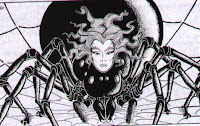
Q1 is not, of course, one's only tussle with Lolth, the demon queen of spiders...she first appears in Gygax's own D3: Vault of the Drow as a god made flesh, dwelling incarnate in the lowest level of her chosen people's greatest shrine (although why she's there is never explained). To be sure, Q1 is a flawed adventure, but I've found it to be a very fun adventure in play, and a rather solid example of possible "god fighting" in D&D.
Note the high level: 10-14 is pretty darn high for AD&D. My very over-powered bard was something like 15th level (max levels for fighter/thief) when I tackled Q1, but the character's total x.p. was equivalent to a fighter of 11th or 12th level. 14th level spell-casters have close to 30 spells per day to play with (more, for high WIS clerics), and all such characters have a ton of resources, both magical and mundane, to draw upon. Attacking an arch-devil or demon prince (or queen) in its lair is a legitimate challenge for D&D characters that have otherwise grown too big for their britches.
 |
| Beefy monster |
"Come on, JB, Sutherland's adventure is the height of cheesiness...you're just being nostalgic here!" Not at all. Given sufficient time adventuring, PCs will acquire resources such that
normal logistical problems no longer apply: the ability to
create food and water.
Bags of holding and
portable holes. Magical mounts and constructs that can carry immense burdens, rarely (if ever) tire, and that can bypass obstacles by flying. Magical means of entry and egress - or escape! - including
teleportation,
passwall,
word of recall. And, of course, the power to bring fellow party members back to life whenever it suits them. Some Dungeon Masters recoil at the thought of their campaigns getting to such a level, it no longer resembling a game of "scurrilous rogues" in running battles with lizard people while trying to hide a gemstone up their nostril. That's right:
it doesn't. High level characters have graduated from such grubby affairs and require larger challenges to test their abilities.
Planar travel becomes an option at high levels, and rightly so...because other planes provide the opportunity for DMs to throw the greatest challenges at PCs. And I'm not just talking encounters with gods and godlings...on other planes, all bets are off with regard to what might be thrown at PCs. Different physics, different rules, screwing with spell effects, reducing or limiting magical abilities. Pocket dimensions and demi-planes provide all sorts of justifications for strange, non-book monsters and unique, fantastic treasures. Q1's problem (in my opinion) isn't one of steam-powered spider ships; rather, it's too many damn
bugbears and coin piles...the adventure could be
even weirder and
stranger than it is (though the demonweb map itself is a rather beautiful thing).
Talking about D&D's literary roots, Moorcock's
Elric stories provide
excellent examples of just how weird and messed up things get when you start skipping around the multiverse...and just how much trouble PCs can get into when their magic and magical items stop functioning the way they're accustomed to on the Prime Material plane.
But that's not low-level stuff. Elric is sometimes accompanied on his extraplanar adventures by low-level characters and (spoiler alert) things usually go very, very badly for them; insanity and death are both par for the course. Which is as it should be. Your high level party isn't going to get any positive results out of taking a small army of men-at-arms into the demonwebs, nor should they. Soldiers have their place in the D&D world, but planar invasions of a demigod's home plane ain't one of them. Such an scenario shouldn't be a place for any character with less than a million experience points. Literally.
Okay, that's enough for Part 2.
Part 3 coming up!