 |
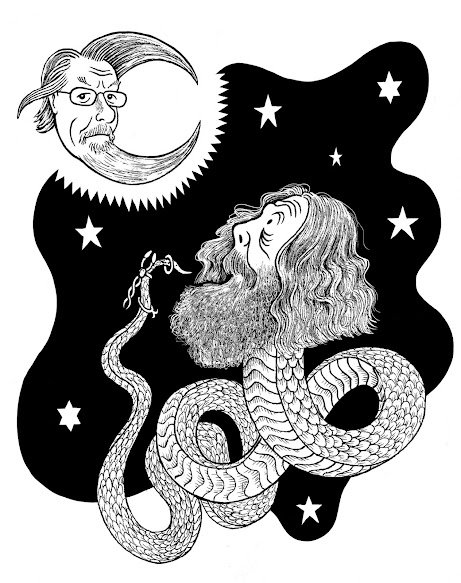
| Steve Moore & Alan Moore. From the Bumper Book of Magic. |
I am extremely proud and honored to present here an exclusive interview with the amazingly multi-talented
BEN WICKEY, the extraordinary artist of the "
Old Moores' Lives of the Great Enchanters" stories contained in
The Moon and Serpent Bumper Book of Magic.
Grazie mille, Ben, for your Art and for your kindness and availability! I can't wait to read your
More Weight graphic novel!
All art included in this post is by
Ben Wickey, unless otherwise indicated.
smoky man: Your name in the Bumper Book could be a "surprise" of sort for the readers. Of course, you did a fantastic work on those enchanters! So, could you present yourself? I mean, I know that you are from New England, an animator with a strong fascination for Edward Gorey and for weird tales. And that you are working on a graphic novel about the Salem witch trials... Ben Wickey: I can understand how my name, previously included in small publications only, would appear a surprise to any comics fans picking up their copy of this long-awaited book. I could even say that no one was more surprised than myself! By way of introduction, I am an illustrator, animator, and writer
from Cape Ann, a peninsula in Massachusetts. My stop-motion animated films include
Ray Bradbury's The Homecoming (2017) and
The House of the Seven Gables (2018). I was also an animator/animation assistant for the 2021 film
Marcel The Shell with Shoes On. For the past ten years I have been the animator for Christopher Seufert's long-awaited
documentary GOREY, focusing on the
life of Edward Gorey. My illustrations can be found in books such as
The Illustrated Vivian Stanshall, written by Stanshall's widow and my close friend, Ki Longfellow,
Supper with the Stars, a Vincent Price cookbook, and now Alan Moore and Steve Moore's
The Moon and Serpent Bumper Book of Magic. My own 400+ page comic book,
More Weight, which attempts to be a historically accurate depiction of the Salem witch trials and their troubling aftermath, is slated to be released by Top Shelf Productions in late 2025.
How did you get involved with the Bumper Book? When did you start working on it?
In December 2019, I was 24 years old and in a state of discouragement with regard to More Weight. It was my first attempt at a long-form comic book, and I had hit a wall. And so, I wrote Alan Moore a letter, and sent it to him without thinking that I would get any response back. It should be noted that I did not send Alan this letter because I was working on a comic book, but because the book's main character,
Giles Corey, was born in the Boroughs of Northampton, England. Corey was actually baptised in the
Church of the Holy Sepulchre, which still stands today. Anyone who knows anything about Alan knows how important that small area is to him, and how it is the center of his magnificent novel Jerusalem. I even remember a small mention of Giles Corey in that novel, as well as in Providence later on. Giles Corey, who was pressed to death in Salem in 1692 after refusing to speak at his witchcraft hearing, seemed to me as the prototypical Northampton anarchist that Alan would be proud of. It can even be said that Corey's gruesome death, (during which he apparently shouted "more weight!"), was one of the first documented protests in American history. These were the things which I discussed in my small letter. A month later, an email appeared from Alan's marvelous assistant, containing Alan's reply: a longer letter than what I had initially sent him! It was also one of the most kind, generous, and encouraging letters I've ever received. In addition to some fantastic advice, he expressed a wish to read
More Weight when it was ready. At this time, I had considered chopping the book into serialized zines.
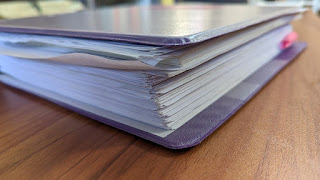 |
| The Moores' scripts! |
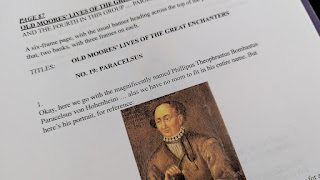 |
Excerpts from the Moores' scripts.
|
In February 2020, I moved to Los Angeles with my now-wife. We had just begun animation on Marcel The Shell with Shoes On when the pandemic hit. Stuck in quarantine, along with the rest of the world, I decided to compile the first half of More Weight into a small, self-published book. There were only about 10 copies made, and I sent one to Alan Moore, along with a copy of The Illustrated Vivian Stanshall. Apparently, Alan liked both books very much, but I didn't know just how much until March, 2021, when his assistant emailed me to ask whether or not I had the time or interest to illustrate the 50 Great Enchanters for the Bumper Book of Magic.
At first, I could not allow myself to believe that I had been given all 50 Enchanters, even though the email was far from cryptic in that respect. Somehow I thought, "oh, Alan's given me one of the fifty! Probably John Dee, considering how much of my work in More Weight contains bearded 17th century men and those post-medieval diamond-paned windows. How cool to have done ONE page of comics for Alan Moore!" Then I read the email again and realized (with great excitement) that I had in fact been chosen to do all fifty. I had been eagerly anticipating that book's release like everyone else, and had assumed that every artist had already been picked for it. Since I had first written to Alan while he was very publicly retiring from the comics medium, it never once occurred to me that he would actually give me a job!
Alan has maintained that the final League of Extraordinary Gentlemen (Volume IV: The Tempest) was his last bow in the comics world. Of course, I have to respect that. Although this is not Alan Moore's final comic book, (indeed, not inherently a comic book at all), I can at least say that my comic book pages are among the last to be published in an Alan Moore book. In Beatles terms, I guess it's sort of an Abbey Road/Let It Be situation. In either case, it's been one of the top thrills and honors of my admittedly small career.
 |
Making-of Lives of The Great Enchanters episode 2.
|
Did Alan provide you with full script for each one-page story or did you follow a different approach? I noticed that there are no speech balloons or sounds and that the whole narrative is dictated by captions...
Yes, I received a full script once my first two "demo" Enchanters were approved. These were "The Dancing Sorcerer" and "The Persian Magi." Once these were approved, Knockabout's Tony Bennett ( a lovely guy) sent me the subsequent 48 scripts as PDFs. Printing them out nearly broke my printer! For 50 pages of comics, there were about 250 pages of script, co-written by Alan and Steve. I can still remember giddily running home from the office supply store with a giant, purple three-ring binder to contain this massive script. Each panel was meticulously described, with additional reference photos for faces, clothing, and locations. Pretty much everything the Moores had in mind wound up in the script, which was immensely valuable and helpful for me. I rather prefer a lot of direction than not enough, especially with now only one Moore to answer to. Throughout the entire process, Steve Moore was very present in the script, and I hope my final illustrations were true to what he had envisioned. From about the 28th Enchanter to the 50th, the scripts included rough thumbnail drawings which Alan had done, which were also greatly illuminating. The only real challenge I had was figuring out where all the text boxes were going to fit!
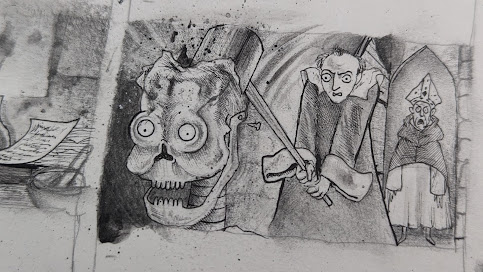 |
| Making-of Lives of The Great Enchanters episode 12. |
Lives of Great Enchanters covers, well, thousands of years of human history and tons of historical and mythological figures. I think you had to do tons of research... Which enchanter mentioned in the Bumper Book is your favourite, in general? Which one was more difficult to handle? Which one was more fun to draw? In general, how did it work?
Since the script for my Great Enchanters pages had been written by Alan and Steve prior to 2014, I realized that perhaps there was now information online which had been unavailable to them at the time. An example of this would be the MacGregor Mathers page, which shows Aleister Crowley, (in a Scottish Black Watch uniform and Osiris mask), approaching W.B. Yeats at the entrance to the Golden Dawn's London headquarters. The Moores' script had asked for only a black-half mask for Crowley, but my additional research had revealed that he was wearing an Osiris mask. I tried to inject into every panel of the "Great Enchanters" pages the same love of research and historical accuracy which I had strived for in More Weight. To me, that was one of the most fun aspects to doing these pages, and one I never tired of.
Since about half of the "Great Enchanters" require caricatures of people which we have some record of, whether from portraits, photographs, or film footage, I knew that it was necessary to apply that same caricatured look to people of the ancient and medieval periods too. I therefore designed specific faces for the early Enchanters, to provide a continuity once the faces become more well-known. For someone like Roger Bacon, who was born in 1214, my only references for what he looked like are either vague engravings or posthumous sculptures. So I'd cherry-pick noses, mouths and eyes from each depiction, and design composite likenesses to then caricature. My main hope was to make these historic figures seem real and specific.
 |
| Making-of Lives of The Great Enchanters episode 26 focused on William Blake. |
Also, the "Great Enchanters" pages strayed into areas in which I already had some interest. I had been drawing William S. Burroughs' face, for instance, since I was about 14, so I felt especially prepared for that particular page. I was already a big fan of Iain Sinclair's writing, so the Bumper Book gave me a great excuse to contact him. According to Alan and Steve's script, Sinclair was born a "blue baby" in Cardiff, Wales, during a 1943 air raid, and his first breath was apparently made possible by his father accidentally dropping pulp fiction crime novels on his head. Iain Sinclair not only corroborated the story, but gave me key details which the script lacked. The book which had fallen on his head was W.B.M. Ferguson's
Crackerjack, and his birthplace looked over the
Scott Memorial Lighthouse at Roath Park Lake, which still exists. These were personal details which I just HAD to get right, especially since Sinclair is the only living Great Enchanter in the book. Sinclair and I have collaborated on book projects since, I'm proud to say.
I am interested in some technical aspects. Did you create the pages on paper, with an analog approach or digitally? Was it a mix? In case of analog, did you use acrylics, watercolors, or? How much time did you spent, averagely, on each page? Did you do the lettering too? I love it...
I would design the layout for each page on the computer first, so that I would know where and how the text would fit in each panel. All of the art for my "Great Enchanters" pages began as pen-and-ink illustrations with graphite shading and, occasionally, gray washes. I'd use a variety of pens on rough watercolor paper so as to give it that inky, "toothy" texture. Then I would scan each page and upload the art into a prepared Photoshop file. The coloring and hand-lettering were all done digitally by hand on a Wacom Cintiq. By lettering digitally, I could zoom into the page and write each word bigger than they appear on the page, so that my hand wouldn't cramp up or get sloppy from hand-writing all those small letters! The coloring was digital only because I'm nitpicky and enjoy making minor adjustments to brightness and shadows and highlights.
 |
| Script excerpt & layout for Lives of The Great Enchanters episode 37 focused on Aleister Crowley. |
Only in the William Blake page did I use physical watercolors. I am a massive devotee of Blake's, and I tried to replicate the look of his coloring style for his page. All my Blake art books were out on the table as I dived into that world. I even inked everything in sepia just to make it extra Blakean. It was quite an adventure!
Also, in the Solomon page, I sculpted and painted a clay maquette of the demon Asmodeus. Since he shows up in Jerusalem as a demonic guide through the 4th dimension, it made sense to have a 3D depiction of him in a 2D drawing. I keep the sculpture locked away in a drawer of my drawing table, in case he tries to escape.
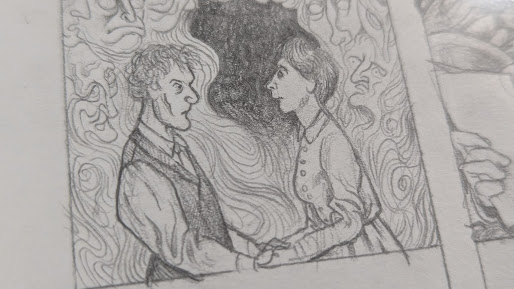 |
| Making-of Lives of The Great Enchanters episode 40 focused on Austin Osman Spare. |
What's about the feedback from Alan? Did you send him the wip pages or what? Did you discuss things before doing the pages or during the process? Did Alan ask for any correction or modification?
Aside from the encouragement relayed to me via his assistant every time I'd send out a new batch of pages, the best response from Alan came in the form of a Christmas card in 2021 when I was about halfway through the Enchanters. The card simply said: "PS: THE GREAT ENCHANTERS ARE ENCHANTING!" We've sent each other Christmas cards every year since, I'm happy to say. Alan really is one of the sweetest and jolliest collaborators —and friends— I could ever hope to have.
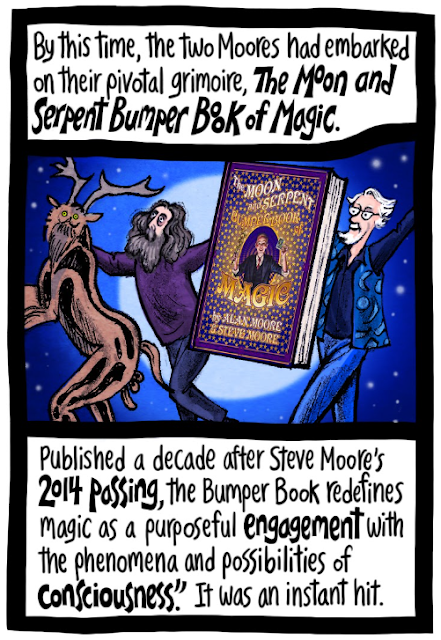 |
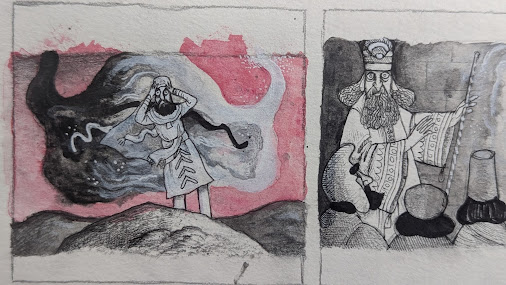
Panel from a special page that Wickey created as a gift for Moore's 70th birthday.
|