Above, a panel from page 22 of Sam Zabel and the Magic Pen by Dylan Horrocks.
For more info and new about Dylan Horrocks visit his site here.
Info about Sam Zabel and the Magic Pen: here.
Showing posts with label Dylan Horrocks. Show all posts
Mar 11, 2015
Mar 30, 2013
AM Portrait: The other Swamp Thing
| Illustration © Chris McLoughlin |
In the following you can read a short article written by Dylan Horrocks and included in Alan Moore: Portrait of an Extraordinary Gentleman (2003, Abiogenesis Press, page 59). In the piece Horrocks remembered a "lost project" about comics creators and their creations and... Alan Moore. With illustration by artist Chris McLoughlin (page 58).
Posted on this blog with the authors' permission.
The other Swamp Thing
© Dylan HorrocksPosted on this blog with the authors' permission.
The other Swamp Thing
Not long ago I was developing a series for Vertigo, centered on the exploits of a comics company and its various employees. The twist was that all the comics they published were entirely true and their stars (Doctor Occult, Adam Strange, the Phantom Stranger, the Swamp Thing and other such DC-Vertigo characters) were all real people. There was a small team of cartoonists, each of whom was given the job of following around one of those heroes and recording their adventures and everyday lives accurately and truthfully in the form of a monthly comic book.
One of those cartoonists was going to be a thinly disguised version of Alan Moore (or at least the 1980s Alan Moore), who would shamble into the editorial office once a month, his legs caked with mud from the Louisiana swamp, his long hair and beard full of twigs and leaves and nesting insects, his breath sweet with whatever hallucinogenic fruit he’d recently chewed, to drop a pile of paper on the editor’s desk. Then with a grunt, this mysterious cartoonist would turn and go, heading back to his beloved swamp, leaving behind a trail of mud and strange aromas and, of course, the latest issue of Swamp Thing. His comic, of course, would be beautiful – a magical, moving masterpiece, full of philosophical musings and profound insight into the human condition and our place in the natural world. It would also be trippy, sexy, pungent and disturbing.
When I described this project to the incredibly talented young cartoonist Chris McLoughlin (who’d drawn a guest-artist issue of Hunter: the Age of Magic), he was so taken with it that he went home and drew this sketch, which summed my idea up perfectly. Needless to say, the project was eventually turned down, although I still intend to do it one day (stripped of its DC properties, of course). But here, for posterity, is Chris’s perfect sketch of the other Swamp Thing: the mystical magus of Louisiana…
| Illustration © Chris McLoughlin |
Labels:
2003,
Alan Moore Portrait,
Chris McLoughlin,
Dylan Horrocks
Mar 11, 2013
AM Portrait: Moore Morality
| Alan Moore as Tom Strong by Dylan Horrocks. |
In the following you can read a piece originally written in 2002 by New Zealand comics artist and writer Dylan Horrocks, included in Alan Moore: Portrait of an Extraordinary Gentleman book (2003, Abiogenesis Press, page 75).
Posted on this blog with the author's permission.
Moore Morality
I still remember the first time I noticed Alan Moore's name. I was 15 or 16 and an avid reader of the British weekly comic 2000AD, which I would pick up every Thursday on the way home and happily lose myself in for half an hour with an after-school snack. This must have been around 1982, because ET was going great guns at the boxoffice and I guess the editors of 2000AD wanted to cash in on that with a cheap imitation of their own. To their credit they gave the job to Alan Moore. The resulting serial was called SKIZZ and by the end of the first episode I knew this was much more than a cheap Spielberg ripoff. I looked up the name of the writer (or 'script droid' as 2000AD wryly put it) who'd taken such a lame brief and turned it into a tense, funny, moving and politically provocative story (complete with witty references to Alan Bleasdale's searing indictment of the unemployment-economy, "Boys from the Blackstuff"). It was an easy name to remember: "Alan Moore". Before long, it was a name no-one could ignore.
American fans usually view "Swamp Thing" and "Watchmen" as Moore's breakthrough stories - the books with which he changed comics forever. Personally, I'm struck by how the key elements of what makes Moore so special are there from the very beginning: the ability to take a trashy formula or forgettable character and shape them into something fresh, profound and beautiful - while at the same time managing to impart a genuinely respectful sense of what was precious about the original. The humour, the literacy, the intelligent political analysis, the technical virtuosity, the sincerity and warmth. And above all (for me), a deep and genuine moral core to his work.
I don't think it's possible to overstate how influential Alan Moore's work has been in the English-speaking comics world. I still hear echoes of "Marvelman" in almost every superhero comic I pick up these days - usually pale, shallow echoes, but they're there nonetheless (and don't get me started on "Watchmen"). "Swamp Thing" effectively gave birth to the entire body of work known as Vertigo Comics (though it's still better than any of them). And now ABC Comics is hauling the mainstream comic in a whole new direction again - actually in two or three new directions (and how many retro-styled tribute covers have we seen since "Promethea" and "Tom Strong" started the trend?).
The extent of this influence is our blessing and Moore's curse. A curse because most of the work that has come in his wake has stolen some superficial elements of Moore's narrative style or tone, while failing to notice what makes his comics REALLY good. Because by trying to make mainstream comics grow up, all he managed (in many cases) was to push them into a rowdy, obnoxious, pretentious adolescence. I love the fact that now, with "Tom Strong", Moore is gently leading us back to childhood again.
But as influential as Moore has and continues to be, that's not what really makes me love his work. It's the work itself. From odd forgotten 80s gems like "Captain Britain" to the phenomenal "From Hell", from ephemeral humour strips like "The Bojeffries Saga" to the deeply serious political manifesto "V for Vendetta", from accessible 'mainstream' adventure stories like "Tom Strong" to the labyrinthine, intensely personal "Birth Caul", Moore's work is always a masterpiece. Sure - he's one of the greatest craftspeople we've ever had. But even that's not the real issue for me.
American fans usually view "Swamp Thing" and "Watchmen" as Moore's breakthrough stories - the books with which he changed comics forever. Personally, I'm struck by how the key elements of what makes Moore so special are there from the very beginning: the ability to take a trashy formula or forgettable character and shape them into something fresh, profound and beautiful - while at the same time managing to impart a genuinely respectful sense of what was precious about the original. The humour, the literacy, the intelligent political analysis, the technical virtuosity, the sincerity and warmth. And above all (for me), a deep and genuine moral core to his work.
I don't think it's possible to overstate how influential Alan Moore's work has been in the English-speaking comics world. I still hear echoes of "Marvelman" in almost every superhero comic I pick up these days - usually pale, shallow echoes, but they're there nonetheless (and don't get me started on "Watchmen"). "Swamp Thing" effectively gave birth to the entire body of work known as Vertigo Comics (though it's still better than any of them). And now ABC Comics is hauling the mainstream comic in a whole new direction again - actually in two or three new directions (and how many retro-styled tribute covers have we seen since "Promethea" and "Tom Strong" started the trend?).
The extent of this influence is our blessing and Moore's curse. A curse because most of the work that has come in his wake has stolen some superficial elements of Moore's narrative style or tone, while failing to notice what makes his comics REALLY good. Because by trying to make mainstream comics grow up, all he managed (in many cases) was to push them into a rowdy, obnoxious, pretentious adolescence. I love the fact that now, with "Tom Strong", Moore is gently leading us back to childhood again.
But as influential as Moore has and continues to be, that's not what really makes me love his work. It's the work itself. From odd forgotten 80s gems like "Captain Britain" to the phenomenal "From Hell", from ephemeral humour strips like "The Bojeffries Saga" to the deeply serious political manifesto "V for Vendetta", from accessible 'mainstream' adventure stories like "Tom Strong" to the labyrinthine, intensely personal "Birth Caul", Moore's work is always a masterpiece. Sure - he's one of the greatest craftspeople we've ever had. But even that's not the real issue for me.
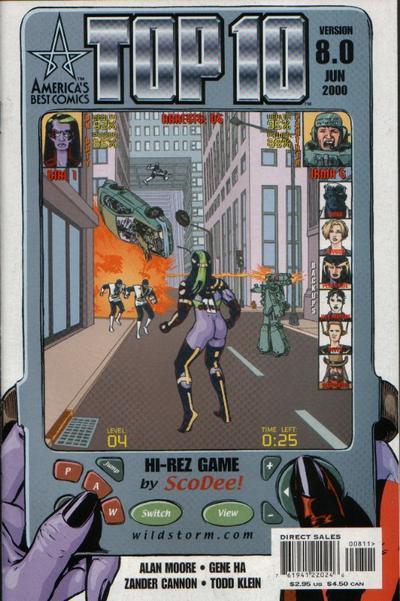
| Top Ten N.8 cover by Gene Ha. |
Let me tell you about the moment I realised just how lucky we are to have him in our strange little literary ghetto. You remember the issue of "Top Ten" when there's been an accident at a teleportation pad? Much of that issue consists of one of our heroes sitting with two of the accident's victims as they slowly die. They talk, they cry, they struggle with fear, they wait for the inevitable. This came as something of a surprise to me, since the previous issues of "Top Ten" had basically been an entertaining and playful spin on TV cop shows. Suddenly, out of the blue - this! At first, I even thought Moore had inserted the incident as black comedy - which seemed uncharacteristically callous of him. But as the issue unfolded, I realised - with that shiver up the spine I associate with so much of Moore's work - that he was putting me through something much worse - and much more valuable. I don't know if this issue was written out of the same impulse that led to "The Birth Caul," but it had the same effect on me. By the last page, I was in tears. It was genuinely moving in the way that only the most sincere and meaningful work can be. Moore was facing the reality of death, not unafraid but free of illusions and sentiment. The closest thing to that issue I can think of is the long passage in "War & Peace" where Andrei is dying.
It was impressive, sure - but ultimately I don't give a shit about impressive. I wasn't crying because Moore had written the thing so damn well. I was crying because he'd taken all his own grief and the lessons he'd learnt from it and had distilled them into this crazy little comic about superheroes and interdimensional travel. He'd given us a gift, carefully copied from the scars on his own heart.
That's what I mean when I say that what really makes Alan Moore's work special is its morality. His work is pure and sincere. And utterly, deeply humane. It was clear in SKIZZ and it's clear in everything he's written since. It was radiantly clear in "This is Information" - his contribution to one of the 9-11 benefit books. Moore's story was intelligent, moving and profoundly mature. He even managed to express perfectly my own complex ambivalence towards the American comics industry's response to the events of September 11. Once again, I was grateful to the man who could pull this off - not because it was a good comic; but because he said what someone needed to say.
I don't care if he worships an ancient snake god and summons demons in his spare time. I would trust Alan Moore with my soul. And every time I pick up one of his comics, that's exactly what I do.
It was impressive, sure - but ultimately I don't give a shit about impressive. I wasn't crying because Moore had written the thing so damn well. I was crying because he'd taken all his own grief and the lessons he'd learnt from it and had distilled them into this crazy little comic about superheroes and interdimensional travel. He'd given us a gift, carefully copied from the scars on his own heart.
That's what I mean when I say that what really makes Alan Moore's work special is its morality. His work is pure and sincere. And utterly, deeply humane. It was clear in SKIZZ and it's clear in everything he's written since. It was radiantly clear in "This is Information" - his contribution to one of the 9-11 benefit books. Moore's story was intelligent, moving and profoundly mature. He even managed to express perfectly my own complex ambivalence towards the American comics industry's response to the events of September 11. Once again, I was grateful to the man who could pull this off - not because it was a good comic; but because he said what someone needed to say.
I don't care if he worships an ancient snake god and summons demons in his spare time. I would trust Alan Moore with my soul. And every time I pick up one of his comics, that's exactly what I do.
Labels:
2002,
2003,
Alan Moore Portrait,
articles,
Dylan Horrocks
Subscribe to:
Posts (Atom)