Showing posts with label Iain Sinclair. Show all posts

Aug 6, 2025

The Great Mystery of Brian Catling

In July, Swan River Press published a collection of Brian Catling's stories entitled A Mystery of Remnant and Other Absences, co-edited by Victor Rees and Iain Sinclair. 
More information about the book can be found HERE. 
 
The book includes three new texts written by Moore in response to 3 photographs of Catling as a young man, all of which are included within the book. 
Check below for one of them! Thanks to Victor Rees for this amazing preview.
 
Moore expressed his admiration for Catling's work in several occasions, they were close friends and kindred spirits. Moore also wrote the introduction of Catling's The Vorrh and defined it "The current century's first landmark work of fantasy". 
 

Dec 12, 2024

Ben Wickey: An Extraordinay Enchanter

Steve Moore & Alan Moore. From the Bumper Book of Magic.
I am extremely proud and honored to present here an exclusive interview with the amazingly multi-talented BEN WICKEY, the extraordinary artist of the "Old Moores' Lives of the Great Enchanters" stories contained in The Moon and Serpent Bumper Book of Magic
For more info about Ben Wickey visit: Instagram - Etsy - IMDB
 
Grazie mille, Ben, for your Art and for your kindness and availability! I can't wait to read your More Weight graphic novel!
 
All art included in this post is by Ben Wickey, unless otherwise indicated.
smoky man: Your name in the Bumper Book could be a "surprise" of sort for the readers. Of course, you did a fantastic work on those enchanters! So, could you present yourself? I mean, I know that you are from New England, an animator with a strong fascination for Edward Gorey and for weird tales. And that you are working on a graphic novel about the Salem witch trials...
Ben Wickey: I can understand how my name, previously included in small publications only, would appear a surprise to any comics fans picking up their copy of this long-awaited book. I could even say that no one was more surprised than myself! By way of introduction, I am an illustrator, animator, and writer from Cape Ann, a peninsula in Massachusetts. My stop-motion animated films include Ray Bradbury's The Homecoming (2017) and The House of the Seven Gables (2018). I was also an animator/animation assistant for the 2021 film Marcel The Shell with Shoes On. For the past ten years I have been the animator for Christopher Seufert's long-awaited documentary GOREY, focusing on the life of Edward Gorey. My illustrations can be found in books such as The Illustrated Vivian Stanshall, written by Stanshall's widow and my close friend, Ki Longfellow, Supper with the Stars, a Vincent Price cookbook, and now Alan Moore and Steve Moore's The Moon and Serpent Bumper Book of Magic. My own 400+ page comic book, More Weight, which attempts to be a historically accurate depiction of the Salem witch trials and their troubling aftermath, is slated to be released by Top Shelf Productions in late 2025. 
Frame from Ray Bradbury's The Homecoming film.
How did you get involved with the Bumper Book? When did you start working on it?
In December 2019, I was 24 years old and in a state of discouragement with regard to More Weight. It was my first attempt at a long-form comic book, and I had hit a wall. And so, I wrote Alan Moore a letter, and sent it to him without thinking that I would get any response back. It should be noted that I did not send Alan this letter because I was working on a comic book, but because the book's main character, Giles Corey, was born in the Boroughs of Northampton, England. Corey was actually baptised in the Church of the Holy Sepulchre, which still stands today. Anyone who knows anything about Alan knows how important that small area is to him, and how it is the center of his magnificent novel Jerusalem. I even remember a small mention of Giles Corey in that novel, as well as in Providence later on. Giles Corey, who was pressed to death in Salem in 1692 after refusing to speak at his witchcraft hearing, seemed to me as the prototypical Northampton anarchist that Alan would be proud of. It can even be said that Corey's gruesome death, (during which he apparently shouted "more weight!"), was one of the first documented protests in American history. These were the things which I discussed in my small letter. A month later, an email appeared from Alan's marvelous assistant, containing Alan's reply: a longer letter than what I had initially sent him! It was also one of the most kind, generous, and encouraging letters I've ever received. In addition to some fantastic advice, he expressed a wish to read More Weight when it was ready. At this time, I had considered chopping the book into serialized zines.

The Moores' scripts!
Excerpts from the Moores' scripts.
In February 2020, I moved to Los Angeles with my now-wife. We had just begun animation on Marcel The Shell with Shoes On when the pandemic hit. Stuck in quarantine, along with the rest of the world, I decided to compile the first half of More Weight into a small, self-published book. There were only about 10 copies made, and I sent one to Alan Moore, along with a copy of The Illustrated Vivian Stanshall. Apparently, Alan liked both books very much, but I didn't know just how much until March, 2021, when his assistant emailed me to ask whether or not I had the time or interest to illustrate the 50 Great Enchanters for the Bumper Book of Magic.

At first, I could not allow myself to believe that I had been given all 50 Enchanters, even though the email was far from cryptic in that respect. Somehow I thought, "oh, Alan's given me one of the fifty! Probably John Dee, considering how much of my work in More Weight contains bearded 17th century men and those post-medieval diamond-paned windows. How cool to have done ONE page of comics for Alan Moore!" Then I read the email again and realized (with great excitement) that I had in fact been chosen to do all fifty. I had been eagerly anticipating that book's release like everyone else, and had assumed that every artist had already been picked for it. Since I had first written to Alan while he was very publicly retiring from the comics medium, it never once occurred to me that he would actually give me a job!

Alan has maintained that the final League of Extraordinary Gentlemen (Volume IV: The Tempest) was his last bow in the comics world. Of course, I have to respect that. Although this is not Alan Moore's final comic book, (indeed, not inherently a comic book at all), I can at least say that my comic book pages are among the last to be published in an Alan Moore book. In Beatles terms, I guess it's sort of an Abbey Road/Let It Be situation. In either case, it's been one of the top thrills and honors of my admittedly small career.
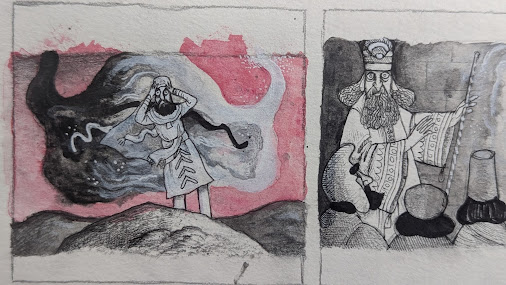
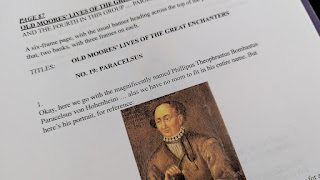
Making-of Lives of The Great Enchanters episode 2.
Did Alan provide you with full script for each one-page story or did you follow a different approach? I noticed that there are no speech balloons or sounds and that the whole narrative is dictated by captions...
Yes, I received a full script once my first two "demo" Enchanters were approved. These were "The Dancing Sorcerer" and "The Persian Magi." Once these were approved, Knockabout's Tony Bennett ( a lovely guy) sent me the subsequent 48 scripts as PDFs. Printing them out nearly broke my printer! For 50 pages of comics, there were about 250 pages of script, co-written by Alan and Steve. I can still remember giddily running home from the office supply store with a giant, purple three-ring binder to contain this massive script. Each panel was meticulously described, with additional reference photos for faces, clothing, and locations. Pretty much everything the Moores had in mind wound up in the script, which was immensely valuable and helpful for me. I rather prefer a lot of direction than not enough, especially with now only one Moore to answer to. Throughout the entire process, Steve Moore was very present in the script, and I hope my final illustrations were true to what he had envisioned. From about the 28th Enchanter to the 50th, the scripts included rough thumbnail drawings which Alan had done, which were also greatly illuminating. The only real challenge I had was figuring out where all the text boxes were going to fit! 
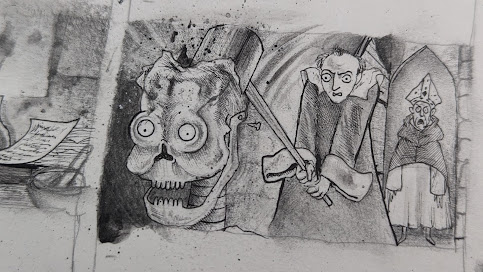
Making-of Lives of The Great Enchanters episode 12.
Lives of Great Enchanters covers, well, thousands of years of human history and tons of historical and mythological figures. I think you had to do tons of research... Which enchanter mentioned in the Bumper Book is your favourite, in general? Which one was more difficult to handle? Which one was more fun to draw? In general, how did it work?
Since the script for my Great Enchanters pages had been written by Alan and Steve prior to 2014, I realized that perhaps there was now information online which had been unavailable to them at the time.  An example of this would be the MacGregor Mathers page, which shows Aleister Crowley, (in a Scottish Black Watch uniform and Osiris mask), approaching W.B. Yeats at the entrance to the Golden Dawn's London headquarters. The Moores' script had asked for only a black-half mask for Crowley, but my additional research had revealed that he was wearing an Osiris mask. I tried to inject into every panel of  the "Great Enchanters"  pages the same love of research and historical accuracy which I had strived for in More Weight. To me, that was one of the most fun aspects to doing these pages, and one I never tired of. 
 
Since about half of the "Great Enchanters" require caricatures of people which we have some record of, whether from portraits, photographs, or film footage, I knew that it was necessary to apply that same caricatured look to people of the ancient and medieval periods too. I therefore designed specific faces for the early Enchanters, to provide a continuity once the faces become more well-known. For someone like Roger Bacon, who was born in 1214, my only references for what he looked like are either vague engravings or posthumous sculptures. So I'd cherry-pick noses, mouths and eyes from each depiction, and design composite likenesses to then caricature. My main hope was to make these historic figures seem real and specific. 
Making-of Lives of The Great Enchanters episode 26 focused on William Blake.
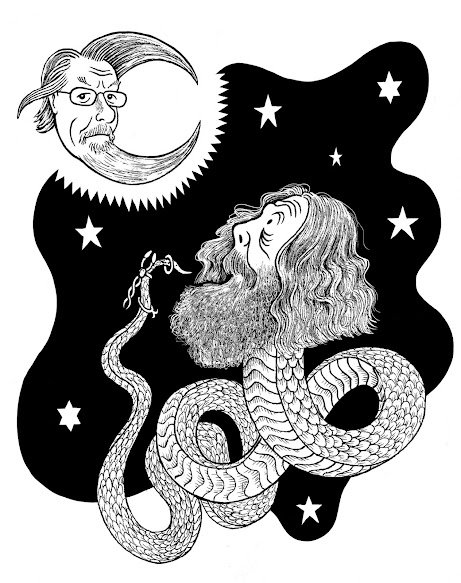
Also, the "Great Enchanters" pages strayed into areas in which I already had some interest. I had been drawing William S. Burroughs' face, for instance, since I was about 14, so I felt especially prepared for that particular page. I was already a big fan of Iain Sinclair's writing, so the Bumper Book gave me a great excuse to contact him. According to Alan and Steve's script, Sinclair was born a "blue baby" in Cardiff, Wales, during a 1943 air raid, and his first breath was apparently made possible by his father accidentally dropping pulp fiction crime novels on his head. Iain Sinclair not only corroborated the story, but gave me key details which the script lacked. The book which had fallen on his head was W.B.M. Ferguson's Crackerjack, and his birthplace looked over the Scott Memorial Lighthouse at Roath Park Lake, which still exists. These were personal details which I just HAD to get right, especially since Sinclair is the only living Great Enchanter in the book. Sinclair and I have collaborated on book projects since, I'm proud to say. 
 
I am interested in some technical aspects. Did you create the pages on paper, with an analog approach or digitally? Was it a mix? In case of analog, did you use acrylics, watercolors, or? How much time did you spent, averagely, on each page? Did you do the lettering too? I love it...
I would design the layout for each page on the computer first, so that I would know where and how the text would fit in each panel. All of the art for my "Great Enchanters" pages began as pen-and-ink illustrations with graphite shading and, occasionally, gray washes. I'd use a variety of pens on rough watercolor paper so as to give it that inky, "toothy" texture. Then I would scan each page and upload the art into a prepared Photoshop file. The coloring and hand-lettering were all done digitally by hand on a Wacom Cintiq. By lettering digitally, I could zoom into the page and write each word bigger than they appear on the page, so that my hand wouldn't cramp up or get sloppy from hand-writing all those small letters! The coloring was digital only because I'm nitpicky and enjoy making minor adjustments to brightness and shadows and highlights.
Script excerpt & layout for Lives of The Great Enchanters episode 37 focused on Aleister Crowley.
Only in the William Blake page did I use physical watercolors. I am a massive devotee of Blake's, and I tried to replicate the look of his coloring style for his page. All my Blake art books were out on the table as I dived into that world. I even inked everything in sepia just to make it extra Blakean. It was quite an adventure!

Also, in the Solomon page, I sculpted and painted a clay maquette of the demon Asmodeus. Since he shows up in Jerusalem as a demonic guide through the 4th dimension, it made sense to have a 3D depiction of him in a 2D drawing. I keep the sculpture locked away in a drawer of my drawing table, in case he tries to escape.
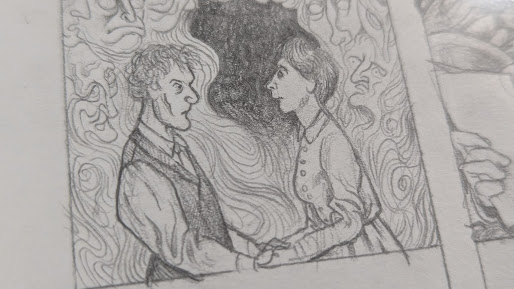
Making-of Lives of The Great Enchanters episode 40 focused on Austin Osman Spare.
What's about the feedback from Alan? Did you send him the wip pages or what? Did you discuss things before doing the pages or during the process? Did Alan ask for any correction or modification?
Aside from the encouragement relayed to me via his assistant every time I'd send out a new batch of pages, the best response from Alan came in the form of a Christmas card in 2021 when I was about halfway through the Enchanters. The card simply said: "PS: THE GREAT ENCHANTERS ARE ENCHANTING!" We've sent each other Christmas cards every year since, I'm happy to say. Alan really is one of the sweetest and jolliest collaborators —and friends— I could ever hope to have. 
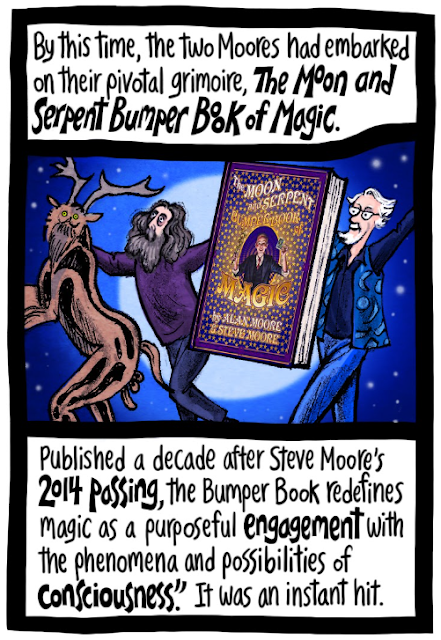
Panel from a special page that Wickey created as a gift for Moore's 70th birthday.

Aug 29, 2024

A walk across Northampton

Excerpts from a great video posted some months ago on Youtube by
London-based film-maker and writer John Rogers. Rogers walked across Northampton together with acclaimed writer Iain Sinclair and then they visited Alan Moore for a great chat.
A fascinating walk exploring elements of the deep history of Northampton with writer Iain Sinclair on the way to a conversation with Alan Moore, author of Jerusalem, The Watchmen, Voice of the Fire, The Great When (Long London Trilogy). Our route takes in St Peter's Church, Gold Street, All Saints Church, the Guildhall, St Andrew's Hospital, and the County Ground. The cast of characters mentioned include John Clare, William Smith, Lucia Joyce, Samuel Becket, John Deakin and more.

Presented as Unearthing Alan Moore at Swedenborg House in Bloomsbury, London.

Alan Moore: [...] The meaning and the poetry of people and places is much more real than the actual substance... I mean if you go to a place and you don't know anything about it... it's just a place, it's not it hasn't got any presence... but if you know all of these little coincidences and things

[...] it's only when you actually scratch the surface of what is popularly known that you discover this kind of seam of fossil material that is full of energy, full of fuel...

[...] I think that the past is ever with us and I think that it just becomes more noticeable when you are approaching the point where you will become the past...

Ian Sinclair: ever with us and ahead of us...
Alan Moore: and ahead of us, yeah...
Watch the complete video, HERE!

Aug 24, 2024

On Mary Shelley, Iain Sinclair, Moorcock and more...

Below, excepts from a great interview published in 2004 on Salon.com. 
It's titled The man who invented the future and conducted by Scott Scott Thill. 
I highly recommend it! There is also an extremely interesting section focused on the political situation of the time.
Scott Thill: [...] my contention in this article is that it's pretty much undisputed that you're the heavyweight champion of comics, but that you should also be considered among the world's literary greats, up there with Pynchon and DeLillo, because of what you do with language and narrative.
Alan Moore: Well, thank you. That is praise indeed. I'm a huge Thomas Pynchon fan. But, I don't know, it's nothing that I'm really that bothered about. Over here, the literary establishment is still running, as back in the days of Jane Austen, on the novel of manners, which she more or less invented. And, of course, they're about the social intricacies of the middle class, who were also the only people at the time who could read or afford to buy the books. They were also the people who made up the book critics. And I think that, around this time, critics were so delighted by this new form of literature mirroring their own social interactions that they decided that not only was this true literature, but this was the only thing really that could be considered true literature. So all genre fiction, anything that really wasn't a novel of manners in one form or another, was excluded from that definition.

Do you still find that to be the case?
I recently saw a program about the history of the novel on TV over here -- it was a short series and it was ridiculous. I predicted before the thing was actually shown that there would be nobody representing any form of genre fiction whatsoever -- and I was, for the most part, right. They managed to get through the 18th and 19th centuries without a mention of, say, the gothic novel. Fair enough, perhaps the gothic novels weren't as extraordinary as literature, but they also didn't mention Mary Shelley's "Frankenstein," which is an incredibly important book for all sorts of reasons. But I guess it has become what they would term genre fiction, so it is amongst the literary damned. My only mistake was that I said I didn't think there would be a mention of H.G. Wells, but my girlfriend told me they did mention "The History of Mr. Polly," which is one of the few works by Wells that I have not been able to get through. To completely ignore "The War of the Worlds," "The Time Machine," "The Invisible Man" and all his other work shows you the way that the literary critical establishment tends to regard even people in so-called lower literary genres. So if you are working in comics, which is considered a whole lower medium, well, let's just say that I'm not anticipating being given the Booker Prize anytime soon -- and I'm immensely glad of that.

You're not too worried about mainstream appreciation.
 
No, I think that the real life in any culture happens on the margins. I'd agree with what the brilliant, divine, wonderful Angela Carter said about Booker Prize-winners; I believe she referred to them as shortlist victims, which I think pretty well sums it up. The most interesting writers are the ones that are seldom going to get anywhere within shouting distance of a literary prize because they are considered too vulgar. Take Michael Moorcock, for example, who wrote the wonderful "Mother London," one of the most astonishing London novels ever written -- and there have been a great many astonishing London novels. "Mother London" is a tour de force; it is the best thing he's ever written, but there is no chance of Moorcock ever being given literary respectability because he has dabbled in ignored, disregarded and, some would argue, frankly juvenile comics or fantasy.

Are there other authors you feel are devalued because of the nature of their work?
 
Sure, people like Iain Sinclair, who is I think perhaps one of the best writers of the English language who is currently alive and working. His books are not an easy read. They're very dense with a lot of information on a single page. Culture today predisposes us to receive our information predigested and prepackaged, and most, as a rule, tend to shy away from anything which hasn't been simplified to the level where anyone could understand it. That is not the job of an artist or a creator, yet all too often in the mainstream you'll find that is what people are doing in order to remain popular. They know their audience, and they know if they push the right buttons in the right order that they can create another bestseller or whatever. I'm very content with this kind of strange, underground ghetto that I've been shunted into. It's a wonderful place and you meet a much nicer class of people. [...]

Jan 7, 2024

Alan Moore Portraits - Excerpts Part 1

With the dubious benediction of old age, a decade more than my allotted biblical span, tired eyes fail but the picture sharpens. Our future is not ‘used up’ as Marlene Dietrich lays on Orson Welles in Touch of Evil, but invigorated, ripe with inventions from a misused past. Potential is now absolute. Veterans hanging around beyond their mortal permissions have an enhanced sense of the world: we are on the cusp of being absorbed into its tacky substance. Disnatured, we leak through former inhibitions, invisible boundaries. We are everywhere. At once. Our own grandfathers. Our children.

Alan Moore, from my side of the grass, is a young man: permanently so. I mean in his boundless energy, his productivity, his continued interest in the obligatory madness of things. And his preternatural ability to ingest the information he needs and to formulate a great synthesis in popular form. [...]
I really love fanzines… I’d much rather do work for a fanzine and not get paid than do work for a slimy media parasite … and not get paid. I think the difference lies in the purity of intentions behind the editorial policy. Fanzine eds whatever their individual quirks, are putting in a lot of work purely out of love for the medium and desire to help and understand it.” –– Alan Moore

When Alan wrote the above to me in 1984 (I was 16) I had no knowledge of his involvement in fanzines or fandom. I had collected older fanzines that were before my time (and often before my ability to read), such as BEM, Comic Media News International and the pre-Martin Lock Fantasy Advertiser but hadn’t come across his name. I assumed Alan hadn’t been involved. I was wrong. He was there, of course, further back than I was able to go, right at the very beginning… [...]
From Hell: The House that Jack Built
I don't know when Alan Moore came in contact with Rudy Rucker’s The Fourth Dimension, but when writing From Hell, the ten-year work on Jack the Ripper’s murders co-created with Eddie Campbell, he was well aware of it. [...]
The early 1980s were a creative ferment for British comics and through this formative period and early professional comics career, Alan Moore was caught up in the thick of it. Xerography helped more people to self-publish fanzines about comics as well as small press comics themselves. Often in modest print runs, with finishing, stapling, perhaps cover-colouring, of necessity usually done by hand. From starting the Fast Fiction table to sell self-published titles at the bimonthly Comic Marts at the Central Hall, Westminster (right across the square from the Houses of Parliament), the next step was to pick out some of most interesting and distinctive voices among them and put them into a bigger, bolder anthology. It was my partner Peter Stanbury who came up with the title and used his handwriting of it as our logo. Escape would feature quite a range of written contributions by Alan over its nineteen-issue run between 1983 and 1989. [...]
The year was 1986 and I was only thirteen years old. Earlier that year I had been blown away by Frank Miller’s The Dark Knight Returns, a comic with an approach to Batman unlike any I had seen before. In May of that year, I went into my local comic shop in London to grab Watchmen n.1, a series which had been advertised in other DC books before it was published. I wasn’t a 2000AD reader as a kid so my exposure to Moore had been limited up to this point. I had seen him and Gibbons create Green Lantern stories for DC’s book of the same name which were fun but I wasn’t prepared for Watchmen. [...]
Scarcely four months after the terrorist attacks of September 11, 2001, Dark Horse put out a collection, 9-11: Artists Respond. The gashes were still fresh, the dead still being counted (or pieced together), the toxic reek still wafting over Manhattan. That’s the context for Moore and Melinda Gebbie’s contribution, the six-page comics essay “This is Information.”

The piece is somber, respectful of the moment and the victims. Still, upon first reading it in January, 2002, I was struck by how different it was in tone from all the other works in the collection, indeed from virtually all discourses about 9-11 which we had been steeped in up ‘til then. [...]
In 1993, to celebrate his 40th birthday, Alan Moore declared himself a ceremonial magician.

In an interview published in Entertainment Weekly, he says: “I was turning 40 and thinking, Oh dear, I'm probably going to have one of those midlife crisis things which always just bore the hell out of everybody. So it would probably be better if, rather than just having a midlife crisis, I just went completely screaming mad and declared myself to be a magician. That would, at least, be more colourful. So, I announced, on the night of my 40th birthday party — probably after more beers than I should have had — that, 'from this point on, I'm going to become a magician’. And then the next morning you have to think, Oh, what have I said now? Are we going to have to go through with this? So I had to go about finding out what a magician was and what they did.” [...] 

Part 2: HERE


Nov 1, 2023

Iain Sinclair 80

Below, a small excerpt from Alan Moore 1-page contribution to IS 80, a limited-edition signed publication to mark the 80th birthday of legendary writer, film-maker, and walker Iain Sinclair.

The 192 page A4 illustrated publication features over 170 contributors, including Peter Ackroyd, Caroline Bergvall, Keggie Carew, William Gibson, Xiaolu Guo, Philip Hoare, Toby Jones, Stewart Lee, Esther Leslie, Rachel Lichtenstein, Robert Macfarlane, Jonathan Meades, Dave McKean, Michael Moorcock, Alan Moore,  J.H. Prynne, Denise Riley and Marina Warner.
 
Unfortunately, the book is currently sold-out. And I sadly confess that I couldn't get a copy. Sigh. Sob. 
Special thanks to friend Omar Martini for sharing the text.
Alan Moore: [...] I met Iain and became entangled in his fascinating human narrative, demoralised to find that he was even better at being a person than he was being an unbeatable writer: generous with his invaluable time, supportive, warm, and always willing to share the astonishing arcane intelligence that flows so freely through his multitude of subterranean channels. Not only a literary example, then: if arguably the best and most bar-raising writer in the English language can be such a lovely individual, what excuse does anybody have for being otherwise?

[...] We are privileged to walk the world while he does. [...]

Jul 24, 2023

Agents of Oblivion

Above a great illustration by the amazing Dave McKean included in Agents of Oblivion by the extraordinary Iain Sinclair. The illustration features Algernon Blackwood but also Steve Moore and... Alan Moore!
Four stories starting everywhere and finishing in madness. Four acknowledged guides. Four tricksters. Four inspirations. Algernon Blackwood. Arthur Machen. J. G. Ballard. H. P. Lovecraft. They are known as “Agents of Oblivion”. And sometimes, in brighter light, as oblivious angels . . .

As host, as oracle, Iain Sinclair moves through this quartet of tales, through a spectral London that once was, or might never have been.
Furthermore: Alan's presence is very much there in the first story, 'The Lure of Silence'. - Iain Sinclair.

Unfortunately the hard-cover seems to be sold out. But... 
Highly recommended!

Mar 11, 2022

Alan Moore's pentagram

Sinclair's refers to Rebecca Hind's Scintilla work.
[...] The Christ Church triptych is a cascade of waterlight scintillating against the assertive grandeur of Hawksmoor, that masculine insistence on 'terror and magnificence': a space stripped and painted for concerts, promotions and televised incantations. A ballroom of vanities in which I remember seeing the magus Alan Moore marking out a pentagram of spectral conjurings for the camera. [...]

Grazie to friend Omar Martini for this little discovery.

Dec 30, 2021

Regime change in Whitechapel by Iain Sinclair

Iain Sinclair and Alan Moore, 2017
From the sold-out Alan Moore: Portrait of an Extraordinary Gentleman book, below you can read the contribution written by acclaimed Welsh writer and film-maker IAIN SINCLAIR to celebrate Alan Moore's 50th birthday in 2003. 
Moore named Sinclair as one of his favourites writers (here) in several occasions.
Regime change in Whitechapel 

Back in the dog days of the last century, before the restaurants in Brick Lane featured celebrity snaps of Prince Charles and a few dejected English cricketers on the piss and somebody in suit and tie who used to read the news (Falklands, Gulf War), a bunch of cultural subversives were gathered to enact, in their own ways, the last rites. The skeletal book-burner John Latham with his mad eyes and posthumous (slow, deadly) voice. Derek Raymond, jaunty, spry, fruity, smart, remembering what it had been like to be Robin Cook - and writing a cod-Bond novel that went so far off the rails that it froze time, a period in the Sixties, and entered all the dictionaries of slang. Poet and performance artist Brian Catling, shaven-headed, cigar-chomping, berobed, returning to scenes of vision and poverty, labours in the ullage cellar of Truman’s Brewery. Alexander Baron, solid but tentative, white raincoat like the negative of a lost life; post-war wanderings through a blasted landscape. And fellow Jewish memory-man, Emanuel Litvinoff, who once discussed alchemical epics with Elias Canetti. A few villains were also present: Tony Lambrianou, chauffeur to the rug-wrapped corpse of Jack the Hat, and the now vanished biblio-maniac Driffield. Then there was Alan Moore.
The excuse was a film for Channel 4, The Cardinal and the Corpse - which suffered from too many cardinals and not enough corpses (the dead wouldn’t lie down). Of all the faces who had to hang around, in Cheshire Street market, in the house with the peeling pink door in Princelet Street (now a regular feature in Dickens heritage romps), in the infamous Carpenters Arms (with its lost apostrophe), only one registered with the citizens, ordinary dishonest folk going about their business. ‘Are you,’ they challenged, not daring to believe it, ‘Alan Moore?’
Alan doesn’t quite believe it himself: that he is on set, grounded in the future of a definitively erased past, space-time anomalies he will activate in his serial composition, From Hell.  This grimoire, with its fearsome apparatus of actual and fantastic scholarship, is the ultimate book on the Whitechapel Murders. The endstop. Many, many others, hacks, snoops, chancers, will follow - but they won’t register. Game over. Patricia Cornwell, the latest, richest, and most absurd, brings the weight (humourless, pan-global paranoia) of the CIA, forensic SWAT teams, art dealers, foot-in-the-door men to bear on a series of terrible Victorian crimes. She is the wrong book, straddled across the razor-wire of the genre fence. It’s like Miss Marple hitting Los Angeles to solve a slasher crime, the slaying of James Ellroy’s mother. Wrong game, wrong century.
Not content with world domination, America wants to invade the only thing we have left: the past. They devoured From Hell. They liked it and they bought the company. And made it into a ‘ghetto story.’ With punch, panache, zizz: the stuff they do so well. And with a brutal disregard for history, so that the pain (which burns through those stones still) of the butchering of Marie Jeanette Kelly is demeaned - by a narrative twist, wrong girl, and a happy John Ford ending in a whitewashed cottage in the west of Ireland.
Alan Moore knows that these sentiments can be floated as recalled potentialities, a single flash-frame in a dying consciousness, before the darkness sets in. One bead of bright light before an eternity of stygian black.
Loping down Princelet Street, with a kind of nautical roll, non-metropolitan - backlit Durer hair - Alan stands out; not belonging to these alleys and rat runs, he is visible in ways the other writers are not. The space between what he writes and what he is dissolves. He acts. The rest of them are what they do, talk, words - or quiet moments, caught at a window, of wounded reverie. There is a thing that won’t leave them alone, a vulture on the shoulder. ‘The general contract,’ Derek Raymond called it. Mortality.
Mortality imprints these streets like a miasma. Alan Moore, playing at the ‘discovery’ of a magical primer, plays at being trapped forever in this house, this place. And so it is. The Vessels of Wrath sail through the sky, clouds pierced by the steeple of Nicholas Hawksmoor’s Christ Church. The extraordinary, hallucinogenic structure that has haunted artists and writers (from Leon Kossoff to Peter Ackroyd) catches Alan’s eye: a stone needle in a pane of dirty glass. The church, with its balanced weight and mass, marries disparate elements: Greek, Roman, Gothic. As Moore will balance the unwieldy mass of dark history, lies, forgeries, echoes of other writers, Blakean epiphany, Crowley ritual.
There are no accidents here. Moore, on the steps of the church, is passing through, gathering what he needs. The rough walkers, the vagrants, the invisibles who challenge him, are there for the duration; no parole. Shifting facades, fresh scams; nothing changes.
                    
Iain Sinclair

Feb 2, 2018

Moore on artists, books, music, movies and TV shows

Excerpt from an interview published on Inside The Rift the 8th of January 2018. 
Full interview available HERE.

Prox: Are there any artists, books, movies/TV shows or music you’d like to recommend to the readers?
Alan Moore: I hardly ever watch movies or television, but I very much enjoy the work of Andrew Kötting (Swandown, By Ourselves), Ben Wheatley (Free Fire, High-Rise, A Field in England), and the increasingly rare outings of Chris Petit (Radio On, The Falconer). On TV I really liked the two seasons of Utopia, am always delighted when Stewart Lee gets a new series of his Comedy Vehicle, and continue to be very impressed by the writing of Vince Gilligan on Better Call Saul. The contemporary art world I know almost nothing of, but Jimmy Cauty’s dioramas of urban collapse and a coup d’état Police force are sobering and wonderful in equal measure. Books make up the greater part of my relatively few leisure activities: I would heartily recommend Iain Sinclair’s The Last London, and I’m eagerly anticipating both the follow-up to Michael Moorcock’s Whispering Swarm – one of the best things he’s ever done – and the final volume of Brian Catling’s hallucinatory Vorrh trilogy. I’ve also recently enjoyed a beautiful and compelling account of rearing a goshawk, Helen Macdonald’s H is for Hawk, which turned up in the mail from an unknown benefactor, and am currently engrossed in Jane Jacobs’ masterful contrarian view of urban planning, The Death and Life of Great American Cities. Oh, and anybody out there who has not yet absorbed Jarett Kobek’s i hate the internet should do so immediately if they hope to ever understand our current ridiculous historical predicament.
Musically, I remain an ardent admirer of Brian Eno – his version of the Velvet Underground’s I’m Set Free on The Ship is tremendous – although I’ve also rather taken to the Sleaford Mods. And you should watch out for a young rapper/performance poet operating under the handle of Testament. I had the good fortune to be sharing a bill with him some months ago, and his reinterpretation of William Blake’s poem London was nothing short of transporting.

[Full interview available HERE.]

Aug 24, 2015

Vital stats on Alan Moore 1999

Iain Sinclair and Alan Moore at Cheltenham Science Festival in 2011.
From Wizard Wildstorm special, 1999, "Vital stats on Alan Moore" box at page 54.

OCCUPATION: Comic book writer
BORN: Nov. 18, 1953 in Northampton, England
BASE OF OPERATION: Northampton, England
Frame from Insignificance.
FAVORITE MOVIE: "Insignificance", directed by Nicholas Roeg. "It's based on some tenuous real-life connections between famous people: Marilyn Monroe, Albert Einstein, Joe DiMaggio and Joseph McCarthy. Apparently, Monroe once said the person she'd most want to sleep was Einstein. Of course, DiMaggio was married to Monroe. McCarthy apparently had a sexual fixation with Monroe, and he also investigated Einstein at one point. These are the real-life connections. What the director did was imagine that they all meet one night at a hotel. There are all these coincidences that bring them all together. It's wonderful."
FAVORITE AUTHOR: Iain Sinclair [*]. "He's probably my biggest influence at the moment, and has been for a couple of years. There is stuff he can do in writing that I've never seen anybody attempt before."
Harvey Kurtzman's cover for Mad N. 1, 1952.
FAVORITE COMIC: Mad Comics. "Nothing has been able to touch that in terms of originality, experiment, sheer quality and the cleverness of the writing and the drawing."
MOTTO HE LIVES BY: "Keep in the dry place, and stay away from children."
HIS TAKE ON PEOPLE SEEING HIM AS A COMIC BOOK LEGEND: "I'm not one. People like to build up these big, imaginary pantomime figures in their heads. I say, 'Why not?' It's fun for them. It just doesn't have much to do with me."

[*] In the actual box the name is misspelled as "Ian Sinclaire".

Jun 30, 2014

Alan Moore on Iain Sinclair


"Iain had a profound effect upon my writing style, it's probably more evident to me than to other people. It was more the fact that after reading Iain's work I felt that I had to man up, I had to shift things up a gear, because knowing that prose of that quality was possible, unless you tried to address that, any other response is like, cowardice, or defeat, surrender... It was like when I read Burroughs as a teenager. It made me realise that prose was capable of doing certain other things than things that I had previously attributed to it. Later on I found that Iain's kind of literary genealogy is not a million miles away from my own, its just that his has got a much finer eye attached to it and a much greater body of knowledge, but I think we were both inspired by the energy of the Beat writers and the culture that spread out from them. So there were points of contact, but the sheer level of attack that Iain puts into his writing... it raises the bar, that's the best way to describe it." [Alan Moore]