 |
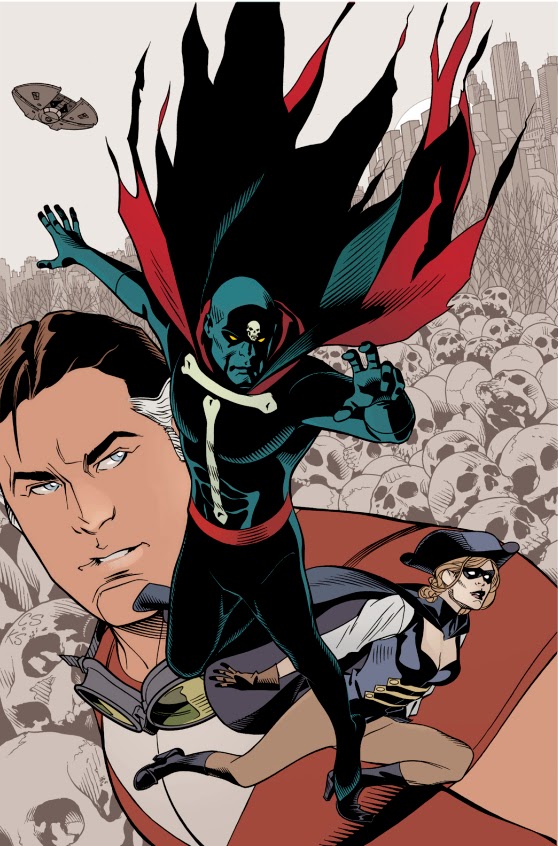
| Cover for Tom Strong and The Planet of Peril N. 2. Penciler: C. Sprouse; Inker: K. Story; Colorist: J. Bellaire. |
Below you can read an interview I did with
Peter Hogan, conducted via email in April and May 2014.
My special thanks to Mr. Hogan for his kindness and willingness.
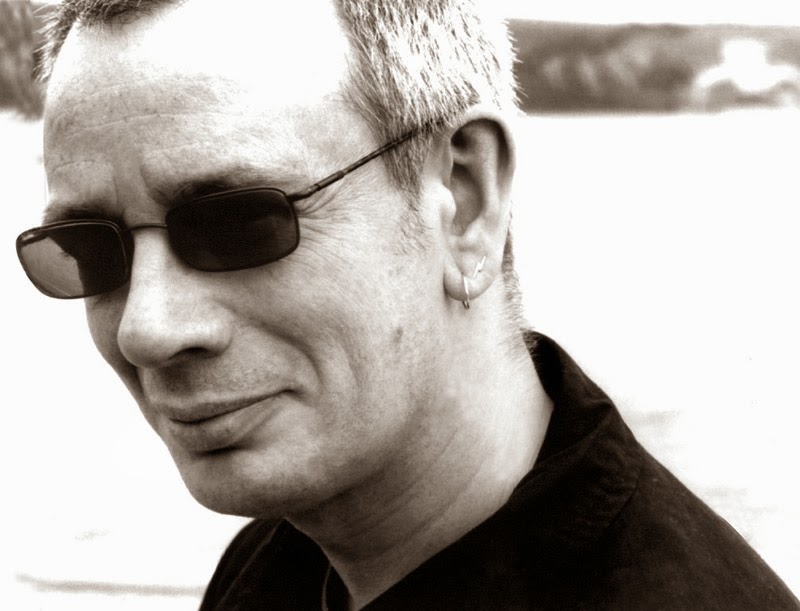 |
| Peter Hogan. |
smoky man: Tom Strong remains the only “survivor” of Moore’s ABC line. You contributed some issues to the original series created by Moore and artist Chris Sprouse, collaborated with Moore on the Terra Obscura miniseries and then, after the end of the line in 2006, you became the writer of the title producing the new miniseries Tom Strong and the Robots of Doom and the recent Tom Strong and the Planet of Peril.
What do you find interesting in writing Tom Strong? I think it’s an almost perfect mix of classic and modern, also a great vessel for entertaining and intelligent adventure stories.
Peter Hogan: Yes, I agree. Tom’s a great character, with a great supporting cast. A lot of people tend to pick up on the pulp trappings, but to me Tom is more of a Silver Age character. He has that purity of being, and whatever the modern world throws at him… I won’t say it has no effect on him, but he can handle it.
I also think that Tom Strong’s family plays a great, key role in his stories, the human dynamics. What is your approach, regarding this aspect? I am curious as a reader interested in better understanding the “creative process”, how you - as writer - approach and handle this specific characters and… characters general…
Well, the good thing about Tom and his world is that it’s on a very human scale. There’s continuity to be dealt with, there’s a complex array of relationships and quite a few characters to be taken into account … but it’s all of a manageable size, so it’s possible to write involving and dynamic stories. I think where the big superhero universes have gone drastically wrong is that they’ve been strangled by their own continuity. There’s a strength and an elegance to simplicity, which is what they once possessed but no longer do.
As to how the character dynamics work … the answer isn’t that easy, because I don’t truly understand it myself. I mean, you can plot out logically what should happen, what you’d like to happen … but the characters might not go along with it. It’s an aspect of writing that probably sounds pretentious to anyone on the outside, but it’s absolutely true. Characters will say and do things that really surprise and delight you, and whether it’s your own subconscious at work, or whether you’re channeling something from out of the Aether … who knows ? But that is genuinely how it works. Bad writers are the ones who can’t put their own egos to one side and allow that process to happen, and consequently their characters tend to be two-dimensional.
Character-driven story versus plot-driven story: which one is your favourite choice as writer? Or maybe this is not a proper question and it depends from time to time…
I don’t really think in those terms. You need good characters, and you need a good plot, whatever you’re doing. But I remember Neil Gaiman once defining ‘plot’ as : anything that keeps the reader turning the pages, and doesn’t leave them feeling cheated at the end. I’d go along with that. So, ‘plot’ can be a pretty loose concept, but you absolutely can’t do without good characters.
Back to Tom Strong. Another key ingredient of the series is… the sense of wonder, often with a classic sci-fi flavor. Which are your references or influences, or just simple interests regarding this subject?
Well, I’m only six months younger than Alan, so broadly speaking we have the same set of influences. We grew up with the same comics and movies and books … and up until the very late 1960s I think that all that sci-fi adventure material was largely very positive and optimistic, and the future was viewed as a set of dazzling possibilities. I think there are echoes of all that in Tom Strong, but it’s all filtered through a modern sensibility.
Which is a hard thing to pull off. It’s a bit like trying to do a Capra-esque fantasy movie now. It’s really, really hard, because the modern world isn’t as innocent as the 1930s, and you have to take that into account. It CAN be done –
Groundhog Day did it, for one – but it’s hard.
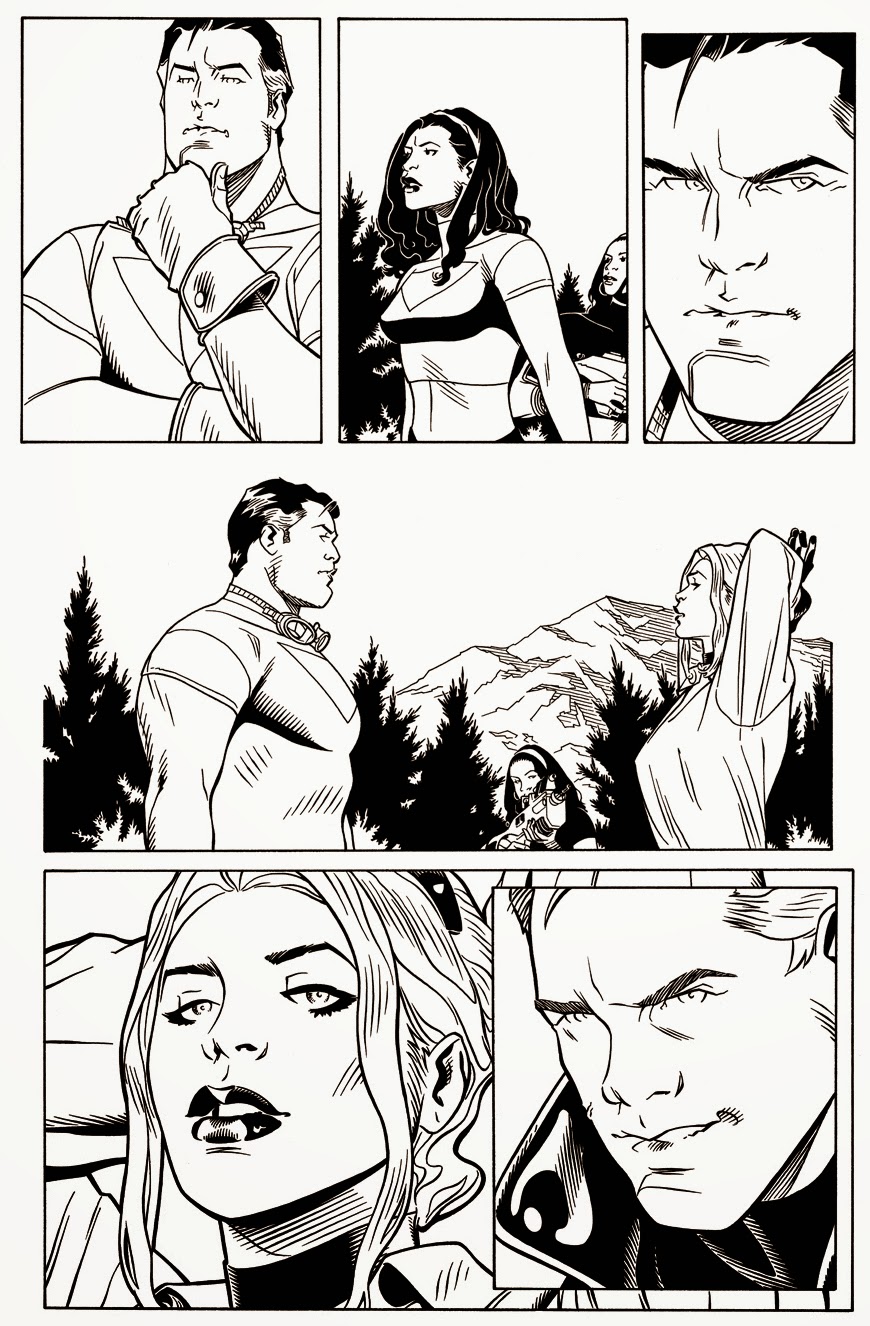 |
| Page 13 from Tom Strong and The Robots of Doom N. 6. Pencils: C. Sprouse. Inks: K. Story. |
We are talking about comics which means… drawings and storytelling, of course. So… what about your collaborative relationship with artist and co-creator Chris Sprouse? I personally think Sprouse’s clean style is the perfect match for Tom Strong being able to create a classic sci-fi atmosphere for the city, the architectures, the machines… and, at the same time, to make the characters act with great naturalness…
I agree. Tom is Chris’s baby, and he does him better than anyone else. For me, that’s a joy, because I know Chris will always come up with the goods and I can just trust him to get on with it. Hopefully Chris feels the same way about me! When Wildstorm asked me to revive Tom for Robots Of Doom, none of us were sure if Chris would be able to take part, but I’m very glad that he did.
And I think Chris would be happy to keep on with Tom forever. On my side, I have ideas for at least the next two storylines, so … I just hope they give us the go ahead to do them.
Now Tom Strong is under the Vertigo label: did this impact in any way on the character and the way you handle him and his stories?
Absolutely not. It was just a change of label, and our editor now is Kristy Quinn, who was the assistant editor on all the ABC titles. I do think it’s a shame that they didn’t keep the ABC name on it, just because, but … it was their call. They probably felt you couldn’t have a comics line with just one comic in it.
The Planet of Peril is still unpublished in Italy. I read the original issues but I don’t want to spoil any bit of the story… so, can you reveal anything about it for the Italian readers?
It sort of grew out of the fact that the last time we saw Tesla in Robots of Doom she’d just announced that she was pregnant. Which I thought was just a nice thing to do, to have Tom becoming a grandfather – and curiously, it also coincided with Alan becoming a grandfather ! Anyway, when it came time to think of a follow-up story it occurred to me that the pregnancy might actually be a dangerous situation for Tesla, since her husband is a fire-being. It could be life-threatening.
So what might save her ? I came to the same conclusion that Tom does in the story, and that leads him to travel to Terra Obscura. Since I’d wanted to go back there anyway, and this allowed me to do it, I was delighted. But it’s a VERY dark story, because Terra Obscura is in the middle of a crisis where millions of people are dying. So there’s no big villain here, and it’s basically a story about death and how people deal with it. People who were expecting a more conventional superhero adventure didn’t really get it, but the people who were a bit more open-minded seemed to really love it. Anyway, it does have a happy ending, and I’m very proud of it.
You and Alan Moore. This is an obvious question for you, probably one you answered several times in the past… So, how did you collaborate with Moore on previous stories and… did you “consult” him, or ask him any “support” or “comment” on the new mini-series you wrote “solo”?
Well, with
Terra Obscura it was a full collaboration – Alan and I sat face to face and thrashed out the plots, and then I went home and wrote the scripts. With the other ABC stuff, like the early Tom stories, we’d chat on the phone and sometimes he’d suggest things, but mostly it was me asking him questions about backstory and so on.
Then when Wildstorm asked me if I’d revive Tom a few years later, it was completely conditional on Alan being okay with the idea. So I rang him up, and fortunately for me he was happy for me to carry on. But there was kind of an implicit understanding that I was on my own from then on, and shouldn’t bother him about it at all. So from that point on it’s been just me.
What did happen to America’s Best Comics: A to Z? Will we ever see the two remaining planned issues?
I very much doubt it. They just cancelled the whole thing halfway through. The only one of mine that never appeared was the entry on Smax, which was the weakest one I wrote by far, so I’m not that sorry that it never came out. The remainder of those issues would have been written by Steve Moore, and that is a loss … I would have absolutely loved to see what Steve might have done with Promethea, but I don’t know if he even wrote a word of it before they cancelled the series. If he did, maybe it’ll surface after all his papers have been gone through.
The whole A-Z thing was weird. It was basically Alan’s idea. He was finishing up his last couple of issues for ABC, and so I think he envisioned this series as a way of rebooting the line, giving Wildstorm a springboard from which to relaunch all the titles. Looked at in that light, it makes perfect sense, whereas if Wildstorm already knew that they were going to shut the ABC line down it made no sense at all – but I think that was actually the case.
They just wouldn’t discuss future plans at all, and that had been the case for months and months before the A-Z series even got under way, so it’s not like it was the poor sales of that which made up their minds. I think they’d just decided to shut it all down the second Alan walked out the door … which is kind of understandable, but I think they could have made it work without him if they’d actually thought about it. They made a LOT of bad decisions back then.
Any desire to do something with the other ABC’s characters, under the hypothesis that it could be something possible? Personally I think you could write a great Top Ten run…
Well, I did get to do Top Ten – and a lot of the other ABC characters – in the A-Z series … but any more than that isn’t very likely. They haven’t even let Zander Cannon finish his run on the title, and I really wish they would. I was thoroughly enjoying it, and I know I’m not the only one.
Right now I’m waiting for them to agree to another series of Tom, which is my first priority. After that, I’d also like to do another series of Terra Obscura … and the only other character that might really tempt me beyond that is Jonni Future. If they ever ask me, we’ll see.
You are also writing an interesting comic for Dark Horse titled Resident Alien, with art by Steve Parkhouse. Can you say something about it? I read that Parkhouse provided the initial impetus for the series…
Yeah, that’s true. I’d worked with Steve before, and wanted to work with him again, and he’d said that he’d like to do something that involved aliens. Resident Alien is what I came up with, and it’s about an alien who’s shipwrecked here, waiting for a rescue ship that might never come. He’s been laying low, and masquerading as a doctor … and even though we show him as an alien throughout the whole story, it’s clear from other people’s reactions that everyone he encounters sees him as being human.
Anyway, when the local town’s doctor gets murdered, they ask him to help out. And he likes being a part of the town, and gets hooked on solving crimes … So, the movie pitch would probably be : alien detective. That’s pretty much all you need to know. The second series is just about to come out in trade paperback, Steve’s currently drawing the third series and I’m halfway through writing the fourth. We plan to be doing this for a while !
From your privileged perspective, what is your perception of comics today, both as a medium and as an industry?
As a medium it remains as fantastic as it ever was, and I think that will endure indefinitely, whatever effect technology has upon how people read.
As an industry it seems to be right in the middle of some big changes, and some of those changes are exciting and some of them are a little scary. We have far more publishers around now, and ones who are open to a wider range of ideas and genres, and that’s a very good thing – especially since the Big Two seem far less adventurous these days than they have been in the past. I’m reminded of dinosaurs, and I wish I wasn’t.
The industry will change, that’s the only thing that’s for certain, but … I wouldn’t want to place any bets on how ! Just so long as we can still create comics AND make a living, it’ll all be okay.
What about your future projects?
More
Resident Alien, for sure. Right now I'm just putting together a proposal for a graphic novel, which I hope I can find a home for. And, as you know, I've done a short story for
Electricomics.
It's an anthology of short stories written especially with electronic gizmos - things like tablets - in mind. Alan Moore rang me up about this nearly three years ago, and asked me if I'd like to take part. It's taken that long to get the project off the ground. The idea is basically to try and come up with stories that take advantage of an electronic medium, that couldn't be told the same way in print. So ... it's kind of an experiment, and was very challenging to write.
Can you also reveal us any detail about Cabaret Amygdala your contribution to it announced as "modernist horror"?
Well, it's actually called
Cabaret Amygdala Presents ... Second Sight.
Cabaret Amygdala was Alan's title, which I thought would make a good umbrella concept, like The Twilight Zone. Anyway, Alan asked me to come up with a horror story that would make people feel ... uneasy. It's not standard supernatural horror at all, because I can't really relate to that. There are aspects of the supernatural that I believe in, like ghosts, but I'm not at all scared of them. And most other aspects - the devil, vampires and so on - I just think are ludicrous, and also well past their sell by date. With this story I pulled together a couple of concepts that I personally find kind of creepy, and I hope other people will feel the same way.
Thank you Peter for your time and the great answers.
Italian version: here.