Showing posts with label 2024. Show all posts

Nov 7, 2025

D.R. & Quinch by Simon Davis

Art by Simon Davis
Above a sketch portrait of our favourite alien delinquents by the amazing painter and comic book artist Simon Davis realized during Lawless Comic Con in 2024.
 
For more about the artist: 2000AD page - Facebook

Sep 20, 2025

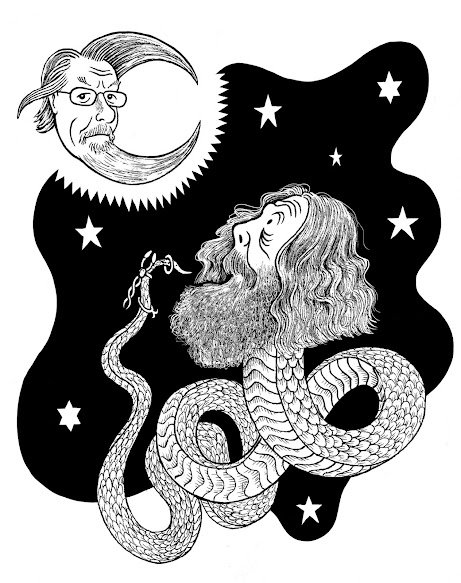
Alan Moore by Tim Acke

Art by Tim Acke
Above, an Alan Moore caricature by Belgian artist Tim Acke.
 
For more info about the artist, visit his site HERE

Aug 16, 2025

Made of Writing

Excerpt from a 2-part interview published on Flaming Hydra site, under paywall (Part I - Part II). 
Zach Rabiroff: All your novels to date have been concerned to a great extent with a sense of place—with Voice of the Fire and Jerusalem, it was Northampton, which allowed you to draw on personal experience. And now in The Great When you’re dealing with London. 
Alan Moore: I like to think that wherever I’m writing about, and in whatever form, I have always tried to pay attention to place, whether in my comic work or other work. I was quite pleased to get a lot of letters from American readers asking how long I’d lived in Louisiana [after using it as a setting in Swamp Thing]. That was touching. But no, actually it was just all research, and then imagining myself into the place. And of course with things like From Hell, it was immersing myself in London. 

[...] The majority of comics—when I started working in them—were set in America. So it felt quite radical to set some stories in London. When I did Voice of the Fire, that seemed to me to be quite audacious in that it was setting a whole novel in Northampton, which is largely a place that nobody cares about, and that doesn’t even get a mention on the local weather maps. And the same with Jerusalem, where I did it much more intensely. But that doesn’t mean that I exhausted London. The nature of a place like that means that you probably never could exhaust it. It’s infinitely deep with stories. [...]

I was actually going to ask whether you consider writing— artistic creation—itself an act of magic.

It is. I believe that all art and creation is an act of magic, consciously or unconsciously. But I believe that writing, specifically, is the closest to actual magic. If you look at the magic gods of most cultures, they are also gods of language. Hermes is the god of magic, but he's also the god of communication. The Egyptian magic god is also the scribe god, which tends to suggest that there is something, a rather intimate connection, between writing and magic. 

[...] with writing, just writing straight prose, which is all I'm doing now, I think that that has got to be the most elegant form of art. You can do so much with so little. All you've got are 26 characters peppered with punctuation.

You’re summoning reality into being with an incantation, so to speak.

You can create the whole universe from those 26 letters, any conceivable universe. And that is the immense power of writing. In writing Long London, I'm actually building that space. This is something that I learned that you can do. I probably learned it from Mervyn Peake, when I first read the Gormenghast books, and I thought, this is incredible—actually creating an architectural space in my mind. Even at this late age, I remember Gormenghast a lot better than I remember places that I've actually been. Better than places in the real world. 

Magic has got to be the art of causing changes in people's consciousness, including that of the practitioner. And anything that you can do with magic, you can do with writing. [...] You can be anything as a writer. [...]

We can never know another human being; that is the sorry fact of our existence. We can never know anything outside of our own skulls. And so, to a degree, everybody around us, the people that we love the most, are fictions that we have made up. We are fictions that we have made up. I can almost remember making me up when I was about 13 or 14. I can almost remember thinking that this childhood personality I have is going to be no use at all; if I want to have a girlfriend, I better write a new one. [...]

I wish I was made of writing, because then I wouldn't be in such a stage of physical collapse, and I would still be as gorgeous looking as I was 40 years ago instead of just almost as gorgeous looking as I was 40 years ago. If I was made of writing, I would be in perfect condition forever. And also, our fictional characters are going to meet and interact with a lot more people than we are, and for a lot longer time. Our fictions have a great deal of importance, I believe, not just as entertainment, but because they provide part of the infrastructure and armature of our world. 

Jul 16, 2025

Alan Moore by Manu Gutiérrez

Art by Gutiérrez
Above, an amazing portrait of our Bearded Magus by Spanish artist Manu Gutiérrez.
The image has been used as cover for Roberto Bartual's Alan Moore: Al otro lado del velo published in 2024 by Ediciones Marmotilla. Check the following images. 
Furthermore, below you can admire some of the sketches that Gutiérrez drew for some lucky fan. Enjoy!
For more info about the artist: Official site - Instagram 
Art by Gutiérrez

Apr 11, 2025

Moore at the Bureau of Lost Culture

At the Bureau of Lost Culture they uploaded a recording of Alan Moore in conversation with Gary Lachman and John Coulthart at the launch of the Bumper Book of Magic for their London Month of the Dead festival, last October 2024.  
 
 
It's really a terrific listen, highly recommended!
 
Back during Covid, they also made another interview with Moore on Counterculture: you can get it HERE too!

For info about the Bureau: Official site - Instagram

Jan 7, 2025

Bits of Magic

Art by Steve Parkhouse
As you know, I am writing a series of articles about The Moon and Serpent Bumper Book of Magic. They are serialized on the Italian web-magazine (Quasi) and so far four episodes are available.
In writing the pieces I contacted some of the contributors to get, if possible, behind the scene info about the book's making-of. 
In the following you can read what I got from Steve Parkhouse, who drew the amazing In the Morning of the Mind comics, and Rick Veitch who created some great illustrations for the first part of "Things to do on a rainy day" section.
Steve Parkhouse: I'm sorry to disappoint - but I have no background stories for you concerning Morning of the Mind. Bear in mind that I drew the strip sixteen or seventeen years ago so it's not really fresh in my mind. I appreciate your kind comments, but the story contains no revelations that I could discern. Since none of us were there at the time, the events depicted were obviously speculative. All the usual problems for an artist were predictable: where to find reference for giant deer, neolithic communities, credible landscapes etc. In other words, how to make the story come to life. 
I was never entirely sure of Alan's intention for the story itself. I formed my own interpretation: that everything in the universe is a fractal of the universe, and consequently natural forms tend to echo each other. That'll have to do.
Rick Veitch: I drew my illustrations over fifteen years ago and all I got to read at the time was the chapter I was working on. So no stories about the rest of it. I really loved finally reading it though. 
Veitch also mentioned The Bumper on his True-Man The Maximortal N.1 book released in August 2024. See the picture below:

Dec 31, 2024

The Bumper Book, TGW, aliens and Glycon

Alan Moore: [...] Well, The Bumper Book is about magic, whereas The Great When has got some magicians in it, but it isn’t really anything that is traditional magic — I was prepared to just make most of it up. The Bumper Book is an encyclopaedic history of magic and all sorts of other things as well, but we’ve got characters like Austin Osman Spare, Aleister Crowley and Dion Fortune in both.

So, there’s a tiny bit of overlap, but the intents of both books are different. One is to explain magic as it is and as it has been, and the other is an attempt to try and create something new in fantasy, without relying upon all the magical tropes you get reiterated so often in fantasy novels. [...]

I mean, the book is me and Steve but if there’s a third contributor it would have to be John, not only for his own beautiful art but his design of the entire book, and making all the other artists fit into it so beautifully. It was him who decided to have the cut-out and assemble temple at the back and the puzzle pages with the goat of Mendes as a join the dots picture, that was him. We thought as well as the immense amount of information in the book, we should have some fun as well. Something that reminds me of an old British annual like the Beano. [...]

[...] with the sequences in Long London I thought I want these to feel as disorienting as it would do if you were suddenly in another world. One of the things about this book is I’m really tired in current fantasy about how the kids go through the back of the wardrobe in Narnia and it’s not really a big deal. Y’know, people go into these worlds as if it was visiting Milton Keynes. [...]

Any time any of my characters enter The Great When, they’re vomiting, weeping, fainting, because that’s what I figure ordinary people would do, if something even slightly fantastic happened. If something happened that challenged your whole ideas of reality, you would fall to bits. Any of us would. We certainly wouldn’t be acting like action heroes. I wanted to get the alienness of this other world, I wanted to establish that. So I thought when we get to the Great When, we shift to italics, because italics makes everything seem more urgent, and shift to the present tense to make it more immediate. [...]

[about alien existence] Let’s act as if we’re on our own. If we do find some nice aliens at some point, that’ll be a treat, but let’s act as if we’re on our own and actively try and sustain life on this planet. Let’s not have these science fiction wank dreams that people like Elon Musk, Jeff Bezos and Richard Branson seem to be having, this cosmic circle jerk. Let’s not talk about terraforming Mars, because anyone who knows about that stuff knows it’s impossible. First we’d have to work out what turned Mars’ electromagnetic field off in the first place, because it hasn’t got one, and then turn it back on, if that’s even possible. [...]

[about Dennis Knuckleyard's name] Well, it was the first time it’s ever happened to me where it came to be semi-conscious, and I suspect a name like that can only come to you when you’re semi-conscious. I was drifting off to sleep and I was in that hypnagogic wilderness between awake and asleep, where there’s just a load of nonsense going through your head. Just a word salad, a stream of connected words and thoughts that don’t really connect but become a narrative you’re telling yourself as you’re drifting off to sleep.

I was just on the verge of sleep when the internal narrator said “so then Dennis Knuckleyard went…” and I sat up in bed, laughing. I just thought that is the most ridiculous name I’ve ever heard, I’m going to write that down. I did have a pen and pad by the bed for writing down dreams but I’m undisciplined when it comes to that so I don’t generally do it. I’d never written an idea down in the middle of the night before, but I put the light on, wrote “Dennis Knuckleyard” and then went off to sleep. It’s a great name, I did a little piece for the local Arts Lab magazine, an experimental piece where I actually tried out the name, not the character, but it wasn’t very satisfying. When it came to The Long London books, I thought that’s the one, isn’t it.

When I found out that there had never, in the history of the world, been anybody or anything called Knuckleyard then, rather than be discouraged, I thought let’s make him part of the story; that both Dennis and his mother have no idea where his now deceased father got the name from in the first place. Did he make it up as a joke? Is it a misspelling of some foreign name? They’ll never know. It was something of a gift. [...]

What I’m enjoying about Dennis is that in the first book he’s 18. The book I’m writing now he’s 28, he’s not grown up a huge amount but he’s grown up some and he’s doing some of that in the course of the book. At 28, you’re only just out of your adolescence, we don’t get out of adolescence until we’re 25, 26, so you’re not quite settled into adult life — you’re having to pretend that you’re an adult, but you’re not quite settled into what feels like an adult identity yet. That’s where Dennis is at the moment, and it’s interesting. One of the things about writing these books, one’s in 1949, 59, 69, 79 — twenty year gap — 1999.
So, characters like Dennis, you can show their development up through fifty years and you can also do that with the book’s main character, which is London. [...]

[about Glycon] Glycon, in various forms, is in the room with us. He’s on a bunch of Romanian postage stamps and money, that I’ve been sent over the year that have images of Glycon on.
It’s still a very big part of my life, even if he was a glove puppet. Especially because he was a glove puppet. [...]
The complete interview is available HERE.  

Dec 20, 2024

The Illuminist Moore

Above, cover of The Illuminist book: a collection of essays on Moore's work by Kristian Williams published by eMERGENCY heARTS.
The Illuminist: Philisophical Explorations in the work of Alan Moore

Alan Moore changed the way we think about heroes, monsters, and the stories we tell about them. From Swamp Thing and Watchmen to Promethea and Neonomicon, he has continuously subverted genre conventions and expanded the range of the comics medium.

He has also, as Kristian Williams argues in the essays collected here, given us in these stories important tools for re-examining the possibilities for justice, the nature of our society, and the sources for value and meaning in our lives.

You can order a copy here and here. Read a review here.

Dec 18, 2024

Swampy by Greg Smallwood

Art by Greg Smallwood
Above, a stunning Swamp Thing commission art by the amazing Greg Smallwood

For more info about the artist, visit his Official site: HERE!

Dec 16, 2024

Naples Comicon poster by Jamie Hewlett

Art by Jamie Hewlett
Above, the stunning illustration created by the legendary Jamie Hewlett for Naples Comicon 2025 poster.
 
You can also recognize a Rorschach patch, sort of, on the girl's jacket. 
On Fumettologica you can find an almost complete list of all the references and homages, here

Dec 12, 2024

Ben Wickey: An Extraordinay Enchanter

Steve Moore & Alan Moore. From the Bumper Book of Magic.
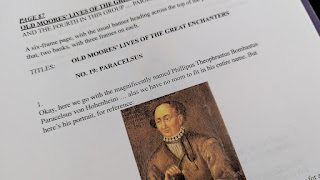
I am extremely proud and honored to present here an exclusive interview with the amazingly multi-talented BEN WICKEY, the extraordinary artist of the "Old Moores' Lives of the Great Enchanters" stories contained in The Moon and Serpent Bumper Book of Magic
For more info about Ben Wickey visit: Instagram - Etsy - IMDB
 
Grazie mille, Ben, for your Art and for your kindness and availability! I can't wait to read your More Weight graphic novel!
 
All art included in this post is by Ben Wickey, unless otherwise indicated.
smoky man: Your name in the Bumper Book could be a "surprise" of sort for the readers. Of course, you did a fantastic work on those enchanters! So, could you present yourself? I mean, I know that you are from New England, an animator with a strong fascination for Edward Gorey and for weird tales. And that you are working on a graphic novel about the Salem witch trials...
Ben Wickey: I can understand how my name, previously included in small publications only, would appear a surprise to any comics fans picking up their copy of this long-awaited book. I could even say that no one was more surprised than myself! By way of introduction, I am an illustrator, animator, and writer from Cape Ann, a peninsula in Massachusetts. My stop-motion animated films include Ray Bradbury's The Homecoming (2017) and The House of the Seven Gables (2018). I was also an animator/animation assistant for the 2021 film Marcel The Shell with Shoes On. For the past ten years I have been the animator for Christopher Seufert's long-awaited documentary GOREY, focusing on the life of Edward Gorey. My illustrations can be found in books such as The Illustrated Vivian Stanshall, written by Stanshall's widow and my close friend, Ki Longfellow, Supper with the Stars, a Vincent Price cookbook, and now Alan Moore and Steve Moore's The Moon and Serpent Bumper Book of Magic. My own 400+ page comic book, More Weight, which attempts to be a historically accurate depiction of the Salem witch trials and their troubling aftermath, is slated to be released by Top Shelf Productions in late 2025. 
Frame from Ray Bradbury's The Homecoming film.
How did you get involved with the Bumper Book? When did you start working on it?
In December 2019, I was 24 years old and in a state of discouragement with regard to More Weight. It was my first attempt at a long-form comic book, and I had hit a wall. And so, I wrote Alan Moore a letter, and sent it to him without thinking that I would get any response back. It should be noted that I did not send Alan this letter because I was working on a comic book, but because the book's main character, Giles Corey, was born in the Boroughs of Northampton, England. Corey was actually baptised in the Church of the Holy Sepulchre, which still stands today. Anyone who knows anything about Alan knows how important that small area is to him, and how it is the center of his magnificent novel Jerusalem. I even remember a small mention of Giles Corey in that novel, as well as in Providence later on. Giles Corey, who was pressed to death in Salem in 1692 after refusing to speak at his witchcraft hearing, seemed to me as the prototypical Northampton anarchist that Alan would be proud of. It can even be said that Corey's gruesome death, (during which he apparently shouted "more weight!"), was one of the first documented protests in American history. These were the things which I discussed in my small letter. A month later, an email appeared from Alan's marvelous assistant, containing Alan's reply: a longer letter than what I had initially sent him! It was also one of the most kind, generous, and encouraging letters I've ever received. In addition to some fantastic advice, he expressed a wish to read More Weight when it was ready. At this time, I had considered chopping the book into serialized zines.

The Moores' scripts!
Excerpts from the Moores' scripts.
In February 2020, I moved to Los Angeles with my now-wife. We had just begun animation on Marcel The Shell with Shoes On when the pandemic hit. Stuck in quarantine, along with the rest of the world, I decided to compile the first half of More Weight into a small, self-published book. There were only about 10 copies made, and I sent one to Alan Moore, along with a copy of The Illustrated Vivian Stanshall. Apparently, Alan liked both books very much, but I didn't know just how much until March, 2021, when his assistant emailed me to ask whether or not I had the time or interest to illustrate the 50 Great Enchanters for the Bumper Book of Magic.

At first, I could not allow myself to believe that I had been given all 50 Enchanters, even though the email was far from cryptic in that respect. Somehow I thought, "oh, Alan's given me one of the fifty! Probably John Dee, considering how much of my work in More Weight contains bearded 17th century men and those post-medieval diamond-paned windows. How cool to have done ONE page of comics for Alan Moore!" Then I read the email again and realized (with great excitement) that I had in fact been chosen to do all fifty. I had been eagerly anticipating that book's release like everyone else, and had assumed that every artist had already been picked for it. Since I had first written to Alan while he was very publicly retiring from the comics medium, it never once occurred to me that he would actually give me a job!

Alan has maintained that the final League of Extraordinary Gentlemen (Volume IV: The Tempest) was his last bow in the comics world. Of course, I have to respect that. Although this is not Alan Moore's final comic book, (indeed, not inherently a comic book at all), I can at least say that my comic book pages are among the last to be published in an Alan Moore book. In Beatles terms, I guess it's sort of an Abbey Road/Let It Be situation. In either case, it's been one of the top thrills and honors of my admittedly small career.
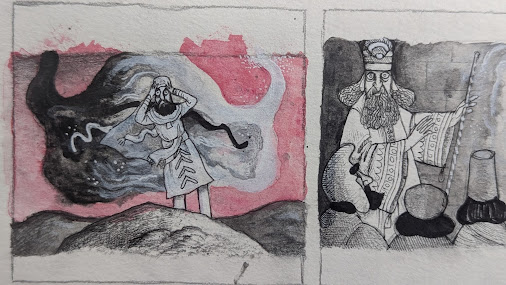
Making-of Lives of The Great Enchanters episode 2.
Did Alan provide you with full script for each one-page story or did you follow a different approach? I noticed that there are no speech balloons or sounds and that the whole narrative is dictated by captions...
Yes, I received a full script once my first two "demo" Enchanters were approved. These were "The Dancing Sorcerer" and "The Persian Magi." Once these were approved, Knockabout's Tony Bennett ( a lovely guy) sent me the subsequent 48 scripts as PDFs. Printing them out nearly broke my printer! For 50 pages of comics, there were about 250 pages of script, co-written by Alan and Steve. I can still remember giddily running home from the office supply store with a giant, purple three-ring binder to contain this massive script. Each panel was meticulously described, with additional reference photos for faces, clothing, and locations. Pretty much everything the Moores had in mind wound up in the script, which was immensely valuable and helpful for me. I rather prefer a lot of direction than not enough, especially with now only one Moore to answer to. Throughout the entire process, Steve Moore was very present in the script, and I hope my final illustrations were true to what he had envisioned. From about the 28th Enchanter to the 50th, the scripts included rough thumbnail drawings which Alan had done, which were also greatly illuminating. The only real challenge I had was figuring out where all the text boxes were going to fit! 
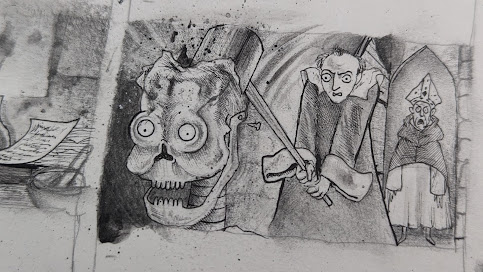
Making-of Lives of The Great Enchanters episode 12.
Lives of Great Enchanters covers, well, thousands of years of human history and tons of historical and mythological figures. I think you had to do tons of research... Which enchanter mentioned in the Bumper Book is your favourite, in general? Which one was more difficult to handle? Which one was more fun to draw? In general, how did it work?
Since the script for my Great Enchanters pages had been written by Alan and Steve prior to 2014, I realized that perhaps there was now information online which had been unavailable to them at the time.  An example of this would be the MacGregor Mathers page, which shows Aleister Crowley, (in a Scottish Black Watch uniform and Osiris mask), approaching W.B. Yeats at the entrance to the Golden Dawn's London headquarters. The Moores' script had asked for only a black-half mask for Crowley, but my additional research had revealed that he was wearing an Osiris mask. I tried to inject into every panel of  the "Great Enchanters"  pages the same love of research and historical accuracy which I had strived for in More Weight. To me, that was one of the most fun aspects to doing these pages, and one I never tired of. 
 
Since about half of the "Great Enchanters" require caricatures of people which we have some record of, whether from portraits, photographs, or film footage, I knew that it was necessary to apply that same caricatured look to people of the ancient and medieval periods too. I therefore designed specific faces for the early Enchanters, to provide a continuity once the faces become more well-known. For someone like Roger Bacon, who was born in 1214, my only references for what he looked like are either vague engravings or posthumous sculptures. So I'd cherry-pick noses, mouths and eyes from each depiction, and design composite likenesses to then caricature. My main hope was to make these historic figures seem real and specific. 
Making-of Lives of The Great Enchanters episode 26 focused on William Blake.
Also, the "Great Enchanters" pages strayed into areas in which I already had some interest. I had been drawing William S. Burroughs' face, for instance, since I was about 14, so I felt especially prepared for that particular page. I was already a big fan of Iain Sinclair's writing, so the Bumper Book gave me a great excuse to contact him. According to Alan and Steve's script, Sinclair was born a "blue baby" in Cardiff, Wales, during a 1943 air raid, and his first breath was apparently made possible by his father accidentally dropping pulp fiction crime novels on his head. Iain Sinclair not only corroborated the story, but gave me key details which the script lacked. The book which had fallen on his head was W.B.M. Ferguson's Crackerjack, and his birthplace looked over the Scott Memorial Lighthouse at Roath Park Lake, which still exists. These were personal details which I just HAD to get right, especially since Sinclair is the only living Great Enchanter in the book. Sinclair and I have collaborated on book projects since, I'm proud to say. 
 
I am interested in some technical aspects. Did you create the pages on paper, with an analog approach or digitally? Was it a mix? In case of analog, did you use acrylics, watercolors, or? How much time did you spent, averagely, on each page? Did you do the lettering too? I love it...
I would design the layout for each page on the computer first, so that I would know where and how the text would fit in each panel. All of the art for my "Great Enchanters" pages began as pen-and-ink illustrations with graphite shading and, occasionally, gray washes. I'd use a variety of pens on rough watercolor paper so as to give it that inky, "toothy" texture. Then I would scan each page and upload the art into a prepared Photoshop file. The coloring and hand-lettering were all done digitally by hand on a Wacom Cintiq. By lettering digitally, I could zoom into the page and write each word bigger than they appear on the page, so that my hand wouldn't cramp up or get sloppy from hand-writing all those small letters! The coloring was digital only because I'm nitpicky and enjoy making minor adjustments to brightness and shadows and highlights.
Script excerpt & layout for Lives of The Great Enchanters episode 37 focused on Aleister Crowley.
Only in the William Blake page did I use physical watercolors. I am a massive devotee of Blake's, and I tried to replicate the look of his coloring style for his page. All my Blake art books were out on the table as I dived into that world. I even inked everything in sepia just to make it extra Blakean. It was quite an adventure!

Also, in the Solomon page, I sculpted and painted a clay maquette of the demon Asmodeus. Since he shows up in Jerusalem as a demonic guide through the 4th dimension, it made sense to have a 3D depiction of him in a 2D drawing. I keep the sculpture locked away in a drawer of my drawing table, in case he tries to escape.
Making-of Lives of The Great Enchanters episode 40 focused on Austin Osman Spare.
What's about the feedback from Alan? Did you send him the wip pages or what? Did you discuss things before doing the pages or during the process? Did Alan ask for any correction or modification?
Aside from the encouragement relayed to me via his assistant every time I'd send out a new batch of pages, the best response from Alan came in the form of a Christmas card in 2021 when I was about halfway through the Enchanters. The card simply said: "PS: THE GREAT ENCHANTERS ARE ENCHANTING!" We've sent each other Christmas cards every year since, I'm happy to say. Alan really is one of the sweetest and jolliest collaborators —and friends— I could ever hope to have. 
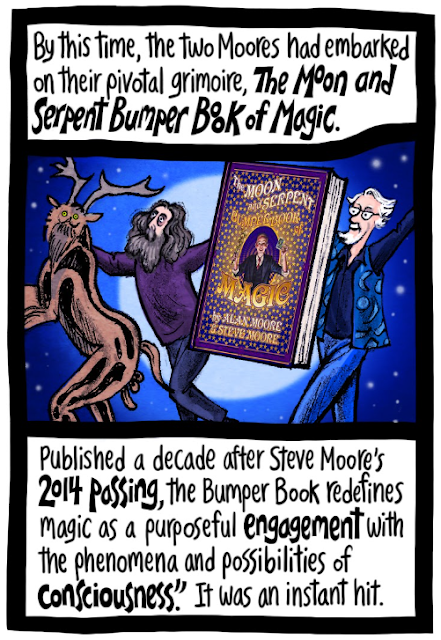
Panel from a special page that Wickey created as a gift for Moore's 70th birthday.

Dec 5, 2024

The Great When: TV adaptation

Excepts from an article published on Deadline.com the 3rd of December. 
The complete piece is available HERE.
“For the first time in my career, I’m genuinely excited and enthusiastic about a work of mine…one that I own, and believe could work marvelously in a different medium…being adapted for the screen,” Watchmen author Alan Moore says in a rare quote about his new fantasy novel, The Great When, getting a TV adaptation. In a competitive bidding situation, Colin Callender‘s production company Playground has landed the rights to the book by the famous graphic novelist [...]

“In Playground, I feel that I’ve connected with people who respect both me and the narrative and are receptive to such input as I can offer,” he said. “And, given Playground’s track record, I have little doubt that this will be anything short of spectacular. It’s taken me some time, but I think at last I’m ready for my closeup.”

Playground landed the rights to The Great When competing against a slew of other suitors. “We did take a big swing with this, really, we wrote a big check to get this,” Callender said.

Talks are already underway with writers for the adaptation. While only the first book has been published, “the roadmap is completely laid out,” with Moore working on the rest of the novels [...]

Read the whole article HERE.

Dec 3, 2024

V by Andrea Cavaletto

Art by Andrea Cavaletto
Above, a commission portrait of V by Italian comic book artist and writer Andrea Cavaletto
 
For more info about Cavaletto, visit his Instagram: HERE.

Dec 1, 2024

The Book of Magic: cover and... Cthulhu

The Bumper Book of Magic cover. Art by J. Coulthart.
I am currently trying to write a series of articles, diving into The Moon and Serpent Bumper Book of Magic section by section. They are serialized on the Italian web-magazine (Quasi) and so far two episodes are available (more to come, I hope. Don't hold your breath!) In Italian, of course.
 
In writing the pieces I also contacted some of the contributors to get, if possible, behind the scene info or extra bits of magic to include in.
In the following you can read what the great John Coulthart revealed about the cover, the magical alphabet and... Cthulhu. 
Special thanks to Coulthart for his time and kindness. Grazie mille!
John you created real magic for the book! And grazie ancora for the permission to share your original answers on this blog!
I highly recommend to visit Coulthart's official site and to follow his amazing { feuilleton } entries!
John Coulthart: The cover evolved from a request from Alan for something with the following elements:
a) the stylistic appearance of an old children's book (or "annual" as they're known here).
b) a central image showing a boy from the first half of the 20th-century holding a Tarot card in one hand and a wand in the other.
c) The title and names of the authors.

A very simple request compared to some of the covers I'm asked to create. The main task was finding a suitable figure for the central image. I could have drawn something myself but old illustrations have a unique quality, they always bring something of their own time into the present day. The boy was taken from a larger illustration on the cover of an American magazine of the 1930s. The first draft of this which I created in 2007 wasn't very successful compared to the version which appears on the printed cover. At the time I could only find a very small image of the original illustration--in 2007 there were fewer archive sources available--so I had to enlarge a small jpeg then paint over it using the mouse. It never looked bad but I was never wholly satisfied with the result. When I started work on the final layout in 2021 one of the first things I did was find a better copy of the cover boy. The image still required doctoring but this was easier to do with a larger picture and the drawing tablet which I now use every day. You'll notice that the final version has more definition than the earlier one, also the badge which I added to the artwork to make the difference between the old and new versions more evident. Everything else about the cover--the stars, the border (which features tiny moons and snakes)--was my own design.
Old version of The Bumper Book of Magic cover. Art by J. Coulthart.
    A note about "annuals". An annual for British readers was (and still is) a book published once a year, usually a large-format volume with a hard cover which would appear shortly before the Christmas season. 100 years ago children's annuals were often expensive productions but by the 1950s they tended to be printed on cheap paper and the contents weren't always very good. Even though The Bumper Book is for adults only, the intention was to create something that would look like the best annual a child could possibly receive as a Christmas gift.   
The alphabet was one of the first Moon and Serpent creations to emerge from Alan and Steve's magical explorations in the 1990s. I'm not sure when they put it together but some time in the late-1990s Alan sent me a computer print-out which showed in a rather crude form the layout of the letters as they are in the page, a grid with coloured letterforms and all their attributions. I'd already been playing around with fonts when I was asked to design the CD package for The Highbury Working so I scanned the shapes of the letters from Alan's pages then made them into a workable font which I used on the Moon and Serpent CDs and their accompanying posters.
The alphabet page was the first addition of my own to the book as a whole, this wasn't something listed in the original contents. I wanted to include it because it explained (at last) the alphabet I'd been using on all the Moon and Serpent CDs. I was always impressed with the alphabet which is why I was so eager to incorporate into the book. As well as being an early product of the Moon and Serpent project it's a clever condensation of a wide range of mythological and occult symbolism into 24 letters. It also looks like nothing but itself--it's not trying to emulate the appearance of older magical alphabets--and it really does work as an alphabet. Despite the unusual shapes of some of the letters the whole thing is relatively easy to read. Grimoires of the past (eg: Francis Barrett's The Magus) often contained pages of magical alphabets so this follows the tradition form while also adding something new to the idea of the magical alphabet. 
Art by J. Coulthart.
   Regarding Cthulhu, if you look at the attributions you'll notice that there are 12 male symbols and 12 female ones, so Cthulhu has been given a female assignation. I don't think terrestrial sex or gender designations can be applied to Cthulhu which is more of an "it" than anything else, and in the original Lovecraft story turns out to have a mutable form. Characters in the Cthulhu Mythos refer to Cthulhu as "he" but this seems more of a convenience or tradition than anything else. As for the letter, the utterance of Cthulhu's name isn't too far from the sound of "Q", while the attribution to Daath is part of Alan's theory that Daath is a kind of Lovecraftian abyss, something you see in the Magical Landscapes section of the book as well as in issue 20 of Promethea.

Nov 21, 2024

Rorschach by Bruce Timm

Above, a cool Rorschach sketch by the legendary BRUCE TIMM.
It was included in a set of 11 sketches by Timm recently sold on ebay

Nov 20, 2024

Magical 71 by Francesco Frongia

Art by Francesco Frongia
Above, a blazing, magic portrait of The Wizard of Northampton by friend
FRANCESCO FRONGIA. It's also a belated birthday gift of sort: notice the number 71 as the magical spell in the illustration!

Francesco Frongia is an Italian illustrator and graphic novelist, founder of the comics collective Mammaiuto. He also draw the cover for Franceso Pelosi's Alan Moore: La Mappaterra del Mago.
For more information about Frongia visit his Instagram HERE. Grazie mille Checco! :) 

From The Moon and Serpent Bumper Book of Magic, page 26:
[...] since the disc or coin is sometimes called a pantacle or pentacle, you might decide to furnish your design with a five-pointed star. In this case it’s important to remember what the symbol means, namely that when the star has one point uppermost, presiding over the four points below, this stands for the supremacy of the so-called ‘fifth element’, the element of Spirit, over the four worldly elements of Fire, Water, Air and Earth. (A pentacle turned upside-down just means the opposite, with Spirit downcast and neglected, dominated by material concerns. This is not to claim that such a symbol can’t be said to be Satanic when inverted in this way, but simply that it is no more Satanic than the ordinary world about us, where material concerns predominate at the expense of soul and spirit.) [...]

Nov 18, 2024

It's Moore 71!

Art by Claudio Calia
Today is Moore's 71st birthday! So, above a fantastic portrait of The Man by Italian comics artist and illustrator CLAUDIO CALIA. What Alan says is a reference to a recent article (here).
 
Grazie, Claudio! Happy birthday, Alan!

For more info about Calia, visit his site HERE.

Nov 12, 2024

Incantations of the present day

Art by Steve Parkhouse
Excerpts from an in-depth and quite interesting review of the Bumper Book of Magic by Joe McCulloch published the 29th of October on The Comics Journal
Joe McCulloch: [...] The great virtue of this book is its accessibility; I found it a concise guide to a variety of esoteric topics, organized with a good sense of intuition.5 This is creditable to not only the authors, but its predominant visual force, John Coulthart, an artist I mostly know through his extensive involvement with Manchester's Savoy Books as a designer, illustrator and cartoonist, though he has been a consistent presence in Moon and Serpent projects though his album art for A. Moore's live performance works with the musicians Tim Perkins, David J and others (The Highbury Working, Angel Passage, etc.). Here, Coulthart is credited with the Bumper Book's overall design, its cover art, large illustrations for nine different sections and many spot illustrations throughout. Sections are differentiated often by page color — white, blue, several shades of brown — while individual illustrations repeat themselves on successive pages to prompt the readers through the authors' esoteric thickets: the image of the Tree of Life repeats page after page as the Moores run down its branches, each of its 10 emanations glowing one by one by alchemical color as they are discussed; Tarot cards are displayed both as in the Tarot de Marseille and in iconographic forms devised by Coulthart himself, running along the tops of pages for quick reference. Decorative borders on most pages pulse dim to strong on a gradient; colors glow cold under glassy digital frost, which is not my favorite look, but further imposes unity on the book as if from an aloof mechanical Demiurge. [...]

[...] the authors draw a distinction between "high" magic, "the urge towards greater understanding, transcendent experience and the ecstatic enhancement of consciousness," and "low magic ... the attempt to bring about desired changes in material reality that are to the magician's personal advantage." In advocating for high magic, the Moores urge the practice of magic for magic's sake, whereby personal, creative, intellectual boons present themselves as if guided by magic itself, "the practitioner left marveling at an abundance of results that he or she had neither asked for nor expected." Render therefore unto Caesar the things which are Caesar's, to add an inappropriate note of my own. The "Great Enchanters" of the comics in this Bumper Book are often buffeted by politics, but they are not usually individuated as activists; rather, magic itself is treated as an expression of anarchy – the promotion of unmediated self-governance vs. the compulsory obedience of doctrinal religion. That magical orders have tended to regiment into elitist fraternities and doom cults does not dim magic as "a subjective practice of the individual, a means by which a single self may come to its own understanding of and make it its own peace with the wonderful and terrible phenomenon that is existence." Importantly, the work of "material" security is a condition precedent to magic practice, because “if we do not have our material circumstances under our control it will be difficult, if not impossible, to progress spiritually.” [...]

[...] A. Moore has said that this book is “intended purely as a statement about magic, rather than as a statement about comics.” But if art is magic, and comics are art, then this is also a book about comics, one that positions the drawn image, the picture story, as fundamental to social beings. This romance feels like a way of raising the art far above the mess of its mercantile circumstances, the shell which too often defines it, the mess from which he fled, a comics that is not just cruel tricks to cop money from suckers, comics preserved in the sky with wizards to voyage far on the silver foam of dreams.

Read the complete article HERE.