Showing posts with label Steve Parkhouse. Show all posts

Nov 1, 2025

Italian Sussidiario di Magia

Above and below, some pics I took of my Italian copy of the Bumper Book of Magic that I bought few days ago. The book has just been published by Panini Comics
It seems they did a good job on it. Viva la Magia!

Jan 7, 2025

Bits of Magic

Art by Steve Parkhouse
As you know, I am writing a series of articles about The Moon and Serpent Bumper Book of Magic. They are serialized on the Italian web-magazine (Quasi) and so far four episodes are available.
In writing the pieces I contacted some of the contributors to get, if possible, behind the scene info about the book's making-of. 
In the following you can read what I got from Steve Parkhouse, who drew the amazing In the Morning of the Mind comics, and Rick Veitch who created some great illustrations for the first part of "Things to do on a rainy day" section.
Steve Parkhouse: I'm sorry to disappoint - but I have no background stories for you concerning Morning of the Mind. Bear in mind that I drew the strip sixteen or seventeen years ago so it's not really fresh in my mind. I appreciate your kind comments, but the story contains no revelations that I could discern. Since none of us were there at the time, the events depicted were obviously speculative. All the usual problems for an artist were predictable: where to find reference for giant deer, neolithic communities, credible landscapes etc. In other words, how to make the story come to life. 
I was never entirely sure of Alan's intention for the story itself. I formed my own interpretation: that everything in the universe is a fractal of the universe, and consequently natural forms tend to echo each other. That'll have to do.
Rick Veitch: I drew my illustrations over fifteen years ago and all I got to read at the time was the chapter I was working on. So no stories about the rest of it. I really loved finally reading it though. 
Veitch also mentioned The Bumper on his True-Man The Maximortal N.1 book released in August 2024. See the picture below:

Feb 20, 2024

The Autumn is Magic!

Cover art by John Coulthart
It's about time! Finally this Autumn (October 15th, to be precise!) we will learn all the secrets of Magic thanks to Messrs. Steve and Alan Moore & friends (and publishers Top Shelf & Knockabout). 
 
From the Top Shelf site:
The most acclaimed writer in comics history, Alan Moore, joins his late mentor Steve Moore (no relation) for one last graphic grimoire: a sprawling and stunning introduction to magic in all its timeless forms, brought to life by five wondrous and whimsical artists.

Splendid news for enquiring minds, and guaranteed salvation for humanity! Messrs. Steve and Alan Moore, current proprietors of the celebrated Moon & Serpent Grand Egyptian Theatre of Marvels (sorcery by appointment since circa 150 AD) are presently engaged in producing a clear and practical grimoire of the occult sciences that offers endless necromantic fun for all the family. Exquisitely illuminated by a host of adepts including Kevin O’Neill, John Coulthart, Steve Parkhouse, Rick Veitch and Ben Wickey, this marvellous and unprecedented tome promises to provide all that the reader could conceivably need in order to commence a fulfilling new career as a diabolist.

Its contents include profusely illustrated instructional essays upon this ancient sect’s theories of magic, notably the key dissertation “Adventures in Thinking,” which gives reliable advice as to how entry into the world of magic may be readily achieved. Further to this, a number of “Rainy Day” activity pages present lively and entertaining things-to-do once the magical state has been attained, including such popular pastimes as divination, etheric travel and the conjuring of a colourful multitude of sprits, deities, dead people and infernal entities from the pit, all of whom are sure to become your new best friends.

Also contained within this extravagant compendium of thaumaturgic lore is a history of magic from the last ice age to the present day, told in a series of easy-to-absorb pictorial biographies of fifty great enchanters and complemented by a variety of picture stories depicting events ranging from the Palaeolithic origins of art, magic, language and consciousness to the rib-tickling comedy exploits of Moon & Serpent founder Alexander the False Prophet (“He’s fun, he’s fake, he’s got a talking snake!”).
Art by Kevin O'Neill
In addition to these manifold delights, the adventurous reader will also discover a series of helpful travel guides to mind-wrenching alien dimensions that are within comfortable walking distance, as well as profiles of the many quaint local inhabitants that one might bump into at these exotic resorts. A full range of entertainments will be provided, encompassing such diverse novelties and pursuits as a lavishly decorated decadent pulp tale of occult adventure recounted in the serial form. Completing this almost-unimaginable treasure trove is a lengthy thesis revealing the ultimate meaning of both the Moon and the Serpent in a manner that makes transparent the much-obscured secret of magic, happiness, sex, creativity and the known Universe, while at the same time explaining why these lunar and ophidian symbols feature so prominently in the order’s peculiar name. (Manufacturer’s disclaimer: this edition does not, however, reveal why the titular cabal of magicians consider themselves to be either grand or Egyptian. Let the buyer beware.)
Art by Rick Veitch
A colossal and audacious publishing triumph
of three hundred and fifty-two pages, beautifully produced in the finest tradition of educational literature for young people, The Moon and Serpent Bumper Book of Magic will transform your lives, your reality, and any spare lead that you happen to have lying around into the purest and most radiant gold. -- a 9" x 12" hardcover

Book design by John Coulthart. Co-published by Top Shelf Productions & Knockabout LTD (UK).

[...] A couple of things are worth noting now that the book is about to enter the world. The first is that the contents are a little different to the press release from 2007 which announced a book of 320 pages, with 78 of those pages being brand new Tarot card designs. The authors subsequently realised that creating an entirely new Tarot deck is a huge task in itself, especially if, as was the intention, you wanted it to be as wide-ranging and authoritative as the Crowley/Harris Thoth deck. [...]
Art by Ben Wickey
The other thing to note is that this book is as much Steve Moore’s as Alan Moore’s, something which I’m sure Alan will want to emphasise but which news reports and reviews are inevitably going to overlook. [...]

The Bumper Book may superficially resemble a children’s annual but this isn’t a book for children. The essays include discussion of the use of drugs and sex in magic, and there’s a lot of nudity (also a fair amount of sex) in the illustrations. The book is a serious study, but not, I hope, a boring one. [...]

I could say more about the contents but I’m not going to spoil things. I’ve been immensely grateful to Alan, Tony and Chris at Top Shelf for not pressuring me to get this one finished. I’m often complaining that publishers don’t give you enough time to work on things but that wasn’t the case with this book. I just wish Steve Moore was still here to see it (and Kevin O’Neill, an artist whose work I always admired but I never got to meet). October this year is going to be lunar and serpentine. We’ll see you in the Theatre of Marvels.
Read the complete post HERE.
Art by John Coulthart

Sep 9, 2021

The Bojeffries: A family to love

The Bojeffries. French edition by Komics Initiative
Some months ago I wrote a little piece for the French edition of The Bojeffries
You can read the English version here. Special thanks to my friends Omar Martini and Gary Spencer Millidge for their editing and proofreading. Grazie amici!
 
The French ed is a gorgeous production: large format, hardcover with also a limited variant cover & print both by Laurent Lefeuvre.
The book is published by Komics Initiative and it has been crowdfunded via Ulule.

A FAMILY TO LOVE
by smoky man

I have to admit it: I discovered The Bojeffries pretty late.

Partly because of a mere question of age: around the second half of the ‘90s I became aware of The Bojeffries stories published in “Warrior” magazine and other publications, but they remained Moore’s obscure British gem to be tracked down and read… sooner or later.
You have to realize that Watchmen’s first complete, Italian edition – the now-classic trade paperback with the bloodstained broken window and the falling smiley-face button over a weird New York skyline background – was dated 1993 and that British comics were hard to find… harder than the American floppies.
At that time in Italy, all the attention was on Moore's main American works: Swamp Thing, V for Vendetta and, as just mentioned, Watchmen. The latter was initially serialised – without the original covers and the text parts – as a supplement in a glorious comic magazine named after the glorious comics character Corto Maltese… but that’s another story.
Furthermore, we were at the very beginning of the Internet era, and information was far more distant than an easy click as it is now.

If my memory serves me well, in the late ‘90s - early 2000s I finally got my hands on – let's describe them in this way – some “adventurous” black and white photocopies from “Warrior” no. 12 and no. 13, where the very first Bojeffries story was published.
The cover of issue no. 12 featured the Bojeffries: five strange-looking characters, an out-of-the-ordinary family in the same vein as The Addams Family or The Munsters, with the captivating tag line “Makes Monty Python look like a comedy” and, at the bottom of the page, “... a soap opera of the paranormal”. I loved Monty Python! And the story, well... it was odd. A strange reading experience with gorgeously perfect art by Steve Parkhouse: you could feel an unreachable Britishness (the town where the Bojeffries live is Northampton, isn't it?) and, at the same time, some deep empathy for that monstrous, but ordinary, working-class family. Well, poor Trevor Inchmale, rest in peace!
I realized there were other Bojeffries stories, but it was not the time yet for me to read them. I had those photocopies, and that was all. I confess that now they are lost, only a thing in my memory. But that’s another story, too.

In 2002 I started working on the Alan Moore: Portrait of an Extraordinary Gentleman book.
The Internet had become an established resource, an infinite web full of, well, everything. If you had the patience to wait during navigation and downloading, of course.
Therefore, while researching for the book, I read tons of material, including dozens of interviews with Moore. In one of them, dated 1984 and published in “Comics Interview” no. 12, Moore was talking with Guy Lawley and Steve Whitaker and discussing his “Warrior” series:
«Guy Lawley: The Bojeffries Saga is your most English strip of all.

Alan Moore: That's my other favorite. It's as experimental in its way as V for Vendetta. Humor in comics, since Harvey Kurtzman's brilliant MADs, has become formularized - fast humor, lots of sight gags in every panel. I wanted to get the character stuff back into humour, and the England of the '50s that I can remember - the quirkiness of it all. Steve Parkhouse is the main vision behind the strip.

Steve Whitaker: It's an opportunity for you to use all that colloquial, idiomatic language.

AM: I love language: slang, jargon, poetry. How silly it can be - and how powerful and evocative.»
Again, in 1985, in an interview taken from “Arken Sword” no. 13/14 (it was a double issue), Moore said:
«In terms of the series I've created myself, V and The Bojeffries are still my firm favourites, and both for surprisingly similar reasons considering that they're such different strips. The thing is, they're both personal strips. V is a strip that recreates the world I see around me in very harsh and dramatic political terms, and by which I've tried to examine a lot of the more abstract concepts that I have floating around my head. The Bojeffries recreates the world I see around me in very affectionate and surreal terminology, enabling me to examine my background from a certain quirky perspective. Raoul's Night Out remains my favourite of The Bojeffries stuff because I think it captured almost exactly what I feel about British working-class life without getting sloppy or maudlin about it.»
In the same period, still putting together Portrait, I came into possession of some bootleg, digital copies of the whole “Warrior” run, and I could finally read Raoul's adventure. He is the funniest werewolf you ever knew of, isn't he? (And he's a bit Moore himself, isn't he?) And what a story and a powerful, satirical piece, too. Are we sure that times have changed?

In 2002 Steve Parkhouse – involved by my friend and co-editor Gary Spencer Millidge – contributed a great text piece and a fantastic Bojeffries illustration to my Portrait book published in 2003 by Gary's Abiogenesis Press. I felt like everything came full circle, sort of, because I knew there were other Bojeffries stories, from “A1 Magazine” and some others published by Fantagraphics, that I needed to read.
Again in 2003, from The Extraordinary Works of Alan Moore edited by my friend George Khoury (a sort of companion piece to my Portrait book), Moore declared:
«Alan Moore: […] Bojeffries was important in that it was one of the most personal things that I’ve done. Among other things, I know that Bojeffries seems weird…

George Khoury: Especially to Americans. I still don’t get it! [laughs]

AM: Well, it looks very surrealistic to Americans, whereas, to me, it’s a thing that I’ve done that I’ve come closest to actually describing the flavor of an ordinary working-class childhood in Northampton. And the inherent surrealism in British life. Yeah, that’s a very important strip to me.

GK: Why weren’t there more Bojeffries strips, or is it a difficult strip for you to write?

AM: It was very difficult. In some ways, the nearest equivalent to Bojeffries that I’m doing today is something like Jack B. Quick, where you can’t do that many because the humor is so peculiar. But you can’t just turn it out on a formula. The humor is strange little bits of observation, or odd little ideas, and you’ll know them when they’re right. Humor is a delicate thing, especially with strips like Jack B. Quick and the Bojeffries, which have such quirky humor. That’s why there are so few of them. I still entertain the idea that I should at some point in the future... me and Steve Parkhouse have talked about doing another Bojeffries strip, after the Blair government has worked its magic upon British society. The family’s probably completely broken up and Ginda Bojeffries is probably one of the Blair babes, Labour new women M.P.s. The son of the family is probably a Booker Prize-winning author who spends most of his time at the Groucho Club, having reached fame by writing what people take to be witty, magic realist stories about his working-class upbringing. Yeah, there’s a lot of stuff that we could do. That we still might do. But we have to wait until we’ve got something that’s good enough.»
There was even more Bojeffries than expected. Maybe…

Fast forward. In 2008 I exchanged some emails with Steve Parkhouse who confessed this to me (I think it's fair to share it now):
«I'm working on a new Bojeffries story right now. It's a very big story and updates all the characters to our present time in 2008-09. We're hoping it will be part of a collected work published next year. [...] Alan has written the script.
I would suggest you keep it confidential for the time being in case it doesn't appear, and people will be disappointed. [...] The artwork is just at layout stage [...]»
WOW! It would be worth the wait.
Meanwhile, I found and read some of the stories published in the “A1” anthology. It was like looking into a parallel reality, a strange British alternate universe that you couldn't fully understand. Fascinating!

Fast forward no. 2. 2013: time has passed and no news regarding The Bojeffries.
In August, in a rare trip outside the island where I live, I flew to Edinburgh and attended Stripped, the comics and graphic novels event, part of The Edinburgh International Book Festival. Going around the city, I discovered by chance a comic shop. Needless to say, I entered and started rummaging through the boxes for something worth buying. Wow, they had a lot of “Warrior” issues! It was a tough choice but... I picked “Warrior” no.12, the one with the Bojeffries first appearance! Maybe it was a good omen, I said to myself. I have to add that the comic shop owners and their friends looked like close cousins of the Bojeffries. But that’s another story, too. Maybe...

At the end of 2013, Top Shelf and Knockabout finally announced The Bojeffries complete edition with a brand-new story set a couple of decades after the original run, to be released in 2014. Hallelujah! It was a good omen, wasn't it?
The new story was pure fun, reuniting the family in a very odd and thunderous way, Big Brother included. And Parkhouse’s art was perfect, as usual.

And now… it’s French time! Ça l'est vraiment!
I am sure you will love the company of The Bojeffries. We all love them.

Final confession. Sure… nowadays Moore is focused on his prose novels, but let me dream a bit... what about a new Bojeffries story set in our current times? Well, maybe in a brighter post-pandemic era would be better.
Time will tell.

smoky man
Sardinia,
May 2021

May 22, 2021

Brian Bolland on The Bojeffries

Below, a text published by Brian Bolland on his FB page few days ago:
There's a writer that I'm quite keen on - Alan Moore. And an artist I'm partial to - Steve Parkhouse. Together they make a combination never bettered. I loved the series back when it first came out in Warrior. This collected and added-to edition only arrived in the post today and so far I'm loving it just as much. I've never met Steve. If I ever did I'd tell him what a big fan I am of his superlative art. Littered, as it is, with a fine drizzle of ironies, scattered circumstances and serious events. If, like me, you're sick to the back teeth of men in spandex and long for stories about accountancy and rent collecting - then this comes highly recommended for you.

May 31, 2014

PETER HOGAN: STRONG AND BEYOND

Cover for Tom Strong and The Planet of Peril N. 2. Penciler: C. Sprouse; Inker: K. Story; Colorist: J. Bellaire.
Peter Hogan is a well-know British comics writer with a long career in the industry. He collaborated with Alan Moore on the ABC's line, especially on Tom Strong series. After the conclusion of the line he wrote solo two miniseries of the character - Tom Strong and The Robots of Doom and Tom Strong and The Planet of Peril. He is also the co-creator - with artist Steve Parkhouse - of Resident Alien series published by Dark Horse. As announced just few days ago, he is also part of Electricomics, Alan Moore's most recent project.

Below you can read an interview I did with Peter Hogan, conducted via email in April and May 2014.
My special thanks to Mr. Hogan for his kindness and willingness.

Peter Hogan's entry at The Comic Book Database: here.
Peter Hogan.
smoky man: Tom Strong remains the only “survivor” of Moore’s ABC line. You contributed some issues to the original series created by Moore and artist Chris Sprouse, collaborated with Moore on the Terra Obscura miniseries and then, after the end of the line in 2006, you became the writer of the title producing the new miniseries Tom Strong and the Robots of Doom and the recent Tom Strong and the Planet of Peril.
What do you find interesting in writing Tom Strong? I think it’s an almost perfect mix of classic and modern, also a great vessel for entertaining and intelligent adventure stories.
Peter Hogan: Yes, I agree. Tom’s a great character, with a great supporting cast. A lot of people tend to pick up on the pulp trappings, but to me Tom is more of a Silver Age character. He has that purity of being, and whatever the modern world throws at him… I won’t say it has no effect on him, but he can handle it.

I also think that Tom Strong’s family plays a great, key role in his stories, the human dynamics. What is your approach, regarding this aspect? I am curious as a reader interested in better understanding the “creative process”, how you - as writer - approach and handle this specific characters and… characters general…
Well, the good thing about Tom and his world is that it’s on a very human scale. There’s continuity to be dealt with, there’s a complex array of relationships and quite a few characters to be taken into account … but it’s all of a manageable size, so it’s possible to write involving and dynamic stories. I think where the big superhero universes have gone drastically wrong is that they’ve been strangled by their own continuity. There’s a strength and an elegance to simplicity, which is what they once possessed but no longer do.
As to how the character dynamics work … the answer isn’t that easy, because I don’t truly understand it myself. I mean, you can plot out logically what should happen, what you’d like to happen … but the characters might not go along with it. It’s an aspect of writing that probably sounds pretentious to anyone on the outside, but it’s absolutely true. Characters will say and do things that really surprise and delight you, and whether it’s your own subconscious at work, or whether you’re channeling something from out of the Aether … who knows ? But that is genuinely how it works. Bad writers are the ones who can’t put their own egos to one side and allow that process to happen, and consequently their characters tend to be two-dimensional.
Chris Sprouse's cover for Tom Strong N. 23.
Character-driven story versus plot-driven story: which one is your favourite choice as writer? Or maybe this is not a proper question and it depends from time to time…
I don’t really think in those terms. You need good characters, and you need a good plot, whatever you’re doing. But I remember Neil Gaiman once defining ‘plot’ as : anything that keeps the reader turning the pages, and doesn’t leave them feeling cheated at the end. I’d go along with that. So, ‘plot’ can be a pretty loose concept, but you absolutely can’t do without good characters.

Back to Tom Strong. Another key ingredient of the series is… the sense of wonder, often with a classic sci-fi flavor. Which are your references or influences, or just simple interests regarding this subject?
Well, I’m only six months younger than Alan, so broadly speaking we have the same set of influences. We grew up with the same comics and movies and books … and up until the very late 1960s I think that all that sci-fi adventure material was largely very positive and optimistic, and the future was viewed as a set of dazzling possibilities. I think there are echoes of all that in Tom Strong, but it’s all filtered through a modern sensibility.
Which is a hard thing to pull off. It’s a bit like trying to do a Capra-esque fantasy movie now. It’s really, really hard, because the modern world isn’t as innocent as the 1930s, and you have to take that into account. It CAN be done – Groundhog Day did it, for one – but it’s hard.
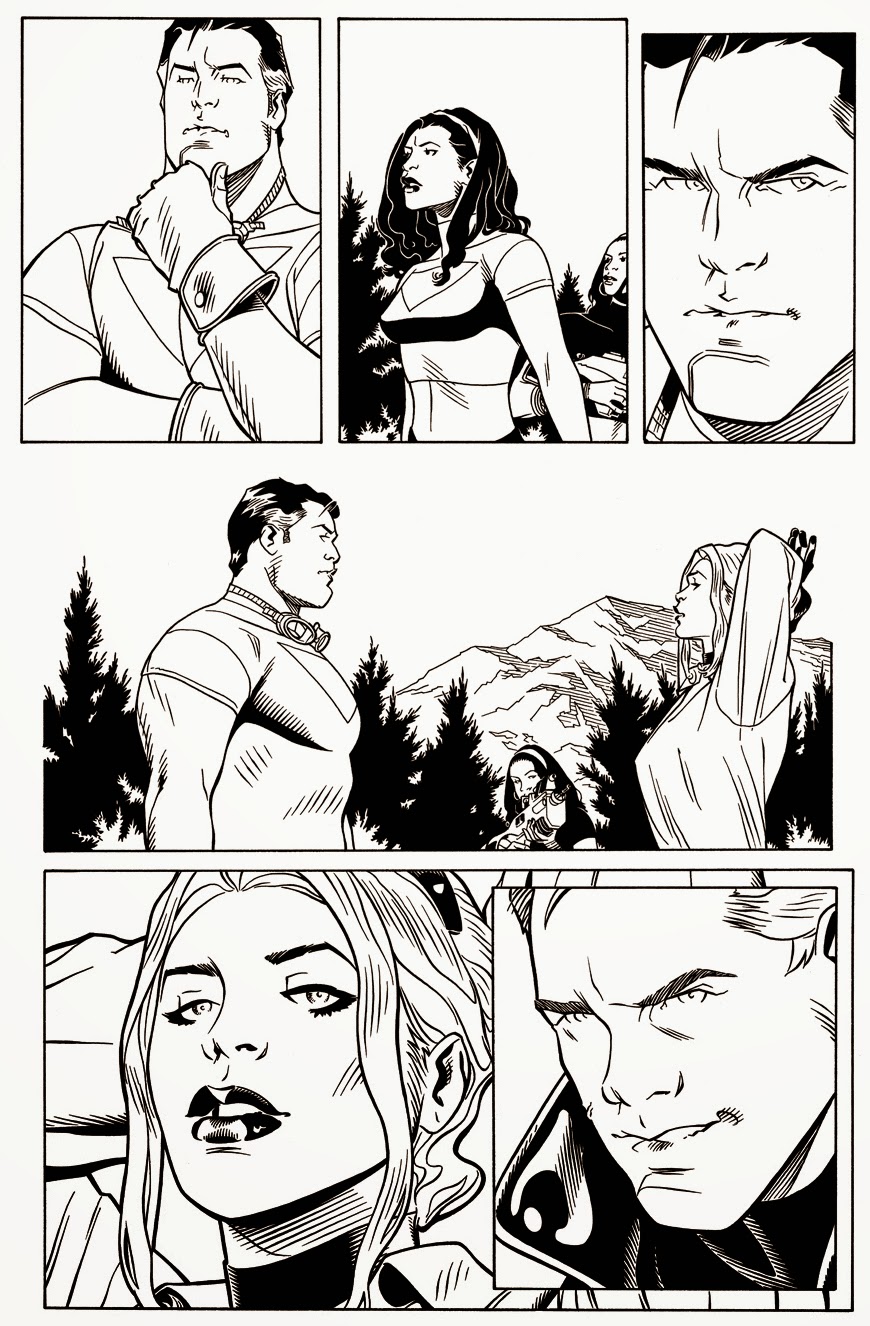
Page 13 from Tom Strong and The Robots of Doom N. 6. Pencils: C. Sprouse. Inks: K. Story.
We are talking about comics which means… drawings and storytelling, of course. So… what about your collaborative relationship with artist and co-creator Chris Sprouse? I personally think Sprouse’s clean style is the perfect match for Tom Strong being able to create a classic sci-fi atmosphere for the city, the architectures, the machines… and, at the same time, to make the characters act with great naturalness…              
I agree. Tom is Chris’s baby, and he does him better than anyone else. For me, that’s a joy, because I know Chris will always come up with the goods and I can just trust him to get on with it. Hopefully Chris feels the same way about me! When Wildstorm asked me to revive Tom for Robots Of Doom, none of us were sure if Chris would be able to take part, but I’m very glad that he did.
And I think Chris would be happy to keep on with Tom forever. On my side, I have ideas for at least the next two storylines, so … I just hope they give us the go ahead to do them. 

Now Tom Strong is under the Vertigo label: did this impact in any way on the character and the way you handle him and his stories?
Absolutely not. It was just a change of label, and our editor now is Kristy Quinn, who was the assistant editor on all the ABC titles. I do think it’s a shame that they didn’t keep the ABC name on it, just because, but … it was their call. They probably felt you couldn’t have a comics line with just one comic in it. 

The Planet of Peril is still unpublished in Italy. I read the original issues but I don’t want to spoil any bit of the story… so, can you reveal anything about it for the Italian readers?
It sort of grew out of the fact that the last time we saw Tesla in Robots of Doom she’d just announced that she was pregnant. Which I thought was just a nice thing to do, to have Tom becoming a grandfather – and curiously, it also coincided with Alan becoming a grandfather ! Anyway, when it came time to think of a follow-up story it occurred to me that the pregnancy might actually be a dangerous situation for Tesla, since her husband is a fire-being. It could be life-threatening.
So what might save her ? I came to the same conclusion that Tom does in the story, and that leads him to travel to Terra Obscura. Since I’d wanted to go back there anyway, and this allowed me to do it, I was delighted. But it’s a VERY dark story, because Terra Obscura is in the middle of a crisis where millions of people are dying. So there’s no big villain here, and it’s basically a story about death and how people deal with it. People who were expecting a more conventional superhero adventure didn’t really get it, but the people who were a bit more open-minded seemed to really love it. Anyway, it does have a happy ending, and I’m very proud of it.
Terra Obscura volume. Cover by Janick Paquette. Ink: Karl Story.
You and Alan Moore. This is an obvious question for you, probably one you answered several times in the past… So, how did you collaborate with Moore on previous stories and… did you “consult” him, or ask him any “support” or “comment” on the new mini-series you wrote “solo”?
Well, with Terra Obscura it was a full collaboration – Alan and I sat face to face and thrashed out the plots, and then I went home and wrote the scripts. With the other ABC stuff, like the early Tom stories, we’d chat on the phone and sometimes he’d suggest things, but mostly it was me asking him questions about backstory and so on.
Then when Wildstorm asked me if I’d revive Tom a few years later, it was completely conditional on Alan being okay with the idea. So I rang him up, and fortunately for me he was happy for me to carry on. But there was kind of an implicit understanding that I was on my own from then on, and shouldn’t bother him about it at all. So from that point on it’s been just me.

What did happen to America’s Best Comics: A to Z? Will we ever see the two remaining planned issues?
I very much doubt it. They just cancelled the whole thing halfway through. The only one of mine that never appeared was the entry on Smax, which was the weakest one I wrote by far, so I’m not that sorry that it never came out. The remainder of those issues would have been written by Steve Moore, and that is a loss … I would have absolutely loved to see what Steve might have done with Promethea, but I don’t know if he even wrote a word of it before they cancelled the series. If he did, maybe it’ll surface after all his papers have been gone through.
The whole A-Z thing was weird. It was basically Alan’s idea. He was finishing up his last couple of issues for ABC, and so I think he envisioned this series as a way of rebooting the line, giving Wildstorm a springboard from which to relaunch all the titles. Looked at in that light, it makes perfect sense, whereas if Wildstorm already knew that they were going to shut the ABC line down it made no sense at all – but I think that was actually the case.
They just wouldn’t discuss future plans at all, and that had been the case for months and months before the A-Z series even got under way, so it’s not like it was the poor sales of that which made up their minds. I think they’d just decided to shut it all down the second Alan walked out the door … which is kind of understandable, but I think they could have made it work without him if they’d actually thought about it. They made a LOT of bad decisions back then. 

Any desire to do something with the other ABC’s characters, under the hypothesis that it could be something possible? Personally I think you could write a great Top Ten run…
Well, I did get to do Top Ten – and a lot of the other ABC characters – in the A-Z series … but any more than that isn’t very likely. They haven’t even let Zander Cannon finish his run on the title, and I really wish they would. I was thoroughly enjoying it, and I know I’m not the only one.
Right now I’m waiting for them to agree to another series of Tom, which is my first priority. After that, I’d also like to do another series of Terra Obscura … and the only other character that might really tempt me beyond that is Jonni Future. If they ever ask me, we’ll see. 
Steve Parkhouse's cover for Resident Alien N. 0.
You are also writing an interesting comic for Dark Horse titled Resident Alien, with art by Steve Parkhouse. Can you say something about it? I read that Parkhouse provided the initial impetus for the series…
Yeah, that’s true. I’d worked with Steve before, and wanted to work with him again, and he’d said that he’d like to do something that involved aliens. Resident Alien is what I came up with, and it’s about an alien who’s shipwrecked here, waiting for a rescue ship that might never come. He’s been laying low, and masquerading as a doctor … and even though we show him as an alien throughout the whole story, it’s clear from other people’s reactions that everyone he encounters sees him as being human.
Anyway, when the local town’s doctor gets murdered, they ask him to help out. And he likes being a part of the town, and gets hooked on solving crimes … So, the movie pitch would probably be : alien detective. That’s pretty much all you need to know. The second series is just about to come out in trade paperback, Steve’s currently drawing the third series and I’m halfway through writing the fourth. We plan to be doing this for a while !

From your privileged perspective, what is your perception of comics today, both as a medium and as an industry?
As a medium it remains as fantastic as it ever was, and I think that will endure indefinitely, whatever effect technology has upon how people read.
As an industry it seems to be right in the middle of some big changes, and some of those changes are exciting and some of them are a little scary. We have far more publishers around now, and ones who are open to a wider range of ideas and genres, and that’s a very good thing – especially since the Big Two seem far less adventurous these days than they have been in the past. I’m reminded of dinosaurs, and I wish I wasn’t.
The industry will change, that’s the only thing that’s for certain, but … I wouldn’t want to place any bets on how ! Just so long as we can still create comics AND make a living, it’ll all be okay.

What about your future projects?
More Resident Alien, for sure. Right now I'm just putting together a proposal for a graphic novel, which I hope I can find a home for. And, as you know, I've done a short story for Electricomics.
Electricomics' people at work.
And... exactly, what is Electricomics?
It's an anthology of short stories written especially with electronic gizmos - things like tablets - in mind. Alan Moore rang me up about this nearly three years ago, and asked me if I'd like to take part. It's taken that long to get the project off the ground. The idea is basically to try and come up with stories that take advantage of an electronic medium, that couldn't be told the same way in print. So ... it's kind of an experiment, and was very challenging to write.

Can you also reveal us any detail about Cabaret Amygdala your contribution to it announced as "modernist horror"?
Well, it's actually called Cabaret Amygdala Presents ... Second Sight. Cabaret Amygdala was Alan's title, which I thought would make a good umbrella concept, like The Twilight Zone. Anyway, Alan asked me to come up with a horror story that would make people feel ... uneasy. It's not standard supernatural horror at all, because I can't really relate to that. There are aspects of the supernatural that I believe in, like ghosts, but I'm not at all scared of them. And most other aspects - the devil, vampires and so on - I just think are ludicrous, and also well past their sell by date. With this story I pulled together a couple of concepts that I personally find kind of creepy, and I hope other people will feel the same way.

Thank you Peter for your time and the great answers.

Italian version: here.

Mar 24, 2014

The Bojeffries Saga: Alan Moore masterpiece of 2014

Warrior N. 12, the first appearance of  The Bojeffries. Cover art by Steve Parkhouse.
"I’d say that The Bojeffries Saga is undoubtedly the funniest of Moore’s writing, elegantly and comedically matched by the fluid stylings of Steve Parkhouse. But more than that I reckon it’s one of his very best.
Funnier than the hilarious D.R. & Quinch? Definitely. Better than Watchmen? Oh yes. Better than V For Vendetta? Yep. Better than Miracleman? Without question. Better than From Hell? Hmm… depends on my mood, but right up there." [Richard Bruton, Forbidden Planet blog]

The volume has been recently reprinted, with new material included in, by Top Shelf and Knockabout.

Dec 25, 2013

The Bojeffries are... back!

Art by Steve Parkhouse.
Next February a collected edition of The Bojeffries Saga - the comedy series which debuted in Warrior in 1983 and ran through until 1991, written by Moore and drawn by Steve Parkhouse - will be finally available thanks to the joint effort of the US and UK’s publishers Top Shelf and Knockabout.
The 96-page softcover volume will contain all the previously published stories and an all-new episode bringing The Bojeffries up to the present day. Don't miss it!
Cover of the collected edition. Art by Steve Parkhouse.
Info about the book can be read at Top Shelf website: here.
More Bojeffries here.

May 16, 2013

AM Portrait: Sex, Vampire and Christmas Shopping

Alan Moore and The Bojeffries. By Steve Parkhouse.
The great Steve Parkhouse contributed to the now sold-out Alan Moore: Portrait of an Extraordinary Gentleman (2003, Abiogenesis Press) with two pieces: an amazing illustration featuring Moore and the beloved Bojeffries (above, at page 84 in the original volume) and a short text (page 83, 85 and 86) - that you can read in the following - full of memories about his collaboration with the Writer from Northampton.

A special thank to the author for his permission to post them on this blog.

Sex, Vampire and Christmas Shopping
© Steve Parkhouse

I first met Alan Moore in 1971. He was about sixteen or seventeen at the time, and I was five years older. I’d just started working at IPC Magazines as a comics sub-editor on titles such as Whizzer and Chips and Buster and mysteriously named prototypes like JNP 49.
Though professing to be producing new comics all the time, IPC Juveniles were simply regurgitating ideas that were fifty years old. Recycling was the name of the game. Editorial staff were paid next to nothing, installed in draughty old buildings with creaking office furniture and expected to co-exist with the rats, the debris and the general malaise of Farringdon Street and its depressing environs.
It was a cottage industry; inhabited by middle-aged men in cardigans who smoked pipes. You could see them in the works canteen, spooning down vast quantities of jam roly-poly and custard while discussing the latest developments in model aircraft design. The very suggestion of producing something new in the comics field would be met with glazed and vacant incredulity.
In this world, Dan Dare was the apotheosis of comics creation. The Eagle comic was the altar upon which everything else was sacrificed. There was another company somewhere in Scotland, in the heathen land beyond the Wall where another clutch of juveniles was being produced by middle-aged men in cardigans and pipes. They had different titles, but were basically the same.

Sitting across from him at the table of a small café, just around the corner from the Bookends bookshop in West London, I was struck by Alan’s demeanour. He was very, very young – but very, very funny. He was undeniably a performer. Very quick, irreverant and totally refreshing.

For the next three years I was engaged in the regurgitation of fifty-year old material, until finally I could stand it no longer and quit. I had occasional glimpses of Alan’s work – or the odd message conveyed through Steve Moore – another IPC sub-editor – who’d been a long standing friend of Alan’s. But we never actually met again until ten years later.

In the interim, I had learned something of the craft of storytelling. I could draw a cartoon or two in about half a dozen styles – and was ploughing a strange and somewhat lonely furrow as a freelance illustrator. I had kept various contacts since IPC days – the most notable being Dez Skinn and Paul Neary, both of whom had been involved in setting up a British office for Marvel Comics. Everybody talked a lot about doing something new. Every time comics people get together, beer flows with the conversation and great, majestic vistas unfold of unlimited creativity. There’s invariably a wistful edge to these conversations – largely because people recognise the fact that comics have never been a true part of British culture. Comics are, and always have been, regarded as children’s entertainment and are consequently marginalised in the national psyche.

So, in the early Eighties, when Dez Skinn commissioned me to start work on a new title called Warrior – I assumed it was another pipe-dream.

I managed to cook up a few things to keep my interest going, but I was totally unprepared for what was to come. And what was to come was Marvelman.

Drawing for a living is a strange occupation. People outside the business assume that it’s an “interesting” job, maybe full of bizarre characters and exciting situations. That’s only partially true. For the most part, drawing comics, like everything else, consists of hard graft and uninteresting chores. Inking, to name but one. The joy of the work is in the original creation, telling the story with rough pencilling work. Getting the artwork “camera ready” is the tedious part, often involving disappointment and lots of reworking.
During the long, isolated and sometimes stressful hours, one’s mind turns to the whole question of “why we do it.”
For the most part, we are working on flimsy fantasies, peopled by two-dimensional characters speaking ridiculous dialogue dreamed up by ten-a-penny hacks. At their best, comics are mildly entertaining kitsch. At worst…well, at worst they’re simply tomorrow’s wood pulp.

When the first few issues of Warrior were in preparation, I was visiting Dez Skinn’s editorial bullpit on a regular basis. On one occasion I walked into Dez’s office to find a very large man with a very large beard looking at some of my artwork. He introduced himself as Alan Moore – and we briefly reminisced about our first meeting. We also went into the time-honoured routine of: We Must Work Together Some Time. Yeh, right.

As I went on my way, I had no idea that Alan was the kind of person who actualises things. Whether his motivation springs from some inner hunger (especially at that time) or a genuine wellspring of creativity, we have never discussed. I guess it’s a large portion of both – and an excelent balance it is. But nevertheless, within a very short time Alan presented me with a choice of three different scenarios that he’d been working on.

Now here’s the really strange part. Here there is a risk of wandering into thickly-wooded hinterlands of esoteric musings. We had agreed to do something funny. We had agreed that Mad magazine had more or less monopolised comics humour for far too long. I had  been working on an extraordinarily dark and difficult piece called Spiral Path, my attempt to put together a totally un-scripted comic. I was exhausted. I was suffering from hallucinations and nightmares. My house was haunted, one of my oldest friends had been abducted by aliens, and my cat had been run over by a tractor.
I was longing to draw cartoons again. I had a vague notion of domestic humour with a strongly surreal twist. When the Bojeffries Saga appeared in the post, it was the beginning of a healing process for me that has spanned many years.
This was a script written by a person who had experienced many trials and tribulations. Though still young, he was a parent of girls (like me) He was a performer, a poet, a songwriter…a voracious reader (like me)…a person of seemingly vast eclectic knowledge (I wish). He was undeniably a dreamer (like me)…in fact we shared the same dreams, literally. And yet he had a grasp of the human drama that revealed a huge undertow of compassion and understanding. There was no cynicism, only affection.
In subsequent scripts, he displayed the peculiar talent that almost every other collaborating artist finds agreement with: the ability to write exactly what the artist wants to draw.
Even though he confessed that sometimes every phrase of the Bojeffries had to be chiselled from granite, he never compromised on quality or commitment. And that involvement made The Bojeffries an unparalleled joy for me to work on.

Like all the best magicians, Alan brings forth ideas from the cornucopia of his mind with a flourish and a panache that disguises the hard work beneath. His power to amaze us conceals an equally amazing feat:  these are no flimsy fantasies. They may be fantastical, but at no time does he stray from his true task of illuminating the human condition. His stories are invariably written from the experience of a life truly lived, with a human scale and dimension woven through them like a thread of gold.

And in the case of the Bojeffries, they are very, very funny.

I confess, I read the first three issues of Warrior with a sinking heart. The power and potency and absolute “adultness” of Marvelman was blowing everything else away. Alan had stepped from the wings with a prodigious talent, and like a grown-up amongst so many children had simply shown us the way.
He seemed to bring a novelist’s sensibility to the craft of writing comics, but in a way that no novelist has ever managed to achieve. He had arrived at exactly the right time, when comics were floundering in a swamp of their own making. We all wanted something new, but nobody had the road map. It had occurred to very few people that maybe comics should be about life as we know it, based on our own experiences. I suspect this is because the milieu of comics seems permanently adolescent in nature.
I know that Alan’s writing encouraged me to draw from a different perspective. To observe from life – the life I saw around me, rather than aping the techniques of established artists.
As more issues of Warrior appeared, my heart stopped sinking and I relaxed into simply acknowledging the emergence of a gifted and inspirational writer.
Through the combined efforts of Dez Skinn and the writers and artists of Warrior, the doors of the cottage industry had been well and truly breached. Battered down, in fact.
There are still those pipe-dreamers who wait patiently for the resurrection of the Eagle.
But I don’t think it’s gonna happen.

The old paradigm has gone.

Alan Moore has seen to it.

Steve Parkhouse
Carlisle, Cumbria
October 2002