Showing posts with label 2002. Show all posts

Aug 27, 2025

Rorschach by Mike Kaluta

Art by M. Kaluta
Above, a Rorschach illustration penciled by the great Mike Kaluta back in 2002! 
For more info about the piece, visit the Romitaman gallery: here

Jun 10, 2022

Love advice for Nicolas Cage... well, sort of...

Alan Moore interviewed at his home in Northampton, England in early 2002 for Hotdog Magazine.
Alan Moore: [...] I do get some funny phone calls. Nicolas Cage phoned me up a few times because he likes my stuff. He seems nice enough, but the phoned me once to ask me for advice on his love life. It must be a lonely existence being a film star.
He was asking me if he should choose this girl over another girl he was seeing.
I just said, "I don't know." But I thing it worked out happily because he's not needed my advice since.

The complete interview is available HERE

Jan 28, 2021

Zander Cannon on Moore

In the past days, I found this text on my archive. I guess it's dated 2002. 
By comic book artist ZANDER CANNON.

From www.zandercannon.com (the site in not online anymore, sm)
What's it like working with Alan Moore?
Zander Cannon: The thing about Alan Moore's work that people usually notice is that it's easy to read. Alan has mentioned to me that he likes his scripts to be "artist-proof", a survival technique from his days at 2000 AD, when he would have no idea who would be drawing the next story that he wrote. For that reason, the scripts oftentimes seem as if Alan is hedging his bets (mentioning characters by name more often, describing an object that everyone is already looking at, commenting on the current plot development an extra couple times, etc). There are also unbelievably long descriptions for every panel on every page. He will almost always say where in the panel everything is located, including placing the characters in the same order as their word balloons. The bottom line is: Alan Moore has covered his bottom line. The story is readable almost no matter what. The real advantage to that is that as an artist getting this script, you are free (insofar as Alan Moore cares) to do whatever you want. As long as you get the basic gist of what's described in the panel, the word balloons will pick up the slack. I try very hard in my comics to make them as readable as possible and not rely on these devices, but sometimes when five things need to be happening at once, I'm awfully glad they're there. As far as what Alan is like as a person, he's awfully friendly to talk with (on the phone; I've never met him face to face), and he's enthusiastic as heck about telling stories (sometimes a smidge irritated about comics in general). He's told me some terrific anecdotes; I highly recommend working with him if you ever get the chance.

Nov 29, 2020

Tom Strong sketch by Dave Gibbons

Above, a quick pen sketch of Tom Strong by Dave Gibbons realized in 2002 during Bristol Comic Festival.

Oct 26, 2020

John Constantine by Warren Pleece

Art by Warren Pleece.
Above, an intense Constantine pencil sketch by British comic book illustrator WARREN PLEECE. It was a great gift for me during Bristol Comic Festival 2002.

For more info about Warren Pleece visit his site: here.

Oct 4, 2020

John Dee: a living and progressive force

Fossil Angel. Art by Marjorie Cameron.
Excerpt from Fossil Angels, an article about Magic written by Moore in 2002, intended for Kaos magazine n.15, which was never published. 
The article is available at Glycon Journal with Moore's permission: HERE and HERE.
John Dee, conversely, was perhaps more wilfully awake than any other person of his day. More focussed and more purposeful. He did not need to search for antecedents in the fictions and mythologies available to him, because John Dee was in no sense pretending, was not playing games. He inspired, rather than was inspired by, the great magic fictions of his times. Shakespeare’s Prospero. Marlow’s Faust. Ben Johnson’s piss-taking The Alchemist. Dee’s magic was a living and progressive force, entirely of its moment, rather than some stuffed and extinct specimen, no longer extant save in histories or fairytales. His was a fresh, rip-roaring chapter, written entirely in the present tense, of the ongoing magical adventure. By comparison, the occultists that followed some three centuries down the line were an elaborate appendix, or perhaps a bibliography, after the fact. A preservation league, lip-synching dead men’s rituals. Cover versions. Sorcerous karaoke. Magic, having given up or had usurped its social function, having lost its raison d’etre, its crowd-pulling star turn, found itself with just the empty theatre, the mysterious curtains. Dusty hampers of forgotten frocks, unfathomable props from cancelled dramas. Lacking a defined role, grown uncertain of its motivations, magic seems to have had no recourse save sticking doggedly to the established script, enshrining each last cough and gesture, the by-now hollow performance freeze-dried, shrink-wrapped; artfully repackaging itself for English Heritage. [Alan Moore]

Sep 28, 2020

Nite Owl by Duncan Fegredo

Above, a great Nite Owl II sketch by British Master artist DUNCAN FEGREDO. He did it for me during Bristol Comic Festival 2002. Those were the days!

For more info about FEGREDO visit his site: here.

Apr 26, 2020

Lost CD game with Dave Gibbons

Art by DAVE GIBBONS.
Excerpt from an interview with DAVE GIBBONS that I did in collaboration with my friend Antonio Solinas in 2007. Originally printed in Italy on Lezioni di Fumetto: Dave Gibbons (October 2008, Coniglio Editore). The complete interview is available HERE.
Some years ago, maybe it was Bristol Con 2002, you told me about a huge project you were developing with Alan Moore. Any chances that it could materialize, or would you say it is a lost project?
Dave Gibbons:
Alan and I have always enjoyed collaborating and I think we both have done some of our best works when we have collaborated. The thing we did talk about for a little while, and this was a while ago, this was in the late 90’s, was the idea of doing something on a kind of a CD game, a computer game… to use their abilities to weave complex worlds and try new kind of storytelling techniques, where there were alternate storylines. We kicked the idea around for a while and put some thought into it but I think what we eventually realized was that we were getting into something that would probably be as fraught with problems as, say, doing a movie, and also into something that we didn’t completely understand or hadn’t completely grown up with.
Computer games nowadays are as big business as movies and therefore there are huge amounts of money involved, which means that the are huge amounts of people that want protect investments and want to maximise profits, so I think we would actually find ourselves in a situation of really just doing some kind of treatment or outline for a movie and then having it taken completely out of our hands. Also, as I said, there was a certain lack of experience in the medium. I mean, I know people in the game industry, and they have the same kind of passion and encyclopaedic knowledge of computer games that us comics fans have of comics. Certainly, I watched my son play computer games, I have dabbled myself, but I am not an expert: I would not know what a state-of-the-art computer game is.
So that faded away, and obviously Alan has got projects that he is working on and he is very enthusiastic about. As you might know, he is writing a novel called Jerusalem at the moment, which sounds fantastic, and I wouldn’t want to take him away from that, even if he wanted to be taken away from it [laughs].
So, we have no plans to do anything in the future but, who knows, when the stars are in the right position, something could happen.

Mar 23, 2020

Promethea by José Villarrubia

Art by José Villarrubia.
Above, a fantastic Promethea sketch that José Villarrubia drew for me during Bristol Con 2002.

Villarrubia is a stunning multi-talented artist, well known in the comic book industry for his amazing work as colorist. With Alan Moore, he has produced two illustrated books, Voice of the Fire and The Mirror of Love, both published by Top Shelf Productions.

Feb 25, 2020

DAILY MOORE [25]

Art by Melinda Gebbie.
From: This is information.
First edition: in "9-11 Artists respond" Vol.1 (2002, Dark Horse).

Feb 10, 2020

V by Michael Avon Oeming

Art by Michael Avon Oeming.
Above, a fantastic illustration drawn by Master of black & white MICHAEL AVON OEMING as contribution to the sold-out Alan Moore: Portrait of an Extraordinary Gentleman published in 2003 by Abiogenesis Press.
For more info about Michael Avon Oeming, visit his site HERE.

Sep 9, 2017

Warren Ellis reviews Alan Moore

Warren Ellis. Photograph by Ellen J Rogers.
Years ago, acclaimed comic book writer and novelist WARREN ELLIS wrote some reviews on Alan Moore's works for Artbomb.net, a site he co-founded. Excerpts are shown below.

Alan Moore's Magic Words: "[...] Not the same as an Alan Moore comic per se, since the artists are doing their own sequential-art interpretations of his songs, but, frankly, any Alan Moore writing is better than no Alan Moore writing. [...]"

The Birth Caul: [...] It's about magic. It's about invocation of something, about a shaman's conversation with the great and secret things lurking at the back of their own brain, about the genetic incantations of the vast skein of life we're brought out into in our silvered veils. [...] This is where Alan Moore's power has been hiding. Listen."

A Small Killing: "[...] It is, perhaps, more a song than the huge symphonies we've come to expect from Moore. But it is a very personal, tremendously affecting piece of work, and a keystone in his body of writing. [...]"

Snakes & Ladders: [...] This, as well as the cave, is where Alan, as a practising magician, does his workings: art as magic and magic as art. [...]"

All the reviews written by Warren Ellis for Artbomb.net are available HERE.

Feb 22, 2017

The music of Alan Moore (in 2002)

Excerpt from a small interview published in Mojo magazine N.99, February 2002. 

[...] Mojo: What, if push comes to shove, is your all-time favourite album? 
"The Humors of..." by Lewis Furey. He’s an American artist who did a couple of albums, "Lewis Furey", and "The Humors of Lewis Furey". He was obviously influenced by the David Bowie glam scene, disco and leftfield Brecht stuff. 

[...] Mojo: What do you sing in the shower? 
Alan Moore: Most of my house is a hovel, but my bathroom is like something Alexander the Great would soak in. l was doing The Smiths yesterday, "How Soon ls Now?" l also tend to find meself doing Elvis Costello, Warren Zevon - it was "Roland the Headless Thompson Gunner" a couple of days ago.

Dec 8, 2016

Supernatural powers

Excerpt from the fantastic interview entitled "The Craft", conducted in two part by Daniel Whiston in 2002 and published on the Engine Comics website. It is now available HERE.

Daniel Whiston: [...] A couple of creative people, one a musician, the other a writer – Steven King and Shane MacGowan – have both made very similar comments about the fact that they discover what they do rather than create it from within themselves, necessarily. I think Stephen King's talked about writing as archaeology, finding things together and dusting them down, Shane MacGowan's talked about: “songs are floating in the air, and it's my duty to grab them before some cunt like Paul Simon does”.
Alan Moore: Ha-ha, good point Shane. R.A. Lafferty, when I asked him: “Where do you get ideas from?”, and he said: “Ideas are like pumpkins, they just float through the air, and hit people on the head”. It's a similar idea. I've noticed – and this is an experiment that perhaps a lot of other writers could try: start writing upon a subject upon which you don't know very much, or about which you have no opinions. Start writing. You will find that you've not got something perfectly planned in your head and you're writing it down, you'll find that the words are forming practically at your fingertips on the keys of the typewriter, the ideas are forming, ideas that you never had before. Juxtapositions are occurring to you. Your mind goes into a very different state. If you actually notice this – you can write certain different types of prose, which can leave your mind in a state every bit as altered, as say psychedelic drugs.

Because our entire universe is made up of consciousness, we never really experience the universe directly we just experience our consciousness of the universe, our perception of it, so right, our only universe is perception. All of our perceptions are made up of words. You alter the words, you alter the perception, you alter the universe. And if you actually look back you come, as I did, to a point where craft no longer really cuts it, where you want something more than craft. Yes, you know skilful ways of persuading people to your argument or things like that, but that's not good enough. That is when you come up against a point like I did. Where I started to look at the archaic notions of writing. Not writing theory as it is now – let's look at what writing used to be. And of course, if you start looking at it, after a while it's obvious that writing must have had its origins in magic, in that anyone who'd got command of written language, would have had supernatural powers.

Oct 28, 2016

The Sopranos, The Simpsons and South Park

Excerpt from an interview published in Wizard magazine N. 130, July 2002

What about American television?
Alan Moore: "The Sopranos" is the best thing that's come out of American television that I can remember. Most television I can't stand it... I don't watch hardly any television at all. Sort of "Ally McBeal", "Frasier", "Buffy the vampire Slayer", "Dr. Who", "Star Trek", "Babylon 5" --- all of this stuff I just cannot be bothered with it. "The Sopranos" on the other hand is actually well-written. It gas wonderful characterization. The episodes, for the most part, are incredibly well-directed. I think over these three seasons, the standard has been maintained wonderfully. Since "Twin Peaks", it's the first American dramatic show that I've enjoyed. That's not to say I haven't enjoyed "The Simpsons" or "South Park" or some of the generally very, very good American cartoon shows.

I wouldn't have associated you with "The Simpsons" or "South Park".
Alan Moore: Oh well, you know it's not all gloom and doom at Moore Mansion [chuckles]. I think "The Simpsons" is very good because it is kept at a wonderful standard of craft and comedy for a very, very ling time. And it is subversive. I think sometimes because it has been around for so long, we forget how subversive [it is]. "South Park", I've got to say, my hat's off to them as well. I mean, considering it is mainly fart jokes and sort of gay jokes and all the rest of it. I think they manage to really push the line quite seriously for American television. They take the stories into all of these really uncomfortable areas. You're certain they're not going to be able to get away without severely embarrassing themselves, but they do.

Jun 13, 2015

skimpy script

Swampmen cover by Frank Cho.
Excerpt from the interview included in COMIC BOOK CREATOR #6 presents SWAMPMEN: MUCK-MONSTERS AND THEIR MAKERS (page 135, Twomorrows, 2014).
The interview was conducted by Jon B. Cooke & George Khoury in May 2002. 

I know that I've been notorious or famous for doing those very long scripts. When I went back to look at the first "Marvelman" script, I was shocked. How did I ever get away with this skimpy script? These descriptions are barely a paragraph long! Some of the panel descriptions are a few lines. These days, say Promethea, that's going to be a 48 pages of type for a 24-page comic, and there have been some like the Moebius strip page in Promethea #15 where the script was 10 pages of manuscript describing it, because it was very complex. I can imagine that my scripts were a lot longer than what DC was used to. [Alan Moore]

Mar 12, 2015

Moore on Strangehaven

From Strangehaven N. 14 (Abiogenesis, 2002) back cover:

A darkly glittering example of the soap opera noir, Gary Spencer Millidge’s Strangehaven is an occasionally-opening portal into a beautifully realised otherworld, a plane all the more intriguing and sinister for its resemblance to our own mundane territories.
Perfectly controlled and naturalistic storytelling creates a wraparound illusion of the everyday in which surreal and threatening incidents are studded like unnerving little jewels.
Gary Millidge is a consummate craftsman, a watchmaker patiently constructing his own unique universe.
For a passport to a planet of unsettling delights that writhe beneath the surface of the ordinary, I strongly recommend that you attempt to be there when the portal next opens. [Alan Moore]

Strangehaven is the cult-series written and drawn by Gary Spencer Millidge.
The new episodes are currently serialized in Meanwhile... anthology published by Soaring Penguin Press.

Nov 23, 2014

Chris Weston talks about Moore

A sketch of Allan Quatermain drawn by Chris Weston at Bristol Con 2003.
The following contribution written by amazing comics artist Chris Weston was originally published in Ultrazine's Alan Moore Special in 2002.

Chris Weston: So what have I got to say about Alan Moore? Not much. Never worked with him; never met him; haven't even read an interview by him. Let's face it, I'm the wrong person to be writing about him, really. He looks like a big hippy bastard and I'm told he smokes too much dope, apparently. I don't know anything else about his private life. Nothing. And I wouldn't have it any other way! "There shouldn't be artists, only their works." Orson Welles once said. I couldn't agree more. In this new millennium, Celebrity is no longer just a Cult; it's a bloody Craze! It's poisoned every single popular art-form I can think of, including comics. I don't need to tell you about all the so-called "big-name" writers who put so much time and effort into promoting themselves, they actually forget to sit down and write some decent stories.
Worse than that, there's even gossip columns devoted to the activities of comics creators... that has got to be the most ridiculous idea I've ever heard.

I don't know if Alan Moore has his own website, and I couldn't give a toss if he did. All I know is I've never heard of one, so I'm going to assume he spends all his valuable time on his craft: writing comics. Funny ones like "D.R. and Quinch". Ground-breaking ones like "Watchmen". Moving ones like "Halo Jones". Traditional ones like "Tom Strong". Shit, I'm not going to reel off his whole back catalogue; we all know his work and its brilliance. But nothing about the man, please!

I will let you know which Alan Moore book is my own personal favourite, though: it's gotta be "The League of Extraordinary Gentlemen"! The single most charming publication in the whole history of comics!

Apr 22, 2014

Will Eisner and Alan Moore

Art by Will Eisner.
From Alan Moore: Portrait of an Extraordinary Gentleman book (2003, Abiogenesis Press, page 6).

Above, you can admire the incredible contribution to the volume drawn by comics Legend WILL EISNER. I confess I was really really stunned when I first saw the illustration: an amazing and heartfelt piece from one of the greatest and most innovative comic book Artists of all time.

Mar 11, 2013

AM Portrait: Moore Morality

Alan Moore as Tom Strong by Dylan Horrocks.
In the following you can read a piece originally written in 2002 by New Zealand comics artist and writer Dylan Horrocks, included in Alan Moore: Portrait of an Extraordinary Gentleman book (2003, Abiogenesis Press, page 75).

Posted on this blog with the author's permission.

Moore Morality

I still remember the first time I noticed Alan Moore's name. I was 15 or 16 and an avid reader of the British weekly comic 2000AD, which I would pick up every Thursday on the way home and happily lose myself in for half an hour with an after-school snack. This must have been around 1982, because ET was going great guns at the boxoffice and I guess the editors of 2000AD wanted to cash in on that with a cheap imitation of their own. To their credit they gave the job to Alan Moore. The resulting serial was called SKIZZ and by the end of the first episode I knew this was much more than a cheap Spielberg ripoff. I looked up the name of the writer (or 'script droid' as 2000AD wryly put it) who'd taken such a lame brief and turned it into a tense, funny, moving and politically provocative story (complete with witty references to Alan Bleasdale's searing indictment of the unemployment-economy, "Boys from the Blackstuff"). It was an easy name to remember: "Alan Moore". Before long, it was a name no-one could ignore.

American fans usually view "Swamp Thing" and "Watchmen" as Moore's breakthrough stories - the books with which he changed comics forever. Personally, I'm struck by how the key elements of what makes Moore so special are there from the very beginning: the ability to take a trashy formula or forgettable character and shape them into something fresh, profound and beautiful - while at the same time managing to impart a genuinely respectful sense of what was precious about the original. The humour, the literacy, the intelligent political analysis, the technical virtuosity, the sincerity and warmth. And above all (for me), a deep and genuine moral core to his work.

I don't think it's possible to overstate how influential Alan Moore's work has been in the English-speaking comics world. I still hear echoes of "Marvelman" in almost every superhero comic I pick up these days - usually pale, shallow echoes, but they're there nonetheless (and don't get me started on "Watchmen"). "Swamp Thing" effectively gave birth to the entire body of work known as Vertigo Comics (though it's still better than any of them). And now ABC Comics is hauling the mainstream comic in a whole new direction again - actually in two or three new directions (and how many retro-styled tribute covers have we seen since "Promethea" and "Tom Strong" started the trend?).

The extent of this influence is our blessing and Moore's curse. A curse because most of the work that has come in his wake has stolen some superficial elements of Moore's narrative style or tone, while failing to notice what makes his comics REALLY good. Because by trying to make mainstream comics grow up, all he managed (in many cases) was to push them into a rowdy, obnoxious, pretentious adolescence. I love the fact that now, with "Tom Strong", Moore is gently leading us back to childhood again.

But as influential as Moore has and continues to be, that's not what really makes me love his work. It's the work itself. From odd forgotten 80s gems like "Captain Britain" to the phenomenal "From Hell", from ephemeral humour strips like "The Bojeffries Saga" to the deeply serious political manifesto "V for Vendetta", from accessible 'mainstream' adventure stories like "Tom Strong" to the labyrinthine, intensely personal "Birth Caul", Moore's work is always a masterpiece. Sure - he's one of the greatest craftspeople we've ever had. But even that's not the real issue for me.
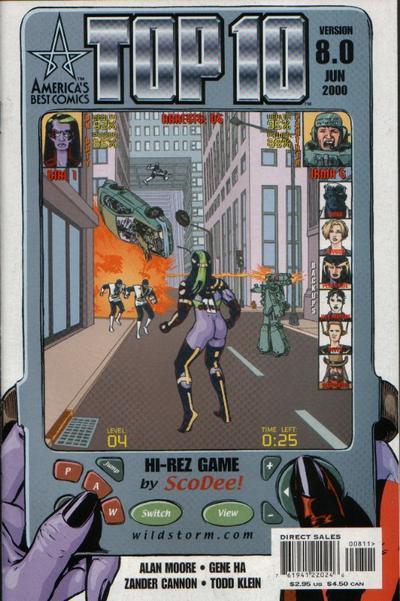
Top Ten N.8 cover by Gene Ha.
Let me tell you about the moment I realised just how lucky we are to have him in our strange little literary ghetto. You remember the issue of "Top Ten" when there's been an accident at a teleportation pad? Much of that issue consists of one of our heroes sitting with two of the accident's victims as they slowly die. They talk, they cry, they struggle with fear, they wait for the inevitable. This came as something of a surprise to me, since the previous issues of "Top Ten" had basically been an entertaining and playful spin on TV cop shows. Suddenly, out of the blue - this! At first, I even thought Moore had inserted the incident as black comedy - which seemed uncharacteristically callous of him. But as the issue unfolded, I realised - with that shiver up the spine I associate with so much of Moore's work - that he was putting me through something much worse - and much more valuable. I don't know if this issue was written out of the same impulse that led to "The Birth Caul," but it had the same effect on me. By the last page, I was in tears. It was genuinely moving in the way that only the most sincere and meaningful work can be. Moore was facing the reality of death, not unafraid but free of illusions and sentiment. The closest thing to that issue I can think of is the long passage in "War & Peace" where Andrei is dying.

It was impressive, sure - but ultimately I don't give a shit about impressive. I wasn't crying because Moore had written the thing so damn well. I was crying because he'd taken all his own grief and the lessons he'd learnt from it and had distilled them into this crazy little comic about superheroes and interdimensional travel. He'd given us a gift, carefully copied from the scars on his own heart.

That's what I mean when I say that what really makes Alan Moore's work special is its morality. His work is pure and sincere. And utterly, deeply humane. It was clear in SKIZZ and it's clear in everything he's written since. It was radiantly clear in "This is Information" - his contribution to one of the 9-11 benefit books. Moore's story was intelligent, moving and profoundly mature. He even managed to express perfectly my own complex ambivalence towards the American comics industry's response to the events of September 11. Once again, I was grateful to the man who could pull this off - not because it was a good comic; but because he said what someone needed to say.

I don't care if he worships an ancient snake god and summons demons in his spare time. I would trust Alan Moore with my soul. And every time I pick up one of his comics, that's exactly what I do.