Showing posts with label Brazil. Show all posts

Thursday, January 02, 2014

Strange Hostel of Naked Pleasure


Strange Hostel of Naked Pleasure
Original title: A Estranha Hospedaria dos Prazeres
Directed by: Marcelo Motta - (co directed, unaccredited, by José Mojica Marins)
Brazil, 1976
Horror/Surrealism, 81min

After a way to long, but superbly surrealistic, what-the-fucking-fuck opening, crosscutting seductively dancing women dressed in equivoque nightgowns, rhythmic beat club Congo-drumming and screaming shots of naked witches, apes and old wrinkly cronies – all the cheapest possible joke shop masks – this metaphorical stand off between Good and Evil where Coffin Joe stands, resurrected form the dead, yet again! (All of which can be seen in glorious colour below!)
Jose Mojica Marins makes his entrance in his Coffin Joe guise, and he does this for a reason. As customary, he kicks off the movie with some of his trademark philosophical ponderings.

“Live to die or die to live? Is there a correct answer? No! Only doubts! Only deductions. Only the certainty of the emptiness! Loneliness is desperately searching for everything or the nothing in the vastness of the dark. For the answer to this riddle would be the end of the mystery. The end of eternity’s secret, the apogee of happiness, before an accomplished mission because man would be face to face with his biggest conquest, the awakening of the own origin itself.”
Sounds fair right? OK, so his line of thought is not to easy to follow this time around, but you know what, it’s Marins trait, so just listen, take in what you can and who knows, someday you may make a connection or a link or something in what the said may make sense… until then, let’s just roll with it. So far you may be right to presume that this is a Coffin Joe piece, in some ways that’s right, but at the same time, and if you are familiar with his works you will know, that this is the way that most of José Mojica Marins movies start. With some food for thought, an appetizer, a clue to what the theme of the movie will be. Such as his existential ramblings and desire to find a woman fit to birth him a child, as to secure his bloodline, his being, his existence. His mark in time if you want, and definitive traits of the three films that make up the Coffin Joe trilogy: À Mela-noite Levarei Sua Alma (At Midnight I’ll Take Your Soul) 1964, Esta noite Encarnarei no Teu Cadáver (This Night I’ll Possess Your Corpse) 1967 and the final instalment, Encarnação do Demônio (Embodiment of Evil) 2008. Other than those films he merely acted as a presenter, a host, a figure of authority for Brazilian genre film in the same way as Alfred Hitchcock presents, perhaps at his finest in the excellent O Estranho Mundo de Zé do Zaixão (Strange World of Coffin Joe) 1968. From here on, as the main narrative starts, Coffin Joe is out of the movie. From here on Marins plays a complete different character, the landlord of the strange hostel of naked pleasure.
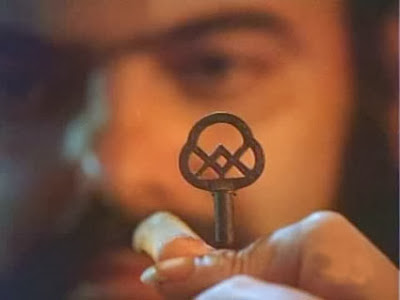
From here on we go to a magnificent space model and a series of even more questions, unanswerable questions, before the story kicks in. It’s Friday the 13th, answering an ad in the paper for position as receptionist at a nearby Hostel several people gather with hopes of finding a job. After being hand picked and hypnotized by the Landlord [Marins] the workers are assigned to attending the “Guests” of the Hostel. One by one the guests of the evening drop in. It’s a real rogues gallery and amongst them we find a gambler, an “adulterous” couple, a suicidal man, a seductive con artist, a biker gang with a lust to party, get high, and laid and a bunch of bandits all pack into the hostel and its many rooms, up to the point where the Landlord has to refuse patrons entry to the hostel.
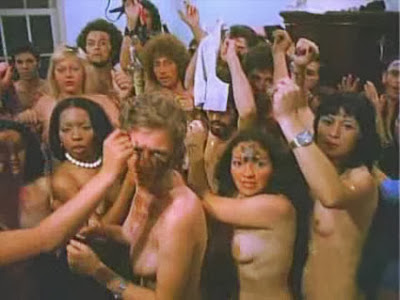
A storm rages outside and finally moral is tested when one of the staff finds a loaded wallet on the floor, but as she stretches out to grab it, it turns into a big terrifying spider. It may be one of the longest build-ups ever, but somewhere around midpoint the biker gang get naked, the adulterous couple start having it off, the gambler makes panic decisions and the bandits start to count their loot!

Well to be honest, the movie really only adds characters to the rooms of the hostel, without any real logic to who the Landlord let’s stay and not. A man who crashes his car get’s out of the wreck and wanders into the lobby. The Landlord rejects him, and despite the man’s stern warning of “Do you not know who I am?” Marins sends him on his way. This tiny of subplots evokes some kind of mini-threat as the man threatens to come back with officials to see to it that the establishment is punished for sending him back out into the rain!
So you have all these patrons going about their business in their respective rooms, shagging, drinking, gambling, wrecking others, and their own, lives… until the clock strikes doom and they are all interrupted, one by one, by the cold hard stare - accompanied by crash edit and screeching audio - of the Landlord, who questions their acts! The suicidal man get’s a second chance after seeing his fate as dead, the con-artist see’s how his ways lead to a deadly triangle, of jealousy and the bandits see how they are shot down in blaze of glory as police gun them down, bikers all have a fatal accident. All of it shown in stylishly surrealism with the most god-awful rendition of Auld Lang Thyme ever warbled out on the soundtrack.

But the real question is… Is the Landlord presenting the guests with foreboding visions of what’s to come, hence giving them the chance to redeem themselves… or is he in fact showing them the terrifying deeds and events that lead them to his little establishment!
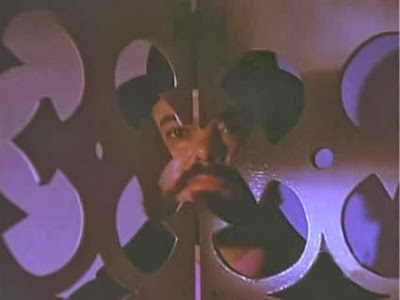
Yes, you guessed it right, as so much of José Mojica Marins world; Strange Hostel of Naked Pleasure is all about symbolism and deeper meaning, the fantastic approach to the subject matters taken by Marins. The hostel is as you probably already figured out a metaphor for purgatory. Hardly surprising and a recurrent theme in all the Coffin Joe movies, the vision of what is to come! The visions we see here, are all renditions of what lead the characters to end up in purgatory, or the strange hostel of naked pleasure – because almost everyone there gets naked at one point other. But it’s not all gloom and doom, one patron, Miriam, is saved as the light comes and summons her out of the hostel.  As she steps towards the psychedelic lights, her name vanishes off the Landlords book of souls as she walks out the door accompanied by a really off kilter rendition of Handel’s Hallelujah.  
Finally, the last string to tie it all together, is pulled. The man from the car accident returns to the scene of the crime along with armed police. They exit the vehicle and the man stares confused off screen. “But it was here… I swear it was here…” he blurts as the coppers laugh at his confusion and explain that the old cemetery has always been there.  The landlord fades in as he walks the cemetery and up to the front porch of the hostel. The Vacancy sign appears and we understand that all’s set for the next batch of guests, although the Landlord has one last shocker up his sleeve for us…        
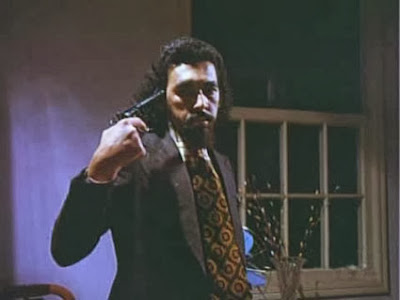

The movie moves at a slow pace, and just like the opening segment, almost every scene goes on for just a tad to long… but it’s Mojica Marins, and for that reason alone it never really gets tedious, as you never know where he’s going to take the next twist of the plot. Because even though it is a terribly thin plot, there is one and it does lead forth. Marins doesn’t get up to much mischief either, he’s just checking people in and shocking the life out of them with his stunning insights… so I can certainly see how people may see this as a rather bland José Mojica Marins movie, but at the same time, there is so much great stuff going on here. Much of the film is classic Marins, with reptiles, insects, fab lighting possibly taping into a Mario Bava-ish prime colours approach, the uncannily “to close close-ups” of Marins unibrowed eyes, super imposed images and a great, great mix of eroticism, horror and surrealism.

Co-writer Rubens F. Luchetti had previously worked with Marins and would again on a few occasions along the road, all of them collaborations with the common denominator that they where something of celluloid quilting’s of fragments held together by the wraparound stories that bookended the movies.
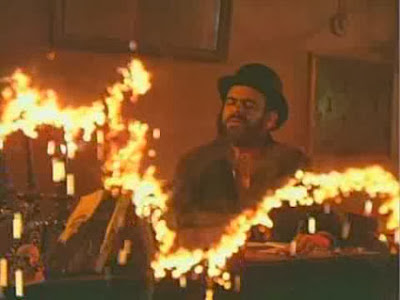
The soundtrack to Strange Hostel of Naked Pleasure sounds like woozy discarded Residents filler, but delightfully catchy and brooding! Marin’s regular cinematographer Giorgio Attilli comes up with some spectacular in-camera effects, blood rain, fire on screen, and that great lighting. There’s spiffy and effective editing! Audio that crashes into the soundtrack like a train wreck, all to that effect as this is most certainly what Mojicas and editor Nilcemar Leyert where after. The edits where intended to shock the audience, and keep them on their feet, which is exactly what they do. Nudity, freaky lighting, insects and reptiles, and open-heart surgery shots and a skull that cries blood in guilt are just some of the sights that José Mojica Marins serves up in this low budget, but at times, highly impressive piece of suggestive surreal horror!
As far as I'm concerned, either you get behind José Mojica Marins visions and support it full-hearted, or you stick to watching ludicrous mainstream generic bullshit and never dare walk the alternative side of genre cinema again. 

VIVA JOSÉ MOJICA MARINS!

Monday, March 18, 2013

Embodiment of Evil


Embodiment of Evil
Original Title: Encarnação do Demônio
Directed by: José Mojica Marins
Brazil, 2008
Horror, 94min


The final chapter, at least as we know it so far, in the saga of Zé do Caixão - Encarnação do Demônio (Embodiment of Evil) is upon us. The part that José Mojicas Marins himself refers to as his masterpiece, the movie he has waited all his life to make. A movie which sees his iconic character Coffin Joe make a final return to the screen in his search for a perfect woman to birth him the son who will continue his bloodline.
Forty years have passed since Zé do Caixão fell into that murky corpse ridden swamp at the end of Esta noite Encarnarei no Teu Cadáver (This Night I Will Possess Your Soul) 1967. A lot has changed in the world since then, but Zé do Caixão still has his conviction that he must find a woman to further his bloodline, which he tells us in his customary opening monologue. A murky prison, agitated police officials swearing loudly that they have to release a prisoner they have within their walls. Stern dialogue presenting exposition, the man they are about to release the beast! The characteristic nails protrude out through the tiny hole in the rusted iron door. The Prison Governor stares into the face inside the hole and proclaims Josefel Zanatas a free man, begging him to leave his alter ego, the murderer Zé do Caixão, dead within the prison walls.
Outside the prison gates waits the faithful servant Bruno [Rui Ressende], who escorts the greyed Zé do Caixão to his new underground lair, complete with coffin, skeletons and new disciples.The disiples line up and start to chant the by now well known mantra "What is Life? It is the Beginning of Death. What is Death?  It is the end of Life! What is Existence? It is the continuity of Blood! What is Blood? It is the reason to exist!" Zé do Caixão has not been left dead in the cell that held him for forty years, he’s alive and kicking and still on a mission!

With the main plot being to once again suffice a woman to further his bloodline, there’s a delicate subplot, which initiates the forces of antagonism and presents the threat of the film, after Caixão saves a child from being executed by the sinister Chief of Police Oswaldo Pontes [Adriano Stuart in his last screen performance]. This is key, as there’s always a scene where Caixão comes to the aid of a boy child in the two earlier films. It’s a metaphor for his desire to father a son and also a demonstration of his anger of not having succeeded at that.
This encounter triggers a vendetta from Oswaldo and his brother Miro [Jece Valadão, who sadly died during production]. There’s a surprise as Miro reveals himself to be the cop who Zé do Caixão blinded in the original censored ending of This Night I Possess Your Soul. The key scenes that where never possible to shoot due to external pressure and conditions put on This Night I Possess Your Soul (which you can read of in that earlier piece) are finally overcome as Marins reconstructs the ending of that film by the fantastic casting of Raymond Castile, a young American collector of monster figures and Coffin Joe impersonator. To spice up the plot further, it’s also revealed that the fact that the Zé do Caixão lawyer Lucy [Crista Aché] who managed to get him freed is Miro’s wife! Rounding up a right raggedy band of companions the Pontes brothers set out to destroy Zé do Caixão once and for all.
Obviously Zé do Caixão quickly becomes the anti heroic protagonist we empathize with. Partially due to the fact that the Police officials are such profound bastards, who wouldn’t flinch an eye at murdering a child or spouse if it came in their way of stopping Caixão, and also by the recurrent device of Caixão being haunted by his past female victims. Characters from both previous instalments make appearances as they taunt the elderly Zé do Caixão through a well-crafted mix of contemporary effects and actual footage flashbacks. 

Zé do Caixão plays his game by the book that he wrote, He kidnaps and beds a series of women and put’s them through his archetypical sadistic trials which gives the police officials a moral carte blanche to put a stop to his terror. Aided by Padre Eugênio [Milhem Cortaz], a frantic monk – also a victim of Zé do Caixão’s previous activities also sworn to have his vengeance, they set up the biggest manhunt since they last chased Zé do Caixão into the swamps. Following the pattern of the earlier instalments, the road to ruin goes through these tests, the desire, the frustration, the hauntings and the visions of hell before Zé do Caixão is run out of town by an angry mob led by the Pontes brothers. Hot on his heels, he leads them through the cursed swamp to an abandoned amusement park, where Zé do Caixão, his antagonists and the ghosts all gather for a last showdown.
Keeping it contemporary, the key scenes of mayhem are all pretty intense and obviously graphic. Marins holds back on nothing and one can clearly see why he considers Embodiment of Evil his masterpiece as he get’s to show and enact all the stuff censorship restrained him from putting up front back in the day. People have their mouths sewn shut in disturbing detail, there’s the classic Zé do Caixão devices, spiders, snakes, cockroaches. But also cannibalism, baths taken in entrails, giant rat’s rammed into orifices, self-mutilation as once scene shows a young woman eating her own buttocks and the crown jewel of the film shows a woman being reborn from the belly off a huge pig as Zé do Caixão slices the beast open and she crawls out of the carcass! Where the earlier films where received as provocative visual and offensive, they a fade in to the full onslaught of Caixão this time around, all in full graphic, naked, gory detail. Embodiment of Evil is nothing less than one of the most beautiful pieces of trash cinema ever put on screen. It’s a true masterpiece of the grotesque and sordid depravity. I salute the team Marins has assembled for this must see film, as their work is top notch! One thing that has changed though is the dark comedic undertone of the film. A lot has changed since Zé do Caixão was locked in his dark cell, and Marins uses that fact to add some amusing cultural crashes along the way. It brings a sort of “Fish out of Water” tone to the Zé do Caixão character and in many ways it’s apparent that the times have passed him by.
Just like the earlier films, Zé do Caixão is an existentialist. His atheism and goal keep him alive, but as previous films taught us, it’s when he strays from his philosophy that evokes his ruin. Falling for the beautiful Elena [Nara Sakarê], a young woman obsessed with Caixão he falls into a deadly plan. Elena is the niece of two witches who propose to Zé do Caixão that they can release him from his curse childlessness and also lift the threat of his previous victims coming back to avenge their deaths on him. Remember, this is the curse that was cast upon Caixão in the very first film, À Mela-Noite Levarei Sua Alma (At Midnight I’ll Take Your Soul) 1964 and a curse that still torments him almost fifty years later. The only catch is that they want Zé do Caixão to acknowledge his faith, turn to god and they only then will grant his wish.
Remember when I talked about how some movies feel like a summary and bookending of plot, story, traits and work back in the piece on Jean Rollin’s Perdues dans New York (Lost in New York) 1989? Well, Embodiment of Evil has that feeling too. Many references to the two earlier Coffin Joe films are noticeable, such as the Witch being present a mere five minutes into the film. Or as Zé do Caixão’s apostles line up in front of him upon his return from imprisonment, he has them recite the opening monologue – which I previously pointed out to be his philosophy – from This Night I Steal Your Corpse. Flashbacks to the two previous films are used to make points about his philosophy, and finally Marins got to shoot his intended original ending from This Night I Steal Your Soul with Raymond Castille a spitting image of  the young Zé do Caixão. In many ways this brings the arc of the three films to a culmination. The film does end as the other did, with a Zé do Caixão presumed dead, but for once, just this once, Zé do Caixão may actually have won! 
I’ve previously mentioned that one should explore these three films of the Coffin Joe series in a chronological manner. I stand by that, as through watching them in this way, you will see how the arc follows through the films. You will also understand the impact the ghosts have on Zé do Caixão in a better way. You will also understand just how wild José Mojicas Marins actually goes with this final part when you have the previous two in mind. Embodiment of Evil is a superb finale to a string of fantastic films, and undoubtedly one of the few examples of a last instalment making the largest bang. 
Do yourself a favour take the time to follow the chronicles of Zé do Caixão as they where meant to be seen and enjoy the naked, violent and strange world of Coffin Joe in all their grandure.


Monday, January 07, 2013

This Night I'll Possess Your Corpse


This Night I’ll Possess Your Corpse
Original Title: Esta Noite Encarnarei no Teu Cadáver
Directed by: José Mojica Marins
Brazil, 1967
Horror, 108 min

Anything can happen in movies. Dead characters can magically be alive in sequels, it happens all the time. What we throught was one absolute ending, is twisted to something else and hey presto, the beast is back! So why not Coffin Joe! Opening with his trademark philosophical questioning - the one that proclaims his philosophy and goal -  This Night I’ll Possess Your Corpse jumps right in where At Midnight I’ll Take Your Soul ends, recapping that story and giving more details about the last moments of the previous film, before quickly taking us through credits, blitzing images of nightmarish scenes to come - and bringing us up to speed - Zé do Caixão is hospitalized, sent to trial, freed of all charges and regains his eyesight. Blam! Now we’re ready to roll again.
Zé do Caixão is still on the prowl for a woman fit enough to bare him a son and keep his blood line running, but this time around he’s got a reputation to stand up to. Fellow villages run in fear as he walks back into town, people are aware of him and keep their distance, and even question him being in their village.
A series of stylish off-screen gloved predator kidnapping several young women rallies up the villagers who rush straight to Zé do Caixão and confront him… Oh yeah, his powers of persuasion are just as sharp as ever and he smooth talks his way out of a heated situation. The punch being in the reveal that all women actually are victims of Zé do Caixão. He’s abducted them to be part of his selection of possible brides to be. After locking them in a room, offers them gold and fortune, but later that night he releases an ocean of deadly spiders into the room to single out the best options. As the night gowned women sleep, the arachnids crawl all over their bodies until panic sets in. As they scream Zé do Caixão opens the door laughs sinisterly and tells them that his rest to measure their courage is now over. Losers are taken to his underground laboratory and given to Bruno the Hunchback [Jose Lobo] as an early birthday present… another example of Zé do Caixão giving to the less fortunate.
The main narrative of This Night I’ll Possess Your Soul is still Zé do Caixão searching for his bride to be and doing so through groups of women he puts through a series of merciless tests along the way – like love making whilst listening to the death cries of the loosing women trapped in a pit of venomous snakes. It’s like a dating show for sadists!
Villagers hardly dare stand up against him, and even the rural law enforcer Colonel is powerless in the presence of Zé do Caixão. Standing feebly, the Colonel can only watch as Zé do Caixão sets his sights for his daughter Laura [Tina Wohlers]. Laura doesn’t waste her time to acknowledge the caped, top hat bearing Caixão, but shows her own true colours as an evil selfish woman with no scruples at all – who even ignores going to her own brothers funeral, with the knowledge that he killed her brother, so that she can stay in a snog Zé do Caixão. Undoubtedly a woman in his taste! It’s during these scenes that Marins once again deliberately provokes by crosscutting his seduction of Laura, undressing her and making love in the cemetery with the funeral of her brother.
I find it fitting at this point to remind you that this sinister, egocentric maniac who was once tried for murder of several people with nothing in his mind but securing his own bloodline, still acts on behalf of others! Early on in the movie a motorcyclist races down the dirt road towards a bunch of children playing blind mans buff. Only thanks to Zé do Caixão does the child seeming to face certain death survive as he courageously throws himself out into the road shoving the young boy out of dangers path. This gives such a great dimension to the character that never is commented on, he can easily abuse and murder innocent people for his means, but he won’t let anyone harm a child. Just like in the original this comes back to bite him in the ass, and is a vital reason for his descent into madness this time too.
Zé do Caixão a very typical anti-hero in every way. An outsider, a vigilante, a lone wolf – but all good things come to an end, and in the sixties “villains” where certainly not getting away with their crimes on screen. The great irony of Zé do Caixão and his desire to keep his bloodline alive is that unbeknownst to him one of the women he murdered in his first tests of the kidnapped women was pregnant. With the realization that he disrupted another man’s bloodline and that he killed a child – remember he’s very protective of children – his world comes crashing down around him once again. It’s in this distressed state of mind that he starts to suffer from nightmarish hallucinations as his guilt starts to drive him insane.
When the skinny shadow man comes to drag him to hell don’t freak out, your acid hasn’t taken you on a bad trip, and the movie does become a colour film for a short while. This is a stroke of genius, as visions of hell on cinema should stand out. Raging from Benjamin Christiansen’s Häxan 1922, through Nobou Nakagawa’s Jigoku and even Olaf Ittenbach’s No Reason 2010, trips to hell are always terrifying experiences, and if one can show the horror in colour the better it is. Marins goes crazy with lighting, effects and sets as Zé do Caixão wanders through corridors of pain, suffering and torture before he has the most shocking reveal of his life!
It’s through empathetic recognition that we feel for this delightful antihero, and what is kind of startling with This Night I’ll Possess Your Corpse is that for a while it looks as if Zé do Caixão is going to succeed with his plan… although some harrowing decisions are to be made before he’s forced into the darkness all alone once again, and challenge God to prove his existence!

With better financing this time around Marins had the chance to dig in deeper and paint with a broader brush. Characters are more extreme than the original; the rouges gallery is a wider span – disfigured villagers, Bruno the Hunchback, more women, more nudity, and more extreme violence. More on that and how it ended up putting a break on Marins vision for the second instalment.
There’s also a shift in pacing this time around, Zé do Caixão isn’t quite as frenetic as he was in the first movie. He’s certainly as eccentric and megalomaniac as ever, he’s still an atheist devout to his existential approach to life, but now he’s more certain of his goals and ambition. Instead of a raving lunatic, he comes off as the disdainful and suave character that certainly will stop at nothing to reach his goal.
There’s some great irony within the piece, such him being an atheist and then confronted with the visions of Hell, or even the use of the Hallelujah chorus from Handel’s Messiah Part 2, when learning Laura is pregnant, remember he’s an atheist and an Existentialist right! This irony may not be intentions, but there’s a reason why it becomes ironic when it’s used in this Existentialist piece. I find a similarity to stuff like Milan Kundera’s existentialist work The Unbearable Lightness of Being – a movie that scared me, and definitely shaped my view on life when I saw it back in the eighties. The theory that Kundera relied on in this piece was that of Eternal Return. One of Nietzsche's pet peeves which suggests that the universe is recurrent and will continue to be so for all eternity. It’s within this recurrent eternity that man must chose wisely. Because when one accepts that there is no God each man and woman must rely on themselves for all their decisions, which gives them freedom of choice. Existence is an individual thing and one has total freedom. I also see it as further reason why the three films all work in similar ways, leading to similar climaxes. This is what Zé do Caixão has, and this is how he lives as he considers his choices to be his own path to freedom. As pointed out in the piece on At Midnight I’ll take your Soul, this is why Zé do Caixão’s world is shattered when he’s taken to hell and shown that there is a Devil, and with a Devil comes a God… Considering that Marins aimed for a much more nihilistic ending to the film – one where Zé do Caixão doesn’t die in the swamp, but instead throws the priests crucifix at the mob and laughs at their religion, staying true to his Existentialism - the movie ends in a much more odd way where the Existentialist views are discarded. Although this was certainly not Marins decision, and I’ll return to that in a short while.

Despite being more or less a pimped version of his original film, I’d like to point out that newcomers shouldn’t take shortcuts and jump in at the second piece. This is a series that evolves and the character develops in certain ways along the way. Do yourselves a favour and start at the beginning.
Unlike many other sequels, Marins pulls a five-fingered punch with This Night I’ll Possess Your Corpse, as it’s everything that At Midnight I’ll Take Your Soul was intended to be, but amplified beyond that initial film. More nudity, an even more sinister Zé do Caixão, bigger sets, better effects and a confused sudden conversion to believing in God at the last moment. At the time Marins started making his Coffin Joe Films in the mid sixties they where films that for the time where extremely graphic and provocative. Something that came back and bit him hard in the ass when the dictatorships censors forced him make several cuts to the film and tag on the religious finale. Tough deal, but when the Dictatorship tells you to change your film or loose it for all eternity, Marins had no other option than to alter the film to their tastes. It still makes a great movie despite Marins still feeling that the censors killed his film. Perhaps this is why Marins only used Zé do Caixão as a cicero and guide through many of his films to come, there’s no point unleashing the beast if he cant be used to his full potential. Something Marins would make sure happen with The Embodiment of Evil more than forty years later. This time Zé do Caixão would be back in every possible way!

Disney Star Wars and the Kiss of Life Trope... (Spoilers!)

Here’s a first… a Star Wars post here.  So, really should be doing something much more important, but whist watching my daily dose of t...