Showing posts with label Piero Umiliani. Show all posts

Sunday, March 17, 2013

Howlers of the Dock


Howlers of the Dock
Original title: Urlatori alla sbarra
Directed by: Lucio Fulci
Italy, 1960
Comedy/Drama/Music, 83min

It may seem odd that Lucio Fulci, the guy most of us associate with gruesome gothic shockers of the late seventies, early eighties – or lush thrillers and Gialli of the mid sixties, late seventies, started off as a director of comedies. It may seem even stranger that he started off with a string of musical comedies, showcasing young talent breaking out in song and dance at any given moment… or is it? Well not really, as the more you learn about Lucio Fulci, the more you learn to understand his versatility and perhaps foremost, appreciate the immense talent this true master of cinema held. For example, did you know that he only ventured into filmmaking as his girlfriend of time ditched, him making him take up film studies instead of medicine instead? Did you know that not only wrote and directed a bunch of fairly successful musical comedies for Italian pop star Adriano Celentano, but also wrote a couple of his most successful songs!
Let me put this into context for you. As a young man having left his initial passion of medicine behind and taken up studies at Centro Sperimentale di Cinematografia, Fulci graduated in 1948 and headed straight for work as an assistant in the world of cinema. Apart from assisting directors such as Max Ophüls, Marcel L’Herbier and his mentor Steno, Fulci frequently wrote art and film criticism for local papers. After a few years of working his way up, co-writing scripts, assisting second unit, shooting second unit for his mentor Steno, and comedian Totò, Lucio finally got the opportunity to direct his first feature, the comedic crime flick I ladri (The Thieves)1959. Using his connections within in the industry, he managed to get Totò to star in this debut film, and undoubtedly hoped for some of his popularity to rub off on the film, possibly generating a success similar to those earlier of Totò’s films… although this was not meant to happen. I ladri bombed and made no major imprint at all. Instead Lucio set sights on a new target audience, the youth of Italy, and what better way to captivate them but with rock’n’roll and rebellion!
The same year of the disastrous I ladri, Fulci set pen to paper, came up with a script, stepped behind the camera once again and directed Ragazzi del Juke Box (The Jukebox Kids), a light hearted comedy with loads of swinging tunes, upcoming musicians like Celentano, and hot young talent like Elke Sommer. Ragazzi del JukeBox also starred the song Il tuo bacio è come un rock, with lyrics written by the Fulci and performed in the film by Celenato, and also featured on his debut album of the same name. On that album Fulci co-wrote the tracks Blue Jeans Rock and Nikita Rock (Blue Jeans Rock featured in Howlers of the Dock). Fulci would later write yet another track for Celentano - 24 Mila Baci, which still to this day, turns up on summer compilations in Italy. Bet you didn’t know that did you? Pretty fucking cool right! Just more reasons to love the maestro.
Ragazzi del Juke-Box was a decent success for Fulci and led to him teaming up with the same co-writers and talent for a second spin at the musically oriented comedy. This time Urlatori alla sbarra (Howlers of the Dock).

Howlers on the Dock uses what is kind of a typical Fulci trait, a satirical approach to politics of the time. (If it wasn’t politics, it was religion) I with no doubt in mind consider this film, despite it’s light-hearted tone to be a satire, as the government try to change something that they can not control and fail miserably…
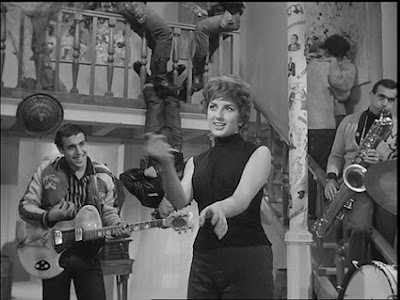
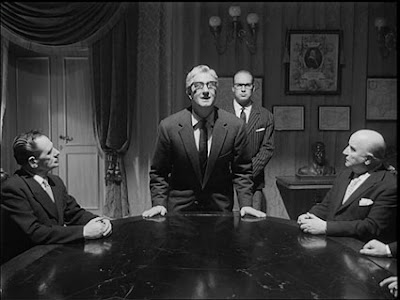
Howlers of the Dock, starts off with a board of executives demanding an investigation into how to stop and control the provocative Teddy Boys that are roaming the streets bringing a bad reputation to “The Blue Jeans Company”. Guessing that sales of Jeans will drop if associated with wild hoodlums, they try to ban the gangs and their music. After establishing what we could call the threat of the film – the banning of fun – Fulci brings on the bunch of swinging hepcats, or misfits if you will, through a bitchin’ party where both Adriano and Mina (another at the time upcoming artist) as they take turns singing a few tunes, whilst Gianni Di Venanzo’s camera circles the party showing us the who’s who of the gang. This opening sequence also introduces the peculiar – or genius – casting of Chet Baker! They sing, the dance, they goof around and do the shit that kids with a rebellious streak do.

The second main narrative focuses on a romantic tale between Guilia Giommarelli [Elke Sommer in one of her first starring roles] and Joe il Rosso [Joe Sentieri, who at the time was though of as the leading man, although in the wake of Celentano’s success to come, the film became a Celentano film and Sentieri secondary when it was reissued in later years].
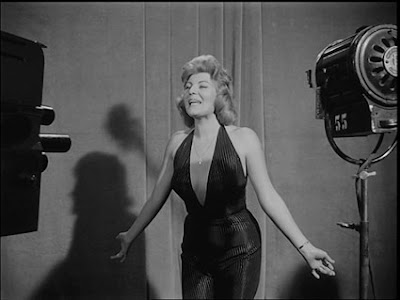
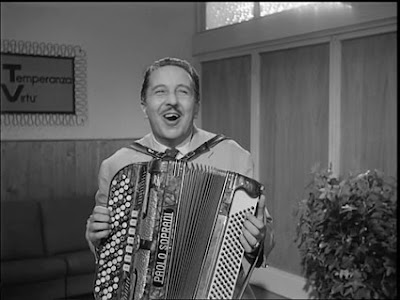
With the "adults/government" trying to ban the rocking kids, Guilia, who’s father, not only is part of the board of executives seen earlier, but also a producer of a successful variety TV show on RAI, introduces him to the gang during a party thanks to Guilia. Her motif is obviously to help make her love interest Joe a star. Here's where that great Fulci irony comes into play. Following some daughterly manipulation she persuades him to give Joe a shot on his show – Adriano get’s one too – and hey presto. Joe is showcased too millions of viewers, although his song is a safe croonery one, and Adriano’s a shit kicking Elvis inspired number. The ban is shattered, the kids win and rock’n’roll is unleashed upon the nation - state fails again.  
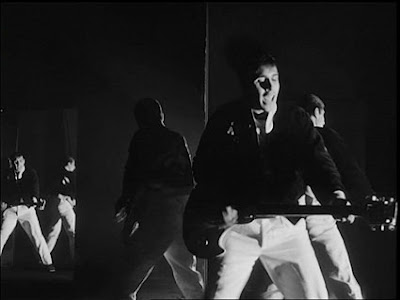
The bands of friends are more or less a comic ensemble, one guy has a Marlon Brando fetish, one dresses as Davey Crocket, another two as cowboys. The women sing, dance and flash jazz hands en masse as everyone get’s at least one number during the course of the film. One spectacular number see’s the kids racing mopeds down the streets to a backdrop of projected city images, although the highlight in my opinion is the park make out session where Chet Baker sings and plays his trumpet in the way only he can.
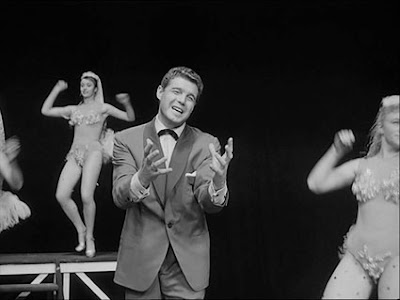
There’s not really much of the Fulci we are familiar with here, apart from the irony and satirical approach to the theme. Howlers of the Dock is very much a nice and safe musical with all the trimmings. Bursting into song and dance, strutting spastic moves and catchy tunes in Italian may not be what the gore fans of Lucio Fulci want to watch. But it’s still a decent movie and if nothing else it’s a fun time capsule. This is Lucio Fulci’s version of a Cliff Richard film or a Jerry Lewis comedy. Adriano Celentano continued to have a successful career as a singer and as an actor in Italy. Apart from his collaborations with Fulci, he also held the lead in Dario Argento’s failed satirical period piece Le cinque giornate (The Five Days of Milan) 1973.
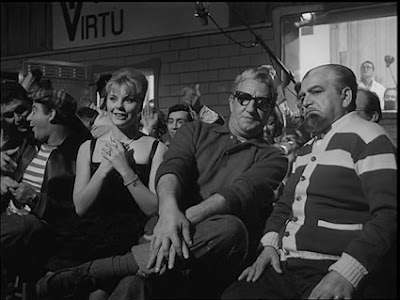
Personally  this movie is appealing to me is because of the fact that infamous bad boy of Jazz, Chet Baker, holds a part in the cast. His presence is commonly referred to as a cameo bit, but it’s much more than a cameo, he’s definitely a supporting cast member and is even credited in the titles – as Chet, the American. A few noteworthy facts/stories about Chet Baker's time in Italy are well worth sharing, such as the one that he was supposedly wasted on heroin throughout the production. Or that he was busted by the cops for heroin possession and spent a year in prison (most likely after the filming). During his time in Italy he also recorded several tracks together with the great Piero Umiliani! The film I Soliti Ignoti (Big Deal on Madonna Street) 1959 features the first appearance of their collaboration and it’s also the first Italian comedy to experiment with the use of Jazz on the score. 1961 saw the release of Smog, where Chet again is featured and is considered to be a highlight of Jazzbased soundtrack productions. Many of the tracks they made together would later surface on the albums Italian Movies, released in 1999 – something worth checking out if you dig Umiliani and/or Baker's music. Despite said to have been a wreck on set, Chet has a few small scenes where he’s present in more than a cameo appearance way, he interacts with cast, has a few lines and even manages to sing a song. Although the film primarily featured a score by Umiliani, Baker sings Umberto Bindi’s Arrividerci. This scene is also the one that closes Bruce Webber’s Chet Baker documentary Let’s Get Lost released in 1988.
Howlers of the Dock, the third ever feature film from the master of the macabre, Lucio Fulci, is quite a novel film. I like it for it’s harmless charm, silly comedy and rather catchy soundtrack. Never the less, the film and it’s theme of revolt and satire earned it a “E” rating from the Catholic Church and nobody under 14 was admitted into cinemas screening the film. Being a fan of Umiliani’s work and a huge admirer of Chet Baker, this is an essential Fulci film for me as it sees’ three very different creative forces melding. Three forces that all stand at their polarized corners in an assortment of ways, but still housing uncanny similarities.

I’ll leave you with the song Arrividerci as sung by Chet Baker in Lucio Fulci’s musical comedy Howlers of the Dock in 1960...


...and Adriano Celentano, always the goof, singing Blue Jean Rock (with Fulci lyrics) on some TV show in the eighties.


Tuesday, December 21, 2010

Paranoia

Paranoia
Directed by: Umberto Lenzi
Italy/France/Spain, 1970
Thriller, 94min

Wrapping up the loose trilogy of Jet-Set thrillers starting with Così dolce… così perversa (So Sweet… So Perverse) and Orgasmo, both 1969, the series comes to an end with Carroll Baker in her third flick for Umberto Lenzi. The suave, mordant and enthralling Paranoia.

Once again relying on Boileau-Narcejac’s novel Celle qui n’était plus (The Woman who Was) which also inspired Henri-George Clouzot’s Les Diabolique 1955, Hitchcock’s Vertigo 1958, not to mention a shit load of other Euro Thrillers including Lenzi’s two previous instalments in the “trilogy “, Paranoia may just be one of the finest adaptations to be inspired by that story and previous movies. Building not only a destructive threesome, the team of writers – including Bruno Di Geronimo (Gianfranco Mingozzi’s Flavia, la monaca musulmana (Flavia, the Heretic)) 1974. Marie Claire Solleville, who also wrote on Orgasmo, and Marcello Cosica who participated on one of my all-time fave zombie flicks, Jorge Grau’s Non si deve profanare il sonno dei morti (Let Sleeping Corpses Lie) 1974 and the screenplay to Mario Bava’s La maschera del demonio (Mask of Satan) 1960, put a twist on the story that actually had me going off track a few times. Which was surprising, unexpected and highly entertaining.

Helen [Carroll Baker] is a filthy rich, jet setting race-car driver who belts prestigious vehicles around the tracks at deadly speeds. After a somewhat serious accident she’s put in hospital all banged and bruised. She may be suffering from slight amnesia, this version is in Italian without subs, so I’m not with it all the way during the set up, but I’m going with the amnesia thread as that works better for the movie. Anyways she’s discharged from hospital and goes to rest along side her ex-husband Maurice [Jean Sorel] and his new sugar momma Constance [Anna Proclemer], who mysteriously invited her there to recuperate at their residence. The atmosphere is tense and the threesomes don’t quite know how to approach each other in this somewhat awkward scenario. Despite being divorced, Maurice still makes moves at Helen, and an effective flashback showing Helen and Maurice back at the breaking point of their relationship – a beautiful slow-mo scene where Maurice wrestles a gun out of Helen’s hand, which somewhat supports the amnesia theory as she wouldn’t be there if she’d recalled the bad ending.

After establishing what we suspect is the set up – Helen and Maurice wanting to get back together and Constance being in the way, there’s the obligatory scene of Carroll Baker in the shower peeked upon by not one, but two characters, and the first of several sudden plot twists. Constance starts to flirt with Helen, and there’s a fantastic scene of Helen trapped in a seductive game of footsie where both Constance and Maurice are working her legs and feet. Some nights later when Maurice comes home drunk, Constance suggests sinister plan to Helen, which would see her assist Constance in the murder of most likely cheating bastard Maurice. This also evokes flashbacks of happy times when Maurice and Helen where still in love, and it makes for a neat twist as it see’s Baker slowly falling into a state of disorder as she’s torn between her love and hate for Maurice. There’s a couple of classic deceptive moments as we now are lead to believe that Constance and Helen are going to off Maurice, but when push comes to shove… Obviously there’s a last minute spin and Helen doesn’t have courage to harpoon Maurice, and things take a completely different turn.

With Constance "out of the way", it looks as Maurice and Helen are safe on route to getting it all back together again, but… and there’s always a but, their happiness is threatened when an attorney friend of Constance, who always has his movie camera with him, starts to ask questions about accident that took Constance life. The suspicion and persecution starts to drive Helen round the bend – which to be honest has been done three times by lenzi and Baker at this time – and to make things worse, Constance daughter Susan [Marina Coffa] arrives and wants’ to know what happened to her mother... and finds her mother's husband being intimate with his ex wife!

It’s quite apparent that Umberto Lenzi started toying with the sadism that would become something of a signature trait of his here. There’s a lot of drawn out moments of mental torture like waiting for a corpse to be emerged from the sea, possible evidence on a reel of home movie, and constant suspicious stares. It all comes together wonderfully as editor Enzo Alabiso draws out the edits to the maximum, creating some immensely tense moments. It’s no wonder that Helen slowly goes insane considering the sadistic mind games that are played at her expense. Much like in previous instalments.

Anyways, back to the flick, where Susan wanders the same house as Helen and Maurice, after all it is her mother Constance house, and stats her own investigation into the mysterious accident that supposedly took her mothers life. Helen who in-between bouts of frustration and paranoia takes to snogging and shagging Maurice to keep her mind off the guilt that torments her, still has a harrowing surprise, shock and twist sequence left before the movie comes to it’s closure.

A common trait for all three movies in the “trilogy” is that cinematographer Guglielmo Mancori has something of a fetish for mirrors and composing frames within the frame. It’s not a bad thing, quite the opposite, as it treats the audience to some fantastic moments and at least once in each movie there’s a splendid illusion that a dead character is in fact alive. Something that lies close to the main device of these three movies – who is fooling who, and more than often with a rather cynical dark ending. It’s also noteworthy that Aristide Massaccesi (Joe D’Amato) worked as Mancori’s camera operator on Paranoia, just a few years before he started directing movies of his own.

Being a Spanish/French/Italian co-production, Antionio Ramírez – who edited several Leon Klimovsky & Paul Naschy flicks – accompanied Enzo Albasio in the editing. But that editing is still as ferocious as ever, and goes hand in glove with Mancori’s superb cinematography. Much of the same hard, almost violent editing style that was found in Orgasmo, and later in Il cotello di ghiaccio (The Knife of Ice) 1972, is seen here.

Gregorio Garcia Segura’s score (directed by Piero Umiliani) is groovy and sounds more like a cheaper companion part to Orgasmo than anything else. It even goes as far as reusing the rock act Weiss and the Airdales performing Just Tell Me once again in a club setting much like the one in Orgasmo.

Paranoia neatly wraps up the loose trilogy and sees some interesting traits evolve from the suite. The three movies showcase a progression of Umberto Lenzi traits that he’d later push further with the thrillers and several Gialli to follow. It’s also a treat to see Carroll Baker and Jean Sorel teamed up again as Paranoia with Romolo Guerrieri’s Il dolce corpo di Deborah (The Sweet Body of Deborah) 1968 are the only two movies they starred in together. Umberto Lenzi would follow Paranoia with a seedy sexploitation thriller – Un posto ideale per uccidere (Oasis of Fear) 1971 before starting off his fascinating string of fascinating Gialli that would definitely have him make his mark on the genre scene.


Image:
2.40:1 Original aspect ratio (16x9 enhanced)

Audio:
Dolby Digital 2.0 Mono, Italian dialogue. No subtitles

Extras:
None.

Here's some freaky opening titles with some suave music for you to enjoy.

Sunday, October 17, 2010

Orgasmo


Orgasmo
Directed by: Umberto Lenzi
Italy/France, 1969
Mystery/Thriller, 91min


Umberto baby – what a trip! As customary I’ll start by saying it again, stick Make them Die Slowly back in it’s case, and seek out the older Umberto Lenzi Gialli and thrillers, because they are some really excellent movies back there that give a better insight into the arts and crafts of that fantastic director.

Lenzi’s career more or less follows the trail of many other great genre directors. He started out way back in the fifties when he used to write critical essays on film in magazines and newspapers whilst he was attending school with the plan of becoming a lawyer. He also penned several adventure and detective stories under a different name. The obvious step to take after completing school and realising that he held a passion for cinematic storytelling led him to landing a job as assistant director on Renzo Merusi’s anti-communist movie Apocalisse sul fiume Giallo (Last train to Shanghai) 1960 starring sexy Swedish export Anita Ekberg.

Following his directorial debut with a pompous period piece – pompous in a good way that is – Le avventure di Mary Read (Queen of the Seas) 1961. From there on he busted onto the scene with a string of Spaghetti Westerns, period pieces, action thrillers, sword and sandal adventures before he rekindled with that genre he’d been so fond of previously – the mystery genre. He did this with a loose trilogy all based on the themes of deception, double-crossing and death. Orgasmo (Paranoia) 1969, Così dolce… così perversa (So Sweet… So Perverse) 1969 and Paranoia (A Quiet Place to Kill) 1970. See some knob somewhere decided that Orgasmo should be called Paranoia which screws things up for that later movie doesn't it, and don't be misled by the title, Orgasmo isn't a screw movie, it's a genuine mystery thriller.

Orgasmo starts off the trilogy of mystery, and also sees the first of four collaborations between Lenzi and actress Carroll Baker. She would go on to star in the following two and the later early Giallo Il coltello di ghiaccio (The Knife of Ice) 1972. Lenzi show’s that he completely understands that there’s no need to waste valuable time on exposition and starts off with Kathryn West returning to Rome after her husband has suddenly died in a freak car accident – there’s no pointless funeral and wishy washy going on, but instead he cuts right to the chase and starts it all off. Some time is spent on establishing Kathryn and her world, her close friend Brion Sanders [Tino Carraro] who deals with all the paperwork following husband Robert’s death and Teresa [Lilla Brigone] who runs the mansion. A soon as we know the setting, Peter Donovan [Lou Castel] makes his entrance. Honking his horn and shouting aloud it’s a fair bet that he’s the antithesis of all Robert once was and it’s no wonder that Kathryn is drawn in by his rough charm and arrogant frankness.

But as soon as Kathryn find’s happiness, there’s going to be something negative to shake that foundation of pleasure. This comes in the shape of the late Robert’s relatives who don’t take to fondly to the young wife he once had and a bickery bitch fest is on the way. Luckily for Kathryn she has the trusty Brion at her side to pick her up when she faints. A rather innocent and deceptive subplot is set in motion when Brion starts to vaguely express his emotions towards Kathryn. But, and there’s always a but, Kathryn is all about her new young stud Peter who at the most unexpected moment surprises Kathryn with the arrival of his sister Eva [Colette Descombes].

From here on the movie takes a plunge into subtle and lusty exploration, there’s a delicate, provocative and suggestive eroticism between the three characters which slowly shifts into a sadistic deconstruction of Kathryn’s mental state.

In the last act, Kathryn uses all her strength to break free from the now abusive couple and certainly put’s up a great fight, but weakened both mentally and physically from long sessions of drink and drugs this is one battle she appears to be loosing. Never the less, Lenzi and co-writers Ugo Moretti and Marie Claire Solleville have a series of surprising twists and shocks up their sleeves before the movie finally comes to it’s crashing climax.

The editing style of Enzo Alabiso (wonder if he's related to Eugenio Alabiso?) is evident and a vital component of the movie. It moves rapidly and forcefully without taking unnecessary breathers that would have slowed down the pacing of the piece. Lenzi would use the talents of Albiso on several movies to follow. So keep your eyes on the screen because Orgasmo moves fast. Adding to the determined forward movement of the piece is cinematographer Guglielmo Mancori’s effective bag of tricks. Orgasmo is riddled with delicate dolly moves, fast swoosh pans and crash zooms to corner in the vital moments – most often focusing on Carroll Baker’s various facial expressions. Mancori and Lenzi would work together on at least seven more movies and Macori would go on to shoot some great genre pieces before calling it a day at the end of the eighties.

There’s the score. A vibrating and quirky score by the majestic Piero Umiliani who you know from such great pieces as Luigi Scattini’s Svezia, inferno e paradiso (Sweden Heaven and Hell) 1968, Mario Bava’s 5 bambole per la luna d’agosto (Five Dolls for an August Moon) 1970 and Corrado Farina’s Baba Yaga 1973 – which also starred Baker in a leading part. The score starts of very suave and quirky, but develops alongside the tone of the movie, the darker the movie gets and the deeper Kathryn falls into her mental decent.

The vocal piece of the movie Fate had Planned it so sung by Lidia MacDonald (the Scottish born singer who also sings on the Sweden, Heaven and Hell album - a must if you don't already have it) is used rather sparsely and holds a wonderful cynical mood that fits the movie, the more rockier track Just Tell Me performed by Weiss and the Airdales is the one that sticks out, but with reason, as it’s used several times to mark a rift between the very young Paul and Eve and the middle aged Kathryn.

An interesting final note on Orgasmo can be found in the fact that the Italian version differs from the American version. The ending of the American version brings a satisfying justice to all ending, but leaves certain valuable information out of the conclusion. Where as the original Italian ending stays closer to that cynicism that we all love about Italian genre cinema and ties in with the references to Robert’s sudden death in that car accident which is mentioned on several occasions. Without the conclusion to this important arc, the referents seem odd and out of place, and rather posing the question what happened to Robert? Well the answer, as told in the Italian version, is that Kathryn isn’t quite the hapless victim that she seems, but rather the initiator of an previous scheme outside the main narrative to claim the entire will and estates of Robert for herself. His death makes her a terribly wealthy widow! I can’t tell you why the decision to change Kathryn's character was made, but perhaps it was in a move to make her a more empathetic victim rather than a cold hearted and complex villain. Lack of dimension and polarisation has always been a favoured trait in American cinema so I’d guess that’s why. Also the Italian version is a preferred piece as it also has a lot more of the sensuality and nudity that comes with the blooming relationship between Paul and Kathryn and later Eve, which the American version exorcises on at least three occasions. We can’t have our empathetic victim being a sexual predator, enjoying both straight and lesbian sex can we, because we all know that bad girls go to hell and we have to keep it easy to follow…

Orgasmo is a riveting movie, which definitely demands that someone salvage it from poor quality copies and re-releases it in a pristine version because it’s a true gem that most certainly will find a new audience. It’s high on entertainment value, effective and still has a decent surprise ending even though there’s an endless amount of movies been made in the same niche both before and after this one. But if you are looking to explore early Umberto Lenzi, the mystery trilogy is an excellent place to start before following the path of evolution towards the splendid Gialli to follow. Just make sure to enjoy the Italian version not the American one will you.

Tuesday, February 02, 2010

Sweden, Heaven and Hell


Sweden Heaven and Hell
Original title: Svezia, inferno e paradiso
Directed by : Luigi Scattini
Italy, 1968
Mondo/documentary, 85min
Distributed by: Klubb Super8


The wild and weird world of Mondo! You can’t stand unaffected by this fascinating odd niche of the Italian Genre Cinema, nor it’s offspring as these contain some of the most disturbing movies ever to have been made.

The Mondo genre is often quoted as starting with Paolo Cavara and Gualtiero Jacopetti’s Mondo Cane 1962. Actually there where “mondo-ish” movies made before Mondo Cane, movies like Luigi Vanzi’s World By Night and Alessandro Blasetti’s Europe by Night both 1959, but these where more focused on nightlife and strange club acts and all round fun. Although Jacopetti did script them, and this eclectic jumble of almost random footage and driving voice over narrative would soon play right into his hands.

Mondo Cane with it’s showcasing of the wild and weird world outside of Italy in an almost Ripley’s Believe it or Not style documentary approach – or shockumentary as they also are known as - created quite a stir when it was released, it was nominated for the Palm D’or at the 1962 Cannes Film Festival and Riz Ortolani’s splendid track “More” was nominated for an Oscar for best music, original score at the 1964 Academy Awards. This unleashed a floodgate of Mondo themed movies, Jacopetti & Franco E Prosperi’s Mondo Cane 2, Franco de Feo’s Mondo Nudo, Gianni Proja’s Ecco all of them 1963, Roberto Bianchi Montero’s Mondo Balordo 1964 and even the American entries Mondo Freudo and Mondo Bizzaro, both 1966 directed by Lee Frost, and Russ Meyer’s Mondo Topless 1966 with a title that says it all. Most of them held a fair share of tantalising sexploitation, a humorous approach but also explored the downsides of life in other places and situations.

But at the late sixties the Mondo movie started taking two definitive paths, one focusing more on the sex and kinky scene, and the other on the a more vicious and violent as movies like Jacopetti & Prosperi's Africa Addio 1969, Antonio Climati and Mario Mora's Savage Man Savage Beast 1975 showed authentic deaths both in the animal kingdom and humans being killed by beasts. These traits also worked their way into the obscure cannibal genre too, where many animals where killed for pointless scenes in the movies narrative. Although many of the Mondo movies later where revealed to be staged situations, the tone had still been set and there was worse to come.

Pushing the boundaries further flicks like Rolf Olsen’s Shocking Asia 1976, Climati & Mora’s Sweet and Savage 1983, and Romano Vanderbes' This is America 1977 went even further, and merely consisted of onscreen deaths and violence almost wallowing in gruesome footage.

In 1979 the Japanese financed US production Faces of Death, directed by John Alan Schwartz became one of the most notorious Mondo movies of all time. And even though it like many Mondo movies before consisted mainly of fake footage acted out for the cameras, and a terrible acting by Michael Carr as Dr. Francis B. Gröss, our narrator and guide though the movie, the film still packed a ferocious punch. But a second Japanese financed US production finally pushed the genre over the limit. Sheldon Renan’s The Killing of America 1982 consisted almost completely of authentic footage of death and carnage, often caught by news cameras and un-expecting witnesses. It’s also one of the first movies to feature the infamous Zapruder Film which graphically shows the assassination of John F. Kennedy. Ironically Ruggero Deodato’s movie Cannibal Holocaust 1980 is not only one of the most infamous cannibal films, but also a stern critique towards the Mondo genre where directors staged and arranged death and execution scenes without interfering. In some ironic way the innovators had finally had enough!

With this last step taken, the gates of hell sprung open, and cheap compilations like the sequels to the Faces of Death series, The German Mondo Cane 4-6 films compiled by Uwe Schier, and abominations like the Traces of Death films, and the Faces of Gore series all focused merely on the of the horrors of life and death started turning up all over the place. Just like those god awful home video shows with stupid people doing stupid shit, the Mondo movie devolved into a cesspool of necrophilic depravity lacking all of the tongue in cheek humour of it’s predecessors.


But not all Mondo are about carnage and disaster situations. Even though the later movies are synonymous with onscreen deaths the early movies held a fantastic documentary style and even though they said exactly what ever they wanted over the random images shown, they had heart and humour to their story.

Like Luigi Scattini’s fantastic Sweden Heaven and Hell, a Mondo study of the sinful living of the Swedes during the sixties. Packed with lusty teens, naked women, violent biker gangs roaming the countryside, and the growing problem of the open alcohol and drug market, it’s no wonder that so many people used to think that Sweden and Swedes where the most open-minded and liberated people on the planet.

Young women who receive sexual education, only to later spend their weekends on the ”Love Boat” practicing what they learned in class. The gangs of Raggare roaming and raping their way through the teenage women of Stockholm (And yes that’s Marie Liljedahl having her clothes torn off by the bikers), turning the young lasses into homosexuals. All Swedish women sunbathe naked! The enforcers of law who spend their day’s making sure people of Stockholm obey the rules, only to pose naked for the photographers camera at night – the double morale of the women of Sweden, as even the most respected citizens indulge in dirty smutty late night actives. The kids, left at day care and later moved to a small community outside of Stockholm, where Dr Johnson cares for the children that all fell into a void of depravity and perversion before he saved them… It’s all here, and it’s a riot, as Scattini just randomly makes whatever claims he wants in his portrayal of the strange country up north. Although we did have sex education with very explicit images at school I never actually found those chicks wanting to do our homework in the practical manner.

Once sequence shows a sex shop on Birger Jarlsgatan – dead in the centre of Stockholm – where men and women gather at the Grotto of Porn, a library dedicated to porn. And one of the treats the filmmakers relish on, or rather points out as a vile obscenity, are the 7” records of authentic sounds of intercourse being sold – Pornophone! Remember Umberto Lenzi’s Oasis of Fear 1971, well that’s the same sort of records that Ornella Mutti and Ray Lovelock where flogging before they got into that first bout of trouble that forced them into hiding.

Scattini bars no holds as they twist facts and fiction into the melting pot of low morale, sexual cravings and perversion. No matter how naive and fake the movie is it is a hilarious movie. I have a weak spot for old photographs and footage of Stockholm of the past. I really love this city, and it’s still one of the most beautiful capitals in Europe, and seeing all these fantastic places and locations, but from Scattini’s warped vision makes me laugh and enjoy living in Stockholm even more.

I adore the short sequence where upper class girl Ulla holds all the power of the family house. As she sits making out with her boyfriend, her parents just sit watching, with the constant threat of Ulla actually deciding to marry her boyfriend which forces the parents to give her the house and move to the old folks home instead! After the young couple have engaged in a bout of pre marital sex – Ulla’s mom serves them coffee and sandwiches to keep Ulla happy! Holy smoke where did Scattini come up with these ideas, it’s uproarious.

On the other side, watching this movie some forty years later, the movie plays more as a parody on Swedish society. The warped discourse and suggestive voice over can easily be laughed at today as in some occasions their bleak portrayal is what we make fun of ourselves today. The cynicism of the young couple now leaving their maternal home only to spend a fortune an a small cramped inner city flat. The car owner beating up the guy trying to steal his car and ends up being the one punished instead – Violence is not accepted, but the youths lust for life is defended. It’s all stuff that still actually happens, victims being the ones punished, and the tiny apartments in the city costing a fortune for a few square metres. The problem with the high suicide rates… Something that in later years has proved to be based on the fact that Sweden are so anal about statistics and numbers that they where the only country with more or less accurate figures – hence the high numbers, no other country documented in the strict way of the Swedes.

But perhaps even more entertaining than the movie and its pseudo documentary narrative is the fantastic soundtrack by Piero Umiliani. It’s a fantastic soundtrack that definitely cheers up the most sombre state of mind, Not only does it contain the song that the Muppets made theirs ”mah na mah na” but also the lead theme; I tried to warn you… perhaps a prophetic tune to the state that the Mondo genre would end up in.

Luigi Scattini’s Sweden Heaven and Hell - It’s rude, it’s crude, it’s cheesy, it’s sleazy and it’s completely bogus of course, but it is the most entertaining Mondo movie ever made about Sweden!


Image:
Full frame 4:3

Audio:
Dolby Digital Mono, English, Italian or Spanish Dub available, with optional Swedish Subtitles.

Extras:
If you like Swedish skin flicks and corny comedies then the extras will please you as there’s a total of fourteen wonderful original trailers to sit though on the disc. There’s also a gallery of movie stills, marketing materials, and international movie posters.

And don't download it Buy it!

Disney Star Wars and the Kiss of Life Trope... (Spoilers!)

Here’s a first… a Star Wars post here.  So, really should be doing something much more important, but whist watching my daily dose of t...