Showing posts with label Vampires. Show all posts

Tuesday, April 15, 2014

Queen of Blood


Queen of Blood
Directed by: Chris Alexander
USA, 2014
Horror, 89min
Distributed by: Autonomy Pictures

Sequel time… or is it? Chris Alexander dived head first onto the genre filmmaking scene with his impressive debut feature Blood for Irina a few years back, and I had the great privilege of checking it out whilst it still was in post. What I saw blew me away, and being a huge fan of Herzog, Rollin and Franco, Blood for Irina was a love letter penned with passion from a guy who certainly knew how to summon up the aura of late seventies Eurohorror.

So when an email dropped into my in box posing the question, ”Would you be interested in seeing an early cut of Queen of Blood? I never hesitated a second. Partially because I truly did enjoy Blood for Irina, and partially because I wanted to see how Alexander tackled the tricky second feature curse!
Vampire queen Irina [Shauna Henry] walks the earth again, although this time it’s set in a western time period. Irina crawls out of a dirty riverbed drooling blood and with hunger in her eyes. Moving from place to place, encountering people along the way. People whose fates she will affect. The tone and atmosphere is much the same as in Blood For Irina, as in being gentle, meditative and cautious. But at the same time, momentary rushes of death and destruction are in place. Irina lashes out in her hallucinatory like state, turning the dreamlike shimmer into a dark nightmare. Remember that Herzog film where everyone was supposedly hypnotized before they shot the movie… Well, this captures the feeling of Heart of Glass, [1979] but with a Vampires and bloodshed!

So does he pull it off? Has Alexander been stricken by the curse of second feature failure? Well if you are a recurrent reader, you know me. I believe in honesty in everything that I do. I only write about movies I like, movies that affected me, movies that have something unique and movies that have some thought put into them. Only on a few occasions have I slammed movies for bad story, missing the bigger picture or not really getting their message through, even though I stand firmly by the theory that sometimes a zombie movie is only a zombie movie.
I do have some small issues with certain moments in Queen of Blood, but they are the kind of things that really don’t affect the movie as a whole, they are merely details of taste, and will vary with each individual viewer. With that said, one of the things that makes modern society so great is that one can discuss films with the filmmakers in a few simple punches of keyboard buttons. I’ve had the pleasure of talking about Queen of Blood with Alexander, and presented the issues to him. I also stand firmly with the belief that if a filmmaker did something intentionally, then that’s fine. I can’t, and won’t really interfere with artistic vision, and when said filmmaker answers with a referent to Franco’s Female Vampire, it kind of made my point void. Chris Alexander knows exactly why every scene, beat and frame looks, feels and works the way it does, and that’s something you have to respect!
The style that Alexander chose for his first feature, was a meditative, fever dream and also gentle, despite the topic. That’s all here too, but this time the content is what makes a difference. You will find multiple characters, multiple story arcs and multiple scenes of violence. Boundaries are pushed, both within the film and with the audience; it’s obvious that Alexander isn’t here to make mainstream mediocrity that we have seen way to much, he’s here to create his own unique space; a realm where Irina is Queen and a force of nature to be wary of.
But let’s talk about characters. In Blood for Irina we saw a pretty basic small cast. We had good, we had evil, kinda, It’s not really fair to call Irina evil in the classic antagonist way, she’s a tormented antagonist that we have an emotional recognition with and we do end up rooting for her, hence turning her into protagonist. This is basically what is transferred right over to Queen of Blood. Irina is that same character, tormented, wounded, vulnerable without being hapless. In some ways, I feel this to be perhaps more of a prequel than a sequel, as I find that there are keys to why she’s the suffering persona of Blood for Irina hidden within this film. (Also a scene where a photograph may unlock a deeper level to Irina’s background) But this time around, Alexander adds an element to the mix; he brings in characters that we almost could call red herring characters. Then there’s the highly intriguing character of The Preacher, portrayed with a broodingly sinister vibe by Skinny Puppy front man Nivek Ogre. Irina and The Preacher characters work splendidly, drawing the audience in with their mystical stories, living parallel lives in the same space, both with drifter-like agendas that we all know will lead them towards each other.

In this way, expanded, multiple character arcs make it a more complex piece than Blood for Irina. It takes some time before we can finally decide where our dedication will be, with Irina, The Preacher or that third character I will keep secret. I really dig movies that take time to establish characters and flip the classic archetypes on their ass, moving protagonist to antagonist and vice versa.
One of the things that I really loved about Mike Mignola’s Hellboy when I first discovered that comic, was that the fights where instant. He didn’t waste time or ink on illustrious battles that stretched over pages and pages with big spreads of glorious combat. “Red” just got in there, got slapped by the foe, cursed and then easily hammered the beast into submission with a single blow from that big ass red hand. Done. All in one page, or two at tops. There is something of this in Queen of Blood to, Alexander doesn’t dwell on the attacks or fights. He builds an atmosphere, get's in there and get’s the job done. I like that, because despite the slow move forth and gentle pacing, he’s not wasting time he lashes out and sending a blast of violence crashing down and then settling into that gentle pace again. Dynamic to say the least!

Queen of Blood is a natural progression of the story presented in Blood for Irina. Alexander takes Queen of Blood and expands on that universe, has a wider space in which its story takes place, locations are bigger, there are more characters, more depth, we get further into the head of the mystical Irina. Also Queen of Blood lives up to its title, as there is more blood and violence this time around, in a provocative way. Alexander get’s in there and pushes some limits and in many ways opening up new roads for fever dreams to come. Just wait until you see the re-birth lake of blood scene, it’s a fantastic moment, and what happens to lead there is shocking indeed.
Personally I see Queen of Blood as a genesis story, I see moments here that clarify why Irina reacts as she does in the initial movie, even though Alexander sees it as a sequel, and another of Irina’s feverish dreams taking place in that remote hotel room of Blood for Irina. An exciting detail is that the movie takes place in a timeless universe. What starts off as a Western setting gradually shifts into a contemporary setting and in its own way becomes a metaphor for Irina’s timelessness. After all, Irina is eternal!

There’s also an interesting and captivating wider aspect to Queen of Blood; Alexander is building a universe in the same way that Rollin and Franco built universes around their recurrent characters, themes and stories. These universes are key to Alexander’s movies, and without them you may just find yourself lost in Irina’s world. It’s the recognition and the familiarity of how those films work that is echoed through Alexander’s Irina movies. Sometimes a perfectly composed shot will tell you more than a line of dialogue; sometimes metaphors will work better than explanatory a poor exposition; sometimes less is more giving the audience an opportunity to become one with the piece instead. It will alienate some viewers, and will undoubtedly polarize the genre fans, but with that said, Queen of Blood isn't a movie for each and every genre fan either. It's a required taste, and as far as I'm concerned, I'd rather go with original over generic any day. Queen of Blood isn't for everyone, and everyone will not be for Queen of Blood
Queen of Blood is a worthy sequel, or prequel if you take my path of interpretation. Alexander has done well within his own universe. He takes us on a completely different path this time, but sticks to the themes and tone that he introduced in Blood for Irina. At times it doesn’t quiet manage to hold the same magic aura that Blood for Irina had, but it’s definitely bigger, bolder and more ambitious creating a captivating tone and universe. Irina is a great character, and the fact that Alexander doesn’t present a transparent backstory and a traditional explanation to her character works in advantage of the piece. She keeps her mysticism and that means it doesn’t collide with the fact that Irina, as she is in both movies, is basically emotionless. Irina shows no angst, no remorse, she’s just cold-blooded killer… or is she? The only thing that haunts her is her eternal damnation to walk this earth and that “loss”, "search" and "longing", the same ever-important Jean Rollin themes.  I have a theory on that, but will leave it to a later time as you still have to see the movie and how it unfolds before we discuss that without spoiling. Queen of Blood also opens up doors into a universe that Alexander knows like the back of his hand, and he doesn’t hold back on tipping his hat, even though he’s claiming his own turf in those familiar spaces. I have a feeling that in a decade or two someone will have the great delight of digging into the universe of Irina and Chris Alexander as many of us have dug into the worlds, themes and symbolism of Jean Rollin and Jess Franco, because Irina is eternal, and she is the Queen of Blood.


Thursday, August 29, 2013

Kiss of the Damned


Kiss of the Damned
Directed by: Xan Cassavetes
Horror/Drama, 97min
USA, 2012
Distributed by: NjutaFilms

It’s odd what catches your attention and emotionally attaches you to a movie at times. For me there was something in an early scene after the initial introduction of Djuna [Joséphine de La Baume], as her maid Irene [Ching Valdes-Aran] answers the telephone. Irene writes a note to Djuna reminding her that the videos she has rented are to be returned to the store. A seemingly unimportant scene, but it was one that really hit a chord with me. It hit a chord with me because it made the ordinary world so real. I’ve worked in video stores and calling customers to remind them to return tapes was a daily task. So there was something in that small scene that appealed to me and made me venture into Kiss of the Damned with a smile on my face and a sense of recognition in my head. From that opening hook to Acanthus Angoisse Temporelle from Jean Rollin’s Le Frisson Des Vampires playing over the closing credits, Kiss of the Damned was undoubtedly some of the most entertaining time spent this year.
Djuna is reclusive woman staying in her friend Xenia’s [Anna Mouglalis] house. During a nocturnal trip to the video store she bums into Paolo [Milo Ventimiglia] and the two connect instantly. Djuna takes him home, but sends him away before things get to serious and remorsefully cuts off all contact. She won’t answer the phone, she won’t come to the door; she won't have anything to do with him. Although Djuna keeps Paolo at a distance, he becomes increasingly obsessed with her. Paolo takes a shot at a chance meeting as he forces his way into the house. Their joint passion overcomes the rejection and when he proclaims his love for Djuna, she explains that she’s in fact a vampire. Paola takes his chance and lets Djuna turn him. From here on the couple could live happily ever after for all eternity. But that’s not going to happen as Djuna’s rebellious and manipulative sister Mimi [Roxane Mesquida] unexpectedly turns up…
Kiss of the Damned is a seductive and magic masterpiece. It takes traditional vampire lore and lives according to those rules. It keeps the romanticism, the poetic and smartness of classic vampire mythology, something I’ve been longing to see for quite some time, without becoming a sanitized piece of commercialized bubble-gum. Smart, adult, believable and sticking to the basic rules, instead of teenage angst, adolescent heartbeat and sparkling nightwalkers jumping from tree to tree in broad daylight - all the things that made vampire flicks safe, cutie pie pop-culture instead of dark, complex creatures of the night. All that silliness is replaced with adult lust, stern rules and the dilemmas of responsibility and it makes for a truly appealing movie that brings the Gothic and Romantic elements back to the vampire film, even if it does take place in a contemporary world.
Xan Cassavetes knows storytelling. She knows it well and Kiss of the Damned goes right up on my list with Nosferatu (both Murnau and Herzog's versions), Tod Browning's Dracula, Terry Fisher's Horror of Dracula, Guillermo Del Toro's Cronos, Tom Holland's Fright Night, Katheryn Bigelow's Near Dark, Paul Morrissey's Blood for Dracula, Abel Ferrara's The Addiction and both adaptations of John Avjide Lindqvists Låt den rätte komma in (Let the Right One In) - not a shabby list for someone who says he doesn't like vampire flicks! But nothing beats a well-told story and believable characters, even if they are vampires. Emotional recognition goes a long way, and that’s what a lot of Kiss of the Damned uses. We may never know what it’s like to be a vampire and all the complications therein, but we can relate to the characters both human and undead, as the basic traits of loyalty, love, heartbreak, pain, remorse and guilt are all the same as we experience in our daily lives.
An important part of Kiss of the Damned is the gentle and delicate approach to the subject matter. It’s a tenderness that flows through the movie generating a strange sternness with characters and mood, and at times becoming almost Lynchian in its style. Characters are almost perversely restrained and calm in all situations. As if showing emotion will expose them (as in the Vampires) to the “real world”, which would be catastrophic for them as a race. Meditative is not the right word, but contemplative is. Everyone is very careful in his or her decisions and actions. Those who are not, become automatic antagonists. And in this world of gentle hand, pensive characters and cautious narrative we find a non-formulaic story much like those told by Xan’s father, John. No other comparisons made, but a possible influence.  Whatever the case, it brings a seductive uniqueness to the story told, and to the way it unfolds.
Early on there’s something about the gentle and reclusive Djuna that appeals to an audience. She’s defying her natural urges, going against vampire convention and eats animals as not to harm humans. She fights her natural urges to bite into Paolo when she’s sexually aroused, and sends him scampering off home after their first encounter. She more or less breaks down and cries when she reveals to Paolo what she is… All of this builds empathy for the character.
Paolo is sceptic when Djuna tells him that she’s a vampire, and this helps us accept the fact of vampires as a reality too, as we have a character that also doubts the existence of vampires. As soon as Djuna has bitten Paolo she starts to tell him the rules (of being a vampire). Now this is where the sceptic character becomes a true believer and the audience is transported from the ordinary world of Paolo into the let us call it ordinary world of the Vampire. The rules together with his scepticism make it believable for us.  Vampires are real, albeit living under new rules.
When it comes to vampire film there’s quite often a problem where to position the audience as they frequently tend to feel empathetic towards the anti-heroic character, that is the vampire, traditionally the antagonist, the monster. So it’s important to create a character that one can relate to, and one that can lay down the rules. Which is what all that first act is about. Creating a believable world, laying out the rules and presenting likeable characters that we will want to invest in.  Because it’s only in the light of how gentile, graceful and honest Djuna is that we can evaluate Mimi. Compared to Djuna, Mimi is the devil, living the life of “old school vampires”, breaking all the rules.
Mimi is a great character. A character much closer to the classic vampire old folklore tells us about. She’s definitely not the kind of vampire the audience will empathize with. We may dig her for her Goth chicness and rough demeanour, but we won’t empathize with her like we do Djuna. She’s manipulative and sinister. She’s deceptive and cunning. She’s a junkie in rehab! Mimi is getting all the characteristics of the bad sister. There’s a subplot concerning vampires that have quit drinking human blood and now only sip animal bloods. Most of the vampires have since long gone “sober” and only feed off non-human blood… according to the “new rules”, possibly part of the staying out of trouble idea, so obviously Mimi is in defiance of those rules too. She want’s human blood, because it’s the drug she’s addicted to!
Although Mimi may be the antagonist of the piece, this doesn’t mean that she lacks dimension. She’s much more than just the “evil vampire”. Cassavetes screenplay gives all characters dimension and backstory, much of which is referred to on occasion during the film. We have two sisters who have been around for a couple of hundred years and obviously don’t share all that many warm feelings for each other. It’s only natural that they will have a lot of bad blood between them.
Such is the case with Mimi and Djuna, and it creates a fascinating dynamic between the two, as there’s something in the backstory that plays a wicked trick on the characters and the audience.  At some time in history, Djuna has accused Mimi of doing wrong… such as turning a human in the name of love. Quite possibly this is what once created the rift between the two sisters. Even if it was in the noblest fashion and everything but against his will, Mimi forces the power of guilt upon Djuna for turning Paolo into a Vampire. The bad sister scolding the good for doing wrong, it’s one of many fantastic moments of character dynamics in Kiss of the Damned!

What makes vampires such interesting beings – not only here, but also generally in folklore - is that they come off as suave, lush, seductive beasts of the night, resistant to pain and set to have fun for all eternity. But there’s a sadness and sorrow behind the lavish façade. There’s a sadness and regret that they, in many ways, are damned to live forever in solitude. This too causes interesting friction between Mimi and Djuna. Mimi scolds Djuna for being selfish enough to turn Paolo, and in such, condemning him to their eternal suffering. At the same time here’s a tone of envy in Mimi’s actions, as somewhere along the backstory it seems that Mimi has lost the love she once had. A love that Djuna in her turn judged Mimi for, just like Mimi now judges Djuna. The tables have turned and the sibling rivalry that one can guess has been going on for decades takes a new destructive twist.
Again as mentioned earlier, characters are restrained; although this does not mean that we never understand the emotions they are experiencing. This is where the emotional recognition comes in. We can relate to them and what they are going through. As the story tells it’s infected tale, gracefully but still with some rather gory moments, the way the movie moves into its climax is done in the exact same fashion. Even though it is a violent climax, it’s told and shown in the same delicate fashion as the rest of the film. Poetic and just, but equally haunting, after al these are complex characters and through the emotional recognition and backstory we can understand their actions. At the end of the day it all becomes about regret, tradition, honouring rules and loyalty.
Totally capturing the magic of low-key independent cinema of the late seventies early eighties, Kiss of the Damned is this years must see art-house indie horror hybrid. An intoxicating combination of old school Vampire lore, classic EuroGoth and contemporary genre film! If Jean Rollin where still alive he would have loved Kiss of the Damned!


Monday, April 22, 2013

Dario Argento's Dracula


Dracula
Original title: Dracula di Dario Argento
Directed by: Dario Argento
Italy/France/Spain, 2012
Horror/EuroGoth, min

Why is it that we always want so much for Dario Argento to find his way back the grand shape that he once had? Actually that’s a rhetoric question, we want him back to the greatness that we grew up loving him for, that’s a no-brainer. But if that is the case, why do we love to hate his later movies? There’s very little love for the films he’s made in the last decade… heck some even say it started going down hill after Phenomena almost twenty years ago. So what can one expect of "Dracula 3D" a movie that we’ve heard quite a fair del of and perhaps mostly groaning about.

Story wise, there’s nothing here that really hasn’t been told before, and despite being a free adaptation of the Bram Stoker classic, this is still the tale of the Count [Thomas Kretschmann] and his minions set against Jonathan Harker [Unax Ugalde] , his fiancé Mina [Marta Gastini], her friend Lucy [Asia Argento] and Vampire slayer Van Helsing [Rutger Hauer]. It’s safe territory; almost everyone knows the story, the characters and what goes down. There’s really nothing new added at all… oh, apart from a bloody big praying mantis!
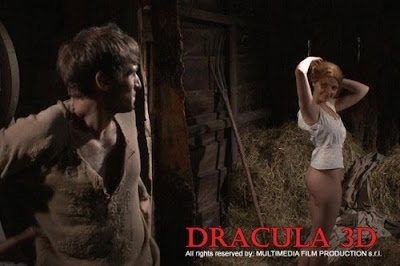


Ok, so let’s start this off. The camera takes us on a CGI journey down towards and through a village into a house. This is exactly what one would expect to find in an Argento movie – flamboyant camera movement, so why not, even if it is CG and looks sort of like Lego. The music – something terribly important in Argento fare - warbles like something pulled off a horror cartoon. Just five minutes in there’s a woman spontaneously getting out of her kit and right into a session of posey, pose-shagging with her boyfriend… the third, rather unusual move for an Argento film…  wait I should be starting this piece somewhere else…  We should be starting with producer Giovanni Paolucci! Giovanni Paolucci may have produced some brilliant pieces of contemporary low budget trash cinema – especially the suite of films that became Bruno Mattei’s last flicks – but when Dario Argento has to turn to Giovanni Paolucci to finance his films, it makes me wonder over the sad state of Italian cinema.

I’m only blurting out gut instict with this theory, but during this film there’s several moments that make me cringe, wonder who the hell OK’d that moment, and come to the conclusion that this time original source material or themes, or genre isn’t being exploited, but it’s actually Dario Argento being exploited by the cunning Paolucci!


So the film then… I’d have to say that a lot of the FX is pretty good, even with the use of CG, there’s still a few grand moments. One effective scene sees Kretschmann’s Dracula speeding through a room slicing off heads as fountains of blood spray all over the place… so as for the gore and effects section, that’s got an OK from me. Well apart from one really shitty wolf to man transition that my kids could have done better with crayons and a notepad, and also the very flat CG train station. Actually the second time the 2D, 3D train station was used I laughed hard a the moment when the horses head moved as I was convinced that it was a mounted prop.

At times the film manages to tap into some kind of Hammers/EuroGoth groove and even if only slightly obtains a good atmosphere. There’s a few neat details have been worked in, or perhaps only one as that’s the one I recall, such as how Lucy hides her bite-marks away from friends who suspect that she’s been seduced by the fangster up in the castle. A moment in the bathtub reveals where and how she’s been drained and put under his spell.

Trying to sum the film up, Dario Argento’s Dracula has some pretty good effects; a couple of successful CG and practical FX combos, do give a decent amount of freaky and gory set pieces (hey we really don’t need very much more do we). The story is safely within the realm of what the title declares – The Dracula story, although it is a lazy adaptation as it all stays in the same location. I’d have loved to see Argento take on the seas, the plague of rats and Whitby. The sets look much better than I feared they would. Hell, even the obvious CG sets get the job done. A fairly familiar crowd surrounds Argento as several of the cast and crew have been with him on earlier productions.
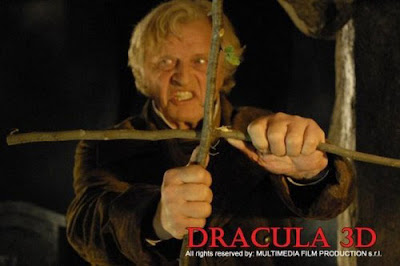

The biggest flaw is that Argento never establishes, invest or develops his characters. He simply lets them run off their own reputations and legacies. There’s no attempt what so ever at bring complexity, dimension or even a vague attempt at actually creating these characters. Nothing is done to blow life into them, give them empathizing traits, or even make us give a damn. This leads to some pretty dull and flat characters and some piss poor acting that never really manages to engage the audience. The result is devastating and the movie really suffers from it.

Also, there’s never really any real value at stake, the threat of death never really feels present. Fights are over in a jiffy, Van Helsing is too cool for school, and Mina never really shows any fear when meeting the Count, her dead friend Lucy or anything else… and spontaneous nudity has never really been a part of Dario Argento’s movies… I know whom I’ll accredit that to.
Dario Argento’s Dracula has several unmistakable Argento traits, and at times his wonderful style shines through with such a powerful ray of light that it would burn any vampire to a cinder…. But the painfully dull characters totally ruin it all. There’s an problem with the film trying a bit too hard, but not managing to reach all the way through. Sure there’s gore, splatter, female nudity, some great moments, and I’m sure that if this one had been delivered somewhere between Tenebrae and Opera it would have been considered a cult classic from the last years of Italian Genre cinema. More importantly, perhaps Dario would have invested more in directing the actors than messing about with technology and trying to do fancy stuff with his camera. Because it’s true, the deeper you get into his filmography, the more his work becomes being about great camerawork and cool shots than great characters and cool story.

Dario Argento’s Dracula, not as terrible as I through it would be, but not as good as I wanted it to be… and believe me, I’ll watch and support Dario Argento no matter what kind of movies he makes. There are great moments, some cool effects, but way shallow on content, story, pacing and passion. In all honestly I don’t think he’s made this as a horror film at all, but as a Gothic pastiche. Style, tone, sets and the little atmosphere that there is, all strafes after some kind of Hammer/EuroGoth style, but in pastiche form.

I don’t think anyone can make Dracula as a period piece horror film these days, and especially not as a Dario Argento film. I’m basing that on the fact that there’s none of the classic Dario Argento sadism in the deaths here – as mentioned, action flashes past before you know the conflict is there, there’ no complexity to the deaths. The story just chugs on, it simply rolls forth without that classic Argentoesque last moment twist or trial. Nobody really seems to give a damn about what’s happening, and Claudio Simonetti’s constant, and somewhat annoying use of Theremin through out the movie, makes it feel like a Scooby-Doo episode. I kind of get the feeling that they played it safe, took a story that everyone knows and used it to see what they could do with modern technology. But taking your genre audience for granted is a deadly mistake.
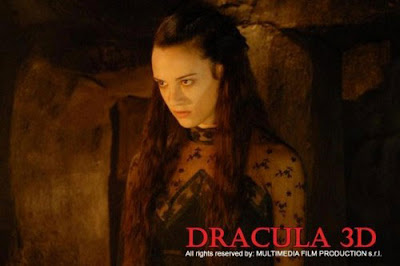
Perhaps, and I’m only guessing, but perhaps this was a lightsome way for Dario and Luciano Tovoli to mess around with 3D cameras? Perhaps, and again I’m only guessing, but perhaps this was a way for Dario Argento and Luciano Tovoli to try out new technology, find out what can be done with 3D, what can be done with CGI, what can they get away with if they push it to the limit? Perhaps there still is one last great masterpiece in there?

I hope so, because Dario can do so much better that this. I feel that each time he brings new writing partners on-board, the story goes right out the window. I’d love to see my dream team constellation of say Luigi Cozzi, Daria Nicolodi, Franco Ferrini to bring story back home, and I also hope that he reconciles his relationship with producer/brother Claudio, because one thing is sure, we don’t need more cheap Dario Argento movies that merely exploit his name and the pure fact that he still wants to make movies.


Disney Star Wars and the Kiss of Life Trope... (Spoilers!)

Here’s a first… a Star Wars post here.  So, really should be doing something much more important, but whist watching my daily dose of t...